Any stage of a language is a historical artifact, and variationist sociolinguistics, as a mode of scientific enquiry, operates overtly on this recognition. Labov has argued forcibly against the Saussurian separation of diachronic and synchronic linguistics (Labov, Reference Labov and Heilmann1975, Reference Labov1989, Reference Labov1994; Weinreich, Labov, & Herzog, Reference Weinreich, Labov, Herzog, Lehmann and Malkiel1968), a case buttressed by Romaine's (Reference Romaine1980:221–222) argument that the development of a viable theory of language change is critically dependent on the ability to link past with present. This fusion of complementary perspectives is the ultimate aim of variationist sociolinguistics, a field rooted in diachrony but often practiced in synchrony.
The emphasis on synchronic dimensions of variation and change is exemplified by recent work targeting direct quotation. Much of this work assumes (implicitly or explicitly) that the quotative system is undergoing rapid and large-scale change via the emergence of forms such as go, be all, and in particular, be like. This interpretation is supported by synchronic perspectives, but the dearth of diachronic ones raises the possibility of alternate scenarios. In particular, we may wonder whether ongoing change is indeed a reflex of new lexical choices to voice dialogue or whether it is emblematic of more broad, longitudinal, and systemic shifts in the ways in which dialogue is constructed.
This paper presents a longitudinal analysis of direct quotation in New Zealand English, revealing that the entire system, from lexical and discourse-pragmatic options to the operation of the variable grammar itself, has undergone whole-scale restructuring during the past 125 years. In the 19th century, direct quotation was highly circumscribed, exhibiting little variation. This architecture has gradually and continuously reorganized as lexical, grammatical, and pragmatic constraints emerge and change over time. This work thus not only highlights the need for historical perspectives on synchronic phenomena, it also serves as a reminder that (socio)linguistic variables cannot be described apart from the grammar in which they are fundamentally situated and constrained (Labov, Reference Labov2001:84).
WHAT WE KNOW ABOUT QUOTATION, AND WHAT WE DO NOT
Phenomena such as inner monologue and speech reproduction have long research traditions (Blyth, Recktenwald, & Wang, Reference Blyth, Recktenwald and Wang1990:215), but the past two decades have witnessed an increasing interest in the construction of dialogue, particularly as reflected in spoken narrative. The result is an extensive body of research (e.g., Buchstaller, Reference Buchstaller2006a, Reference Buchstaller2006b, Reference Buchstaller2008; Buchstaller & D'Arcy, Reference Buchstaller and D'Arcy2009; Blyth et al., Reference Blyth, Recktenwald and Wang1990; Cukor-Avila, Reference Cukor-Avila2002; Dailey-O'Cain, Reference Dailey-O'Cain2000; D'Arcy, Reference D'Arcy2010; Ferrara & Bell, Reference Ferrara and Bell1995; Macaulay, Reference Macaulay2001; Mathis & Yule, Reference Mathis and Yule1994; Romaine & Lange, Reference Romaine and Lange1991; Singler, Reference Singler2001; Tagliamonte & D'Arcy, Reference Tagliamonte and D'Arcy2004, Reference Tagliamonte and D'Arcy2007; Tagliamonte & Hudson, Reference Tagliamonte and Hudson1999). Much of this work is united by two trends: (1) a focus on individual verbs of quotation, and (2) synchronic perspectives on patterns of use. Both points have implications for our understanding of quotation as it functions in contemporaneous spoken discourse.
A focus on form
The literature is replete with discussions of innovative forms. In London, the periphrastic quotative this is + [speaker] has recently emerged (Cheshire, Kerswill, Fox, & Torgersen, Reference Cheshire, Kerswill, Fox and Torgersen2011). California has witnessed the advent and decline of be all (Buchstaller, Rickford, Traugott, Wasow, & Zwicky, Reference Buchstaller, Rickford, Traugott, Wasow and Zwicky2010; Rickford, Buchstaller, Wasow, & Zwicky, Reference Rickford, Buchstaller, Wasow and Zwicky2007). Suggestions that go is making inroads in contemporary varieties of English have also surfaced (e.g., Buchstaller, Reference Buchstaller2006a; Butters, Reference Butters1980). These forms are exemplified in (1). However, the development that has received the bulk of attention is be like.
(1)
a. This is him, “Don't lie. If I search you and if I find one I'll kick your arse.” (London, England; Cheshire et al., Reference Cheshire, Kerswill, Fox and Torgersen2011)
b. She's all, “What do you mean, gum?” (California, USA; Rickford et al., Reference Rickford, Buchstaller, Wasow and Zwicky2007)
c. ...later on we just go, “Oh man, you shut your old prune face.” (Wilmington, North Carolina; Butters, Reference Butters1980)
By their very nature, innovations are interesting. This partly explains the tendency to focus on change rather than stability, as well as the tendency for the diachronic dimension of variation to be identified with change (Labov, Reference Labov1989). Innovations are also useful. Be like has proven a robust heuristic in the effort to develop an empirical theory of language change, providing key insights into such issues as age-grading, lifespan change, and the incrementation of change, as well as allowing detailed exploration of linguistic, social, and geographic facets in the diffusion of change. Replicability is a sign of good science, and it follows that research on be like should lead to more research on be like.
No individual form (or select subset of forms) can be the sole focus of variationist analysis. The Labovian framework is defined by what gets counted. All variants must be included in the quantitative model (Labov, Reference Labov1966, Reference Labov1972a). In the case of constructed dialogue, the variable context is defined not by form (e.g., be like) but by function (i.e., direct quotation). However, because individual verbs of quotation are defined as dependent variables, the quantitative procedure can foreground forms and background broader systemic considerations.
What we gain in viewing quotation from this perspective is a strong understanding of how a particular verb functions at a particular stage of the language. What we risk losing sight of is how the system itself operates. Though we may see strong probabilistic effects of contextual factors, we tend not to ask why those constraints operate as they do, let alone why they operate at all. What is their role within the quotative system more generally, and how is direct quotation (as a discursive mode) constrained? To move further in our understanding of quotation in spoken narrative, a broader interpretive context is required.
Synchronicity
Early work on be like was often restricted to younger speakers, as they were the only ones to use this form. More recent work has redressed this imbalance, targeting a broader age spectrum, but, as is well acknowledged, the primary shortcoming of apparent time is that it is insufficient for disentangling age-grading from generational change (Labov, 1984:84). The persistence of be like among adult speakers, its increasing rates of use, and evidence for lifespan change have all served to dispel the question of age-grading (Buchstaller, Reference Buchstaller2006a; Cukor-Avila, Reference Cukor-Avila2002; Tagliamonte & D'Arcy, Reference Tagliamonte and D'Arcy2007). No longer an “innovative fad,” be like is well entrenched within the quotative repertoire and its apparent time trajectory has been corroborated by real-time analyses (Barbieri, Reference Barbieri2009; Buchstaller, Reference Buchstaller2006a; Buchstaller et al., Reference Buchstaller, Rickford, Traugott, Wasow and Zwicky2010; Cukor-Avila, Reference Cukor-Avila2002; D'Arcy, Reference D'Arcy2010; Durham, Haddican, Zweig, Johnson, Baker, Cockeram, Danks, & Tyler, Reference Durham, Haddican, Zweig, Johnson, Baker, Cockeram, Danks and Tyler2011; Ferrara & Bell, Reference Ferrara and Bell1995).
These real-time perspectives on be like have narrow time depths, ranging from just 2-year increments to 15-year increments. In targeting particular forms, it is both sufficient and logical to restrict the analytical window to one that provides insight to the phenomenon in question. Because be like is relatively new, short periods are more than sufficient for establishing ongoing shifts in use and constraint patterning; they also allow examination of the overall functioning of the major verbs of quotation immediately before and after be like. These comparisons reveal what appear to be recent, sudden, and catastrophic shifts within the overall configuration of the quotative system, yet they are constrained in their ability to address questions concerning the nature and causation of change.
Linguistic change is known to proceed somewhat chaotically in fits and starts (see Janda, Reference Janda1999:329; Joseph & Janda, Reference Joseph, Janda, Joseph and Janda2003:20; Lass, Reference Lass1997:304), but evolutionary “realignments” are rarely confined to a few frenetic years. Neither synchronic nor real-time analyses of direct quotation have illuminated what its substantive nature may have been at more distal stages in the recorded history of spoken English. We cannot assume that the system was stable immediately prior to the incursion of be like, or that the rise of new forms has shifted the distributional, functional, and/or pragmatic workloads of traditional verbs for direct quotation. Until synchronic aspects of constructed dialogue become informed by diachronic perspectives, our understanding runs the risk of being fundamentally teleological.
Buchstaller (Reference Buchstaller2011) is the only research published to date in which the longitudinal development of the English quotative system is scrutinized. Drawing on data from five decades of conversational recordings from the North-East of England, Buchstaller ascertained that change has not been abrupt; “continuous restructuring” has occurred over several generations, sparked, she argued, by the “intrusion” of be like and go.
DATA AND METHOD
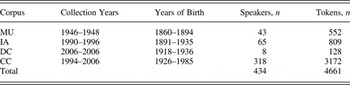
Shifts in the operation of the constraints on variation can be used to elucidate pathways of change (e.g., Poplack, Reference Poplack, Narrog and Heine2011; Torres Cacoullos, Reference Torres Cacoullos, Tsiplakou, Karyolemou and Pavlou2009, Reference Torres Cacoullos and Diaz-Campos2011).Footnote 1 In assessing the operation of the system of direct quotation across time, the current analysis traces the (recent) evolutionary trajectory of this grammatical function in speech. The data come from the Origins of New Zealand English Archive ([ONZE] see Gordon, Campbell, Hay, Maclagan, Sudbury, & Trudgill, Reference Gordon, Campbell, Hay, Maclagan, Sudbury and Trudgill2004; Gordon, Hay, & Maclagan, Reference Gordon, Hay, Maclagan, Beal, Corrigan and Moisl2007); its three collections cover the history of New Zealand English from 1850 to the present.
The Mobile Unit
The Mobile Unit (MU) recordings were made between 1946 and 1948 by members of the Mobile Disc Recording Unit of Radio New Zealand. The primary aim was to collect personal reminiscences of life in rural towns at the beginning of British settlement. The speakers were the children of the first European colonizers. The oldest were in their 90s at the time of recording, but the median age is about 75 years (years of birth: 1851–1910).Footnote 2
The Intermediate Archive
The Intermediate Archive (IA) consists of oral history projects and, to provide continuity of data, interviews with some of the descendants of the original MU speakers. The various IA materials were recorded between 1990 and 1996 (years of birth: 1890–1935).
The Canterbury Corpus
The Canterbury Corpus (CC) is a sociolinguistic monitor corpus, growing annually since 1994 (speaker years of birth: 1926–1985). Because the sample does not include speakers over the age of 60 years, these data are supplemented by recordings of older speakers from the Darfield Corpus (DC), a regional sociolinguistic corpus compiled in 2006 (years of birth: 1918–1935).
The intersection of corpus and historical development
The ONZE collections were assembled for distinct purposes; their formats are not consistent. Methodological discontinuities of this nature pose an unavoidable challenge when constructing longitudinal collections, even when the framework is held constant (e.g., Buchstaller, Reference Buchstaller2011). Field methods, sample designs, and topics of conversation all affect comparability, and yet using composite corpora as windows on diachrony presupposes that the materials are in fact (sufficiently) analogous.
What unifies the ONZE collections is the type of talk they represent, which on the whole is dialogic. ONZE has proven an invaluable resource for the documentation of variation and change in New Zealand English (e.g., Gordon et al., Reference Gordon, Campbell, Hay, Maclagan, Sudbury and Trudgill2004; Hay & Schreier, Reference Hay and Schreier2004). It has also enabled key insights to a number of theoretical statements about language more generally (e.g., Hay & Sudbury, Reference Hay and Sudbury2005; Langstrof, Reference Langstrof2006; Trudgill, Reference Trudgill2004). In the case of direct quotation, the ONZE data are constrained by type of dialogue (Blyth et al., Reference Blyth, Recktenwald and Wang1990; Tannen, Reference Tannen and Coulmas1986). They are largely restricted to narrative complicating action (Schiffrin, Reference Schiffrin1981:58; see also Hymes, Reference Hymes1977; Wolfson, Reference Wolfson1978).Footnote 3 Because narratives are a naturally bound unit of discourse (Schiffrin, Reference Schiffrin1981:45), they present an ideal site for quantitative analysis. Their privileged status as the primary locus of direct quotation functions to further level methodological discrepancies between the ONZE collections.Footnote 4 Drier, more stilted recordings will feature little in the current analysis as they do not tend to contain direct quotation, creating comparability with respect to the overarching discourse genre from which the data were extracted.
Method
Following well-established traditions in variationist analysis of constructed dialogue (e.g., Tagliamonte & D'Arcy, Reference Tagliamonte and D'Arcy2004, Reference Tagliamonte and D'Arcy2007; Tagliamonte & Hudson, Reference Tagliamonte and Hudson1999), the variable context is defined functionally as direct quotation—the recreation of speech, thought, action, sound, or gesture. Delineating the envelope in this way resulted in over 4600 tokens. As detailed in Table 1, the analysis is based on data from 434 speakers with birthdates spanning 125 years.Footnote 5
The ONZE quotative sample

Due to the nature of the historical materials, the only social factor that can be examined is speaker sex, though fewer women than men were interviewed by the MU. To maintain constancy across the collections, the analysis focuses on speaker age as an external correlate of variation and change in the quotative system.
A number of linguistic factors are implicated in synchronic variation among verbs of quotation. The two “classic” ones are grammatical person (of the matrix subject) and content of the quote (Tagliamonte & D'Arcy, Reference Tagliamonte and D'Arcy2007:203). They relate in particular to be like (believed to have entered the repertoire in response to the developing niche for the reporting of first-person inner states through monologue; see Ferrara & Bell, Reference Ferrara and Bell1995:283; Tagliamonte & D'Arcy, Reference Tagliamonte and D'Arcy2007:212), but have been examined for other quotatives as well. Say and go are associated with third-person speech; go is also predicted to occur with nonlexicalized sound (Blyth et al., Reference Blyth, Recktenwald and Wang1990; Buchstaller & D'Arcy, Reference Buchstaller and D'Arcy2009; Romaine & Lange, Reference Romaine and Lange1991; Tagliamonte & D'Arcy, Reference Tagliamonte and D'Arcy2007).
Another much discussed linguistic effect concerns the intersection of tense and temporal reference (Blyth et al., Reference Blyth, Recktenwald and Wang1990; Buchstaller & D'Arcy, Reference Buchstaller and D'Arcy2009; D'Arcy, Reference D'Arcy2010; Romaine & Lange, Reference Romaine and Lange1991; Singler, Reference Singler2001; Tagliamonte & D'Arcy, Reference Tagliamonte and D'Arcy2007). Be like tends to encode the Historical Present (HP), present tense morphology with past temporal reference. The HP is a well-known feature of English narrative more generally (Schiffrin, Reference Schiffrin1981; Wolfson, Reference Wolfson1981, Reference Wolfson1982) and has been reported to coincide with verbs of direct quotation in particular (Schiffrin, Reference Schiffrin1981).
Dialogue can be constructed using a regular speaking voice, but quotation can also report sounds and gestural content, as well as lexical material that is rendered expressively through changes in pitch, intonation, rhythm, and accent (e.g., Buchstaller, Reference Buchstaller2008; Klewitz & Couper-Kuhlen, Reference Klewitz and Couper-Kuhlen1999). Examples are given in (2). Be like has been linked with mimetic effects since the outset (Butters, Reference Butters1982; Romaine & Lange, Reference Romaine and Lange1991; Tannen, Reference Tannen and Coulmas1986); the role of mimesis within the broader repertoire is less studied.
(2)
a. And it's like “[grunts].” (CC, fyn99-11a, b. 1968)Footnote 6
b. ...they said, “[raises pitch] Oh my hands, my hands.” (DC, fe1, b. 1936)
c. The old lady said, “[lowers pitch, slows rate] I'm not a robber.” (MU, Annie Hamilton, b. 1877)
Grammatical person, content of the quote, tense/temporal reference, and mimesis are the primary system-internal constraints on direct quotation. Their operation across time provides the foundation of the analysis presented here. Two additional quotative resources are also considered: specification of an addressee and verb placement.
For many verbs of quotation, valency is categorically invariant. Ask and tell are generally verbs of indirect speech (She asked me whether she), but they sometimes introduce speech directly. When used in the active voice, they require an indirect object (ask John, tell her). In contrast, the null form cannot be specified for addressee, and early literature discussed the inability of be like and go to specify an object (Butters, Reference Butters1980; Schourup, Reference Schourup1982). A single instance of each occurs in the ONZE materials, shown in (3), but as these constructions do not (yet) appear productive in New Zealand, they will not be discussed further (though see Buchstaller [2008] for British English). However, there is a handful of verbs for which valency is variably marked (say, think, call/cry/yell [out], remark, suggest).
(3)
a. I was like to people “Just stop taking photos of me.” (CC, fyn99-22a, b. 1979)
b. I went to my mum, “Mum, he did it to me.” (CC, fyn97-13a, b. 1968)
Finally, the canonical English position for quotative verbs is immediately before the quoted material (Romaine & Lange, Reference Romaine and Lange1991; Schiffrin, Reference Schiffrin1981). The main clause may be postposed, however, such that it follows the quoted material, as exemplified in (4). In speech, this strategy is restricted to say.
(4)
a. “Oh I'll take thirty shillings for it,” the blacksmith said. “Right-oh,” said the engineer. (MU, Vivian Young, b. 1885)
b. “Oh,” she says. “You're not drunk,” she says. (IA, Harvey Summers, b. 1905)
c. I had a three-pence up my nose. “Well, pull it out then,” she said. (CC, mop97-20, b. 1942)
The questions this research seeks to address are straightforward. English speakers have a number of resources on which they can draw when constructing dialogue. Is the system in which these resources operate consistently constrained across time, or has it undergone change? Is synchronic change restricted to the number of lexical options available to speakers, or have other changes affected the construction of dialogue?
THE DIACHRONY OF QUOTATION
The nineteenth century, 1860–1894
Contemporary perspectives of direct quotation reveal a system that is robustly variable, both lexically and internally, via the operation of a number of constraints that function in tandem as a “choice mechanism” (Poplack, Reference Poplack, Narrog and Heine2011:213). The MU data provide no such perspective. The system can best be described as “contained”: What variability exists is highly circumscribed. The passages in (5) are exemplary of direct quotation in the MU.
(5)
a. I said, “Oh I think I'd better get home.”
And so Mrs. Hawkins said, “Have all the soldiers gone to bed?”
And I said, “Oh I don't know.” (Mary Ann Turnbull, b. 1875)
b. He said, “You'd shoot a man? You've got a gun?”
So Peter says, “Come on then now.”
He says, “I've got no gun now.” (Robert Templeton, b. 1887)
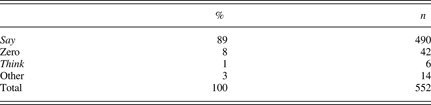
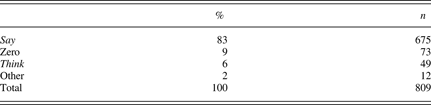
The overall distribution of forms is provided in Table 2. A single form, say, accounts for nearly 90% of direct quotation. The second most frequent strategy, the null form, is marginal, accounting for less than 8% of the data overall. Quotative think—widely considered a “conservative” variant—is virtually nonexistent. It occurs just six times. The remainder, comprising a mere 3% of the data, consists of a handful of forms (eight to be exact), none of which occurs more than three times. In short, the repertoire is minimal, and it is dominated by say.
Overall distribution of forms in the MU
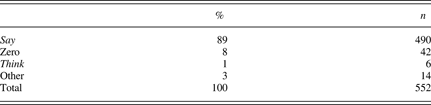
Note: Here and elsewhere, total percentage may not equal 100 due to the effects of rounding.
This lexical restraint is striking. Putative functions of direct quotation include increasing the dramatic element of a narrative and adding authenticity to evaluative claims (e.g. Schiffrin, Reference Schiffrin1981:60). Speakers thus “emphasize various aspects of the report” (Romaine & Lange, Reference Romaine and Lange1991:234) through the use of a range of speech reporting verbs. The historical materials contain more than one verb of saying, but such occurrences are exceptional.Footnote 7
Moreover, the pragmatic content of direct quotation is virtually invariant. The instances of think reported in Table 2 are the only cases of quoted inner dialogue (i.e., thought/attitude); writing is quoted just two times. In other words, the quotidian function of constructed dialogue in the MU is speech encoding (99%; n = 544). Other types of content are exceedingly rare.
Despite the lexical and pragmatic uniformity of quotation in the MU, narrators had other strategies available to them. As the most robustly variable of the internal constraints, the primary mechanism is mimesis. A full third of direct speech is rendered with voice effects (34%). Another strategy used by these speakers is tense variation, yet the available choices are limited. Past-tense encoding is the most frequent overall (69%), followed by the HP (25%); this latter configuration is categorically restricted to say. Use of the simple present is an absolute minority option (5%), and the past progressive occurs once. No other aspectual or modal distinctions are attested.
Grammatical person also fails to have a discernible effect. The system operates along a binary contrast skewed in favor of third persons. Quotation is largely a tool for the speech of others (80%). Speakers are less likely to quote themselves (20%), and second persons are virtually unattested (n = 2).Footnote 8
Another little used strategy is the specification of an addressee, which is variably employed just 35 times (7% overall). The majority of these instances occur with say. Other verbs with prepositional objects in the MU are suggest and remark, but each occurs just once.
Finally, speakers in the MU rarely place the main clause after the quoted material (7%), and when they do, only clauses with say are postposed.
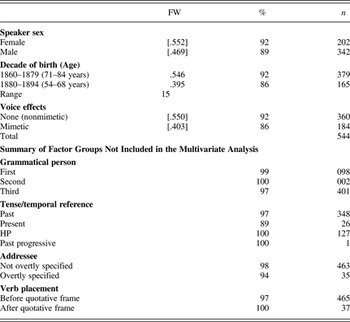
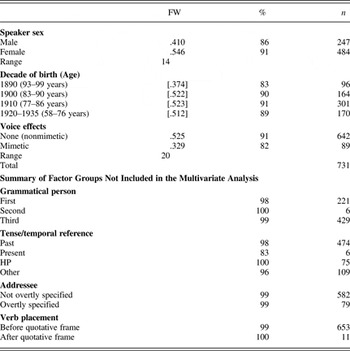
Table 3 presents the results of a multivariate analysis. In this case, the analysis is concerned not with constructed dialogue as broadly construed in the methodological discussion but specifically with the phenomenon of constructed speech, as this is the function of quotation in the 19th-century ONZE materials. The application value is say (overall distribution in speech, 90%; n = 544). Only three factors can be modeled: speaker sex, speaker decade of birth, and mimesis. The remaining groups cannot be included because there is simply too little variation. Most if not all factors in each group have (near-) categorical distributions (see Guy, Reference Guy, Ferrara, Brown, Walters and Baugh1988).Footnote 9
Multivariate analysis of factors conditioning the use of say in the MU (speech only)
Input .900

Note: Factors not selected as significant appear in square brackets.
Speaker age (reflected through decade of birth) has a significant main effect. Speakers born in the final two decades of the 19th century disfavor say. This result is largely attributable to increasing use of the null form, rising from just 4% overall among speakers born in the 1860s (n = 193) to 12% overall among those born in the 1880s and early 1890s (n = 165) (χ2p = 0.032).
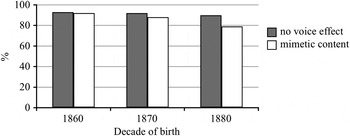
In contrast, there is little evidence for grammatical conditioning. Historically, direct quotation in this variety appears fundamentally to have been a means to an end: the reporting of speech, with little elaboration of the quotative context (through voicing effects, tense, and aspectual nuances, verb movement, etc.). However, this aggregated model masks a difference in the operation of the variable grammar in apparent time. Though not significant, mimetic quotes are assigned a lower factor weight than are nonmimetic ones (.40 versus .55). As shown in Figure 1, the rate of say in nonmimetic contexts is fairly constant across the MU. In mimetic contexts, however, use of say declines slowly yet steadily.Footnote 10 Among speakers born in the final decades of the 19th century, a weakly significant contextual effect is manifest (χ2p = 0.0467). In other words, the effect of mimesis is emergent in the MU.
Quotative say and mimesis across apparent time in the MU.

To summarize, the MU data exhibit a constricted quotative ecology, with variation confined to small sectors within the system. Nonetheless, subtle shifts were taking place. Mimesis was developing a more active role as a systemic constraint and the lexical restriction to say was weakening.
Turn of the century, 1891–1935
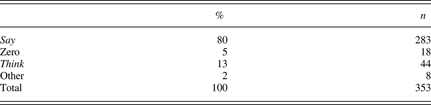
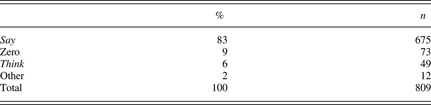
The overall perspective from the IA both resembles and differs from that of the MU in critical respects. Shared characteristics include a restricted lexical repertoire and a restriction to speech encoding; say again preponderates. The overall distribution of forms is given in Table 4. The lexical containment of the historical data is replicated here, and the “other” category remains distributionally marginal and compositionally restricted, consisting of just seven forms. Notably, however, the repertoire includes quotative go, which occurs four times in total. All instances are provided in (6).
(6)
a. You would hear him going “clank clink clink” down the hill. (Dorothy Hagitt, b. 1896)
b. There would be all old ladies with their knitting needles going “click click click.” (Will Oliver, b. 1907)
c. He said to me, “You know how much they cost?” And I went, “Yeah, about so and so and so and so.” (IA, Ivy Thomas, b. 1912)
d. The kids would all go, “Ha ha, water works is on again.” (John Johnson, b. 1922)
Overall distribution of forms in the IA
These examples are important in two respects. Go is long attested for introducing lexicalized sounds and gestures (first Oxford English Dictionary attestation: 1791). This is precisely how go functions in (6a, 6b). In (6c, 6d), however, it unambiguously introduces spoken content. These tokens thus capture the extension of go to a new pragmatic context, marking the transition point to the contemporary system in which go is used to introduce a wide range of content types. Moreover, go is often considered an innovative form. This is true only in so far as it has yet to be attested for speech encoding before the 20th century. These data clearly illustrate, however, that it is not a contemporary of be like with respect to its temporal genesis in speech (see also Buchstaller, Reference Buchstaller2006a).Footnote 11
Lexical choices remain restricted in the IA, but use of think has increased markedly (1% in the MU versus 6% in the IA). The IA speakers thus appear to use direct quotation for reporting internal states more frequently than did those of the MU. I will return to this point. The critical observation at this point concerns pragmatic encoding in these early 20th-century data.
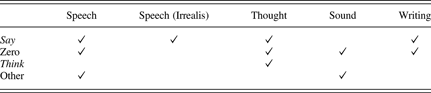
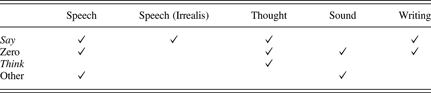
Summarized in Table 5, a broader range of content types are attested in the IA than what is found in the MU. Moreover, these content types are less restricted in terms of the verbs by which they are introduced. Two content types not attested in the MU are lexicalized sound, as in (6a, 6b), and hypothetical speech (she's going to say “. . .”; we couldn't say “. . .”). Quoted writing occurs more frequently overall (0.3%, n = 2 versus 3%, n = 21). Say, strictly a speech verb in the MU, also introduces inner monologue in the IA (I said to myself “. . .”). And the null form, likewise restricted to speech in the MU, introduces most content types attested in the IA. Thus, whereas direct quotation remains a fundamentally speech-oriented activity (90%), a functional expansion is evident in the increase in content types and by the generalization of most verbs across multiple content types.
Content and verb collocations in the IA
The continued emphasis on speech reporting, however, again necessitates that exploration of the variable grammar be confined to this content type. Table 6 reports the multivariate results.
Multivariate analysis of factors conditioning the use of say in the IA (speech only)
Input .899

Note: Factors not selected as significant appear in square brackets.
As with the MU, the only factor groups that can be included are speaker sex, speaker decade of birth, and mimesis. With the remaining groups, individual cells again display nearly categorical distributions and, in some cases, extremely low token numbers (second-person subjects, simple present tense, postposed clauses). Nonetheless, some important shifts have occurred. Where in the MU the majority of quotation was third-person speech, in the IA there is a marked increase in first-person reporting (MU 19% versus IA 34%; p < .0001), in part a reflex of the increased ability to quote inner monologue (primarily, though not exclusively, a first-person mode). The use of tense and temporal combinations beyond simple past, simple present, and HP is also noteworthy. A number of modal, aspectual, participial, and infinitival constructions, including a range of habitual collocations (would say, used to say, used to go around saying; n = 92), are used.Footnote 12 This qualitative difference suggests that the scope of tense and aspect distinctions is broadening.
Overt addressees and main clause postposing remain minority options overall. Both phenomena continue to be (largely) restricted to say, but postposing, already infrequent in the MU, has decreased markedly and appears obsolescent in the IA (7% versus 2%; χ2p < .0001).
Corroborating the trajectory in Figure 1, mimesis exerts a significant and strong main effect in the IA, disfavored with say (FW: .33, range: 20). Additionally, speaker sex is selected as significant. The internal factor explains more of the variation, but the variable grammar now includes a nontrivial social condition. Women favor say; men disfavor it. The explanation lies in the rise of the null form. Still a minority contender in the system, its overall frequency has increased, albeit marginally (cf. Tables 2 and 4), and it is men who are primarily responsible (men: 12%, FW: .584; women: 8%, FW: .457).Footnote 13 In fact, given that say and zero together account for 99% of quoted speech in the IA, it follows that they should pattern in complementarity, say for nonmimetic speech among women, and zero for mimetic speech among men.
In sum, the IA results reveal the emergence of a systemic variable grammar for the construction of dialogue in discourse. Social and linguistic constraints have come to the fore (mimesis, speaker sex); other internal factors may be preparing for activation as well (e.g., tense/temporal reference, grammatical person).
The 20th century, 1918–1987
The CC (including the DC) captures New Zealand English across the bulk of the 20th century. Table 7 reports the overall distribution of forms among speakers aged 60 years and older. They are contemporaries of the youngest cohorts in the IA, enabling a comparison between the two. The similarities are striking: The lexical choices available to the oldest CC speakers are few (say, think, zero); the overall frequency of say is little different from that in the IA (83% versus 80%)
Overall distribution of forms: Older speakers (b. 1918–1936)
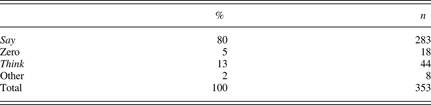
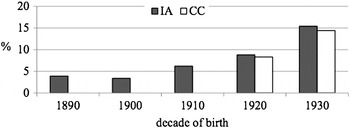
At the same time, the IA system is fundamentally predicated on speech reporting. Although the main function of direct quotation among the oldest CC speakers is the construction of spoken dialogue, the rate does not approach categoricity (83%). Moreover, the overall frequency of think is twice that found in the IA overall. Given that the IA results in Table 4 collapse data from four and a half decades and that those in Table 7 overlap with just the final one and a half of those, it is possible that Table 4 obfuscates a more general trend. Figure 2 explores this possibility, tracking the frequency of think across apparent time in the IA and comparing these results with those from the oldest speakers in the CC. The trend is consistent with monotonic change: The propensity to report thoughts and attitudes through direct quotation increases incrementally over time. Notably, although roughly 13 years separate the collection of the IA recordings and the CC materials from speakers aged 60 years and older, the results indicate much stability with regard to the lexical and pragmatic organization of direct quotation.
Overall distribution of think: IA (1890–1935) and CC (1918–1936).

The MU and the IA recordings were collected over fairly circumscribed periods (most of the IA materials used here were recorded from 1993 to 1996). The recordings in the CC represent 13 years of continuous, real-time data. Despite the evidence for systemic maintenance across the lifespan for speakers over the age of 60 years, it is well-established that in contemporary use, the repertoire for speakers under the age of 30 differs significantly from that of older ones (Tagliamonte & D'Arcy, Reference Tagliamonte and D'Arcy2007). From this point, the analysis focuses on quotation among speakers aged 19 to 59 years, and the recordings are segmented into three periods: interviews collected from 1994 to 1997, 1998 to 2001, and 2002 to 2006.
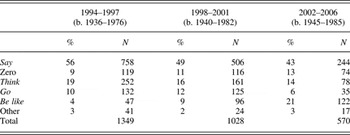
The overall distribution of forms across the CC is provided in Table 8. The number of forms accounting for more than 1% of the data has increased from three to five (say, think, zero + be like and go), and patent shifts take place from one period to the next. Say remains the most frequent form, but the familiar and established upward trajectory of be like is clear.
Overall distribution of forms across time in the CC (b. 1936–1985)

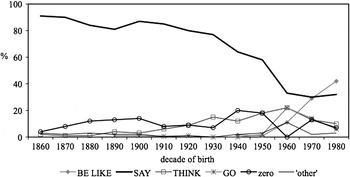
Crucially, it is not simply that the repertoire has changed (see also Figure 4, which displays lexical items across time, according to speaker decade of birth). Concomitant with shifting lexical frequencies, the overarching organization of the quotative system has continued its pathway of restructuring, already evident in the MU and IA datasets. Most analytically significant of the changes is the function of direct quotation itself. Quotation has generalized across content types. Moreover, the trend suggested by Figure 2 (an increase in inner thought reporting via the steady rise of think) is corroborated by the CC. No longer exceptional, the construction of inner dialogue is a fully productive aspect of narrative reporting.
Across the CC, thought constitutes roughly one-quarter of all instances of direct quotation. Furthermore, thought reporting is no longer coterminous with think. Inner monologue is also introduced by say (to self), go, zero, be like, and a range of other, less frequent forms (e.g., be, feel, figure out, decide, realize). It is precisely for this reason that analyses of contemporary data do not partition constructed dialogue into pragmatic fields. The system is robustly variable both in terms of quoted content types and in terms of the verbs introducing them. All quotative contexts must be included to allow for developmental pathways to be discerned.
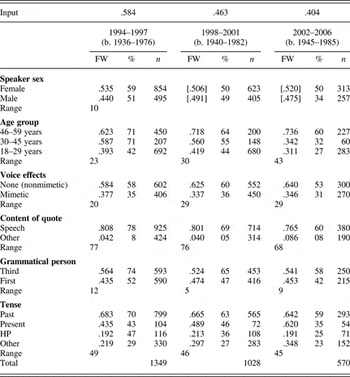
Three identical multivariate analyses are presented in Table 9, one for each CC period. To provide a comparative perspective with the results for the MU (Table 3) and the IA (Table 6), the application value is say. The declining rate of say is reflected by the input values, which decrease steadily.
Multivariate analyses of factors conditioning the use of say in the CC

In Table 9, the complexity of the model sets these results apart from those of the MU and the IA. In the older materials, only speaker sex, age (date of birth), and mimesis could be modeled. Here, not only are content of the quote, grammatical person, and tense/temporal reference also included, they are significant in every period. The variable grammar is thus more finely articulated in contemporary spoken dialogue than it was historically, where the only evidence of grammatical conditioning was the (emergent) mimetic effect.
In the CC, mimesis remains a significant effect on say in all periods. It is consistently outranked, however, by two newly evidenced language-internal effects: content of the quote and tense. Indeed, the variable grammar operating on say is quite stable across the CC. Say is favored for nonmimetic, third-person, past-tense speech, and content of the quote is consistently the strongest factor. This last observation is unsurprising, given that say is a verbum dicendi. However, the inclusion of the content group in the model highlights the fundamentally altered state of the quotative system vis-à-vis the results from the MU (Table 3). Once pragmatically monolithic, content of the quote is now a robust feature of the variable grammar.
Despite the consistent hierarchies and rankings across the CC, subtle and important shifts are discernible. Most obvious is the effect of speaker sex, which remains significant in the first period (cf. Table 6, IA) but then levels out, failing to be selected in subsequent periods. The person constraint—stable with respect to direction, ranking, and significance—weakens relative to the other factors across time. By the second and third periods, it accounts for much less variation in the use of say than does its next closest competitor, mimesis. In contrast, age gains in strength. In the first and second periods, its effect is just slightly stronger than is that of mimesis. By the third period, it rivals tense; speakers under the age of 45 years strongly disfavor this traditional form.
These small shifts are independent of the overall frequency of forms, providing a view of the operation of the system itself. This is particularly striking in the case of pragmatic content. Content is consistently the strongest constraint affecting the probability of say, even though its use in speech contexts decreases over time. Its overall trajectory of decline is not a facet of its use in nonspeech contexts (compare the first and last periods). This difference between pragmatic environments is reflected in the relative weakening of the content constraint in the final period, where the margin between its strength and that of the next strongest constraint, tense, has narrowed. Content still “matters more,” but it accounts for less of the variation than it has in prior periods.
The effect of tense/temporal reference is less clear-cut, arising from fluctuation due to small cells when tense cross cuts other groups. Nonetheless, say is consistently most frequent in, and most favored for, simple past-tense contexts, whereas it is always strongly disfavored with the HP. This latter result is striking when considered in broader historical context. In both the MU and the IA (Tables 3 and 6, respectively), the HP occurs only with say. In Table 9, this categorical correlation is obliterated, a trajectory that is visible corpus-internally, in apparent time. It is this result that accounts for the discrepancy between factor weights and frequencies. The oldest speakers maintain the association of say with HP encoding, whereas among the youngest speakers, the reverse obtains, and the HP is eschewed with say. This is because other verbs have become probabilistically associated with this feature of English narrative complicating action clauses.
Discussion of quotative tense/temporal reference has not often taken in the wealth of configurations evidenced in contemporary discourse. This is in part the consequence of form-focused analyses, but it also derives from a tendency to consider contexts that have previously received attention in the literature (and for which claims exist): simple past, simple present, HP (Blyth et al., Reference Blyth, Recktenwald and Wang1990; Romaine & Lange, Reference Romaine and Lange1991; Schiffrin, Reference Schiffrin1981; Tagliamonte & D'Arcy, Reference Tagliamonte and D'Arcy2007). However, cursory examination of the “other” category in Table 9 reveals the robust presence of configurations beyond those usually discussed. In addition to the habitual constructions first attested in the IA, the CC includes a number of inceptives, modals, and aspectuals (kept on saying, remember saying, could say, should have said, having been told, etc.). It is also replete with progressive structures (past, present, and HP), as in (7).
(7)
a. I was thinking, “What? That's gross.” (fyn04-8, b. 1982)
b. ...whereas now I'm saying, “Why did I bother?” (fyn98-1, b. 1978)
c. I'm saying, “Look, Nathan's not here.” (myn98-16b, b. 1977)
In contemporary narrative, the use of the progressive is well-attested and unremarkable (see Labov, Reference Labov1972b; Schiffrin, Reference Schiffrin1981). The ONZE materials suggest that its use with verbs of direct quotation is, however, recent. Unattested in the MU and the IA, past and simple present progressives (7a, 7b) are first used by speakers born in the 1940s. The HP progressive (7c) does not appear in these materials until later, with speakers born in the 1970s.
To summarize, the results from the CC suggest that during the 20th century, a complex system of internal constraints coalesced and became fully operative. Crucially, this is not simply a consequence of the genesis of be like, which did not appear in the repertoire of New Zealand English until relatively late. In the aggregate data for 1994 to 1997, be like accounts for (not quite) 4% of direct quotation (N = 1349). Crucially, an intricate system is already fully established, having built on trends in both the MU and the IA datasets. The ONZE data therefore demonstrate that be like is not responsible for “disruption” of the status quo; rather, it entered an already volatile system.
THE EVOLUTION OF SAYING WHAT WAS SAID
The accumulated evidence from ONZE suggests that the contemporary quotative system is the product of a historical evolution and not the reflex of recent lexical innovations and incursions. A number of subtle, longitudinal shifts have been ongoing, traces of which were visible in the late 19th century.
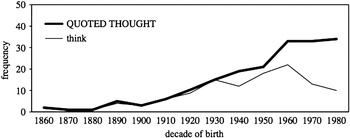
The most fundamental change concerns the pragmatic function of direct quotation. In the MU, quotation recreates speech. In the IA, the onset of the generalization of quotation to new content types is discernible, and the quotative verbs themselves have begun to generalize across content types. In the CC, quotation is pragmatically unrestricted, introducing a range of content types. Most notable of these types is thought/inner state reporting. Figure 3 presents the trajectory of quoted thought over time in ONZE.Footnote 14 Also included is the frequency of think as a verb of direct quotation, because this is the canonical and historical form for introducing thought.
Diachronic trajectory of direct quotation (1) introducing thought and (2) introduced by think in ONZE (1860–1890 MU; 1890–1930 IA; 1940–1980 CC).

The diachronic view in Figure 3 reveals an increase in thought reporting over time; the correlation between decade of birth and the frequency of thought is positive, strong, and significant (r = .95075226; p < .0000001). Concomitant with this change, the lexical options for reporting inner monologue also increase, a trend that is first evidenced in the IA (Table 5). In Figure 3, quoted thought and the verb think permanently diverge with speakers born in the 1940s. From this point forward, a host of forms has emerged to perform this function.
This highlights another key operational difference between quotation historically and synchronically. Historically, the system revolved around say and speech reporting. A handful of other verbs occurred occasionally, but given their overall rarity, their use likely signaled a fine pragmatic or dramatic distinction within the context of the narrative (cf. Romaine & Lange, Reference Romaine and Lange1991:234). In contrast, verbs of quotation are pragmatically versatile in contemporary use. Although probabilistically favored for certain types of encoded material (say for speech, be like for thought, etc.), none except think is functionally restricted.
Figure 4 presents the overall distribution of quotative verbs across time. First and foremost, this figure captures the gradual decrease of say over time. Crucially, this trajectory is paralleled by an increase in overall competition between forms. At no point is say subject to lexical replacement; “change” in the system is not simply a changing of the primary means for introducing constructed speech. In 1860, when say dominates the quotative landscape, there is virtually no layering of forms (N = 196). A century later, there is robust variation between forms and say is but one among many options for introducing constructed dialogue (N = 336). This difference is significant within the ONZE data as a whole. If corpus is included in the model, it exerts a strong main effect (MU: .661, IA: .571, CC: .262).Footnote 15
Overall frequency of verbs of quotation over time in ONZE (1860–1890 MU; 1890–1930 IA; 1940–1980 CC).

Figure 4 also captures the ebb and flow of individual forms across time. Forms do not necessarily rise in frequency to be maintained at that level. In the MU, there was evidence that the null form was increasing in apparent time. Indeed, a general pattern of increase is visible in Figure 4 across nearly a century, 1860 to 1949, but a pattern of declination is visible across the final three decades captured by ONZE. Quotative go displays a slightly different diachronic trajectory. It is first attested among speakers born in the final decade of the 19th century. Rather than increasing, it is used continuously yet marginally until suddenly peaking among speakers born in the 1960s, after which it recedes. Although not identical in the details, the null form and go display vacillating waves of use, coming in and out of fashion. Buchstaller (Reference Buchstaller2006a:19) hypothesized that this pattern characterizes the diachronic trajectory of “recycled” variants, forms that persist latently in the repertoire and that can be actively redeployed by the speech community, spurred in part by social associations (and disassociations). Certainly a key arbiter of frequency is the operation of the variable grammar (i.e., opportunity for use), and yet sociolinguistic enquiry has made it clear that language-external factors are also critical in the use of variable forms.
Nonetheless, the shift from a system marked by little pragmatic or lexical variation to one characterized by dynamic variation can only have occurred via shifts in the operation of the grammar underlying direct quotation. In other words, the overall trajectory captured in Figure 4 is symptomatic of the changing nature of quotation over time.
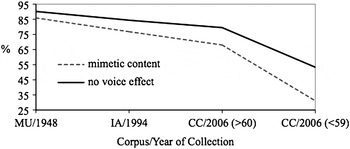
Of the full set of grammatical constraints currently operating on direct quotation in New Zealand English, mimesis has had the longest continuous presence in the system. However, historically a significant factor only for say, clear constraint effects have developed for all the primary quotative strategies—independent of shifting frequencies—across time. This is most compelling in the case of say, which has lost significant traction within the system with respect to both overall rates of use and its stranglehold on speech reporting. Say is most disfavored among the youngest CC speakers, and yet it is robustly constrained by mimesis in their grammar. Although not the strongest constraint operating on say, the results in Figure 5 highlight that the context where this traditional verb of quotation retains a foothold in the system is for nonmimetic quotes (specifically, nonmimetic speech).
The mimetic effect on say across time, ONZE.

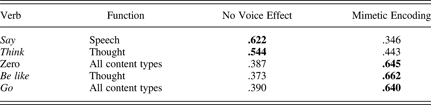
Table 10 lists the partitioning of the current system along functional and pragmatic lines. The mimetic constraint is significant for all forms; it operates systemically. Thus, say and think favor nonmimetic quotes, whereas the null form, be like, and go favor quotes with mimetic encoding.
The functional and pragmatic workload of the contemporary quotative system
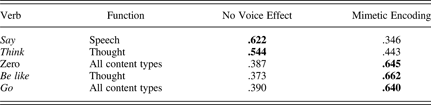
Notes: All CC speakers, aged 59 years and under: N = 2947. These results come from five separate multivariate analyses, each of which includes all possible constraint effects. The results are reported from the best run for each verb; in each case, the mimetic result is significant. Bolding highlights the favoring context.
Two other internal constraints have also saturated the system: grammatical person and tense/temporal reference. In both the MU and the IA, there was too little variation for these contextual factors to exert a probabilistic effect on direct quotation. In the CC, person and tense overarch the operation of the system. Inextricably linked to the fundamental pragmatic function of think and be like, these verbs favor first-person matrix subjects; third-person subjects favor say and go.
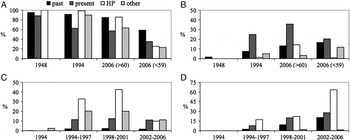
The emergence of tense presents a more complex case, as the system has reorganized along this parameter. The MU presents a system focused on a tripartite division between past, present, and HP. Of these, the simple past far outnumbers the other two. In the IA, the simple past remains the primary tense configuration, but the second most frequent is not the HP or the simple present, but a collection of tense, aspectual, and modal combinations. In short, the options are considerably more broad and more varied. This trend continues in the CC, where the “other” category is robustly attested across all periods. Moreover, there are clear knockout contexts for all verbs except say. Certain tense/verb collocations have specialized. This grammatical redistribution is visible in Figures 6a to 6d.
The organization of tense across time, ONZE. A. Quotative say (MU, IA, CC). B. Quotative think (MU, IA, CC). C. Quotative go (IA, CC). D. Quotative be like (CC).

The longitudinal erosion of HP encoding with say is visible in Figure 6a. Consistently a feature of direct quotation, HP say has specialized as a robust sociolinguistic marker. It is used more frequently by women, but its strongest language-external correlate in the CC materials is socioeconomic status. It is significantly associated with nonprofessional speakers (χ2p = .004476). Thus, a feature that was historically unmarked within the repertoire (cf. example 5b) appears to have developed a social function in current use for nonprofessional women.
The trajectory for think appears in Figure 6b. Whereas say is simply disfavored with the HP, the HP represents a nearly categorically nil temporal configuration for think. The primary tense encoding is the simple present, yet a trajectory of encroachment by the simple past is visible. There is also apparent time evidence in Figure 6b that other tense/aspect/modal configurations are emerging as viable morphosyntactic options for think, though these remain a disfavoring context.
Quotative go is strongly associated with the HP during its peak in usage (Figure 6c). In the most recent CC recordings, this association has leveled distributionally and has reversed probabilistically. A significant tense effect remains, but go is no longer favored for HP reference. It is favored for the simple present and for other tense/aspect modal configurations. What it does not encode, to the point of near categoricity, is simple past.
Unmarked use of the HP in New Zealand English has transferred in full to be like. There is no social marking on this configuration, or at least, none that is distinct from its monotonic association with age (i.e., younger speakers use HP be like more frequently than older ones do, but this parallels the fact that younger speakers simply use be like more frequently than older ones do). And unlike HP say, HP be like is not the subject of metalinguistic commentary. Tagliamonte and D'Arcy (Reference Tagliamonte and D'Arcy2007:209) observed that in the early stages of the development of be like, the simple present and the HP pattern closely together, but as be like becomes entrenched in the quotative system, the simple present and the HP pull apart and be like specializes for the HP. This developmental trajectory is clearly visible in Figure 6d. Compare the 1998 to 2001 results to those from 2002 to 2006. Not shown here, this distributional readjustment is reflected in the operation of the variable grammar, in which the HP ultimately emerges as the only temporal context in which be like is probabilistically favored (FW: .810). The simple present and the simple past are heavily disfavored, but other tense/aspect/modal morphosyntax represent a nearly categorical exclusion for be like.Footnote 16
In sum, historically a nonfactor, tense now actively conditions variation within the quotative system. Over time, this factor has been subject to ongoing reorganization, ultimately resulting in the assignment of individual quotative strategies to particular configurational niches within the sector.
Finally, there are the matters of addressee specification and verb postposing. Overall, the use of addressees appears relatively stable across ONZE. It remains in speech a feature of quotative say, and though its overall rate of use fluctuates across time, the diachronic trajectory is not particularly suggestive of change.Footnote 17 Verb postposing, however, follows an arch of obsolescence. Never particularly robust in ONZE, it has gradually eroded, dropping from an overall rate of 7% in the MU to a mere .3% among speakers under the age of 59 years in the CC. Thus, placement of the verb after quoted content appears to be a lost feature of spoken narrative in New Zealand.
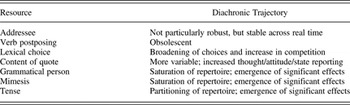
Table 11 summarizes the full extent of systemic change in the operation of direct quotation over 125 years of New Zealand English. What is critical about these changes is that, with the exception of the number of primary quotative forms, none can be restricted to the period during which go and be like entered the repertoire. Each has been shown, through detailed distributional and multivariate analysis, to have been undergoing change prior to the emergence of these forms.
The evolution of saying what was said

The diachrony of quotation is that of a system in flux, resulting in a discourse practice that is both qualitatively and quantitatively different across time. The repertoire expands, but the newcomers are precipitated by a host of other changes affecting the operation of the system as a whole. To surmise the nature and extent of these changes, a diachronic perspective was required. Ultimately, the phenomenon is the same, but saying what was said has developed—through nuanced and longitudinal change—an active and richly articulated variable grammar, a grammar in which each form has a distinct role to play.
CONCLUSION
Joseph (Reference Joseph, Fischer, Norde and Perridon2004:62) argued that “the key to understanding language change is not to look at elements atomistically, but to see them in connection with other elements in actual use.” It is precisely this holistic view of change that enables the variationist paradigm to explore questions concerning the evolution of grammatical systems. In this instance, diachronic analysis of constructed dialogue reveals that direct quotation has over time emerged as a locus of robust and highly constrained variability. Shifting beyond synchronic perspectives and form-based analyses to consider the system as a whole reveals a trajectory of expanding constraints, as individual forms lose, transfer, and acquire contextually driven effects. Language-internal conditioning of variant choice, once moot, now drives variation in the system.
An outstanding issue concerns why the system of direct quotation has reorganized so unequivocally over 125 years. This is not an issue that can be addressed here, but it is likely that at least part of the answer lies outside constructed dialogue itself, embedded in distinctions of style, genre, or register. The norms for spoken language are known to have undergone a number of changes in the recent past, belying the assumption that Present Day English is more or less the same as 19th- and early 20th-century English (Kytö, Rydén, & Smitterberg, Reference Kytö, Rydén, Smitterberg, Kytö, Rydén and Smitterberg2006:1; see also Romaine, Reference Romaine and Romaine1998:7; Rydén, Reference Rydén1979:34). Because quotation is often embedded in discourse routines and structures (e.g., complicating action clauses of narratives of personal experience), then changes to the ways in which such routines are transacted and encoded will surely have reflexes for their component parts.
One shift that seems particularly pertinent to the construction of dialogue concerns the emergence of self-revelation as a mode of discourse. Carbaugh (Reference Carbaugh1988) suggested a general tendency toward “lionization of self-revelation” (Ferrara & Bell, Reference Ferrara and Bell1995:283). In this light, Ferrara and Bell found the rise of internal state reporting in their data of “no wonder” (1995:283). The increasing tendency to use quotation for dramatic reenactments of internal, experiential personal experience is not unique to the New Zealand. Apparent time evidence from England, Canada, and the United States suggest that it is a characteristic of English more generally (Buchstaller & D'Arcy, Reference Buchstaller and D'Arcy2009), whereas further diachronic support is provided by Buchstaller (Reference Buchstaller2011).Footnote 18
Certainly there are other factors implicated as well, as the architectural changes affecting direct quotation are highly articulated and widespread, but a shift in discourse mode is certainly a key contributing factor, at least as far as the significant broadening of the pragmatic function of direct quotation is concerned. But regardless of underlying causation, it is clear that the construction of dialogue has altered qualitatively and quantitatively since the late 19th century. Longitudinal analysis reveals a multifaceted trajectory of change in which the operation of the system changes fundamentally. A highly constrained variable grammar emerges, the effects of which reverberate throughout the sector.