Introduction
Changes in personal circumstances in the years surrounding retirement are for many people associated with residential mobility, at least in affluent western countries (Alsnih and Hensher Reference Alsnih and Hensher2003; Duncombe et al. Reference Duncombe, Robbins and Wolf2001). A move on retirement is frequently associated with a quest for different or improved amenities and lifestyle, and many of the destinations are geographically removed from existing social networks (Hugo Reference Hugo2003). The resultant risk is that proximal social relations are severed at a time in life when they become increasingly important, which contributes to the risk of social isolation for older people as they become less mobile and able to travel any distance to remain connected to their social contacts (Victor et al. Reference Victor, Scambler, Bond and Bowling2000).
The strength and quality of social relationships play a vital part in the physical and mental wellbeing of people as they age. As people move from the more active years of early retirement into their later years of frailty and decreasing mobility, membership of a community of place where social support is geographically proximate can greatly add to the quality of life (Bowling et al. Reference Bowling, Gabriel, Dykes, Dowding, Evans, Fleissig, Bannister and Sutton2003; Higgs Reference Higgs1999; Wellman and Wortley Reference Wellman and Wortley1990; Zahava and Bowling Reference Zahava and Bowling2004). In contemporary western settings, the high occupational and residential mobility of family members (Randolph Reference Randolph2004), and changing understandings of filial obligation to parents (Aboderin Reference Aboderin2004), have added new importance to the role of friends in local social networks. There is a growing body of epidemiological evidence that the presence and strength of proximal non-kin social relationships are important sources of effective support in old age (Fiori, Antonucci and Cortina Reference Fiori, Antonucci and Cortina2006; Giles et al. Reference Giles, Glonek, Luszcz and Andrews2005; Litwin Reference Litwin2001; Mendes de Leon Reference Mendes de Leon2005). There is also acknowledgement that older people's social and material welfare is increasingly a matter for personal negotiation, rather than to be taken for granted as might have been the case in the past with more structured and static roles and with the security provided by state and family (Featherstone and Hepworth Reference Featherstone, Hepworth, Bytheway, Keil, Allatt and Bryman1989; Olsberg and Winters Reference Olsberg and Winters2005; Phillipson Reference Phillipson, Phillipson, Allen and Morgan2004).
Since the beginnings of the systematic social sciences, researchers have been documenting the decline of place-based community in industrial and post-industrial societies, particularly in urban and suburban settings (Jacobs Reference Jacobs1962; Nisbet Reference Nisbet1969; Park, Burgess and McKenzie Reference Park, Burgess and McKenzie1967; Tönnies [Reference Tönnies1887] Reference Tönnies1955, 2001; Wirth Reference Wirth1938). Late modernity and the mobility associated with employment, consumption and lifestyle, and advances in transport and communications, have meant that the stability and predictability of proximal relationships have decreased over time (Urry Reference Urry2000a). While community is certainly not absent in urban environments, the residents of large contemporary western cities for the most part find enduring social support in complex and spatially diffuse webs of relationships in which place plays a supporting rather than a central role (Kasarda and Janowitz Reference Kasarda and Janowitz1974; Wellman and Leighton Reference Wellman and Leighton1979; Ziller Reference Ziller2004). Perhaps because of its ‘scarcity value’, the concept of place-based community and social connectedness has increasingly captured the imaginations of marketeers (Cova Reference Cova1997), particularly those for property developers who frequently invoke nostalgic communitarian values to sell a vision of comfortable, secure and friendly ‘communities of place’. Many articulate idealised and sentimental visions of community from a mythical past (Conway Reference Conway2003; Wood Reference Wood2002), as exemplified by the following advertisement for a new suburban estate in Australia:
There's a real sense of community here, binding the neighbourhood together and fostering a social spirit. Getting to know each other is easy and there is an open friendliness evident. … The well-planned open areas encourage social interaction, balancing public and private space. Residents say hello and watch out for each other and the neighbourhood (Stockland 2005).
These invocations of community reflect Ferdnand Tönnies' ([Reference Tönnies1887] Reference Tönnies1955) concept of gemeinschaft as a form of human association characterised by close kinship, continuity, in-depth social relationships and an unreflexive attachment to place, buttressed by strong social norms and institutions, particularly those emanating from religious codes. The contrast that Tönnies drew is with gesellschaft, a form of association that is more instrumental, rational, contractual and specialised, which has come to be seen as characteristic of the industrial-urban milieu of modernity. The discourse of communitarianism manifest in this type of marketing, and other late-modern evocations of community of place, sustains the gemeinschaft/gesellschaft dichotomy and the characterisations of the imagined community of the past as an escape from the anonymity of modernity.
The paper is set against the background of the recognised need for strong proximal communities for older people alongside the long history of their erosion in developed urban environments, and the property marketing that envisages the reincarnation of local communities. It reports a case study of the ways in which older people developed a meaningful social network by moving into a new, all-age, housing development. They did this following their decision (obligatory for the group, but also increasingly common for the cohort) of moving to a new residential environment on retirement. We investigate the ways in which a group of older residents, who separated themselves geographically from previous networks of kin and friends, negotiated personal networks in an environment which a property developer had heavily promoted as offering a ‘community’, but where the neighbourhood dynamics were those typical of a western suburban setting. We conclude with a discussion of a form of social bonding that goes beyond the gemeinschaft/gesellschaft dichotomy.
Springfield Lakes
The site for the case study, Springfield Lakes, is a new, outer-suburban, residential development or ‘master planned estate’ (MPE), located 40 minutes drive southwest from the centre of Brisbane, Australia. The estate was not designed for any particular age group, and the older research participants lived alongside those of working ages. This type of estate and suburban development is becoming widespread in Australia, and may be characterised by its ‘planned aesthetic’ character and relatively comprehensive amenities and facilities (Costley Reference Costley2006). These developments are distinguished by the attention given to the marketing of the estate as a community and by the interventions that seek to establish the architecture of a community of place. The population of Springfield Lakes in mid-2007 was approximately 6,000, and it is forecast to reach 30,000 by completion in 2020 (Delfin Lend Lease 2006). As of mid-2007, 13 per cent of the residents were aged 50 or more years, with less than one per cent aged 75 or more years (Australian Bureau of Statistics (ABS) 2007b). The estate was chosen for study as part of the wider Australian Research Council funded project Building Sustainable Social Capital in New Communities in conjunction with its private-sector developer.
Methods
The presented findings are based on semi-structured interviews conducted during 2005 and 2006 with 51 older residents of Springfield Lakes who had lived in the development for between one and three years. The participants were recruited through their membership in various community organisations in the development, through introductions at developer-sponsored ‘welcome nights’, and through letterbox drops. Most interviews took place in the residents' homes, but four were in a café; they lasted between one and two hours and were recorded. Spouses or partners participated in around 50 per cent of the interviews. The participants' ages ranged from 50 to 75 years (average and median 62 years). The questions focused on the participants' reasons for their move to Springfield Lakes, their personal networks before and after the move, the centrality or otherwise of kin, their relationships with neighbours and other residents in the development, their plans and aspirations for retirement, and the backgrounds to their activities, interests and affiliations.Footnote 1
Over two years the first author undertook approximately 70 hours of participant observation at meetings, parties, on day trips and during other activities of the Springfield Lakes Leisure Group, a recreational club for ‘empty nesters’, to understand the motivations, expectations and benefits of membership. The analysis was guided by the basic principles of grounded theory (Glaser and Strauss Reference Glaser and Strauss1967), but following Charmaz (Reference Charmaz, Denzin and Lincoln2000) with a less rigid and less purely inductive or theory-free interpretation. The first stage, when approximately one-half of the older residents' interviews had been completed, we developed codes from the participants' accounts. The framework provided by the interview schedule guided this stage of analysis, so that codes were constructed for: reasons for moving to Springfield Lakes; personal community before the move; personal community after the move with a focus on family, neighbours and friends, and new bonds. The second stage of analysis was carried out after all remaining interviews had been conducted, when the coding was refined and finalised. The categories were created by the first author and checked for consistency and coherence by the second author and other project team members. The findings were mailed to the respondents and several oral presentations were made by the project team. Feedback was invited from the participants and received both by mail and in person.
Findings
Three main sources of social support were considered during interviews. The first two sources, the nuclear family and the neighbourhood, correspond to what could be understood as customary sources of support for older people in stable and predictable place-based social environments. The third source, the more reflexive ‘communion’, or reflexive community, emerged from observations and interviews with a sub-group of participants when their local associational ties were investigated. This theme reflects their responses to a more contingent contemporary residential environment.
The family as a source of support
One of the traditional foundations for support in old age has been the family, particularly the spouse and a couple's descendants (Winter Reference Winter2000). While most participants identified their adult children as their most significant relationships, both the nature of those relationships and the expectations surrounding them were ambivalent. While many had adult children in the Greater Brisbane area, many had no expectation that their children would, or should, remain in the area, which acknowledged the contingent nature of mobile careers, the housing market and the demands of children's and their partners' social networks. This changing sense of obligation and expectation was underwritten by the facts of family mobility. While some participants had moved to Springfield Lakes to be closer to their adult children, others had chosen the estate independently of the locations of their families. As a 61-year-old woman explained:
To my way of thinking … we have to go where we want to be because the kids just go off wherever they need to go, because work will take you anywhere now. So it's very unlikely that your kids are going to be anywhere near where you are anyway.
Regardless of their adult children's residential proximity, not one participant offered the view that children or grandchildren might provide care or support in frail old age. When asked how they saw the trajectory of old age, almost all responded that they would inevitably move from independent living into some form of assisted living. For example, a 71-year-old woman had adult children in the area but no expectations that they would later provide support. She said, ‘I mean, God willing, we'll die in the house, but I mean we can get meals-on-wheelsFootnote 2 and we can get household help if we need it … but I mean you don't know, do you? At our age we're just playing it day-by-day.’ Contact with family was constructed by most as something to be grateful for while it lasted, but the norms of reciprocity that regulated these relationships did not extend to expectations of care in late old age, indeed the prevailing sense was that any such expectation would be an imposition. Gavin, who was not yet 60-years-old, lamented the fact that there were no concrete plans for aged-care or assisted living on the estate, as he wanted the reassurance that he would be able to stay in the area and not impose on his family. He said:
I would like to think that something would be up and running when we get to there. I hope I've got enough brains to know when to go in there. I hope the marbles stay together long enough to say [to myself], ‘Gavin, this is time that you should do this, don't put your family through 10 ton of stress’ … you know, but that's just my … that's my greatest wish.
Another informant, Sharon (aged 65 years) and her husband had adult children living within an hour's drive, but she also expressed the common view that although they would like to see their children and grandchildren more regularly, to do so would be to impose on their busy lives. She said, ‘We can't expect to see too much of [our son]. I mean we can go and see him every week if we wanted but he's building a home; they've got stuff to do and the kids have got soccer and piano and swimming’. Despite the high prevalence of divorce and separation in the interview sample, there were only isolated examples of estrangement or hostility between parents and adult children. With a few exceptions, the participants had warm feelings toward their immediate families but no expectations of filial obligation.
The neighbourhood as a source of support
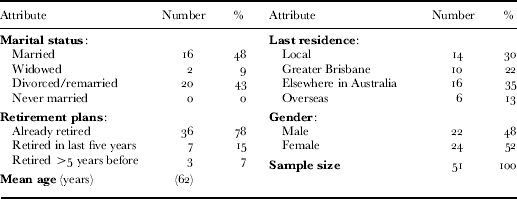
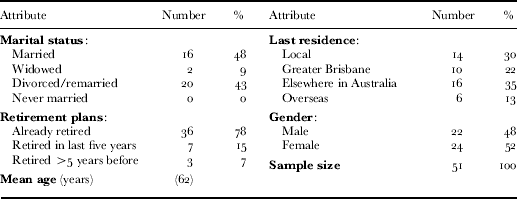
The participants' accounts revealed the limited potential of neighbourly relations, for very few had formed close bonds with neighbours (taken as those living adjacent or no more than a few houses away, or on occasion in the same cul de sac). With the exception of those who had purposively searched for social contact (discussed in the next section), even fewer had formed a social relationship with anyone in the wider environs of Springfield Lakes. The politics of neighbourhood relationships in contemporary western suburban settings are characterised by an unwritten code that allows neighbours to exist in peace with each other (Baumgartner Reference Baumgartner1988). For neighbourly relationships to progress beyond this point, a degree of homophily is usually required, such as a shared interest or outlook, typically associated with shared life stage, educational level or ethnicity (McPherson, Smith-Lovin and Cook Reference McPherson, Smith-Lovin and Cook2001). As Robert Putnam (Reference Putnam2000; Putnam et al. Reference Putnam, Feldstein and Cohen2003), a leading advocate of closer neighbourhood and community ties, acknowledged with dismay, diversity is often the enemy of the community of place (Anon 2004). The diversity among the residents of Springfield Lakes is both a legacy of the fluid social landscape of late modernity and the developer's marketing. For many of the older residents, it was manifest in the types of people with whom they were likely to share their street. Although older people were well represented for a new suburban development (see Table 1), Springfield Lakes had many younger families; this was the perception of many of the older residents. While the older residents did not suffer any obvious hardships as the result of neighbourhood diversity, there were sufficient differences with many of their neighbours to form barriers to relationships of trust and reciprocity. In response to a question about neighbourly relations, a man aged 61 years said that they did not ‘live in each others pockets’. He elaborated in these terms:
Yeah, I know the people [who live on] both sides. As I said, this fella's just moved in here and he's got a young girl, she'd be about seven or eight. We talk to them. We don't sort of live in one another's pockets; we say ‘Hello’ and ‘How are you?’ – that type of thing. These people next door, that's just a [young] husband and wife next door and I don't think if you didn't see them hanging out the washing, you'd never see them. They keep themselves to themselves.
Socio-demographic attributes of the interview sample (n=51, mean age 62)
Tenure was an important concern for many participants, most of whom were homeowners. Many had come to Springfield Lakes to escape or avoid living alongside ‘renters’ (those privately renting their house rather than owning it or paying it off).Footnote 3 In Australian cities, renters are regarded as potential perpetrators of anti-social behaviour, and seen as likely to ‘lower the tone’ of the residential area. As a 50-year-old woman said:
[We are] not happy with the rental people and the rentals around the place. A lot of [us] have bought their houses here to retire, and to have good neighbours and to have a perfect, I suppose community. They think that way … they don't have ambition to own a house, they have no plans for the future, or they have no … it's just day-to-day living.
There was also the perception that renters were transient and unlikely to commit to the community. As a 66-year-old woman said, ‘Why would [renters] be interested in ‘Neighbourhood Watch if they are not going to be there long enough? With the transfer of jobs nowadays, a young couple could move here and you hardly settle in and your job moves so you move.’ Some older residents perceived Springfield Lakes as ethnically diverse, although the census figures reveal that it is no more so than Brisbane as a whole. Some Vietnamese had moved to the suburb; they formed four per cent of the households (ABS 2007 b). Their presence added to the perception of diversity, and for some heightened a sense of isolation. One 61-years-old lady said:
I'm surrounded by them [Asians]. They don't worry me but they don't mix. So you may as well be living on a desert island, that's how I feel where I am, I don't know a soul. The people across the road from me, they're Aussies but they both work every day and their kids go to day-care and I never see them. I've seen them once since Easter; it's true.
The diversity at Springfield Lakes was a factor in the social lives of the older residents. As the residents' statements made clear, diversity operated as a barrier to the growth of a traditional or non-reflexive place-based community. Forrest and Kennett (Reference Forrest and Kennett1997: 351) recognised that as well as the forms of diversity that are immediately apparent, such as between a disadvantaged ‘underclass’ and a privileged elite, in late-modern urban settlements there are also forms of more subtle heterogeneity, where neighbouring households appear undifferentiated in terms of housing circumstances and broad (former) occupational categories but have different social resources and lifestyles. This subtle heterogeneity may be a barrier to satisfactory local social inclusion. While the inherent and perceived diversity of Springfield Lakes was for many of the older residents a source of ambivalence in their attitudes to neighbours, this factor in non-kin relationships is common to suburban neighbourhood relations in both Australia and developed western countries. Few residential developments have the deep and enduring characteristics of traditional community without the bedrock of temporal permanence, common outlook and strong family networks (Baumgartner Reference Baumgartner1988; Gleeson Reference Gleeson2006; Pusey Reference Pusey2003).
Seeking out a local social network: the Leisure Group
This section profiles a group of the older residents of Springfield Lakes who, implicitly acknowledging their lack of established social contacts, successfully established a durable and supportive social network on the estate through their own agency and the early initiative of the property developer. Some took up the available constructed opportunities to form close social relationships in an environment where the conditions of late modernity provided limited opportunities for spontaneous or unreflexive forms of creating place-based community. Most of these opportunities were through the Springfield Lakes Leisure Group, an association of older people that was established in 2003 on the initiative of the property developer's community development staff. The community development officer from the property development company conceived and instigated the idea, and hosted the initial meetings in its boardroom. Within months the club had the critical mass to continue and there was little further involvement by the developer, who claims it is the most rapidly growing and durable of all the social and recreational groups in Springfield Lakes. The members referred to themselves as ‘empty nesters’. At the time of the study, the group had over 100 regularly active members and was growing steadily. The group had no charter beyond recreation and camaraderie. Kate (aged 60 years), the secretary and treasurer, in response to a question about her reasons for her membership of the group put it in this way:
We're here to have fun … and I think being our age group, we're sort of past the stage now of our kids are off our hands, you can go out and enjoy yourself and I suppose let your hair down and have that bit of fun. You haven't got to think, oh God! The kids are at home, I've got to get home, and get their meals, and so forth.
The activities were predominantly recreational and included regular parties, potluck suppers, theatre outings and day trips around the region. There was an emphasis on lack of commitment; there were no duties to fulfil and no expectations of any particular level of involvement. There was a president, a secretary/treasurer and a social planner to maintain a degree of momentum and organisation. Activities were publicised and arranged at a monthly meeting in the community hall and then by email and word-of-mouth. The reflexivity, or agency, required to join the group was evident – most, if not all, of the membership had joined ‘cold’, without the security that an introduction from a friend or relative provides. One 67-year-old man and his wife had heard about the group through the marketing material provided by the developer and had joined before they built their house. He said, ‘We heard the advertising down in Melbourne. I thought, yeah, yeah … but before we finished the house we joined the leisure group because with the paper work [the property developer] sent out invitations.’
Eighteen of those interviewed were active in the Leisure Group. Most had moved to Springfield Lakes from further than the immediately surrounding suburbs. The friendships formed through participation in the Leisure Group provided members with significant benefits, or social capital, within the estate. This was made manifest in several ways, in its simplest form as companionship. A 57-year-old woman said, ‘It's just been really good for me because I get really, really homesick, and I've got two children that I've left behind [overseas]. They're not little, they're 35 and 30, but mothers always think of their children as children. I do miss them a lot, and my friends.’ For a retired couple, the empathy of the group allowed them to share the fact of the 57-year-old husband's mental illness and allowed them to take part in activities with the peace of mind from the shared understanding. As the 50-year-old wife said:
I thought, some of the people in the [Leisure] group should know, the people that we were walking with, they seemed to click with us, and I've decided that I'm going to tell them [about my husband's mental illness] just in case something comes out of the ordinary. I felt it's important, and they were quite fine. Everybody knows, they're quite fine about it, and they encourage him and they're great with him.
For a 60-year-old woman, the shared emotional and physical support available from the Leisure Group was particularly associated with an individual. The woman explained, ‘in August 2003 my mum passed away and [a Leisure Group friend] was very supportive and looked after us at the time. And our grandson was born on her birthday so that's another [link]. And I had a [surgical procedure] in early 2004 and [she] nursed me through that’. Like any group, the Leisure Group had informal barriers to entry. It had developed a distinctive culture and was largely ethnically homogeneous. There were no single men in the group, although there were a few single (divorced and widowed) women. New members were subjected to a particular style of loud (good natured) welcome and bawdy humour; they either found themselves quickly incorporated into the group or didn't come again. Over the two years of participant observations, numerous people came to try the club and, whilst made to feel welcome, found that they did not fit in and did not return.
During a research interview, the President summarised how he began his address to newcomers at the developer-hosted ‘welcome’ evenings: ‘Usually my opening comment is that we're slightly crazy and do you enjoy a drink?’ For some this was a forewarning and acted as a filter to continuing membership, as did the idea that it was a group devoted exclusively to ‘empty nesters’. Several interviewees reflected the thoughts of those who did not want to part of an ‘old persons' group’. A 59-year-old man said, ‘We are not club people. I don't like the structure of clubs very much – the whole psychology – somebody climbs the ladder and becomes the boss and tries to bully everyone else. We went to the leisure club one morning but I felt a bit out of place for that. I'm too young for that.’ But for many of its members, the Leisure Group provided a degree of social certainty in conditions where the support of family and older friends was limited because of distance, divorce, ambivalence or alienation. This need for social connection as it applies specifically to those in early old age was evident from the accounts of members of the group who, for example, noticed a distinct lack of alternative outlets for older people. A 72-year-old woman said:
Well we met the Leisure Group and they were really nice, they all looked our age, they have meetings, they have bus trips. … When you're older it is harder to get to know people than when you're younger and you're going to tuckshop [school canteen] and all the other groups. Well we didn't [have problems] at [a small country town] but then country people are different.
The local aspect was important. The strong friendships and support of the group did not substitute for family or life-long friends, but instead provided day-to-day social contacts that were missing from their spatially-diffuse networks. A 62-year-old woman acknowledged this need when she compared her membership of the Leisure Group and its potential for local support with the alternative of isolation: ‘For us personally it's not because our friends are not all here, they're scattered around in Brisbane, but I think it's good to have people here that you know because, again you don't know if you ever have to call on people. It's another part of … overall what you do in life. You don't live an isolated life.’ The Leisure Group may hold clues about how older people are able to connect with a sustainable form of community in the future, particularly as social networks based on proximity decline. In the discussion that follows we provide a theoretical interpretation of the potential role in forming social interactions, capital and support.
Discussion
The type of idealised community most commonly evoked in the discourse of a ‘return to community’ or ‘neighbourhood’ favoured by marketers, social commentators and politicians is based on the determinism of place (see Etzioni Reference Etzioni1995; Harvey Reference Harvey1997); that is, the idea that living in a particular location somehow bestows upon the residents the benefits of the social capital that is imagined to develop through a shared location. Where a place-based community does develop, however, it happens spontaneously as a function of proximity, geographical stability and a shared outlook over a long period (Nisbet Reference Nisbet1969). It is the community associated with the traditional village of agriculturalists, the type typified by Tönnies as Gemeinschaft, celebrated by Jacobs (Reference Jacobs1962), or referred to by Gans (Reference Gans1962) as ‘ethnic inner city enclaves’, where people could be confident that neighbours were keeping watch and doing small favours, and frail older people were integrated with extended families and community structures.
Membership of such communities was unreflexive, or taken for granted unless it was threatened. This type of community is increasingly rare in contemporary suburban environments and as a result of the subtle heterogeneity at work in Springfield Lakes, the older residents displayed little propensity, or opportunity, to form these neighbourly relationships. Proximity, although not necessarily creating tension or enmity, was not a basis for the homophily that comes with similarity in age and outlook and which leads to deep and lasting social ties (McPherson, Smith-Lovin and Cook Reference McPherson, Smith-Lovin and Cook2001). Adult children, while still central in an affective sense, were for the most part not in close geographical proximity and were not expected to provide day-to-day support for their parents.
With the absence of old networks and uncertain prospects for spontaneous neighbourly integration, a space existed for another form of ‘contrived’ social bond, provided in this instance by the Springfield Lakes Leisure Group. While the Leisure Group might initially appear to resemble the type of group, club or association that older people have been joining on retirement for decades, it offers a distinctive form of social interaction that warrants further explanation. First, the Leisure Group had no other objective than social camaraderie or friendship. Previous affiliations, skills or biographical histories were neither grounds for exclusion nor did they facilitate access to the group, and they afforded the individual no particular status once he or she had joined.
In this regard, the Leisure Group differed markedly from, say, a bowls or golf club that focuses on a particular pursuit and maintains often long-established bureaucratic hierarchies and codes of behaviour. Similarly, traditional working men's clubs and armed-services veterans' associations, while designed to bring people together for fellowship, were also supported by a strong institutional or class lineage, both of which are becoming more fragmented or ambiguous in late-modern social conditions. Of course, no group is without its barriers to entry and the Leisure Group had an explicit life-stage requirement. There were also certain cultural qualities to the group with which the new member had to feel comfortable. For any group to sustain its cohesion there must be at least a basic system of shared meanings (Lash Reference Lash, Beck, Giddens and Lash1994). Secondly and closely related was the issue of agency, the nature of the Leisure Group, its location in a new residential estate and its lack of structural or institutional lineage meant that joining such as group involved an act of ‘agency laid bare’. Almost all the Leisure Group members who were interviewed or encountered had joined the group ‘cold’, without the security of an introduction or institutional entrée.
The Leisure Group exemplifies a type of social organisation that has been neglected in social theory. Because the association is based primarily on affect relationships, it is not easily incorporated into typologies based on types of functional or structural social bonds, the focus of much sociological attention since Tönnies's distinction between gemeinschaft and gesellschaft communities (Urry Reference Urry and Turner2000b). According to this dichotomy, social bonds can be explained by the institutional or structural conditions that brought them about. In these conditions it was possible to be a member without the intrusion of affect, and where affect existed, it was treated analytically as a corollary of the structural determinant. Ray Pahl (Reference Pahl2002) described this ambivalence by defining a friend as inevitably linked with some other structural role: ‘evidently a friend is a person: he or she may also be a wife or husband, a sibling, a workmate, a neighbour, an old school or college mate and so on’ (2002; 412). In other words, friendship, or affect, has usually been seen in mainstream sociology as a relationship of the private realm and not subject to the same sociological import as more orthodox definitions of social structures and institutions (Allan Reference Allan1998; Eve Reference Eve2002; Macionis Reference Macionis1978; Pahl Reference Pahl2002).
In theoretical terms there have been several attempts to give the group based primarily on affect its own social ontology. An early theorist of the purely affective bond was Herman Schmalenbach (1885–1950), a German sociologist and a critic of Tönnies. He believed that social bonds existed that were not properly accounted for by the modernist dichotomy of gemeinschaft/gesellschaft, or even by a continuum between the two. Schmalenbach recognised the hold that Tönnies's ‘community’ had on the popular imagination even at this early stage when he observed that ‘the term, community, has become a catchword to designate every possible (as well as the most impossible) delusion of the time’ (Schmalenbach Reference Schmalenbach1977: 64). He recognised the existence of a third form of social bond that he called ‘communion’ (or Bund in the original German) that he had observed in rapidly modernising Germany in such forms as youth movements and break-away charismatic religious groups. Communion described an affective form of community characterised by its intentionality – a reflexive act of joining with strangers (Hetherington Reference Hetherington1994) and, like the Leisure Group, a social bond formed for no other reason than the bond itself.
Similar arguments in subsequent years found more relevance as sociologists began to address the social effects of late/post-modernity (Bell and Newby Reference Bell, Newby, Herbert and Johnston1976; Hetherington Reference Hetherington1994; Stone Reference Stone1954; Urry Reference Urry and Turner2000b). Much of this subsequent work focused on a form of reflexive community, or communion, exemplified with reference to phenomena such as fringe groups (Cova Reference Cova1997), musical and sporting subcultures (Lash Reference Lash, Beck, Giddens and Lash1994), and ‘New Age’ groups (Hetherington Reference Hetherington1994). Maffesoli (Reference Maffesoli1996) has brought a very similar but more everyday perspective to this concept, by describing a form of affective social bonding or aesthetic sociality as ‘neo-tribes’. The term ‘aesthetic’ is used by Maffesoli to describe the nature of these bonds ‘in the etymological sense of the word, as the common faculty of feeling, of experiencing’ (1996: 74), rather than in its narrower creative or artistic sense. Maffesoli takes neo-tribes out of the exceptional circumstances of, for instance, the counter-culture, and affords them greater normality in contemporary circumstances by positing that more and more people now have the opportunity for self-expression through the groups with which they have an aesthetic connection, as with the followers of a particular style of dress, motorcycle enthusiasts, or devotees of particular styles of music. He sees the emergence of these groups in terms of a paradigm shift, rather than as curiosity or fringe phenomenon.
Eve (Reference Eve2002) developed the sociological importance of affective bonds or communion, and gave it a direct applicability to the Leisure Group and other older people in similar circumstances. Like the theorists above, he argued that rather than being a private matter, friendship is very much a sociological phenomenon. Because people rarely maintain an exclusively dyadic relationship with another individual, friendship has a significant role to play in the way that a person orders his or her life and the opportunities afforded to that person. Friendships are typically part of friendship networks or configurations (as Eve terms them), which play a vital intermediate socio-structural role between the individual or family, and what remains of larger social structures such as social class or the occupational hierarchy. This re-ordering of configurations often coincides with significant life changes, such as retirement, bereavement and divorce or, in the case of the older residents of Springfield Lakes, a residential move. The success or failure of that re-ordering can have a significant impact on how an individual copes with a life change. The transition from one social state to another, whether it be from education to work, from being married to single, or from the workforce to retirement, all imply a reordering of social networks as these transitions imply leaving one mode of living and pattern of interaction for another. The configuration of the Leisure Group has allowed the transition, from work to retirement and from one residential location to another, to be a positive experience for its members.
Despite the various ways in which the idea has been employed, the unifying thread is that these groups have at their core a strong sense of a communal being that is missing from the wider social environment. The achievement of communion, reflexive community, a neo-tribe or a friendship configuration is through a purposeful modus operandi, rather than as a by-product of another activity. There are examples in the literature of older people forming friendship groups that bring mutual long-term benefit, and they demonstrate the possibilities available for older people to improve their social situation in the absence of old networks. In an Australian context, Olsberg and Winters' (Reference Olsberg and Winters2005) national research project on older peoples' housing choices found that there was strong acknowledgement from older Australians of the benefit of deliberate communion, where bonds of affect could be used to overcome some of the structural deficiencies in society, such as the need to submit to the demands of the state or private-sector markets in the provision of aged care.
This idea of deliberate community, a form of communion, with perhaps a more focused aim than the Leisure Group, is also reflected in European examples of older people with the necessary resources conceiving and developing their own retirement ‘communes’, populated by other like-minded older people and managed according to both affective and rational considerations (Baars and Thomese Reference Baars and Thomese1994; Bamford Reference Bamford2005). In a well-known early example, Hochschild (Reference Hochschild1973) in The Unexpected Community described a form of communion that was rooted to place. She explicated the way in which a group of older people in a San Francisco apartment building came together to form a deliberate affective community in the absence of family and former neighbours, with many similar characteristics to the Leisure Group, particularly in their patterns of leisure, support and organisation. Hochschild's group was enriched both materially and emotionally as a result. Older people were able to interact day-to-day as equals and to discuss freely and share issues such as sex and death in their own language. A short extract describes well how access to friends every day enriched the lives of the women in the group:
Their society together offers them not just a chance to share their vicarious lives. It offers an alternative to vicarious living – a chance to live directly, in the here and now, in one's given body, whatever its disabilities (Hochschild Reference Hochschild1973: 111).
It is this regular and familiar contact with friends, which Hochschild described in terms of ‘sibling’ type relationships that do not replace family relationships or life-long friendships, but instead complement them through proximity. The Springfield Lakes Leisure Group had not reached the point where members were making plans to spend their later retirements constantly in each others' company, but the foundation was forming for a strong local network of support, something that many older people sacrifice when they move house on retirement. The identification of conditions in which older people are able to come together, with a minimum of common structural references (as when they move into a new residential environment) is important – Springfield Lakes is but one example. A group that is established and sustained with friendship as its core aspiration should, in the absence of other structural, bureaucratic or aptitude-based demands, focus the collective minds of its membership on social bonding. The lengths to which the Leisure Group members went to welcome and quickly integrate new members testify the effect. It is also important to recognise the role of the property developer in the story. On the one hand, like most others, the developer promoted the estate using a discourse of a nostalgic local neighbourhood community, an ideal that is largely unattainable, particularly for older residents in contemporary social conditions in a new estate. Its programme of local social interventions laid the foundations of the Leisure Group, an idea that had clearly found its time and place. The fact that this could be achieved with relatively little effort and expense by a property developer attests two things: there is a demand for such groups in such settings, and this type of intervention can be implemented with relative ease and to great effect.
Conclusions
This paper has reported a case study of a new suburban residential development in a contemporary western setting that investigated the ways in which a supportive community might be made available to people as they age. The study found that for the residents of Springfield Lakes, nostalgic constructions of geographically-determined neighbourhood communities were inconsistent with the experience of the older residents for whom a local source of social capital would become more important as they aged. Added to this was the fact that kinship ties, while still strong, were largely geographically distant and accompanied by norms that did not extend to day-to-day care of older parents. For one group of older residents though, the foundations of close and supportive local bonds were laid down through the Springfield Lakes Leisure Group. For its members, a re-configuration of friendship networks coincided with their recent move to the estate, and for many of them, their recent or impending retirement.
The paper has placed the Leisure Group in a particular category of social bond to distinguish it from other forms of association for older people. Its value lies in its capacity to absorb members and create friendships where no previous ties existed (Eve Reference Eve2002). The focus of the group on social connection, with no affiliated structural or bureaucratic overheads, allows its members to form rapid and substantial social bonds. This ‘communion of strangers’ is possible because membership assumes no structural affiliations and no particular qualifications or skills apart from age. The benefits of these bonds were already evident in the social capital that members had derived from these friendships. The fact that the Springfield Lakes Leisure Group was by far the most successful of the developer-initiated groups suggests that in an environment of late-modern diversity there was a need for this model of ‘communion’, and secondly, that older people increasing at risk of social isolation were prepared to ‘take the risk’ in actively and reflexively joining this type of group to construct a more rewarding and socially well-supported Third Age.
Acknowledgements
This research was conducted as part of a University of Queensland, Australian Research Council Linkage project ‘Building Sustainable Social Capital in New Communities’, with the industry partner Delfin Lend Lease, the developer of Springfield Lakes. The authors would like to thank the research participants for their co-operation and the reviewers for their valuable advice.