Introduction
Mild cognitive impairment (MCI), which is a heterogeneous diagnostic category of subtle cognitive decline in older adults, is used to describe transitional state between normal aging and dementia (Petersen, Reference Petersen2004; Economou et al., Reference Economou, Papageorgiou, Karageorgiou and Vassilopoulos2007). Although episodic memory impairment is a characteristic feature of amnestic MCI (a-MCI), a number of other cognitive measures, including working memory (WM), are also sensitive to differences between normal cognitive aging and MCI, and between MCI and Alzheimer's disease (AD; Economou et al., Reference Economou, Papageorgiou, Karageorgiou and Vassilopoulos2007; Belleville et al., Reference Belleville, Sylvain-Roy, de Boysson, Ménard, Sossin, Lacaille, Castellucci and Belleville2008).
Working memory is used to maintain and manipulate information without external cues, and it is critical for several higher order cognitive abilities, such as fluid intelligence, planning, problemsolving, reasoning, and language comprehension and production (Unsworth et al., Reference Unsworth, Redick, Heitz, Broadway and Engle2009). When assessed within a larger range of cognitive functions, WM is usually one of the most severely impaired cognitive functions in MCI. Aretouli and Brandt (Reference Aretouli and Brandt2009) found that, among the three components of executive function studied (planning/problemsolving, WM, and judgment), only WM was associated with daily functioning abilities. Economou et al. (Reference Economou, Papageorgiou, Karageorgiou and Vassilopoulos2007) found that scores for the Working Memory Index of the Wechsler Memory Scale-III (sum of the Letter–Number Sequencing and Spatial Span subtest scores), among other cognitive processes, were significantly lower in the MCI group than in the elderly control group. Nevertheless, these differences were smaller than episodic memory differences when both groups were compared (Economou et al., Reference Economou, Papageorgiou and Karageorgiou2006).
Patients with cognitive impairments in more than one domain experience more difficulties in carrying out daily activities than those with impairment in a single domain, possibly due to more widespread brain pathology. Brandt et al. (Reference Brandt, Aretouli, Neijstrom, Samek, Manning and Albert2009) found that multiple-domain amnestic MCI (mda-MCI) patients displayed more severe impairments in WM than in single-domain amnestic MCI (sda-MCI) patients, leading to the supposition that the former have a higher risk of imminent dementia. Wu Nordahl et al. (Reference Wu Nordahl, Ranganath, Yonelinas, DeCarli, Reed and Jagust2005) suggested that although specific types of hippocampal damage are associated with isolated episodic memory impairment, more extended or more diffuse patterns of brain damage would lead to a distinct pattern of deficits that affect episodic memory and WM impairment jointly.
Belleville et al. (Reference Belleville, Chertkow and Gauthier2007) assessed WM in individuals with MCI, and compared the performance of these individuals with that of AD patients and control participants to investigate different attentional control mechanisms within WM that may be selectively impaired in MCI. These authors used the following three tasks: an adapted version of the Brown–Peterson procedure to assess dual-tasking, the alphabetical recall procedure to assess manipulation capacities, and the Hayling paradigm to assess semantic inhibition. Participants with MCI showed selective impairments, with significantly poorer performance of the Brown–Peterson procedure than control participants, but no impairment was visible in the alphabetical recall procedure, in which these differences were not significant, and in the Hayling test. However, differences were found in a version of the Hayling test designed to diminish the likelihood of using alternative strategies not related to inhibitory processes (Belanger and Belleville, Reference Belanger and Belleville2009).
Working memory span tasks, in which participants are required to process a series of data and recall series-final items in correct serial order, are commonly used to measure WM as they necessarily involve simultaneous processing and storage of information (Daneman and Carpenter, Reference Daneman and Carpenter1980; Gagnon and Belleville, Reference Gagnon and Belleville2011). The WM span tasks are unambiguous measure of WM that necessarily involve retention of information while other elements are being performed, fitting well with the definition of WM as the global capability to simultaneously maintain and manipulate information (Belleville et al., Reference Belleville, Sylvain-Roy, de Boysson, Ménard, Sossin, Lacaille, Castellucci and Belleville2008; Aretouli and Brandt, Reference Aretouli and Brandt2009). Measurement of WM performance by WM span tasks successfully predicts higher order cognitive functions because the tasks reflect the general capacity to maintain representations in memory in spite of distractions from information processing (Conway et al., Reference Conway, Kane and Engle2003). Gagnon and Belleville (Reference Gagnon and Belleville2011) used a sentence span task and an operating span task in participants with MCI, and found that individuals with MCI performed both tasks significantly better than individuals with AD and significantly worse than controls.
Cognitive processes that mediate individual differences in WM span tasks, such as processing speed and cognitive reserve (CR), are somewhat controversial and these have been suggested to influence age-related deficits in storage, processing, or both components of WM (Salthouse and Babcock, Reference Salthouse and Babcock1991; Blair et al., Reference Blair, Vadaga, Shuchat and Li2011). Processing efficiency, as measured by processing speed, mediates age-related decline in WM performance, since slower processing times make it more difficult to maintain active memory representations. CR proxies, such as vocabulary measures, have also been used in WM span task studies (Buckner, Reference Buckner2004).
The first aim of this exploratory study was to investigate WM capacities of patients of two types of a-MCI (single-domain and multi-domain) by comparing their performances with that of a cognitively normal group. We expect general decline in WM in MCI that will be larger in the tasks requiring larger amounts of processing resources. This decline will also be higher in mda-MCI patients because their impairment in multiple cognitive domains. The study also aimed to test whether WM components are influenced by processing speed and CR in patients with MCI, and to specify the direction of these influences. Since these variables represent different cognitive ability constructs, but share age-related influences (Salthouse and Davis, Reference Salthouse and Davis2006), we hypothesize significant effects of both processing speed and CR in WM memory scores, reducing but not removing differences between groups.
Methods
Sample
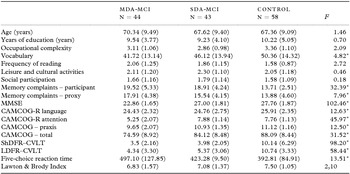
A total of 145 participants with memory complaints (90 women and 55 men), of Spanish-speaking background, aged 50 years and over, and with no previous diagnosis of dementia, psychiatric, or neurological disorders, were selected from those who took part in an on-going longitudinal cognitive assessment studies carried out in primary care health centers. Each participant underwent extensive evaluation, including review of his or her medical history and neuropsychological assessment. The demographic characteristics, CR proxies, and clinical results are shown in Table 1. The participants included in the final sample had Mini-Mental State Examination (MMSE) scores higher than 20 (the cut-off measures were based on age- and education-related norms), had no history of clinical stroke, traumatic brain injury, motor-sensory defects, alcohol, or drug abuse/dependence, and were not diagnosed with any significant medical or psychiatric illnesses. To control for the effects of depression, patients with a score of more than 10 in depression screening (Geriatric Depression Scale, GDS) were not included in this study. All patients had normal or corrected-to-normal vision and hearing.
Mean values and standard deviations (in parentheses) of the demographic and cognitive measures in each group

Note: *p < 0.001.
A questionnaire on socio-demographic and clinical data was used to obtain information from the participants and/or a family member about the following factors: age, medical history and CR proxies (years of education, occupational complexity, reading habits, leisure and cultural activities, and social participation). Occupational complexity was evaluated according to the general protocol of the Network for Efficiency and Standardization of Dementia Diagnosis (NEST-DD) project (Garibotto et al., Reference Garibotto2008), and the main occupation of the participants was scored on a scale from 1 to 6 as follows: 1 – unemployed, 2 – unskilled workers, 3 – housewife, 4 – qualified workers, 5 – technical grades, teachers, liberal professions, managers, and 6 – professors and high executives. Reading frequency, leisure and cultural activities, and social participation were assessed with specific Likert-type questions. In addition to assessing these indicators of CR, vocabulary was assessed by the Spanish version of the vocabulary subtest of the Wechsler Adult Intelligence Scale (WAIS; Wechsler, Reference Wechsler1988). A short version of the Questionnaire for subjective memory complaints (Benedet and Seisdedos, Reference Benedet and Seisdedos1996), comprising seven items, each of which was scored on a Likert scale from 1 to 5 (maximum 35), was administered to the participants and a family member to assess the severity of complaints. The Lawton & Brody Index was used to evaluate instrumental activities of daily living (IADL; Lawton and Brody, Reference Lawton and Brody1969). This estimates individual's performance in these activities according to assessment of information provided by a family member. The scale indicates the level of dependence according to the amount of help needed. Individuals who did not require any help or assistance with any of the activities investigated obtained the maximum score (8 points) and were considered to be independent.
The general cognitive functioning of the participants was evaluated by the Spanish version of MMSE (Lobo et al., Reference Lobo1999) with norms for age and education groups. Cognitive impairments in several domains (orientation, language, attention, praxis, perception, and executive functioning) were tested by the Spanish version of the Cambridge Cognitive Examination (CAMCOG-R) from the revised version of the Cambridge Examination for Mental Disorders of the Elderly (CAMDEX-R; Roth et al., Reference Roth, Huppert, Mountjoy and Tym1999), whereas specific memory impairments were tested by the Spanish version of the California Verbal Learning Test (CVLT; Benedet and Alejandre, Reference Benedet and Alejandre1998), considering the short-delayed free recall (ShDFR) and long-delayed free recall (LDFR) scores as the most relevant measures.
Diagnosis of MCI essentially followed the core clinical and cognitive criteria outlined by Petersen et al. (Reference Petersen2004) and updated by Albert et al. (Reference Albert2011): (1) Concern regarding a change in cognition corroborated by an informant; (2) impairment in one or more cognitive domains; (3) preservation of independence in functional abilities with minimal aid or assistance; and (4) not having dementia according the National Institute of Neurological and Communicative Disorders and Stroke and the Alzheimer's Disease and Related Disorders Association (NINCDS–ADRDA) and the Diagnostic and Statistical Manual of Mental Disorders-IV (DSM-IV) criteria. As a cut-off for MCI, scores lower than 1.5 SDs below age and education norms for the corresponding Spanish versions of MMSE, CAMCOG-R subscales, and of both ShDFR–CVLT and LDFR–CVLT were considered. We used cut-off scores from the Spanish validation of MMSE (Lobo, et al., Reference Lobo1999) and from the data collected by our own research group for the Spanish version of CAMCOG-R. A score on both ShDFR–CVLT and LDFR–CVLT of less than 1.5 SDs below age and education norms for the Spanish version of CVLT was considered as a cut-off for memory impairment.
The 145 participants were classified into three groups. Group 1 included individuals with mda-MCI, who scored less than 1.5 SDs below age- and education-related norms on MMSE and at least two CAMCOG subscales, and who had also displayed memory impairment. Group 2 included individuals with sda-MCI, with normal cognitive functioning measured with MMSE and CAMCOG-R, but with memory impairment measured with CVLT. Group 3 comprised individuals with normal cognitive and memory functioning and a low level of subjective memory complaints (i.e. those individuals scoring below percentile 25 and <15 in the Questionnaire for subjective memory complaints, maximum score = 35). The composition of groups was as follows: Group 1, mda-MCI patients, comprised 44 individuals (31 women and 13 men); Group 2, sda-MCI patients, comprised 43 individuals (21 women and 22 men); Group 3, control participants with low memory complaints comprising 58 individuals (38 women and 20 men).
Materials and procedure
In the Counting Span task, a random number of target items (dark blue circles) were shown on slides in which non-target items sharing a feature with the targets were presented at the same time (light blue circles and dark blue squares). The participants were asked to count out loud and then recall the number of dark blue circles in each slide, in the same order, as soon as a recall cue appeared on the screen (Case et al., Reference Case, Kurland and Goldberg1982). The task consisted of 21 experimenter-paced trials ranging from two to eight figures presented in an ascending format. The test was terminated when the participants failed to remember the number of dark blue circles in three trials with a given number of stimuli. Administration time was about five minutes, depending on the level of impairment.
The listening span task is an adapted version of the reading span task (Daneman and Carpenter, Reference Daneman and Carpenter1980), in which participants listen to, rather than read, the stimuli. A set of sentences is read aloud by the experimenter, and the participant must confirm if each sentence is true or false. Once the set of sentences has been presented, a recall cue appears on the screen and the participant must remember the last word of each sentence in the same order that the sentences were presented. Participants are trained to respond “true” or “false” according to the content of each sentence (i.e. “lions have four legs”: true), then to repeat the last word of the sentence (“legs“) and finally to respond “true” or “false” and the last word (“true, legs”). The task consisted of 15 experimenter-paced trials ranging from two to six sentences presented in an ascending format. The number of sentences in each trial increased by one every three trials until the participant incorrectly recalled two or more trials. The test was terminated when participants failed to remember the final words in three trials at a particular list length. Administration time is about five minutes, depending on the level of impairment.
In the spatial span test, nine white squares are presented on the screen; some of the squares briefly change color, one by one, in a variable sequence, and participants have to indicate, by touching the screen, the order in which the squares change color. This test is part of the Cambridge Neuropsychological Test Automated Battery (CANTAB; Robbins et al., Reference Robbins, James, Owen, Sahakian, McInnes and Rabbitt1994) and is similar to the Corsi Block test, which examines the ability to remember the order in which visual stimuli are presented. The task consisted of 24 automated trials ranging from two to nine figures presented in an ascending format, with sequence and color varying throughout the test. The test is terminated when participants fail to remember the order of color change in three trials with a given number of stimuli. Administration time is about five minutes.
In the counting and listening span tests, at the end of the trial, the experimenter scored the span completed without mistakes, the frequency of items correctly recovered, and the mean percentage of correct items in each set of stimuli. In the spatial span test, the Cantab system provided information about the total span completed without mistakes and the frequency of correct items and the mean latency of correct items. Taking into account the absence of significant differences between scoring methods in the WM span tasks (Friedman and Miyake, Reference Friedman and Miyake2004; Unsworth et al., Reference Unsworth, Redick, Heitz, Broadway and Engle2009), the frequency of correct items was considered as a dependent variable because it yielded the widest range of scores within the scores available in the three tasks. None of these span tasks were used in the diagnostic formulation.
Processing speed was measured by the RTI Five-choice reaction time in the CANTAB Automated Battery. Reaction Time (RTI) is a latency test in which the participant must react as soon as a yellow dot appears in one of the five locations.
The participants were referred to the project by professionals in the collaborating health centers, and each participant attended several assessment sessions. The study was approved by the local Ethics in Clinical Research Committee and was conducted in accordance with the Declaration of Helsinki as revised in Seoul in 2008. Written informed consent was obtained from all the participants prior to the study.
Statistical analysis
Group differences in socio-demographics and variables providing information about cognitive status were analyzed by ANOVA, and Bonferroni's tests were used for post hoc comparisons. To enable comparisons between WM tasks, the number of correct items, processing speed, and CR scores were also transformed into z-scores. GLM Repeated Measures (3 × 3) were conducted by considering the task (counting, listening and spatial span tasks) as the within-subject factor, and group (mda-MCI, sda-MCI, and controls) as the inter-subject factor. Processing speed, CR (vocabulary), and age were included as covariates in subsequent models. To test the influence of CR and processing speed, hierarchical multiple regression models were used to analyze the entire sample, and counting, listening, and spatial span tasks were considered as dependent variables. The statistical analyses were performed with SPSS for Windows, version 15.0.
Results
Clinical data and preliminary analyses
The participants were first compared for their socio-demographic and clinical characteristics by analyses of variance (ANOVA) between groups (Table 1). No significant differences were found in relation to age or IADL.
Regarding CR, no significant differences were found for years of education, occupation, frequency of reading, leisure, and cultural activities, or social participation. The only significant difference in CR indicators was in the WAIS vocabulary subscale, with post hoc analyses revealing differences between the mda-MCI and control groups. Therefore, only vocabulary was selected as a CR proxy for between-group comparisons, since differences between groups indicate different levels of vocabulary knowledge that may be related to differences in memory performance.
As expected, significant differences were found between groups in episodic memory and cognitive status. In both episodic memory measures, ShDFR–CVLT and LDFR–CVLT, post hoc analyses revealed poorer performance by the two MCI groups than by the control group, whereas for general cognitive functioning, the mda-MCI group obtained lower scores than the sda-MCI and control groups in MMSE and in the CAMCOG total score. The performance of the mda-MCI group was significantly poorer than that of other two groups in the following three CAMCOG-R subscales: language, attention, and praxis. The results indicate that, as expected, the mda-MCI displayed impairment in general cognitive functioning, memory, and in several other specific domains, whereas the sda-MCI displayed only memory impairments. In consequence, the mda-MCI group displayed lower scores in MMSE than the sda-MCI group because impairments in multiple domains affected their MMSE total scores. Although cognitive performance of the mda-MCI group was lower than that of the sda-MCI group, we have to point out that none of the patients included in the mda-MCI group met NINDS–ADRDA and DMS-IV criteria for diagnosis of dementia.
Significant differences between groups in the RTI Five-choice reaction time were detected. Post hoc analysis revealed differences between the mda-MCI group and other two groups.
Between-group differences in WM and the role of processing speed and CR
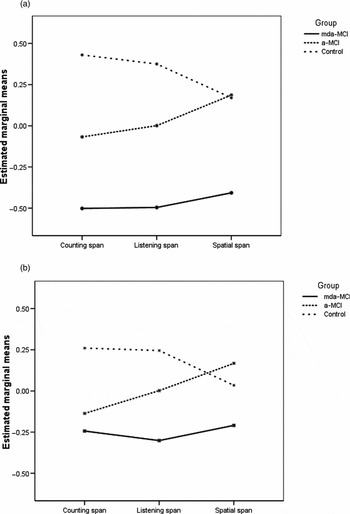
The numbers of correct responses in the three WM span tasks are shown in Table 2. In order to enable comparison between tasks, the numbers of correct items were transformed into z-scores. The GLM Repeated Measures analysis, in which the z-scores for counting, listening, and spatial span tasks were considered as dependent variables, revealed a significant main effect of the group (F(2, 142) = 16.60, p < 0.05, ŋ p 2 = 0.19; observed power = 1.00) (Figure 1), but neither for the type of task (F(2, 284) = 0.05, p = 0.95, ŋ p 2 = 0.00; observed power = 0.06) nor for the interaction between the group and the task (F(4, 284) = 1.57, p = 0.18, ŋ p 2 = 0.02; observed power = 0.48). Post hoc comparisons (Bonferroni) revealed that the control group performed significantly better than the mda-MCI and sda-MCI groups in the counting span task (F(2, 142) = 12.81, p < 0.001, ŋ p 2 = 0.15; observed power = 0.99), and that the mda-MCI group performed significantly worse than the sda-MCI and the control groups in the listening span task (F(2, 142) = 10.78, p < 0.001, ŋ p 2 = 0.13; observed power = 0.99) and the spatial span task (F(2, 142) = 5.57, p < 0.01, ŋ p 2 = 0.07; observed power = 0.85).
Mean values and standard deviations (in parentheses) of WM measures in each group

Estimated marginal means in the counting, listening and spatial span tasks (a) without covariates, and (b) with processing speed and cognitive reserve as covariates.

A second GLM Repeated Measures model was then applied, with the processing speed and CR z-scores as covariates. Significant effects were found for the covariates processing speed (F(1, 137) = 13.24, p < 0.001, ŋ p 2 = 0.09; observed power = 0.95) and CR (F(1, 137) = 21.64, p < 0.001, ŋ p 2 = 0.14; observed power = 0.99). Multivariate analysis maintained the main effect of the group (F(2, 137) = 4,83, p < 0.01, ŋ p 2 = 0.07; observed power = 0.79) (Figure 1), as in the previous analysis without covariates, and no significant effects were observed for the type of task (F(2, 274) = 0.09, p = 0.92, ŋ p 2 = 0.001; observed power = 0.06) and the interaction between group and task (F(4, 274) = 1.32, p = 0.26, ŋ p 2 = 0.02; observed power = 0.41). Post hoc comparisons (Bonferroni) only revealed significant differences between the mda-MCI and control groups in the counting span task (F(2, 137) = 4.27, p < 0.05, ŋ p 2 = 0.06; observed power = 0.74) and the listening span task (F(2, 137) = 3.67, p < 0.05, ŋ p 2 = 0.05; observed power = 0.67) but no differences in the spatial span task (F(3, 137) = 1.57, p = 0.21, ŋ p 2 = 0.02; observed power = 0.33). In this regard, although no major differences were found in the group effect or in the lack of task effect, the effect of processing speed and CR appears to reduce differences between sda-MCI and control groups.
Influence of processing speed and CR on WM span
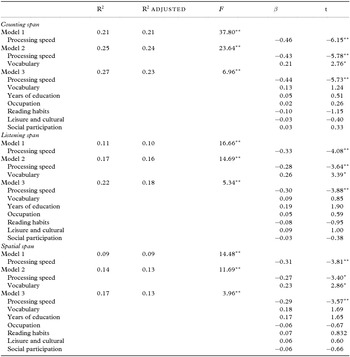
In order to test how processing speed and CR influence the WM span, hierarchical regression analysis was applied to the entire sample, with counting, listening, and spatial spans as dependent variables, and processing speed, vocabulary, and other CR proxies (years of education, occupation, frequency of reading, leisure, and cultural activities, and social participation) as independent variables or predictors. The results indicated that processing speed and vocabulary significantly predicted performance in these three tasks (Table 3, Model 2), explaining 23%, 18%, and 13% of variance in counting, listening, and spatial span tasks respectively. The inclusion of the rest of CR proxies as independent variables in Model 3 did not increase the variance explained by processing speed and vocabulary. The β scores confirm that processing speed has a negative effect on the WM span with higher probabilities of shorter WM spans when reaction times are longer, and that vocabulary has positive effect with higher probabilities of larger WM spans with higher vocabulary scores.
Hierarchical multiple regression analysis with processing speed, vocabulary, and other cognitive reserve proxies as independent variables or predictors, and counting, listening, and spatial span tasks as dependent variables

Note: **p < 0.001; *p < 0.01.
Discussion
The results confirm the previously reported differences between MCI groups and controls with normal cognitive aging (Economou et al., Reference Economou, Papageorgiou, Karageorgiou and Vassilopoulos2007; Brandt et al., Reference Brandt, Aretouli, Neijstrom, Samek, Manning and Albert2009; Gagnon and Belleville, Reference Gagnon and Belleville2011). The group differences in WM span were highlighted by post hoc comparisons, with lower WM spans for the mda-MCI group than for the sda-MCI group and much lower for the control group (Table 2). These differences may be a specific manifestation of greater severity of memory impairment in mda-MCI patients. The only alteration to this pattern was produced in the spatial span task, in which equivalent scores were obtained by the sda-MCI and control groups. In this regard, it can be hypothesized that the processing load of spatial span task does not enable identification of storage differences between controls and sda-MCI patients with impaired episodic memory.
Similarly, when potential masking factors, such as processing speed and CR, were taken into account, differences between the mda-MCI group and controls in counting and listening span tasks were maintained but differences in spatial span tasks were eliminated. This may reflect specific differences in the types of processing (watching a sequence instead of counting aloud or listening to a sentence) and stimuli to be remembered (positions instead of numbers or words), which may be sensitive to processing speed and vocabulary differences, even though performance of the three WM span tasks did not differ significantly and the general processing and storage requirements are considered equivalent (Daneman and Carpenter, Reference Daneman and Carpenter1980; Conway et al., Reference Conway, Kane and Engle2003).
In accordance with our hypothesis about significant effects of processing speed and CR in WM memory scores reducing but not removing differences between groups, the regression models revealed the relative contribution of each of these two constructs, reflecting moderate but significant percentages of explained variance. Hierarchical multiple regression analyses confirmed that processing speed has negative effects and vocabulary has positive effects on the WM span. The present results indicate that processing speed was significantly slower in MCI groups than in controls, although these differences did not substantially affect the significance of group differences in WM, suggesting that MCI difficulty in complex memory span is not simply an artifact of slowed processing speed. Regarding CR, it has been defined as an active process whereby the brain adapts to a situation of deterioration by using cognitive processing resources to compensate for deficits (Stern, Reference Stern2009). As CR is a non-observable construct, it is usually studied through proxies related to the level of education (such as years of education, occupational attainment, reading habits, and vocabulary knowledge) and lifestyle (such as frequency of social and cultural activities). These indicators have been shown to be associated with delay in the manifestation of MCI symptoms so that people with a high level of education and an active lifestyle have better cognitive performance and a lower risk of cognitive decline (Lojo-Seoane et al., Reference Lojo-Seoane, Facal and Juncos-Rabadán2012). Vocabulary was selected as a proxy for CR in between-group comparisons instead of other proxies such as years of education or occupational complexity because it was the only significant variable in ANOVA. Vocabulary, which is a classical measure of crystallized intelligence represented by verbal and general knowledge, has been considered a better indicator of CR than education (Schmand et al., Reference Schmand, Smith, Geerlings and Lindeboom1997). Solé-Padullés et al. (Reference Solé-Padullés2009) demonstrated a negative correlation between brain volume and WAIS subscale vocabulary scores in the participants with MCI, which suggests a slower neuropathological process in the participants with greater CR. It has been hypothesized that CR would be significantly related to WM performance because of the influence of verbal and general knowledge in the availability of processing resources. Furthermore, CR can also have an indirect effect via WM on other cognitive processes that are relevant in the continuum between normal cognitive aging and cognitive decline (Lojo-Seoane et al., Reference Lojo-Seoane, Facal and Juncos-Rabadán2012). In our results, CR had a significantly positive but limited effect on WM, and could benefit general cognitive performance from the greater availability of processing resources. The introduction of other CR proxies related to education level and life-style in Model 3 did not increase the explained variance by Model 2 and all CR variables lose their significance, suggesting that all these variables are related, and because of this the influence on WM performance is shared between them.
Apart from the relationship between CR and WM in MCI, the differentiation of the two a-MCI groups is one of the contributions of our work because many of the studies on WM in MCI did not differentiate them and used to present a general group of a-MCI patients (including multiple and single domains) or a specific sda-MCI group with MMSE scoring similar to that of the healthy control participants. The study of patients with mda-MCI who display greater cognitive impairment than those with sda-MCI but without presenting clinical criteria for dementia may contribute to a better understanding of the continuum between MCI and dementia. The results appear to indicate a continuum from normal controls to mda-MCI group, in which mda-MCI patients showed the most important impairment in WM span, and sda-MCI patients exhibited poorer performance than the control participants but better than mda-MCI patients. Differences in WM between sda-MCI group and controls were no longer significant when processing speed and vocabulary were taken into account, indicating that the reduction of cognitive processing resources in the sda-MCI group is not yet able to affect the simultaneous processing and storage of information, and that their CR has had a positive effect on these simultaneous processing and storage processes.
In this regard, differentiation between the two a-MCI subtypes is a novel contribution of our research and expands the scope of previous research on WM. In addition, our study could be helpful for the professionals in the promising area of WM training in a-MCI (Carretti et al., Reference Carretti, Borella, Fostinelli and Zavagnin2013), since it presents major differences according to the a-MCI subgroup and also suggests certain differences regarding processing load and storage requirements of the stimuli used. Further studies with longitudinal follow-up should be performed to confirm the influence of processing speed and CR on WM and on the process of decline from MCI to AD.
Conflict of interest
None
Description of authors’ roles
David Facal wrote the paper and collaborated in the design of the study and in statistical analysis. Onésimo Juncos-Rabadán designed the study, supervised the data collection, and collaborated in writing the paper. Arturo X. Pereiro was responsible for statistical analysis, collaborated in the design of the study, and revised the final version of the paper. Cristina Lojo-Seoane collected data and revised the final version of the paper.
Acknowledgments
This work was supported by the Spanish Directorate General for Science and Technology under Projects SEJ2007-67964-CO2-01 and PSI2010-22224-C03-01, and by the Galician Government: Conselleríade Industria e Innovación/Economía e Industria (PGIDIT07PXIB211018PR; 10PXIB2011070PR).