Introduction
This article examines the contrasting experiences of two British musical instrument manufacturers by tracing the unfolding relationship between their pursuit of entrepreneurial opportunities and capability development. In doing so, it seeks to contribute to recent theorizing in this area. In a 2013 issue of this journal, Daniel Raff encouraged business historians to give greater consideration to methodological issues and, in particular, to adopt a more forward-looking perspective that he described as “a history of choices rather than outcomes.”Footnote 1 The limitations of retrospective accounts are well rehearsed,Footnote 2 and have prompted recent calls for greater sensitivity toward the ways in which people “experience and behave in time.”Footnote 3 These arguments have obvious implications for historical research on entrepreneurial processes in which actors are making “new investments in innovation” under conditions of uncertainty.Footnote 4 They also go to the heart of recent efforts to (re-)conceptualize “entrepreneurial opportunity,” which have resulted in a proliferation of literature in the fields of organization studies, entrepreneurship, and business history.Footnote 5
Contributors to a recent special issue of Business History Footnote 6 examined entrepreneurship and the pursuit of opportunity in different periods and industry sectors, illustrating both the explanatory potential of historically informed analysis and the difficulties that can arise from a retrospective examination of such fleeting, diffuse, and emergent phenomena.Footnote 7 As the special issue editors suggest, the growing interest in process-based, interpretive historical methods on the part of entrepreneurship scholars creates space for a more constructive dialogue with business historians.Footnote 8 However, there are substantial obstacles to overcome. Several of the contributions identify flaws in the “discovery”-based approach to entrepreneurial opportunity that has prevailed in the mainstream entrepreneurship literature, citing inter alia a lack of engagement with temporal and spatial complexities and an associated tendency to abstract from its emergent properties. More specifically, Roscoe and colleagues introduce the concept of “material agency” and deploy actor network theory to address what they describe as the “historical and material specificity of the entrepreneurial process,”Footnote 9 while Popp and Holt argue that the “lived experience” of this kind of entrepreneurial activity “is better conceived of as an imaginative and historically embedded process.”Footnote 10
In this article, we seek to connect these insights into the entrepreneurial process by drawing on three pioneering theoretical works: Edith Penrose’s The Theory of the Growth of the Firm, G. L. S. Shackle’s The Nature of Economic Thought, and Dorothy Leonard-Barton’s Wellsprings of Knowledge: Building and Sustaining the Sources of Innovation. Our theoretical framing draws on the Penrosean “productive services”—“productive opportunities” dynamic and other components of her “single argument.”Footnote 11 It also makes reference to Shackle’s closely related subjectivist insights and to Leonard-Barton’s analysis of “core capabilities” and “core rigidities,” highlighting their relationship with firm-level knowledge flows and innovations.Footnote 12 We use the resulting framework to trace the closely linked processes of opportunity recognition and exploitation in a particular historical setting: the world of brass musical instrument manufacturing in the mid-twentieth century. Boosey & Hawkes was a well-established business created in the early 1930s through a merger of two of the largest instrument makers. The company had been responsible for an early design innovation in the French horn, a technically complex brass instrument that was supplied to two distinct market segments: military bands and classical orchestras. By the end of World War II, Boosey & Hawkes had acquired all of the existing British horn manufacturers, while its main rivals in continental Europe had yet to recover from the hostilities. How then was Boosey & Hawkes effectively displaced in the international market for this instrument by the much smaller London-based musical instrument business of Paxman Bros., which had no prior involvement in product design and only very limited manufacturing experience?Footnote 13 This narrative reveals how Paxman Bros. developed new capabilities that gave rise to a series of innovations in horn design and a succession of new models. Paxman’s technological and market base combined traditional artisanal skills and values, entrepreneurial bricolage,Footnote 14 and a capacity to form close, collaborative relationships with leading musicians. The resulting interactions contributed to its emerging role as a leading specialist manufacturer at the forefront of innovation in this sector.
In the next section, we elaborate on the theoretical concepts and how they are used to frame the historical evidence. This is followed by a brief overview of our main sources, which comprise specialist writing about particular instruments, published research on the history of musical instrument manufacturing, interviews with key informants, and archival evidence. We then introduce the historical narrative, which examines the experiences of the principal actors in each company in parallel. The narrative reconstructs the unfolding of a series of entrepreneurial opportunities and indicates the contrasting ways that they were enacted in each company by tracing the development of particular, firm-specific, technological, and organizational capabilities. In the discussion section, we apply the theoretical framework to shed additional light on these developments. The conclusion identifies the main contributions of the study and reflects on its wider implications.
Theoretical Framework: Penrosean Dynamics and Core Capabilities
Business historians have long acknowledged the potential applications of Penrosean learning. In an early review article, Galambos highlighted the way in which Penrose’s dynamic theory could be used to inform historical studies: “As Penrose makes clear, it is the interaction between the material and human factors which is decisive in shaping an organization’s development.”Footnote 15 More recently, Lazonick has highlighted her contribution, arguing that “more than any other economist in the post-Schumpeter generation, Penrose’s work elaborated the foundations of a theory of innovative enterprise.”Footnote 16 Despite a thorough grounding in orthodox neoclassical economics, she drew freely on related disciplines, including industrial organization, and her contribution is now located within the broad post-Marshallian tradition that has addressed the interplay between human knowledge and the evolution of economic systems.Footnote 17 Penrose encouraged her readers to consider The Theory of the Growth of the Firm as a “single argument,” but for the purposes of this article it is possible to highlight two components that have the most direct application to our theme. First, Penrose introduced two vital distinctions—“productive resources” and the “productive services” that they can render (emphasis added)Footnote 18—and two categories of services—“managerial” and “entrepreneurial.”Footnote 19 In developing this part of her argument, she also recognized how managerial decision making over the deployment of resources provides a primary source of the uniqueness of each firm. Second, she introduced the concept of “subjective” productive opportunity, which she defined as what a firm “thinks it can accomplish,”Footnote 20 based on managerial interpretations of the environment in which it is operating and taking account of its internal resources, operations, and other influences. There is a strong recursive dimension to this process, with the organizational framework of the firm providing the necessary environment for the “production” of entrepreneurial services, and these services, in turn, becoming a “significant aspect” of the firm’s changing productive opportunity. The subjective and forward-looking concept of productive opportunities has strong parallels with Shackle’s work on the central role of imagination in the entrepreneurial process, captured in his insight that “men’s decisions are not choices among actual but among imagined outcomes.”Footnote 21 Even so, Penrose was at pains to emphasize the limits of subjectivism, both acknowledging the “reality” of the external selection environment and clarifying its temporal relationship to firm-level decision making: “In the last analysis the ‘environment’ rejects or confirms the soundness of the judgements about it, but the relevant environment is not an objective fact discoverable before the event” (emphasis added).Footnote 22
In a Penrosean interpretation, the firm provides an institutional setting for conjecture and innovation that gives rise to a variety-generating dynamic. While gales of creative destruction might sweep away particular products or technologies, firms can learn and evolve by making “connections” between past activities and future options.Footnote 23 It provides a “kind of temporary evolutionary equilibrium,”Footnote 24 in which managerial teams can conjecture over the application of productive services to particular opportunities. However, Penrose also recognized that the scope for conjecture is influenced by a firm’s “unique” history, including the managerial team’s perception of productive opportunity, which is itself shaped by previous experience, and the shared interpretive frameworks that this engenders.Footnote 25
Leonard-Barton’s work on “core capabilities” and “core rigidities” provides a valuable complement to the Penrosean learning dynamic while also making a direct connection to the innovation literature.Footnote 26 Leonard-Barton identified core capabilities as a knowledge set comprising employee knowledge and skills embedded in technical systems, directed by managerial systems, and underpinned by values and norms. This is what provides a company’s competitive advantage. She highlighted the “dual nature”Footnote 27 of core capabilities, referring to the ways in which the value-creating activities can become institutionalized in the form of core rigidities that hamper the innovation process by inhibiting subsequent knowledge flows. Leonard-Barton suggested a number of sources of path dependency—including skills and knowledge, organizational values, and physical and managerial systems—that served a company well in the past, but may give rise to core rigidities in a changed product or market context. These insights point to a necessary tension between innovation and the status quo as organizational managers struggle to maintain core capabilities yet simultaneously promote their renewal.Footnote 28
In the following narrative, we trace the unfolding and recursive relationship among the pursuit of entrepreneurial opportunities, capability development, and innovation in two purposive yet also socially embedded businesses. Our theoretical framing emphasizes the role of human imagination and the growth of knowledge, which enables organizational actors to become “makers and not mere executants of history.”Footnote 29 As Loasby has noted, this distinctively human faculty to construct imagined futures is an essential prerequisite of innovation.Footnote 30 However, in adopting a creative process perspective on entrepreneurial agency, we remain attentive both to its material specificityFootnote 31 and to the roles of human values, emotions, and personal idiosyncrasies in shaping the outcome.
The Literature on Musical Instruments and Instrument Manufacturing
There is an extensive specialist literature covering musical instruments in general and brass instruments in particular. The greater part of this material is concerned with detailed descriptions of the history, design, and development of individual instruments, together with the music written for them and issues relating to performance practice, rather than analyzing the firms that produce and market them. The literature itself comprises chiefly books and a wide range of scholarly periodicals, including many published by learned societiesFootnote 32 devoted to specific instruments. Although some of these publications verge on hagiography, nonetheless they provide a wealth of background detail and technical information.
Major works include Baines, Montagu, and Herbert and Wallace,Footnote 33 all of which are scholarly tracts that cover brass instruments. There are also books dealing with specific instruments, including Humphries, Morley-Pegge, and Tuckwell,Footnote 34 which focus on the French horn. Accompanying these major works are more modest offerings comprising scholarly articles published in periodicals that specialize in particular instruments or groups of instruments. These include a number that deal with brass instruments, such as Bacon, Giannini, Humphries, Myers, and White and Myers.Footnote 35 While several of these works provide valuable background information, including details of one of the two companies that form the basis of this study, they say little about the business of manufacturing and marketing musical instruments.
Among the small number of business historical studies that deal specifically with musical instruments, Berghoff Footnote 36 examines the marketing of Hohner harmonicas as a differentiated global brand from the mid-nineteenth century, while Carnevali and NewtonFootnote 37 address the changing relationship between piano manufacturers, retailers, and consumers in Victorian Britain. Wallace’sFootnote 38 detailed company history of Boosey & Hawkes provides useful insights into the company’s publishing interests but says little about instrument manufacturing. Fortunately, the latter is covered by two important contributions in the form of doctoral theses. BrandFootnote 39 analyzes the company’s clarinet production, and HowellFootnote 40 provides a broader analysis of wind instrument manufacturing.
Of the studies that address manufacturing practices, BigioFootnote 41 examines the leading instrument maker Rudall, Carte & Co., but concentrates almost entirely on flutes and ignores the brass instruments that formed an important part of its business. Rayna and StruikovaFootnote 42 provide a fascinating historical account of the dominance of incumbent electric guitar manufacturer Gibson, which was challenged from 1945 to 1984 by a highly innovative entrant, Fender. Though there are some parallels with the present study, much of the analysis focuses on patent records rather than the organization of production. Last, it is worth noting that although biographies of the celebrated horn player Dennis BrainFootnote 43 provide a few glimpses of horn makers in the twentieth century, comparatively little has been published about brass instrument makers, and almost nothing has focused on the manufacturing of French horns in this period.
In addition to drawing on this specialist and business historical literature, we conducted interviews with key informants, including the late Robert Paxman, former employees of both companies, professional and amateur horn players, musical instrument retailers, and curators of instrument collections. We also examined archival sources, such as the Morley-Pegge Papers held in the Bate Collection of Musical Instruments, University of Oxford; and the business records of several leading brass instrument manufacturers, including Boosey & Co.; Hawkes & Son; Rudall, Carte & Co.; and Besson & Co., at the Horniman Museum and Gardens, London, all of which provided details of production levels and methods over an extended period.
Innovation of the French Horn in Britain, 1930–1985
For much of the nineteenth century and a substantial part of the twentieth century, British orchestras had a distinctive sound that differentiated them from their counterparts in other parts of Europe and the United States. This sound was the product of the instruments they played, most notably in the horn section. In Britain, horn players typically played instruments modeled on the Raoux horn from France, which had a narrow bore, a small bell, and piston-operated valves. Although more difficult to play and prone to “cracked notes,” this was the instrument that dominated horn playing in Britain for more than a hundred years. However, during the interwar years, concertgoers in Britain started to experience a different sound from foreign orchestras visiting Britain, which generally used a German-designed horn rather than its French counterpart.Footnote 44 The German instrument used rotary valves instead of piston valves, had a wider bore, and a larger flared bell. These features gave it a deeper, richer, and louder sound. Although the leading British horn players of the time continued to adhere to the French version of the instrument, in the mid-1930s one of the leading British brass instrument manufacturers boldly stepped forward to produce the country’s first German-style horn.
The wide bore, rotary valve horn was to become a dominant designFootnote 45 and the clear preference of professional players in Britain in the second half of the twentieth century. However, the course of this technological and market innovation was far from straightforward, as British brass instrument manufacturers responded in different ways to the changes in musical tastes that took place from the mid-1930s onward. A new entrant (Paxman Bros.) took the lead in refining the design and manufacture of the German instrument, producing many variants, while the original innovator (Boosey & Hawkes), unwilling to develop its product range, continued to offer a single model. By the end of the period, the incumbent had exited the industry, while the new entrant had become one of the world’s leading specialist horn makers. Our narrative traces the contrasting experiences of each company in turn, beginning with the established manufacturer, Boosey & Hawkes.
The Incumbent: Boosey & Hawkes
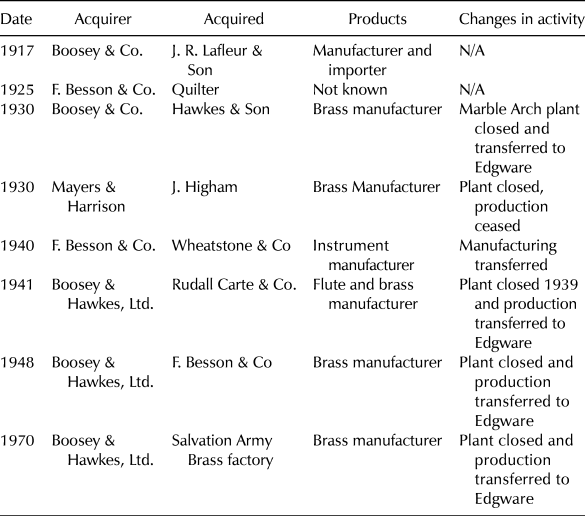
Boosey & Hawkes was the product of a merger in 1930 between the brass instrument manufacturers Boosey & Co. and Hawkes & Son. The merger came about through the dramatic decline in the marketFootnote 46 in the late 1920s, the associated economic depression, and changes in technology.Footnote 47 In the 1940s, concentration of the sector intensified as Boosey & Hawkes acquired the two remaining major brass instrument makers: Besson & Co. and Rudall Carte & Co. Hence, over the course of less than twenty years, Boosey & Hawkes effectively “swallowed up” the firms that had been their principal rivals from the late nineteenth century (Table 1).Footnote 48
Mergers of brass instrument makers
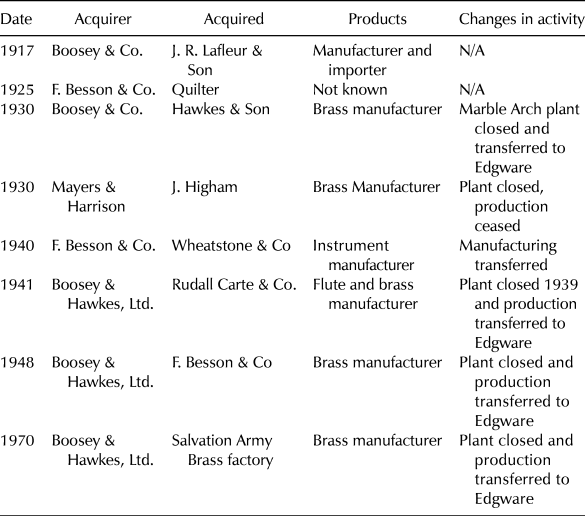
Source: Smith and Blundel, “Improvisation and Entrepreneurial Bricolage,” 65.
Notes: N/A is not applicable.
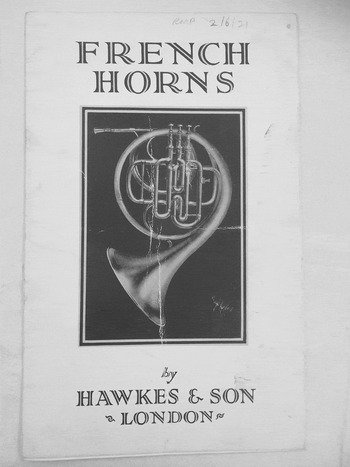
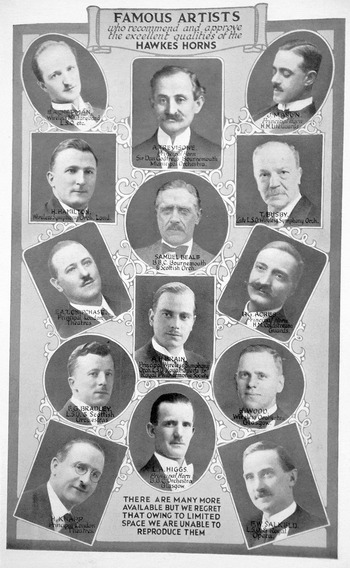
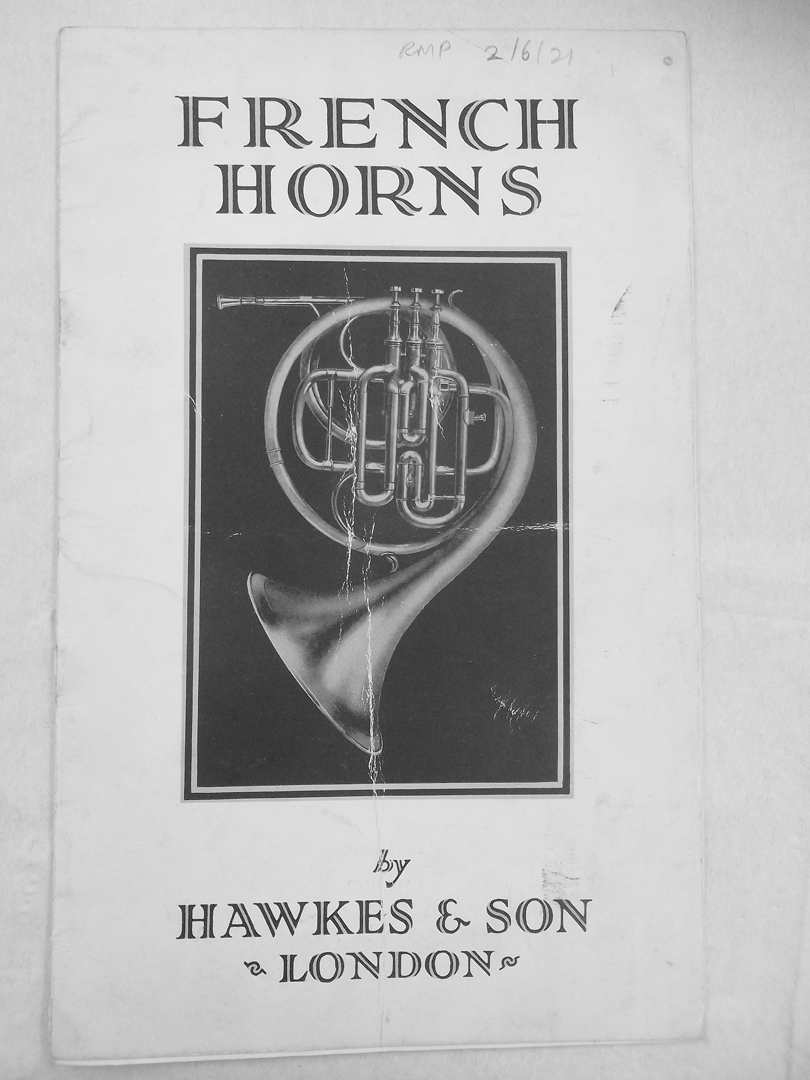
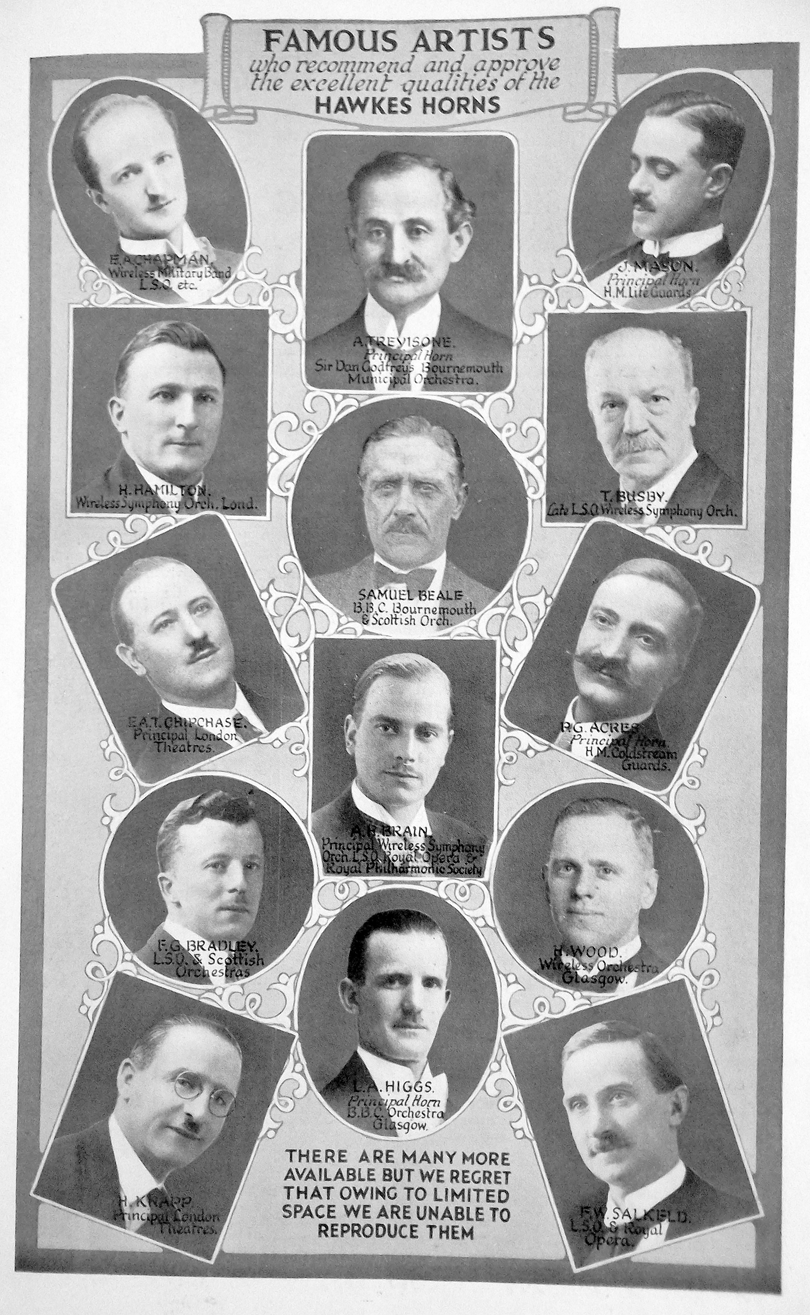
Prior to the merger, all four firms manufactured French horns, with their London-based factories each employing about 100 staff. At this time, production methods relied heavily on traditional artisanal skills acquired through a lengthy apprenticeship in brass instrument making. All of the firms manufactured the French-style narrow-bore horn then favored by British horn players as well as a variety of other brass instruments. Most firms produced horns for both the orchestral and military markets, though, of the four, Hawkes & Son appears to have had a particularly strong relationship with the top professional horn players, who featured prominently in their contemporary promotional literature (Figures 1 and 2).Footnote 49
French horn catalogue of Hawkes & Son, c.1930.
Founded in the early nineteenth century as a music publisher, Boosey & Co. began making woodwind instruments in the 1850s. In terms of capabilities, the firm’s skill base was initially limited, so much so that instruments were quite often brought in from other firms,Footnote 50 particularly small instrument workshops. However, the range of capabilities expanded as Boosey & Co. moved into brass instrument manufacturing in the 1870s following the acquisition of Distin & Co.Footnote 51 The attraction for brass instruments was the rapidly expanding brass band market in Britain at the time. Between 1870 and 1900, Boosey & Co.’s sales to bands grew from 7 percent to 32 percent of total sales.Footnote 52 However, expansion was not without its problems, particularly in acquiring skilled craftsmen. Hence, by 1900, around one-third of the company’s 100 craftsmen were of continental European extraction and had learned their trade abroad.Footnote 53 Surprisingly, there was little specialization, as each worker was required to make a number of different instruments.
Nearly from the outset, Boosey & Co.’s technical capabilities in manufacturing extended to innovation in product design. Initially, the company developed new woodwind instruments, including the Pratten flute in the 1860s and the Clinton clarinet in the 1890s.Footnote 54 The firm’s factory manager, David Blaikley,Footnote 55 played an important part in both innovations. He also developed and patented a number of important improvements in brass and wind mechanisms. Although many of the innovations of Boosey & Co. before World War I were incremental, a leading instrument specialist nevertheless characterized the Blaikley era as “a well-informed and earnest endeavor to improve brass instrument design coupled with a high quality of workmanship gave the company a position of advantage.”Footnote 56
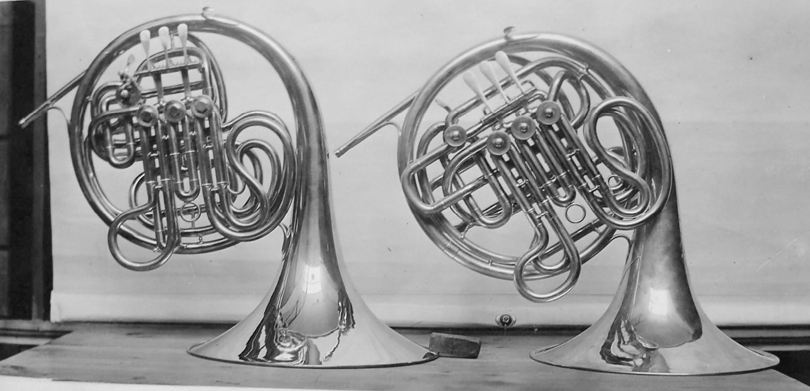
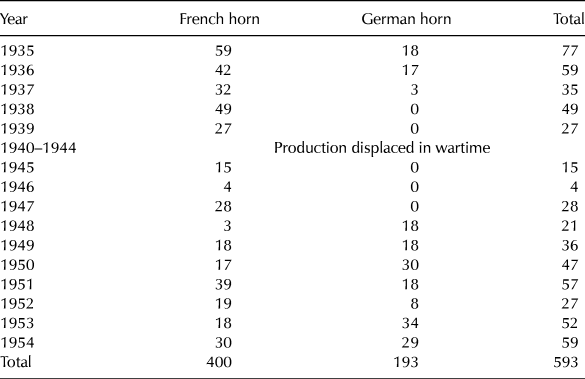
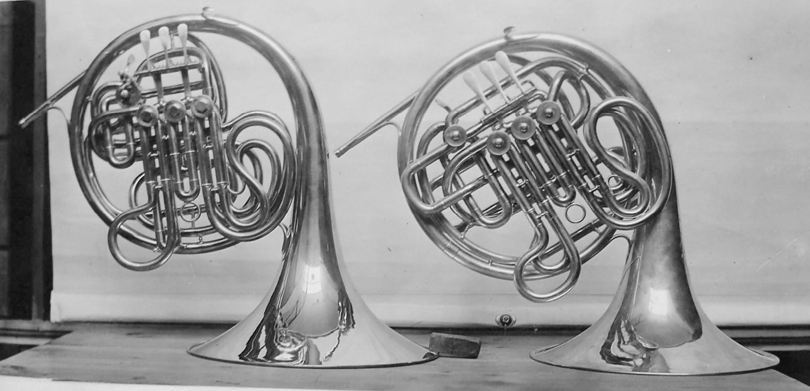
In 1935 Boosey & Hawkes launched the first wide-bore German-styleFootnote 57 horn to be produced in Britain (Figure 3). The new horn was designed in collaboration with, and possibly at the instigation of, Alan Hyde, a horn player in Sir Thomas Beecham’s London Philharmonic Orchestra. Hyde was a powerful advocate of the German instrument,Footnote 58 and the new design was modeled on a horn produced by one of Germany’s leading horn makers, Ed. Kruspe, in Erfurt.Footnote 59 The new horn incorporated rotary valves, which was a radical departure from the traditional French-style piston valves used in British-made horns at this time. Many leading British horn players, including Aubrey Brain of the BBC Symphony Orchestra,Footnote 60 remained committed to the French style of narrow-bore horn, thus initial sales of the new design were unsurprisingly modest (Table 2).Footnote 61 However, through a combination of factors, German-style horns would become the instrument of choice for horn players in Britain. Why did such a large and powerful incumbent such as Boosey & Hawkes fail to capitalize on this early innovation in the postwar period? To answer this question, we consider two distinct but related aspects of the company’s entrepreneurial and innovative activity: the growth of its international music publishing business and the reconfiguration of its core manufacturing capabilities.
Boosey & Hawkes, German horn, c.1935 (left).
Boosey & Hawkes Archive. Reproduced courtesy of the Horniman Museum and Gardens, London.
Boosey & Hawkes production of orchestral horns, 1935–1954

Source: A227 Instrument Books, Boosey & Hawkes Archive, Horniman Museum and Gardens, London.
More Than Just a Publishing Opportunity
At the time of the merger, both Boosey & Co. and Hawkes & Son combined music publishing and instrument manufacturing. However, in terms of managerial capabilities, it was significant that the main instigators of the merger, Leslie Boosey and Ralph Hawkes, were personally much more allied to music publishing, both having previously served as directors of the Performing Rights Society.Footnote 62 Boosey & Co., a much larger and wealthier company, had the more comprehensive catalogue, which included a small number of British classical music composers, notably Edward Elgar and Gustav Holst, in addition to more popular ballad music.Footnote 63 Hawkes & Son was the junior partner in terms of music publishing, with a catalogue that owed more to Tin Pan Alley than serious classical music.Footnote 64 However, it was Ralph Hawkes, the younger of the two Hawkes brothers, who took over the publishing side of the merged business. The thirty-two-year-old was a keen sportsman, active in winter sports and ocean racing. He was widely regarded as a more capable business leader than his older brother, Geoffrey, who subsequently took charge of manufacturing. Ralph combined powerful ambitions to promote contemporary classical music with the entrepreneurial drive and social skills to do something about it: the composer Aaron Copland later noted, “His flair made up partly of business sense and the pleasure of association with creative personalities.”Footnote 65 Consequently, at the company’s first board meeting late in 1930, the decision was made to develop the company’s classical music catalogue.Footnote 66
Over the next ten years, Ralph Hawkes pursued his mission to develop the company’s serious music catalogue in earnest. Although his most important early signing was the young British composer Benjamin Britten, his efforts were especially focused on making the company’s music publishing an international enterprise.Footnote 67 Among those he signed during the 1930s were the Hungarian composers Bela Bartok and Zoltan Kodaly,Footnote 68 and from America, Aaron Copland and Leonard Bernstein. Boosey & Hawkes opened a number of international offices, including in Australia in 1934. At the time war broke out in Europe in 1939, Ralph was making plans to split the company by moving the publishing arm to New York City while the instrument manufacturing remained in London. The war brought an end to his ambitions, but they resurfaced in the immediate postwar period when Ralph was president of Boosey & Hawkes and living in the East Coast town of Westport, Connecticut. Though these plans were not implemented following Ralph’s premature death in 1950, they indicate the extent to which the international publishing side of the business had developed during his tenure.
Mass Market Manufacturing
Boosey & Hawkes’ initial plans for instrument manufacturing involved rationalization and consolidation, with both Leslie Boosey and Ralph Hawkes seeking “great savings”Footnote 69 by combining and restructuring this part of their business. In 1931 Boosey & Co.’s entire instrument manufacturing business was transferred from Stanhope Place, in central London, to Hawkes & Son’s large, modern factory on Deansbrook Road, in the north London suburb of Edgware.Footnote 70 The impact of these changes is apparent from pre- and post-merger production figures. The merged company manufactured an average of 2,723 instruments per year in the period 1930–1939, less than the 2,923 instruments per year that Boosey & Co. alone produced during the preceding decade.Footnote 71 In 1932, the year following the consolidation of its production facilities, Boosey & Hawkes introduced the Regent range of inexpensive popular instruments, such as cornets, trumpets, and trombones, which Myers describes as “the first step toward mass production.”Footnote 72 However, the most significant step in that direction took the form of a process innovation with the introduction in the mid-1930s of hydraulic forming. This was the brainchild of Arthur Blaikley, the son of David Blaikley, who managed the factory throughout the interwar period. Arthur was also an enthusiastic innovator, but whereas his father was responsible for product innovations in the form of new or improved instruments, David focused his attention on production processes. He held a number of patents associated with machine tools,Footnote 73 but his most significant contribution was the introduction of the hydraulic expansion process to form bends in all types in brass tubing. This innovation dramatically reduced the amount of time required to produce bends, and it eliminated wrinkling on the inside. However, the capital investment and tooling costs for these machines could be justified only by a dramatically greater output of standardized instruments.
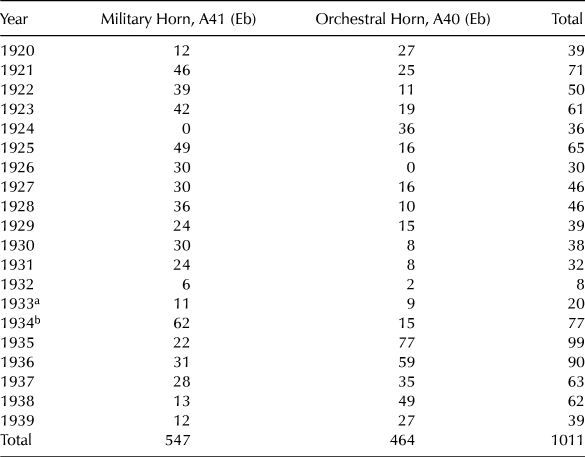
These developments in publishing and manufacturing left Boosey & Hawkes’ French horn manufacturing as an increasingly marginalized area of activity. The technical complexity of the horn combined with a relatively small market as compared to those of simpler and more popular brass instrumentsFootnote 74 meant it was not suited to high-volume production. Although batch sizes for these instruments increased during the second half of the 1930s, they continued to be produced in relatively low volumes (see Table 3) and reflected only modest progress toward mechanization.Footnote 75
Boosey &Co., horn production, 1920–1939*

Notes: *Boosey & Hawkes from 1931.
a In 1933 Boosey & Co.’s A40 Orchestral horn started to be replaced by Hawkes & Son’s No. H1 Professional Raoux model.
b In 1934 Boosey & Co.’s A41 Military horn started to be replaced by Hawkes & Son’s No. H2 Military and Orchestral model (currently designated as B4707).
Source: A227 Instrument Books, Boosey & Hawkes Archive, Horniman Museum and Gardens, London.
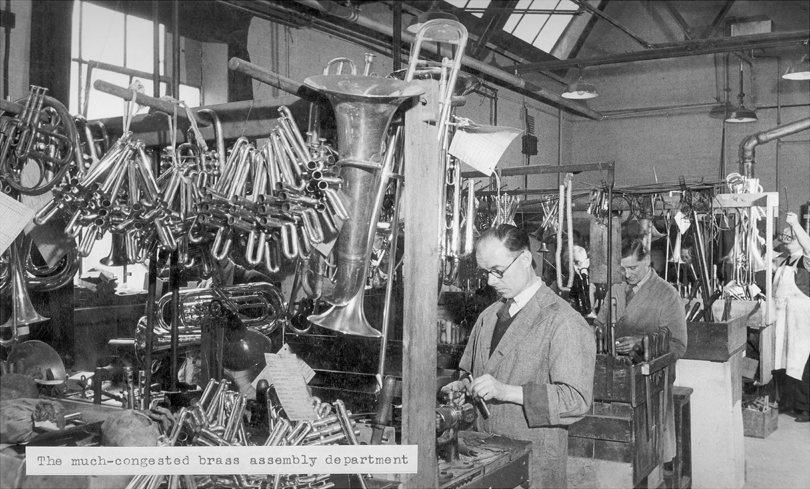
During World War II, instrument production was confined to a small section of the Edgware factory when the company switched to the production of aircraft components and munitions for the war effort (Figure 4). War production brought investment in new machinery and the introduction of line production to the manufacture of standardized items comprising “engine tubing, exhaust pipes, and other stuff”Footnote 76 for military aircraft. The increasing use of unskilled machine operators resulted in a diminishing role for skilled craftsmen.Footnote 77 By the end of the war, the Edgware factory had been transformed from traditional workshops producing handcrafted instruments aided by a small amount of machinery into an industrial production system with mass production methods.Footnote 78 The ending of hostilities saw the machinery adapted to instrument making, enabling the company to progress developments begun in the 1930s, eventually leading to mass production of low-priced models. As Howell notes, this “led to a complete change of ethos” within the company.Footnote 79 Batch sizes for popular instruments rose dramatically. Line production of trumpets began as early as 1945, and other popular instruments followed in the early 1950s. Although output was initially slow to increase, during the 1950s it rose rapidly, with output of brass instruments increasing from fifty per week in 1946 to six hundred per week in 1958.Footnote 80
Boosey & Hawkes, brass instrument production, World War II.
Reproduced courtesy of Horniman Museum and Gardens, London.

The company’s much enhanced manufacturing capability, in particular its ability to mass-produce low-priced popular instruments complemented the dominance of the brass band market that it enjoyed following the acquisition of Besson & Co. in 1948. Boosey & Hawkes was also helped by a resurgence of the brass band movement in the 1960s.Footnote 81 Andy Taylor, an instrument maker with forty years of experience in the trade, including several years working at Paxman, observed, “Brass band is its own little world. They [Boosey’s] had it to themselves … for a long time they had it all to themselves.”Footnote 82 Instruments for schools and colleges also formed an important part of Boosey & Hawkes’ business at this time, helped by the rapid growth of music education in Britain in the 1950s.Footnote 83 Similarly, lower costs through mass production enabled the company to ship an increasing proportion of its output overseas, although many fewer brass instruments than woodwinds were exported.
However, Boosey & Hawkes’ dominance of the brass band and education markets came at a price. According to Howell, the advent of mass production led to an overall decline in quality, as “the company started to lose sight of the high standard of their top range instruments and the requirements of their professional customers.”Footnote 84 Professional players were put off by Boosey & Hawkes’ focus on the brass band and education markets. As Andy Taylor told us, “There’s three markets in brass. There’s what we laughingly call “legit” [i.e., legitimate], which is the classical, straight-ahead, traditional market. There’s the commercial jazz/pop market … and there’s brass bands, a whole different world of their own—their own politics, their own instruments.”Footnote 85 As Howell noted, “the harsh reality was that many British professional players favoured instruments made abroad.”Footnote 86 Howell also pointed out that Boosey & Hawkes’ high-quality brass instruments were mainly purchased by band musicians and that only a very small proportion was used for orchestral playing.Footnote 87 This was especially true of horns. This most complex of brass instruments did not lend it itself to mass production, with the result that horn output languished and became confined to just two of the company’s remaining craftsmen (see Table 2).
Even though it pioneered the production of German-style horns in Britain in the 1930s, Boosey & Hawkes was unable to seize the opportunity to build on its initial product innovation. Andy Taylor noted, “Boosey’s were very good at piston valves stuff, brass band instruments, that was their thing … [but] … there’s a delicacy about a French horn, about the way it’s built and the balance of it and all that, and Boosey’s couldn’t quite get their heads round it … they went at it like it’s a tuba.”Footnote 88 He also recalled that the company’s horns failed to find favor with professional classical musicians precisely because the brass band market was such an important part of its business: “I think that’s where the French horn thing suffered. Not only was it just crudely made, but the traditional market couldn’t take Boosey’s seriously because they made brass band instruments.”Footnote 89
Hence, by the 1960s, French horns represented only a tiny fraction of Boosey & Hawkes’ output of brass instruments. The same horn that was described in the instrument books as a “rotary horn” and branded as the Emperor model remained in production throughout the 1950s and 1960s. The company flirted with innovation in the mid-1960s by introducing a redesigned double horn, but, as Howell notes, this proved to no avail.Footnote 90 Unlike other instruments, batch sizes for horns remained very small, and the company continued to rely on same two craftsmen who had made them during the prewar era. Then, toward the end of the 1960s, Boosey & Hawkes stopped manufacturing their own rotary valves, thereby abandoning a key manufacturing capability. Instead, as a former employee explained, valve clusters were outsourced from a German company,Footnote 91 a strategy the company increasingly relied on as it wrestled with what has been described as a “mind boggling” range of instruments in its product portfolio.Footnote 92
Outsourcing was carried to its logical conclusion in the 1970s, when Boosey & Hawkes decided to subcontract horn production in its entirety to the Czech firm of Josef Lidl, in Brno.Footnote 93 The resulting product, identified as Model 400, was branded as a Boosey & Hawkes horn, although it was clearly inscribed “Made by Josef Lidl” on the bell. Lacking the cachet of better-known brands of orchestral horn,Footnote 94 it was rarely used by professional horn players, so sales continued to be modest.Footnote 95 The trigger for the outsourcing of horn production was apparently the retirement of one of the company’s two remaining craftsmen. However, in reality, it was part of a broader trend in which Boosey & Hawkes increasingly outsourced the production of instruments in the 1980s to other countries, including Czechoslovakia, Taiwan, and Pakistan.Footnote 96 This strategy not only reflected a continued attempt to lower costs but also the company’s pursuit of acquisitions, especially overseas.Footnote 97 It also resulted in a lack of investment in the company’s core manufacturing asset: the Edgware factory. The outdated plant and the company’s greater reliance on outsourcing meant further dilution of the Boosey & Hawkes brand.
As Howell comments, the company’s attention to the popular (that is, brass band) and education markets was at the expense of its traditional customer base.Footnote 98 She notes how Boosey & Hawkes increasingly lost sight of its long-established professional customers and standards within the factory. By pursuing expansion and mass production, the company “lost its focus on craftsmanship, quality and custom-built instruments.”Footnote 99 The decision to outsource its horn production represented a key turning point. It not only marked the exit from horn manufacturing of the last of the four incumbent horn-making companies that produced the instrument in the prewar era but it also marked the loss of Boosey & Hawkes’ artisanal skills and technical capabilities in this field, which had accumulated over a period of 100 years. It was to prove a prelude to the company’s eventual closure of its Edgware plant in 2001.Footnote 100
The New Entrant: Paxman Bros.
The early years of the twentieth century saw the demise of small workshops making brass instruments as part of a move to factory production,Footnote 101 but this trend began to reverse in the years after World War II. Among the first of a new generation of small brass instrument manufacturers was Paxman Bros., of London, which specialized in the production of French horns. Unlike its predecessors, which had made French-style narrow-bore horns fitted with piston valves, Paxman chose to innovate by manufacturing a wide-bore German-style horn,Footnote 102 an instrument that was becoming increasingly popular at the time.
Paxman Bros. started as a retailer selling a range of musical instruments. Harry Paxman had ambitions to pursue a career as a professional clarinet player but injuries sustained during World War I prevented this, so instead he turned to selling musical instruments. Harry and his brothers, William and Bertram, founded the firm in 1919, with premises on Southwark Street, near London Bridge.Footnote 103 Prominent among its customers were northern brass bands and military bands. Like many dealers in musical instruments, the firm’s capabilities at this time extended beyond retailing and distribution to include metalworking skills associated with the maintenance and repair of brass instruments. For this purpose, Harry set up a workshop for repairs, and among his early clients were several military bands based at Aldershot.Footnote 104
Initially, Paxman sold a variety of musical instruments,Footnote 105 but then it began to specialize in brass instruments, including French horns. This increasing specialization is evident in its decision to become an agent for the Paris-based horn maker Courtois,Footnote 106 and that its entry in the Musicians Union Handbook for 1936 is located in the section that lists professional horn players. With the strapline “First Class Repairs,”Footnote 107 the advertisement indicates the firm’s developing capabilities in repair work, which would subsequently open up the opportunity for its move into instrument manufacturing.
In 1935 the firm relocated to 165 Shaftesbury Avenue,Footnote 108 in the heart of London’s theater district. This move reflected both the decline of the traditional brass band marketFootnote 109 during the depression of the early 1930sFootnote 110 and Harry’s active role in targeting sales of instruments to professional musicians, including those playing in dance bands. The move to Shaftesbury Avenue led to a new development for the firm: producing as well as selling and repairing instruments, a step that reflected its growing capability in terms of the technical skills and expertise of its staff. Initially, production was confined to a single instrument, the sousaphone, which was popular with dance bands in the 1920s and 1930s. Lacking the necessary resources and capabilities to produce the instrument ab initio, Harry instead chose to improvise by modifying an existing brass instrument, the helicon,Footnote 111 which was of similar design. This involved substituting a larger forward-facing bell for the somewhat smaller one found on helicons. However, the firm’s capabilities at this time did not extend to the construction of the large flared bell of the sousaphone because its compound shape presented one of the most technically demanding challenges in brass instrument manufacturing.Footnote 112 Lacking the specialized skills and equipment needed to produce its own bells, Harry decided to seek out a subcontractor. He again opted to improvise, but on this occasion approached one of his neighbors to help him out. According to his son, “He got a company which spun cooking utensils for the trade—giant dustbin-type things—to produce flares [bells] and by making what amounts to a couple of right angle bends … the flares connected to the body of the thing with a bayonet arrangement and a locking nut.”Footnote 113 By pursuing this somewhat convoluted route, Paxman Bros. became brass instrument manufacturers, albeit on a very small scale. With the onset of war in 1939, this experiment was discontinued and the firm had to fall back on repair work.
In 1940, after the Shaftesbury Avenue location had been bombed during the blitz, Harry continued to repair instruments from his home in suburban Twickenham.Footnote 114 As the war drew to a close, he returned to central London, having acquired spacious new premises on Gerrard Street, in Soho.Footnote 115 The new building provided space for an enlarged workshop, and Harry lost little time in seeking out skilled craftsmen to extend the firm’s capabilities. This posed a challenge, however, as “there was a shortage of skilled people around because of the war and the casualties and so on.”Footnote 116 Harry’s initial response was to draft one of his sons into the business in early 1945. At the time, Robert Paxman was training to be a plumber, but Harry was confident that Robert’s metalworking skills were transferable to instrument making. Robert’s mother was also reluctant for him to take up plumbing on account of his weak chest, providing an additional prompt for this change of occupation.Footnote 117 Harry was also successful in “poaching” three skilled craftsmen from Boosey & Hawkes: Harry Page, Charles Staneford, and Joe Dobson, who were all experienced brass instrument makers. Now, with five employees in the workshop,Footnote 118 there was scope not just to repair and adapt instruments but also to resume manufacturing.Footnote 119 Building on the firm’s prewar reputation as something of a specialist in horns,Footnote 120 Harry was keen to begin making this instrument.
He decided to produce a German-style horn, recognizing both the increasing popularity of this wide-bore design, especially among younger horn players, and that the two leading manufacturers of high-quality horns—Alexander and Kruspe—were German companies and unlikely to offer serious competition in the immediate aftermath of the conflict.Footnote 121 This ambitious step presented significant challenges, despite the progress that the firm had made in developing its capabilities, especially in traditional artisanal skills associated with metalworking techniques and brass instrument making. The biggest challenge was the manufacture of valve clusters, because German-style horns employ rotary valves rather than the piston valves normally found on British-made horns at this time. Morley-Pegge, in his definitive study of the horn, notes that rotary valves are significantly more complex mechanically.Footnote 122 As Andy Taylor noted, “A rotary valve French horn is a much more delicate piece of kit.”Footnote 123 In Germany, the smaller companies making horns, whose scale of production was insufficient to justify the capital investment in the precision machining that was required, could source their rotary valves from third parties. However, in Britain this option was out of the question as there were no specialist valve manufacturers.Footnote 124
Harry came up with a novel solution to the problem of acquiring this substantive capability. In a classic piece of entrepreneurial bricolage, he persuaded two machinists to “moonlight” from their day jobs at the local gas board. As Robert put it, “We were fortunate enough regarding the bells and the valves to engage on a part-time basis, normally on a Saturday, these people to come in and produce things.”Footnote 125Although neither machinist had any experience with musical instruments, they were employed to carry out precision machining of prototype gas fittings. Their metalworking skills were transferable as the tight tolerances needed to produce rotary valve clusters were similar to those needed to make gas fittings.Footnote 126 Eventually, one joined the company on a full-time basis.Footnote 127 This was not the only example of improvisatory techniques used to facilitate the production of horns. For example, Robert explained how his father “became associated with a general engineer who lived in Hampton, in Middlesex, only a relatively short distance from where my father lived, and he got him to knock up a mandrel.”Footnote 128
Having acquired the capabilities necessary not just to adapt and convert instruments but also to manufacture them, Paxman Bros. began producing its first horns. These were essentially copies of the Alexander 103 horn, a logical choice given that, as Robert noted, “Alexander’s were the principal suppliers to the profession from before the war.”Footnote 129 However, the company’s initial output was very modest. By 1948, three years after production started, the firm’s annual output had just crept into double figures.Footnote 130 Despite this, the firm’s capabilities were clearly improving and it was establishing a reputation for its rotary valves. Dennis Brain, the leading British horn player, made extensive use of Paxman instruments.Footnote 131 On several occasions in the late 1940s, Paxman modified horns for Brain, including fitting additional rotary valves. A letter from the horn player to Paxman praises the firm’s “expert workmanship.”Footnote 132
Over the 1950s, the firm’s capabilities in terms of instrument manufacturing were gradually extended. A catalogue from the mid-1950s describes the firm as “specialist makers of Rotary Valve Horns and Repairers of Horns of all descriptions and rotary valve work.”Footnote 133 In terms of capabilities, a degree of specialization had developed around three key craftsmen. Robert Paxman made bells and Fred Leach was “the valve man.”Footnote 134 Leach had perfected the machining and turning of rotary valves, and he was now able to craft very high-quality valve blocks. The third person was Ted Adams, the horn builder. Unlike the others, he himself was a horn player, which meant that as well as being “a really good craftsman” he was also someone who “really cared about making beautiful horns.”Footnote 135 This small, close-knit team of craftsmen, each of whom contributed in a different way, formed the cornerstone of Paxman horn-manufacturing capability for more than thirty years. However, for much of the 1950s, horn manufacturing remained mostly a sideline, attracting little attention in the market. When the leading Australian professional horn player Richard Merewether first visited Paxman in 1958, he described it as “a repair shop,”Footnote 136 and expressed surprise on learning that, in addition to selling and repairing horns, the firm was also manufacturing its own instruments. Production levels remained modest, and by 1959 Paxman was making only some thirty horns a year.
The Paxman–Merewether Partnership
While the skill base of Paxman employees continued to develop, the firm’s technical capabilities were constrained by a lack of design knowledge and expertise.Footnote 137 However, it was at this point that design expertise entered the picture, in the form of Richard Merewether. As a professional musician, Merewether was what Von Hippel terms a “lead user,” that is, someone performing at the leading edge of his profession.Footnote 138 Merewether specialized in the high registers of the French horn, among the most difficult parts of a repertoire to perform.Footnote 139 He had studied at the Sydney Conservatorium of Music, at which his circle of friends included the conductor Charles Mackerras; the violinist Patricia Tuckwell; and her brother, Barry Tuckwell, who later became a horn player of international renown.Footnote 140 Merewether followed Mackerras to Britain in 1950, with Tuckwell arriving shortly afterward. By the late 1950s, Merewether was working as a freelance horn player in London. As Robert Paxman observed, “His bread and butter earnings when he was a player would have been in the theatres in the West End.”Footnote 141 In this role, he “made something of a specialization of very, very high register parts.”Footnote 142 However, Merewether was unusual. Not only was he a highly talented performer with distinguished musical connections but also he had a keen interest in horn design based on new ideas of the physics and construction of the instrument.Footnote 143
In the mid-1950s, Merewether persuaded Gebr. Alexander, in Mainz, Germany, to build a horn to his own design specifications for his personal use. When in 1959 he wanted further modifications, rather than make the trip to Mainz, he hired Paxman to carry out the work.Footnote 144 The following year, he returned to Paxman with a new design, this time for an F/f-alto double descant horn. Having learned that Paxman possessed the capacity to manufacture rotary valves in-house, he asked the craftsmen to build it. As a “one-off,” this particular instrument, built solely for Merewether to use in playing pieces in the higher registers, it proved extremely effective. Gradually the word “got around” about the outstanding performance characteristics of this Merewether-designed, Paxman-manufactured horn.Footnote 145 As Andy Taylor noted, “Once the principal’s got one, it’ll spread down the line and that’s enough to get the big cheese in the other orchestra interested.”Footnote 146 As a result, Paxman began making this horn in small numbers.
The technical success of this instrument prompted further collaboration between the horn player and the horn makers, a relationship that was facilitated by Paxman’s location in the heart of London’s entertainment district. As Robert Paxman explained, “He was a freelance professional musician operating around the West End doing all the musicals. You know, there was quite a lot in those days, so he had quite a bit of free time, which he was able to spend with us. So he gradually talked about new ideas starting from the basis of what we had.”Footnote 147 In time this led to further additions to Paxman’s product line, including a similar instrument in Bb/f-alto.Footnote 148 Whereas hitherto Paxman horns had been little more than copies of the Alexander horn, these new double descant horns represented genuine innovations in horn design. In addition to satisfying the increasing demand in Britain for German-style, wide-bore horns, they were meeting the need for more specialized instruments. The new generation of horn players was being asked to perform an expanding and increasingly demanding repertoire, influenced by the work of leading horn players, especially Dennis Brain, who had done much to popularize the instrument in the early postwar years.Footnote 149
Paxman’s innovative new horns were well received by professional horn players such as Barry Tuckwell.Footnote 150 As another leading contemporary professional horn player observed, “All descant horns that were made before Merewether came along did have flaws,” such as being “difficult to play” and “fairly out of tune.”Footnote 151 The critical acclaim that greeted these new instruments proved to be the prelude to a highly productive partnership between craftsman and horn player, which was to last more than twenty-five years and lead to a succession of innovations in horn design.
When Harry Paxman retired in 1961, Robert became the firm’s managing director, and Richard Merewether, although still playing professionally, joined him as a member of the board. Renamed Paxman Musical Instruments Ltd., Merewether was joined on the board by two of the firm’s established craftsmen, Fred Leach and Ted Adams.Footnote 152 A catalogue for the firm from the mid-1960s reflects the impact of the Paxman–Merewether partnership.Footnote 153 It includes an expanded range of twelve horns (all German-style rotary horns), labeled as Paxman RM horns and featuring “the Merewether valve system … that provides minimum interruption of the air column.”Footnote 154 The catalogue went on to note that the horns were “of the highest quality” and stressed their adherence to traditional artisanal methods of manufacture, such as the use of “hollow rotors built from tube and sheet metal as used by the finest German makers before the War, but now abandoned by them in the cause of mass production.”Footnote 155
Toward the end of the 1960s, the Paxman–Merewether partnership unveiled another significant innovation in horn design: the world’s first triple horn.Footnote 156 Described by horn virtuoso Tuckwell as “an ingenious machine,”Footnote 157 it was an offshoot of the double descant horn and was pitched in F, Bb, and f-alto. Constructed of three full sections of tubing, Paxman was able to keep the weight of the instrument down by using the hollow valves for which they were noted, and which was a product of their outstanding craftsmanship. The triple horn proved a particular success in the United States, helping to establish the company’s reputation in North America for horns of the highest quality. It brought Paxman to the attention of Osmun Music, a leading instrument dealership in New England, which became an agent for Paxman horns.Footnote 158 The innovative features and outstanding quality of this instrument were even recognized in Germany. Among the leading horn players to adopt this horn in the 1970s was the German virtuoso Herman Baumann. This was a significant step, as Baumann was, and still is, internationally recognized as one of the world’s leading horn players. From this point forward, Paxman horns gained international recognition. As former Paxman instrument maker Andy Taylor noted, “Orchestras are probably a bit more like football teams than jazz musicians in as much as there’s a premier division and there’s a first division and a second division. All you really need is a few people in those orchestras. By that we’re talking LSO [London Symphony Orchestra], Berlin Philharmonic, New York Symphony, Boston Philharmonic. They travel all over these world; [the] local ones don’t.”Footnote 159 Hence, with the introduction of the triple horn, Paxman achieved more than simply building its reputation as an innovator in horn design;Footnote 160 it also marked the beginning of the firm’s recognition among top international playersFootnote 161 as a leading brand that produced the highest quality horns.
In 1971 Richard Merewether was forced by ill health to retire from horn playing. This provided him with an opportunity to work for Paxman full-time, and it gave added impetus to the Merewether–Paxman partnership. Andy Taylor explained the key features of this unique partnership at that time: “Bob [Paxman] was the craftsman. He was good on sort of techniques of making things. He might not have been quite as good at everything, is the impression I’ve got, but he was good at the technical stuff. And Dick’s [Merewether] great thing was his ability to visualize, particularly being able to sort of figure out some of the significant points.”Footnote 162
Paxman continued to innovate by producing new horn models. A Paxman catalogue for 1975 reveals the product range had expanded dramatically, with the company now offering no less than thirty-six different models of horn.Footnote 163 With this extensive range of specially designed horns, Paxman was able to meet the varied needs of professional horn players, and the company was now producing more than two hundred professional-quality, hand-built horns per year.Footnote 164
This growth presented new problems, in particular the subcontracting of production activities. However, colleagues saw Robert Paxman as particularly astute in distinguishing “which stuff you do in-house and which stuff you outsource so that your time is used effectively.”Footnote 165 In practice, a large proportion of the work was retained in-house. From a capabilities perspective, retaining control of production enabled the company to build horns of the highest quality, characterized in a contemporaneous feature article as “really good quality, an almost totally British made horn … [built by] people who were really proud of their work.”Footnote 166 This approach also helped Paxman to retain its core manufacturing capabilities in the form of knowledge and artisanal skills that had been built up over more than thirty years.
In 1985 the Merewether–Paxman design partnership came to an end with the untimely death of Richard Merewether. By then, the collaboration had produced some fifty different horn models and was widely acknowledged as having made a major contribution to the development of the instrument.Footnote 167 Paxman was now internationally renowned as makers of horns of the very highest quality. As a brand, it ranked alongside the world’s leading horn makers, including Alexander and Kruspe. As Andy Taylor explained, “They’d [Paxman] become recognized within the UK as making very high quality horns … but by the late ’80s and early ’90s they had become internationally recognized as pretty much the top.”Footnote 168
The firm’s position as one of the leading French horn brand reflected the development of core capabilities over an extended period. Foremost among these was the unique combination of traditional artisanal instrument-making skills allied to a highly creative design capability that was itself informed by the first-hand experience of a lead user. These were complemented by other capabilities, such as managerial strength that centered on the pursuit of specialization. This, in particular, was Harry Paxman’s decision at the end of World War II to focus exclusively on the French horn and company values that embraced both an active interest in musicianship and the pursuit of quality in manufacturing.
Discussion: Contrasting Visions and Capabilities
This account has contrasted the fortunes of a large incumbent firm and a new entrant firm in brass musical instrument manufacturing in Britain over a period of five decades. Leonard-Barton’s analytical framework, in particular her notions of “core capabilities” and “core rigidities” has much to offer in explaining the changes that took place, especially in terms of the market for horns in Britain.Footnote 169 We have sought to trace the resulting patterns of development by combining a broadly Penrosean theoretical interpretation of the growth process with Shackle’s key insight into human imagination in the entrepreneurial process.Footnote 170 Boosey & Hawkes pioneered the introduction of the German-style horn in Britain in the 1930s, yet it failed to capitalize on the knowledge by not developing the instrument further. Instead, this large and established firm replicated manufacturing practices that it first learned in the prewar period, but which became further entrenched as a consequence of its engagement in wartime production. Under the often-erratic leadership of Geoffrey Hawkes, its core capabilities in manufacturing were largely oriented around process innovations in pursuit of mass-production methods. Meanwhile, with Ralph Hawkes pursuing his own personal vision, much of the company’s entrepreneurial energies were devoted to building its international music publishing business. Secure in its dominant position in the brass band market, a product of the greatly increased market concentration that emerged following its acquisitions in the 1930s and 1940s, the manufacturing operation in Britain was content to rely on standardized products—mainly popular instruments like trumpets and trombones.
Relying on process innovations, Boosey & Hawkes lowered unit costs, which was the managerial priority during the depression of the 1930s. However, this came at a price in that it demanded massive increases in the scale of instrument manufacturing to justify the expense of mechanization. Most operational processes (for example, the use of hydraulic forming for pipework) were reduced to repetitive tasks carried out by semiskilled staff. These were not specialists or craftsmen who had completed brasswind apprenticeships. As a result, instrument manufacture for the more common models became primarily a matter of assembly. By the 1960s, these core capabilities were fast becoming core rigidities. They had allowed the company to cater to mainstream customers, such as those in the important brass band market, the lucrative educational market, and a growing export market.Footnote 171 However, the gradual loss of traditional artisanal knowledge and skills meant that Boosey & Hawkes was unable to pursue productive opportunities in the growing international market for premium-quality professional instruments. The implications of the company’s failure to invest in design and craftsmanship became apparent as its products began to experience increasingly intense competition from volume manufacturers, such as the Japanese firm Yamaha and its American counterpart Selmer.
In contrast, Paxman Bros. focused on an entirely different set of core capabilities. Unlike the incumbent, it specialized in a single instrument. Over a number of years, it acquired and developed a range of craft skills, particularly in the fields of valve machining and bell making. This, combined with entrepreneurial bricolage to make the necessary resources available within a relatively small business, gave the company the necessary core capabilities to secure a competitive advantage in producing instruments of the highest quality. Perhaps most important of all, however, was its ability to combine these distinctive manufacturing capabilities with novel insights into horn design.
The partnership between Robert Paxman and Richard Merewether brought together specialized craftsmanship, design capability, and a distinctive vision for the French horn. As a professional horn player, Merewether was able to draw on first-hand experience as “a high note specialist” tackling the most demanding pieces in the horn repertoire.Footnote 172 By coupling this with an active interest in the scientific aspects of horn construction, he was able to make a decisive contribution as a lead user who was “well positioned” at the “leading edge” of contemporary practice.Footnote 173
This unique combination of skills, domain knowledge, and technical systems formed the basis of Paxman’s core capabilities over several decades. When allied to the company’s distinctive values and embedded position within the horn community, these capabilities gave it a unique position in this industry sector. Fueled by Merewether’s passion for design and Robert Paxman’s entrepreneurial ingenuity, the company seized this productive opportunity to generate a steady succession of innovations in horn design. The new instruments met the needs of an expanding community of professional horn players, reflected the emergence of a new generation of horn virtuosi,Footnote 174 and saw the horn increasingly used not just in classical orchestras but also in chamber ensembles. In the 1960s, these horns were used in well-known recordings of popular music as well.Footnote 175 At the same time, as a small company specializing in a single instrument, they were able to provide professional horn players with the support required for a complex musical instrument. As Andy Taylor noted, “They [professional horn players] want to be able to fiddle with it and when you’re dealing with a small company, generally speaking, you’re in a better position than you are in a big one.”Footnote 176 This helped give the firm credibility with serious musicians and in time helped create an internationally recognized brand.Footnote 177
The emergence of a small specialist firm like Paxman is consistent with another aspect of the Penrosean theory of firm growth. Penrose argued that large, growing firms tend to focus on those activities or market segments in which large-scale operations provide them with the most profitable opportunities. In the process, they leave other opportunities open that Penrose termed “interstices,” which small entrepreneurial firms can take advantage of by exercising “unusual ability, original ideas and considerable versatility.”Footnote 178 By the 1950s, Boosey & Hawkes had gained a dominant position in the mass market for popular instruments, but much of the company’s growth was focused on its publishing division. As a consequence, the market for professional-quality French horns represented just this kind of productive opportunity. Being a complex instrument, the manufacture of the French horn was much less amenable to large-scale operations, which provided scope for a small specialist firm to enter the market. There are also parallels with Carroll’s “resource partitioning model,” which has been used to explain the growth of microbrewing in Britain and the United States.Footnote 179 In this model, large “generalist” firms meet a uniform demand for a standardized product through reliance on scale economies, leaving small “specialist” firms to cater to niche markets by adapting themselves to the limited resources available.
There is evidence that the Paxman story is part of a broader pattern in this sector and across other creative and craft-based industries, which has continued into the twenty-first century. Over the course of the last forty years, several new entrants have emerged in musical instrument manufacturing, including a number of firms established by former employees of existing instrument makers. Notable examples in the United Kingdom are Rath Trombones and Smith–Watkins Trumpets. In both cases, these are firms that specialize in a single brass instrument and produce very high-quality products aimed at professional musicians. This is not a purely British phenomenon. In Italy, Paolo Fazioli set out in 1980 to design a piano with superior sound as compared to any other piano on the international market.Footnote 180 As Paxman did, Fazioli relies on a combination of artisanal skills and design expertise. Producing only 140 instruments a year, his handmade products are seen as embodying “true craftsmanship.”Footnote 181 As such, they are firmly aimed at the top niche in the market and to rival the leading incumbents, including the legendary Steinway brand. Similar patterns are evident in other sectors in which one finds distinctive market niches with users who require high-quality, high-performance products and in which artisanal knowledge and skills are at a premium. For example, in the sports equipment sector in the United Kingdom, several specialist manufacturers of bespoke, handcrafted cricket bats continue to operate successfully alongside much larger mainstream brands.Footnote 182
Concluding Remarks
This article has made a contribution to research on the organizational growth process and to innovation theory. It responds to recent calls for historical examinations of entrepreneurial activity that adopt a more forward-looking perspective, which Daniel Raff has described as “a history of choices rather than outcomes.”Footnote 183 The theoretical framing combined a long established yet rarely applied Penrosean “productive opportunities–productive services” dynamic, with the radical subjectivism of Shackle’s “imagined outcomes” and Leonard-Barton’s conceptualization of “core capabilities” and “core rigidities.”Footnote 184 This was used to analyze the pursuit of entrepreneurial opportunities and capability development in a manufacturing industry sector in which increasing consolidation and the application of volume production methods have coincided with the growth of new types of highly specialized, craft-based businesses.
By using this theoretical framing, a number of distinctive findings emerged from the empirical analysis. It was found that personal interests and passions were influential in driving the Penrosean productive opportunities–productive services dynamic. In both of the musical instrument manufacturers studied, the personal interests of key players played crucial roles in terms of the entrepreneurial opportunities pursued and the capabilities developed. Thus Ralph Hawkes’s personal passion for contemporary classical music was shown to have exerted a powerful influence on Boosey & Hawkes’ development, in particular the way in which the publishing side of the business and its portfolio of contemporary classical composers came to the fore. Similarly, Richard Merewether’s interest in and enthusiasm for horn design strongly influenced Paxman’s pursuit of the international orchestral market through a string of innovations in horn design.
Another aspect of the theoretical framing that found support in both cases was the cumulative influence of past decisions in shaping the capabilities and future direction of each business over time. Thus, Boosey & Hawkes’ pursuit of industry consolidation in the prewar years, combined with an emphasis on volume production during World War II, led to the company’s development of large-scale production and the pursuit of mass markets in the postwar era. Similarly, Paxman’s prewar involvement in instrument retailing and repair work, especially in its location in the heart of London’s entertainment district, led to close relationships with professional musicians, and this was to play a key part in the company’s postwar success as a specialist manufacturer of high-quality orchestral instruments.
In addition to providing insights into the entrepreneurial processes of opportunity recognition and exploitation and capability development, this article contributes to the literature on musical instrument manufacturing, a relatively under-researched field in business history. While the literature on musical instruments is extensive, most of the work addresses highly specialized technical and performance issues. In contrast, our study focuses on the business of making and selling musical instruments. In the process, it provides valuable insights into the dynamic relationship between design, manufacturing and marketing in this industry sector. The Paxman story also challenges many prevailing assumptions about craft production, which frequently fail to recognize the potential for product innovation that is present in this type of organization. The Paxman–Merewether partnership exemplifies the benefits of combining traditional workshop practices with new sources of design knowledge and expertise. By comparing the experiences of Paxman and Boosey & Hawkes, the historical narrative reveals how specialist, craft-based small businesses can successfully coexist alongside much larger industrial counterparts.