While the study of BlackFootnote 1 politics in the American context has not been a top priority in political science, it is indisputable that this topic in general is more likely to be discussed in the discipline's journals in recent decades than in the more distant past. What accounts for this noticeable increase in prominence? How did the study of Black politics move from total obscurity to occupying a more significant (although still relatively marginalized) position within mainstream political science? To answer these questions, we draw a parallel between politics and political science. Specifically, we posit that the increased focus on African American politics is due to Black agency in the form of social movement activity, which reached its zenith during the civil rights movement. Before the civil rights movement, we note as numerous others have, that the racially conservative views of American society in the nineteenth century resulted in Black politics being an understudied area. We argue, however, that as social movement activity increased the salience of racial issues in America, so too did it raise the importance of race for political scientists.
In what follows, we determine how Black political studies became social problems in the eyes of political scientists by examining the topic's introduction into the discourse of the discipline. To this end, we analyze two major political science journals over their publication periods to determine the pathway of Black politics into the academic discourse. The findings support the argument that Black agency brought Black politics to the attention of political scientists. To be sure, we find that the frequency of articles about Blacks in academic journals is associated with increases in civil rights movement activity. In the decades prior to the civil rights movement, political science was noticeably silent on racial issues. In the post-civil rights era, political science's silence on Black politics is broken. Moreover, our comparison of political science journals to the journals of other disciplines finds that history and sociology reacted similarly, responding in the post-civil rights movement era with increased attention to Blacks. Hence, our analyses demonstrate how the powerless can make themselves visible to academia and the world at large, influencing and gradually legitimizing their plight as a “social problem.”
An Invisible Politics Materializes
Recent years have witnessed an interesting although restrained conversation among political scientists about the conspicuous absence of race-related topics as subjects of political science inquiry throughout much of the discipline's history (Smith Reference Smith2004). A subset of these scholars has noted the even more marginalized discussion of Blacks' position within historic and contemporary American society (Jones and Willingham Reference Jones and Willingham1970; Wilson Reference Wilson1985; Walton, McLemore, and Gray Reference Walton, McLemore and Gray1989; Dawson and Wilson Reference Dawson, Wilson and Crotty1991; Harris-Lacewell Reference Harris-Lacewell2003). Walton, McLemore, and Gray (Reference Walton, McLemore and Gray1989), for example, conclude that “it appears that few researchers were interested in the topic [of Black politics]. Hence, prior to 1965, to view or understand black politics one had to truly use the imagination. The literature in its broad scope left a great deal to be desired” (Walton, McLemore, and Gray Reference Walton, McLemore and Gray1989, 210). In a similar vein, Jones and Willingham (Reference Jones and Willingham1970) wrote that “[m]ore often than not the black experience is simply ignored” (31).
It is important to note that political science did not ignore race and more specifically Black politics as an area worthy of academic attention because of its peripheral importance to the central questions of politics (Dawson and Wilson Reference Dawson, Wilson and Crotty1991; King and Smith Reference King and Smith2005).Footnote 2 Rather, the obscurity of Black politics within political science is a result of the historical legacy of racism that plagued the discipline during its founding years in the late nineteenth and early twentieth centuries (Farr Reference Farr2004). Early ideas about race and its origins revolved around the notion that observed differences among the races were biological. Hence, political, social, and economic inequalities were thought to be “natural and pre-political” (Smith Reference Smith2004, 41). Scholars were acutely aware of racial tensions in the United States, particularly in the South (Myrdal Reference Myrdal1944). It was believed, however, that America's racial dilemma could only be resolved by increasing the education levels of Whites in Myrdal's formulation or even more extreme non-political interventions (see Rose Reference Rose1906 for instance). Thus, scholars within the field of political science stopped talking about race because there was little left to say from this viewpoint. The discussion of discrepancies between the races was better left to biologists, geneticists, and the like. This approach (or lack thereof) to the study of Black politics, combined with political science's continuing focus on power and institutions, would outlive its originators; political science continues to lag behind other disciplines when it comes to the incorporation of Blacks into its discourse (Wilson Reference Wilson1985; Smith Reference Smith2004).
Interestingly enough, there has been a marked increase in the number of articles related to race and Black politics featured in mainstream political science journals in recent decades compared to the first half of the twentieth century. As Rogers Smith writes in “The Puzzling Place of Race in American Political Science,” “things have clearly changed dramatically in the past decade and a half…. Suffice it to say that race has become a concern in studies of voting behavior, legislative behavior, public opinion, history of political ideas, executive, administrative, public policy, and judicial studies, urban studies, and much more in ways that were unknown a generation ago” (Reference Smith2004, 43). This phenomenon raises the question of how and when did racial issues and interests begin to become incorporated into the political science literature, if only marginally so.
We argue that the integration of Black politics into mainstream political research occurred as a result of the activities related to the civil rights movement. In order for Black politics to become incorporated into mainstream research, something needed to have disrupted the status quo (i.e., the relative lack of interest in race). It would seem logical to assume that academics cannot take an interest in every event or potential social problem. As sociologist Herbert Blumer explains, “current sociological theory and knowledge, in themselves, just do not enable the detection or identification of social problems. Instead, sociologists discern problems only after they are recognized as social problems by and in a society” (Reference Blumer1971, 299). Presuming that this process occurs across disciplines, Blumer's argument suggests that political scientists have “taken their cue from what happens to be in the focus of public concern” (299) rather than randomly focusing on one of the many societal conditions and/or differentials that may exist at any given moment in time (see also Hilgartner and Bosk Reference Hilgartner and Bosk1988).
With respect to race, we would expect political scientists to incorporate racial topics in their research during times in which race as an issue becomes particularly salient in the public eye. For instance, when speaking about the early, more racially insensitive, writings of American political science, Walton, Miller, and McCormick (Reference Walton, Miller, McCormick, Farr, Dryzek and Leonard1995) theorize that race's impact on political science discourse is related to the fact that “political science was responding to realities and reflecting ideologies outside the walls of the academy” (146). Drawing upon the work of John Dryzek and Stephen Leonard (Reference Dryzek and Leonard1988), Walton, Miller, and McCormick (Reference Walton, Miller, McCormick, Farr, Dryzek and Leonard1995, 147) conclude “that no social science discipline in general, or political science in particular, can fully escape or ignore external social, economic, and political upheavals taking place in the larger society…. [because] sooner or later, these forces will influence the ‘meta theories, paradigms, research programs [and] research traditions’ in the field.”
The task then is to ascertain a particular racialized event that caused an upheaval in the political world in such a way that the social sciences presumably would notice. In other contexts, it is difficult to rate events on an imaginary “upheaval” scale, but in this race-specific context there is at least one “event” (to use the phrase loosely) that scholars who advocate the study of race and American politics will unanimously term an “upheaval”: the civil rights movement. As one scholar describes it:
The most significant insurgent challenge to arise in this country during the last quarter of a century was the black protest movement of the 1950s and 1960s…. Although it never effected the fundamental restructuring of American society sought by many insurgents, the civil rights movement nonetheless created new opportunities, overturned an anachronistic regional caste system, and sparked something of a politico-cultural renaissance within the black community. (McAdam Reference McAdam and Freeman1983, 298)
Clearly, the civil rights movement should evoke varying academic responses from political scientists. The civil rights movement offered several elements that we presume political scientists might find interesting in the framework of political science: the movement was long term,Footnote 3 very public, broad in scope, and its goals as well as its mechanics were very political in the sense that Blacks were pursuing a set of political objectives (voting rights, equal access to accommodations, education, job opportunities, etc.) through political devices such as protest, lobbying, etc.
Therefore, we posit that as African Americans gained agency in American society more generally by raising the salience of their struggle for equality, political scientists took notice. Consequently, Blacks' received greater attention in political science journals during the post-civil rights era than they did in prior decades. While our explanation might seem intuitive, scholars have underestimated the civil rights movement's involvement in the integration of the study of Blacks into political science. For instance, some political scientists, notably Wilson (Reference Wilson1985), have speculated about the civil rights movement's role in the evolution of Black politics, but have treated the civil rights movement as a second-order effect. In other words, they see the civil rights movement as an indirect catalyst to the process by introducing Black political scientists into the discipline. Since Black political scientists have been more likely to pursue questions of race, their presence in the discipline increased the prominence of Black politics (Jones and Willingham Reference Jones and Willingham1970). While we do not dispute these claims, we part company with these scholars by also arguing that the civil rights movement served as a first-order or direct influence by raising the salience of Black politics among White and other non-Black scholars as well.
Research Design Strategy
The idea of how a discipline can actually “view” anything obviously induces considerable debate. For this study, we set up the analysis of this particular political science “viewpoint” by examining whether political scientists, sociologists, and historians discuss Blacks in their writing. By ascertaining the frequency of scholarship on Blacks in the cross-disciplinary literature we arrive at an empirical referent for the degree of incorporation of Black concerns.
To assess the inclusion of Blacks into the three disciplines of interest, we examine various racial milestones in several top journals. We utilize journals due to the continuity and regularity of the publishing timeline and the dynamics of the refereeing process—a “ratification” by editors and/or peer reviewers that screens many journal articles. More than books, peer-reviewed journals represent the best way to systematically gauge the norms of a discipline because of the ability of academics to consciously police their content. Therefore, the presumption here is that top journals will capture much of what “mainstream” political science, sociology, and history consider important to study. For political science we examine the American Political Science Review and Political Science Quarterly. The American Political Science Review (APSR) has been in print since 1906 and is generally considered the main or “flagship” journal of the political science discipline (Somit and Tanenhaus Reference Somit and Tanenhaus1964). Political Science Quarterly (PSQ) is another top journal and is one of the oldest continuing journals in political science (Walton, Miller, and McCormick Reference Walton, Miller, McCormick, Farr, Dryzek and Leonard1995). Sociology is represented in our study by the American Sociological Review (ASR) and the American Journal of Sociology (AJS), the discipline's top two journals (Allen Reference Allen1990). History is represented here as well by two of its top journals, the American Historical Review (AHR) and the Journal of American History (JAH) (see Wilson Reference Wilson1985). Admittedly, an analysis of these journals does not exhaust the academic literature in these three disciplines. However, as the most distinguished journals in these disciplines, they represent, at the very least, the various disciplines' self-representation of their best and most important work.
Since the data in which we are interested are written communications, we employ content analysis as our research tool. According to Holsti (Reference Holsti1969), “content analysis is a multipurpose research method developed specifically for investigating a broad spectrum of problems in which the content of communication serves as the basis of inference” (597). Content analysis is also the method of choice for the majority of scholars in the extant critical literature (see Wilson Reference Wilson1985; Dawson and Wilson Reference Dawson, Wilson and Crotty1991; Walton, Miller, and McCormick Reference Walton, Miller, McCormick, Farr, Dryzek and Leonard1995). In order to utilize more flexible measures of a discipline's attention to Blacks, we pay attention to the total number of articles published on the subject of Black politics and other measures that disaggregate articles. A content analysis framework employing multiple measures and levels of aggregation allow for a more nuanced tracking of racial references throughout the journals.
We utilize electronic databases (JSTOR and ProQuest) as our main source of data, to both access and to assess the journals. All searches and coding are computer content analyzed using relevant search parameters to assign classifications. Articles featuring the phrase “African American” (or “Black,” “Negro,” “Afro-American”) in their titles were drawn from the American Political Science Review (1906–2005), Political Science Quarterly (1886–2005), American Sociological Review (1936–2005), American Journal of Sociology (1895–2005), American Historical Review (1895–2005), Journal of American History (1914–2005) and included in the analyses.Footnote 4
The Impact of the Civil Rights Movement on Political Science, Sociology, and History
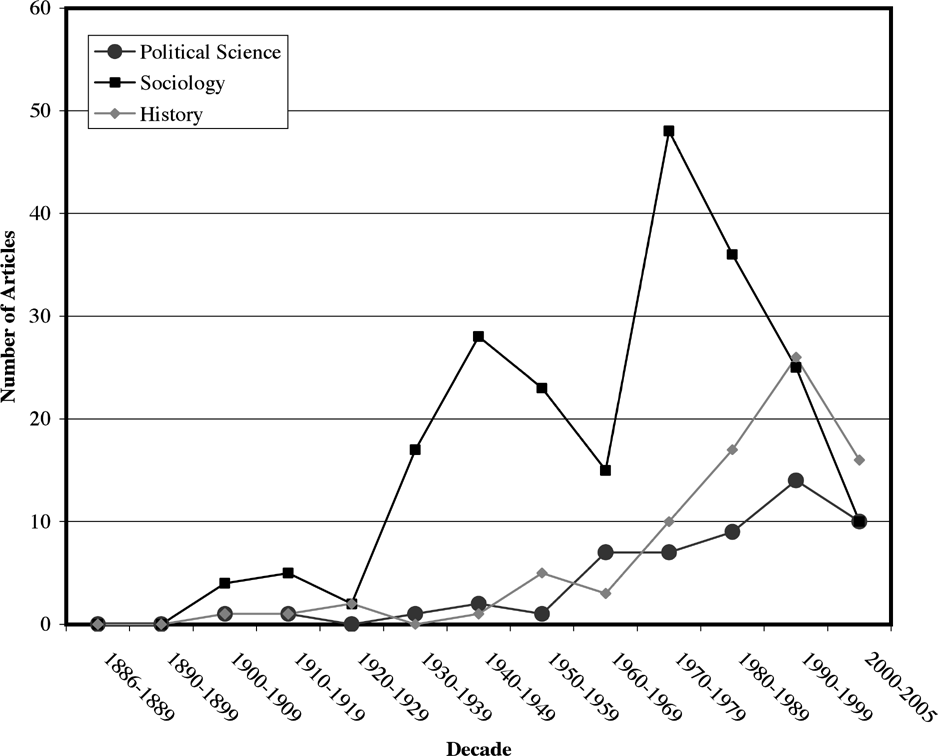
Political science articles about African Americans are rare, although not altogether absent, prior to the civil rights movement (see Figure 1). Each of the journals examined publish 30 to 60 total articles on all subject matters in any given year. From 1900 to 1959, political science journals were averaging about one article on Blacks (as indicated by title) per decade. Beginning in the 1960s, the number of Black politics articles increases significantly. During the decade spanning 1960 to 1969, seven articles about Blacks were published. The increase in agency experienced as a result of the civil rights movement apparently opened the door for Black politics, even though Black political scientists rarely published in these journals at that time. In the post-civil rights era, the number of articles about African Americans continues to be higher than the decades before. Moreover, it appears that political scientists' interest in African Americans is modestly increasing.Footnote 5
The Presence of Articles on Blacks in Academic Journals
Source: The chart traces all academic articles in the three disciplines (Political Science/Sociology/History) featuring the phrase “African American” (or “Black,” “Negro,” “Afro-American”) in their titles. The data were drawn from the American Political Science Review (1906–2005), Political Science Quarterly (1886–2005), American Sociological Review (1936–2005), American Journal of Sociology (1895–2005), American Historical Review (1895–2005), and Journal of American History (1914–2005) using the databases JSTOR and ProQuest.

Likewise, the number of articles about Blacks increases in both history and sociology in the decades following the civil rights movement. Similar to the findings of other scholars, we find that history and sociology in general have outpaced political science in terms of integrating Black politics into the disciplines' scholarship. Sociology in particular has devoted much more journal space to African Americans. In the decades prior to the civil rights movement, the two history journals we examined featured zero to five articles about Blacks, while these numbers range from zero to 28 in sociology per decade. In the post-civil rights movement era, we see the hypothesized relationship. From 1970 to 1979, the number of articles increases to 48 and 10 in sociology and history, respectively. Much like in political science, these heightened levels remain.
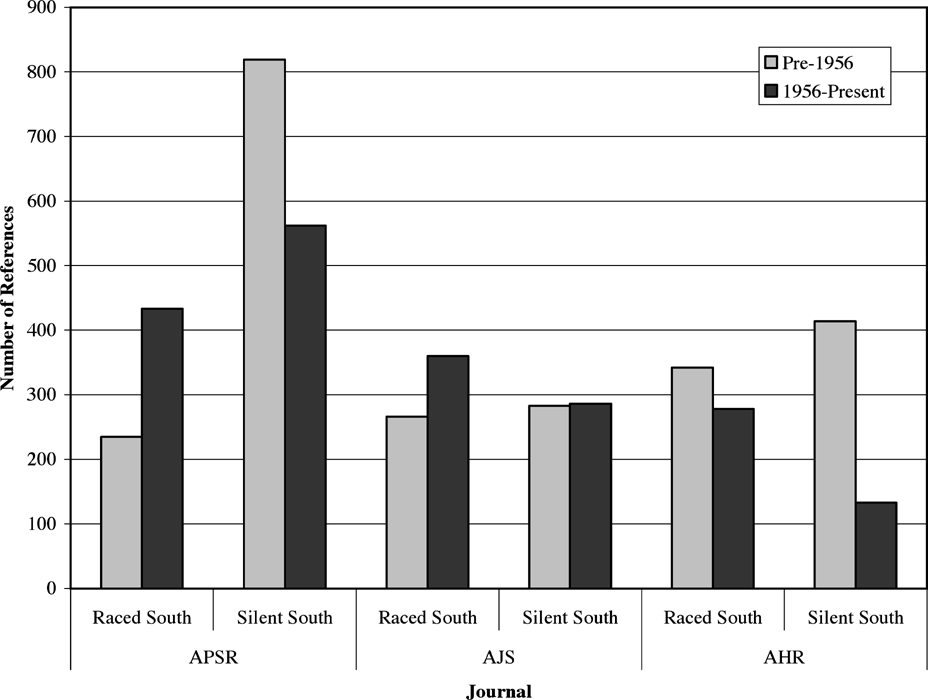
We also include an analysis of the relative absence of Black politics in political science. Numerous critics say that political science has been more quiescent on race than it should have been (see Wilson Reference Wilson1985; Dawson and Wilson Reference Dawson, Wilson and Crotty1991; Walton, Miller, and McCormick Reference Walton, Miller, McCormick, Farr, Dryzek and Leonard1995). Consequently, if that were true, one would expect political science to fail to mention race in places where race would otherwise be an accepted part of the discourse. We examine political science scholarship on the American South to explore this possibility. Many academic and popular culture references signal that the American SouthFootnote 6 has been the region of greatest racial strife in American history (see Key Reference Key1949 for example). Thus, if a discipline is being “silent” on racial concerns, one possible “symptom” could be a propensity to discuss political issues in the South without making any references to race. Being “silent on the South” (Silent South, for short) in our formulation is simply discussing any of the Southern states without referring to Blacks (or, as before, “African Americans,” “Negroes,” or “Afro-Americans”). Conversely, Raced South here refers to published items that discuss the South and Blacks simultaneously anywhere in the text of the article.Footnote 7
As Figure 2 indicates, our analyses reveal several interesting points. First, political science is much more likely to be silent than history or sociology over the total publication span of these journals. Whereas the ratio between Raced South versus Silent South among history and sociology is 6:5, this ratio is 1:2 in political science. In other words, for political science, the total number of references to the South absent any discussion of Blacks is twice that of references to the South in conjunction with African Americans.
Raced versus Racially Silent References to the South, by Discipline
Source: Data are drawn from the American Political Science Review (1906–2005), American Journal of Sociology (1895–2005), and American Historical Review (1895–2005). These three journals are used because they were the top disciplinary journals that were in print at least 50 years prior to 1956. Silent South references are those to any of the 11 states of the Confederacy (MS, SC, FL, AL, GA, LA, TX, TN, VA, AR, and NC) absent a discussion of Blacks (or the synonymous terms “African Americans,” “Negroes,” “Afro-Americans”). Raced South references are those that mention any of these former Confederate states in conjunction with Blacks. All searches done through databases JSTOR and ProQuest and are based on the full text of each article.

Related to our argument about Black agency, our findings also suggest that the civil rights movement played a role in breaking the silence. Specifically, the civil rights movement tended to make all three of the disciplines less silent on racial issues in the South, with strong effects occurring for political science and history. For instance, the political science Raced South to Silent South ratio is almost 1:4 before the public events of the civil rights movement became widespread. During the civil rights movement and the decades thereafter, this ratio is 4:5. Similarly, history's ratio is roughly 3:4 before the civil rights movement and 2:1 after. Prior to the civil rights movement, the ratio of Raced South to Silent South references in sociology was nearly 1:1. After Blacks began to gain agency as a result of the activities related to the civil rights movement, the number of Raced South references exceeded that of Silent South references in sociology by a ratio of about 4:3.
Conclusion
In this article, we have sought to explain the process that sparked the increased prominence of Black politics within mainstream political science. As our data suggest, the civil rights movement not only disrupted the status quo in American society, but also in political science. The discipline appeared to have started slowly into the study of Blacks and of the social movement that encapsulated their drive for legalized rights as citizens, as if the discipline were an old car warming up on a cold day. But as the 1960s came to a close, political science seems to have finally moved at a quicker pace on these important and presumably interesting political and social issues. Moreover, the effects of the civil rights movement were not limited to political science; we find similar post-civil rights movement trends in history and sociology as well.
But what was the mechanism that enabled an issue on the political agenda to reach the research agendas of political scientists? Based on our argument, certain events in the political world, given the magnitude of their impact on society, have the ability to define what academics choose to study and ultimately publish—that even topics previously unrecognized or deemed important simply become too significant to ignore. By exploring the publication records of the authors who wrote articles on Black politics that were published in the APSR during and immediately after the civil rights movement, we found that many of these scholars previously published work on some aspect of Black politics in other outlets. This suggests that in the case of the American Political Science Review, the civil rights movement's most significant impact on political science was to prove to editors and reviewers that Black politics was a respected field of research, thereby granting permission for scholars already doing research in this area as well as scholars inspired by the activities of the civil rights movement to publish in the discipline's flagship journal. No longer could political scientists conducting research on Black politics be credibly denied access to the APSR. Thus, in addition to opening the door for Black scholars to pursue questions related to race, the civil rights movement made Black political matters more important to the discipline more generally. In the post-civil rights era, scholars of all races and ethnicities have increasingly incorporated Black politics into their research agendas.
We note, however, that our focus on academic journals has not exhausted the possible sources of information that could be brought to bear on this topic. Indeed, there are a range of academic outputs. Unfortunately, it is extremely difficult to conduct a systematic analysis of these sources since there is no central location that houses information of the universe of books, book chapters, and conference papers. Nevertheless, we expect that the inclusion of such works would support our argument and further illuminate the process by which Black politics emerges in the discipline. Given the presence of such enduring classics as Myrdal's An American Dilemma and Gosnell's Negro Politicians, we can see that Black politics found its way into the discipline through other avenues. It is through these other avenues, which were not as tightly policed by mainstream political science, that we see the predominance of research on Black politics, including work written by those few Black political scientists who received their Ph.D.s before the civil rights movement. Even in the post-civil rights movement era, scholarly monographs tend to be the most common format of Black politics research.
Although the discipline in recent decades has better incorporated Blacks into the discussion of American politics as well as other subfields within political science, we have noted from the onset that a significant number of scholars remain discontented with the still relatively marginalized position of Black politics. Our findings demonstrate that an upheaval large enough to upset the power structure enabled a more fully fleshed out integration of political science in the 1960s. What will it take to integrate the study of Blacks and other politically relevant minority groups more generally into mainstream political science?
Author Bios
Harwood K. McClerking is assistant professor of political science at the Ohio State University. He has research interests in group politics, group identity and heuristics, and race and representation in the U.S. Congress. He is completing a book manuscript with the working title “A Common Fate: Group Identification in Black Americans,” which examines how groups maintain identification through political means.
Tasha S. Philpot is associate professor of government at the University of Texas at Austin. Her work has been published in the American Journal of Political Science, Political Behavior, Public Opinion Quarterly, National Political Science Review, Journal of Black Studies, and the Journal of Politics. She is the author of Race, Republicans, and the Return of the Party of Lincoln (2007, University of Michigan Press).