Implications
The chicks are sensitive to brooding temperatures (BT) which have been known to be a critical aspect of broiler management. On the other hand, longer egg storage durations (ESD) before incubation affect chick weight and posthatch growth negatively. Providing the correct BT will influence the chick growth. From the day of hatch to 7 days posthatch, BTs above the optimum would increase BW and improve villus development in chicks from egg stored for 14 days at 14°C. At low BTs, expression of Na-dependent glucose transporter increases in jejunum in order to provide necessary energy for chicks.
Introduction
Although a chick is anatomically complete on the day of hatch, its digestive system which is critical for development and growth is not fully developed (Uni et al., Reference Uni, Ganot and Sklan1998). A shift from the yolk-based diet to a carbohydrate–protein diet after the hatch requires dramatic changes in morphology of the intestine with a nutrient transport mechanism (Sklan, Reference Sklan2001). Indeed, active nutrient transport system is already present in chicks’ prenatal small intestine to prepare the chicks for exogenous feeding. Di- and tripeptide transporters seem to be represented by the PepT1 (H+-dependent peptide transporter), which provides a major mechanism for protein absorption. Increase in PepT1 messenger RNA (mRNA) from embryonic day 20 to 14 days posthatch was reported by Gilbert et al. (Reference Gilbert, Li, Emmerson, Webb and Wong2007) and Zwarycz and Wong (Reference Zwarycz and Wong2013). The transporter Na-dependent glucose (SGLT1) of which expression is likely to influence the development and absorptive function of digestive system also develops prenatally. Gilbert et al. (Reference Gilbert, Li, Emmerson, Webb and Wong2007) and Li et al. (Reference Li, Gilbert, Zhang, Crasta, Emmerson, Webb and Wong2008) showed that intestinal SGLT1 was upregulated from 18 days of incubation to 14 days posthatch.
Previous studies reported that feed restriction and dietary protein influence PepT1 and SGLT1 expression (Chen et al., Reference Chen, Pan, Wong and Webb2005; Gilbert et al., Reference Gilbert, Li, Emmerson, Webb and Wong2008). Our recent study (Yalcin et al., Reference Yalcin, Gursel, Bilgen, Horuluoglu, Gucluer and Izzetoglu2016) showed that long-term egg storage depressed expression of PepT1 and SGLT1 nutrient transporters on the day of hatch. Depending on the supply of hatching eggs, variable market demands for broiler chicks and hatchery capacity, eggs are stored for 3 to 18 days before incubation. But storage longer than 7 days adversely affects embryonic development by slowing embryo metabolism and growth (Christensen et al., Reference Christensen, Wineland, Fasenko and Donaldson2001; Yalcin and Siegel, Reference Yalcin and Siegel2003; Fasenko, Reference Fasenko2007) and chick weight at hatch (Reis et al., Reference Reis, Gama and Soares1997; Ruiz and Lunam, Reference Ruiz and Lunam2002). Long-term egg storage also affects the postnatal growth (Tona et al., Reference Tona, Bamelis, De Ketelaere, Bruggeman, Moraes, Buyse, Onagbesan and Decuypere2003), however the mechanisms behind have not been clearly understood.
It is questionable if BTs and ESD interacts to influence the broiler growth. Chicks are not able to control their body temperature at the day of hatch. After hatching, the transition into a warm-blooded organism takes place about 3 and 4 days, depending on the chick size (Molenaar, Reference Molenaar2012). Therefore, it is important to maintain the chicks at optimum BTs during the first 2 weeks of postnatal period. In order to maintain cloacal temperatures between 40°C and 41°C, the optimum BT for broiler chicks should be around 32°C during the first few days of life (Scott and Washburn, Reference Scott and Washburn1985). Because of the differences in growth performance of chicks between short- and long-term stored eggs, BTs may influence intestine development and expression of nutrient transporters. Thus, the objective of the present study was to evaluate the effect of BT on BW, intestine development and nutrient transporters of chicks from eggs stored for short or long periods before incubation. For this purpose, chicks were brooded at three different temperatures from 1 to 21 days.
Material and methods
Eggs, incubation and rearing conditions
All animal care and use were approved by the Ege University Animal Care and Use Committee. Eggs were obtained from a Ross 308 broiler breeder flock aged 38 weeks and stored at 18°C for 3 days (ESD3-18°C) or at 14°C for 14 days (ESD14-14°C), with 75% relative humidity. Different storage temperatures were chosen, as these temperatures emulate current industry conditions to optimize hatchability (Meijerhof, Reference Meijerhof1992; Schulte-Drüggelte, Reference Schulte-Drüggelte2011). In order to incubate all eggs at the same time, eggs were collected in 11-day interval. Average egg weights were 62.89 and 61.19 g (±0.38) for ESD3-18°C and ESD14-14°C eggs before incubation (P<0.001). All eggs were warmed to room temperature before setting in the same incubator. Incubation temperature was set at 37.6°C with a relative humidity of 58%.
On the day of hatch, 396 chicks from each ESD (a total of 792 chicks) were wing banded and weighed individually. Chicks from each storage duration were placed into 36 environmentally controlled pens and assigned to 1 of 3 BTs. Temperatures were initially set at 32, 34 and 30°C for control (BT-Cont), high (BT-High) and low (BT-Low) BTs. Brooding temperatures were decreased by 2°C each at day 2, 7, 14 and 21. Temperature was maintained at 21°C from day 22 to slaughter age. Heaters were turned on 24 hours before the placement. During the experiment, the temperature was recorded continuously at chick height to be certain that brooding conditions are uniform. Relative humidity was between 50 and 70% through the experiment. There were 6 replicated pens with 22 chicks (14 chicks/m2) for each egg storage and BT duration.
All pens were covered with pine shavings and had 2 hanging feeders and one bell-type drinker. Chicks were reared at 23:1 (hours, light : dark) from day-old to 7 days; at 16:8 from 8 to 42 days. The feed and water were provided ad libitum. Chicks were fed with a commercial starter diet consisted of 23% protein and 3100 kcal/kg ME from day 1 to 10, a grower diet with 22% protein and 3150 kcal/kg ME from day 11 to 22, and a finisher diet with 20% protein and 3200 kcal/kg ME from day 23 to 42.
Data collection
On the day of hatch, 12 chicks were randomly selected from each storage, weighed, and killed by cervical dislocation. The residual yolk sac and whole intestine were dissected and weighed after the intestine contents were emptied by gentle pressure. Jejunum was also excised and weighed. Weights were calculated relative to chick weight. A 2 cm of jejunum tissue near Meckel’s diverticulum was removed from 8 chicks for histological measurements. About 2 cm of the jejunum sample from 4 randomly selected chicks was immediately rinsed in PBS, frozen in liquid nitrogen and stored at −80°C until the RNA extraction and analysis. The same procedure was repeated with 12 chicks from each egg storage and BT group at 14 days. Individual BWs were determined at day 2, 7, 14, 21, 28 and 42. Cloacal temperatures of the 12 chicks from each ESD and BT were recorded from 1 to 14 days by inserting a thermocouple to a depth of 3 cm into the cloaca.
Histological measurements
The sampled jejunum was gently flushed with 0.9% NaCl to remove the intestinal contents, Bouin’s solution for 24 h, wash in 70% alcohol until no more yellow comes out, serially dehydrated and embedded in paraffin. Three serial sections from each bird were taken at 5μm, stained with Mayer’s hematoxylin (Merck 1.09249) and eosin (Merck 1.09844), and then dehydrated quickly through 70%, 96% and absolute alcohols, cleared in xylene and mounted. Sections were examined for villus length, and villus width with light microscopy (Uni et al., Reference Uni, Ganot and Sklan1998) using a computer software (Sigma Scan, Point Richmond, CA, USA). The crypt depth was also measured at day 14. The villus length was from the tip to the base of the lamina propria, villus width was in the middle of the villi, and the crypt depth was the distance from the lamina propria to invagination between adjacent villi. The villus area was calculated as the length multiplied by the width. Values used were means of 12 villi/chick.
Real-time Polymerase Chain Reaction (PCR) analysis
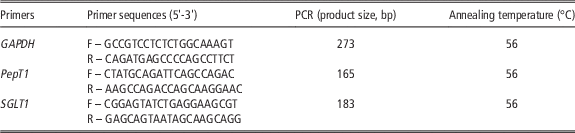
Polymerase chain reaction reaction was done as described previously (Yalcin et al., Reference Yalcin, Gursel, Bilgen, Horuluoglu, Gucluer and Izzetoglu2016). Briefly total RNA was extracted from jejunum and complimentary DNA (cDNA) was synthesized with a cDNA synthesis kit (NEB, Ipswich, MA, USA). PCR reaction was prepared with Quick-load Taq 2X Master Mix (NEB). Conditions for PCR reaction were; 10 min 95°C for denaturation, and 34 cycles of denaturation 95°C for 10s, annealing 56°C for 30 s, extension 72°C 30 s and final extension of 10 min at 72°C. PepT1 and SGLT1 primers were designed by Primer 3 software and gene expression levels were calculated using the ΔΔCt method to that of glyceraldehyde-3-phosphate dehydrogenase (GAPDH) expression as the endogenous control (Table 1). ΔΔCt values were generated by quantitative PCR system for calculation. The values represent the expression levels of each primer in the samples (PepT1 and SGLT1 primers in this case). The ΔΔCt values were normalized against GAPDH. The fold inductions were calculated comparing BT-Cont for each gene for each storage duration.
Chicken primer sequences and their expected product size

GAPDH=Glyceraldehyde-3-phosphate dehydrogenase; PepT1=H+-dependent peptide transporter; SGLT1=sodium-glucose co-transporter.
Statistical analyses
The data collected on the day of hatch were subjected to a one-way ANOVA to evaluate the effect of the ESD. The data collected during the rearing period were subjected to a two-way ANOVA to estimate main effects of the ESD and BTs and interaction between them. Chick weight was used as covariate to analyze BW measurements. T-test was used to analyze the magnitude of fold change. Means were considered significant at P<0.05 unless otherwise indicated.
Results
Cloacal temperatures and body weights
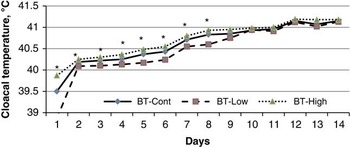
Cloacal temperatures were 39.70°C and 39.54°C on the day of hatch and 40.31°C and 40.11°C on day 2 for ESD3-18°C and ESD14-14°C chicks, respectively (P<0.05). Thereafter, ESD3-18°C and ESD14-14°C chicks had similar cloacal temperatures. Cloacal temperatures increased from 1 to 10 days. Brooding temperatures had significant effect on the cloacal temperatures from 1 to 8 days. For the chicks kept at BT-Low, the cloacal temperature was lower compared with BT-Cont and BT-High (Figure 1). After 8 days, there was no effect of BT on cloacal temperatures.
Cloacal temperatures of chicks from 1 to 14 days. Temperatures were initially set at 32°C, 34°C and 30°C for control (BT-Cont), high (BT-High) and low (BT-Low) brooding temperatures (BT). Brooding temperatures were decreased by 2°C each at 2, 7, 14 and 21 days. *Means differ significantly (P<0.05).

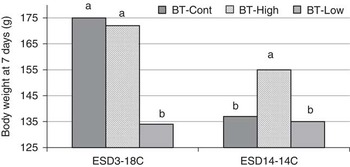
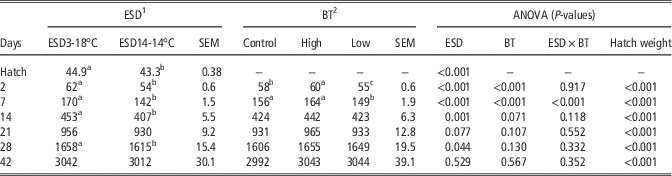
ESD3-18°C chicks were heavier than ESD14-14°C chicks from 1 to 28 days, except at 21 days, BW difference between ESD3-18°C and ESD14-14°C chicks was only 26 g, being non-significant (P=0.077) (Table 2). No effect of ESD was detected at 42 days. Chicks maintained at the BT-Low had lower BW at day 2 than broilers maintained at BT-Cont and BT-High. At day 7, ESD by BT interaction was significant, implicating that the highest BW for ESD14-14°C chicks were obtained at BT-High. The ESD3-18°C chicks had similar BW at BT-Cont and BT-High, but BW of chicks maintained at BT-Low was lighter than the others at day 7 (Figure 2). On the day 14, chicks at BT-High conditions were slightly but not significantly heavier than BT-Cont and BT-Low (P=0.071). From day 14 to slaughter age, there was no effect of BT on BW (Table 2).
Egg storage duration (ESD) and brooding temperature (BT) interaction for BW of chicks at 7 days, a,bMeans within the same egg storage group with no common superscript letter differ significantly (P<0.05).Chicks from eggs stored at 18°C for 3 days (ESD3-18°C) or at 14°C for 14 days (ESD14-14°C) before incubation. Temperatures were initially set at 32°C, 34°C and 30°C for control (BT-Cont), high (BT-High) and low (BT-Low) BTs. Brooding temperatures were decreased by 2°C each at 2, 7, 14 and 21 days.

BWs (g) of broilers by egg storage duration (ESD) and brooding temperature (BT)

a,bMeans within the same row and treatment with no common superscript letter differ significantly (P<0.05).
1 Chicks from eggs stored at 18°C for 3 days (ESD3-18°C) or at 14°C for 14 days (ESD14-14°C) before incubation.
2 Temperatures were initially set at 32°C, 34°C and 30°C for control, high and low BTs. BTs were decreased by 2°C each at 2, 7, 14 and 21 days. Temperature was maintained at 21°C from 22 days to slaughter age.
Yolk sac and intestinal histological and morphological measurements
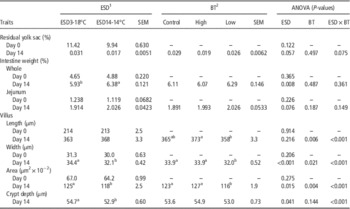
On the day of hatch, relative residual yolk sac weight was similar for ESD3-18°C and ESD14-14°C chicks (Table 3). At 14 days, the effect of BT on the residual yolk sac weight was not significant. The ESD3-18°C chicks had numerically heavier residual yolk sac than ESD14-14°C chicks (P=0.057), however this result existed only at the BT-Low conditions (residual yolk sac weight was 0.044 v. 0.007%, for ESD3-18°C and ESD14-14°C, respectively) (data not shown in Tables). The weights of whole intestine and jejunum were similar for ESD3-18°C and ESD14-14°C chicks on the day of hatch (Table 3). At day 14, BT had no effect on the weights of whole intestine and jejunum. The ESD14-14°C chicks had significantly heavier whole intestine weight than the ESD3-18°C chicks, whereas jejunum of ESD14-14°C chicks was slightly but not significantly heavier than ESD3-18°C chicks (P=0.076).
Residual yolk sac weights and intestinal parameters of broilers by egg storage duration (ESD) and brooding temperature (BT) at 14 days

a,bMeans within the same row and treatment with no common superscript letter differ significantly (P<0.05).
1 Chicks from eggs stored at 18°C for 3 days (ESD3-18°C) or at 14°C for 14 days (ESD14-14°C) before incubation.
2 Temperatures were initially set at 32°C, 34°C and 30°C for control, high and low BTs. BTs were decreased by 2°C each at 2, 7, 14 and 21 days.
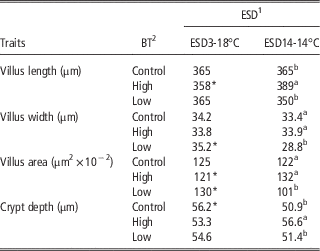
On the day of hatch, there was no effect of ESD on villus length, width and surface area (Table 3). At 14 days posthatch, BT-High increased villus length, width and area compared with BT-Low, but was not different from BT-Cont. Interaction between ESD and BT showed that ESD3-18°C chicks had similar villus length, width and area and crypt depth under three BTs. ESD14-14°C chicks had the highest villus length at BT-High while smallest villus width at BT-Low thus villus area (Table 4, marked with superscripts). Compared to ESD14-14°C chicks, ESD3-18°C chicks had shorter villus length at BT-High, but larger villus width and area at BT-Low (Table 4, marked with asterisk). At BT-Cont conditions, ESD3-18°C chicks had deeper crypts than ESD14-14°C chicks while for ESD14-14°C chicks the highest crypt depth was obtained at BT-High.
Means for interaction between egg storage duration (ESD) and brooding temperature (BT) for villus length, width, area and crypt depth

a,bMeans within the same column and measurement with no common superscript letter differ significantly (P<0.05).
*Means within the same row differ significantly (P<0.05).
1 Chicks from eggs stored at 18°C for 3 days (ESD3-18°C) or at 14°C for 14 days (ESD14-14°C) before incubation.
2 Temperatures were initially set at 32°C, 34°C and 30°C for control, high and low BTs. BTs were decreased by 2 °C each at 2, 7, 14 and 21 days.
Gene expression of nutrient transporters
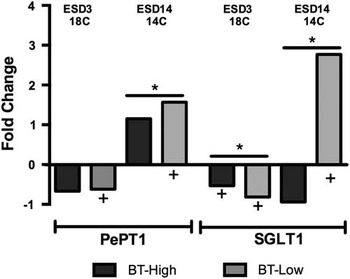
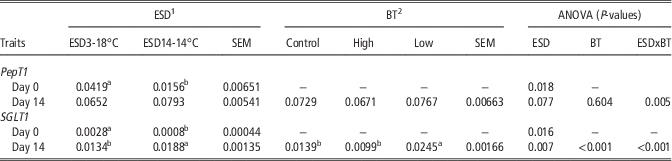
Expression of PepT1 and SGLT1 was higher in ESD3-18°C chicks than in ESD14-14°C on the day of hatch (Table 5). At day 14, ESD effect on expression of PepT1 was not significant, however, ESD14-14°C chicks had numerically greater PepT1 expression than ESD3-18°C chicks (P=0.077). There was a significant ESD by BT interaction on jejunum PepT1 gene expression. Expression of PepT1 in ESD3-18°C chicks was greater under BT-Cont than under BT-Low conditions (P<0.01). Indeed, compared with BT-Cont, downregulation in PepT1 expression of ESD3 chicks was not significant at BT-High conditions but PepT1 expression was downregulated 0.52-fold at BT-Low conditions (P<0.01) (Figure 3). ESD14-14°C chicks had greater PepT1 expression at BT-Low than at BT-Cont conditions. Fold increase of PepT1 in ESD14-14°C chicks was 1.57 at BT-Low condition compared with BT-Cont (P<0.01), being significantly different from those at BT-High (P=0.017).
Relative PepT1 and SGLT1 gene expression compared with control brooding (BT-Cont) for ESD3-18°C and ESD14-14°C chicks at 14 days. Gene expression was calculated using the ΔΔCt method. GAPDH was used as the endogenous control. Temperatures were initially set at 32°C, 34°C and 30°C for control (BT-Cont), high (BT-High) and low (BT-Low) brooding temperatures (BT). Brooding temperatures were decreased by 2°C each at 2, 7, 14 and 21 days. Chicks from eggs stored at 18°C for 3 days (ESD3-18°C) or at 14°C for 14 days (ESD14-14°C) before incubation. +Means that are significantly different compared with that of BT-Cont (P<0.05). *Means that are significantly different between the BT-High and BT-Low within the same gene expression and egg storage duration (P<0.05).

Expression of PepT1 and SGLT1 in jejunum of broilers at 14 days by egg storage duration (ESD) and brooding temperature (BT)

PepT1=H+-dependent peptide transporter; SGLT1=sodium-glucose co-transporter.
a,bMeans within the same row and treatment with no common superscript letter differ significantly (P<0.05).
1 Chicks from eggs stored at 18°C for 3 days (ESD3-18°C) or at 14°C for 14 days (ESD14-14°C) before incubation.
2 Temperatures were initially set at 32°C, 34°C and 30°C for control, high and low BTs. BTs were decreased by 2°C each at 2, 7, 14 and 21 days.
At day 14, higher expression of SGLT1 was observed in ESD14-14°C chicks compared with ESD3-18°C (Table 5). The interaction between ESD and BT implicated that the greatest expression of SGLT1 in ESD3-18°C and ESD14-14°C chicks was under BT-Cont and BT-Low conditions, respectively. Notably, compared with BT-Cont, SGLT1 expression in ESD3-18°C chicks decreased 0.53- and 0.81-fold at BT-High and BT-Low conditions (P<0.01 and <0.01, respectively), respectively, being significantly different from each other (P=0.01) (Figure 3). Compared with BT-Cont, SGLT1 expression level in ESD14-14°C chicks showed 2.77-fold increase (P<0.01) at BT-Low condition, being significantly different from those at BT-Low (P<0.001).
Discussion
It is very well known that longer ESD before incubation associated with lower chick quality and postnatal performance in broilers (Christensen et al., Reference Christensen, Wineland, Fasenko and Donaldson2001 and Reference Christensen, Wineland, Fasenko and Donaldson2002; Ruiz and Lunam, Reference Ruiz and Lunam2002; Tona et al., Reference Tona, Bamelis, De Ketelaere, Bruggeman, Moraes, Buyse, Onagbesan and Decuypere2003 and Reference Tona, Onagbesan, De Ketelaere, Decuypere and Bruggeman2004). The present experiment was conducted to evaluate the interaction between ESD and BTs. To mimic industrial conditions, different storage temperatures were used for 4 and 14 days stored eggs. Because growth is associated with gastrointestinal tract development and maturation, the intestinal morphology and the expression of PepT1 and SGLT1 in jejunum were investigated.
As expected, longer ESD before incubation decreased chick weight at the day of hatch. Goliomytis et al. (Reference Goliomytis, Tsipouzian and Hager-Theodorides2015) reported that the lower hatch weight from longer storage duration could be attributed to the water losses during egg storage which led to lighter egg weights before incubation. They found no effect of ESD on BW at days 7 and 35 when BW was corrected for egg weight before incubation (Goliomytis et al., Reference Goliomytis, Tsipouzian and Hager-Theodorides2015). In our study, we used chick weight as covariate and showed that the ESD effect on BW was significant up to 28 days. This result was persistent when egg weight was used as covariate, as well (data not shown in the text). Therefore, the observed lighter BWs of ESD14-14°C chicks up to 28 days might be attributed to growth potential of those chicks in our study. However, the chicks compensated the growth retardation between 28 and 42 days. The lack of ESD effect at slaughter age was in disagreement with Tona et al. (Reference Tona, Onagbesan, De Ketelaere, Decuypere and Bruggeman2004) who found broilers from fresh eggs were heavier at day 42 than those from stored eggs. This difference could be explained by our statistical analyses where hatch weight was used as covariate for BW of broilers.
Regardless of ESD, highest BW was obtained at BT-High conditions at day 2. Our results showed that BT requirement of ESD14-14°C chicks was higher than ESD3-18°C chicks between 2 and 7 days while BT-High had no advantage on BW of ESD3-18°C chicks. Body weight differences between ESD3-18°C and ESD14-14°C at day 7 were lowest for chicks at BT-High conditions. This result indicated that BT-High triggered growth of ESD14-14°C chicks. This result was consistent with longer villus, larger villus area and crypt depth of ESD14-14°C chicks at BT-High conditions. The increased crypt depth may indicate continued mucosal growth and would allow more enterocytes to develop and migrate to increase villus length (Barri et al., Reference Barri, Honaker, Sottosanti, Hulet and McElroy2011) which would play a fundamental role in meeting ESD14-14°C chicks’ nutrient demands. Malheiros et al. (Reference Malheiros, Moraes, Brunu, Malheiros, Furlan and Macari2000) reported a decline in the BW when the chicks were kept at 20°C. In our study, BT-Low reduced ESD3-18°C chick weight at day 7, whereas it was not different from ESD14-14°C chicks under the same conditions. This result indicated that lower critical temperature for broiler chicks should be higher than the BT-Low temperatures used in this study. Indeed, BT-Low chicks had the lowest cloacal temperatures until 8 days. Therefore, the lower BW of BT-Low chicks might be related to energy saving, avoid of moving for feed and water (Malheiros et al., Reference Malheiros, Moraes, Brunu, Malheiros, Furlan and Macari2000). However, this growth retardation of BT-Low chicks was compensated at 14 days.
This study showed that expression of PepT1 and SGLT1 increased from day-old to 14 days. While PepT1 is a low-affinity/high capacity transporter and maximize amino acid assimilation, SGLT1 is a high affinity/low capacity transporter and responsible for glucose absorption (Leibach and Ganapathy, Reference Leibach and Ganapathy1996; Wood and Trayhurn, Reference Wood and Trayhurn2003). Up regulation of PepT1 and SGLT1 would enhance the uptake of small peptides and glucose, respectively. The increase in PepT1 expression of ESD14-14°C chicks at BT-High compared to the chicks at BT-Cont associated with villus length and crypt depth of chicks being agreed with Barri et al. (Reference Barri, Honaker, Sottosanti, Hulet and McElroy2011) and suggested increased nutrient utilization for mucosal development. In spite of the higher PepT1 and SGLT1 expression of ESD14-14°C chicks compared with ESD3-18°C under BT-Low conditions, their BW was low which indicated that changes in nutrient transporters may not result in BW differences (Barri et al., Reference Barri, Honaker, Sottosanti, Hulet and McElroy2011). The highest fold increase in PepT1 and SGLT1 that was obtained for ESD14-14°C chicks at BT-Low may indicate (1) adaptation to cold temperature to maximize amino acid utilization and to provide necessary glucose transport for energy expenditure under cold conditions, and (2) their low feed consumption, however feed consumption was not measured in the present study. An increase in PepT1 and SGLT1 expression following a feed restriction was reported (Gilbert et al., Reference Gilbert, Li, Emmerson, Webb and Wong2007; Duarte et al., Reference Duarte, Vicentini-Paulino, Buratini, Castilho and Pinheiro2011; Madsen and Wong, Reference Madsen and Wong2011). In our study, all birds were on ad libitum feeding. Therefore, this increase in PepT1 and SGLT1 in ESD14-14°C chicks BT-Low may be due to their behavior, to avoid moving for feeding to conserve heat, as indicated above. Thus, the increase in these transporters would have a role in the assimilation of nutrients when luminal concentration is lower than in blood. On the other hand, the absorption of nutrients from residual yolk sac has a crucial role in intestinal development (Noy and Sklan, Reference Noy and Sklan1999) and growth (Murakami et al., Reference Murakami, Akiba and Horiguchi1992). The highest fold increases in nutrient transporters for ESD14-14°C chicks at BT-Low was accompanied with lower residual yolk sac weights of chicks and suggested exhaustion of yolk reserves necessitates the surge in glucose transport for growth (Obst and Diamond, Reference Obst and Diamond1992). Indeed, BT effect was disappeared at day 14.
In conclusion, pre-incubation egg storage conditions affected growth performance of broilers until 28 days posthatch. The results indicated that higher BTs used in this study had no advantage on BW of chicks from shorter ESD (ESD3-18°C); however, chicks from longer ESD (ESD14-14°C) could grow better under higher BTs by maximizing nutrient absorption capacity and expression of PepT1. Under lower BTs, chicks from longer ESDs (ESD14-14°C) increased expression of SGLT1 nutrient transporters to supply necessary energy. Although protein amount may not be deduced by measuring mRNA, our results clearly demonstrated that pre-incubation egg storage conditions and BTs affected intestine morphology and relative gene expression of PepT1 and SGLT1. Further studies on the other nutrient transporters would be valuable to understand the interaction between the BT and prolonged egg storage periods.
Acknowledgement
This research was supported by TUBITAK (Project no: 112 0 220).