1. Introduction
Throughout the second half of the twentieth century, molecular biology was spectacularly successful at unraveling some of the fundamental mechanisms of gene expression and regulation. However, as a consequence of the large sequencing projects and the so-called data deluge, there has been a general feeling that molecular biologists have underestimated the complexity of the molecular mechanisms underlying the phenomena of life. Systems biology has been proposed as a superior approach to cope with this complexity. Sometimes this debate is framed in terms of Occam’s razor, the principle that simpler or more parsimonious explanation should be preferred.
In a very schematic form, the argument put forward by systems biologists seems to go as follows: by expecting and proposing simple molecular explanations, molecular biologists make illegitimate use of Occam’s razor. As a consequence they end up with simplistic ideas about biological processes or do not arrive at satisfactory explanations at all. Systems biology overcomes this cognitive impasse: by making use of superior analytical tools such as computational models or quantitative data analysis, it can afford to drop Occam’s razor altogether.
Does this argument work? Several aspects complicate the picture. First, it is not really a new idea to contest the applicability of Occam’s razor in biology, and molecular biologists themselves have emphasized that living systems are complex and messy and far from the idealized systems that, for instance, physics deals with. Furthermore, systems biology itself appears to rely on considerations of simplicity. For example, it uses idealized models and strives for unifying design principles. How then can systems biologists coherently criticize the application of Occam’s razor in molecular biology?
More generally, there seems to be confusion regarding the possible meaning and role of Occam’s razor in biology. This is reflected in a recent comment by the renowned systems biologist Eberhart Voit (and one of the rare occasions where a scientist calls philosophers for help):
Philosophers might join a discussion about the widely accepted fourteenth century dogma of Ockham’s razor, which essentially states that the simpler of two explanations is to be preferred. At first the concept makes much sense, as we certainly do not want to clutter our thinking or theories with details that are not needed. Yet, the more we study biological systems, the more often we find enormous redundancy and could quite easily imagine simpler systems that would perform the same task. Is the observed complexity a violation of Ockham’s razor or are the two completely consistent and only appear to clash because we do not understand all the tasks and constraints that biological systems have to satisfy in order to survive in a rapidly changing, uncertain world?
(Voit Reference Voit and Green2017, 250)Some clarification might be expected from the observation that Occam’s razor can be, and has been, understood in very different ways (Sober Reference Sober2015). It is thus conceivable that systems biologists are correct in their negative assessment of how the principle is used in molecular biology, while their own way of interpreting and applying it is unproblematic.
The aim of this article is to discuss some of the philosophical issues regarding Occam’s razor and to assess the debate around molecular and systems biology in light of this clarified picture. In section 2, I distinguish different versions of Occam’s razor and review various attempts of justifying or refuting the principle on philosophical grounds. In section 3, I investigate the role of parsimony in molecular biology and argue against the critics that its usage can to a large extent be justified. Finally, in section 4, I suggest that parsimony is also central in systems biology, even though it appears in a different and possibly more problematic form.
2. Occam’s Razor in Philosophy
The idea behind Occam’s razor is often traced back to Aristotle’s famous dictum “nature does nothing in vain.” This principle can be found in many different places, but notably in Aristotle’s biological writings (Huby Reference Huby, Mahalingam and Carr1991). Aristotle says, for example, that no animal has both lungs and gills because they both serve the same purpose (Resp. 10, 476a11–5). Thus, according to him, nature is parsimonious because it avoids superfluous or redundant features. In the scholastic period Aristotle was often invoked to justify a more general principle of parsimony whose formulation “entia non sunt multiplicanda praeter necessitatem” (entities are not to be multiplied without necessity) has been attributed to William of Occam, although he never seems to have put it in those words (Thorburn Reference Thorburn1918). Furthermore, the principle figures prominently as the first of Isaac Newton’s Rules of Reasoning: “No more causes of natural things should be admitted than are both true and sufficient to explain their phenomena. … As the philosophers say: Nature does nothing in vain, and more causes are in vain when fewer suffice. For nature is simple and does not indulge in the luxury of superfluous causes” (Newton Reference Newton, Cohen and Whitman1999, 440). Occam’s razor thus appears to be tightly connected to the modern scientific worldview. Since Newton, the general expectation in physics has been to find explanations of phenomena in terms of simple laws (Cushing Reference Cushing1998).
Despite its central role, the principle has led to puzzling philosophical questions. The main issues are about what the principle actually says and how it can be justified. My aim in what follows is not to give an exhaustive overview of the relevant philosophical literature but to selectively address certain points that will be important for the remainder of this article.
2.1. Interpretations of Parsimony
One fundamental distinction in interpreting the meaning of Occam’s razor is whether it should be understood in an ontic or an epistemic sense. According to an ontic version of the principle, an explanation is simpler (more parsimonious) if its ontological commitments are smaller. Thus, one should prefer theories that assume fewer entities (objects, causes, processes, etc.). Applying the principle in this way presupposes a particular way of slicing up the world into entities or kinds of entities. A famous, although not uncontested, example of ontic parsimony is the prevalence of the theory of special relativity over theories that presupposed the existence of a transmission medium for electromagnetic waves (Sober Reference Sober1981; Baker Reference Baker2007).
An epistemic understanding of Occam’s razor, by contrast, is not (directly) concerned with the simplicity of the world but with the simplicity of our theories, explanations, or models. A famous historical example, again not uncontested, of epistemic parsimony is the decision in favor of Copernicus’s heliocentric worldview because it enabled a much simpler description of planetary motion than the traditional Ptolemaic model (e.g., Kuhn Reference Kuhn1957). A general problem with the notion of epistemic parsimony is that it appears to be relative to the language being used, and it is unclear whether there exists a unified and invariant measure of simplicity of scientific theories.
2.2. Justifications of Parsimony
There can be strong pragmatic or aesthetic reasons to prefer simpler theories. Scientists sometimes pursue simpler hypotheses just because they are more manageable or more beautiful in their opinion. The tougher question is whether it is epistemically useful to do so. One can broadly distinguish three ways of defending an epistemic role of simplicity: by arguing that simpler theories are more likely to be true, that they lead to the truth more efficiently, or that they have other epistemic virtues, such as explanatory unification or predictive accuracy.
2.2.1. Simplicity as an Indicator of Truth
Traditionally, justifying Occam’s razor was seen as a matter of arguing that nature itself is simple. In the scholastic period, but also later, this idea was defended theologically by connecting it to the aims of a rational and benevolent creator. Since the nineteenth century, one increasingly finds attempts to justify the principle on nontheological grounds (Sober Reference Sober2015).
There is a straightforward way in which hypotheses that make additional unfounded assumptions about the world are less likely to be true (Mill Reference Mill1865). Assume that in a murder investigation there is some evidence that the perpetrator is male. Then the hypothesis “the perpetrator is male” is more probable than the more complex hypothesis “the perpetrator is male and has red hair.” This follows directly from the theorem of probability theory that  for any A and B.
Thus, in this case the simpler theory is more likely because it is more encompassing, or logically weaker. A very similar argument can be made for epistemic parsimony, when we consider the precision of our hypotheses. This is illustrated by Quine’s example of quantitative measurements: “If a measured quantity is reported first as 5.21, say, and more accurately in the light of further measurements as 5.23, the new reading supersedes the old; but if it is reported first as 5.2 and later as 5.23, the new reading may well be looked upon as confirming the old one and merely supplying some further information regarding the detail of further decimal places. Thus the ‘simpler hypothesis’, 5.2 as against 5.21, is quite genuinely ten times likelier to be confirmed, just because ten times as much deviation is tolerated under the head of confirmation” (Reference Quine1963, 105).
As Sober (Reference Sober1981) has pointed out, this justification strategy covers only the particular subset of cases in which the simpler theory is agnostic about the truth of the superfluous assumption. For instance, our “simple theory” that the murderer is male (A) is consistent with both his having red hair (B) and not having red hair (¬B). Either A&B or A&¬B might be accepted as refinements of the initial theory once additional evidence is gathered. However, theory choice often involves stronger versions of parsimony in which assumptions are explicitly negated (e.g., as in the case of the ether), which leads Sober to distinguish between the weak “razor of silence” and the strong “razor of denial.” Even more generally, it might be the case that the rival theories differ in complexity but are not related in the sense that the assumptions of one are a proper subset of the assumptions of the other.
It seems difficult to defend such stronger versions of Occam’s razor a priori, but it is possible to assign a higher prior probability to the simpler hypothesis on empirical grounds. For example, a criminal investigator might pursue a simple hypothesis based on previous experience or on certain general facts about human psychology. Similarly, scientists sometimes have empirical grounds for expecting simple explanations.
2.2.2. Occam’s Razor as a Methodological Principle
Even if they are not true, it might be a good strategy to pursue simpler hypotheses first since they might lead us to more adequate ones. Popper’s (Reference Popper1935) view on simplicity may be understood along these lines. He considered simpler theories to be stronger and more falsifiable, as they required fewer measurements to be refuted. However, Popper’s equation of simplicity and strength of hypotheses has been shown to be untenable in general (Goodman Reference Goodman1961). Quine’s case of reported precision in measurements, discussed in section 2.2.1, provides a straightforward counterexample.
Along different lines, it has been proposed that Occam’s razor is an efficient strategy in the sense that it requires less retractions of hypotheses than any other strategy in the worst case scenario (Kelly Reference Kelly2004). However, it is not obvious whether this criterion is actually relevant for scientific practice.
2.2.3. Other Accounts of Simplicity as an Epistemic Virtue
It has been argued that simplicity is desirable in the form of a unification of our scientific knowledge. On this view, simpler theories are preferable not because they are more likely to be true but because they have greater explanatory power. Friedman, for example, sees the goal of scientific explanation in a simplification of our descriptions of the world by reducing “the number of independent phenomena that we have to accept as ultimate” (Reference Friedman1974, 18).
Another reason why simpler theories might sometimes be preferred is that they can have greater predictive power. This is particularly relevant in the area of statistical modeling, where the complexity of a model is usually measured in terms of the number of free parameters that are used to fit the model to a set of data. A model with less parameters can have greater predictive accuracy because it avoids the risk of “overfitting,” which means that it is more robust to features of the data that are not representative of the population the model is supposed to describe.
3. Simplicity in Molecular Biology
Several of the founding figures of molecular biology, such as Erwin Schrödinger, Max Delbrück, or Francis Crick, were physicists. It is thus plausible that some of the methodological principles of physics were carried over into the new discipline. Some systems biologists seem to argue along these lines: “Newton insisted on the prevalence of simple explanations. … For understandable, but historical, reasons, ‘Occam’s razor’ … has become a paradigm for physics, and for molecular and cell biology” (Westerhoff et al. Reference Westerhoff, Winder, Messiha, Simeonidis, Adamczyk, Verma, Bruggeman and Dunn2009, 3883). However, Crick was acutely aware that the ideals of physics cannot directly be transferred to the domain of living systems: “What is found in biology is mechanisms, mechanisms built with chemical components and that are often modified by other, later, mechanisms added to the earlier ones. While Occam’s razor is a useful tool in the physical sciences, it can be a very dangerous implement in biology. It is thus very rash to use simplicity and elegance as a guide in biological research” (Reference Crick1988, 138). This suggests that if simplicity plays a role in molecular biology, it takes a very different form than in physics. While in physics Occam’s razor might reveal itself in the search for elegant and simple laws, in biology we might have to look for it in the guiding principles of mechanistic explanations.
In this sense one might argue that molecular biologists expect living phenomena to be explainable in terms of simple mechanisms. They can hope to be successful only if they believe that the organization of biological mechanisms does not exceed a certain level of complexity. Such a belief cannot be justified a priori, but a belief of that kind underlies most if not all scientific endeavors. Furthermore, biologists often do attempt to justify expectations of simplicity empirically, for example, by arguing that evolutionary processes may favor certain organizational features in living systems that make them intelligible (Simon Reference Simon1962). Moreover, the early findings of molecular biology, like the central dogma, increased the hope of finding explanations in simple terms. In many cases such attempts at justifying simplicity might be misguided, but to evaluate them is a scientific rather than a philosophical task.
But let us take a look at what systems biologists actually mean when arguing that molecular biology makes unjustified use of Occam’s razor. Westerhoff et al.’s argument starts from an estimate that at least 375 genes are necessary for life and to maintain each other:
Physics is accustomed to reduce its systems of study to two or three components, and if that does not work, then perhaps 6. Three hundred and seventy-five is certainly not in the realm of simplicity. The implication of this is substantial. Let us suppose that we study the chemical function of extraction of Gibbs free energy from glucose by a living organism. Chemically this process may be carried out by a series of 14 chemical reactions. Using Occam’s razor we might therefore wish to explain biological formation of ATP in terms of the action of 14 proteins. The above implies that this is impossible, as the 14-enzyme pathway cannot be disentangled from the functioning of 361 other gene products.
(Reference Westerhoff, Winder, Messiha, Simeonidis, Adamczyk, Verma, Bruggeman and Dunn2009, 3885)The implicit claim is thus that molecular biologists apply an ontic version of Occam’s razor by striving for mechanistic explanations in terms of a small number of component parts. But to accept a candidate mechanism just because it is sufficient to produce the phenomenon is unjustified, as it neglects the integrated complexity of living systems. Note that the situation is not one of choosing between two given hypotheses; the claim is rather that by proposing a simple mechanism, molecular biologists implicitly shave away all more complex candidates.
In order to assess this claim, consider an example from cell biology. Figure 1 shows the spindle assembly checkpoint mechanism, the molecular process that ensures the reliability of chromosomal replication by temporarily arresting the cell cycle during the so-called metaphase-anaphase transition. The cell resumes the cycle only when all pairs of chromosomes (the so-called sister chromatids) are properly positioned and correctly attached to the mitotic spindle. This is a typical instance of an explanation in terms of a molecular mechanism and, indeed, attempts to account for the phenomenon in terms of a relatively small number of components.
Representation of the spindle assembly checkpoint mechanism. Source: Lara-Gonzalez, Westhorpe, and Taylor (Reference Lara-Gonzalez, Westhorpe and Taylor2012), reprinted by permission from Elsevier.

How did biologists arrive at this particular set of components? The elucidation of the molecular mechanism, like many others, started with the creation of a population of mutant organisms that were used to screen for particular phenotypes. Two independent studies in the early 1990s found several genes in yeast cells whose disruption caused cells to resume the cell cycle, even in conditions in which normal cells would arrest in metaphase. In this way the checkpoint proteins Mad2, Bub3, and BubR1 were identified that together form the inhibitory complex shown in the lower left of figure 1. It had already been known that in a regular cell cycle the progression from metaphase to anaphase depends on the enzymatic activity of a large protein complex called APC/C. This complex destroys the cohesin rings that hold the sister chromatids together and degrades cyclins, which are proteins that control the progression through the cell cycle. An explanatory account of the spindle assembly checkpoint mechanism emerged with the finding that the formation of MCC is catalyzed by unattached chromosomes and that this complex inactivates the APC/C. When all chromosomes are properly aligned, the formation of the inhibitory complex stops, and the cell can progress to the next stage.
This admittedly rather incomplete account of the discovery of the mechanism serves to illustrate an important point: molecular biologists make an effort not only to ensure the sufficiency of their explanatory accounts but also to identify all necessary components. Ideally, the tool of a mutagenic screen is a genome-wide and unbiased method to identify gene products that are required for a given process of interest to occur. When a set of necessary components is available, the next step is to understand how they are organized to produce the phenomenon of interest. The goal is a description of the causal processes involved that does not leave any gaps, or, in the words of Machamer, Darden, and Craver (Reference Machamer, Darden and Craver2000), displays “productive continuity.”
I do not suggest that these exemplary strategies are error-proof ways of producing biological explanations. My goal was rather to illustrate that considerations of parsimony in molecular biology are perhaps not as important as it may seem. One might argue, however, that parsimony is relevant precisely to the extent that the mentioned experimental tools are imperfect. A mutagenic screen might for principled or practical reasons not guarantee the identification of all necessary components of a mechanism. To accept an explanation despite this uncertain basis might be considered an application of Occam’s razor. But what kind of razor is at work here? Do biologists use a “razor of denial” by excluding the possibility of additional necessary components? A look at the scientific literature suggests otherwise: in virtually any article presenting a mechanism, one finds lengthy discussions of aspects that are still incompletely understood, which often refers to additional factors that might be involved. Thus, we have to take into account that the discovery process of a biological mechanism rarely has a definite end point. Molecular biologists produce accounts of mechanisms that are deliberately open and consistent with possible extensions. This suggests that ontic parsimony in this context actually takes the innocuous form of the “razor of silence,” that is, restricting oneself to entities established by evidence, while not denying the existence of others not included in the account. As we have seen in section 2, this version of the razor can be justified a priori.
An alternative way of interpreting the criticisms of systems biologists is in terms of unjustified epistemic parsimony, that is, as the claim that molecular biologists describe molecular interactions and mechanisms in a simplistic fashion, for example, by using cartoon diagrams or informal, qualitative descriptions (e.g., van Regenmortel Reference van Regenmortel2004). A look at figure 1 seems to confirm this view: interactions are represented by arrows and described with simple terms, such as ‘activation’, ‘degradation’, or ‘cleavage’, even though the underlying processes are in reality complex chemical reactions. But again one can ask: Do molecular biologists actually deny the possible complexity of the underlying reactions by representing them in this way? Recall Quine’s point that reporting a measurement as “5.2” can be consistent with subsequent results that specify more digits. Similarly, describing a feature of a mechanism as ‘activation’ is actually consistent with many different more precise accounts of the underlying interactions. So it seems possible once more to justify this application of simplicity on a priori grounds.
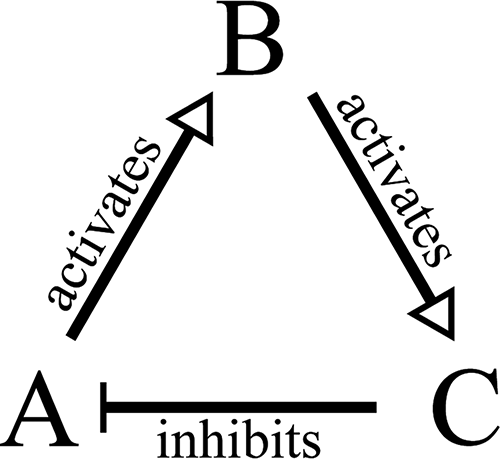
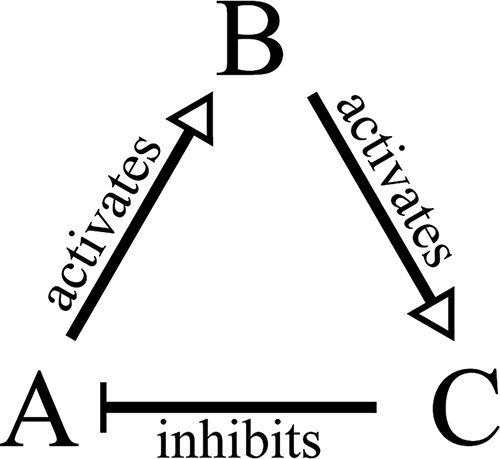
But surely this cannot be the whole story. Are simple cartoon diagrams not often misleading because they are distorted representations of the underlying biological reality? They can indeed be misleading, but the issue is not with the representation itself (unless it is wrong, of course); the problem is rather that it is very easy to draw unwarranted inferences from an informal description. To explain what I mean, consider figure 2, which represents a scheme of molecular reactions known as the ‘Goodwin oscillator’ (Goodwin Reference Goodwin1965). As the name suggests, this kind of organization can produce oscillatory behavior. An informal explanation might go like this: if A is active in the initial state, it will activate B, which in turn activates C. But once C is active, it will inhibit A, which leads to the inactivation of B, which as a result inactivates C again. This relieves the inhibition of A, and the cycle starts again. The problem with this intuitive account is that it works only for very specific realizations of the interactions (Bechtel and Abrahamsen Reference Bechtel and Abrahamsen2010). For example, the inhibition of A by C must be strongly nonlinear for oscillations to occur. Thus, while the informal account above might be considered a sufficient explanation of oscillatory behavior, the same kind of reasoning can be misleading if it is used for purposes of inference, for example, to predict how the system will behave in different circumstances. But this should not be considered a failure of parsimony but a failure of inference. It is like failing to take into account the possibility that  if the numbers are represented with limited precision. In sum, while parsimony plays a role in the mechanistic explanations of molecular biology both in an epistemic and in an ontic sense, it often appears in the innocuous form of the razor of silence.
Goodwin oscillator.
4. Parsimony in Systems Biology
Systems biology is often presented as a superior way of coping with biological complexity, and given that Occam’s razor is considered a bad tool by some of its proponents, one might expect that considerations of simplicity do not play a significant role in this field. It might come as a surprise then that the renowned systems biologist Uri Alon dedicates an entire chapter of his introductory textbook to “simplicity in biology.” There he writes: “There is no a priori reason that immensely complex biological systems would be understandable. But despite the fact that biological networks evolved to function and not to be comprehensible, simplifying principles can be found that make biological design understandable to us” (Alon Reference Alon2007, 233). As examples of such principles he mentions network motifs, modularity, the ability to use simple mathematical models, and unifying design principles such as robustness. This suggests that for their strategies to be successful, systems biologists rely on certain empirical expectations about the simplicity of biological organization as well. One of the main factors in this context are the limits of mathematical modeling.
Mathematical tools can avoid problems of informal reasoning by making assumptions more precise and by drawing more reliable inferences. For example, using an explicit mathematical model of the Goodwin oscillator shown in figure 2, one can determine the conditions under which oscillations occur and what other behaviors can be expected. At the same time mathematical models never represent the full complexity of biological systems. Even with the computational power available nowadays, the limits of the level of detail with which molecular processes can be described are quickly reached, so even the most advanced models usually include drastic simplifications. But even more importantly, the complexity of a model must be balanced against the quality of available data if it is to serve as a reliable inferential tool (Gross and Green Reference Gross and Green2017). This use of parsimony can be defended in terms of predictive accuracy, as mentioned in section 2.2.3.Footnote 1
Can the simplicity of models in systems biology also be defended on grounds of truth? Unfortunately, the razor of silence is not available to justify the kinds of idealizations used in mathematical models. While making assumptions more precise may be advantageous for purposes of inference, it unavoidably makes the model less probable. Because a mathematical model is a formal tool, it is not consistent with possible extensions in the same way as the informal descriptions of molecular biology. To exclude possible causal factors from such a model effectively means to treat them as nonexistent and thus to apply the razor of denial. Similarly for epistemic parsimony: if a nonlinear interaction is represented as linear in a model, the model is strictly speaking wrong.
5. Conclusion
Parsimony plays an important role in both molecular and systems biology, and at first sight these roles seem to mirror each other. In both cases there is an expectation that biological organization is in some sense simple such that the proposed scientific approach has a chance of being successful in the first place. Furthermore, simplicity is introduced deliberately in the concrete accounts of biological phenomena.
It is important to note, however, that there is a clear asymmetry in the sense that simplicity plays very different roles and may be justified in different ways. Molecular biologists use simple informal descriptions that can be literally true while consistent with possible refinements or extensions. These informal descriptions bear the risk of leading to wrong inferences. Systems biology offers formal models as a remedy for such inferential failures, but the kind of simplicity introduced in the models drives them away from the truth.
These differences should not be seen as implying the incompatibility of the two approaches. On the contrary, clarifying the roles of simplicity leads to a better understanding of how they can work together synergistically.