


1. INTRODUCTION
Personal pronouns are common in everyday conversation, and hearers usually understand who the intended referent is. However, pronoun reference can sometimes be ambiguous. A speaker can try to avoid misinterpretation due to ambiguity, by using cues like pointing to the referent (gesture) or by using syntactic focus (grammar). The speaker often does this unconsciously, and expects the hearer to be sensitive to the cues. One of the cues that speakers and hearers use without being aware of it, is intonation. Nevertheless, a focally accented pronoun should guide hearers to select an alternative referent to the one they would select if the pronoun had been unaccented.Footnote 1 At least, this has been postulated on the basis of theoretical accounts (see references below). However, it remains an open question whether hearers understand those cues as expected, and how sensitivity to intonation as a cue develops across ages and in different languages.
Several studies suggest that if a pronoun in subject position is unaccented, both children and adults generally prefer the first-mentioned antecedent (which is also often the subject) of the preceding sentence (see Hartshorne, Nappa & Snedeker Reference Hartshorne, Nappa and Snedeker2014 for an overview), as shown in the example in (1).
(1) Annai hugged Monicaj, and then shei hugged Christinek.
In contrast, if the pronoun is focally accented, as in (2), its natural referent will instead be the object/second-mentioned antecedent of the previous sentence (e.g. Givón Reference Givón1983, Ariel Reference Ariel1990).Footnote 2
(2) Annai hugged Monicaj, and then SHEj hugged Christinek.
Furthermore, syntactic position plays a role: If the pronoun appears in object position, as in (3), it refers to the object antecedent when unaccented and to the subject antecedent when focally accented.
(3) Annai hugged Monicaj, and then Christinek hugged herj/HERi.
This may be explained by the fact that the interpretation of pronouns is constrained by parallelism.
1.1 Parallelism
An unaccented pronoun in subject position is often intended to refer to a previously mentioned referent that is also in subject position, due to their parallel positions (e.g. Solan Reference Solan1983, Smyth Reference Smyth1994). Furthermore, having the same verb in both sentences can lead to a stronger sense of parallelism (e.g. examples (1), (2) and (3) above, where hug is mentioned repeatedly in each story) (Venditti et al. Reference Venditti, Stone, Nanda and Tepper2002). However, there are exceptions. Pragmatic factors like contrasting accent and choice of verbs can easily override parallelism. Contrasting accent does not indicate which referent the pronoun refers to, but signals that the referent is not in a parallel position to it (Baauw, Ruigendijk & Cuetos Reference Baauw, Ruigendijk, Cuetos, van Kampen and Baauw2004). Syntactic parallelism is widely attested in a number of related phenomena, such as ellipsis, constituent substitution, etc. (Dubey, Sturt & Keller Reference Dubey, Sturt and Keller2005, Dubey, Keller & Sturt Reference Dubey, Keller and Sturt2008). It has been shown that parallel structures, such as coordination, occur frequently in corpora, and facilitate processing by means of priming (Dubey et al. Reference Dubey, Keller and Sturt2008).
Earlier research (Hornby Reference Hornby1973, Solan Reference Solan1980, Baauw et al. Reference Baauw, Ruigendijk, Cuetos, van Kampen and Baauw2004) suggests that when adults resolve pronouns, they use parallelism as a strategy to find the intended referent: If the pronoun is unaccented, they find the parallel antecedent and select it; if the pronoun is accented, they first find the parallel antecedent and then select a different antecedent. Children seem to find this process too complicated or they simply lack sensitivity to this phenomenon (Hornby Reference Hornby1973, Solan Reference Solan1980, Baauw et al. Reference Baauw, Ruigendijk, Cuetos, van Kampen and Baauw2004). There is, however, no consensus about which strategy children use instead when faced with focally accented and unaccented pronouns in various sentence positions.
Several researchers have studied the development of children's pronoun resolution skills (e.g. Arnold, Brown-Schmidt & Trueswell Reference Arnold, Brown-Schmidt and Trueswell2007, Bittner & Kuehnast Reference Bittner and Kuehnast2011, Hartshorne et al. Reference Hartshorne, Nappa and Snedeker2014, Järvikivi et al. Reference Järvikivi, Pyykkönen-Klauck, Schimke, Colonna and Hemforth2014, Pyykkönen, Matthews & Järvikivi Reference Pyykkönen, Matthews and Järvikivi2010, Sekerina, Stromswold & Hestvik Reference Sekerina, Stromswold and Hestvik2004), but few have investigated the role of intonation in this domain (see Section 1.4 below). In addition, most of the pronoun studies have been done with English-speaking children (English: e.g. Sekerina et al. Reference Sekerina, Stromswold and Hestvik2004, Arnold et al. Reference Arnold, Brown-Schmidt and Trueswell2007, Pyykkönen et al. Reference Pyykkönen, Matthews and Järvikivi2010, Hartshorne et al. Reference Hartshorne, Nappa and Snedeker2014; German: e.g. Järvikivi et al. Reference Järvikivi, Pyykkönen-Klauck, Schimke, Colonna and Hemforth2014; German and Bulgarian: Bittner & Kuehnast Reference Bittner and Kuehnast2011). The current study aims to fill this gap by using eye-gaze data in the context of focally accented pronoun resolution, and with monolingual Norwegian children as participants. We also tested a group of monolingual Norwegian adults, to be able to determine whether the children had reached adult proficiency. In the following sections, we present relevant theories and previous research on the topic, and justify the rationale of the current study.
1.2 Central theories in pronoun resolution
Among the theories that are central in regards to pronoun resolution, we find the Givenness hierarchy, the Centering theory and theories by Kameyama (Reference Kameyama, Bosch and van der Sandt1999), like the Complementary Preference Hypothesis. These theories aim to explain why speakers sometimes use unaccented pronouns and other times resort to focally accented pronouns or even full noun phrases to refer to an antecedent. They are thus appropriate as frameworks for how to interpret findings in experimental research on focally accented pronoun resolution.
In the Givenness hierarchy (Gundel, Hedberg & Zacharski Reference Gundel, Hedberg and Zacharski1993), possible referents can have low or high cognitive status, which affects their probability of getting selected as the intended referent. Imagine that a speaker wants to refer to an entity, for example a book. In English, the referring expression is likely to be it if the entity is both activated (e.g. mentioned in the previous discourse) and in attentional focus. In contrast, a book will be appropriate if the referent is minimally activated. A highly activated entity is represented in the hearer's short-term memory, is in the center of the hearer's attention, and is likely to be the topic of the speaker's subsequent utterances (Gundel et al. Reference Gundel, Hedberg and Zacharski1993). In the sentences in (1) and (2) above, the subject referent (Anna) is both activated and in focus, whereas the object referent (Monica) is only activated. This is due to the subject referent being the first-mentioned entity and the agent of the action (the hugging).Footnote 3 In sentence (1), the unaccented she can only refer to Anna. However, in sentence (2), the focally accented she is lower in the Givenness hierarchy and thus has fewer restrictions when it comes to possible referents. It can refer to a referent that is only activated, or to a referent that is both activated and in focus (Gundel et al. Reference Gundel, Hedberg and Zacharski1993). Focally accented pronouns are thus more ambiguous in nature, although they most often refer to the referent with the lower status, in accordance with Givón (Reference Givón1983) and Ariel (Reference Ariel1990). This suggests that our experiment will yield clearer preferences for unaccented pronouns than for accented ones.
According to the Centering theory (Grosz, Weinstein & Joshi Reference Grosz, Weinstein and Joshi1995), some entities in an utterance are more central than others, and thus more likely to be referred to in the subsequent utterances. The choice of referring expression depends on the properties of the entities in the preceding utterance, similar to the Givenness hierarchy. Building on the centering framework, Walker & Prince (Reference Walker and Prince1996) suggest that initiation of a new center entity could be achieved by accenting a pronoun so that it may refer to the lesser prominent entity from the preceding utterance. Thus, Centering theory and the Givenness hierarchy agree with Givón (Reference Givón1983), Ariel (Reference Ariel1990) and Fretheim (Reference Fretheim1996) in that pronouns typically switch referent when they are focally accented.
Another theory dealing with referent assignment, the Complementary Preference Hypothesis, states that ‘[a] focused pronoun takes the complementary preference of the unstressed counterpart’ (Kameyama Reference Kameyama, Bosch and van der Sandt1999:315). An example is shown in (4) (Kameyama Reference Kameyama, Bosch and van der Sandt1999:306).
(4) Johni hit Billj. Then hej/HEi was injured.
Here, the unaccented he refers to Bill despite the fact that the pronoun and its referent are not in parallel positions. This is due to the verb injured, because getting injured is likely to be a consequence of getting hit. However, a focally accented he will refer to the other possible referent, which is John. The accent emphasizes the contrast between the two possible outcomes, as we initially expected Bill to be injured, not John.
Nevertheless, de Hoop (Reference de Hoop, Blutner and Zeevat2004) rejects the Complementary Preference Hypothesis, and she also proposes that Ariel and Givón's theories are too simplistic. These theories cannot explain cases where the pronoun is accented despite there being only one available antecedent. De Hoop (Reference de Hoop, Blutner and Zeevat2004:164) exemplifies this with (5).
(5) Johni hit Maryj. Then HEi was injured.
Despite the lack of other male antecedents, the accented pronoun does not sound strange. This is due to the surprising outcome of the hitting, which is a contrast to the expected outcome. In de Hoop's own words: ‘stressed pronouns indicate the presence of a rhetorical relation of contrast between two situations within the discourse’ (de Hoop Reference de Hoop, Blutner and Zeevat2004:171). Thus, contrast should be controlled for when investigating accented pronouns, either by keeping contexts neutral or by making clear contrasts.
1.3 Norwegian studies on focally accented pronouns
Apparently, Norwegians rarely pronounce pronouns with focal accent when reading texts where that would have been appropriate (Andreeva et al. Reference Andreeva, Bott, Koreman, Solstad, Asu and Lippus2013). Nonetheless, Norwegian comprehension studies suggest that intonation in oral communication is of great importance. In a study by Fretheim (Reference Fretheim1996), adults heard the story in (6) three times (Fretheim Reference Fretheim1996:91). The only difference between them was the intonation used in the final sentence.
(6) Denne historien handler om Kim. Kim bor sammen med sin mor. Hun lever og ånder for sin datter.
‘This story is about Kim. Kim is living with his/her (refl) mother. She dotes on [literally: lives and breathes for] her (refl) daughter.’
This led to three different interpretations, depending on the intonation in the final sentence. If it was ‘She lives and breathes for her DAUGHTER’, it would be about Kim and her previously unmentioned daughter. If it was ‘She lives and BREATHES for her daughter’ (with non-focal accent on ‘she’) it would be about Kim's mother and Kim. Finally, if the sentence was ‘SHE lives and breathes for her DAUGHTER’, it would be about Kim's mother and Kim's previously unmentioned sister (here, Kim must be a boy) (Fretheim Reference Fretheim1996).
In another study, Borthen, Fretheim & Gundel (Reference Borthen, Fretheim, Gundel, Mitkov and Boguraev1997) investigated how, in Norwegian, participants comprehended the feminine pronoun henne ‘her’ when the neuter pronoun det was unaccented (equivalent to ‘it’) or focally accented (equivalent to ‘that’) in the story in (7) (Borthen et al. Reference Borthen, Fretheim, Gundel, Mitkov and Boguraev1997:90–91).
(7)
a. Gro spurte Anne om hun var klar over at Senterpartiets oppslutning var synkende.
‘Gro asked Anne if she was aware that the Center Party's popularity was decreasing.’
b. Hun fikk ikke noe svar.
‘She didn't get any answer.’
c. Det/DET kom som en overraskelse på henne.
‘It/That came as a surprise to her.’
Here, no accent on det ‘it’ links it to the furthest possible antecedent.Footnote 4 Thus, det was intended to refer to the fact that the Center Party's popularity was decreasing, and henne ‘her’ was intended to refer to Anne. Focal accent on det ‘that’ links it to the closest antecedent. Det was intended to refer to the fact that Gro did not get any answer, and henne ‘her’ was intended to refer to Gro. The authors also used a story where sentence (7b) was replaced with Hun svarte ikke ‘She didn't answer’, in which hun ‘she’ now was intended to refer to Anne instead of Gro. There, the intended referents of sentence (7c) were the opposite of what they were in the first-mentioned story. For all stories, the participants mostly gave the answer that was expected on the basis of the pronunciation of det. However, they showed a slight tendency to let henne ‘her’ refer to whichever woman was the intended referent in utterance (7b) even when this was not the expected interpretation. Thus, even though the participants were influenced mostly by the intonation in utterance (7c), they were also inclined to select the antecedent that was in the center of their attention from utterance (7b). This is in accordance with the Centering theory (Borthen et al. Reference Borthen, Fretheim, Gundel, Mitkov and Boguraev1997).
1.4 Children's production and comprehension of focally accented pronouns
Children attend to prosodic aspects of speech already from birth. Before two months of age infants can discriminate their native language from another language on the basis of prosodic properties alone (intonation and rhythm, Mehler et al. Reference Mehler, Jusczyk, Lambertz, Halsted, Bertoncini and Amiel-Tison1988, Nazzi, Bertoncini & Mehler Reference Nazzi, Bertoncini and Mehler1998). 1- to 2-month-olds can discriminate pitch changes (Kuhl & Miller Reference Kuhl and Miller1982); 6-month-olds begin to use prosodic information to bootstrap syntactic phrasing (Speer & Ito Reference Speer and Ito2009), and 4-year-olds can both understand and use intonation based information structure (Sauermann et al. Reference Sauermann, Höhle, Chen, Järvikivi, Washburn, McKinney-Bock, Varis, Sawyer and Tomaszewicz2011). This is reflected in child-directed speech, which is characterized by exaggerated expression of prosody (Trainor, Austin & Desjardins Reference Trainor, Austin and Desjardins2000). These facts suggest that children may be sensitive to intonation in speech, including utterances with pronouns. However, syntactic parallelism is apparently not straightforward or easy to grasp for children (see references below). In addition, children's pronoun comprehension develops slowly, as attested in research (see references below).
The earliest study of children's use of intonation in distinguishing referents was conducted by Hornby & Hass (Reference Hornby and Hass1970). English-speaking 3- to 4-year-olds participated in a picture description task. They were first shown a picture of a girl riding a bike, and were asked what was happening in the picture. When they had answered, they were shown a new picture where a boy was riding a bike. When they were asked about what was happening there, most of the children put focal accent on the word boy (a BOY rides a bike). This is also what adults would do. The accenting was triggered by the contrast between the two pictures, whose only difference was the referent. The boy was a contrastive referent, and this use of accenting can be called contrastive accent. MacWhinney & Bates (Reference MacWhinney and Bates1978) studied the same in English-speaking 3- to 5-year-olds, and found that the 5-year-olds produced accented words more often than the 3-year-olds. They did not find this in Hungarian- and Italian-speaking children, which suggests that there are cross-linguistic differences in accentuation. Here, the differences seemed to be due to the existence of other ways to mark newness in Hungarian and Italian, such as word order. Norwegian seems to be more similar to English in this respect (Fretheim Reference Fretheim1996).
Both the production and comprehension of focally accented pronouns seem to develop gradually. According to Chen (Reference Chen2011), the distribution of focus-marking accents becomes relatively more adult-like in Dutch-speaking 7- and 8-year-olds as compared to 4- and 5-year-olds. However, English-speaking 10-year-olds are still not quite adult-like in their comprehension of certain aspects of intonation (Cruttenden Reference Cruttenden1985, Wells, Peppé & Goulandris Reference Wells, Peppé and Goulandris2004). Thus, while we can expect a difference between the Norwegian 3-, 5- and 7-year-olds in the current study, even the oldest age group will probably not be totally adult-like in their pronoun resolution.
There are few existing studies of children's comprehension of focally accented pronouns. In a study by Maratsos (Reference Maratsos1973), English-speaking 3-, 4- and 5-year-olds listened to sentences with ambiguous pronouns that were either focally accented or unaccented, like sentence (8) (Maratsos Reference Maratsos1973:3).
(8) Susiei jumped over the old womanj, and then Harryk jumped over HERi.
Afterwards, the children were to act out the two actions with small dolls. The three age groups were equally proficient when the pronouns were unaccented (83–93% correct). However, when the pronouns were focally accented, the 3-year-olds chose the correct referent in fewer than half of the trials (47% correct). In contrast, the 5-year-olds performed almost as accurately on the focally accented pronouns as the unaccented ones (78% correct). The finding that young children manage to select the intended referent more easily when the pronoun is unaccented, is also supported by other studies (Hornby Reference Hornby1973, Baauw et al. Reference Baauw, Ruigendijk, Cuetos, van Kampen and Baauw2004).
Nevertheless, Solan (Reference Solan1980) found the opposite pattern when he studied English-speaking 5- to 7-year-olds. They were more accurate after focally accented pronouns than after unaccented ones. Here too, the gap seemed to close with age; whereas 5-year-olds got 80% of focally accented words and 39% of unaccented words correct, 6-year-olds scored 84% versus 67%, and 7-year-olds scored 77% versus 74% (Solan Reference Solan1983). The 5-year-olds in Solan's study behaved very differently from their peers in the study by Maratsos (Reference Maratsos1973). This could be due to an artifact of methodology, as different types of pronoun resolution tasks have been found to lead to quite different results (Bergmann, Paulus & Fikkert Reference Bergmann, Paulus and Fikkert2012). Solan's participants heard sentences with similar structure to those in the study by Maratsos (Reference Maratsos1973). However, they only had to act out the last-mentioned action. They may therefore have paid more attention to that clause than the first one, to prepare for their task. By focusing more on the pronoun clause, they may have noticed differences in intonation better. In contrast, the participants in the study by Maratsos had to pay an equal amount of attention to each of the two clauses, because they were to act out both of them. This may have driven their focus away from the intonation of the utterance.
It is, however, difficult to identify from these studies which strategies children employ when resolving focally accented pronouns. Baauw et al. (Reference Baauw, Ruigendijk, Cuetos, van Kampen and Baauw2004) claim that they use the Topic Prominence Principle, which states that ‘sentence topics are privileged antecedents for pronouns’ (Baauw et al. Reference Baauw, Ruigendijk, Cuetos, van Kampen and Baauw2004:110). In their study, Spanish-speaking 5-year-old children tended to prefer the subject referent (which was also the sentence topic) from the preceding sentence. They did this not only after unaccented pronouns in subject position, but also after many of the unaccented pronouns in object position. They showed poor performance on parallelism (see Section 1.1 above) and even poorer on contrastive accent. Baauw and colleagues suggest (Baauw et al. Reference Baauw, Ruigendijk, Cuetos, van Kampen and Baauw2004) that the children had skills in these two systems, but that lack of processing resources often stopped them from applying that knowledge. Instead, they resorted to another strategy, namely the Topic Prominence Principle. However, the finding may also have to do with children's sensitivity to visual context, in that visual action creates a bias towards the subject/agent (Foyn, Vulchanova & Eshuis Reference Foyn, Vulchanova and Eshuis2017).
On the one hand, Baauw et al. (Reference Baauw, Ruigendijk, Cuetos, van Kampen and Baauw2004) suggest that when children are resolving focally accented pronouns, they first have to employ parallelism and then choose the referent that is not selected by parallelism. Baauw and colleagues further state that this exceeds many children's processing capacity and makes them choose the subject referent in general. On the other hand, Solan (Reference Solan1983) claims that since the 5-year-olds are not using parallelism correctly in his 1980 study, they are getting the focally accented utterances right for the wrong reasons. He argues that they use the Reciprocal Function Strategy, which states that ‘[a] pronoun is interpreted as referring to a referent in the opposite role in the preceding clause’ (Solan Reference Solan1983:193). Solan (Reference Solan1983) ran a second experiment, and the results suggested that to the extent that children use the parallelism strategy, they use it semantically rather than grammatically (i.e. prefer parallel agents rather than parallel subjects). They also seem to use this strategy more frequently as they get older. Thus, the account in Solan (Reference Solan1980, Reference Solan1983) can explain his results, and the account offered in Baauw et al. (Reference Baauw, Ruigendijk, Cuetos, van Kampen and Baauw2004) can explain their results, but neither study can explain the results of the other. The current study is intended to bring new experimental evidence to bear on resolving this controversy.
1.5 Eye-tracking studies on intonation
The few existing eye-tracking studies on children's comprehension of prosody have not investigated pronoun resolution, but can still give insights into other aspects of how proficient children are in their processing of focally accented words. For example, Ito and colleagues had displays of animals in different colors, and asked their participants questions like in (9) (Ito et al. Reference Ito, Jincho, Minai, Yamane and Mazuka2012:269).
(9)


She found that this naturally confused Japanese-speaking 6-year-olds and adults. They initially looked at an orange rabbit after hearing the second question, because accenting ore'nji ‘orange’ suggested that the referent's color was the only contrast with the first question. This was also found when English-speaking 6- to 11-year-olds participated in the same study. However, in both languages, even the oldest children processed the focally accented words slower than adults (Ito et al. Reference Ito, Jincho, Minai, Yamane and Mazuka2012, Ito et al. Reference Ito, Bibyk, Wagner and Speer2014). The delay is in part due to children's tendency to continue to look at the last-mentioned referent, as has been found in a number of studies (e.g. Arnold et al. Reference Arnold, Brown-Schmidt and Trueswell2007, Colonna, Schimke & Hemforth Reference Colonna, Schimke, Hemforth, Hemforth, Mertins and Fabricius-Hansen2014, Hartshorne et al. Reference Hartshorne, Nappa and Snedeker2014). Thus, Ito (Reference Ito and Matthews2014) claims that the pause before the critical sentence should be long enough for the children to get past their tendency to perseverate.
Few eye-tracking studies have looked at adults’ resolution of focally accented pronouns. However, Venditti and colleagues (Venditti et al. Reference Venditti, Stone, Nanda and Tepper2001, Reference Venditti, Stone, Nanda and Tepper2002) investigated which illustrated referent English-speaking adults looked at when hearing the pronouns in stories like (10) (Venditti et al. Reference Venditti, Stone, Nanda and Tepper2001:28).
(10)
a. The animals were playing out near the barn when something unexpected happened.
b. The lion started going ballistic.
c. He hit the alligator with a long wooden rake.
d. Then he/HE hit the duck.
e. A big fight ensued and it was a terrible scene.
The results suggested that adults have trouble with comprehending focally accented pronouns. However, this study is problematic in several respects: it included only eight participants; it depicted the duck (object referent of sentence (10c)), and was thus drawing attention away from the actually interesting antecedents; it may have created a subject bias by pronominalizing the subject antecedent (i.e. the lion), but not the object antecedent (i.e. the alligator), prior to the critical sentence (10d) (see Arnold et al. Reference Arnold, Brown-Schmidt and Trueswell2007). Hence, a new, less biased, study on adults’ processing of focally accented pronouns is needed.
1.6 The current study
The results from previous studies are conflicting, and no eye-tracking studies have investigated how children resolve focally accented pronouns. Furthermore, this area has not been studied with Norwegian children before. With the current study we will try to fill this gap by having not only adults, but also children, as participants. We aim to explore what strategies they resort to when hearing pronouns, and to what extent they can successfully use focal accent in pronoun resolution. In addition to offline responses, we used eye-tracking measures in the design. Eye-tracking can reveal detailed information on how children go about moment by moment when they process pronouns (Trueswell Reference Trueswell and Hoff2011).
In the current study, the participants heard sentences like (11) (see the complete set of sentences in Appendix A).
(11)

While hearing the sentences, the participants saw the corresponding figures (e.g. Maria and Sara) on the screen in front of them (see Figure 1 for an example). We decided to use cartoon girls and boys as visual referents rather than cartoon animals, since it is easier to show the gender of humans than animals. Moreover, in a previous study where we used cartoon animals (Foyn et al. Reference Foyn, Vulchanova and Eshuis2017), several of the child participants selected pronoun referents depending on which animal had the abilities or looks that best fit the action from the preceding sentence. A kangaroo would be more likely to jump on a trampoline than an elephant would. With cartoon boys and girls, we avoided this problem. Two girls would be equally likely to perform any action. Hartshorne et al. (Reference Hartshorne, Nappa and Snedeker2014) have previously run successful experiments with cartoon boys and girls, which made us confident that this was the right visual design to choose.
Example of the stimuli figures shown on screen. The illustrations were in color in the experiment.

Furthermore, we tried to avoid a general subject bias in the current study by keeping the visual context neutral. This was done by never visually depicting the actions performed by the subject referent. It appears that both adults and young children who see the action are more prone to choose the agent as the pronoun referent (Foyn et al. Reference Foyn, Vulchanova and Eshuis2017). Instead, we showed the subject and the object referent standing still with the same posture. It is reasonable to expect that less animated visual context will make the participants pay more attention to the linguistic cues.
1.7 Hypotheses
Previous studies attest conflicting evidence for children (see Maratsos Reference Maratsos1973 and Baauw et al. Reference Baauw, Ruigendijk, Cuetos, van Kampen and Baauw2004 vs. Solan Reference Solan1980, Reference Solan1983). Nevertheless, we can expect a development towards adult proficiency between the ages of three years and seven years (Maratsos Reference Maratsos1973; Solan Reference Solan1980, Reference Solan1983; Chen Reference Chen2011). For the 3- and 5-year-olds in the current study, we can expect confusion in their choice of pronoun referent, due to limitations in language comprehension, and most probably, processing limitations. Furthermore, we expect the 7-year-olds to resolve the pronouns correctly to a large degree, consistent with Solan (Reference Solan1980). In addition, we expect children to process the pronouns at a lower speed than adults, but to improve with age (e.g. Hartshorne et al. Reference Hartshorne, Nappa and Snedeker2014). Finally, we expect the children to not yet master the parallelism strategy (see Section 1.1), and thus be less proficient in their pronoun resolution than the adults.
Consistent with theoretical accounts (Givón Reference Givón1983, Ariel Reference Ariel1990), we expect the adults to resolve unaccented pronouns as subject referents, and focally accented ones as object referents from the preceding sentence. However, even though the adults probably master the parallelism strategy (see Section 1.1 above), experimental research attests that they sometimes resort to selecting the subject referent from the previous utterance regardless of intonation (Borthen et al. Reference Borthen, Fretheim, Gundel, Mitkov and Boguraev1997, Venditti et al. Reference Venditti, Stone, Nanda and Tepper2002, Baauw et al. Reference Baauw, Ruigendijk, Cuetos and Avrutin2011). This can be explained by the Givenness hierarchy (Gundel et al. Reference Gundel, Hedberg and Zacharski1993), where accented pronouns allow a wider range of possible referents because they are lower in the hierarchy than unaccented pronouns. An additional explanation is offered by Baauw et al. (Reference Baauw, Ruigendijk, Cuetos and Avrutin2011), who suggest that adults resort to their default subject preference if they are for some reason distracted from applying the correct pronoun resolution strategies (e.g. parallelism, cause-effect relation, and contrastive accent). Consequently, we expect the adults to show a slightly lower target preference after focally accented subjects than after unaccented ones. Still, we expect an overall preference for the object referent from the preceding sentence after focally accented pronouns, and a subject preference after unaccented pronouns.
2. METHOD AND MATERIALS
2.1 Participants
In the current study, we included Norwegian monolingual 3-, 5- and 7-year-olds as participants, in addition to a Norwegian monolingual adult control group. The study was conducted at the kindergarten, school or university the participants attended. Originally, the study had 31 3-year-olds, 29 5-year-olds, 31 7-year-olds, and 30 adult participants. Participants who provided eye-tracking data for only one of the two conditions, had more than one first language, or were noticeably unfocused on their tasks during the experiment, were excluded from further analysis. The remaining participants thus included 22 3-year-olds (female: 10, mean age: 3;6 (i.e. three years;six months), range: 2;8–4;1), 27 5-year-olds (female: 15, mean age: 5;5, range: 4;6–6;1), 25 6–7-year-olds (female: 13, mean age: 6;8, range: 6;3–7;2) and 26 adults (female: 16, mean age: 24;7, range: 19;8–34;4). The study was carried out in accordance with the recommendations of the Norwegian Social Science Data Services (NSD), and informed written consent was obtained from the adult participants and the child participants’ parents or caregivers. In exchange for their participation, the children received a lab T-shirt and the adults received a bookstore voucher of 50 NOK (Norwegian kroner).
2.2 Materials
The experiment was designed in E-Prime 2.0, and conducted with a portable Tobii T120 eye-tracker.
There were four stimuli figures in the experiment; two girls and two boys. The figures’ names were selected from lists of the most popular names for Norwegian children, to heighten the chances that the participants were familiar with them.
In order to avoid potentially confounding factors, we counterbalanced left/right screen position of the figures within and between participants (i.e. had the figures appear on the left side 50% and the right side 50% of the time). We also counterbalanced the subject/object roles of the figures within and between participants.
There were two different experimental conditions (unaccented pronoun and focally accented pronoun), and four trials per condition. As filler trials, we used 12 trials from another experiment on grammatical gender.
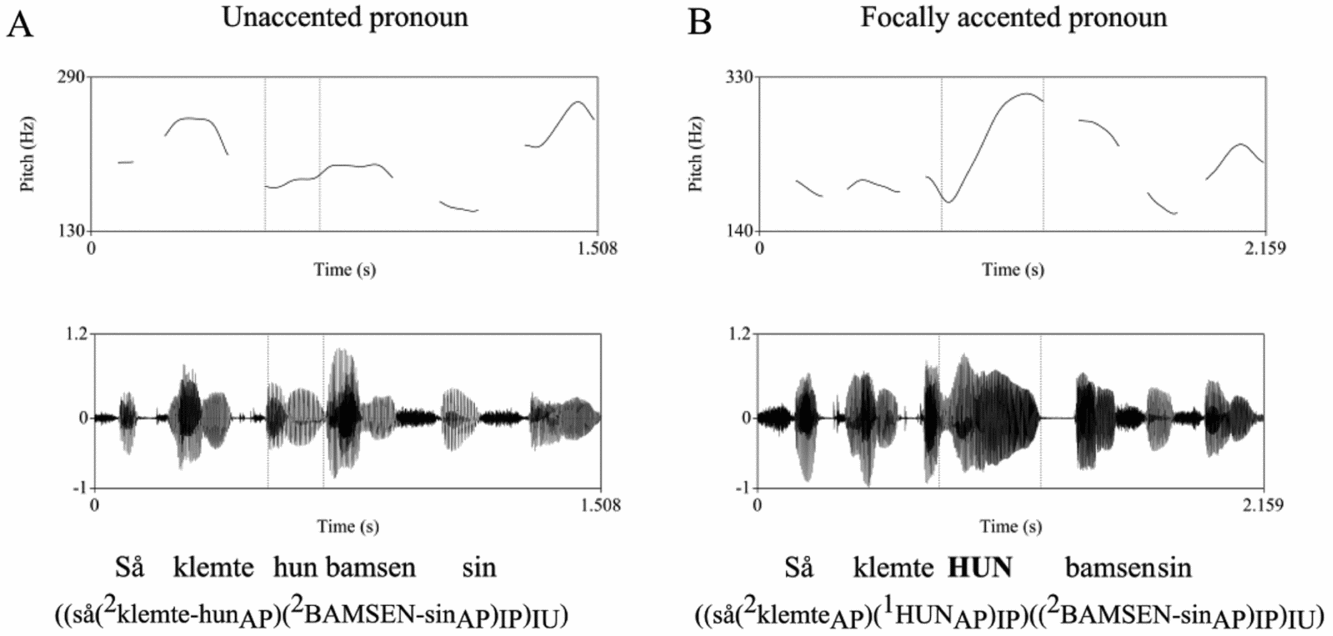
During the experiment, the participants listened to recorded stimulus sentences. These were recorded in a sound-proof room, and read by a Norwegian female voice in a low-tone dialect.Footnote 6 The sentence intonation was held constant except for exchanges between focally accented and unaccented pronouns, as illustrated in Figure 2. Note that the focally accented pronoun lasts longer than the unaccented one, and has a higher pitch and frequency. Together, these factors make it more prominent.
Example of pitch contours and waveforms from the critical pronoun sentence Så klemte hun/HUN bamsen sin ‘Then she/SHE hugged her own teddy bear’. Unaccented pronoun in A and focally accented pronoun in B.

We created eight stories that were compatible with both experimental conditions (see Appendix A). The sentences were in the past tense, because the actions were not shown visually and thus the present tense was not suitable. The counterbalancing and story distribution produced eight lists. An approximately equal number of participants were tested on each list. The trials were presented in a pseudo-random order, so that the same condition never appeared twice in a row.
Experiment trials were structured as follows: A fixation cross appeared in the middle of the screen, and spun around until the participant looked at it. The eye-gaze instigated continuation of the trial, and the fixation cross disappeared. This was done to ensure the participant was paying attention to the screen. He/she then saw two figures, one on each side of the screen. They remained unchanged on the same spots throughout the trial. Before hearing any sentences, the participants saw the figures for three seconds, in order to get used to them and their positions. They then heard the first sentence (e.g. Maria klemte Sara ‘Maria hugged Sara’). Two seconds after the onset of that sentence, they heard the critical pronoun sentence (e.g. Så klemte hun bamsen sin ‘Then she hugged her own teddy bear’) Four seconds after the onset of that sentence, they heard the interrogative sentence (e.g. Hvem klemte bamsen sin? ‘Who hugged her own teddy bear?’).
The participants were given four seconds to look at the figures without interruption after the onset of the critical pronoun sentence, because we wanted to ensure enough eye-gaze data. According to Hartshorne et al. (Reference Hartshorne, Nappa and Snedeker2014), young children can take up to four seconds to process a pronoun.
The experiment lasted for approximately 10 minutes, depending on how long breaks the participants wanted between trials. In the breaks, drawings of flowers and birds were shown in the middle of the screen until the participants were ready to start on the next trial.
2.3 Procedure
Each participant was presented with illustrations of two boys and two girls. The experimenter said the name of each figure while pointing at them. The experimenter then repeated the name of one of the figures, and asked the participant to point to it. This was done for all the figures. If the participant succeeded in this task, he/she was asked to say the name of the figures that the experimenter was pointing at. The experimenter changed the order of the drawings, and then repeated the latter naming task again. After repeated trials, most participants succeeded in saying the correct names of the figures while pointing at them. However, some of the youngest children refused to speak, but were still allowed to participate in the experiment if they repeatedly pointed to the correct figures after hearing their names.
The eye-tracker was calibrated to participants’ eyes with a five-point dot pattern. After the final question sentence in each trial, the experimenter repeated the question if the participant did not answer immediately. The participants answered by pointing to a figure on the screen or saying the name of a figure. To register the answers, the experimenter pressed the left or the right arrow on a computer keyboard, corresponding to the location of the chosen figure on the screen.
2.4 Analyses
Before running the analyses, we determined whether gazes were focused on the left or the right figure, elsewhere on the screen, or off screen. The size of the Areas of Interest (i.e. the area covered by a figure) was the same for all four figures. The data were median filtered, with window size 100 ms. We filled in data for track loss (i.e. where neither eye had been located by the eye-tracker) below 75 ms, by merging it into the preceding look (e.g. a look to the subject referent, object referent or elsewhere on the screen), resulting in a longer preceding look. The eye-tracking data were considered for analysis from the exact point in time of pronoun onset in each of the different pronoun sentences, and for the following 4000 ms. Data from trials with more than 50% track loss were excluded from the time course analyses, thus leaving us with 78.82% of the data.
The analyses we ran were influenced by those run by Barr (Reference Barr2008) and by Knoeferle & Kreysa (Reference Knoeferle and Kreysa2012). We analyzed offline answers to the interrogative sentence, about which of the figures the pronoun referred to (e.g. Hvem klemte bamsen sin? ‘Who hugged her own teddy bear?’), and log gaze probability ratio of looks to the target referent (as opposed to non-target referent) for each condition, over selected periods of time (see below). We ran generalized linear mixed effects analyses on the offline data, and linear mixed effects analyses on the different time course intervals. In all of the analyses, we started with running model selection in R (R Core Team 2015). We used the packages languageR (Baayen Reference Baayen2013), lme4 (Bates et al. Reference Bates, Kliegl, Vasishth and Baayen2015) and lmerTest (Kuznetsova, Brockhoff & Christensen Reference Kuznetsova, Brockhoff and Christensen2015).
In both the offline and the online analyses, intonation (i.e. no accent vs. focal accent on pronoun) was a fixed factor. In addition, the offline analysis included age, and the online analysis included slope (i.e. changes in looking behavior over time), as fixed factors. By including slope, we could determine whether any target preferences increased or decreased over time. The random factors consisted of participants (e.g. participant 1), stimuli figures (e.g. Maria and Sara) and story (e.g. the hugging story). We used R to select the model of best fit. In the first model, we included all two-way interactions, and in the subsequent models we removed step by step any random effects that did not contribute significantly to the maximal model. We then did the same for the fixed effects. The procedure was continued until either the removal of a term led to a significant decrease in model fit (AIC), or until the model contained only main effects.
An effect of intercept denotes that the mean is different from zero for a particular age group, i.e. a general target preference, or a general non-target preference.
2.4.1 Analysis of online data (eye-tracking measures)
For each of the intonation conditions from the overall data, we extracted the proportion of target referent looks relative to other looks, and the proportion of non-target referent looks relative to other looks. For creating plots, the data were divided into 50 ms windows, starting at pronoun onset and ending approximately 4000 ms after the onset. Here, we calculated the log gaze probability ratio for each window. Log gaze probability ratio was computed for the proportion of target referent looks relative to proportion of non-target referent looks (ln(P(target looks)/P(non-target looks))). A score of zero indicated that the two referents were looked at equally much or that the participant looked elsewhere on the screen; a positive value indicated more target referent looks, and a negative value indicated more non-target referent looks. For analysis, the data were aggregated into 200 ms windows, starting at 200 ms and ending 2600 ms after pronoun onset. We calculated the log gaze probability ratio for target referent looks (i.e. looks to the subject referent after unaccented pronouns and looks to the object referent after focally accented pronouns) relative to non-target referent looks for each window, and ran analyses of two time windows for each age group. To minimize collinearity, the first 200 ms of the window were coded as –1.5, the second 200 ms as –0.5, the third 200 ms as +0.5 and the last 200 ms as +1.5. We ran model selections for each of the two windows in each age group, by using a linear mixed effects approach in R. See Appendix B for the final model structures.
We ran separate model comparisons for each age group from the start, to find the best fitting models for each group. Since previous research shows that children and adults often process ambiguous pronouns with different speed (Hartshorne et al. Reference Hartshorne, Nappa and Snedeker2014), this seemed like a reasonable way to analyze the data. It allowed us to analyze earlier time windows for older compared to younger participants, in the cases where this was justified by the online data graphs. Otherwise, effects happening at different times in the four different age groups might have led to interactions that might not be detectable with four items per condition, and hard to detect and interpret in general. The time windows were selected following a visual inspection of the timeline curves’ beginnings and ends observed in the overall data. Since the first parts of the timeline begin before the participants have started to process the pronoun, and the last parts end after the oldest participants have finished their pronoun processing, we focused on the middle parts of the timeline.
Thus, for the 3-year-olds, we analyzed the time windows 800–1599 and 1600–2399 ms after pronoun onset; for the 5-year-olds, we analyzed the time windows 800–1599 and 1600–2399 ms after pronoun onset; for the 7-year-olds, we analyzed the time windows 600–1399 and 1400–2199 ms after pronoun onset; for the adults, we analyzed the time windows 400–1199 and 1200–1999 ms after pronoun onset.
2.4.2 Analysis of offline data (response to question)
We did not run separate offline comparisons for each age group, as processing speed was not an issue there. Target answers were coded as 1 and non-target answers were coded as 0. Model selection was performed using a generalized linear mixed effects model approach in R. See Appendix B for the final model structures.
3. RESULTS
3.1 Results from the adults
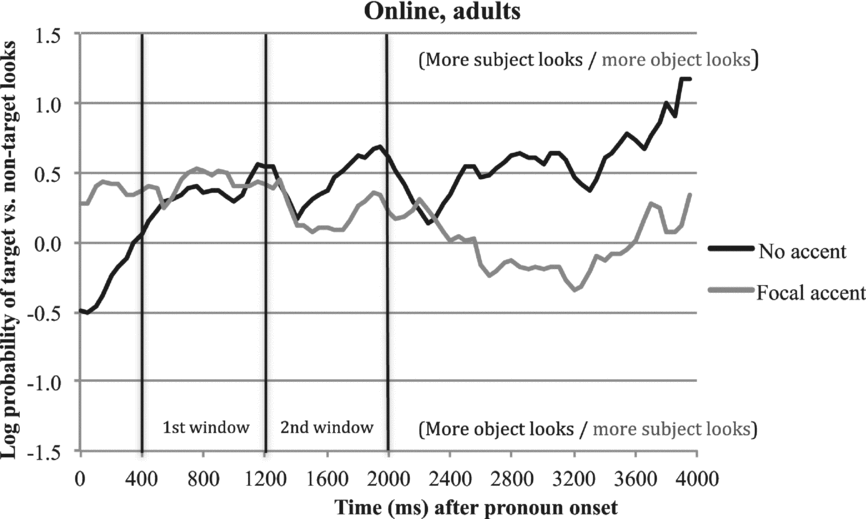
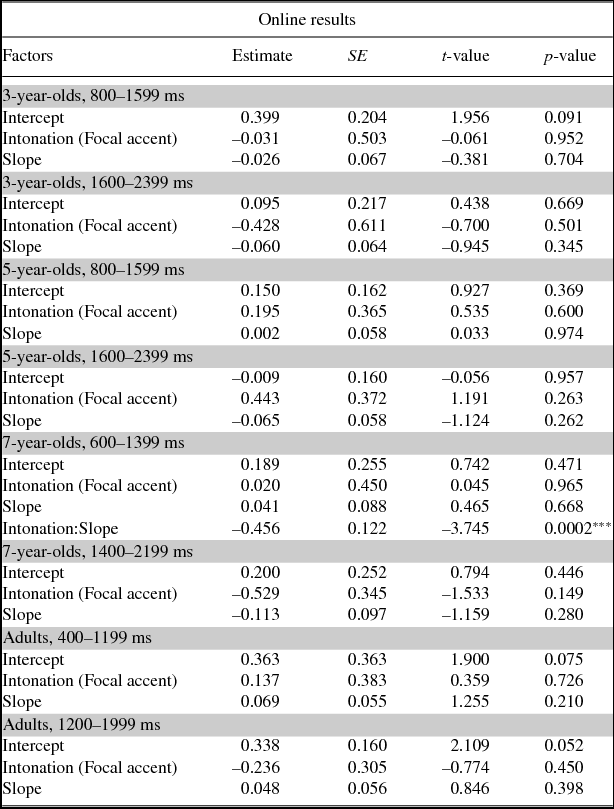
Online, there was a surprising lack of significant effects in the adults. However, the intercept (i.e. the difference from chance level) is marginally significant in both time windows. This indicates that the adults generally tended to look more towards the target referents than the non-target referents (i.e. the subject referent in the no accent condition and the object referent in the focal accent condition).
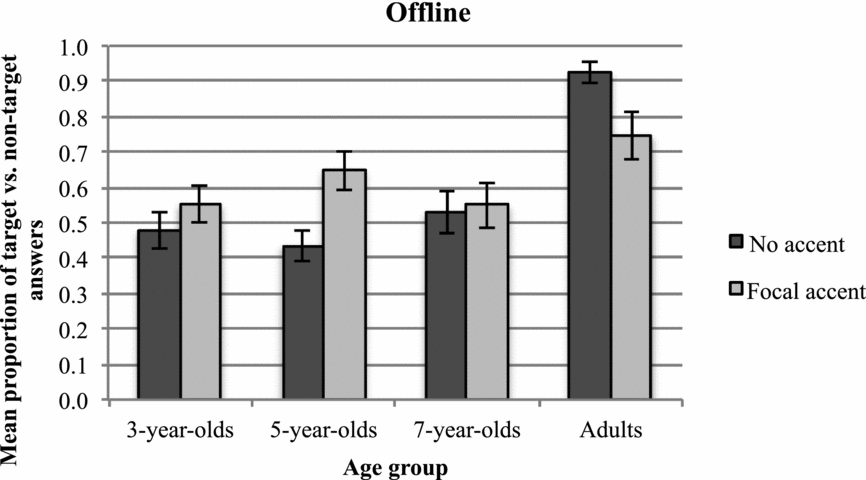
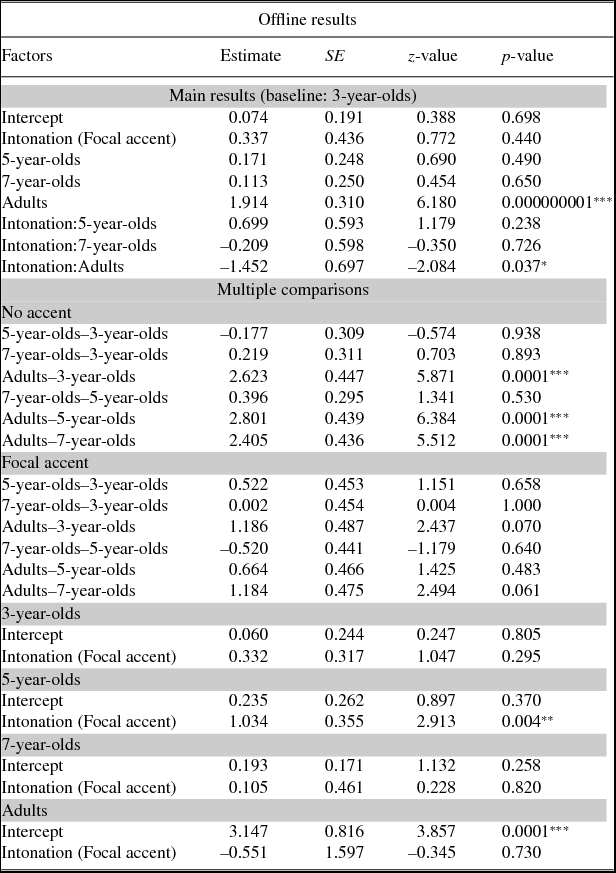
Offline, the adults showed a significant effect of intercept (p < .0001), which means that they answered above chance level in both conditions. As shown in Figure 7, they mostly answered with the target referent, regardless of condition.
We also found that the adults gave target answers significantly more often than the child groups (all ps < .0001). See Tables A1 and A2 in Appendix C for online and offline results and Figure 3 for online graph.
The adults. Log probability of proportion of looks to the target referent (as opposed to looks to the non-target referent) distributed over time, with the intonation conditions. A value of 0.0 means no preference. Values above 0.0 mean more target looks (more subject looks for no accent and more object looks for focal accent). Values below 0.0 mean more non-target looks (more object looks for no accent and more subject looks for focal accent). The numbers are calculated from data aggregated by participant and the specified conditions.

3.2 Results from the 7-year-olds
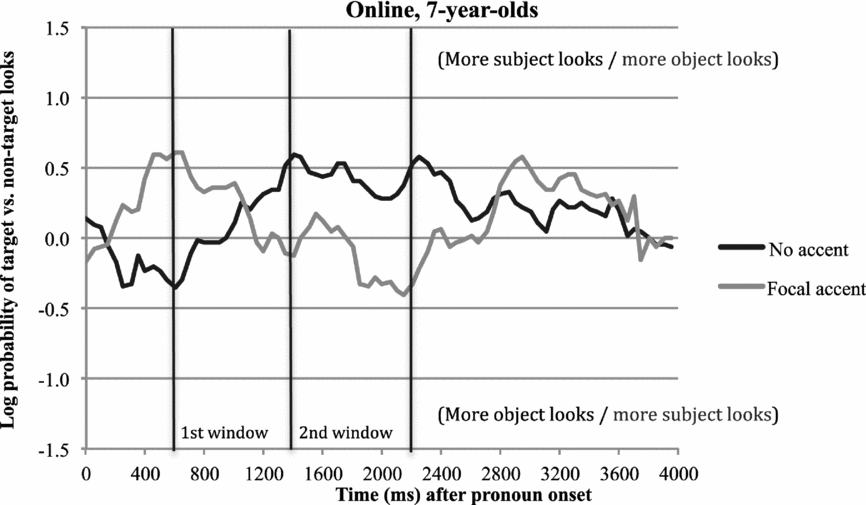
From 600–1399 ms after pronoun onset (first time window), the 7-year-olds showed a significant interaction effect between intonation (i.e. focally accented pronoun vs. unaccented pronoun) and slope (i.e. changes in looking behavior over time) (p < .0002). In the no accent condition, they switched from looking mostly towards the object referent (non-target) to looking increasingly more towards the subject referent (target). In the focal accent condition, they switched from looking mostly towards the object referent (target) to looking increasingly more towards the subject referent (non-target). See Tables A1 and A2 in Appendix C for online and offline results and Figure 4 for online graph.
The 7-year-olds. Log probability of proportion of looks to the target referent (as opposed to looks to the non-target referent) distributed over time, with the intonation conditions. (See Figure 3 caption for more information.)

3.3 Results from the 5-year-olds
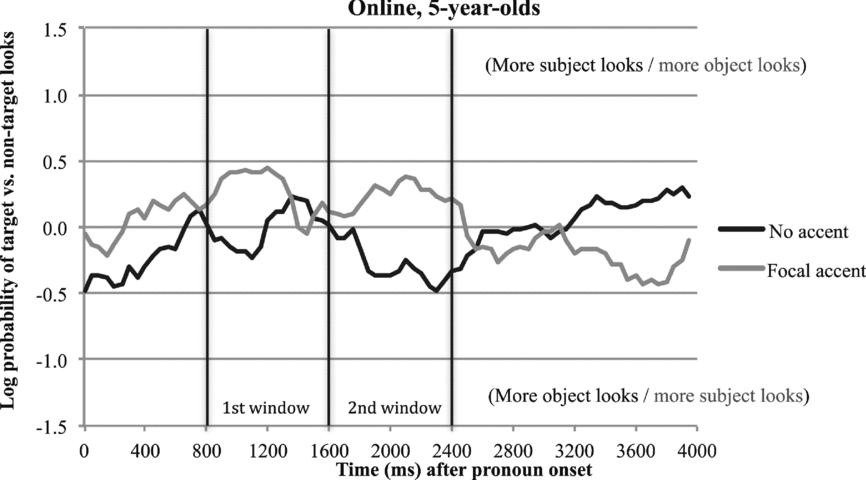
Online, the 5-year-olds showed no significant effects.
Offline, they were significantly more affected by one condition than another (p < .0004). They provided the target referent as the answer more often in the focal accent condition (target = object) than in the no accent condition (target = subject). This suggests that they were more proficient in resolving focally accented pronouns than unaccented ones. See Tables A1 and A2 in Appendix C for online and offline results and Figure 5 for online graph.
The 5-year-olds. Log probability of proportion of looks to the target referent (as opposed to looks to the non-target referent) distributed over time, with the intonation conditions. (See Figure 3 caption for more information.)

3.4 Results from the 3-year-olds
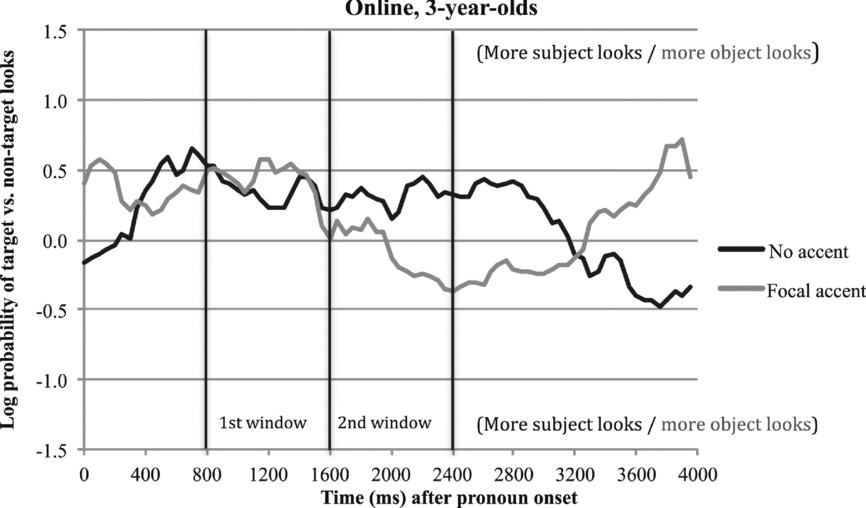
We found no significant online effects in the 3-year-olds, indicating that they did not behave significantly differently from chance level in the time periods we analyzed. They only showed a marginally significant effect of intercept (i.e. the difference from chance level) in the first time window, indicating that they generally tended to prefer the target referents over the non-target referents (i.e. the subject referent in the no accent condition and the object referent in the focal accent condition). See Tables A1 and A2 in Appendix C for online and offline results and Figure 6 for online graph.
The 3-year-olds. Log probability of proportion of looks to the target referent (as opposed to looks to the non-target referent) distributed over time, with the intonation conditions. (See Figure 3 caption for more information.)

Mean proportion of offline target referent answers (as opposed to non-target referent answers) and standard errors, with the intonation conditions. A value of 0.5 means no preference, whereas >0.5 means more target looks and <0.5 means more non-target looks. The numbers are calculated from data aggregated by participant and the specified conditions.

4. DISCUSSION
The current study set out to investigate how Norwegian adults and children resolve pronouns when the pronouns have focal accent compared to when they are unaccented. In theory, unaccented pronouns in subject position refer to the subject of the previous sentence, whereas focally accented pronouns switch referents and thus refer to the object (Givón Reference Givón1983, Ariel Reference Ariel1990). We tested Norwegian 3-, 5- and 7-year-olds to see how sensitivity to the focus marking cue develops, and compared their results with those of Norwegian adults.
According to the online eye-tracking results, the 7-year-olds shifted from looking mostly towards the object referent to looking more towards the subject referent in their first time window (600–1399 ms after pronoun onset).
When asked about the pronoun referent, the adults were in line with existing theoretical assumptions (Givón Reference Givón1983, Ariel Reference Ariel1990). They preferred the subject as the referent after hearing unaccented pronouns, and switched to a preference for the object referent after focally accented ones. They were significantly more proficient in their offline pronoun resolution than the all of the child groups. When the 5-year-olds answered, they chose the target referent more often after focally accented pronouns (target = object) than after unaccented ones (target = subject).
The 3-year-olds showed no significant effects, neither offline nor online.
4.1 The adults’ pronoun resolution
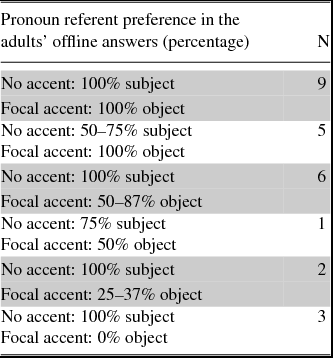
When asked to select pronoun referents, most of the adults answered according to our hypotheses: All 26 adults chose the subject antecedent after unaccented pronouns more than half of the time (see Table 1 below). Twenty-one of them chose the object antecedent after focally accented pronouns more than half of the time. Nevertheless, five of the adults tended to always choose the subject antecedent, regardless of pronoun intonation. However, it should be noted that one of them said that he/she sometimes gave a different answer than his/her immediate response to the question. This is reminiscent of what Venditti et al. (Reference Venditti, Stone, Nanda and Tepper2001) report from their interviews with participants: Some participants remembered that they had learned in school that you should not start a sentence with a pronoun unless it referred to the previous subject, and they answered according to this instead of giving their initial reaction to focally accented pronouns. This is hard to control for in an experiment. Fortunately, since most of our participants answered the intended referent even when it was the object, it is not a troublesome confounding factor in the current experiment.
Pronoun referent preference in the adults’ offline answers.

The Complementary Preference Hypothesis (Kameyama Reference Kameyama, Bosch and van der Sandt1999), which had the same hypothesis as us, was supported by most of the adults, but not all. The Givenness hierarchy states that this is not totally unexpected, as accented pronouns can refer to any antecedent that is activated. This finding also supports Baauw et al.’s (Reference Baauw, Ruigendijk, Cuetos and Avrutin2011) suggestion that the default subject preference can take precedence when the application of other procedures (e.g. parallelism, cause–effect relation, and contrastive accent) fails. According to Centering theory (Grosz et al. Reference Grosz, Weinstein and Joshi1995), the most central antecedent (here: the subject referent) is more likely to be referred to. This should have been overridden when the pronoun was accented, but a few of the adults still chose the subject referent.
Accenting the pronoun in order to switch the reference to the object of the preceding sentence is probably not uncommon in everyday Norwegian speech. See several examples of use in Fretheim (Reference Fretheim1996). Still, it is more common to have an unaccented pronoun refer to the preceding subject, but it is hard to tell if the difference in frequency has affected the participants’ responses. Another possible explanation for our findings is that the role of contrast was not very prominent in the current study's stimuli sentences. Thus, the current results cannot compare with what de Hoop (Reference de Hoop, Blutner and Zeevat2004) found concerning focal accent and contrast. In our study, the object referent hugging her teddy bear is no more surprising than the subject referent doing it. This may have made the accented pronouns more ambiguous.
We can also dismiss the idea that the weaker target preference after focally accented pronouns was due to differences between the participants in dialectal background in whether they had a high-tone or low-tone dialect. The sentences were read in a low-tone dialect, but the adult participants were from different parts of Norway. However, we found no correlations with dialect, which suggests that Norwegians find it unproblematic to follow the intonation in other dialects than their own.
The adults did not show any significant preferences online. This may have to do with the fact that the illustrations were not necessary for solving the tasks; the auditory stimuli (utterances) alone were enough. Also, no actions were shown. Thus, the adults did not always look at the figures that corresponded to the uttered names and pronouns.
4.2 The children's pronoun resolution
The only significant online effect we found in the children was an effect of intonation interacting with slope in the 7-year-olds’ first time window (600–1399 ms after pronoun onset). They showed an increasing target preference after unaccented pronouns and a decreasing target preference after focally accented pronouns. Simply put, they went from initially preferring the object to preferring the subject increasingly more in both conditions. We expected the oldest child group to show stronger preferences than the younger ones, but we did not expect them to show a preference for the same stimulus character in both conditions (unaccented vs. focally accented pronoun). This suggests the development of a default subject preference in that age group, as found in earlier pronoun resolution studies (Song & Fisher Reference Song and Fisher2005, Reference Song and Fisher2007; Arnold et al. Reference Arnold, Brown-Schmidt and Trueswell2007; Hartshorne et al. Reference Hartshorne, Nappa and Snedeker2014). The effect is consistent with the expectations of the Givenness hierarchy (Gundel et al. Reference Gundel, Hedberg and Zacharski1993), since it allows the accented pronoun to refer to any antecedent that is activated, including those that are in attentional focus (i.e. the subject antecedent in the current stimuli sentences). The increasing subject preference is also indicating that the 7-year-olds prefer the referent that is selected by parallelism. Since they do not show this preference online, they may not yet be consciously aware of it.
Alternatively, the 7-year olds’ online data can be interpreted as an early and adequate response to focal accent as a cue, since they display a preference for the target referent (the object) in an earlier time window in the focal accent condition. This, in turn, can be taken as a developing sensitivity to accent as an information structure cue. Since no focal accent is present in the unaccented pronoun condition, they take longer to orient to the target referent (the subject), and do this in a later time-window. However, as discussed above, both of these skills, a default subject preference strategy and sensitivity to focal accent/prosody, are still developing, but cannot be integrated, and, as a result, apply to different time points in the processing.
Offline, the 5-year-olds preferred the object referent after hearing focally accented pronouns significantly more than they preferred the subject referent after hearing unaccented pronouns. This does not mean that they generally preferred the object antecedent as the pronoun referent. As a matter of fact, in a separate analysis of the offline data where we analyzed object answers instead of target answers, we found that the 5-year-olds’ object preference was merely a tendency and not above chance level (p = .0971).
Our results support those found by Solan (Reference Solan1983), who also found that 5-year-olds had more trouble with unaccented pronouns than with accented ones. To explain his findings, Solan uses the reciprocal function strategy, which states that a pronoun in subject position refers to an antecedent in the opposite position of the preceding clause, regardless of intonation. Since our experiment did not include sentences with pronouns in object position, it is difficult to confirm or dismiss the reciprocal function strategy. In fact, the effect in the Norwegian 5-year-olds may simply indicate that they are particularly sensitive to the contrastive effect of focal accents, and that they are not yet sensitive to the subject bias that often affects ambiguous pronoun resolution.
Even though it is only a tendency, a part of the explanation may be that the 5-year-olds tend to linger on the last-mentioned referent, as found in studies by Arnold et al. (Reference Arnold, Brown-Schmidt and Trueswell2007), Colonna et al. (Reference Colonna, Schimke, Hemforth, Hemforth, Mertins and Fabricius-Hansen2014) and Hartshorne et al. (Reference Hartshorne, Nappa and Snedeker2014). Another similarity with Hartshorne et al. (Reference Hartshorne, Nappa and Snedeker2014) is that our results are not so different from theirs, where the 5-year-olds chose the subject referent answer 65% of the time in the first-mention condition (e.g. Emily ate dinner with Hannah. She skipped her salad and only ate dessert. Can you point to her? Hartshorne et al. Reference Hartshorne, Nappa and Snedeker2014:430). Thus, not only Norwegian 5-year-olds have problems with finding the intended pronoun referent in ambiguous sentences.
The 7-year-olds showed no specific preference tendencies offline, and thus did not mirror their online preferences there. Their lack of preference offline may be due to a switch from the child-like object preference to a more adult-like overall subject preference, so far only present in their online results. This indicates that the 7-year-olds are not yet consciously aware of their preferences, probably because they have not fully developed their meta-linguistic awareness. The fact that we found a significant difference in proficiency between the adults and the children also supports this, and suggests that the children have yet to fully develop their strategies and their sensitivity to prosody as a cue. It would have been interesting to check whether a stronger subject preference could be discovered in even older children on the road to the target preference we found in the adult control group.
The weak preferences here cannot be generalized to other areas of prosody. We know that some aspects of prosody seem to be acquired earlier than others, and one cannot assume that a child's proficiency in one area of prosody is representative of all aspects of it (Wells et al. Reference Wells, Peppé and Goulandris2004). Norwegian children may thus very well be proficient at other prosodic tasks than using intonation as a cue for the resolution of focally accented pronouns.
The fact that the Norwegian children responded closer to chance level than the English-speaking children in Maratsos’ (Reference Maratsos1973) and Solan's (Reference Solan1980) studies suggests that they may have experienced difficulties that did not have to do with intonation only. It is curious that even the 7-year-olds did not select referents above chance level offline when encountering unaccented pronouns. The current study's experimental tasks were perhaps more difficult than those used in earlier studies, because the actions were not shown on screen and the participants did not get to act them out with toys. In addition, the children probably found it difficult to remember the names of the figures. We chose to use cartoon humans instead of cartoon animals to avoid biases triggered by the different abilities of certain animals (e.g. that a horse is more prone to kick than a rabbit). However, that bias would probably have been less problematic than the difficulty with remembering names. It may be that the cartoon humans worked better in a study like Hartshorne et al.’s (2014). Their stimuli characters did not interact with objects, but were doing other activities like playing, travelling and eating.
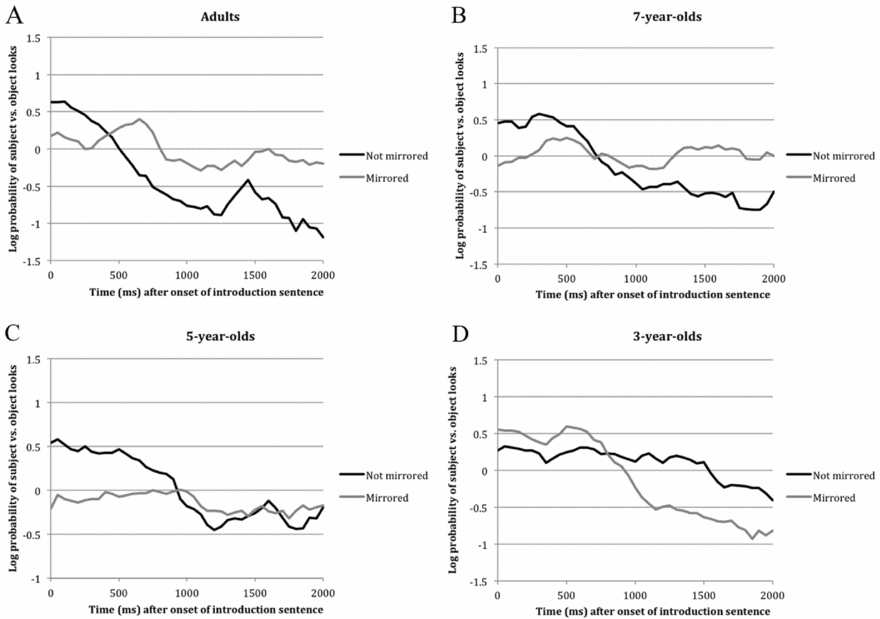
To examine whether it was the conditions or the naming that caused the unclear results, we created graphs that show where the participants looked during the experiment trials’ first sentence (e.g. Maria klemte Sara ‘Maria hugged Sara’) (see Appendix D). Apparently, the screen position of the stimuli figures affected the participants’ eye-gaze. When the first-mentioned figure was placed to the left, the participants tended to look at the figures in the order they were mentioned. When the second-mentioned figure was placed to the left, the participants showed no specific preference. Even the adults were at chance level here. This suggests that the counterbalancing of stimuli position, typical of eye-tracking studies, should be re-considered in line with visual and auditory processing. Thus, our online results may have been caused more by problems with connecting names to figures in the counterbalanced position condition, where the referents appear on screen in a position inconsistent with their order of mention (i.e. where the first-mentioned figure appears on the right side), rather than by the intonation conditions. However, this does probably not affect the offline results too much. At least the adults should not need the visual figures to comprehend the utterances and give answers when asked about the pronoun referent. Also, the significant online effects we found in the 5-year-olds may still show their pronoun resolution skills, as they would hardly have appeared for other reasons.
Concerning the question of what strategy children apply, the current study does not provide clear answers. Only one child answered the intended referent all of the time. Surprisingly, this was a 3-year-old. This indicates that there are large individual differences in language development within the group of children. When it comes to the 7-year-olds, it seems that they are on their way towards mastering the parallelism strategy, as reflected in their ability to switch interpretation preference. Also evident in their online data is some sensitivity to focal accent, and a developing default subject bias. However, since we found an overall difference in the offline pronoun resolution between the adults and each of the child groups, the children are still far away from the adult way of resolving pronouns. Overall, it seems that the children's sensitivity to intonation is developing slowly towards adult proficiency: starting at chance level, proceeding to a sensitivity for contrastive accent, then towards a default subject preference, and finally landing on a preference for the target referent.
5. CONCLUSION
According to Givón (Reference Givón1983) and Ariel (Reference Ariel1990), unaccented pronouns in subject position refer to the subject of the preceding sentence, whereas focally accented pronouns switch referents and thus refer to the object. Previous studies have tried to determine whether English-speaking adults’ pronoun resolution supports Ariel and Givon's theories, and at which age children become sensitive to the prosody cue. Their results have been conflicting. The current study investigated whether Norwegian children and adults select the intended antecedents when they resolve pronouns with and without focal accent. By using eye-tracking, we tried to obtain a more thorough view of pronoun processing in those age groups.
We found that the adults chose the intended referent in both conditions: They chose the subject as the referent for unaccented pronouns and the object as the referent for focally accented pronouns. The 5-year-olds selected the intended referent more often in the focal accent condition than in the no accent condition. The 7-year-olds looked at the intended pronoun referent earlier after focally accented pronouns than after unaccented pronouns, while the 3-year-olds select pronoun referents at chance level. However, none of the child groups had reached adult competence, as reflected in the performance of the adult group. This indicates that Norwegian children under the age of seven are still uncertain when asked to select a pronoun referent, probably due to limitations in working memory and meta-linguistic awareness. It may well be the case that the older children in our study have acquired the necessary independent skills (prosody, grammar), but cannot apply them in an integrated way. In addition, difficulty with remembering the names of the stimuli figures may have caused the unclear results. Future studies should use improved designs taking into account e.g. working memory (for the names of characters) and the position of stimuli on-screen.
ACKNOWLEDGEMENTS
This work was funded by the Norwegian Research Council (NFR) under grant no. 222 640. We would like to thank Prof. Kristin Melum Eide, for commenting on the manuscript; Stine Thordarson Moltubakk, for drawing the stimuli illustrations; Håkon Lorentzen, for helping with preparing the data for analysis; Dr. Rik Eshuis, for analysis advice; the local schools and kindergartens in which we conducted experiments, and the participants, for their good effort. Finally, we would like to thank the editor, the copy-editor and the anonymous reviewers for their valuable comments.
APPENDIX A
Stimulus sentences

APPENDIX B
Final model structures

APPENDIX C
Results from online analyses.

Results from offline analyses.

APPENDIX D
Looks during introduction sentence (e.g. ‘Maria hugged Sara’)
Log probability of proportion of looks to the first-mentioned referent (as opposed to looks to the second-mentioned referent) distributed over time in the introduction sentence, with the mirroring conditions. A value of 0.0 means no preference, whereas >0.0 means more first-mentioned referent looks and <0.0 means more second-mentioned referent looks. The numbers are calculated from data aggregated by participant and the specified conditions. In the not-mirrored condition, the first-mentioned referent is to the left and the second-mentioned referent is to the right. In the mirrored condition, the second-mentioned referent is to the left and the first-mentioned referent is to the right.