Implications
This study indicated that the semi-extensive system improved carcass parameters of foal slaughtered at 18 months. On the other hand, foal meat from the semi-extensive system displayed the highest levels of intramuscular fat and heme-iron and the lowest levels of cholesterol content and tenderness. From a nutritional point of view, foals from an extensive production system on wood pasture could be considered as healthier in relation to their fatty acid profiles (low n-6/n-3 ratio and high h/H ratio) as a result of the beneficial effects of grass on meat fatty acid profile.
Introduction
Horsemeat has become more popular in recent years and, although still perceived as a product for niche markets, it has great potential as an alternative meat in the wider domestic markets (Sarriés et al., Reference Sarriés, Murray, Troy and Beriain2006). This meat is characterized by low fat (6.63 g/100 g), low cholesterol content (61 mg/100 g), high iron content (3.89 mg/100 g) and vitamins of B group (Badiani et al., Reference Badiani, Nanni, Gatta, Tolomelli and Manfredini1997). This meat has a favorable dietetic fatty acid profile, with a high content of unsaturated fatty acids relative to saturated acids and contains a greater proportion of components from the α-linolenic fatty acid family (Sarriés et al., Reference Sarriés, Murray, Troy and Beriain2006; Tateo et al., Reference Tateo, De Palo, Ceci and Centoducati2008; Lorenzo et al., Reference Lorenzo, Fuciños, Purriños and Franco2010).
These nutritional characteristics reveal that this type of meat may be considered as a new alternative in meat consumption. Horsemeat consumption has increased in recent years, with Spain being the fourth major producer of horsemeat in the UE in 2011 with 6500 tons (FAOSTAT, 2011), but still not comparable to the consumption of other types of meats such as beef, chicken or pork, which are more important in the human diet (Franco et al., Reference Franco, Rodríguez, Purriños, Crecente, Bermúdez and Lorenzo2011). These increases might be due to changes in attitude toward this type of meat and the interest of the consumers to taste new meat products (Sarriés et al., Reference Sarriés, Murray, Troy and Beriain2006).
There are some ways to improve the carcass weight (CW) and meat quality of foal meat, i.e. crossing with heavier breeds, increasing slaughter age and including a finishing period with concentrate, which could make exportation easy (Franco et al., Reference Franco, Crecente, Vázquez, Gómez and Lorenzo2013). It has been established that the quality of horsemeat can be influenced by several factors such as breed (Juárez et al., Reference Juárez, Polvillo, Gómez, Alcalde, Romero and Valera2009; Lanza et al., Reference Lanza, Landi, Scerra, Galofaro and Pennisi2009; Franco et al., Reference Franco, Crecente, Vázquez, Gómez and Lorenzo2013), livestock production system (Franco et al., Reference Franco, Rodríguez, Purriños, Crecente, Bermúdez and Lorenzo2011 and Reference Franco, Crecente, Vázquez, Gómez and Lorenzo2013), finishing feeding (Sarriés and Beriain, Reference Sarriés and Beriain2006; Franco et al., Reference Franco, Crecente, Vázquez, Gómez and Lorenzo2013; Franco and Lorenzo, Reference Franco and Lorenzo2014), muscle types (Tateo et al., Reference Tateo, De Palo, Ceci and Centoducati2008; Lorenzo and Pateiro, Reference Lorenzo and Pateiro2013; Lorenzo et al., Reference Lorenzo, Pateiro and Franco2013a) or age/live weight (LW) (Sarriés and Beriain, Reference Sarriés and Beriain2006; Franco et al., Reference Franco, Rodríguez, Purriños, Crecente, Bermúdez and Lorenzo2011), among others.
The aim of this work was to study the effect of livestock production system (extensive v. semi extensive) and concentrate level (1.5 v. 3 kg of fodder/foal-day) on carcass traits, physico-chemical properties (chemical composition, pH, WHC, color parameters and textural profile) and nutritional value (fatty acid and amino acid content) of foal meat slaughtered at 18 months.
Material and methods
Experimental design and animal management
For this study, 49 foals from crossing Galician Mountain×Hispano-Bretón were used. Twenty-one foals were obtained from Monte Cabalar (agricultural cooperative of ‘Galician Mountain’) located in a mountain (A Estrada, Pontevedra, Spain). Animals were reared with their mothers on pasture and they were kept suckling and grazing until the weaning age at 6 to 7 months. After weaning, the foals were fed mainly with ryegrass (Lolium perenne), Ulex europaeus L. and Pteridium aquilinum (L.) Kuhn., receiving complementary grass silage ad libitum when the grass available was limited, especially during summer and winter. All foals were reared with their mothers in an extensive production system in freedom regimen, according to an extensive production system on wood pasture. Animals that belong to this herd were denominated as freedom extensive system (FES).
The other 28 foals were obtained from an experimental herd of Agricultural Research Centre of Mabegondo (Marco da Curra, A Coruña, Spain). Animals were reared with their mothers on pasture and were allowed to suckling freely until 6 to 8 months old. Then they were fattened with commercial feeding and pasture for 4 months (from May to September, months where the pasture have the best conditions of amount and quality). At this point, half of the foals were separated and fed with two different amounts of concentrate (n=14: 1.5 kg of fodder/foal-day (1.5 SES) and n=14: 3.0 kg of fodder/foal-day (3 SES)). Composition (%) of commercial feed was CP (15.1), crude fiber (6.7), ashes (5.5), fat (4.5) and sodium (0.2). Commercial feed was composed of barley, corn, soybean flour, wheat bran, alfalfa, sugar cane molasses, beet, animal fat, calcium carbonate, sodium chloride and powder lactose. This ration was supplemented with the next mineral/vitamin mix: vitamin A (6000 UI/kg), vitamin D3 (600 UI/kg), mineral expressed in mg/kg zinc (150), manganese (70), iron (90), copper (10), cobalt (0.30), iodine (2), butyl-hydroxyanisol (0.03 mg/kg) and etoxiquine (0.03 mg/kg). There was a period of adaptation to the commercial feeding, in order to avoid colics that usually appear with a sudden change in the diet. The amount of commercial feed was gradually increased, starting with small quantities to reach the final amount. The period of adaptation was 20 and 30 days for each group (1.5 SES and 3 SES kg, respectively). Animals belonging to this herd and being managed in a semi-extensive system were described as semi extensive production system (SES).
All foals were slaughtered at the age of 18 months. They were transported to the abattoir (distance around 70 and 15 km, for SES and FES, respectively) the day before slaughter, without mixing foals from different groups at any time, trying to minimize the stress of the animals. The animals were stunned with a captive bolt and slaughtered and dressed according to the specifications outlined in the European legislation (Council Directive 93/119/EC).
Carcass measurements and sample collection
Carcasses were chilled for 24 h at 4°C in a cold chamber immediately after slaughter. At this moment, carcasses were weighed and dressing percentage (DP) was calculated. At this point, the left half-carcasses were moved to the research center pilot plant and the following carcass measurements were collected: length of carcass (LC), length of leg (LL), width of leg (WL) and internal depth of chest (IDC) as described by De Boer et al. (Reference De Boer, Dumont, Pomeroy and Weniger1974), whereas external depth of chest (EDC) and perimeter of leg (PL) were also obtained. These parameters were determined to assess carcass morphology. In addition, carcass compactness index (CCI)=(CW/LC) and hindlimb compactness index (LTI)=(LL/WL) were calculated (Espejo et al., Reference Espejo, García, López, Izquierdo, Robles and Costela2000). Lean thickness (muscle and subcutaneous fat) in three different points was measured. Between 4th and 5th ribs, a knit needle was inserted on (serratus ventralis and cutaneus homo-brachialis) and thickness was measured (LT1); 11 cm to the left and right, (to chuck and loin, respectively) of this point, two new measures were made in pectoralis superficialis and profundus (LT2) and cutaneus trunci, intercostalis internus and externus, respectively (LT3) (Franco et al., Reference Franco, Crecente, Vázquez, Gómez and Lorenzo2013).
The longisimus dorsi (LD) muscle was cut into five 2.5 cm thick steaks. The first three steaks were used to determine pH, color, proximate composition and fatty acid and amino acid profile. The 4th and 5th steaks were packed under vacuum conditions (99%) (FRIMAQ, V-900, Lorca, Spain) and aged for 4 days at 4ºC. Water holding capacity and texture parameter were obtained after this period.
Analytical methods
The pH, chemical composition color and heme-iron content were measured according to Franco et al. (Reference Franco, Rodríguez, Purriños, Crecente, Bermúdez and Lorenzo2011) at 24 h post-mortem. Water holding capacity was measured in two ways: cooking loss (CL) and drip loss (DL) as described in Franco et al. (Reference Franco, Rodríguez, Purriños, Crecente, Bermúdez and Lorenzo2011). Textural profile analysis (TPA) test was measured by compressing to 80% with a compression probe of 19.85 cm2 of surface contact at a compression speed of 1 mm/s in a texture Analyzer (TA.XT.plus of Stable Micro Systems, Vienna Court, Churwell, UK). Between the first and second compression, the probe waited for 2 s. Hardness, cohesiveness, springiness, gumminess and chewiness were obtained. The Warner Braztler test was performed following the procedure described in Franco et al. (Reference Franco, Rodríguez, Purriños, Crecente, Bermúdez and Lorenzo2011).
Analysis of cholesterol
For saponification, 0.75g of the homogenized meat sample was placed in a screw teflon-lined cap tube, in duplicate, to which 0.2g l-ascorbic acid and 5.5 ml saponification solution were added. The saponification solution, freshly prepared each week, contained 11% w/v potassium hydroxide in a mixture of 55% v/v absolute ethanol and 45%v/v distilled water. The sample was then immediately vortexed in order to avoid meat agglomeration. After vortexing, the air was eliminated from the reaction, by displacement with nitrogen gas and the sample was further shanked until the ascorbic acid was completely dissolved. The saponification was carried out in a shaking water bath (THER-SPIN, Orto Alresa, Madrid, Spain) (200 r.p.m) at 80ºC for 15 min.
After saponification, samples were cooled in tap water for 1min. Following cooling, 1.5ml of distilled water and 3ml of 25 µg/ml BHT solution in n-hexane were added (final proportions of 4.5 ml H2O : 3 ml ethanol : 3 ml n-hexane; the meat sample was assumed to contribute with 0.5 ml H2O). The samples were vigorously vortexed for 2 min and centrifuged at 1500×g for 5 min, in order to accelerate phases separation. An aliquot of the upper layer (n-hexane) was transferred into a small screw teflon-lined cap tube and a spatletip of anhydrous sodium sulfate was added. Finally, the tube was briefly shaken and an aliquot of the n-hexane layer was filtered through a 0.45-µm hydrophobic membrane into an amber screw-cap vial with teflon septum.
The HPLC systems used was an Alliance 2695 model (Waters, Milford, MA, USA) and 2475 scanning fluorescence detector (Waters). Empower 2TM advanced software (Waters) was used to control system operation and results management. The analysis of cholesterol in foal meat were performed using a normal-phase silica column (SunFireTM Prep Silica, 4.6 mm ID×250 mm, 5 μm particle size, Waters), with UV–Vis photodiode array detection for cholesterol (202 nm). The solvent (1% v/v isopropanol in n-hexane) flow rate was 1 ml/min, the run last for 17 min and the temperature of the column oven was adjusted at 20ºC. The injection volumes used varied between 20 and 100 µl in order to get values inside the linearity range of the standard curves.
The content of total cholesterol in foal meat was calculated, in duplicate for each muscle sample, based on the external standard technique, from a standard curve of peak area v. concentration.
Analysis of fatty acid methyl esters
Intramuscular fat (IMF) was extracted from 5 g of ground meat sample, according to Folch et al. (Reference Folch, Lees and Sloane-Stanley1957). Lipid extracts were evaporated to dryness under vacuum at 35°C and stored at −80°C until analysis by preparation of fatty acid methyl esters (FAMEs). Lipids were transesterified with a solution of boron trifluoride (14%) in methanol, as described by Carreau and Dubacq (Reference Carreau and Dubacq1978). Fifty milligrams of the extracted lipids were esterified and the FAMEs were stored at −80°C until chromatographic analysis.
Separation and quantification of FAMEs was carried out using a gas chromatograph, GC-Agilent 6890 N (Agilent Technologies Spain, S.l., Madrid, Spain) equipped with a flame ionization detector and an automatic sample injector HP 7683, and using a Supelco SPTM-2560 fused silica capillary column (100 m, 0.25 mm i.d., 0.2 μm film thickness, Supelco Inc., Bellafonte, PA, USA). Chromatographic conditions were as follows: initial oven temperature of 120°C (held for 5 min), first ramp at 2°C/min to 170°C (held for 15 min), second ramp at 5°C/min to 200°C (held for 5 min) and third ramp at 2°C/min to final temperature of 235°C (held for 10 min). The injector and detector were maintained at 260°C and 280°C, respectively. Helium was used as carrier gas at a constant flow-rate of 1.1 ml/min, with the column head pressure set at 35.56 psi. One microliter of solution was injected in split mode (1:50). The fatty acids were quantified using nonadecanoic acid methyl ester at 0.3 mg/ml, as internal standard, which was added to the samples before fat extraction and methylation. Identification of fatty acids was performed by comparison of the retention times with those of known fatty acids and the results expressed as a percentage of total fatty acids identified.
Protein amino acid profile
The hydrolysis of the protein, derivatization and identification of hydrolyzed was carried out following the procedure described by Lorenzo and Pateiro (Reference Lorenzo and Pateiro2013). Once the amount of amino acids in the LD muscle was determined, the chemical score (CS) of the essential amino acids was calculated in relation to the reference on pattern protein proposed by FAO/WHO/UNU (2007) applying the following equation:
 $$CS={{{\rm g\ EAA\ in\ tested\ protein}} \over {{\rm g\ EAA\ in\ pattern\ protein}}}{\times}100$$
The essential amino acids index (EAA) value was also calculated applying the following equation described by Shahidi and Synowiecki (Reference Shahidi and Synowiecki1993):
 $$EAA=100{\times}\root n \of {{a \over {a_{p} }}{\times}{b \over {b_{p} }}{\times}{c \over {c_{p} }}{\times}......{j \over {j_{p} }}} $$
where a, b, c, …, j=content of histidine, isoleucine, leucine, lysine, methionine, phenylalanine, tyrosine, threonine and valine in each sample; a p , b p , c p , …, j p =content of histidine, isoleucine, leucine, lysine, methionine, phenylalanine, tyrosine, threonine and valine in protein Standard (FAO/WHO/UNU, 2007); n=number of amino acids used.
Statistical analysis
For the statistical analysis of the data of carcass parameters, meat quality and nutritional value, an ANOVA of one way using IBM SPSS Statistics 19.0 program (IBM Corporation, Somers, NY, USA) was performed. A total of 49 animals were studied: (21 animals from FES, 14 animals from 1.5 SES and 14 animals from 3 SES). The least squares mean (LSM) were separated using Duncan’s t-test. All statistical tests of LSM were performed for a significance level P<0.05. Correlations between variables were determined by correlation analyses using the Pearson’s linear correlation coefficient with the above statistical software package mentioned.
Results and discussion
Carcass characteristics
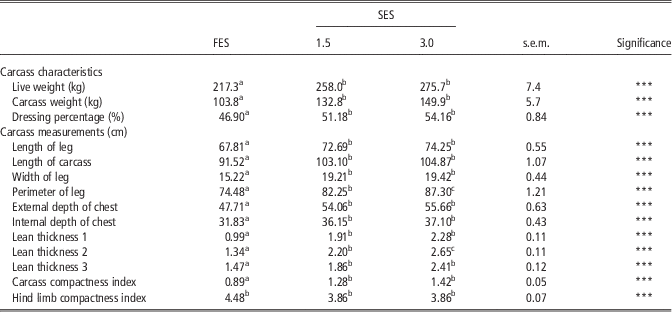
The effect of livestock production system and finishing feeding on LW, carcass traits and morphology measurements is shown in Table 1. LW, CW, DP and all morphometric measures were significantly (P<0.01) affected by livestock production system. LW presented the lowest values (P<0.001) in FES compared with 1.5 SES group (+41 kg) and 3 SES animals (+58 kg). This result was lower than those reported by Franco et al. (Reference Franco, Crecente, Vázquez, Gómez and Lorenzo2013) who found mean values of 284 kg in foals slaughtered at 15 months. The LW of the animals consequently influenced (P<0.001) CW as the CW of the 3 SES group was higher compared with the FES group (Table 1). Our results were less than those reported by Sarriés and Beriain (Reference Sarriés and Beriain2005) who observed CWs at around 275 kg in Burguete foals slaughtered at 16 months of age, and those found by Lanza et al. (Reference Lanza, Landi, Scerra, Galofaro and Pennisi2009) who reported CWs ranging between 244 kg for Sanfratelano and 208 kg for Haflinger foals slaughtered at 18 months of age. Obviously, these differences can be attributed to the type of foal carcasses used in these studies, which have been obtained from specialized breeds for meat production.
Effect of production system and concentrate level on carcass parameters of foals slaughtered at 18 months of age

FES=free extensive system; 1.5 SES=semi-extensive system with 1.5 kg of fodder/foal-day; 3.0 SES=semi-extensive system with 3 kg of fodder/foal-day; s.e.m.=standard error of mean.
Significance: ns: not significant; ***P<0.001.
a-cMeans in the same row with different letters differ significantly (P<0.05).
Statistical analysis indicated that DP was affected significantly (P=0.001) by the livestock production system because the carcass yield had higher values in foals from SES (mean value of 52.67%) than the foals from FES (46.90%). These values were lower than those found by Sarriés and Beriain (Reference Sarriés and Beriain2005), in Burguete foals slaughtered at 16 months of age (63.3%) and Lanza et al. (Reference Lanza, Landi, Scerra, Galofaro and Pennisi2009) in Sanfratellano and Halfinger foals slaughtered at 18 months (59.3% and 59.6%, respectively). However, the finishing feeding only had a significant (P<0.05) effect on PL and on lean thickness (LT2) where the concentrate level of the SES (3 kg of fodder/foal diet) had higher values for these carcass measurements than showed by the SES group (1.5 kg of fodder/foal diet). Carcass measurements were significantly (P<0.01) affected by the livestock production system, as foals from the FES group presented shorter carcasses than SES (91.5 v. 104 cm) and shorter leg (67.8 v. 73.5 cm). Regarding other measurements obtained from the leg, such as WL and PL, livestock system production also presented significant (P<0.01) differences, as foals from the SES group showed greater values (Table 1). CCI was significantly higher in foals from the SES group than in foals from the FES group (0.89 v. 1.28 v. 1.42; P<0.05, for FES, 1.5 SES and 3.0 SES groups, respectively), whereas LTI was significantly higher in foals from the FES group than in foals from the SES group (4.48 v. 3.86 v. 3.86; P<0.001, for FES, 1.5 SES and 3.0 SES groups, respectively), which proves its better shape and greater compactness. These results were similar to those reported by Franco et al. (Reference Franco, Crecente, Vázquez, Gómez and Lorenzo2013), whereas Sarriés and Beriain (Reference Sarriés and Beriain2005) found higher values of CCI (1.63) in Burguete foals slaughtered at 16 months.
Meat quality
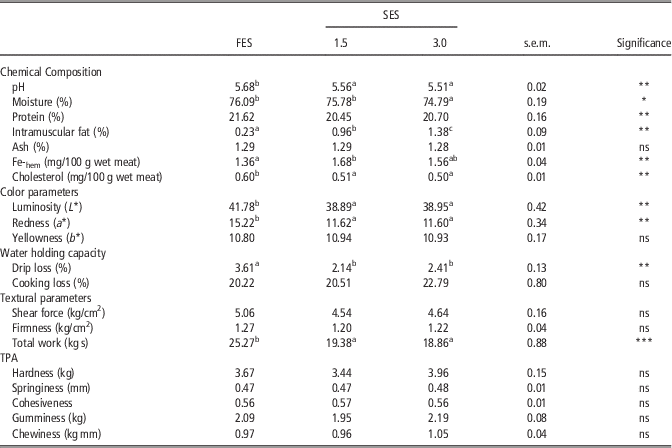
Physical and chemical proximate composition, color, water holding capacity and textural parameters of LD from foals are shown in Table 2. Statistical analysis showed that almost all physico-chemical properties were affected (P<0.05) by the livestock production system with the exception of ashes content (P>0.05). The pH values were higher in foals from the FES group than in animals from the SES group (5.68 v. 5.53 v. 5.51; P<0.01, for FES, 1.5 SES and 3.0 SES groups, respectively). Our values of meat pH were similar to those obtained for foal meat in previous studies (Sarriés and Beriain, Reference Sarriés and Beriain2005; Lanza et al., Reference Lanza, Landi, Scerra, Galofaro and Pennisi2009; Franco et al., Reference Franco, Rodríguez, Purriños, Crecente, Bermúdez and Lorenzo2011 and Reference Franco, Crecente, Vázquez, Gómez and Lorenzo2013; Lorenzo et al., Reference Lorenzo, Sarriés and Franco2013b). The IMF content was affected significantly (P<0.001) by livestock production system and finishing feeding. Animals with concentrate had 408% more IMF than foals without finishing (0.23 v. 0.96 v. 1.38%; P<0.01, for FES, 1.5 SES and 3.0 SES groups, respectively). On the other hand, foals finished with 3 kg of commercial feed showed the highest values of IMF (0.96 v. 1.38%, P<0.01). This result was expected because it is the principal objective of the finishing periods. It seems that an amount of 3 kg per foal per day and an increase in slaughter age were enough to increase the IMF content, because in a previous work with foals without finishing period Franco et al. (Reference Franco, Rodríguez, Purriños, Crecente, Bermúdez and Lorenzo2011) found low values of IMF (0.31%) in foals slaughtered at 12 months. These low contents of IMF are recommended in terms of human consumption to reduce fat intake and consistent with a favorable image from a dietetic point of view. Anyway, our values were lower than those previously reported by other authors in horsemeat (Tateo et al., Reference Tateo, De Palo, Ceci and Centoducati2008; Juárez et al., Reference Juárez, Polvillo, Gómez, Alcalde, Romero and Valera2009; Lanza et al., Reference Lanza, Landi, Scerra, Galofaro and Pennisi2009) who found values above 2.5%. The low IMF content obtained in the present study may be attributed to genetics and length and/or the amount of finishing period. On the other hand, water content decreased in finishing foals (76.1 v. 75.8 v. 74.8%, P<0.05, for FES, 1.5 SES and 3.0 SES groups, respectively), which was also to be expected as it is accepted that the increase in IMF content in the meat means a decrease in water content (Franco et al., Reference Franco, Rodríguez, Purriños, Crecente, Bermúdez and Lorenzo2011). Pearson’s correlation test indicated that moisture contents were negatively correlated with IMF level (r=−0.530, P<0.01).
Effect of production system and concentrate level on chemical composition, color parameters, water holding capacity and texture of Longissimus dorsi from foals slaughtered at 18 months of age

FES=free extensive system; 1.5 SES=semi-extensive system with 1.5 kg of fodder/foal-day; 3.0 SES=semi-extensive system with 3 kg of fodder/foal-day; s.e.m.=standard error of mean; TPA=textural profile analysis.
Significance: ns: not significant; *P<0.05; **P<0.01; ***P<0.001.
a-bMeans in the same row with different letters differ significantly (P<0.05).
Statistical analysis indicated that heme-iron content was affected (P<0.01) by the livestock production system because foals from the 1.5 SES group showed higher heme-iron contents (1.62 mg/100 g meat) than the foals from the 3.0 SES group (1.56 mg/100 g meat) and FES group (1.36 mg/100 g meat). This result is in disagreement with the findings of Franco et al. (Reference Franco, Rodríguez, Purriños, Crecente, Bermúdez and Lorenzo2011) who did not find significant differences between production systems. These possible differences can be due to the fact that the heme-iron content of horse varies with temperament (Franco et al., Reference Franco, Rodríguez, Purriños, Crecente, Bermúdez and Lorenzo2011). Our results were lower than those reported by Badiani et al. (Reference Badiani, Nanni, Gatta, Tolomelli and Manfredini1997) and Tateo et al. (Reference Tateo, De Palo, Ceci and Centoducati2008) who found heme-iron values ranging from 3.20 to 4.58 mg/100 g meat. This different iron content could be related with the age of slaughterer, breed, etc. On the other hand, cholesterol content showed significant differences (P<0.01) between livestock production systems, as lower cholesterol contents were found in foal from the 3.0 SES group (0.50 mg/100 g meat) than in the foals from the 1.5 SES (0.51 mg/100 g meat) and FES groups (0.60 mg/100 g meat). This result was similar to those reported by other authors (Badiani et al., Reference Badiani, Nanni, Gatta, Tolomelli and Manfredini1997; Lorenzo and Paterio, Reference Lorenzo and Pateiro2013; Lorenzo et al., Reference Lorenzo, Sarriés and Franco2013b) who found values ranging from 0.49 to 0.73 mg/100 g in equine meat. On the basis of a daily consumption of a 150 g steak, trimmed of all visible fat, except for IMF, foal meat provides 0.76 to 0.90 mg of cholesterol for FES and SES groups, respectively, which represents 25% to 30% of the maximum daily cholesterol recommendations (<300 mg/day) (USDA, 2012).
Production systems play an important role in differentiating meat samples on the basis of color (Lanza et al., Reference Lanza, Landi, Scerra, Galofaro and Pennisi2009) and are in agreement with the results obtained in our study. L*-value and a*-value were significantly (P<0.01) affected by livestock production system, as meat from the FES group had a more intense (P<0.01) redder color (higher CIE a*-value) and higher (P<0.01) lightness (higher CIE L*-value) compared with those from the SES group (Table 2). Pearson’s correlation test indicated that L*-values were negatively correlated with heme-iron values (r=−0.576, P<0.01). In this regard, Sarriés and Beriain (Reference Sarriés and Beriain2006) also found a negative correlation between L*-values and heme-iron values. These results are in disagreement with the findings of Vestergaard et al. (Reference Vestergaard, Oksbjerg and Henckel2000a) who found that pasture-finished bulls showed lower meat L*-values compared with stall-finished bulls because of higher physical activity and muscle fiber characteristics. Our values of L*-values were higher than those reported by Polidori et al. (Reference Polidori, Cavallucci, Beghelli and Vincenzetti2009) and Tateo et al. (Reference Tateo, De Palo, Ceci and Centoducati2008) who found L*-values of 35.86 and 36.58, respectively, but the findings of the present study were similar to those obtained by Lanza et al. (Reference Lanza, Landi, Scerra, Galofaro and Pennisi2009) who observed L*-values ranging from 38.8 to 40.8.
Water holding capacity and textural parameters are important for consumer decision in order to provide an idea about meat quality, mainly in terms of juiciness and tenderness. The cooking loss was unaffected (P>0.05) by livestock production system, whereas DL was affected (P<0.01). Foal from the 1.5 SES group presented lower DL (2.14%) compared with those from the 3.0 SES (2.41%) and FES groups (3.61%). The water holding capacity is influenced, among several factors, by the raw material composition, especially the content and distribution of IMF, as the presence of IMF decreases moisture diffusivity coefficient (Muriel et al., Reference Muriel, Ruiz, Ventanas, Petrón and Antequera2004). This is partially in good agreement with those found in this study because Pearson correlation test indicated that DL was negatively correlated to IMF content (r=−0.455, P<0.01).
Mean values of foal meat textural parameters are presented in Table 2. Contrary to Franco et al. (Reference Franco, Rodríguez, Purriños, Crecente, Bermúdez and Lorenzo2011), Warner–Bratzler (WB) parameters did not reveal differences (P>0.05) in shear force between production systems. These results are in agreement with the findings of Sarriés and Beriain (Reference Sarriés and Beriain2006) in Burguete breed foal meat aged 4 days. Foals from the SES group had lower total work, which may be related to the higher IMF content from the SES group than the FES group. The increased IMF may be responsible for the improved tenderness (Vestergaard et al., Reference Vestergaard, Therkildsen, Henckel, Jensen, Andersen and Sejrsen2000b). As expected, Pearson’s coefficient also indicated that total work was significantly linked to IMF (r=−0.394, P<0.01). With regard to the tenderness classification, according to the categories proposed by Belew et al. (Reference Belew, Brooks, McKenna and Savell2003), foal meat from the SES group could be considered as ‘intermediate’ (3.9<WB<4.6 kg)) and foal meat from the FES group could be considered as ‘tough’ (WBS>4.6 kg).
Nutritional value (fatty acid and amino acid profile)
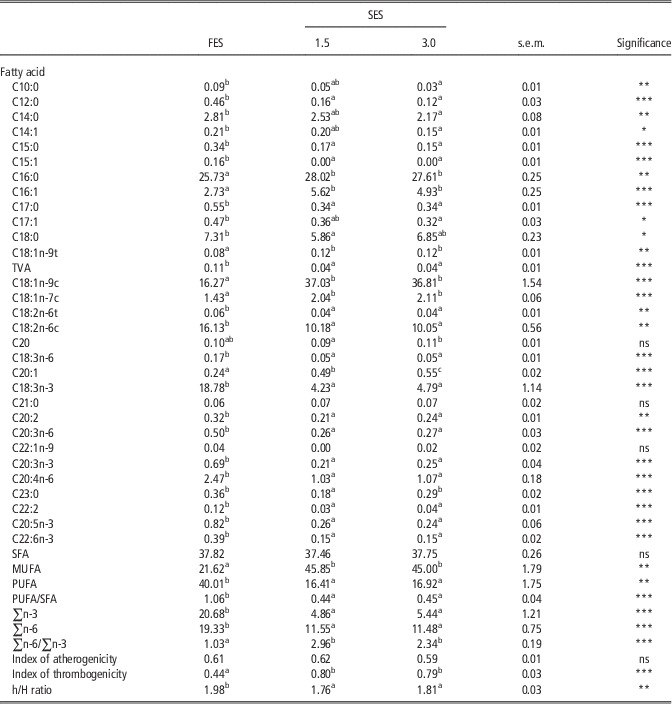
The effect of livestock production system and finishing feeding on fatty acid composition of foals’ LD muscle is shown in Table 3. The fatty acid profile showed significant (P<0.05) differences between livestock production systems, whereas finishing feeding did not present significant (P>0.05) differences with the exception of eicosenoic (C20:1) and tricosanoic (C23:0). The fatty acid profile of foals’ LD muscle from the FES group was predominated by polyunsaturated fatty acid (PUFA), ~40% of total methyl esters, followed by saturated fatty acid (SFA) ~38% of total methyl esters and finally monounsaturated fatty acid (MUFA) ~22% of total methyl esters. The livestock production system showed significant differences in PUFA content (P<0.01) that it was major in extensive production system in freedom regime and in MUFA content (P<0.01) that it was most important in semi extensive production system; these findings are in agreement with those reported in a previous study (Lorenzo et al., Reference Lorenzo, Fuciños, Purriños and Franco2010).
Effect of production system and concentrate level on fatty acid profile of Longissimus dorsi from foals slaughtered at 18 months of age

FES=free extensive system; 1.5 SES=semi-extensive system with 1.5 kg of fodder/foal-day; 3.0 SES=semi-extensive system with 3 kg of fodder/foal-day; s.e.m.=standard error of mean; SFA=saturated fatty acid; MUFA=monounsaturated fatty acid; PUFA=polyunsaturated fatty acid.
SFA=∑(C12:0+C14:0+C15:0+C16:0+C17:0+C18:0+C23:0).
MUFA=∑(C14:1+C16:1+C17:1+C18:1+C20:1+C22:1n9).
PUFA=∑(C18:2n6+C18:3n3+C20:2+C20:4n6+C20:3n6+C22:6n3+C20:3n3).
Results expressed as fatty acid percentage composition (percentage by weight of total fatty acids).
Significance: ns: not significant; *P<0.05; **P<0.01; ***P<0.001.
h/H ratio: hypocholesterolemic/hypercholesterolemic ratio=[∑(C18:1n9c, C18:2n6c, C18:3n3, C20:3n6, C20:3n3, C20:4n6, C20:5n3 and C22:6n3)/Σ(C14:0 and C16:0)].
Index of atherogenicity=(tS′+uS′′+vS′′′)/(xP+yM+zM′) where S′=C12:0, S′′=C14:0, S′′′=C16:0; P=∑(n-6+n-3 PUFAs); M=C18:1n9c+M′=∑(other MUFAs). Empirical constants t, v, x, y and z have been provisionally set at unity, whereas u has been set as 4.
Index of thrombogenicity=mSiv/∑(nM+oM+p×∑(n-6))+(q×∑(n-3))+(∑(n-3)/∑(n-6)), where Siv=∑(C14:0+C16:0+C18:0); ∑(n-6)=∑n-6 PUFAs; ∑(n-3)=∑n-3 PUFAs; M=C18:1n9c; and M′=∑(of other MUFAs). Empirical constant m has been set at unity; n, o and p have been assigned the value 0.5; q has been assigned the value 3.
a-cMeans in the same row with different letters differ significantly (P<0.05).
With regard to PUFA, linolenic acid (C18:3n-3) was the most abundant in foal from the FES group, with percentages of ~47% of total intramuscular PUFA, whereas linoleic acid (C18:2n-6) was the main fatty acid in foal from the SES group, with percentages of ~62% of total intramuscular PUFA. Forages such as grass and clover contain a high proportion (50% to 75%) of total acids as linolenic acid (Dewhurst et al., Reference Dewhurst, Shingfield, Lee and Scollan2006) and its content in tissues is directly related to the dietary intake of the animal. The greater proportion of C18:3n-3 found in foals from the FES group (18.78%) can be attributed to them having eaten only pasture until they were slaughtered and is in good agreement with those reported in a previous study (Lorenzo et al., Reference Lorenzo, Fuciños, Purriños and Franco2010). The content of (C18:3n-3) acid found in foals from the FES group was higher than that reported by different authors (Tateo et al., Reference Tateo, De Palo, Ceci and Centoducati2008; Juarez et al., 2009; Franco et al., Reference Franco, Crecente, Vázquez, Gómez and Lorenzo2013), who reported levels of 12%, 4.92% and 5.50%, respectively.
With regard to MUFA content, foals from the SES group had a greater amount (mean value of 45.4%) compared with those from the FES group (21.6%). This outcome is in agreement with those reported by Lorenzo et al. (Reference Lorenzo, Fuciños, Purriños and Franco2010), as foal meat from SES presented the highest level of MUFA. The major MUFA contents in foals from the SES group could be related with the elevated stearoyl CoA desaturase activity (delta-9-desaturase), stimulated by the low temperature of the body surface (Beaulieu et al., Reference Beaulieu, Drackley and Merchen2002). Within SFA, palmitic acid (C16:0) was the most abundant fatty acid, showing significant differences (P=0.001) between production systems, as foals from the SES group presented the highest values (mean value of 27.8%) compared with those from the FES group (25.7%). These results are in agreement with those found by Franco et al. (Reference Franco, Crecente, Vázquez, Gómez and Lorenzo2013), Lorenzo et al. (Reference Lorenzo, Sarriés and Franco2013b) and Polidori et al. (Reference Polidori, Vincenzetti, Cavallucci and Beghelli2008) as palmitic acid was the main SFA in equine meat.
In the case of the ratio n-6/n-3, the obtained values ranged from 1.03 and 2.96 for FES and 1.5 SES groups, respectively, values that were within the nutritional recommendations of the British Department of Health (1994) for the human diet, because this ratio should not exceed 4.0. These ratio values were higher than the values (0.6) found by Tateo et al. (Reference Tateo, De Palo, Ceci and Centoducati2008) in muscles from foal slaughtered at 11 months. Higher values were found in foals slaughtered at older ages. Thereby, Sarriés et al. (Reference Sarriés, Murray, Troy and Beriain2006) found ratios of 15.5 and 8.5 in foals slaughtered at 16 and 24 months, whereas Lanza et al. (Reference Lanza, Landi, Scerra, Galofaro and Pennisi2009) found values of 6.7 and 4.1 in foal slaughtered at 18 months. The index PUFA/SFA showed mean values of 0.45 for foal meat from the SES group, which is in agreement with the typical values (0.5 to 0.7) of the Mediterranean diet (Ulbricht, and Southgate, Reference Ulbricht and Southgate1991) and the recommendations (0.45) of the British Department of Health (1994). However, foal meat from the FES group presented the highest values (1.06; P<0.001).
A better approach should be use of another index, the ratio of hypocholesterolemic/hypercholesterolemic (h/H), based on the functional effects of fatty acids on cholesterol metabolism (Santos-Silva et al., Reference Santos-Silva, Bessa and Santos-Silva2002). The percentage of fatty acids considered as hypocholesterolemic (C18:1n-9, C18:1n-7, C18:2n-6, C18:3n-6, C18:3n-3, C20:3n-6, C20:4n-6, C20:5n-3 and C22:6n-3) was significantly higher (P<0.05) in foal meat from the SES group compared with those from the FES group, whereas the amount of hypercholesterolemic fatty acids (C14:0 and C16:0) showed the opposite behavior (<28% in foal meat from the SES group v. >28% in foal meat from the FES group) (data not shown). As a result, from a health point of view, the h/H ratio of foals from the FES group was significantly (P<0.01) more favorable (>1.98) (Table 3).
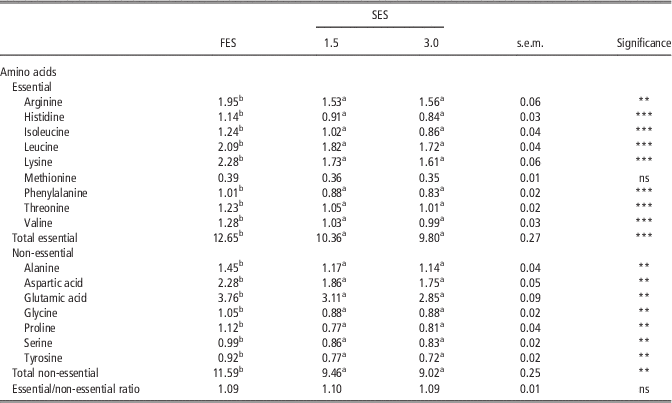
The hydrolizated amino acid profile of foal meat, expressed as g/100 g edible portion is shown in Table 4. Statistical analysis indicated that amino acid content was affected (P<0.01) by the livestock production system except for methionine content (P>0.05). On the contrary, finishing feeding did not show significant differences (P>0.05) between groups. In the essential fraction, the major amino acid was lysine followed by leucine, which showed the highest values in foal from the FES group. These values obtained for lysine (from 1.61 to 2.28 g/100 g) and leucine (from 1.72 to 2.09 g/100 g) were higher than those obtained by Polidori et al. (Reference Polidori, Vincenzetti, Cavallucci and Beghelli2008) who reported values of 1.77 and 1.51 g/100 g for lysine and leucine, respectively, in donkey meat and they were also higher than those given by Badiani et al. (Reference Badiani, Nanni, Gatta, Tolomelli and Manfredini1997) who displayed values of 1.57 and 1.52 g/100 g for lysine and leucine, respectively, in horsemeat. The lysine and leucine requirements for an adult man weighing 70 kg are 2.1 and 2.7 g per day (FAO/WHO/UNU, 2007), respectively. Our results indicated that 100 g of foal meat covered 89.0% and 69.6% of the daily requirement for lysine and leucine, respectively.
Effect of production system and concentrate level on amino acid profile (g/100 g wet tissue) of Longissimus dorsi from foals slaughtered at 18 months of age

FES=free extensive system; 1.5 SES=semi-extensive system with 1.5 kg of fodder/foal-day; 3.0 SES=semi-extensive system with 3 kg of fodder/foal-day; s.e.m.=standard error of the mean.
Significance: ns: not significant; **P<0.01; ***P<0.001.
a-cMeans in the same row with different letters differ significantly (P<0.05).
With regard to non-essential fraction, all amino acids presented significant differences (P<0.01) with respect to livestock production system. Glutamic acid, aspartic acid and alanine were the most abundant amino acids found in the non-essential fraction, obtaining the highest values in foal meat from the FES group. On the other hand, a particularly high essential amino acids/non-essential amino acids ratio was also recorded. In this case, we did not find significant differences (P>0.05) with respect to livestock production system (Table 4). Finally, the essential amino acid requirement for an adult man weighing 70 kg is about 12.90 g per day (FAO/WHO/UNU, 2007). Our results indicated that 100 g of foal meat covered from 98.1% to 78.1% of the daily requirement for essential amino acids for foal meat from FES and SES, respectively.
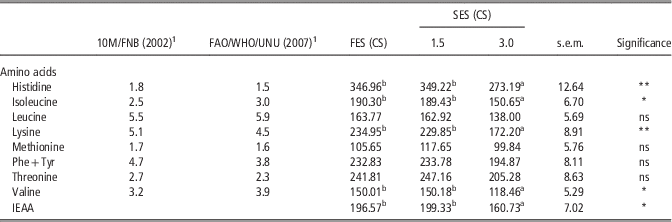
The nutritional quality of protein for foal meat was evaluated. The mean values of the CS, expressed as g/100 g protein, for each of the essential amino acids with respect to the pattern protein, as proposed by FAO/WHO/UNU (2007) for humans (children of more than 1 year old and adults), is shown in Table 5. The profile of Institute of Medicine, Food and Nutrition (2002) is also shown for comparative purposes. The analysis of the CS allows the order of the restrictive amino acids to be determined. The results obtained showed that histidine presented higher values of the CS ranged between 349.2% and 273.2% (P=0.015), as the lowest values were obtained in foals finished with 3 kg of commercial fodder. The second most abundant was threonine, which presented the highest contents in tendency in foals finished with 1.5 kg of commercial fodder (247.2%). The different muscles studied were not limited in aromatic amino acids (Phe+Tyr) in relation to the reference protein, the percentage of which varied from 233.8% to 194.9% (P>0.05). Finally, statistical analysis showed significant differences (P=0.036) for the IEAA index, which was lowest in foals finished with 3 kg of commercial fodder (160.73%).
Effect of production system and concentrate level on protein quality index (SC and IEAA) of Longissimus dorsi from foals slaughtered at 18 months of age

The pattern proteins are expressed in g/100 g protein.
FES=free extensive system; 1.5 SES=semi-extensive system with 1.5 kg of fodder/foal-day; 3.0 SES=semi-extensive system with 3 kg of fodder/foal-day; s.e.m.=standard error of the mean.
Significance: ns: not significant; *P<0.05; **P<0.01.
1Values obtained from literature.
a-bMeans in the same row with different letters differ significantly (P<0.05).
Conclusions
Livestock production system had an effect on carcass characteristics, as foals from semi-extensive presented the best values for LW, CW, DP, PL and CCI. On the other hand, finishing feeding also showed an effect on PL and LT2, as the highest values were obtained in foals finished with 3 kg of commercial fodder. With regard to meat quality, foal meat from semi-extensive system displayed highest levels of IMF and heme-iron and the lowest of cholesterol content and tenderness. With respect to color parameters, foal meat from an extensive production system had a more intense redder color and higher lightness. From a nutritional point of view, foals from an extensive production system on wood pasture could be considered as healthier in relation to their fatty acid profiles (low n-6/n-3 ratio and high h/H ratio) as a result of the beneficial effects of grass on meat fatty acid profile. Finally, amino acid content was affected by the livestock production system, whereas the finishing feeding did not display significant differences between groups.
Acknowledgments
Authors are grateful to Xunta de Galicia (The Regional Government) (Project 10MRU004CT) for the financial support.