This study investigated the treatment of externalising behaviour problems in children 6–8 years of age. Childhood and adolescent disorders are typically subdivided into the two categories of internalising and externalising disorders (Ruttle et al., Reference Ruttle, Shirtcliff, Serbin, Fisher, Stack and Schwartzman2011). The main characteristic of externalising disorders are rule-breaking and aggressive behaviours that are directly observable and affect most of the interactions of the child with parents, teachers and peers (Janssen et al., Reference Janssen, Craig, Boyce and Pickett2004). The average prevalence is estimated to be about 3.3% (American Psychiatric Association, 2013). In clinically referred populations, rates of up to 50% have been cited (Kazdin et al., Reference Kazdin, Siegel and Bass1990), thus making up a large part of any typical clinical case load (Costin et al., Reference Costin, Lichte, Hill-Smith, Vance and Luk2004). Symptoms show a high level of stability over time and develop in varying forms during the evolution process. Early forms of extrinsic symptoms are visible from the second year of life and include restless, mischievous, high crying and stubborn behaviour (Gilliom & Shaw, Reference Gilliom and Shaw2004). In the years that follow, physical aggression, antagonism and first-time violations of the home and school environment are observed; and in adolescence, verbal aggression, theft, substance abuse and antisocial behaviour are seen. These individuals may overtly contradict the rules of society and later slip into juvenile delinquency (Liu, Reference Liu2004). In other words, the prognosis is undesirable, and these children are at risk for other problems, such as learning disorders (Johnson, Reference Johnson2005), mood disorders (Hayden et al., Reference Hayden, Klein and Durbin2005), anxiety (Humphreys et al., Reference Humphreys, Aguirre and Lee2012), alcohol abuse, antisocial personality disorder (Odgers et al., Reference Odgers, Milne, Caspi, Crump, Poulton and Moffitt2007) and delinquent behaviour (McConaughy & Skiba, Reference McConaughy and Skiba1993).
Mindfulness as a therapeutic technique was first introduced by Kabat-Zinn in Reference Kabat-Zinn1990. He defines mindfulness as: ‘the awareness that is attained through attending to goals, being at present moment, without judgment’ (Purser, Reference Purser2015, p. 680). Mindfulness-based intervention (MBI) is a system designed to acquire new types of control based on internal abilities to stay calm, pay attention, and maintain awareness and insight (Kabat Zinn, Reference Kabat-Zinn2003). Mindfulness-based therapies are an important element of the third-wave cognitive-behavioural therapy models (McCarney et al., Reference McCarney, Schulz and Grey2012).
Mindfulness-Based Stress Reduction (MBSR) is a specific form of mindfulness training designed by Kabat-Zinn (Reference Kabat-Zinn2003). It consists of an eight-session intervention in which participants are instructed to interact with their inner and outer world at the present moment, without judgment and with full awareness. Similarly, MBI for children is one of the earliest attempts to apply MBSR to young children and families and was developed by Eline Snel (Reference Snel2014). This intervention method is offered over eight sessions that introduce the basics of mindfulness to children in an easy-to-understand and playful way. It guides children in the cultivation of presence of mind, presence of heart and presence in the body. These practices help children calm down, become more focused, fall asleep more easily, alleviate worry, manage anger, and generally become more patient and aware.
Only a few studies have shown the effects of MBI on externalising disorders in children. Lo et al. (Reference Lo, Wong, Wong, Wong and Yeung2016) described a family-based mindfulness intervention as a treatment option for attention deficit hyperactivity disorder. MBI positively affected internalising and externalising symptoms in elementary school students aged 9 to 12 with severe learning disabilities (Malboeuf-Hurtubise et al., Reference Malboeuf-Hurtubise, Lacourse, Taylor, Joussemet and Ben Amor2017). Semple et al. (Reference Semple, Lee, Rosa and Miller2010) suggested that mindfulness-based cognitive therapy was effective in reducing anxiety symptoms and behavioural problems in children aged 9 to 13 years, and mindfulness-based cognitive therapy also reduced internalising and externalising symptoms in children aged 9 to 12 (Lee et al., Reference Lee, Semple, Rosa and Miller2008). Furthermore, Singh et al. (Reference Singh, Lancioni, Manikam, Winton, Singh, Singh and Singh2011) reported that a mindfulness-based strategy can help in the self-management of aggressive behaviour in adolescents with autism. Together, this literature shows the effects of different methods of mindfulness on pathological symptoms in children aged mainly between ages 9–13, whereas the effect of MBI on externalising disorders for students aged 6 to 8 awaits empirical evaluation.
Accordingly, the present study aimed to examine the effect of MBI on (a) aggressive behaviours and (b) rule-breaking behaviours in this previously untested age group.
Method
Participants
A randomised, controlled pretest-posttest design was utilised to assess the effectiveness of the MBI program. Participants included students from two elementary schools (n = 30, 16 students from one school and 14 students from the other one), during the academic year 2018–2019 in Tabriz/Iran. Parents and the principal of the school attended a briefing seminar, and parents completed informed consent forms, then the Child Behaviour Checklist (CBCL) test was performed on students. The sample was selected based on the cut-off point of the test to distinguish children with externalising disorders from children without externalising disorders. Screening interviews were arranged for assessing eligibility. The inclusion criteria included (a) being male, (b) aged between 6 and 8 years, and (c) committed to joining the MBI program. We decided to focus initially on boys only because of the known much higher prevalence of this problem in boys. The exclusion criteria included: (a) children with another developmental disability, as reported by the principal of the school if children had received formal diagnoses before; (b) receiving medical or other psychological interventions at the same time; and (c) the inability of the child to attend 80% of the program sessions due to other commitments in training programs or social and leisure activities. A total of 30 students were randomised into either the intervention group (n = 15) or the wait-list control group (n = 15). Among the experimental group, seven students were from one school and eight students were from another school; and among the control group, nine students were from one school and six students were from another school.
After the students were assigned to groups, another research team member contacted the parents by phone to inform them about the results of randomisation and to confirm that their child would participate in the study. The MBI program was then offered to the intervention group. All students in the wait-list control group underwent the same program after the posttest of the intervention group. MBI followed the child mindfulness program ‘Mindfulness Matters’ (the green book for children 5 to 8 years of age; Snel, Reference Snel2014). The program includes groups of four to six children, and each session lasts one hour. Six of the students did not complete the study due to loss of contact. The session themes and key contents of the protocol are summarised in Table 1.
Mindfulness-based intervention for children (developed by Snel, Reference Snel2014)

Measures
CBCL. This is a widely used parent-report questionnaire which allows clinicians and researchers to assess a wide range of behaviour problems and competencies (Achenbach & Rescorla, Reference Achenbach and Rescorla2001). This checklist divides emotional-behavioural disorders into categories of internalising behaviour disorders (anxiety-depression, loneliness-depression and physical complaints), externalising behaviour disorders (aggressive behaviour and rule-breaking behaviour), and total problems (attention problems, thinking problems and social problems) (Achenbach & Rescorla, Reference Achenbach and Rescorla2001). The CBCL is one of the most widely used and comprehensive tools for assessing and diagnosing childhood disorders and has acceptable validity and reliability (van Meter et al., Reference Van Meter, Youngstrom, Youngstrom, Ollendick, Demeter and Findling2014). In the standardisation of this test in Iran, the internal consistency coefficient for the externalisation scale was .88 (rule-breaking .67 and aggression behaviour .87). Test-retest reliability (ranging from 5 to 8 weeks) also showed that all correlation coefficients were significant at .05 level and were in the range of .97 (for the externalisation scale; Minaei, Reference Minaei2012).
Data analysis
Regarding statistical analysis, it should be clarified first that the choice of sample size was not based on a priori power calculations because this intervention had not been tested previously for this age group. To assure maximal usefulness of results we computed inferential tests and we are also reporting effect sizes so that future researchers can more easily conduct sample size estimation. All inferential analyses were completed using SPSS 21.0. The main hypothesis was tested with a multivariate analysis of covariance (MANCOVA) to examine the effectiveness of a MBI on rule-breaking behaviours and aggressive behaviours of children. Assumptions of this method were examined a priori. Levene’s test showed that the error variance of the dependent variable is equal across groups (F = 2.38, p = .13), (F = 6.24, p = .02). Also, results of one-sample Kolmogorov-Smirnov test showed that test distribution is normal (z = 1.01, p = .26), (z = 0.63, p = .81). On the other hand, Box’s test of equality of covariance matrices showed that the observed covariance matrices of the dependent variables were equal across groups (F = 2.90, p = .03). The decision criterion for rejecting or confirming targets is a significant probability at the .01 level. The effect sizes were described as Cohen’s d, where mean 1 – mean 2 was subdivided by the average of their standard deviations. As is traditional, effect sizes >.8 were labelled ‘large’.
Results
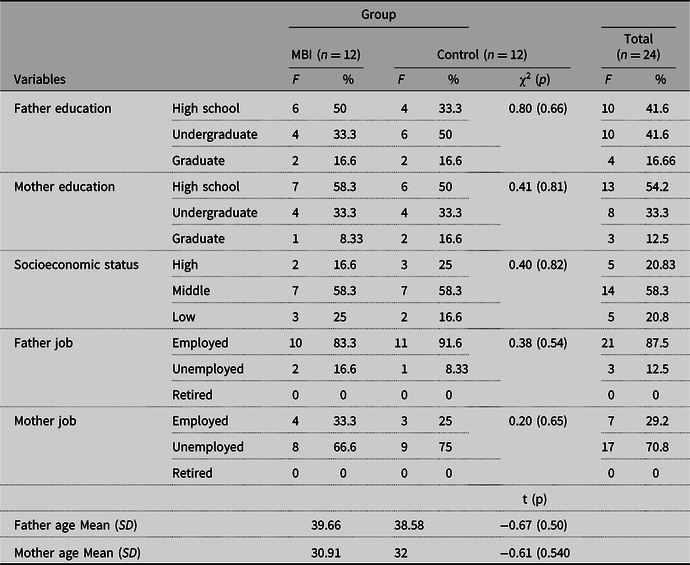
Descriptive statistics of sample demographics are shown in Table 2. Descriptive statistics for all measures pre- and postintervention are summarised in Table 3. The mean scores of rule-breaking behaviour and aggressive behaviour are almost identical at pretest but differ greatly at posttest. The results of the analysis of covariance are reported in Table 4, as are the corresponding effect sizes.
Descriptive statistics of sample demographics (n = 24)

Note: MBI, mindfulness-based intervention.
Descriptive statistics for all measures pre- and post-intervention

Note: MBI, mindfulness-based intervention.
Results of covariance analysis for the effectiveness of MBI on rule-breaking behaviors and aggressive behaviours

In summary, the results shown in Table 4 indicate that after controlling for pretest scores, there was a significant difference between the posttest scores of the experimental versus the control groups on the rule-breaking variable (F = 27.37, p < .001). Considering the mean difference between the two groups, the mindfulness-based intervention for children was associated with a large reduction in rule-breaking behaviours. Accordingly, the eta coefficient, 57% of rule-breaking variance, is explained by the MBI. The results also showed that there was a significant difference between the posttest scores of aggressive behaviours in the experimental and control groups after controlling for the pretest scores (F = 15.23, p < .001). That is to say, a MBI for children can reduce the aggressive behaviours. Computation of an eta coefficient suggests that 43% of aggression variance is explained by the MBI. The corresponding effect size differences (i.e., the differences between change in the experimental group vs. change in the controls were very large, with d = −2.52 and d = −1.88 respectively).
When the control group was treated subsequently, this allowed a test of the replicability of the treatment effects and revealed a reduction of d = − 2.52 for rule-breaking behaviours and d = − 2.46 for aggressive behaviours.
Discussion
The purpose of this study was to evaluate the effect of a MBI on aggression and rule-breaking behaviours in elementary school boys, and it represents a proof-of-concept study for this age group.
The results reveal that a MBI for boys may significantly reduce rule-breaking behaviours and also aggressive behaviours relative to a no-treatment control group. Statistically significant differences were further mirrored in the impressively large observed effect sizes. Furthermore, when the group initially placed on the wait-list was treated later, the same positive treatment response was replicated for both outcome variables. Observing that a MBI can reduce rule-breaking and aggressive behaviours is consistent with the research of Lee et al. (Reference Lee, Semple, Rosa and Miller2008) and Malboeuf-Hurtubise et al. (Reference Malboeuf-Hurtubise, Lacourse, Taylor, Joussemet and Ben Amor2017).
We posit that a powerful treatment effect must have been present, because the study not only found a positive result with a relatively small sample but also succeeded in replicating the finding with another small sample (the later-treated wait-list control group). The treatment effects may be attributable in part because the protocol has very simple exercises that children are able and willing to engage in (Snel, Reference Snel2013).
Finding benefits for mindfulness training in boys as young as 6–8 years old is new but should not really surprise because the treatment focus is well aligned with the developmental stages of the typical child. Executive function and emotion regulation are closely related in development, arguably because they all depend on the same underlying process of reflection made possible by neural circuits that coordinate hierarchically arranged regions of prefrontal cortex (Bunge & Zelazo, Reference Bunge and Zelazo2006). The ability to control potentially interfering thought processes and actions develops rapidly in the preschool period. By 5 years of age children are much more proficient in inhibitory control, which is a key aspect of executive function (Carlson, Reference Carlson2005). At the same time, children improve in the ability to regulate the experience of emotions by monitoring their expressive behaviour (Carlson & Wang, Reference Carlson and Wang2007). Mindfulness training scaffolds the development of self-regulation and executive function by creating conditions conductive to reflection (Zelazo & Lyons, Reference Zelazo and Lyons2011).
The current study did not directly test mechanisms of change. We speculate that mindfulness practices might stimulate children to respond to situations with a new attitude about themselves and the environment which in turn might attenuate reflexive responses. This kind of change can improve social activities and relationships and reduce the inefficiencies and potential failures that lead to rule-breaking behaviours. The key here is that children learn that all feelings are okay, but not all behaviour is (Snel, Reference Snel2013). Thus, during this intervention, children learn how to respond to environmental demands without judgment and with acceptance, thereby reducing defiant behaviours. During mindfulness sessions children learn practices such as the pause button exercise, and to focus their attention on breathing to find out what is going on inside them, so they continue their activities and reactions in the outside world in a different way (Snel, Reference Snel2013). This is consistent with other research: mindfulness was positively associated with thought recognition that has an influence on positive mental health as well as reduction of anger and aggression (Kelly & Lambert, Reference Kelley and Lambert2012; Fix & Fix, Reference Fix and Fix2013). Additionally, mindfulness has also been linked to increased compassion for both the self and others, which may foster a great sense of interconnectedness and facilitate the response to potential conflict with nonaggressive approaches (Condon et al., Reference Condon, Desbordes, Miller and DeSteno2013).
Limitations
Given that only boys had been included, it is unclear how these findings can be generalised to female students. The coherent and large effects seen here encourage a similar trial with girls. Also, the short project period did not allow the investigation of the sustainability of the treatment effects. Studies should consider a 6-month or 1-year follow-up period to assess the sustainability of effects.
Finally, it is suggested additional measures be used to examine the stability and generalisability of the results from this study.
Conclusion
Our results showed the usefulness and efficacy of Snel’s protocol in reducing rule-breaking and aggressive behaviours in young boys, and child psychotherapists might choose mindfulness training to reduce child pathological symptoms, especially externalising disorders.
Acknowledgments
The authors would like to thank all the students, parents and principals of schools who participated in the research.