Introduction
Revolutionary processes in the world have become drivers of great changes in the international political arena. They have resulted in some cultural contradictions between revolutionary and counter-revolutionary countries (Lawson Reference Lawson2021). Scholars and historians often view revolutions not as instruments of the international order, but as problematic episodes in a straightforward historical development. They have to be addressed by artists and contribute to the development of new symbolic movements and attitudes that give rise to cultural transformations.
In the research on the global theme of revolutions, in particular, comparing the political foundations of Western monarchies and Eastern (Asian) regimes, Goldstone (Reference Goldstone2016) discusses that the great crises of the past have influenced the stages of modern revolution. All of them followed the same scheme of the revolutionary struggle but had different results and diverse impacts on the countries' economies. Inflexible political and social structures are actively influenced changes in the population composition, modernization, urbanization, and the separation of state–elite relations that affect the social background, symbolism, and semiotics of cultural heritage. At the present stage of the states' development and the perception of revolutionary uprisings, revolutions, as such, do not have a great potential for new political elites to establish the government and do not threaten the state order (Malecki Reference Malecki2001). In China, the Culture of Proletarian Revolution was initiated by Mao Zedong in 1966. It has introduced the new party ideology and led to the emergence of new trends in art and literature with characteristic features of Chinese revolutionary ethics (Andrews Reference Andrews2010; Sun Reference Sun2022). Compared to capitalist ethics characterized by individualism and liberalism, Chinese revolutionary ethics adheres to the basic principles of collectivism, puts the interests of the people first, and demands the subordination of personal interests to the interests of the people (Sun Reference Sun2022). Compared to the sharp separation of public morality and private morality in capitalist ethics, Chinese revolutionary ethics insists on a high degree of coherence between the two, emphasizing that revolutionaries are not only pioneers of the revolutionary cause, but noble individuals (Li and Jiang Reference Li and Jiang2022).
The art of the Cultural Revolution is expressed in two opposing art movements that emerged in the decade from 1966 to 1976 (Purtle Reference Purtle2016). The art of this period served to embody the dominant ideology of the country on the one hand and acted as the flagship of the movement against the dominant ideology on the other (Purtle Reference Purtle2016; Reynolds Reference Reynolds2014). However, representatives of opposition to state ideological art were persecuted and harassed, and their works were banned, so opposition art existed within the framework of underground organizations and art collectives (Reynolds Reference Reynolds2014). The art of the Cultural Revolution refers to the art that emerged within the official art system of the time, serving and expressing the art of the political intent of the Great Proletarian Cultural Revolution (Pozzi Reference Pozzi2018). The functions of this art were as follows: art (as a whole with culture) should be used as a weapon of national ideology and a means of struggle against various forces; monopolization by the state of all areas and phenomena of artistic life; strict control over the development and direction of art; destruction of all art (except official art) considered hostile and reactionary (Xue Reference Xue2015). The Marxist conception of literature and art held a leading position in artistic thought during this period, advocating the need to combat the various non-Marxist tendencies that existed in literary and artistic circles (Dong Reference Dong2022). Nevertheless, for Chinese revolutionary culture, the combination of the basic principles of Marxism with traditional Chinese culture, with the condition of its focus on the principles of patriotism and “Chineseness,” was representative (Zhao and Zhu Reference Zhao and Zhu2018).
The new visual culture of the Cultural Revolution was represented by official visual art showing workers, soldiers, industrial progress, and Chairman Mao (Kyo Reference Kyo2017). During the Cultural Revolution, the image of the leader was ubiquitous (Yueqin Reference Yueqin2022). The compositional style of most paintings was based on Soviet models with an imposing central figure (Fu and Yan Reference Fu and Yan2017). The main color of the artworks was red, the color of the revolution, and landscape paintings included symbols of industrial achievements, such as iron towers, bridges, and factories (Kyo Reference Kyo2017; Pozzi Reference Pozzi2018). Propaganda painting, as a political tool, was one of the main areas of art during the Cultural Revolution (Reynolds Reference Reynolds2014).
After the Cultural Revolution, Chinese culture and social life reflected the symbolism of the era in the images of the destruction of political idealism and the idealism of the generation. During this historical period, opposing political views were prohibited and contrasting points of view were silenced. Cultural figures who devoted their lives to art, literature, and the social sphere created the system of symbolism and semiotics as part of the cultural rebirth. In China, the political leaders did not struggle against the Cultural Revolution, however, they used so-called euphemistic labels to create abstract terms for the post-revolutionary cultural world (Andrews Reference Andrews2010).
During the cultural recovery process, China changed ideologically from a communist regime to a society of consumerism manifested in the new political symbols and semiotic mechanisms adopted by the media and advertising industries. The key role of new symbolism and semiotics was to ensure the smooth transition and bring new cultural meanings to society and art (Zhao and Belk Reference Zhao and Belk2008). The concept of semiotics includes three main objects: (1) the sign or symbol itself; (2) the principle according to which the system of signs is structured; and (3) the context in which these signs appear and function (Crow Reference Crow2011). Thus, semiotics can be interpreted as visual communication (art, architecture, advertising, theater, etc.) and as a linguistic category (literature, music, performances, etc.).
The change in the general social atmosphere in the post-revolutionary period caused the emergence of new artistic currents, within which the subject of art again became “human” as a person, and art in general began to move toward humanistic tendencies expressed in such art movements as art of scars, art for the sake of art, flow of life, pseudonaturalism, village painting, and the New Wave 85 (Zhou Reference Zhou2020a). In the new era of China after the Third Central Committee Plenum of the 11th Convocation (1978), an important chapter in the development of Chinese art was Scar Art (Scar Literature and Scar Painting) as an artistic phenomenon of reflection and critique of the historical mistakes of the Cultural Revolution decade (Wu Reference Wu2017). The emergence of The Art of Scars marked a major change in the creative concept of Chinese artistic circles, moving from initial idealism and heroism to tragic realism and popularism, from the expression of heroes and model formation to a description of the reality of the fates of ordinary people in the cultural revolution era (Huang Reference Huang2020). Following Scar Art in the mid-1980s, the art movement 85 New Wave Art with Western modernist theory as its core, and inseparable from the artist's own reflection, emerged in China as the beginning of the boom of Chinese contemporary art (Mao Reference Mao2018). The forms of Chinese painting during the Cultural Revolution were purely artistic, lacking humanized creative thinking and perspective (Zhou Reference Zhou2020a). After New Wave 85, Chinese painting gradually became humanistic creationism, and art forms gradually merged with the humanities to form a new academic painting (Liu et al. Reference Liu, Wang and Wang2016). During the development of the New Wave 85 movement, China began the rise of reform and openness, and artists sought to express new art forms with Western cultural connotations integrated with Chinese cultural and social characteristics (Andina and Onnis Reference Andina and Onnis2019). For example, late in the development of the New Wave 85 movement and due to the development of globalist trends in the world, the art movements Chinese pop art and cynical realism formed in China, integrated with such concepts as anti-art, anti-aesthetics, and anti-system (Yuan Reference Yuan2018). These currents depart from aesthetic and moral artistic categories in the traditional sense, displaying the irony of domestic perfectionism and the metaphor of consumer fetishism (Szatkowski and Kupś Reference Szatkowski and Kupś2021). Artists of this period were strongly influenced by Western surrealism, carried out artistic descriptions through a combination of realism and surrealism, expressing their own aspirations to break through traditional ideas of artistic expression (Zhou Reference Zhou2020a). After its rapid development during the New Wave 85 period, realist art in China found a new mode of expression in the 1990s, called state realism, in which the conceptual state refers to artists' state of their own lives and to certain segments of events in the life process of ordinary people; forms of photographic images were also used to depict scenes from real life (Zhou Reference Zhou2017).
Literature review
During the Cultural Revolution in China, culture and art were used as the enlightenment of the masses and followed certain rules. As a result, the Chinese culture demonstrated the realist tradition and socialist trends combined with romantic features in art. Such art developed symbols and images with an idealistic character appealing to the minds and hearts of citizens of the modern socialist country.
In China, the symbols of utopia appeared in art. They included the signs of an angelic halo as a model of the rising sun, as well as symbols of red flags and the red environment symbolized Communism and the color of prosperity and happiness. Moreover, these symbols and the red color mean the very concept of a coup and revolution (Yang and Suchan Reference Yang and Suchan2009).
The underground art movements, known as wuming (Chinese: 无名画会, the Wuming Painting Collective), gained great popularity after the Cultural Revolution, they presented themselves as No Name Painting Association or Anonymous Painting Group, and a countercultural collective. They opposed political motifs of the traditional Chinese art, portrayed the concept of Art for Art's Sake in their works and engaged in cultural activities that reflected Chinese modernity and interpretation of the Cultural Revolution. Their artworks have symbols of protest against political propaganda (Aihe Reference Aihe2009).
The Cultural Revolution influenced the theater performances and the artists' perception of the new reality (Roberts Reference Roberts2010), more precisely, gender erasure and femininity were avoided in the culture of the Maoist era. Thus, the concept of Genderless Revolutionaries appeared in art. In the Cultural Revolution, gender symbols were no longer significant, and the concept of gender equality dominated in Chinese art. The artists created social class and party symbols without a certain relation and distinction in gender (Roberts Reference Roberts2006). Semiotic perspectives and theoretical approaches to theater art were influenced by post-modern and post-revolutionary changes (Helbo Reference Helbo2016).
In the present research on the art of the People's Republic of China during the Cultural Revolution, the scholars are faced with the problem of collecting and interpreting the symbolism and semiotics of art objects. A problem of interpreting the elements of Chinese controversial themes of revolution in the art exists in visual culture.
Chinese art has been developed under the influence of communism and Maoism, as well as national identity and communist symbolism. These features formed as a separate trend based on the ideas of Chineseness with its special style and content (Barnes Reference Barnes2016). The concept of the Chinese nation (Chinese: 中华民族) and its symbols appeared at the beginning of the twentieth century during the May Fourth Movement (Chinese: 五四运动) of 1919 under the influence of the October Revolution in Russia. In a multi-ethnic country, there was no identification with the concept of the Chinese nation and patriotism before. Then, the stress caused by the national revolutionary crisis led to the rise of modern Chinese identity reflected in symbolism and semiotics (Zheng Reference Zheng2019).
Since the end of the Cultural Revolution and within the framework of Western perception and comparison with the revolutionary experience of other countries, the culture of the Mao era influenced two areas of science: (1) the representation of revolutionary China in museum studies; and (2) the global reception of Maoism based on the image and iconic symbols of another society and its policies with a wide range of reflections from a Utopian Ideal to a Dystopian Nightmare (Ho Reference Ho2017).
During the Cultural Revolution, the movement Painting by Candlelight became popular. It included the artists of the Maoist culture who secretly painted different pieces of art under their aspirations and desires, but at the same time, they remained under political pressure and were forced to depict symbolism of the regime, distorting the artists' vision of reality. The concept of Private art at night by candlelight expresses true intentions and experiments with symbols and forms that reflect the hidden semiotics of independence, identity, and democracy in culture (Hawks Reference Hawks2017).
After the end of the Cultural Revolution and the Opening-up reforms in 1978, restrictions on artists were eased and they revealed the truth of life in China during the Maoist era. Thus, the new concept and genre of literature emerged, and it was known as Scar Literature (Chinese: 伤痕文学) and related to the above concept of art. This phenomenon revealed the features of the cultural development of society with its symbols and stipulated the formation of images in forbidden literature and works of art (Löfstedt Reference Löfstedt2011).
Analyzing the role of meaning in visual art, scholars argue that there is a certain process in which artistic signs function and influence the development of a semiotic system. They construct a key meaning through mediatization (Jappy Reference Jappy2022). Other scientists argue that art pieces have a unique semiotic and symbol structure as the basis of the social and cultural history of art and these elements are distinctive from other cultural artifacts. These artworks should be understood beyond historical and political traditions and views (Moxey Reference Moxey1991; Suhor Reference Suhor1992).
The present research analyzes the revolutionary symbolic and semiotic system of four artworks by Chinese artists such as Gao Xiaohua (Chinese: 高小华) (Quan Reference Quan2019; Wang Reference Wang2019), Wang Guangyi (Chinese: 王广义) (Ma Reference Ma2018; Qu Reference Qu2015), Zhang Xiaogang (Chinese: 张晓刚) (Li Reference Li2022; Zhang Reference Zhang2021; Zhi Reference Zhi2019), and Zeng Fanzhi (曾梵志) (Li Reference Li2016; Zhang Reference Zhang2017) compared with two works of the American artist Grant Wood (Chouard and Adrien Reference Chouard and Adrien2017; Evans Reference Evans2010) and the French painter Eugene Delacroix (Aguillon Reference Aguillon2015; Llalnohar Reference Llalnohar2018; Wosth Reference Wosth2019).
Theoretical framework
The theoretical framework of the research includes the study of scientific articles and monographs that address revolution images in Chinese and world works of art, as well as scientific papers devoted to the artworks analyzed in this study. These scientific works that underlie this study investigate:
• revolutionary processes as instruments of cultural transformations in the international context (Lawson, Goldstone, Malecki),
• the Great Proletarian Cultural Revolution in China (Andrews, Sun, Li, Jiang, Ho),
• the art of the Cultural Revolution in China and the post-revolutionary period (Reynolds, Purtle, Pozzi, Xue, Dong, Zhao, Zhu, Kyo, Yueqin, Fu, Yan, Wu, Zhou, Huang, Mao, Liu, Andina, Onnis, Yuan, Szatkowski, Kupś, Hawks, Löfstedt, Jiang, Chen),
• symbols and semiotics of art objects from different countries, color semantics in world culture (Zhao, Belk, Crow, Yang, Suchan, Aihe, Helbo, Zheng, Barnes, Jappy, Moxey, Suhor),
• artworks analyzed within the framework of this study (Quan, Wang, Aguillon, Wosth, Llalnohar, Ma, Qu, Li B., Zhang L., Zhi Y., Zhang A., Li H., Evans, Chouard, Adrien).
Problem statement
The research purpose is to analyze the features of the artistic language of four Chinese artists of the Cultural Revolution and examine the symbolic and semiotic system of the culture. Special attention is paid to the Chinese features comparing them with the revolutionary symbols of the July Revolution (The French Revolution of 1830) and life in America during the Great Depression.
The research goals involve the following problems and tasks:
• conduct a comparative analysis of the artworks of painters, who represent the culture of revolution in China, America, and France;
• compare symbolism and semiotic systems of revolutions in the artworks of Chinese artists with French and American painters;
• evaluate the influence of the revolutionary trend in art on the development of Chinese art and culture and compare it with the world culture of revolution;
• investigate the structure and formation of images, signs and symbols in the semiotic perspective of revolutionary art;
• explore the differences and similarities in the symbolism of the revolutionary culture in China using an example of the global culture.
Methods and materials
The following five methods are used to investigate the research theme.
The method of holistic analysis of six artworks was applied to perform detailed research of the symbolic, sign, and semiotic system of the art objects that characterized the revolutionary movements and compare these pieces of art. The analysis of the paintings used the formal stylistic method with the parameters of form analysis formulated by G. Wölfflin (Wölfflin Reference Wölfflin1915).
The systematic review, classification of components, and the partial search method was used for the analysis. The scholars collected and identified theoretical information and constructed a hypothesis about the semiotic perspective and structure manifested in representatives of visual culture. This method helped to group existing views on the main art features and formation of the symbolic and sign system of the revolution art and understand the main trends and influences on the creative process and artistic creativity of painters from different countries, especially China (Goldstone Reference Goldstone2016; Ho Reference Ho2017; Jappy Reference Jappy2022; Lawson Reference Lawson2021).
The method of the semantics and connotations of symbols and signs of the semiotic system consists of an in-depth analysis of the main cultural features of the revolutionary movement in China during the Cultural Revolution. The analysis of these symbols is considered a specific visual tool that reflects the cultural, historical, and social background.
The method of hypotheses development is characterized by the formation of certain models used to explain the main factors associated with the symbolic and semiotic manifestation of the cultural theme of revolution in Chinese art in comparison with Western and American images of revolution.
The explanatory and illustrative method has been used to analyze the distinctive features and similarities of revolutionary symbolism under the influence of social and political factors in artworks.
The selection of art pieces and painters of Chinese origin was determined by their popularity and belonging to the generation of Scar paintings, cynical realism, political pop art, as well as the modern movement of Mao and the Cultural Revolution. These trends are compared with the famous painting by the French artist Eugene Delacroix Freedom on the Barricades (fr. La Liberté guidant le peuple), as well as the work Daughters of the American Revolution by the American artist Grant DeVolson Wood.
Research limitations
In this research, only four selected artworks by Chinese artists of the Cultural Revolution period, as well as two paintings by French and American painters, were analyzed. The research aim was to examine the symbolic and semiotic system of the culture of revolution and compare Chinese, Western, and American perceptions of the political upheavals that create deep social turbulence and social confusion. The art trends influence the society and artistic creativity of certain artists. Therefore, the results obtained cannot reflect a complete picture of the Chinese revolution compared with the world culture of revolution.
Results and discussion
The system of images and symbols of the Cultural Revolution suggested the rejection of Western motives in literature, art, as well as the Restoration of Capitalism. The ideological and political campaign aimed to free the Chinese national identity from the influence of Western individualistic and subjectivist trends.
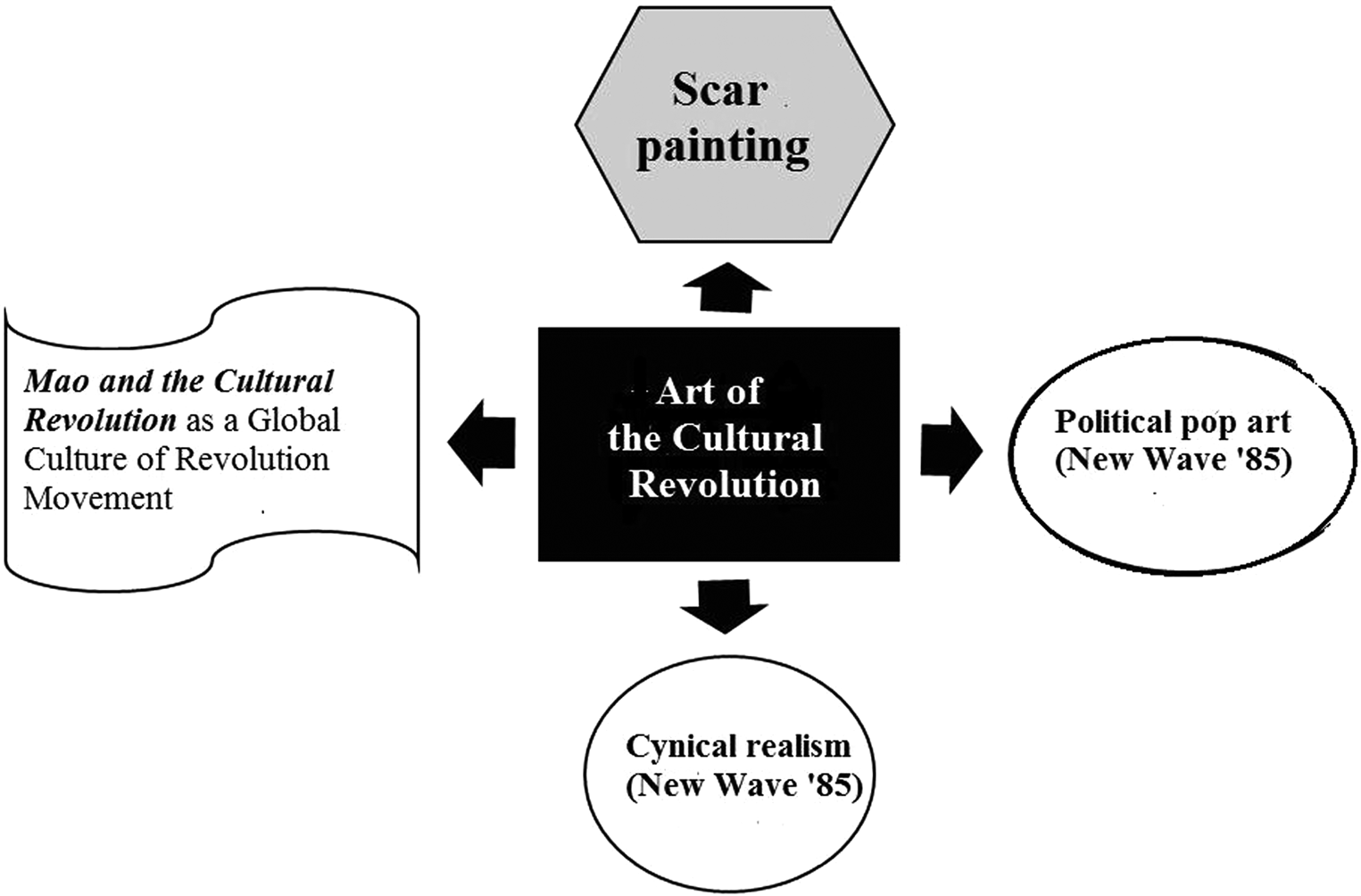
Previously, in Chinese painting existed two main movements: (1) Western motifs with Chinese features; and (2) classical Chinese painting known as shan shui (Chinese: 山水). During the period of the Cultural Revolution and after that, several new revolutionary movements were formed in Chinese art characterized by the opposing nature of the system and structure of images. These features contradicted the key foundations of the ideological concept of the Cultural Revolution. Therefore, it was possible to distinguish four main movements in art, namely Scar painting, after which the New Wave ’85 (NV85) movement came on the stage and marked the beginning of cynical realism and political pop art trends. The cultural movement Mao and the Cultural Revolution belongs to modern art and even at the beginning of the twenty-first century, it is influenced by Western art that plays an important role in the Chinese culture of revolution and the world art of revolution (see Figure 1).
Four movements formed during and after the Cultural Revolution in China.
Source: Author's elaboration.

Each of these movements was characterized by a certain system of symbols, signs, and images that influenced the artworks of Chinese painters.
Scar painting or Scar art (Chinese: 傷痕藝術)
The name of this trend can be found in literature and art. Its main feature was creativity suppressed by prohibitions of the party regime. Therefore, artists who after Mao Zedong's death began to call themselves representatives of Scar painting used symbolism that differed from the political symbols of the Maoist regime. Artists and writers realized that the political interventions aimed to protect Chinese art from Western influences, and it led to political repressions against individuals who were objectionable to the government. Thus, the artists focused their attention on the genres of critical and revolutionary realism using the elements of sentimentalism and romanticism.
The main features of Scar art were expressiveness and vivid symbolism of revolutionary culture, interpreted as a painful stage in the revival of an entire Chinese culture. The purpose of Scar art was to portray criticism of the Cultural Revolution against the backdrop of dramatic portraits of individuals suffering from revolutionary changes in social and political life. Such works had a hidden meaning with the purpose to stop the bloodshed of the enemies of revolution in China.
In the artworks, a certain system of symbols functions as a semiotic perspective and helps to understand their key meanings. For example, the painting Why (Chinese: 为什么) by the Chinese artist Gao Xiaohua (Chinese: 高小华) is one of the early works of the Scar painting generation. It reflects the most striking systems of revolutionary symbols and includes the elements of critical realism combined with the features of sentimentalism.
The analysis of Gao Xiaohua's Why (Chinese: 为什么) (according to Wölfflin's formal stylistic method with the parameters of form analysis):
(1) The meaning of the painting's name.
The demonstration of the fatuity of bloodshed during the Cultural Revolution.
(2) The genre.
Historical painting, “the art of scars.”
(3) The picture's plot specifics.
The painting depicts members of student detachments, known as hungweibing or red guards (Chinese: 红卫兵). They participated in military confrontations and were wounded in battle. The painting shows a scene after a fierce battle during the Cultural Revolution: the Red Guards are exhausted and wounded, and one of them (in the center of the picture) looks directly at a viewer with a puzzled expression on his face, silently asking himself, the author's contemporaries, and the people of the whole country: “Why…,” demonstrating an understanding of the fatuity of this bloodshed.
(4) The painting's composition features.
The artist used the method of overlaid composition and a lead-gray brush to make the whole picture a low and gloomy scene. The characters were created and described without a mythological aura for a realistic depiction of the social reality of the Cultural Revolution.
(5) The main means of the artistic image.
The dark, but soft, not translucent gray-blue color became the main color of the painting. Realistic skin and hair colors are mixed with realistic red military uniforms, emphasizing the drama of the artwork. The bright red color is combined with a lot of cold colors to make the whole picture complete and convey a feeling of sadness and depression.
In this art piece, several key symbols have a certain semiotic and semantic meaning and connotation (see Figure 2).
(1) The symbol of red. In traditional Chinese culture, it means happiness and prosperity. However, during the Maoist era and in works of the Scar painting generation, it was interpreted as the color of revolution, struggle, anger, revenge, as well as all innocently shed blood.
(2) Images of young individuals with the connotation of Killed Youth. They represent a new national identity that wants to be reborn but demonstrates disappointment, lack of hope, and doubt.
(3) Signs of the injury to the nation and the devastation that existed in the Chinese society during the Cultural Revolution. Their purpose is to detect propagandists of Western ideas.
(4) Facial expression that depicts thoughtfulness and the question Why? on behalf of the Chinese population.
Collage with fragments of the painting Why? (1978) by Gao Xiaohua demonstrates the central system of symbols.
Source: Author's elaboration.

This art object can be compared with the painting Freedom on the Barricades (fr. La Liberté guidant le peuple) by the French artist Eugene Delacroix.
The analysis of Eugene Delacroix's Freedom on the Barricades (according to Wölfflin's formal stylistic method with the parameters of form analysis):
(1) The meaning of the painting's name.
It is dedicated to the rebellion of the citizens in Paris on July 27, 1830, that aimed to overthrow the Bourbon dynasty.
(2) The genre.
Historical painting, symbolic painting.
(3) The picture's plot specifics.
The painting depicts a street battle scene of the July Revolution at the critical moment of the victory. The main characters are workers, the petty bourgeoisie, and the intelligentsia.
(4) The painting's composition features.
The painting has a rectilinear composition. Corpses lying on the ground, fighting soldiers, and a woman with a French flag form a stable triangle with inertia (with the flag at the top of the isosceles triangle). The golden ratio lines depict the figure of a young woman in a Phrygian cap.
(5) The main means of the artistic image.
The main colors of the painting are red, white, and blue (the colors of the French Republic's flag). The picture has saturated, “fiery” colors and contrasts of light and shadow.
The French artwork was painted in 1830 after the July Revolution (The French Revolution of 1830). Gao Xiaohua painted his work more than a hundred years later than the French artist during the Cultural Revolution in China.
The comparative analysis of these works shows the key differences in the Western and Chinese experiences of the culture of revolution (see Figure 3). The two works belong to the genre of historical painting. Moreover, the critical realism and genre of sentimentalism of the Chinese painting Why? are similar to the romantic features of Freedom on the Barricades vividly portray the connection between a patriotic and revolutionary system of images.
Collage with fragments of the painting Liberty at the Barricades (1830) by Eugene Delacroix demonstrates the central system of symbols.
Source: Author's elaboration.

The image of Anna Charlotte (Marianne) is a symbol of individualistic freedom with the motto Freedom, Equality, Brotherhood, whereas the Chinese painting Why? reflects images of frustration, fatigue, and disappointment with the success of the revolution. At the same time, individualism in the image of Anna Charlotte is due to the painting's drawing style (romanticism), which is also characterized by an emphasis on the central characters' emotions and individualism (Cole Reference Cole2022; Gautam Reference Gautam2018). Against the background of real events, the woman in a yellow dress is not a real character but a collective image that stands out in the center of the plot. She towers in the upper corner of the central triangle in the picture's composition. The symbol of the girl's bare breast becomes a sign of openness and readiness of the French people to oppose the power of the state and gain the desired freedom. The main heroes of the French painting step on the corpses of dead bodies, while the Chinese HunWeibin is wounded in battle. They have lost hope of fighting and have been waiting without a clear understanding of how the war would go on.
The French painting represents images of both the working class and the individuals who participate in revolutions. Instead, the Chinese painting depicts only young students fighting for the right to live in a society free from political dictatorship. Similar features and signs of both paintings are weapons in the hands of the young generation who continue to take responsibility and a social and cultural battle against political oppression.
The Chinese painting is characterized by the red colors perceived as a sign of revolution, blood, and revenge (Chen Reference Chen2018; Jiang Reference Jiang2017; Quan Reference Quan2019). The French artwork is identified with the yellow color, a symbol of fortitude, wisdom, courage, and holiness (Aguillon Reference Aguillon2015; Wosth Reference Wosth2019). Moreover, Gao Xiaohua's painting has a more negative connotation and a critical semiotic system of metaphorical imagery, while Delacroix's work reflects a positive structure of exaggerated signs, focusing on the boldness of individualism in the image of Anna Charlotte.
The Chinese culture of revolution portrays the general mood of the individuals (rather negative), not relying on the central image of the man-fighter but concentrating on the idea of a collective burden and joy.
Given the paintings' genre (“historical painting”) and the historical context of revolutions, the studied artworks considered symbolism historically, not regionally. These paintings were chosen for comparison since both paintings are representative in terms of the historical background and prerequisites of creation. Why? has changed the creative purpose of art serving political propaganda before the Cultural Revolution, while Freedom, Equality, Brotherhood is the flagship of the July Revolution and a symbol of the struggle against censorship in art and literature during the Bourbon Restoration period (Llalnohar Reference Llalnohar2018; Quan Reference Quan2019). Both paintings combine aesthetic value with epochal significance and demonstrate battle plots.
New Wave ’85 (Chinese: ’85 美術運動)
This trend got its name during the Conference (1985) in the city of Huangshan, devoted to the issues of Chinese art reformation. The artists admitted that art should not depend on politics, proclaiming the freedom of creative expression and individualism (Zhou Reference Zhou2020b). It substituted the Scar art movement and put forward other humanistic matters that became not only conceptual movements in art but also philosophical concepts. Consequently, this trend became a basis for different art movements and a conglomerate of diverse trends in art.
Political pop art (Chinese: 政治波普)
This trend is an example of the influence of American art on Chinese artistic expression adopted by the painters to Chinese social realities. Therefore, political pop art can be described as a complex modernist movement, where Chinese socialist realism after the Cultural Revolution and American pop art united. These cultural movements initiated the development and search for new forms and means of subjective expressiveness describing social, political, and historical events.
Works of political pop art have an interesting symbolic structure and combine images from advertising and propaganda posters of totalitarian Chinese art with Western and American symbols of mass popular culture. This trend in art is characterized by expressiveness and synthesis of opposite images of politics and mass consumerism. It portrays the rethinking of political and cultural crises and the way to create new ideas about the ironic and grotesque national identity of the Chinese.
The artwork Mao Zedong: AO by the Chinese artist Wang Guangyi (Chinese: 王广义), who created the Post-Classical series and put the philosophical concepts of Nietzsche's theories into his work, reflected a system of symbols important for the history of culture and cultural factors that influenced art and culture of the country and revised traditional Chinese painting patterns. His creative symbolism is a rethinking of Mao Zedong's cult of personality.
The analysis of Wang Guangyi's Mao Zedong: AO from the Black Mind series (according to Wölfflin's formal stylistic method with the parameters of form analysis):
(1) The meaning of the painting's name.
The deconstruction of the official portrait of Mao Zedong from the Cultural Revolution period.
(2) The genre.
Figurative art.
(3) The picture's plot specifics.
The painting depicts a standard portrait of Mao Zedong with a grid applied over it. The grid symbolizes the image of the prohibitions and restrictions of political culture during the Cultural Revolution. The letters A and O are alternately applied in the corners of the painting.
(4) The painting's composition features.
Austere portrait composition.
(5) The main means of the artistic image.
The painting was created with a simple method of flat painting without expressive strokes and traces. The painting has a monochromatic color scheme.
The painting Mao Zedong: AO from the Black Mind series (Chinese: 黑色理性) contains the symbols of the classical, but changed, tradition (see Figure 4):
(1) Cold gray tones, like the opposition of black and white, are a symbol of the struggle of ancient Chinese principles of Yin and Yang. The image of the unity of two opposites of the evil and good sides, as well as the good and bad intentions of Mao Zedong.
(2) A frozen static form: an image of common national memory.
(3) A stable and balanced composition is a symbol of calm against the backdrop of revolution.
Painting Maozedong AO (Chinese: 毛澤東 AO), 1988–1989, by Wang Guangyi.
Source: Contemporary Asian Art (2021).

The artwork has iconographic symbolism expressed in the large frontal silhouette of Mao Zedong's head. Conceptual iconography is evident in the portrait through the presence of black symmetrical bars that act as a symbol of prison and the oppression of cultural enemies in China. The semiotics is evident in the sign system and the letters A and O. These letters are a reference to Ludwig Wittgenstein's Philosophical Investigations on the partial similarity and cross-similarity of network-like forms (Contemporary Asian Art 2021). This symbolism means a transition from the religious concepts of art to analytical thinking. The iconography of the portrait with a black grid and letter marks reveals the departure of art from the religiosity of Mao idolatry, traditional motifs and mysticism to modern concepts of the subjective perception of the world by artists who rethink revolutionary history and its impact on future changes.
Cynical realism (Chinese: 玩世现实主义)
This trend gained great popularity among Chinese critics. It was a kind of genre transformed under the influence of avant-garde and socialist realism during the Cultural Revolution and perceived as its parodic and grotesque adaptation. This trend demonstrates the individualistic features of the Chinese national identity against the backdrop of collective and global thinking. Therefore, cynical realism is based on exaggerated images and symbols that operate in the context of the totalitarianism that dominated Chinese society during the revolutionary period. These conditions were formed during a period of political pressure on artists who promoted this trend in underground groups. Moreover, when artworks in the style of Chinese cynical realism were published, they gained popularity in the Western society that supported the development of artists who had paintings in this style.
Zhang Xiaogang (Chinese: 张晓刚)
Zhang Xiaogang (Chinese: 张晓刚) was one of the representatives of cynical realism. His series of paintings Bloodlines became famous due to the vivid imagery and a unique system of symbols in his works.
The analysis of Zhang Xiaogang's Bloodline: The Big Family (according to Wölfflin's formal stylistic method with the parameters of form analysis):
(1) The meaning of the painting's name.
The expression of life melancholy through the prism of blood relations, family relations, society, culture.
(2) The genre.
Figurative art, group portrait.
(3) The picture's plot specifics.
The painting depicts a portrait of a “ Chinese socialist family.” The facial expressions of the characters are devoid of a smile and extremely simple. At the same time, the characters themselves do not have a pronounced aesthetic individuality. There is no interaction between them, their joint portrait is due only to the fact that these people are related by blood.
(4) The painting's composition features.
In terms of composition, silver-gray tones and blurred edges of the image are used to emphasize the basic combined style of family photos of the past. The dark background hints at the coldness of that era's cultural climate.
(5) The main means of the artistic image.
There are no clear strokes in this painting, they are extremely smooth, similar to flat painting in the oil painting technique. The painting has an old photo color tone.
The painting Bloodline: The Big Family is an example of semiotic signs that help to analyze in detail the structure of the imagery of this genre (see Figure 5):
(1) Static portraits of Asian people, as in photographs, demonstrate the endurance of the national strength of citizens who suffer from the Cultural Revolution for the sake of the future collective good. The figurative emphasis is placed on the eyes of Asian appearance and on emotionlessness, which, in turn, is an expressive oxymoron for the expression Silent Cry.
(2) The light yellow color that falls on the face of the mother, father, and child symbolizes the collective national memory and the memory of generations. It affects modern history, the changes in the real world, and the concern of every person and family member about their life and the future: from children to adults.
(3) The red threads that go from the heart of the child to the hearts of the parents are a sign of the collective memory of both a Chinese family and the country.
(4) The bright yellow color of the child's skin, which distinguishes him from his parents, is a symbol of youth, prosperity, courage, and the beginning of a new life. This combination of yellow can be interpreted from the point of view of Chineseness, as a unique symbol of the ancient emperor Huangdi (Chinese: 黃帝), who was the founder of China, and whose name means Yellow Emperor.
(5) The hazy yellow color on the faces of the parents and against the general background of the entire work can also be interpreted as a symbol of universal sadness and despair.
Collage with fragments of the painting The Big Family (Bloodlines Series) by Zhang Xiaogang that demonstrates the central symbol system.
Source: Author's elaboration.

The image structure, semiotic perspective, and general themes of Zhang Xiaogang's painting can be compared with the art piece of the American artist Grant DeVolson Wood Daughters of Revolution. The painting depicts three American women during the Great Depression. Although the two works are in different genres, however, their style and imagery have similar features and it's possible to compare the works and identify the differences in the world's revolutionary experience. Therefore, in both portraits, images of the citizens of different countries that have undergone a revolution and economic crisis were the main themes.
The analysis of Grant DeVolson Wood's Daughters of Revolution (according to Wölfflin's formal stylistic method with the parameters of form analysis):
(1) The meaning of the painting's name.
The three women depicted in the painting are members of a group called the Daughters of the American Revolution, which was founded in 1890.
(2) The genre.
Group portrait.
(3) The picture's plot specifics.
The painting depicts three ladies who arranged a tea party. Their facial expressions are proud, indifferent, and a little arrogant, showing polite smiles. One of the ladies holds a cup of tea with thin fingers in an unnatural position.
(4) The painting's composition features.
In terms of composition, Emanuel Leutze's George Washington's crossing of the Delaware river is used as a background in the painting. The composition resembles a photograph, where the image of three elderly women seems to be cut off in their chest area.
(5) The main means of the artistic image.
To paint the picture, the author used the technique of a fine brush and pen and the technique of drawing under photos “sepia.” The contrast of the dark background and the soft light tones of the foreground emphasizes the satirical nature of the work.
A detailed analysis of the structure of the symbol in Daughters of Revolution is as follows (see Figure 6):
(1) The faces of women symbolize the citizens of America or even the image of the United States, an ideal of democratic principles and freedom. These images can be interpreted as the desire of every American citizen to belong to the elite strata.
(2) Emotions of complacency and celebration are a symbol of satisfaction with the process and the impact of revolutionary trends on the quality of people's lives (the opposite image of Chinese Collective cultural sadness and hopes for future improvement).
(3) A cup, raised by one of the women, is a symbol of a toast in honor of the anniversary of the Revolution. It is a symbol of triumph.
(4) One of the most important details and symbols is the painting behind the women in the background of the artwork. The other piece of art, George Washington Crossing the Delaware River (1851) by Emmanuel Leutze, marked the victory in the Independence War (Crossing the Delaware in Art 2022). However, this painting is a gray small reproduction, a symbol of satire and irony of the false pride of the citizens of America.
Collage with fragments of the painting Daughters of Revolution (1932) by Grant DeVolson Wood that demonstrates the central system of symbols.
Source: Author's elaboration.

The similarities and differences between both artworks of Chinese and American origin helped the scholars to identify the main features of cynical realism. Both works represent portrait symbolism; however, in the Chinese painting, one can trace the metaphorical and abstract nature of the semiotic structure of images, manifested in ephemeral colors and the exaggerated sign of community (red thread). Consequently, the symbolism of collective experience in the American painting is expressed with the help of real signs with references (a reprinted painting, a raised cup). Moreover, the general connotation of the system of images in the Chinese work demonstrates a negative attitude against the backdrop of social and family hope, while the American painting depicts satisfaction and agreement.
Mao and the Cultural Revolution
This trend in art is quite modern because it has become popular at the beginning of the twenty-first century at the exhibitions in the Saatchi Gallery on the theme The Revolution Continues: New Art from China in London. In this trend, the influences of Western art movements on the development of revolutionary culture and contemporary art in China are evident (The Guardian 2022).
This trend is characterized by criticism of Chinese propaganda of the communist era, ironic, grotesque, critical, and scandalous images of Mao Zedong and the Communist Party, influenced by Western democratic and individualistic views on the art and artistic creativity of Chinese painters during the Cultural Revolution. After the death of the chairman, Chinese culture, art, and literature was transformed and went far from the traditional symbolic system, considered obsolete. However, modern artists did not abandon the original culture of the Celestial Empire but began to adapt and transform the culture of revolution combined with Western ideas. The painting of Chinese artist Zeng Fanzhi Last supper (see Figure 7) was chosen as the most impressive artwork of this movement.
Painting Last supper (2001) by Zeng Fanzhi.
Source: Public Delivery arts organization.

The analysis of Zeng Fanzhi's Last supper (according to Wölfflin's formal stylistic method with the parameters of form analysis):
(1) The meaning of the painting's name.
An allusion to Leonardo da Vinci's The Last Supper.
(2) The genre.
Chinese contemporary art.
(3) The picture's plot specifics.
The painting depicts pioneers in masks and red scarves eating watermelon at a table. The pioneers are arranged in the same way as the religious characters in Leonardo da Vinci's The Last Supper.
(4) The painting's composition features.
The painting's compositional form stems from da Vinci's The Last Supper and applies the traditional rules of line composition in two-dimensional planar space.
(5) The main means of the artistic image.
The painting uses techniques of excessive exaggeration of artistic images and figures, lines for drawing elements (ties), and color purity of calm paint tones that hide the overall drama of the plot. The characters have deformed and big bony hands, bright red lips, and bulging eyes. The strong contrast between red and white in the picture seriously affects vision, causing a deviant reaction in a viewer.
This work demonstrates the following semiotic model and symbolism:
(1) the Chinese political image of the young communists (Red Guards), the active participants of the Cultural Revolution, was an accomplice to the destruction of enemies of the revolution.
(2) Jesus and the twelve apostles depicted as young communists in white shirts and red ties (except Judas), eating watermelon, symbolized collective liquidation of citizens and mass total control over cultural figures who tried to oppose the political propaganda of the totalitarian regime. The image of Judas is distinguished by a yellow tie that symbolized the turn of China toward Western capitalism.
(3) The figure of Jesus symbolizes Western culture and religion. His image is used as a symbol of the noble intentions of the Western world with its innovative ideas, rapid development and technology but suppressed during the Maoist era.
(4) The masked apostles eat watermelon and leave red spots, symbolizing the bloody tyranny during the Cultural Revolution.
The culture of revolution in China, with its symbolism and semiotic system of images, was not limited to the socialist realism and political propaganda of Mao Zedong. It went against regulations and disregarded prohibitions but borrowed major Western and American art trends. The Chinese art adopted the new features from the West uniquely and originally preserved Chineseness and the culture of revolution that is reflected in the rapid development of modern Chinese culture and art.
In the research on the features of the semiotic perspective of cultural and art objects, Threadgold (Reference Threadgold1986) underlines that structuralism, post-structuralism, and semiotics, as a new critical theory, are similar and the scholars use them to consider cultural objects as part of dynamic socio-cultural changes.
The human factors reflected in art construct a system and structure of symbols and images. These statements are similar to the present research based on the identification of models and semiotic structures of cultural iconic metaphors and symbols. These elements can be found in art objects through the transformation of social and historical memories of the past. The present research analyzes the system of revolutionary images found in the works of Chinese painters and influenced by cultural events. The research compares the images of Chinese artists with similar images and perceptions of the culture of revolution in the works of French and American painters.
The concept of Scar art was also understood by Chinese scholars as a revolutionary and critical realism movement that gives rise to sentimental realism with Chinese features of romanticism and symbolism with patriotic features (Lining Reference Lining2017). These theories are similar to the present research that compares the Chinese painting representing the Scar art movement in the painting Why? by Gao Xiaohua and the French work Freedom on the Barricades by Eugene Delacroix. The two paintings have common features and a similar semiotic system of critical realism and sentimentalism with images of revolutionary and patriotic symbols within the framework of historical painting. Xu (Reference Xu2017) argues that the historical painting Why? by Gao Xiaohua is characterized by the symbols of folk Chinese painting and ethnic style. The scholar re-evaluated historical and cultural events before the New Wave ’85 movements that transformed the structure of images into a post-academic style of the new generation. The research results highlight that Art of Scars and New Wave ’85 are different movements emerging as the cultural reaction to the events of the Cultural Revolution. The other art movements (political pop, cynical realism, and the modern version of Mao and the Cultural revolution) are being transformed into Western and post-academic movements reflecting a special model of Chinese metaphorical symbols.
Kong (Reference Kong2009) describes the development of Western modernist art and Westernism in China in the 1980s. The research underlines that the Art of the ’85s can be considered a synthesis of Chinese and Western reactions to the Cultural Revolution. Consequently, Western motifs ensure the free artistic research and methods to examine the semiotic and symbolic system of different cultures, as well as political views on revolutionary China.
These events inspired the development of political pop art, which, according to Lu (Reference Lu2016), is a product of the art. It drove the reforms and opening-up and changed the thinking of the Chinese nation. Thus, political pop art was a vivid example of Chinese consumer art entering international contemporary art. This movement reflected the socio-political, economic, and ideological changes in Chinese society. The scholars argued that political pop art was based on the philosophical themes of materialistic desires versus the spiritual heart of art.
The analysis of the two scientific works is very similar to the present research that examines the painting Maozedong: AO by Wang Guangyi and identifies the artist's commitment to the philosophical ideas of Nietzsche and Wittgenstein. These philosophical concepts are evident in the semiotic system based on the unique symbols and images of the painting with the Chinese national features. In the works of Chinese artists, political pop art is evident in rethinking the political culture of revolution along with the philosophical doctrines of Western culture and national identity as part of global identity.
Meng (Reference Meng2017) discussing the contemporary trends and semiotics of Chinese art argues that the social development of Chinese society after the Cultural Revolution facilitates the adoption of global diversity, including the ideas of freedom (Chinese: 自由) and liberality (Chinese: 宽松).
The cynical realism movements influenced the art movement known as Grotesque without frames (Chinese: 一点正经都没有的泼皮幽默). Thus, the research supposes that there is a certain turning point in Chinese art, the Period of subjective symbols. Meng Tong proves that the culture and art of the Chinese revolution are based on a modern structure of semiotic images and symbols that abandons traditional theories and creates a new system of symbolic artistic images that mirrors modern social realities. The results of this research are similar to the present research that analyzed the symbols and images of the painting The Big Family by Zhang Xiaogang, representing the cynical realism movement. The research reveals a certain metaphorical abstract system of symbols used by the artist and adapted to the cultural and revolutionary background of Chinese society. The semiotic system of the analyzed elements in the work The Big Family is not limited to the simple development of a national and social symbolic system, but it extends to the subjectivism and individual vision of the painter, thereby developing a uniquely modern genre of revolutionary art.
The comparison of the works The Big Family by Zhang Xiaogang and the painting Daughters of Revolution by the American artist Grant DeVolson Wood allows concluding that the satirical elements and symbolism of both works reflect metaphorical images of the social reactions to revolutionary processes and economic and political upheavals in China and America. Other scholars investigate the role of satire in the painting Daughters of Revolution that making the painting dialectic rather than didactic (Chouard and Adrien Reference Chouard and Adrien2017). The painters give some hints to viewers using the painting George Washington Crosses the Delaware River by Emmanuel Leutze as a symbol of the old revolution. The painting's reproduction is small and gray. It can be interpreted as an image of a big revolutionary story behind a small one, a little story of three women during the Great Depression. The present research compares the images of Chinese family members with images of American women: the heroes experience hardship, danger, and infighting influenced by historical changes. Despite their life troubles, they look at the future of their state and national identity differently and it can be considered the hallmark of Chinese and American culture of revolution.
The American painting, which appeared much earlier than the Chinese one, has the features of cynical realism that has been developed in China under the influence of Western trends in later years.
The present research advanced the concept of Mao and the Cultural Revolution movement as a separate modern trend in art that gains its popularity in Western society and is advertised at international exhibitions. Leung (Reference Leung2011) suggests that Chinese culture and arts have undergone a national transformation from a self-isolated culture into a society that interacts and adopts the multicultural experience of other countries. The art critics consider the artwork Last Supper by Zeng Fanzhi as one of the best examples of a new modernist trend of avant-garde revolutionary art in China, where Western artistic concepts were applied, and a new visual symbolic language was created. These results are very similar to the present research. The other important research finding is that the Chinese artist, Zeng Fanzhi, represent an innovative art trend that combines artistic iconography, Western religion, and traditional Chinese philosophy and interprets Chinese historical realities through the lens of Western traditions.
Conclusions
The research is a detailed analysis and comparison of the semiotic and symbolic systems of four Chinese paintings, namely Why? by Gao Xiaohua, Maozedong: AO by Wang Guangyi, The Big Family by Zhang Xiaogang, and Last Supper by Zeng Fanzhi, as well as the French work Freedom on the Barricades by Eugene Delacroix and the American painting Daughters of Revolution by Grant DeVolson Wood. The selection of these artworks is explained by the fact that they belong to the art movements such as Scar painting, New Wave ’85, political pop art, cynical realism, and the modern version of Mao and the Cultural Revolution influenced by Western traditions. The paintings of American and French artists depicted the global culture of revolution. The analysis of the above artworks helped the scholars to identify the semiotic structure of images, signs, and symbols influenced by political, cultural, ideological, and historical changes during the Cultural Revolution and their impact on the development of Chinese culture and society.
The research reveals that the art of the Chinese revolution can be divided into three main movements: (1) Scar painting; (2) New Wave ’85, including political pop and cynical realism; and (3) the new movement of Mao and the Cultural Revolution influenced by the international modern trends in art. Each of these movements reflects unique artistic, cultural, and artists features. The artwork Why? by Gao Xiaohua belongs to the Scar Art movement representing critical and revolutionary realism and adopting some features of sentimentalism and romanticism. These elements are similar to the genre of Freedom on the Barricades by the French artist Eugene Delacroix.
The research identifies a system of symbols in the Chinese paintings where the central symbol is the red color which means blood and revolution. Moreover, the signs of the injury to the nation and the artist's metaphor of the collective loss of hopes are presented. The yellow color in the French painting can be interpreted as national rebirth and joy. The central portrait is a symbol of the man-fighter, but this symbol is absent in the Chinese painting. Special attention is paid to a collective metaphor for the common joy and grief of the Chinese nation. The analysis of the work Maozedong: AO by Wang Guangyi suggests that it belongs to the style of political pop art combining the features of iconography, academic classics, and philosophical Western concepts. These elements are reflected in semiotic signs and two letters that reference viewers to Wittgenstein's book.
This symbolism suggested that the artist shifted away from the religious cult of Mao Zedong toward an analytical approach to art that received its popularity in the 1985s and became known as New Wave ’85. The analysis of the cynical realism painting The Big Family by Zhang Xiaogang shows that the symbolism of this movement is based on a rethinking of academicism. The system of symbols reflects a unique artist's semiotic system of signs that mirror historical and social realities artistically with metaphorical, abstract, and mythological overtones.
The comparison of the Chinese painting with the work Daughters of Revolution by the American artist Grant DeVolson Wood reveals that the two works have similar symbolism of satire and tension portraying images of citizens who witness historical upheavals.
The analysis of the painting Last Supper by Zeng Fanzhi shows that it belongs to the Mao and the Cultural Revolution movement and gains its popularity at the beginning of the twenty-first century. This artwork adopts Western religious traditions and transforms Chinese cultural realities. It is based on the traditional Chinese models but criticizes the Maoist era. The semiotic system of artworks of Chinese painters is characterized by a negative connotation, while Western artists demonstrate a more positive figurative background.
The research results can be used for further analysis of the culture of the Chinese revolution and the development of an original symbolic and semiotic structure of images. The research is important for modern art critics, the further research of Chinese art history, and the analysis of influences of Western trends on art in China including symbolism, semiotics, and cultural studies in the context of Chinese culture.
Data
Data will be available on request.
Financial support
This study was supported by The project of the Chinese Communist Party's Revolutionary Spirit and Human Resources Research Center (Zunyi Normal College), the key research base of Humanities and Social Sciences of the Ministry of Education: Research on the path of red culture integrating into the practice of ideological and political courses in colleges and universities (20KRIZYYB06).
Conflict of interest
This research has no conflict of interests.