“The nature of the workings of government depends ultimately on the men who run it (Key Reference Key1956).”
For this very reason, political selection is critical to the performance of any political system. The primary challenge in understanding the logic of political selection stems from the multidimensionality of selectors’ preference in their choice of candidates. While political selection in democracies has been extensively studied, it is far from the case in authoritarian regimes. This article, therefore, seeks to decipher the logic of authoritarian political selection by studying entry-level political selection in China.
Due to lack of transparency in authoritarian regimes, studying their political selection is often challenging. However, since authoritarian regime survival is closely tied to, and largely dependent on, government performance, political selection is all the more important to these regimes. According to Svolik (Reference Svolik2012), the two main challenges facing authoritarian rulers are authoritarian power-sharing among elites and authoritarian control over the masses. What types of individuals are selected into the political elite class has direct consequences on both of these issues, which in turn affect regime survival.
First, the ruling class must resolve the internal challenge of power-sharing in order to prevent elite defection. In addition to employing institutional instruments (Boix and Svolik Reference Boix and Svolik2013), elite cohesion is maintained by recruiting individuals with similar ideology (Svolik Reference Svolik2012). Consequently, elites in charge of political selection often make decisions based on candidates’ support for the regime (usually indicated by membership to the ruling party, e.g., Walder Reference Walder1995) or personal loyalty to the ruler (Haber Reference Haber2006; Egorov and Sonin Reference Egorov and Sonin2011).
Second, ruling elites must manage the tension between themselves and the masses to prevent rebellion against the regime. One key function of an authoritarian state is repression, which is more effective when organized by competent individuals. Similarly, when competent elites are in charge of policy-making to promote economic development, the masses are more likely to benefit materially, which helps lessen their discontent. Studies have found that meritocratic selection has a positive impact on governance in developing countries (Evans and Rauch Reference Evans and Rauch1999; Rauch and Evans Reference Rauch and Evans2000). For this reason, authoritarian elites consider competence another important factor in political selection.
Based on these considerations, authoritarian regimes often establish norms that prioritize loyalty and/or competence in political selection. It is especially evident in institutionalized regimes such as China and the former Soviet Union. Under the rule of the Chinese Communist Party (CCP), for instance, China has long championed the principle of “red and expert” in cadre management.
However, since the task of political selection is usually delegated by the ruler to elites, who are allies and agents of the regime, the issue of moral hazard inevitably arises. On the one hand, elites are interested in strengthening the regime by selecting competent and loyal candidates; on the other hand, they may be motivated by private interests—such as material gains or formation of patron-client ties—to make different choices. As such, there exists an agency problem: elites eschew institutional norms and favor candidates with political connections, even though choosing these candidates does not necessarily contribute to regime survival. Existing literature on authoritarian agency problem mostly focuses on policy selection; recent studies find that regimes can overcome this problem with certain strategies, such as allowing the media to expose elites’ deviation in policy implementation (Lorentzen Reference Lorentzen2014; Huang, Boranbay-Akan and Huang Reference Huang, Boranbay-Akan and HuangForthcoming). However, it is unclear whether these strategies would be effective in detecting deviant elite behavior in the opaque process of political selection. Moreover, there also exists a collective action problem: although elites as a group benefit from having a coherent and competent ruling class, they as individuals have little incentive to practice meritocracy in selection. Combined, the agency problem and the collective action problem complicate political selection and introduce an additional preference dimension, i.e., candidates’ political connections.
Selection based on political connections is not unique to authoritarianism. As Michels (Reference Michels1911) notes, even in modern democracies, political elites have the tendency to perpetuate themselves in power. In US congressional elections, for instance, candidates with political connections—particularly in the form of kinship ties to politicians—are favored by voters, as they enjoy greater name recognition and are perceived to be better suited for the job (e.g., Laband and Lentz Reference Laband and Lentz1985; Dal Bó, Dal Bó and Snyder Reference Dal Bó, Dal Bó and Snyder2009; Feinstein Reference Feinstein2010). Similarly, in authoritarian regimes, political connections can serve as a useful informational cue, where elites favor politically connected candidates because they are perceived as more competent or loyal. However, in regimes where elites have easy access to detailed candidate information, these cues are less useful and elites’ preference for politically connected candidates is more likely to be motivated by private gains. Whatever the motivation, elites’ preference at times diverges from that of the regime.
Given the significance of authoritarian political selection, it is important to understand elites’ logic behind their choice. In this article, I examine decision-making by Chinese government officials in entry-level political selection. Political selection in China is dictated by the CCP in a top-down fashion: loyalty to the regime and technocratic expertise are two main pillars of selection criteria (e.g., Li and Zhou Reference Li and Zhou2005; Shih, Adolph and Liu Reference Shih, Adolph and Liu2012; Landry, Lü and Duan Reference Landry, Lü and Duan2015). Meanwhile, the prominent role of informal institutions in Chinese political life (e.g., Tsai Reference Tsai2007; Xu and Yao Reference Xu and Yao2015) means that its unique relational culture of personal connections, or guanxi,Footnote 1 also exerts influence on political selection: individuals with connections generally benefit in terms of career opportunities (Bian Reference Bian1997). Given these considerations, it is worth asking whether government officials always follow the institutional norms and select candidates based on loyalty and competence. Alternatively, do they deviate from the norms and take into account personal preference such as candidates’ political connections? And, in the event that they do, what functions does such information serve?
To answer these questions, I employ a conjoint experiment (Hainmueller, Hopkins and Yamamoto Reference Hainmueller, Hopkins and Yamamoto2014) conducted among over 300 Chinese government officials. The experiment simultaneously estimates the effects of personal competence, loyalty to the regime, and political connections, respectively. It also explores possible causal mechanisms through which political connections influence selection. Unlike most existing studies on political selection in China that focus on the promotion of existing elites, I look at the recruitment of new elites. Since the cadre system in China is a closed hierarchy where leaders are promoted from within, political recruitment plays a critical role of gate-keeping and determines who can enter the political elite class.
This article also distinguishes itself from previous works by directly studying decision-makers’ behavior rather than selection outcomes. By doing so, it delineates several dimensions of elite preference and estimates their effects simultaneously. With a fully randomized survey design, the experiment overcomes some of the major challenges in studying this topic, including correlations among multiple personal characteristics, interference of name recognition, and social desirability bias.
Results from the analysis show that personal competence, loyalty to the regime, and political connections all have significant positive effects on selection. The large effects of competence and loyalty indicate that elites do comply with institutional norms to a large extent. Meanwhile, the analysis also shows that political connections, measured by a candidate’s father’s occupation, have a strong effect. Additional results on causal mechanisms indicate that elites do not perceive candidates’ political connections as signals of competence or loyalty; it is more likely that elites value them for reasons such as political transactions or psychological affinity.
This article provides the first simultaneous testing of all three preference dimensions in political selection in China. It illustrates the relative importance of each, depicting a comprehensive picture of the logic of selection by incumbent elites. It demonstrates the co-existence of institutional norms and personal preference in the selection process. On the one hand, evidence of meritocracy provides some clue to why CCP has been successful in maintaining an effective bureaucracy that is instrumental to economic growth and regime stability. On the other hand, evidence of patronage and nepotism suggests that, despite the regime’s effort to move toward a technocratic bureaucracy, elites’ personal preference often undermines the trend. It highlights yet another area where authoritarian regimes suffer from the political agency problem, and it has adverse implications for state capacity and intergenerational political mobility in the long run.
ENTRY-LEVEL POLITICAL SELECTION IN CHINA
Civil Service: The Political Elite Class
In this study, I define the political elite class in contemporary China as the entire civil service. A product of the CCP personnel reform in the 1980s and 1990s, the Chinese civil service was built on the basis of the cadre system from the Maoist era with an emphasis on technocracy and professionalization (Manion Reference Manion1985; Manion Reference Manion1993; Burns Reference Burns1989; Burns Reference Burns1994). All employees of the government who work in the administrative capacity and have a bureaucratic rank are defined by law as “civil servants,” including government officials and party leaders at all levels, and they enjoy many privileges.Footnote 2 Although China has a ponderous public sector of over 50 million people,Footnote 3 the civil service is selective with some 7 million employees.Footnote 4 Moreover, like the cadre system in the earlier era, the civil service is a closed hierarchy that recruits newcomers only at the entry level and promotes leaders strictly from within; individuals with political aspirations must first enter the government as entry-level civil servants and work their way up to leadership positions. Recruitment of entry-level civil servants, therefore, is crucial for the regime, as it determines the talent pool from which future leaders are identified and promoted.
Selection in the civil service is carried out by government officials under the supervision of the CCP Department of Organization and the Ministry of Human Resources and Social Security. Institutional features have been put in place to promote the norms of technocratic expertise and political loyalty, such as the cadre evaluation system (e.g., Whiting Reference Whiting2004; Landry Reference Landry2008). At the same time, incumbent elites in charge of selection enjoy considerable discretion in decision-making. As a result, selection outcomes reflect both preference of the regime and preference of individual elites.
Civil Service Examination: Institutionalized Political Recruitment
Recruitment of entry-level political elites used to be done via a job assignment system, where CCP unilaterally identified promising youths and recruited them into the system. In the 1990s, the National Civil Service Examination (NCSE) was introduced as part of the personnel reform;Footnote 5 it was further codified as the mandatory recruitment method for entry-level recruitment at all levels of government when the Civil Service Law was enacted in 2006.Footnote 6
The introduction of NCSE has transformed entry-level political selection in China in profound ways. First, it fundamentally changed the labor market for government employment. Instead of unilateral selection by the government, NCSE provides a platform that opens up the application opportunity to millions of youths who previously did not have access. Consequently, the supply side of political recruitment expanded exponentially; political elites now must choose from a diverse pool that reflects many dimensions of their preference. Second, NCSE has largely institutionalized government recruitment: all entry-level civil servants now must be recruited via NCSE, which takes place once a year at both the national and provincial levels. By clearly stipulating the procedure and evaluation criteria, NCSE standardizes the selection process to promote transparency and fairness.Footnote 7 In other words, it helps enforce the institutional norms of “red and expert” and reduce unwanted influence of individual elites involved in the process. In some ways, NCSE reflects the centuries-long tradition of meritocratic elite recruitment in imperial China, where individuals, regardless of family background, could take the imperial examination (keju) in hope of becoming a member of the gentry class or even a mandarin official (e.g., Ho Reference Ho1962; Miyazaki Reference Miyazaki1981).
The selection process of NCSE consists of two stages—a written test and an interview. In the first stage, each eligible candidate applies for a specific position and sits for the standardized test.Footnote 8 In the second stage, the top five scorers for each position are qualified for an interview where the final selection is made.
Compared to the written test, selection during the interview is much more intricate. Typically, a group of government officials form a panel of interviewers to evaluate candidates and give scores accordingly; scores for each candidate are then tallied to determine the final selection. According to NCSE guidelines, interviewers are expected to evaluate candidates based on only interview performance, and interviewers are provided with no additional candidate information. In reality, however, interviewers come into contact with much more information, both during and prior to the interview. For instance, when answering interview questions, candidates often draw on their own experience and cite personal achievements to boast their credentials; information indicating competence or loyalty is hence conveyed to interviewers. Moreover, despite the fact that NCSE is largely transparent, it is common for candidates to reach out to interviewers or other government officials before the interview in order to increase their chance of selection. These efforts to “pull strings” are usually made via family ties and personal connections, and they are met with varied degree of success. Upon being contacted by a candidate, an interviewer inevitably learns more about him or her, especially with regards to political connections.
For an interviewer, candidate evaluation is essentially a process of aggregating multidimensional preference based on available information. While the interviewer is expected to adopt the regime’s preference by focusing on competence and loyalty, he or she is also likely to take into account personal considerations such as candidates’ political connections. Given that those involved in NCSE recruitment are often local officials in the multi-level government structure, the divergence of preference between them and the regime can be large.
Since most Chinese government officials are familiar with NCSE and many have the experience of interviewing candidates, the setting of an NCSE interview provides an ideal scenario for a conjoint experiment to explore their multidimensional preference in entry-level political selection.
EMPIRICAL STRATEGY
For the purpose of the study, I employ a conjoint analysis (Hainmueller, Hopkins and Yamamoto Reference Hainmueller, Hopkins and Yamamoto2014), which is a survey experiment method that asks respondents to choose between a pair of hypothetical profiles made up of several attributes of interest. In this survey, pairs of hypothetical NCSE candidate profiles were presented to respondents and they were asked to determine which one to recruit based on the information provided. The survey was implemented among Chinese government officials exclusively, which rendered the survey questions highly realistic for respondents and allowed for data collection from a sample closely resembling the actual decision-making body. To my knowledge, this is the first conjoint experiment conducted among government officials in China.
Challenges in Studying Authoritarian Political Selection
There are several key challenges in measuring the effects of personal competence, loyalty to the regime, and political connections on political selection. Studies using observational data often encounter the problem of correlated attributes or multiple attributes being contained in one piece of information. The observational equivalence renders interpreting causal relations difficult. For instance, it is found that having a father in the US Congress increases one’s chance of being elected to a political office, but this fact could signal either skills, name recognition, or political capital (Dal Bó, Dal Bó and Snyder Reference Dal Bó, Dal Bó and Snyder2009; Feinstein Reference Feinstein2010). In China, as the CCP tries to co-opt capable individuals into the ruling class, signals of loyalty can sometimes imply competence. Similarly, individuals with political connections are more likely to have access to better education and other resources that make them more competent; and they may also be perceived as more loyal to the regime. By employing a conjoint experiment, I overcome this challenge by measuring the marginal effect of each attribute. The use of choice-based and rating-based questions simultaneously also provides an opportunity to parse out the effect of each attribute.
Another challenge in studying political selection with observational data is the issue of name recognition, especially when dealing with the effect of political connections. When a candidate is associated with a political elite with name recognition in real life, what is being measured is the effect of association with that particular individual rather than the effect of political connections per se. Moreover, in an authoritarian setting, the effect of association with a recognized name could be either positive or negative, depending on the relationship between the selector and the associated elite. Without complete information on the internal dynamics among elites, it is impossible to accurately estimate the effect of political connections. By using hypothetical candidates, the conjoint experiment ensures that name recognition does not interfere with respondents’ evaluation of political connections.
For all the problems of working with observational data to understand political selection in China, the biggest challenge is the lack of data. Unlike upper-level political selection where decisions are usually made public and accompanied by candidate biographies, entry-level selection is not documented with the level of detail and the records are unavailable to the public. To overcome the data shortage, scholars often resort to survey methods. One main concern with using traditional survey methods is the issue of social desirability (DeMaio Reference DeMaio1984; Nadeau and Niemi Reference Nadeau and Niemi1995; Tourangeau and Yan Reference Tourangeau and Yan2007). More so in authoritarian regimes than others, political selection is a highly sensitive topic. When directly asked about selection criteria, government officials in China tend to give generic answers that do not reflect their true preference. The concern of social desirability is further exacerbated in NCSE, where the guiding principle of merit-based selection makes government officials even less willing to admit the influence of non-merit factors. A conjoint experiment reduces the concern of social desirability in several ways. First, by simultaneously presenting multiple attributes in candidate profiles, it provides respondents with a large amount of information, which renders the presence of a sensitive item (i.e., political connections in this case) less alarming. The survey design also affords respondents multiple reasons to justify their choice, so they would be more comfortable to take into account the sensitive item in decision-making. Lastly, the row positions of attributes in the conjoint table are randomized to make sure that the sensitive item does not stick out prominently. In short, it would be hard for respondents to parrot official guidelines in a conjoint experiment, where they must process multiple pieces of information at once to reach a decision.
Experimental Design
The main objective of the experiment is to test the relative importance of three factors in NCSE recruitment, namely a candidate’s personal competence, loyalty to the regime, and political connections. To do so, the experiment uses randomly generated profiles of hypothetical candidates.
It begins with a scenario description that puts a respondent in the position of an NCSE interviewer.
Scenario Question: The government department you work in plans to recruit one entry-level civil servant via the NCSE this year. On behalf of your department, you are interviewing the five finalists who have passed the written test. Assume that the two following candidates perform equally well during the interview. Based on their additional personal information provided below, which candidate are you more inclined to choose?
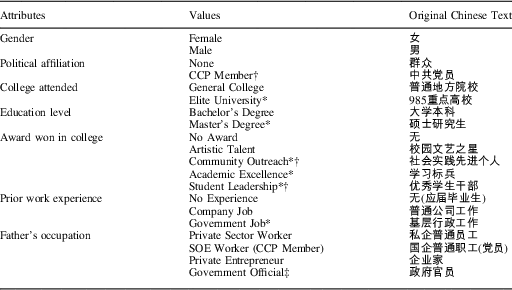
Following the description, the respondent is presented with a pair of candidate profiles. Every profile includes seven attributes, each containing an important piece of information about the candidate. Each attribute in turn is varied into several values that distinguish candidates from one another. In total, all attribute values generate about 1000 unique candidate profiles. The row positions of the attributes in the table are randomized to limit possible row-specific effects, but they are held constant for each respondent to reduce cognitive difficulty.Footnote 9
Although there are many factors that could influence a candidate’s chance of selection, I incorporate only seven attributes for both theoretical and practical considerations, as shown in Table 1. To render the survey as realistic as possible, only information that is usually available to NCSE interviewers is presented. Despite the parsimoniousness, these attributes serve as clear signals of competence, loyalty, and political connections.
Attributes and Values Used in Candidate Profiles

Note: The first value in each attribute is the reference category.
An attribute value with * is a signal of competence relative to its reference category; an attribute value with † is a signal of loyalty relative to its reference category; an attribute value with ‡ is a signal of political connections relative to its reference category.
CCP=Chinese Communist Party; SOE = state-owned enterprise.
A detailed description of each attribute can be found in the Online Appendix. In sum, four attributes contain values that signal competence relative to their respective reference categories, including type of college attended (with value elite university), education level (with value master’s degree), award won in college (with values community outreach, academic excellence, and student leadership), and prior work experience (with value government job). Two attributes contain values that indicate loyalty to the regime relative to their reference categories, namely political affiliation (with value CCP member) and award won in college (with values community outreach and student leadership).Footnote 10 Another attribute, father’s occupation, contains the value government official that signals political connections relative to the reference category. While political connections can take many forms, I choose the most direct one, i.e., that by kinship, such that respondents would not miss the information. This choice is also based on existing literature that examines the effect of having a father in politics; incorporating it allows this study to contribute to the discussion. Two additional values in father’s occupation, i.e., state-owned enterprise (SOE) worker (CCP member) and private entrepreneur, are included as placebos to test possible causal mechanisms of political connections.
Following the conjoint table, the survey asks four questions to measure the outcomes of interest. The first question asks the respondent to choose the preferred candidate (i.e., a choice-based question), followed by one that asks to rate each candidate in terms of being “suitable and qualified” for the civil service job on a scale of 1–5 (i.e., a rating-based question). The two adjectives used in the rating-based question are designed to capture the respondent’s evaluation of a candidate both in terms of objective competence (qualified) and any subjective heuristics that are deemed desirable (suitable).
In addition, the respondent is asked to rate each candidate on “leadership quality” and “task implementation ability,” both of which are important competence qualities valued in a civil servant. Task implementation is arguably the most relevant and desirable quality in an entry-level civil servant, as the main job description is to perform tasks delegated by superiors. Given that roughly 90 percent of all Chinese civil servants hold bureaucratic ranks of deputy section chief (fukeji) and below and do not occupy leadership positions,Footnote 11 the ability to implement tasks efficiently and effectively is crucial for the vast majority. For the small number of those who advance to higher ranks, leadership quality becomes more important.
Among the four outcomes, the choice-based question is the primary outcome of interest.Footnote 12 The three rating-based questions serve not only as robustness checks but also provide valuable information on perceived candidate competence. Significant discrepancies between the choice and rating outcomes can be viewed as evidence that the selection process is not entirely based on merit, as respondents’ choices are not always guided by their evaluation of competence.
In the survey, each respondent is presented with five pairs of profiles and repeats the tasks for each pair. At the end, the respondent is asked a series of personal information questions.
Hypotheses
Based on the survey design, I simultaneously test the three main hypotheses.
Hypothesis 1 : Individual attributes that signal personal competence increase a candidate’s probability of being selected in NCSE.
Hypothesis 2 : Individual attributes that signal loyalty to the regime increase a candidate’s probability of being selected in NCSE.
Hypothesis 3 : Individual attributes that signal political connections increase a candidate’s probability of being selected in NCSE.
Beyond the main hypotheses, I also explore the possible causal mechanisms through which political connections influence selection. As discussed earlier, elites may regard candidates’ political connections as a signal of intrinsic personal qualities such as competence and loyalty. Alternatively, elites may view these as a currency in possible political transactions with other elites or in rent-seeking activities with the business community. Lastly, it is plausible that elites prefer politically connected candidates simply because they feel a stronger psychological affinity toward them.
Because of the sensitivity of this topic among political elites in China, some of the hypotheses cannot be tested within the scope of this experiment, including that on political transactions and psychological affinity. Given the limitations, I test the following three hypotheses.
Hypothesis 3.1 : Candidates with political connections are more likely to be selected because they are perceived to be more competent.
Hypothesis 3.2 : Candidates with political connections are more likely to be selected because they are perceived to be more loyal to the regime.
Hypothesis 3.3 : Candidates with political connections are more likely to be selected because they have stronger social networks.
Hypotheses 3.1 and 3.2 contend that political connections serve as an informational cue about a candidate’s personal qualities. To test Hypothesis 3.1, I compare the effects of attribute value government official in father’s occupation on the choice outcome and on the rating outcomes. If offspring of government officials are both favored in selection and rated more highly for their competence, it is likely that they are selected because they are perceived as more competent.
To test Hypothesis 3.2, I compare the effect of a placebo value SOE worker (CCP member) in father’s occupation with that of government official on the choice outcome. If offspring of government officials are perceived to be more loyal to the regime, so should offspring of SOE workers who are rank-and-file party members, since both types are likely to have been raised in a pro-regime family environment.
Hypothesis 3.3 concerns the possibility that elites view candidates’ political connections as capital for rent-seeking activities with other segments of the society. To test it, I compare the effect of another placebo value in father’s occupation, private entrepreneur, with that of government official on the choice outcome. Since both occupations indicate that the candidate has a strong and robust social network as a result of his or her father’s social prestige,Footnote 13 both attribute values should have similar positive effects on selection, should this hypothesis be true.
If any of the three hypotheses are confirmed, we would have some conclusive evidence on how political connections influence NCSE recruitment. If, on the other hand, all three hypotheses are rejected, it would at least move us closer to the real causal mechanism(s) by way of elimination. In other words, it would increase the likelihood of hypotheses on political transaction and psychological affinity, which cannot be tested directly here due to social desirability concerns.
To test the hypotheses, I estimate the average marginal component effect (AMCE) of each attribute value (Hainmueller, Hopkins and Yamamoto Reference Hainmueller, Hopkins and Yamamoto2014) on various outcomes. A detailed discussion on the statistical approach and its assumptions can be found in the Online Appendix.
Survey Implementation and Data
The survey was implemented in China between August and November 2015. In order to collect data from a sample representative of the actual decision-making body, only government officials were recruited as respondents.
To maximize sample size, the survey was implemented both online and offline. Both versions had the same layout and design. The online survey was disseminated to known government officials via social networking applications. A total of 113 completed responses were returned. The offline survey was implemented using paper questionnaire. To account for regional heterogeneity in political selection, it was conducted in five cities in different parts of China.Footnote 14 The range of cities selected covers both the coast and the inland, north and south, and account for variation in economic development and administrative rank. Questionnaires were administered in classrooms of cadre training workshops and Master of Public Administration programs in local universities, both of which were attended by government officials exclusively. Admittedly, sampling among attendees of these programs was not random and could lead to selection bias. However, government officials attending these programs are usually occupants of leadership positions and hopefuls for political promotion, or at least the most motivated aspirants to work their way up to leadership positions. The sampled respondents are hence more likely to be representative of actual NCSE interviewers. The offline implementation returned 219 completed responses.
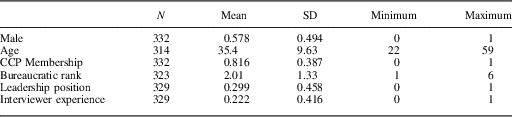
With eight incomplete online responses and three offline respondents who declined to participate, the overall response rate for the survey was 96.8 percent, which significantly mitigated the concern of sampling bias caused by social desirability.Footnote 15 In total, 332 valid responses were collected. Though not a probability sample, it is roughly representative of the Chinese civil service in terms of observable demographic characteristics (Table 2).
Respondent Characteristics: Descriptive Statistics

Note: CCP=Chinese Communist Party.
In particular, the sample has a good portion of respondents with experience in political selection: 39.6 percent of the respondents either hold leadership positions or have actual experience as NCSE interviewers, and 49.0 percent of the respondents hold bureaucratic ranks of deputy section chief or higher. These statistics indicate that approximately half of the respondents are political elites entrusted with the responsibility of making personnel decisions. This adds external validity to the study. Furthermore, the online and offline portions of the sample exhibit similar respondent characteristics (see Table A1 in the Online Appendix). Because each respondent was asked to evaluate five pairs of candidate profiles, a total of 3320 observations were collected for analysis.Footnote 16
MAIN RESULTS
Rivaling Effects of Institutional Norms and Personal Preference
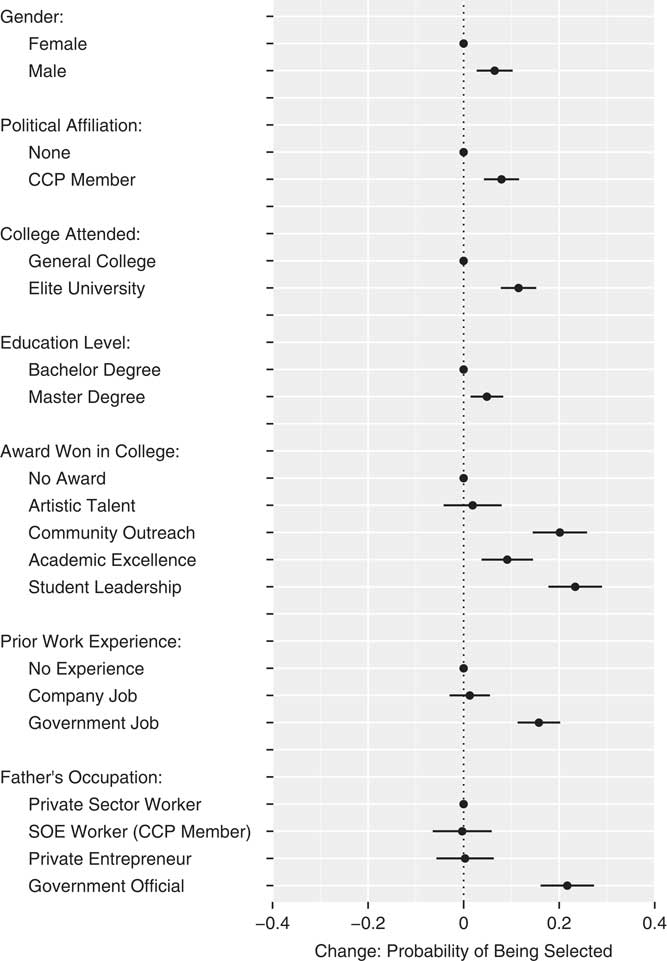
Results on the primary outcome of interest, candidate choice, are reported in Figure 1, which shows the estimated AMCEs on the probability of being selected. At least one value in each attribute has a significant effect relative to the reference category.
Effects of candidate attributes on probability of selection Note: This plot shows the estimated average marginal component effects of attribute values on a candidate’s probability of being selected for the civil service job. Estimates are based on the benchmark ordinary least squares model with standard errors clustered at the respondent level. Horizontal bars represent 95 percent confidence intervals. CCP=Chinese Communist Party; SOE = state-owned enterprise.

Among them, all attribute values exclusively signaling personal competence have significant positive effects, including elite university in college attended (11.5 percent), master’s degree in education level (4.87 percent), academic excellence in award won in college (9.14 percent), and government job in prior work experience (15.8 percent). They show that personal competence—either in the form of intellectual capacity or human capital accumulation—is highly valued in entry-level political selection.
Similarly, attribute values signaling loyalty to the regime also have significant positive effects, including CCP member in political affiliation (7.93 percent), community outreach (20.1 percent), and student leadership (23.4 percent) in award won in college. They show that being politically loyal or demonstrating a willingness to be co-opted increases a candidate’s chance of selection.
A closer look at the results reveals that, when recruiting newcomers, incumbent elites value certain skills more than others. The effect magnitudes are noticeably larger for government job in prior work experience, community outreach and student leadership in award won in college than that for master’s degree in education level and academic excellence in award won in college. The former three signal skills closely compatible with the political profession, such as leadership, organizational skills, and familiarity with how government functions; in comparison, the latter two reflect academic merits which are less relevant to government work, although they do indicate higher learning ability. To the extent that skills are heterogeneous and not always transferable, government officials pay more attention to those that are more readily applicable to politics. For the effect of political connections, we look at government official in father’s occupation. Not only does it increase a candidate’s probability of selection by 21.7 percentage points, its effect magnitude is the second largest among all, only next to that of student leadership in award won in college, which is a compounded signal of both competence and loyalty.
The findings on candidate choice provide clear evidence in support of the three main hypotheses. They show that personal competence, loyalty to the regime, and political connections all play significant roles in determining entry-level political selection.
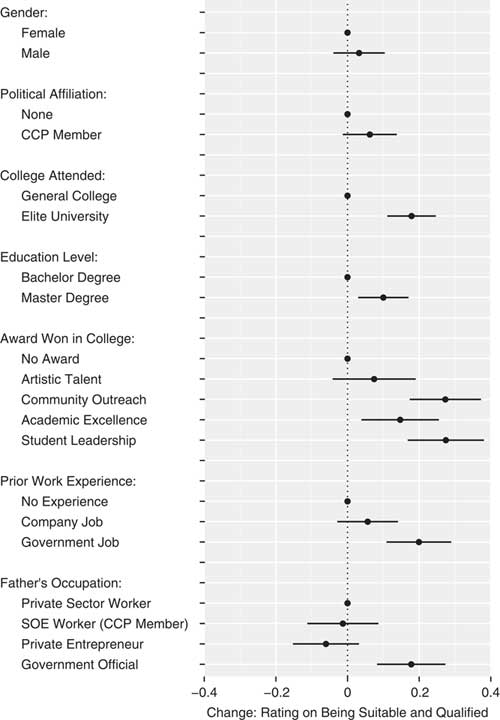
To check whether these findings are robust, we look at the overall rating outcome. If government officials are consistent in their judgment, they should rate the preferred candidate in each pair more highly than the other. Moreover, the rating question, by not forcing respondents to pick a winner in each pair, reflects their evaluation of each attribute value more accurately. Figure 2 presents the estimated AMCEs on a candidate’s rating for being “suitable and qualified” for the job. The results are very similar to that for the choice outcome; they provide further evidence supportive of the main hypotheses.Footnote 17
Effects of candidate attributes on rating of being “suitable and qualified” Note: This plot shows the estimated average marginal component effects of attribute values on a candidate’s rating of being “suitable and qualified” for the civil service job. The outcome is a continuous variable on a scale of 1–5. Estimates are based on the benchmark ordinary least squares model with standard errors clustered at the respondent level. Horizontal bars represent 95 percent confidence intervals. The points without horizontal bars denote the reference category for each attribute. CCP=Chinese Communist Party; SOE = state-owned enterprise.
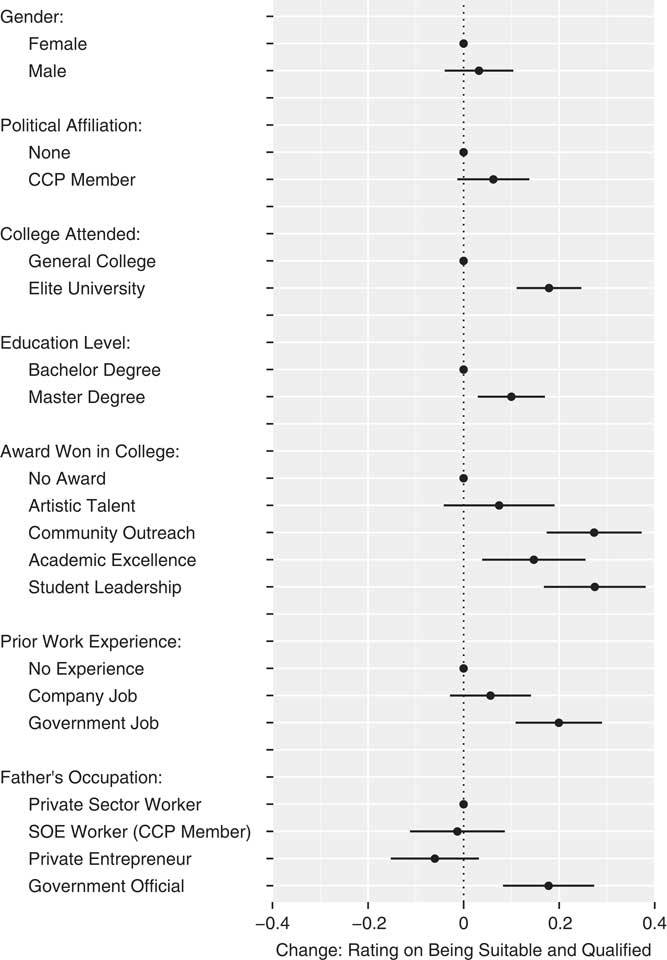
Amid the overall consistent results, a few things stand out. For instance, while male candidates are clearly preferred when a choice must be made, they are not considered more suitable or qualified than their female counterparts. It is also the case for CCP members when compared to non-members. The discrepancies between choice and rating suggest that NCSE recruitment is not purely meritocratic; instead, factors such as elites’ idiosyncratic tastes also influence the selection.
The AMCE estimates for government official in father’s occupation on both choice and rating outcomes are similarly large (21.7 percent and 17.8 percent, respectively), indicating that elites consistently prefer candidates with political connections. In the next section, I explore possible mechanisms through which candidates’ political connections contribute to their advantage in selection.
Political Connections: Possible Causal Mechanisms
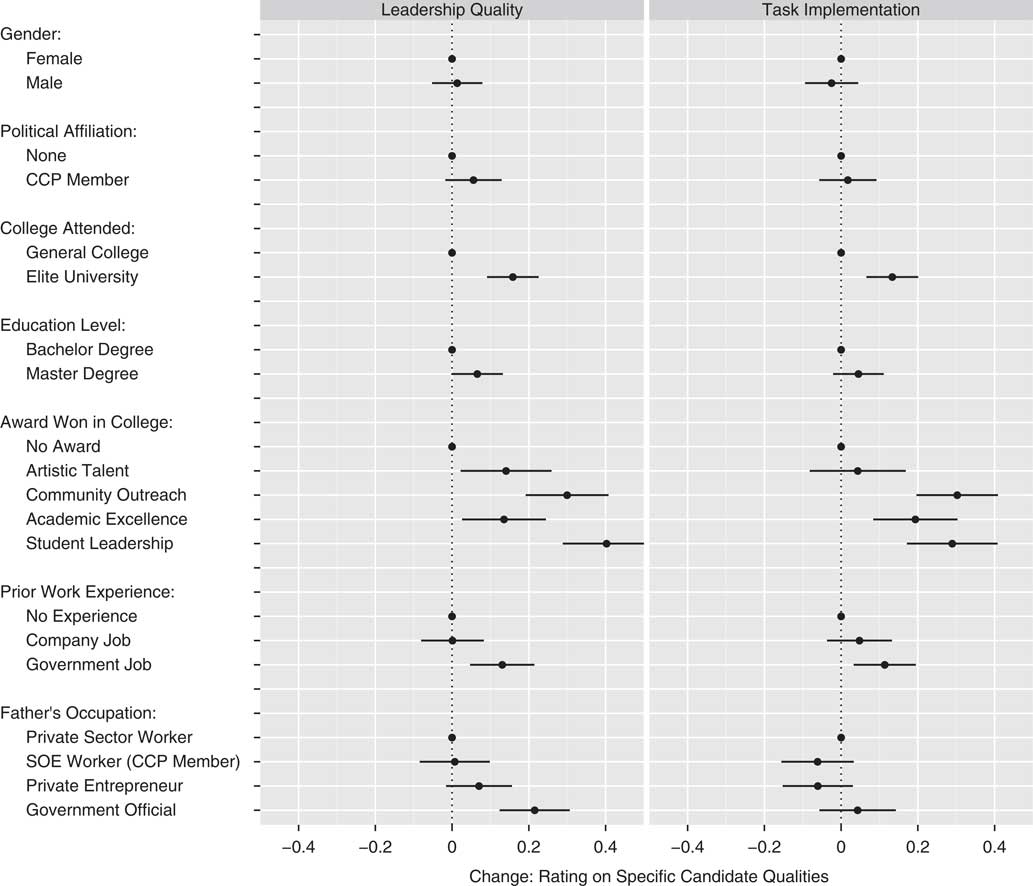
We now test Hypotheses 3.1–3.3 to explore possible causal mechanisms of political connections. First, to examine whether politically connected candidates are perceived as more competent, I analyze candidates’ rating on two specific competence qualities: (1) leadership and (2) task implementation. Figure 3 presents the results; the patterns of estimated AMCEs are largely consistent with previous results.
Effects of candidate attributes on ratings of specific competence qualities Note: This plot shows the estimated average marginal component effects of attribute values on a candidate’s ratings of specific competence qualities: “leadership quality” in the left panel and “task implementation” ability in the right panel. Estimates are based on the benchmark ordinary least squares model with standard errors clustered at the respondent level. Horizontal bars represent 95 percent confidence intervals. CCP=Chinese Communist Party; SOE = state-owned enterprise.
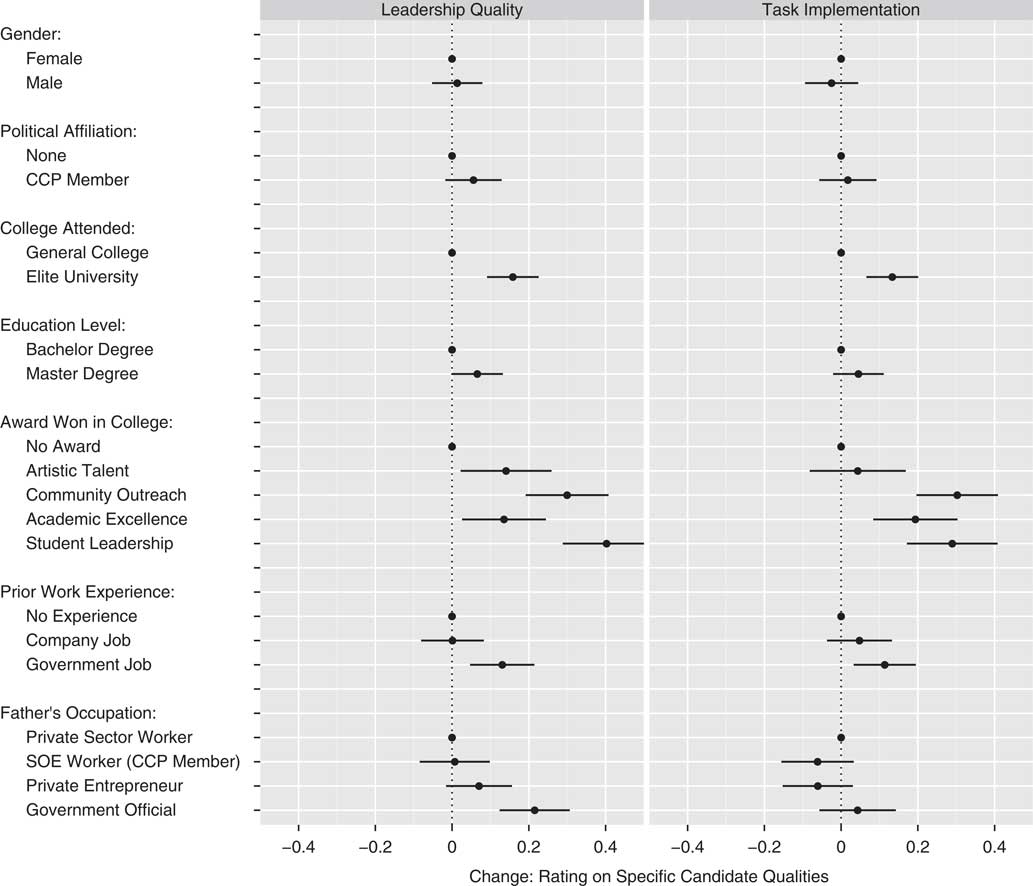
A closer look at the estimates for government official in father’s occupation, however, indicates that candidates with political connections are not rated more highly for task implementation (see panel on the right). Although they are considered to possess more leadership quality (see panel on the left), these results fail to provide conclusive evidence to support Hypothesis 3.1, especially since job description for entry-level positions consists largely of task implementation.
To test Hypotheses 3.2 and 3.3, I go back to the analysis of candidate choice in Figure 1 and compare the estimated AMCE of government official to that SOE worker (CCP member) and private entrepreneur. Neither has a significant effect on candidate choice, leading us to reject these two hypotheses.
Although the rejection of Hypotheses 3.1–3.3 does not directly identify the causal mechanism(s) of political connections at work, it provides some important information. Rejection of Hypotheses 3.1 and 3.2 shows that candidates’ political connections do not function as a cue for their competence or loyalty; incumbent elites are not thinking of institutional norms of personnel selection when they consider candidates’ political connections. Similarly, rejection of Hypotheses 3.3 suggests that the advantage of political connections does not come from candidates’ social networks outside the political realm.
Furthermore, rejection of these hypotheses helps narrow the range of possible causal mechanisms. It is now more likely that political connections influence selection because incumbent elites are motivated by potential political transactions inside the government or their psychological affinity. In fact, by adding an interaction term of government official in candidate’s father’s occupation with respondent’s work unit (see Figure A4 in the Online Appendix), I show that, while the effect of political connections is significant across all branches of government, it is particularly pronounced in party organizations (45.1 percent). Since party organizations are the centers of political power at each level of government, elites in these places are more likely to engage in political transactions (e.g., faction building, quid pro quo, etc.) or feel a stronger affinity to those who are politically connected; these factors could lead them to attach more weight to candidates’ political connections in selection. However, these are only conjectures based on exploratory analysis.
There is yet another possible interpretation of incumbent elites’ preference for candidates with a father in government. Although elites do not consider these candidates to be more competent in term of task implementation, they may perceive the kinship ties to government as a signal of certain type of human capital transmitted through family education, such as familiarity with the modus operandi in local government, knowledge on the implicit rules among cadres, and other similar “soft skills.” Although this kind of human capital does not necessarily amount to competence or contribute to efficiency, it may make these candidates more attractive coworkers in the eyes of incumbent officials.
DISCUSSION
In this article, I use a conjoint experiment to unpack the multidimensional preference of Chinese government officials in entry-level political selection. The results show that incumbent elites take into account both institutional norms and personal preference when choosing candidates. Specifically, elites value competence and loyalty to the regime in a candidate; these are qualities deemed desirable by the regime. Competence, especially in the form of politically relevant skills, is highly valued. This finding is in line with existing studies on political promotions in China, especially at lower levels where competence is the main determining factor (Whiting Reference Whiting2004; Landry, Lü and Duan Reference Landry, Lü and Duan2015). Similarly, loyalty to the regime, defined as pro-regime attitude, also increases a candidate’s chance in NCSE. The prominence of these two factors indicates that political recruitment in China is largely bound by institutional norms. In particular, selection based on competence is evidence of meritocracy. By recruiting civil servants who are both capable and supportive of the regime, the CCP government is able to strengthen and maintain its state capacity, which in turn contributes to regime survival. This finding is also evidence that, through institutionalization like NCSE, an authoritarian regime can achieve and sustain merit-based political selection.
In the meantime, I find that political connections also play an prominent role in selection. Other things being equal, kinship ties to government increase a candidate’s chance of selection by over 20 percentage points. Further tests on causal mechanisms show that respondents perceive these candidates to be neither more competent nor loyal. The large positive effect of political connections is thus not a result of incumbent elites following institutional norms; instead, it suggests that they allow their personal preference to influence selection. This finding establishes the minimal effect of political connections on entry-level selection, where all other candidate attributes are randomized. In reality, a candidate’s family background often determines, or at least is correlated with, his or her access to good education and party membership, which in turn further compound his or her chance of selection.
In some ways, this finding is no surprise. Studies have shown that political connections are a valuable asset for individuals and private firms in their interaction with the Chinese state (Ang and Jia Reference Ang and Jia2014; Tsai and Xu Reference Tsai and XuForthcoming). However, the large effect magnitude of kinship ties to government should still raise some eyebrows. Although it is well documented that factional ties—another form of political connections—are critical in upper-level political promotions in China (Shih, Adolph and Liu Reference Shih, Adolph and Liu2012; Landry, Lü and Duan Reference Landry, Lü and Duan2015), there has been little systematic evidence of the effect of political connections on entry-level selection (with the exception of works on the cadre system in the 1980s before the personnel reform and NCSE, e.g., Walder Reference Walder1995; Walder, Li and Treiman Reference Walder, Li and Treiman2000).
The influence of kinship ties to government is even more noteworthy when we consider that none of the other types of father’s occupation has a significant effect on candidate choice. The non-effect of SOE worker (CCP member) is in line with the findings by Chen, Pan and Xu (Reference Chen, Pan and Xu2016) that display of party loyalty alone does not elicit a positive response from the Chinese government. Similarly, the non-effect of private entrepreneur shows that political elites are less interested in connections or influence outside the government. Together, these findings suggest that elites’ predilection for political connections likely stems from personal considerations in the political realm, such as possible political transactions or psychological affinity toward political insiders.
The significant role played by political connections in NCSE selection is a manifestation of the political agency problem facing authoritarian regimes, where elites act in accordance to their private preference rather than that of the regime. Existing literature has documented the agency problem in the realm of policy selection (e.g., Lorentzen Reference Lorentzen2014; Huang, Boranbay-Akan and Huang Reference Huang, Boranbay-Akan and HuangForthcoming); this paper presents evidence that the same problem also exists in the realm of personnel selection. It remains a challenge for authoritarian rulers to address this issue, either by employing strategies that align elite interest with the regime or by introducing monitoring mechanisms to correct information asymmetry.
The prominence of political connections in entry-level political selection has important implications for the Chinese state, especially when it is motivated by elites’ private interest. As explained earlier, the political elite class in China is relatively closed with an opening at the entry level. By favoring candidates with ties to the government, incumbent elites in effect erect a barrier of entry to those who do not have such ties. This practice thus reduces intergenerational political mobility and could lead to greater discontent of the disenfranchised. Moreover, while elites prefer candidates with political connections, they recognize that these candidates are not superior to others in terms of competence. Their preference thus undermines the effort by CCP leadership to promote meritocratic selection. To the extent that entry-level selection shapes the talent pool of future leaders at various levels of government, incumbent elites’ nepotistic tendency weakens the state in the long run.
I am aware that the conjoint experiment employed in this paper has certain limitations in answering the research question. Although it establishes the significance of political connections in selection, it is unable to produce conclusive evidence on causal mechanisms. By elimination, it narrows the range of possible mechanisms down to elites’ interest in political transactions and their psychological affinity. However, due to concerns over social desirability, these mechanisms cannot be directly tested. Second, despite the fact that the survey questions are closely modeled upon actual NCSE interviews, there exist differences. The amount of candidate information received by interviewers varies across provinces, depending on specific local regulations. Also, in reality, candidates are evaluated for specific positions rather than for a general qualification to enter civil service; respondents’ preference hence may vary across government departments. The survey design does not account for these heterogeneities. Lastly, probability sampling was not used in the survey, and the sample size was rather limited.
Notwithstanding the limitations, the findings in this paper provide the first comprehensive picture of incumbent elites’ multidimensional preference in entry-level political selection in China. It offers a glimpse into individual elites’ logic of political selection, where they largely follow institutional norms but also deviate from them for personal considerations. In other words, they fuse together both the regime’s logic of selection and their own. As a result, elements of both meritocracy and nepotism are present in the process. While individuals can advance into the political elite class on the basis of their own merit, political connections still give one a significant leg up.