Although we have already noticed various changes in the period under survey, we have still been insufficiently able to escape a certain static view (Chapter I, §1). In this last chapter, therefore, I will concentrate on changes in Greek religion. I first discuss the Eleusinian Mysteries (§1), which became increasingly important in the fifth century, then Orphic ideas and Bacchic Mysteries (§2), which both emerged around 500 bc, and conclude with a sketch of the structural transformations during the transition to the Hellenistic period (§3).
1. The Eleusinian Mysteries
Mysteria was originally the Athenian term for the Eleusinian festival of Demeter and Kore but was later used for a whole range of cults, from Isis to Mithras, whose principal resemblances were initiation, secrecy, and a certain interest in the afterlife (the Samothracian and Mithraic Mysteries excepted).Footnote 1 The Eleusinian Mysteries were celebrated annually in the sanctuary of Demeter and her daughter, Kore/Persephone, on a hill outside Eleusis (Chapter III, §2), one of the many demes of Attica; the autumn festival lasted more than a week and knew two degrees of initiation, of which the first one seems to have focused on the finding of Persephone and the second one on the revelation of an ear of corn.Footnote 2
After a procession from Athens to Eleusis along the (still-existing) Sacred Way and more individual rites of fasting and purification, the actual initiation took place over two consecutive nights in the main building, the telestêrion.Footnote 3 On the first night, the Eleusinian ‘clergy’ and the prospective initiates acted out the myth of the Homeric Hymn to Demeter (late seventh century bc), the foundation myth of the Mysteries, which relates how Hades kidnapped Persephone, and how her mother, Demeter, wandered the earth in search of her. When Persephone had been returned to her, Demeter promised fields yellow with corn and a better afterlife. After Persephone was found, in ways that we cannot reconstruct, the ritual came to an end with ‘rejoicing and brandishing of torches’, as the Christian author Lactantius tells us.
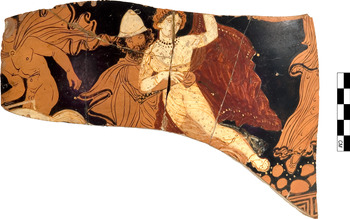
The second night was reserved for the initiation into the highest degree of the Mysteries, the so-called epopteia (‘contemplation’). As its climax, the hierophant showed ‘a single harvested ear of grain’ and called out at the top of his voice: ‘The reverend goddess has given birth to a sacred boy, Brimo to Brimos, that is, the strong one has borne a strong child.’Footnote 4 The mention of the ear of corn seems to confirm Isocrates’ words that Demeter was well disposed towards Attica ‘because of benefits which only the initiated may hear’ (Paneg. 28). It also suggests that the Mysteries did not conceal an esoteric wisdom. In fact, the Homeric Hymn to Demeter, the oldest source to relate the institution of the Mysteries by Demeter during her search for her kidnapped daughter (Figure 14),Footnote 5 explains the secrecy from the ‘awesomeness’ of the rites and states that ‘a great reverence of the gods restrains utterance’ (478–9).
Capture of Persephone by Hades. Fragment of south Italian (Taranto) red-figure krater, akin to Painter of the Birth of Dionysos, c. 380 bc.

The Homeric Hymn of Demeter singles out two gains for initiates: prosperity in this life and a blessed state in the life hereafter (480–9). The prosperity was reinterpreted by the Athenians as the gift of corn and connected with Triptolemos, an Eleusinian king, who is relatively unimportant in the Hymn. During the heyday of the Athenian empire he was promoted to great prominence as the Attic cultural hero who taught the art of agriculture to humans.Footnote 6 After the decline of the Athenian empire, the emphasis gradually seems to have shifted from agriculture to eschatological theories, but the Mysteries increased in popularity, as Plato extensively used Eleusinian realia and terminology in his Symposium and Phaedrus, and followers of Epicurus argued the ‘religious correctness’ of the master by his participation in the Mysteries.Footnote 7
The earliest archaeological evidence for the sanctuary dates from the late eighth century bc.Footnote 8 Yet the widespread occurrence of a Demeter Eleusinia in Ionia and the Peloponnese (the Laconian sanctuary dates from c. 700 bc) demonstrates an early popularity of the cult. The Peloponnese with its beauty contest (Chapter VI, §1) points to an initiatory background, whereas the Ionian connection with (royal) families (Chapter II, §2) and the administration of the Eleusinian cult by two genê (clans), the Eumolpids and Kerykes, suggest the cult of a genos.Footnote 9 If we combine these data with the presence in the Eleusinian festival of a boy ‘who was initiated from the [state] hearth [at the marketplace]’, it seems to follow that initiation into the Mysteries probably originated in the archaic puberty rites of a genos.Footnote 10
A similar development from initiatory to Mystery cult probably took place elsewhere in Attica. In Phlya, Themistocles rebuilt a shrine of Mystery rites (telestêrion) for his clan, the age-old Lykomids, after it had been burnt down by the Persians. Many centuries later the traveller Pausanias reported that the Lykomids chanted songs of Orpheus and a hymn to Demeter at the ceremonies in their ‘clubhouse’ (kleision). The resemblance of this ‘clubhouse’ to other Greek ‘men's houses’, and the ‘wolf’ (lykos) in the name of the genos, suggest a background in tribal initiation. Apparently, some Attic initiatory cults were reconstructed and reinterpreted as Mysteries after the disintegration of male puberty rites in the course of the archaic period.Footnote 11
Unfortunately, much less is known about three other public Mysteries in the classical period – those of Samothrace, Lemnos, and Thebes – even though we know that the first two had been influenced by the Eleusinian Mysteries. As regards Samothrace, it is unlikely that the local gods had a Greek origin, since a form of Thracian was locally used well into the Hellenistic period. Unlike Eleusis, the Samothracian Mysteries were geared towards protection at sea and not eschatological expectations. Of the Mysteries of the Kabeiroi on Lemnos and in Thebes, little is known with certainty, except that wine played an important role in these cults and that puberty rites can still be seen in the background. The consistent connection of the Kabeiroi with the Great Goddess points to an origin in a pre-Greek cult, but the lack of sufficient data makes it impossible to disentangle the mixture of non-Greek roots and Greek (re)interpretations.Footnote 12
2. Orphic ideas and Bacchic Mysteries
If the interpretation of the Eleusinian Mysteries is only progressing at snail's pace, in the last five decades the discovery of new texts and vase-paintings has spectacularly increased our knowledge and understanding of the books, doctrines, rites, initiators, and groups connected with Orphic ideas and Bacchic Mysteries.Footnote 13 Around 500 bc, if not somewhat earlier, a new religious movement arose in southern Italy, which distributed its ideas in the form of poems ascribed to Orpheus, the archaic mythical singer par excellence, to legitimize the innovation.Footnote 14 The earliest sources betray influences from Anatolia and Phoenicia, but also indicate closeness to Pythagorean ideas and practices, as well as to Dionysiac cult.Footnote 15 Herodotus (2.81) identified Orphic and Bacchic rites, and in Euripides’ Hippolytus (428 bc) Theseus uses the verb bakcheuein for Orphic rites (953–4); moreover, in Black-Sea Olbia, fifth-century bone plaques have been found with the mention of Orphikoi in a Dionysiac context.Footnote 16 Evidently, Orphic ideas and Bacchic mysteries belonged to the same complex. The two most popular early Mysteries, then, were cults of precisely those two divinities who were ‘eccentric’ in the Greek pantheon (Chapter II, §3; Chapter III, §2; Chapter IV, §2).
It was always known that the most important, original Orphic poem was a theogony. Direct knowledge, though, was lacking, and scholars had to extrapolate from reconstructions of the ever-expanding Hellenistic and late antique Orphic theogonies.Footnote 17 Thanks to the publication of a papyrus (c. 325 bc) from Derveni (Macedonia) that contains a commentary on the oldest Orphic theogony, we now have direct access to a number of its verses.Footnote 18 The papyrus shows that Orphic theogony contained a succession myth à la Hesiod but with more scandalous details, such as Zeus's incest with his mother. The actual theogony probably started with Night, since the papyrus mentions ‘Night-born heaven, who was the first king’ (XIV.6 Kouremenos = §43 Kotwick). Such a beginning is supported by the birth of Aristophanes’ Orphic egg of Night in the Birds (693–7) and by the fourth-century philosopher Eudemus’ knowledge of a theogony beginning with Night; after two introductory hymns, the imperial collection of Orphic Hymns also starts with a hymn to Night.Footnote 19 However, a Protogonos is mentioned as first king in the so-called rhapsodic Orphic theogony, which is possibly as early as the Attic historian Clidemus (c. 350 bc: FGrH 323 F 25).Footnote 20 We may therefore conclude that competing versions already existed at an early stage of the ‘movement’.
The papyrus breaks off at the moment of Zeus's incest with his mother. In later versions Zeus mated with the product of this union, Persephone, and begot Dionysos, whom the Titans slew but who was restored to life with the help of Athena or Demeter-Rhea, a sequence of motifs that seems to have been influenced by the Egyptian myth of the dismemberment of Osiris. This ‘ancient grief of Persephone’ is mentioned by Pindar (fr. 133): it was therefore, presumably, already part of the Derveni theogony.Footnote 21 The meaning of the episode is clarified by the climax of the rhapsodic theogony, which dealt with the origin of humankind, as perhaps in the oldest theogony: as descendants of the Titans, humans were of tainted but divine origin.Footnote 22 Unfortunately, the fragmentary state of the papyrus does not allow us to see whether the theogony also referred to reincarnation, a doctrine attributed to Orphism by later sources.Footnote 23
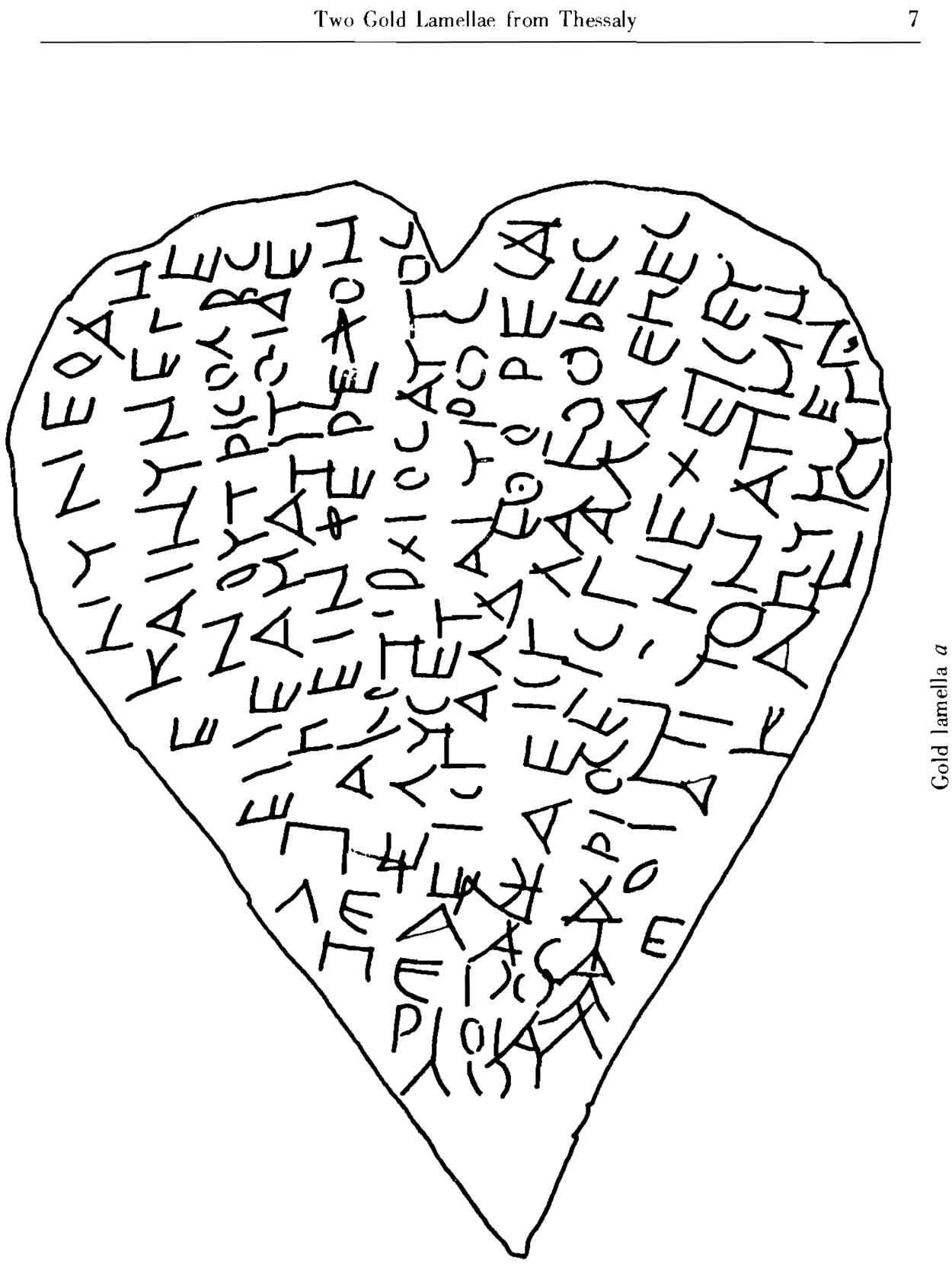
In addition to the papyrus, recent years have witnessed the discovery of a number of so-called Orphic gold tablets. These minute tablets were, so to speak, passports to the underworld and have been found in graves in Italy, Crete, Thessaly, and Lesbos, but not in Attica. Here the prestige of the Eleusinian Mysteries must have blocked any competition in the area of afterlife expectations. Around 1970, the then available texts (which presuppose oral circulationFootnote 24) had been classified into two groups: in one (A) the soul addresses the powers of the underworld; the other group (B) contains instructions to the dead person.Footnote 25 But the Pelinna gold tablets published in 1987 (Figure 15) bridged the differences between the two groups and also provided additional evidence for the connection between Orphic anthropogony and Bacchic mysteries, since the dead person has been instructed: ‘Tell Persephone that Bakchios [in Orphism Persephone's son: see above] himself has set you free’ (line 2) – a line understandable in the light of Persephone's ‘ancient grief’.Footnote 26 New discoveries complicate the matter even further, since the most recently published tablets not only mention Brimo and thus seem to indicate Eleusinian influence (see above), but also Chthonic Demeter and the Mountain Mother, thus pointing to ecstatic rites (below, §3).Footnote 27
Pelinna gold tablet (no. a) in the shape of an ivy-leaf, the plant sacred to Dionysos. After Tsantsanoglou and Parâssoglou 1987: 7.

The literary evidence for Bacchic mysteries is rather poor and the gold tablets provide few pointers to Bacchic ritual, although a reference to purity suggests purifications. In fact, it is not even clear in what ritual context the tablets were used: initiation into the Mysteries or funerals?Footnote 28 The Derveni papyrus suggests a ritual setting for the Orphic theogony, since its first line states: ‘I will speak for those that understand. Close the doors, ye profane’ (Orph. frag. 1). Moreover, if we may compare the end of the so-called Jewish-Hellenistic Testament of Orpheus, the theogony would have closed with a call for secrecy.Footnote 29 Since the commentator mentions that the initiates had to pay for their ceremony but failed to achieve understanding (XX.3–12 Kouremenos = §§67–8 Kotwick), Bacchic initiates probably had to listen to the theogony during initiation but did not interpret it correctly in the eyes of the commentator.
The mention of pay suggests that, in the time of the commentator, Orphic/Bacchic initiators demanded money for their services. This fits with Plato's denigratory remarks about Orphic ‘begging priests and soothsayers’ at ‘rich men's doors’, who used Orphic books in their ritual and performed sacrifices for purifications and special rites for the dead (Resp. 2.364D–E).Footnote 30 Plato's observations also indicate that the clientele was rich, which is confirmed by the discovery of tablets in graves of wealthy women (Chapter VI, §1) and by Herodotus’ mention of the Bacchic initiation of the Scythian king Skyles in Olbia (4.78–80). Two tantalizing testimonia even suggest the existence of ‘congregations’: the Olbian mention of Orphikoi and the statement in a fifth-century inscription from Italian Cumae that ‘it is not lawful for anyone to be deposited here [presumably a burial plot] unless he has been initiated to Bakchos (bebakcheumenon)’.Footnote 31 Yet it seems hardly permissible to extrapolate from these two examples to a more general model.
As often with new cults, Orphism was a mixture of old and new. While using the traditional idea of genealogy, it presented a somewhat more streamlined succession. The Derveni papyrus also reminds us of Xenophanes’ philosophy (fr. 23) with its stress on the position of Zeus: ‘Zeus is the head, Zeus the middle, through Zeus all things come to pass’ (XVII.12 Kouremenos = §55 Kotwick).Footnote 32 At the same time, it presented an explanation of the origin of humanity and some eschatological comfort. By preaching an ancient guilt and practising vegetarianism, Orphism directly opposed the this-worldly spirit of Greek religion (Chapter I, §2) and its community-supporting practice of sacrifice (Chapter IV, §2). Moreover, Euripides’ mention of a variety of Orphic books in his Hippolytus (954) points to another striking difference from mainstream religion. The books were clearly considered offensive in the predominantly oral society of ancient Greece, just as sceptical Sophists were negatively associated with books.Footnote 33 Despite these ‘deviations’, the ‘movement’ was successful and by the fifth century Orphic ideas had penetrated the Eleusinian and Theban Mysteries (see above).Footnote 34
The new discoveries, then, have greatly illuminated the early history of Orphism, even though the reasons for its origin, popularity, transmission of ideas, connection with Bacchic Mysteries, and social location still pose many questions.Footnote 35
3. Structural changes
The rise of Orphic ideas and connected practices was only one of the developments which gradually changed the face of traditional religion. I will therefore close this chapter by sketching some of those transformations, while focusing on the gods, the area in which arguably most changes occurred. Xenophanes’ critique of divine anthropomorphism (Chapter II, §1) and Orphic changes in divine genealogy show that around 500 bc the Homeric picture of the gods no longer satisfied intellectuals. In the following century this dissatisfaction only intensified, if in various different ways. To start with, we can notice a blurring of identity of some divinities. In Aeschylus’ Lycurgus trilogy,Footnote 36 Orpheus probably calls Apollo Helios,Footnote 37 and the connection with Orpheus may not be Aeschylus’ innovation, since the Derveni commentator quotes an Orphic hymn that equates Demeter with Rhea, Ge (= Gaia), Meter, Hestia, and Deio. Similar equations also occurred in Pindar, Sophocles, and Euripides, but in all these cases they remained limited to Demeter and less important divinities such as Rhea, Ge, and the Mother of the Gods.Footnote 38 There was more to come.
It had always been known that the Sophist Prodicus first denied the essential qualities of the gods but subsequently invested them with a new identity by claiming that they had been deified by their admiring contemporaries because of their discoveries of ‘foods, shelter and the other practical skills’. A papyrus from Herculaneum shows, that according to Prodicus, in an earlier stage of cultural evolution ‘primitive man, [out of admiration, deified] the fruits of the earth and virtually everything that contributed to his subsistence’.Footnote 39 These views were an instant success in Athens and are parodied in Aristophanes’ Birds (414 bc; 685ff) and Euripides’ Bacchae (c. 406 bc; 274–85).Footnote 40 Their mention in comedy and tragedy shows that Greek intellectuals not only discussed these ideas in private but brought them out in the open to be discussed by the whole of Athens.Footnote 41 Prodicus, however, remained an honoured citizen on his home island of Keos and nothing suggests that he had drawn consequences from his theoretical views for ritual practice; in fact, except for Orphics and Pythagoreans, few philosophers seem to have been critical of animal sacrifice before Theophrastus’ On Piety (fr. 584 Fortenbaugh), although in his last work, the Laws, Plato calls non-animal sacrifice ‘pure’ (6.782C).Footnote 42
On the other hand, we should not underestimate the impact of these ‘atheistic’ views. Admittedly, the regular atheistic statements in Euripides’ tragedies do not show that the poet actually was an atheist, as has often been thought, but they do demonstrate that such views could be debated and formed part of contemporary discourse.Footnote 43 In addition, Euripides’ late tragedies problematize the position of the gods. His Ion and Orestes show the protagonists Creusa and Orestes deserted by the gods, and in his Helen and Iphigeneia in Tauris gods no longer play a significant role.Footnote 44 It is even more telling that in Thucydides they are virtually absent, and the religious factor is largely neglected in his work.Footnote 45 Others went beyond intellectual scepsis: the mutilation of the statues of Hermes and the profanation of the Eleusinian mysteries in 415 bc, just like the founding of sacrilegious clubs like the Kakodaimonistai (‘Worshippers of bad luck’), show to what extent sections of the upper classes had been estranged from traditional religion.Footnote 46
If the existence of the gods becomes problematic in certain circles, interest in divine intervention in the public sphere will soon diminish. After the catastrophic Athenian expedition to Sicily in 415, Aristophanes all but neglected the seers who for so long had been one of the main targets of his mockery; Thucydides no longer paid attention to oracles in the part of his work that covered the period after 416; and they are absent from New Comedy.Footnote 47 Oracles returned to favour around the fateful time of the Battle of Chaeronea (338), when the Greek cities lost their independence to Philip and his Macedonians. As Plutarch notes in his biography, Demosthenes argued that the Athenians of Pericles had ‘regarded things of this kind as pretexts for cowardice, and therefore followed the dictates of reason’ (Vit. Dem. 19–20, trans. Perrin 1919). Such a strong contrast between reason and divination would hardly have been possible in the fifth century.
Religious developments, however, are rarely straightforward. If intellectuals could be dismissive of the gods, others welcomed them. In the second half of the fifth century, various new gods, healing and ecstatic, made their entry into Athens, the city about which we are best informed. Just before 420, the healing god Asclepius from Epidaurus arrived at Athens, accompanied by his sacred snake, which Sophocles supposedly welcomed into his house. The cult of the god immediately became very popular, although it was not free: in many sanctuaries of healing gods, excavations have uncovered ‘treasuries’ in which grateful patients had to leave donations – an interesting indication of the monetization of cult that started to spread from central Greece and the Peloponnese from the later fifth century. This particular attention to the body is typical of a growing interest in the private sphere, which becomes more noticeable in the fourth century, and can hardly be separated from an increasing individualism, just as we can observe an increasing interest in physical fitness in our own individualizing times.Footnote 48
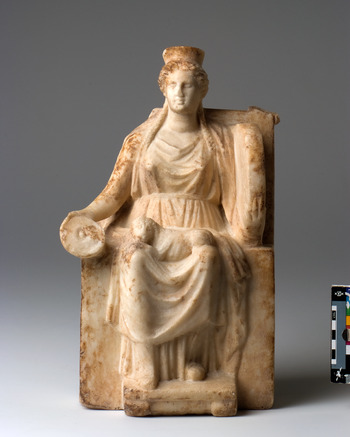
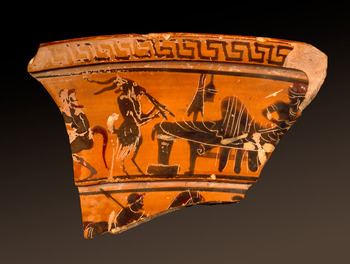
The growing interest in divinities with ecstatic cults reflects a similar movement away from the ordered public sphere, but also, perhaps, from too great a distance between gods and worshippers, as suggested by votive reliefs and vase-paintings.Footnote 49 From Phrygia, via Ionia and southern Italy, the goddess Kybele (Figure 16) had gradually migrated towards mainland Greece, where the aspect of ecstasy in her cult became visible in Athens around 420, when her name is first mentioned in Attic comedy.Footnote 50 Other divinities who seem to have entered Athens at about the same time or slightly later were Adonis (Chapter VI, §3), Bendis, and Sabazios.Footnote 51 All these gods have in common both an ecstatic cult and, apparently, often a female clientele. Sally Humphreys has attractively suggested that the male attention of vase-painters and playwrights shows a deep but ambiguous attraction to these rites, in which one could become completely possessed by a god and escape from the framework of the polis. In the same way, we can consider Euripides’ portrayal of the maenads (Chapter VI, §3) and Pentheus’ initiation in his Bacchae as a kind of mental experiment in such an escape and loss of self. But it would still be some time before male citizens could openly practise such possession cults. One exception occurred in Attica, around 400, when a certain Archedemos of Thera decorated a cave of Pan (Figure 17) for the Nymphs and composed a number of inscriptions, in which he calls himself nympholeptos, or ‘seized (possessed) by the Nymphs’.Footnote 52
Marble statue of Kybele as ‘Lady of Animals’, c. 330 bc.

The oldest-known representation of Pan playing on his pipes. Fragment of Attic black-figure krater, c. 490–485 bc.

It was not only ecstasy which distinguished these new cults from those of the traditional gods. As Euripides’ Bacchae shows, the new gods also required to be praised.Footnote 53 The chorus names Dionysos ‘the foremost divinity of the blessed ones’ (377–8) and ‘not less than any of the gods’ (777), and calls him ‘Lord, Lord’ (583). Words even fail Teiresias to describe ‘how great he will be throughout Hellas’ (173). This aspect foreshadows a feature of the gods which becomes much more prominent in Hellenistic times.Footnote 54 The elevation of one god over all the others also entails a more exclusive affection for one god. The believer wants ‘to serve’ the god and becomes his ‘servant’ or ‘slave’. This feature, too, only becomes prominent in Hellenistic times, but Euripides already presents us with Hippolytus’ love for Artemis and Ion's devotion to Apollo. Both protagonists are youths, as is Pentheus in the Bacchae: apparently, the playwright found it difficult to imagine adult males in such religiously dependent roles.Footnote 55
A preference for one god became more common in Hellenistic times, when religion as embedded in the polis increasingly became religion as the choice of differentiated groups.Footnote 56 This tendency was already apparent in the middle of the fourth century when in his Laws Plato proposed a law that
no man shall possess a shrine in his private house; when a man feels himself moved to offer sacrifice, he shall go to the public temples for that purpose and deliver his offerings to the priests of either sex whose business is to consecrate them. (10.909D)Footnote 57
It is intriguing that according to Plato's Laws this ‘privatization’ of religion went hand in hand with a growing interest in magic (11.933A). Magic is one of those contested terms, like religion, which a number of scholars want to banish from scholarly discussions,Footnote 58 although, as with religion (Chapter 1, §1), we can hardly do without the term. It does denote a series of oppositions that were negatively valued in Greek society, such as public/secret, night/day, individual/collective, anti-social/social or voces magicae/understandable language. Yet these practices and discourses should not be contrasted with religion, as frequently happened in the twentieth century.Footnote 59 Admittedly, the fringes of magic are often fuzzy and a precise definition is virtually impossible to give, especially since its meaning developed over the centuries and was never permanently fixed. But we have no convincing alternative. Thus, when using the term, we should always remain conscious of whether we use it in an emic or etic sense: that is, whether we follow ancient concepts and judgements or apply our own modern ideas.
Despite its age-old traditions, magic became increasingly marginalized in the public arena through the attacks of philosophers and doctors, who in some ways competed for the same clientele.Footnote 60 Plato prescribes solitary confinement for those who
in their contempt of mankind bewitch so many of the living by the pretence of evoking the dead [necromancy] and the promise of winning the gods by the supposed sorceries of prayer, sacrifice, and incantations, and thus do their best for lucre to ruin individuals, whole families, and communities. (Laws 10.909B)Footnote 61
Yet the increasing number of recent discoveries of curse tablets (defixiones) shows magic to have been pervasive in all strata of society, and several tablets curse leading politicians of late fourth-century Athens.Footnote 62
It is not easy to trace the causes of all these transformations. Historical developments, such as the democratic ideology and war-weariness in Athens, promoted the new goddess Demokratia and increased the popularity of the goddess Eirene (‘Peace’), but these divinities always remained marginal.Footnote 63 Ideas about the traditional gods clearly changed under the influence of philosophers and playwrights, but the increasing interest in private religion is more difficult to explain. An important factor must have been the gradual change in the political situation in Greece, which developed into large blocks, such as the Athenians and Spartans with their respective allies. This development promoted a growing professionalization in war and politics of one part of the upper classes but estranged another part from public life and the polis itself. This development also reflected itself in growing cultic honours for the few powerful individuals. Whereas the Spartan general Brasidas was only worshipped after his death in 422, his colleague Lysander, who for a time was the most powerful individual in the eastern Aegean, received divine cult on Samos at the end of the fifth century.Footnote 64 Ruler cult would not become popular before Alexander the Great, but the way was paved for a completely new relationship between Greek poleis and their rulers.Footnote 65
It is time to come to a close. At the end of the classical period, Greek religion showed all the signs of a religion in transition. Although ritual had not essentially changed, ideas about the gods certainly had, and the emphasis on public cult was partially shifting to private religious practices.Footnote 66 Yet the traditional structure was still fairly strong and would only slowly be transformed by new elements, such as ruler cult, growing social stratification, competition among cities regarding festivals, and continuing philosophical criticism.Footnote 67 The ultimate defeat by Christianity was still far away.