


The onset of independent walking is recognized as a significant milestone in children's overall development. With independent walking, infants’ point of view changes and the occasions for experiencing and interacting with their physical and personal environment increase (Campos et al., Reference Campos, Anderson, Barbu-Roth, Hubbard, Hertenstein and Witherington2000; Iverson, Reference Iverson2010). In contrast to crawling infants, walking infants more frequently observe distal objects and people (Kretch, Franchak, & Adolph, Reference Kretch, Franchak and Adolph2014), travel further and faster across a room to reach these distal objects, and interact with their caregivers about those objects (Karasik, Tamis-LeMonda, & Adolph, Reference Karasik, Tamis-LeMonda and Adolph2011). As a consequence, walking infants receive more verbal responses from their caregivers than their crawling peers (Karasik, Tamis-LeMonda, & Adolph, Reference Karasik, Tamis-LeMonda and Adolph2014). Furthermore, the upright position of walking frees the hands while locomoting for communicative gesturing and object carrying. The transition from crawling to walking thus extends opportunities for learning and support for the infant as a more active and salient communication partner (cf. Clearfield, Reference Clearfield2011; Karasik et al., Reference Karasik, Tamis-LeMonda and Adolph2014). This could explain the close association between walk onset and language skills (e.g., Clearfield, Reference Clearfield2011; He, Walle, & Campos, Reference He, Walle and Campos2015; Longobardi, Spataro, & Rossi-Arnaud, Reference Longobardi, Spataro and Rossi-Arnaud2014; Oudgenoeg-Paz, Volman, & Leseman, Reference Oudgenoeg-Paz, Volman and Leseman2012; Walle & Campos, Reference Walle and Campos2014; West, Leezenbaum, Northrup, & Iverson, Reference West, Leezenbaum, Northrup and Iverson2019). Oudgenoeg-Paz et al. (Reference Oudgenoeg-Paz, Volman and Leseman2012), as well as Walle and Campos (Reference Walle and Campos2014), found increased language growth following the onset of walking in typically developing children. This finding was recently confirmed by West et al. (Reference West, Leezenbaum, Northrup and Iverson2019) for typically developing children and – to a smaller extent – for children who went on to receive a diagnosis of language delay at a later age.
Other researchers looked more closely at gestures as a combined fine motor and communicative skill for the prediction of language development (Clearfield, Reference Clearfield2011; Longobardi et al., Reference Longobardi, Spataro and Rossi-Arnaud2014). Clearfield (Reference Clearfield2011) analyzed the use of deictic gestures (pointing and showing) in independent walking infants and same-aged crawling infants in a baby-walker. The baby-walker enabled infants to move in an upright position and use their hands for gesturing. However, Clearfield found that infants who walked independently produced more gestures accompanied by a gaze to an interaction partner, spent more time in interactions, and used more vocalizations compared to infants who were not yet able to walk independently, but used the baby-walker. Longobardi et al. (Reference Longobardi, Spataro and Rossi-Arnaud2014) went a step further in demonstrating that the use of representational gestures (e.g., holding an empty fist to the ear for ‘telephone’) at 12 months mediated the relationship between motor skills at 12 months and lexical skills at 16 to 23 months.
These two studies hint at highly complex interdependencies between gross motor skills, gestural communication, and language. To date, there is no evidence on the specific relationship between walk onset, first observations of pointing gestures, and later language skills. This is particularly relevant since pointing gestures are known as one of the most important precursors of language acquisition (e.g., Bates, Camaioni, & Volterra, Reference Bates, Camaioni and Volterra1975; Colonnesi, Stams, Koster, & Noom, Reference Colonnesi, Stams, Koster and Noom2010).
Pointing to objects and directing the attention of communication partners typically emerge towards the end of the first year of life (Liszkowski, Reference Liszkowski2011). Colonnesi et al. (Reference Colonnesi, Stams, Koster and Noom2010) demonstrated with their meta-analysis that children who used many pointing gestures at a young age had better language skills at a later age compared to children who used fewer pointing gestures. This finding about the predictive value of pointing gestures for later language skills is also supported by more recent research (e.g., Kuhn, Willoughby, Wilbourn, Vernon-Feagans, & Blair, Reference Kuhn, Willoughby, Wilbourn, Vernon-Feagans and Blair2014).
Children produce pointing gestures with the whole hand at about 7 months of age (Lock, Young, Service, & Chandler, Reference Lock, Young, Service, Chandler, Volterra and Erting1990). About 3 months after using whole-hand points, children also begin to point with their abducted index finger (Lock et al., Reference Lock, Young, Service, Chandler, Volterra and Erting1990). The first index-finger point is interpreted as an important milestone in social-cognitive, communicative, and language development (Liszkowski & Tomasello, Reference Liszkowski and Tomasello2011; Lüke, Grimminger, Rohlfing, Liszkowski, & Ritterfeld, Reference Lüke, Grimminger, Rohlfing, Liszkowski and Ritterfeld2017). Liszkowski and Tomasello (Reference Liszkowski and Tomasello2011) showed that 12-month-old children who used the index finger for pointing understood the communicative intentions of others better, pointed more frequently, and accompanied their pointing more often with vocalizations compared to 12-month-olds who pointed only with their whole hand. Recent findings indicate that children who pointed exclusively with their whole hand at 12 months had significantly lower language skills and a higher risk of language delay at 24 months than children who also pointed with the index finger at 12 months (Lüke, Grimminger et al., Reference Lüke, Ritterfeld, Grimminger, Liszkowski and Rohlfing2017).
The importance of walk onset for children's language acquisition has received much attention within the last years (e.g., Clearfield, Reference Clearfield2011; He et al., Reference He, Walle and Campos2015; Longobardi et al., Reference Longobardi, Spataro and Rossi-Arnaud2014; West et al., Reference West, Leezenbaum, Northrup and Iverson2019). Building on this research, we aim to compare the predicitive values of independent walking to the ability of index-finger pointing, with the latter being well known as predictive for language skills (for a meta-analysis, see Colonnesi et al., Reference Colonnesi, Stams, Koster and Noom2010). We further ask whether the predictive values of walk onset and of pointing gestures for later language skills are grounded in the same underlying process of motor development, and whether the combined motor and communication skills of early index-finger pointing are a stronger predictor than independent walking.
Method
Participants
Forty-five children (24 boys, 21 girls) and their primary caregivers (96% mothers) participated in this longitudinal study. At the first measurement, mean age of the children was 12 months and 5 days (SD = 12 days, R: 344–402 days). All children were raised as monolingual German speakers. Their general development was rated by pediatricians and measured at the beginning of the study with a standardized test that included cognitive, motor, language, social, and emotional development (Entwicklungstest für Kinder von 6 Monaten bis 6 Jahren, ET 6-6 [Developmental test for children aged 6 months to 6 years], Petermann, Stein, & Macha, Reference Petermann, Stein and Macha2008). According to pediatricians, as well as standardized test results, all children were developing typically. Information about the socioeconomic status of the family and the birth order of the children were collected via parent reports. On average, the children were being raised by parents with a rather high educational level (see Table 2 for maternal and paternal years of education) and an average household income (compared to the median family income in Germany in the same year: Statistisches Bundesamt Deutschland, 2013).
Design and procedure
All children and their primary caregivers have been participating in a larger longitudinal study incorporating a total of 14 observation sessions (12, 14, 16, 18, 21, 24, 30, 36, 42, 48, 54, 60, 66, and 72 months; cf. Lüke, Grimminger, et al., Reference Lüke, Ritterfeld, Grimminger, Liszkowski and Rohlfing2017; Lüke, Ritterfeld, Grimminger, Liszkowski, & Rohlfing, Reference Lüke, Grimminger, Rohlfing, Liszkowski and Ritterfeld2017) over the course of five years. Here, we refer to data when the children were between ages 1;0 and 4;0.
Eliciting and coding of pointing gestures
The gestural behavior of the children was monitored during observation sessions between 12 and 21 months. A semi-natural setting within a room equipped with interesting objects and pictures (cf. Liszkowski & Tomasello, Reference Liszkowski and Tomasello2011) was used to elicit spontaneous pointing gestures in children. Caregivers were instructed to engage with their children while carrying them for 6 minutes, and to look at various items without touching them. Caregivers were not aware of the aim of the study, and that gestures were being analyzed. Four cameras recorded the scene from each corner of the room. Two research assistants used the annotation tool ELAN (EUDICO Linguistic Annotator; Lausberg & Sloetjes, Reference Lausberg and Sloetjes2009) to code the videos for the occurrence of pointing. Pointing was defined as an extension of the hand and the arm at least more than halfway toward an object or picture without grabbing or touching it. Pointing gestures were coded either as index-finger points – when the index finger was clearly extended relative to all other fingers – or as hand points – when the index finger was not clearly extended relative to the other fingers. Based on this procedure we obtained the individual age of the first objective observation of index-finger pointing.
To assess inter-rater reliability, a random 10% of the collected data was coded independently by the two coders for each time of measurement. For all five times of measurement, the inter-rater reliability for infants’ pointing was very good (Krippendorff's α: 12 months = .968, 14 months = .932, 16 months = .980, 18 months = .966, 21 months = .892; cf. Krippendorff, Reference Krippendorff2013).
Measuring independent walking
To assess the onset of independent walking, parental reports were used at the first date of data collection. If the infant was not independently walking at 12 months, this was asked again at the following dates of data collection until the infant was able to walk independently. Independent walking was defined based on previous investigations as the infant locomoting a distance of 10 feet without falling or requesting help (cf. Adolph, Reference Adolph1997).
Measuring language development
To capture the language development of the children at ages 1;0, 2;0, 3;0, and 4;0, two commonly used parent questionnaires (German versions of the MacArthur–Bates Communicative Development Inventories MCDI; Fenson et al., Reference Fenson, Dale, Reznick, Thal, Bates and Hartung2007) and various standardized tests were used. Table 1 gives an overview of the parental reports and tests used and the linguistic components addressed.
Parental reports and standardized tests used to measure language skills
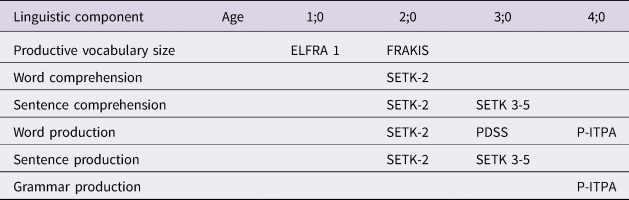
Notes. ELFRA 1: Elternfragbogen für die Früherkennung von Risikokindern [Parent Questionnaire for Early Detection of Children at Risk; German MCDI-version for children at 12 months], Grimm & Doil, Reference Grimm and Doil2006; FRAKIS: Fragebogen zur frühkindlichen Sprachentwicklung [Questionnaire for Early Language Acquisition; German MCDI-version for children between 18 and 30 months], Szagun, Stumper, & Schramm, Reference Szagun, Stumper and Schramm2009; SETK-2: Sprachentwicklungstest für zweijährige Kinder [Language Acquisition Test for 2-year-old Children], Grimm, Reference Grimm2000; SETK 3-5: Sprachentwicklungstest für drei- bis fünfjährige Kinder [Language Acquisition Test for 3- to 5-year-old Children], Grimm, Reference Grimm2001; PDSS: Patholinguistische Diagnostik bei Sprachentwicklungsstörungen [Patholinguistic Diagnostics for Language Impairments], Kauschke & Siegmüller, Reference Kauschke and Siegmüller2010; P-ITPA: Potsdam-Illinois Test für Psycholinguistische Fähigkeiten [Potsdam-Illinois Test of Psycholinguistic Abilities], Esser & Wyschkon, Reference Esser and Wyschkon2010.
Results
On average, the first observations of index-finger pointing (M = 12.58, SD = 1.20 months) were recorded earlier than walk onset (M = 13.44, SD = 2.11 months, t(44) = –3.04, p = .004). All descriptive data of the measured variables are presented in Table 2.
Walk onset significantly correlated with the first observation of index-finger pointing, as well as with the productive vocabulary size of the children, their results in sentence comprehension, and word and sentence production tests at age 2;0 (Table 3). No correlations were found between walk onset and language skills of the children at ages 3;0 and 4;0, whereas the first observation of index-finger points correlated with all measures for language skills at ages 2;0, 3;0, and 4;0 (Table 3).
Descriptive results
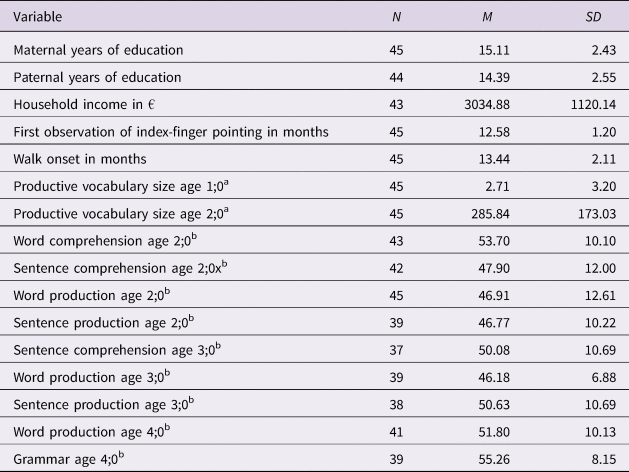
Notes. N: Since few children did not participate in all testing the exact number of tested children is reported. a Results are presented in number of words. b Results are presented in standard T-scores (M = 50, SD = 10).
Correlations between the walk onset, the first observations of index-finger points, and language skills
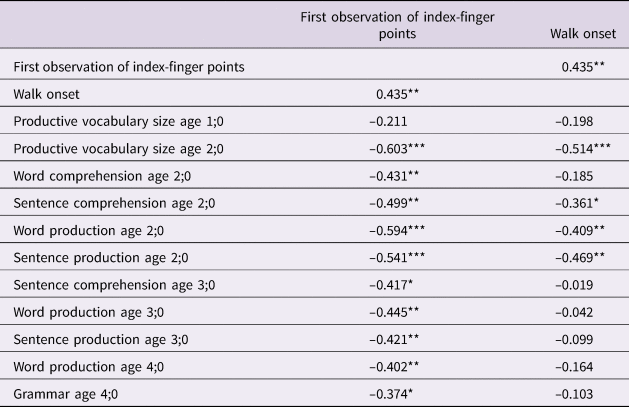
Notes. First observation of index-finger points and walk onset are reported in months with high values indicating higher age and therefore slower development, whereas high numbers in the linguistic variables represent higher skills and therefore faster development; negative correlations between index-finger pointing and walk onset with linguistic skills are expected; *p < .05, **p < .01, ***p < .001.
To test the predictive power of the first observation of index-finger pointing and walk onset for later language skills, we conducted multiple, stepwise regression analyses. In addition to walk onset and the first observation of index-finger pointing as predictor variables, we controlled for predictors of language skills that had been shown relevant for explaining variance: the socioeconomic status of the family (SES, operationalized via a principal components analysis of maternal and paternal years of education and household income), sex, birth order, and productive vocabulary size at age 1;0. To check for multicollinearity we proofed the variance inflation factor (VIF) for all models. VIF values < 1.146 indicate no collinearity within the data.
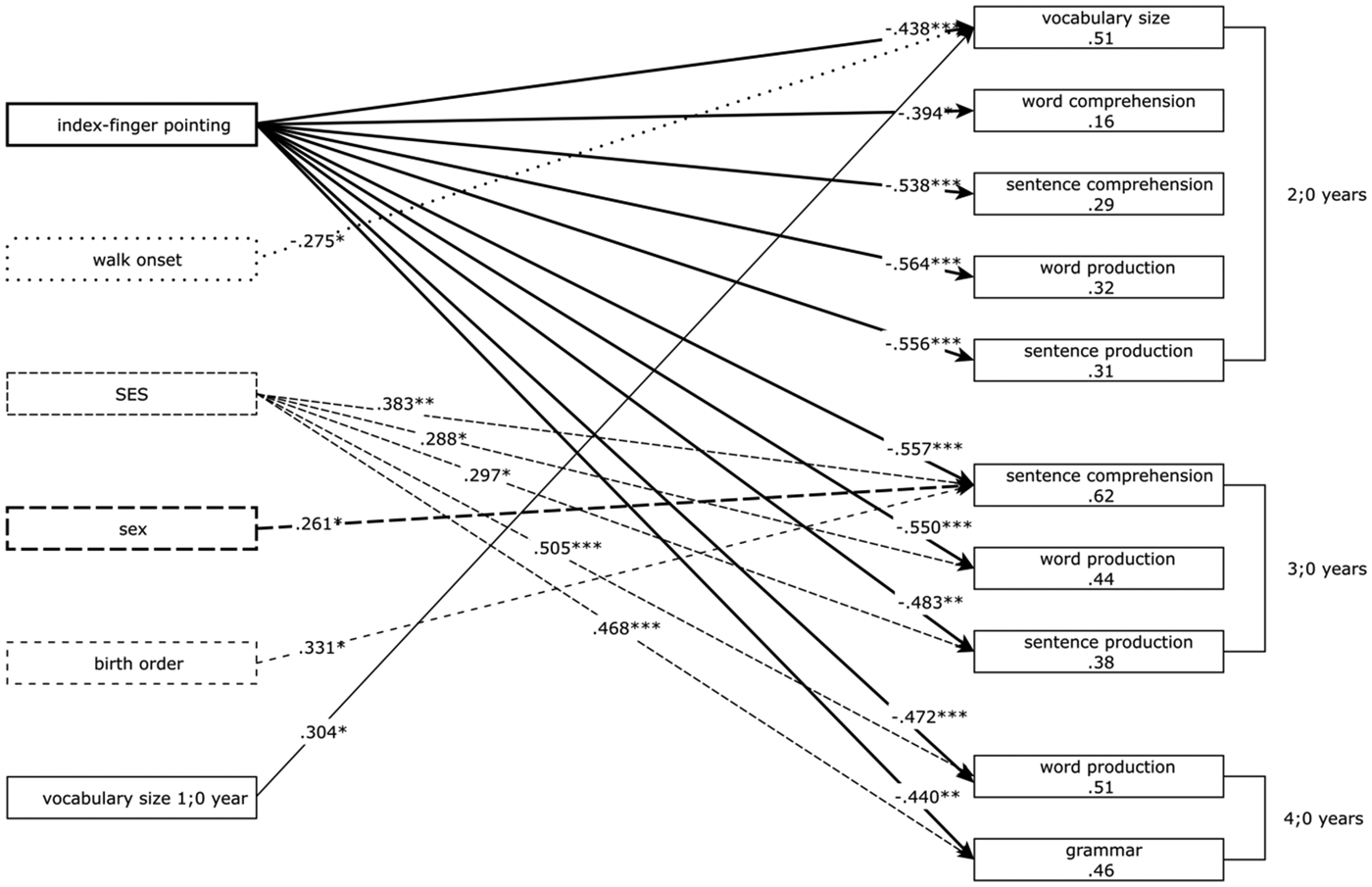
The first observation of index-finger pointing was confirmed to be predictive for all measured language skills of the children at ages 2;0, 3;0, and 4;0 (Figure 1; see Supplementary materials for more detailed statistics, available at <https://doi.1017/S0305000919000394>). Pointing alone explained 16% of the variance in the word comprehension test and – together with other predictor variables – up to 51% of the variance in the measured language abilities. Walk onset was only predictive for the productive vocabulary of the children at age 2;0. Together with the first observation of index-finger pointing (β = –0.438***) and the size of the productive vocabulary of the children at age 1;0 (β = 0.304*), walk onset (β = –0.275*) explained 51% of the variance of the productive vocabulary.
Final models of 10 stepwise regressions with the independent variables first observation of index-finger pointing, walk onset, SES, sex, birth order, and productive vocabulary size at age 1;0, and the dependent variables vocabulary size, word and sentence comprehension, word and sentence production at age 2;0, sentence comprehension, word and sentence production at age 3;0, and word production and grammar skills at age 4;0. Predictor variables were included if they could significantly (p < .05) improve the ability of the models to predict the outcome variables. Presented are standardized betas of the predictor variables and the R 2 of the final models, *p < .05, **p < .01, ***p ⩽ .001. Detailed statistics are presented in the see online Supplementary materials.
Discussion
The aim of the current study was to investigate the links between walking, index-finger pointing, and language acquisition in children between ages 1;0 and 4;0. We found that walk onset and first observation of index-finger points are associated with each other and with language skills at age 2;0. This result is in line with earlier findings showing that the onset of walking is accompanied with an increase in vocabulary growth (Oudgenoeg-Paz et al., Reference Oudgenoeg-Paz, Volman and Leseman2012; Walle & Campos, Reference Walle and Campos2014; West et al., Reference West, Leezenbaum, Northrup and Iverson2019). The onset of walking had previously been described as a catalyst that provides a multitude of learning and interacting opportunities, which in turn might facilitate language development (cf. Iverson, Reference Iverson2010; Walle & Campos, Reference Walle and Campos2014; West et al., Reference West, Leezenbaum, Northrup and Iverson2019). However, since we found no correlations between walk onset and language skills at ages 3;0 or 4;0, and walk onset only predicted productive vocabulary at age 2;0, it seems that the early achievement of independent walking is no main driving force for long-term language acquisition. But, a more detailed approach to the measurement of walk onset might possibly lead to slightly different conclusions (see for this the discussion in the ‘Limitations’ section). In contrast, index-finger pointing, a fine-motor as well as a communicative skill, was found to be predictive for all measured language skills until age 4;0. In comparison to walk onset and other influences on language acquisition, such as the SES of the family (e.g., Horwitz et al., Reference Horwitz, Irwin, Briggs-Gowan, Bosson Heenan, Mendoza and Carter2003; Tomblin, Smith, & Zhang, Reference Tomblin, Smith and Zhang1997), or the sex of the children (e.g., Horwitz et al., Reference Horwitz, Irwin, Briggs-Gowan, Bosson Heenan, Mendoza and Carter2003; Law, Rush, Schoon, & Parsons, Reference Law, Rush, Schoon and Parsons2009; Tomblin et al., Reference Tomblin, Smith and Zhang1997), first observation of index-finger points turned out to be the strongest predictor for later language skills. This is in line with a multitude of earlier findings indicating that the use of pointing gestures is strongly predictive for later language skills (see, for a meta-analysis, Colonnesi et al., Reference Colonnesi, Stams, Koster and Noom2010; for more recent work, e.g., Kuhn et al., Reference Kuhn, Willoughby, Wilbourn, Vernon-Feagans and Blair2014; Lüke, Grimminger et al., Reference Lüke, Ritterfeld, Grimminger, Liszkowski and Rohlfing2017). Our findings extend the available research in confirming that the age of first observed index-finger points, and not just the frequency of pointing as has been analyzed so far, predict language skills until age 4;0. This highly predictive value of first observed index-finger points can be explained with the nature of pointing as one of the first means of intentional communication (Liszkowski, Reference Liszkowski2011), which might be driven by the same developmental domain as language acquisition. Further studies aiming at analyzing the predictive value of index-finger points should observe the infants at an even younger age to capture the real onset of index-finger pointing.
Besides the determination of language skills through early pointing gestures, we found indication for an impact of SES, which becomes even more significant with the age of the children. The impact of SES on linguistic skills at three and four years is in line with earlier findings (e.g., Levine et al., Reference Levine, Pace, Luo, Hirsh-Pasek, Michnick Golinkoff, Villiers and Sweig Wilsonin press), but beyond our findings the impact of SES on language skills was also found in younger children (e.g., Hoff, Reference Hoff2003).
In earlier research it was found that representational gestures at 12 months mediate the relationship between motor skills at 12 months and lexical skills at 16 to 23 months (Longobardi et al., Reference Longobardi, Spataro and Rossi-Arnaud2014). Based on this finding, one might assume that index-finger pointing also mediates the relation between walk onset and later language skills. Our data do not allow putting this assumption to the test, since in this sample the onset of walking occurred after the first observations of index-finger points.
Further research should measure the relevant fine and gross motor, communicative, and language skills again at an earlier age and in shorter intervals. In addition, even earlier skills within the domains of motor and communicative development should be considered. The onset of sitting and babbling seem to be especially important precursors of language skills, too (Libertus & Violi, Reference Libertus and Violi2016; Stoel-Gammon, Reference Stoel-Gammon2011). In younger children also, the first productions of gestures with the whole hand might be predictive for later communicative and language skills. Within such further studies a detailed analyze of infants’ eye-gaze behavior should be considered, too, since controlling for adults’ attention during pointing is a clear marker for infants’ communicative intention (Bates et al., Reference Bates, Camaioni and Volterra1975).
Limitations
Limitations of this work should be noted. First, we used parental reports to assess the onset of walking. This was administered first at the first date of data collection, when the infants were 12 months old, and again at the following dates of data collection until each infant was able to walk independently. We verified the reports of the parents via experimenter observations in our laboratory, but only in quite large intervals of two months, starting at the age of 12 months. Observations starting at an earlier age and at shorter intervals in a laboratory would be a more valid method to assess the onset of walking. Another alternative could be giving the participating parents the task to track in a calendar the gross motor development of their child starting at the age of 8 or 9 months. Influences on the findings based on our method cannot be excluded. In particular, we do not know if the onset of walking measure was sensitive enough.
Second, we ran our analyses with the variable of first experimenter observation of index-finger pointing starting at 12 months. Therefore, we cannot rule out that our findings might be slightly different if we had started our observations before the age of 12 months to capture the real onset of index-finger pointing.
Third, we used only a rough measure of fine motor skills at the age of 12 months (Entwicklungstest für Kinder von 6 Monaten bis 6 Jahren, ET 6-6 [Developmental test for children aged 6 months to 6 years], Petermann et al., Reference Petermann, Stein and Macha2008) to identify severe motoric disorders, and as a consequence to exclude those children from the study. In further research a substantial assessment of gross and fine motor skills (e.g., Mullen, Reference Mullen1995) should be implemented. This might lead to deeper insight and help us to understand the relation between gross and fine motor skills, communicative, and language skills.
Conclusion
Compared to other variables (e.g., sex, birth order, walk onset), first observed productions of index-finger points – a combined fine motor and communicative skill – is the strongest predictor for different linguistic skills between ages 2;0 and 4;0. The ability to walk independently, a gross motor skill, is also of high importance for children's development, because it provides children with a multitude of new possibilities to perceive and interact with their physical and social environment. Regarding children's language development, it seems that the onset of walking contributes to a temporary increase, but not to long-term gains.
Supplementary materials
For Supplementary materials for this paper, please visit <https://doi.org/10.1017/S0305000919000394>.
Acknowledgments
We are grateful to all families for participating in the study. This project has been funded by the Deutsche Forschungsgemeinschaft, RI 898/6-1, RI 898/6-2, LU 2116/1-2. We are grateful to our partners in cooperation: Katharina J. Rohlfing, Ulf Liszkowski, and Angela Grimminger. We want to thank Jana Iverson and her lab for the insights into their research on motor development. The authors report no conflicts of interest. This research had been approved by the Internal Review Board of the University of Münster (2011-517-f-S) on 3 November 2011, and by the Internal Review Board of Bielefeld University (EUB 2015-079) on 30 July 2015.



