INTRODUCTION
European wild rabbits (Oryctolagus cuniculus), are considered a multifunctional keystone species in the Iberian Peninsula (Delibes-Mateos et al. Reference Delibes-Mateos, Redpath, Angulo, Ferreras and Villafuerte2007). Rabbits conspicuously alter landscapes and provide foraging, shelter and nesting habitats for a diverse array of species, their grazing activities alter plant species composition and vegetation structure, especially by creating open areas and preserving plant species diversity, and they are prey for a large number of predators (Delibes-Mateos et al. Reference Delibes-Mateos, Delibes, Ferreras and Villafuerte2008a; Gálvez-Bravo et al. Reference Gálvez-Bravo, Belliure and Rebollo2009).
Rabbits have massively declined in the Iberian Peninsula since the first half of the 20th century, and this is frequently attributed to the arrival of the viral diseases myxomatosis from 1953, and rabbit haemorrhagic disease (RHD) from 1988. However, rabbit decline was already ongoing in the first half of the 20th century, apparently as a consequence of habitat loss and fragmentation (Ward Reference Ward2005). Rabbits populations declined in Spain by 73% between 1973 and 1993 and this decline was by no means restricted to the period 1988–1993 (Virgós et al. Reference Virgós, Cabezas-Díaz and Lozano2007), when RHD was becoming widely established. Other factors such as habitat loss are evidently also involved in the decline of rabbits. The decrease in rabbit numbers may have had important cascading effects on the functioning of the Iberian Mediterranean ecosystem, with serious ecological and economic consequences (Delibes-Mateos et al. Reference Delibes-Mateos, Delibes, Ferreras and Villafuerte2008a).
Researchers have therefore made great efforts to study the main causes of rabbit population decline in the Iberian Peninsula; the number of research papers focused on this species has significantly increased in the Iberian Peninsula following the population decline (Piorno Reference Piorno2006). Most of this research effort has focused on diseases. However, and although many studies have addressed the relationships between habitat characteristics and the distribution and abundance of rabbit populations in the Iberian Peninsula (for example Calvete et al. Reference Calvete, Estrada, Angulo and Cabezas-Ruiz2004; Fernández Reference Fernández2005), information on the effects of habitat loss on Iberian rabbit populations is scarce. In general, nearly all studies have focused on the association of recent rabbit abundances and/or trends with present landscape features (for example Calvete et al. Reference Calvete, Pelayo and Sampietro2006), whereas there are no studies on this relationship several decades ago. In fact, past information on rabbit abundance has never been used in previous studies. Therefore, it is very difficult to know how landscape changes have affected rabbit populations, and how such changes have contributed to rabbit decline in the Iberian Peninsula.
In Andalusia (southern Spain; Fig. 1), where rabbits have traditionally reached high densities (Villafuerte et al. Reference Villafuerte, Viñuela and Blanco1998), land use has changed substantially over recent decades (Fernández-Alés et al. Reference Fernández-Alés, Martín, Ortega and Ales1992). Economic growth and the rural exodus have led to the intensification of agriculture and livestock farming in certain areas, and to the under-use of other vast rural areas (Fernández-Alés et al. Reference Fernández-Alés, Martín, Ortega and Ales1992). Both processes have destroyed large areas of traditional agricultural landscapes, where rabbits usually reach their highest densities (Calvete et al. Reference Calvete, Estrada, Angulo and Cabezas-Ruiz2004). We suspect that the drastic changes in land use (Fernández-Alés et al. Reference Fernández-Alés, Martín, Ortega and Ales1992) must have affected the rabbit distribution and abundance in Andalusia.
Study area. The main mountain ranges (Sierra Morena and the Baetic System, sub-divided into two ranges, Sub-baetic and Penibetic) and the most important valley (Guadalquivir valley) are shown in schematic form. Limits between provinces are also indicated.

In this paper, our main aims were to identify areas in Andalusia that are favourable for rabbits at present and during the 1960s, and to establish the environmental and land use factors that determine these areas in both periods. We define favourable areas as those where the environment increases the probability of presence of rabbits, independently of the proportion of area they occupy (‘prevalence’; see Real et al. Reference Real, Barbosa and Vargas2006). Using this approach, we evaluated whether rabbit habitat requirements may have changed in recent decades. Alternatively, we identified areas where the favourability for rabbits has markedly changed (either increased or decreased) during recent decades, and evaluated the evolution of the main land use that explains rabbit favourability in these areas, as well as in the whole study area. We also discuss how land-use changes have affected rabbit distribution and abundance in recent decades in the western Mediterranean Basin.
METHODS
Study area
Andalusia covers more than 87 000 km2 in the southernmost part of mainland Spain, and is administratively divided into 771 municipalities. The main mountain ranges are the Sierra Morena, along the northern fringe of the region, and the Baetic System, sub-divided into two ranges, Sub-baetic and Penibaetic, which are oriented NE–SW and mainly occupy the eastern part of the region. The most important plain is the Guadalquivir valley, which is longitudinally oriented between the Sierra Morena and the Baetic System (Fig. 1). Andalusia has a Mediterranean climate, with mild winters and severe summer droughts (see Delibes-Mateos et al. Reference Delibes-Mateos, Farfán, Olivero, Márquez and Vargas2009a for a wider description of the study area).
Variables
Andalusian municipalities were assigned to groups according to whether rabbits were relatively abundant or not at present and during the 1960s, using information from current hunting yields (1993–2001) and from game species abundance maps available from the Mainland Spanish Fish, Game and National Parks Service, respectively.
We analysed 32 134 annual hunting reports (AHRs) from the period 1993–2001 reported by 6049 game estates to estimate the average hunting yields of the abovementioned species in each Andalusian municipality (n = 771), according to the following equation:

where HY is the hunting yield per municipality expressed by the number of individuals captured per 100 ha of game estate where the species is hunted (Vargas et al. Reference Vargas, Farfán, Guerrero, Barbosa and Real2007). The Mainland Spanish Fish, Game and National Parks Service made abundance maps for each game species by using estimated hunting yields in the 1960s. These maps, whose scale is 1:2 000 000, indicate the abundance of the main game species throughout Spain on a 1–6 scale (where 1 = absent, 2 = rare, 3 = scarce, 4 = frequent, 5 = abundant and 6 = very abundant; Ministerio de Agricultura 1968; see also Gortázar et al. Reference Gortázar, Herrero, Villafuerte and Marco2000; Delibes-Mateos et al. Reference Delibes-Mateos, Farfán, Olivero, Márquez and Vargas2009a). Using this information, we extracted the mean value of wild rabbit abundance in each municipality following the procedure described in Delibes-Mateos et al. (Reference Delibes-Mateos, Farfán, Olivero, Márquez and Vargas2009a).
As our aim was to detect areas favourable to rabbits, we followed the criterion of Farfán et al. (Reference Farfán, Guerrero, Real, Barbosa and Vargas2004) and Vargas et al. (Reference Vargas, Guerrero, Farfán, Barbosa and Real2006) to estimate where the abundance of this species was good (index of abundance, IA = 1) or poor (IA = 0). In this way, IA = 1 for the present period, when HY > 20, as well as for the 1960s, when the abundance value was 4 or higher. In contrast, IA = 0 for the present period when HY ≤ 20, as well as for the 1960s, when the abundance value was lower than 4. IA was then used as a target variable in the modelling procedure.
We related the IA to 27 predictor variables that provided information on the environmental characteristics, land use and vegetation in the Andalusian municipalities (Table 1). Orographic variables were derived from US Geological Survey (1996), and GlobDEM50 (Farr & Kobrick, Reference Farr and Kobrick2000), whereas natural vegetation and crops variables were obtained from Mapa de usos y coberturas vegetales del suelo de Andalucía (Junta de Andalucía 1956, 1999). Exposure to the south and exposure to the west (the SE and WE variables) were derived from GlobDEM50 high-resolution digital elevation data, based on raw data from the Shuttle Radar Topography Mission (SRTM; Farr & Kobrick Reference Farr and Kobrick2000). To this end, we used the spatial analyst toolbox of ArcMap. We calculated a 90 × 90 m resolution aspect map with surface analysis, and from this we extracted the degree of exposure to the south and west, respectively. Thus, for variable SE, a pixel whose aspect is south was given the value 180, a pixel whose aspect is north was given the value 0, and pixels with intermediate aspects were given intermediate values. The procedure was analogous for variable WE. More details in relation to the process used to obtain the rest of the orographic, natural vegetation and crop variables included in Table 1 are provided in Vargas et al. (Reference Vargas, Farfán, Guerrero, Barbosa and Real2007).
Variables used to model the potential distribution of wild rabbit abundance in south-Iberian municipalities. Sources: 1US Geological Survey (1996); 2derived from GlobDEM50 (Farr & Kobrick, Reference Farr and Kobrick2000); 3Mapa de usos y coberturas vegetales del suelo de Andalucía (1956, 1999).

Predictive models
To select a subset of significant predictor variables, we performed stepwise logistic regression (Hosmer & Lemeshow Reference Hosmer and Lemeshow1989) of IA on the predictor variables, using SPSS 14.0 statistical software. We then used the environmental favourability function of Real et al. (Reference Real, Barbosa and Vargas2006) to eliminate from the model the effect of the uneven proportion of ones and zeros in the dataset. The favourability for a positive IA in each municipality was obtained from the formula:

where P is the probability value given by logistic regression, and n1 and n0 are the number of municipalities with IA equal to 1 and 0, respectively (Real et al. Reference Real, Barbosa and Vargas2006). This function provided a description of local deviations from the overall probability of obtaining good abundances. Thus, a value F > 0.5 meant that the probability of an IA = 1 (anticipated owing to local environmental conditions) was higher than that expected only according to the IA = 1 / IA = 0 ratio (namely the reported IA = 1 prevalence in the territory).
To obtain an explanatory model, the variables introduced in the final predictive model were grouped into orographic, natural vegetation and crop factors (Table 1), and each group of variables was used to obtain partial orographic, natural vegetation and crop favourability models. To take into account the effect not explained by a single factor, which often results in an overlaid effect in space owing to collinearity between them (Borcard et al. Reference Borcard, Legendre and Drapeau1992; Legendre Reference Legendre1993), we performed a variation partitioning procedure to specify how much of the variation of the final model was explained by the pure effect of each explanatory factor, which proportion was an indistinguishable effect of more than a single factor (intersection) and how these factors interacted and affected the distribution of the wild rabbit abundances (Legendre Reference Legendre1993; Legendre & Legendre Reference Legendre and Legendre1998; see an application in Farfán et al. Reference Farfán, Vargas, Guerrero, Barbosa, Duarte and Real2008). Mathematically, negative intersections between factors can appear, which measure the amount by which the effect of a factor is obscured by another factor through interrelationships between variables (Cartron et al. Reference Cartron, Kelly and Brown2000; Bárcena et al. Reference Bárcena, Real, Olivero and Vargas2004).
Municipalities with high, low or intermediate environmental favourability for rabbits were defined according to a classification threshold. We considered favourable all municipalities whose favourability was 0.8 or higher, that is, where the odds of good abundance were at least 4:1 (Rojas et al. Reference Rojas, Cotilla, Real and Palomo2001; Muñoz & Real Reference Muñoz and Real2006). Municipalities whose favourability was 0.2 or lower were considered unfavourable (maximum odds 1:4), and favourability values between 0.2 and 0.8 were considered intermediate. We then compared the two models for the two periods that represented those municipalities where favourability was high in the 1960s and now, where this was low in the 1960s and now, and where favourability had changed from high to intermediate (F-I), from intermediate to low (I-U), from low to intermediate (U-I) and from intermediate to high (I-F). Changes in the areas dedicated to the different land uses within every municipality were calculated as percentages (according to the Mapa de usos y coberturas vegetales del suelo de Andalucía; Junta de Andalucía 1956, 1999), and then we quantified the changes in every land use within the F-I, I-U, U-I and I-F areas.
RESULTS
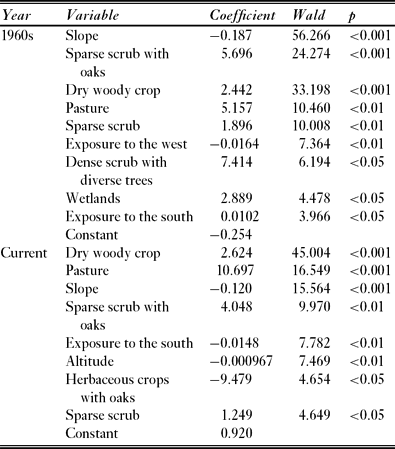
The variables included in the logistic regression models, ranked according to their order of entrance in each model (Table 2) included six variables that were common to both models, representing 66% and 75% of the variables included in the 1960s and the current models, respectively. According to these models, municipalities in Andalusia judged as favourable for rabbits tend to be aggregated (Fig. 2). In the 1960s, the most favourable areas for wild rabbit were mainly located in the western part of the Sierra Morena and Guadalquivir valley. However, currently favourable areas are located along the Guadalquivir slope of the Sub-baetic System and less mountainous regions of the western part of the Baetic System (Fig. 2).
Favourability models including coefficients of variables in the favourability functions. The Wald parameter indicates the relative importance of each variable. p = statistical significance.

Favourability values for good wild rabbit abundances in the municipalities of Andalusia, shown on a scale ranging from 0 (white) to 1 (black).

The relationships between the explanatory factors were complex (Fig. 3). In the 1960s, the effect owing to the intersection of orography, natural vegetation and crops was positive, and the characteristics of factors that favour good abundances tended to be present simultaneously. However, the effect owing to the intersection between orography and natural vegetation was negative after excluding the effect of crops; this was also the case regarding both the effect owing to the intersection between natural vegetation and crops after excluding the effect of orography, as well as the effect owing to the intersection between orography and crops after excluding the effect of natural vegetation. At present, the intersection between factors shows the same pattern as in the 1960s, except for the effect due to the intersection between orography and natural vegetation, which has changed from negative to positive (Fig. 3).
Variation partitioning of the final model. Values shown in the diagrams are the percentages of variation in good abundance explained by the factors orography, natural vegetation and crops and by their interactions.

Figure 4 shows the municipalities where favourable and unfavourable conditions for wild rabbits have remained stable from the 1960s to now, and where these conditions have changed. Some municipalities have changed toward more favourable conditions (Fig. 4a). Thus, in the western and central region of Andalusia, favourability increased from intermediate to favourable, whereas in the eastern region this improved from unfavourable to intermediate. Other municipalities have changed toward more unfavourable conditions (Fig. 4b). Changes in favourability from favourable to intermediate are concentrated in the middle of the western Andalusia, and changes from intermediate to unfavourable mainly in the eastern region.
Municipalities where favourable and unfavourable conditions for a high abundance of wild rabbits have remained stable from the 1960s to now (black and light grey, respectively), and where these conditions have changed (dark grey). (a) Dark grey indicates change toward more favourable conditions: either from intermediate to favourable (I-F zone), or from unfavourable to intermediate (U-I zone); (b) dark grey indicates change toward less favourable conditions: either from favourable to intermediate (F-I zone), and from intermediate to unfavourable (I-U zone). Thresholds for favourable and unfavourable areas are 0.8 and 0.2, respectively.

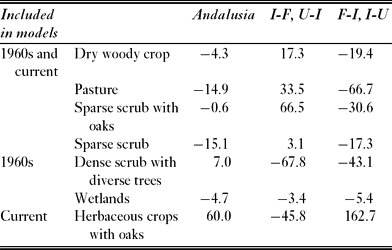
Municipalities where favourable and unfavourable conditions for rabbits changed between the 1960s and present day showed substantial changes in the percentage of surface area occupied by vegetation types included in the favourability models (Table 3). Thus, the percentages of surface area occupied by dry woody crops, pasture, sparse scrub with oak and sparse scrub have decreased in Andalusia since the 1960s. Nevertheless, in the municipalities where conditions favourable for rabbits have increased, the percentage of surface area occupied by these vegetation types has increased. The percentage of herbaceous crops with oaks increased in Andalusia since the 1960s. However, in the municipalities where favourable conditions increased, the percentage of surface area occupied by this vegetation type decreased, whereas in the municipalities where favourable conditions decreased, the percentage of surface area occupied by this vegetation type increased.
Increase in the percentage of surface area occupied by land use and vegetation types included in the favourability models. I-F: municipalities where the environment has changed from intermediate to favourable for the wild rabbit; U-I: from unfavourable to intermediate; F-I: from favourable to intermediate; I-U: from intermediate to unfavourable.

DISCUSSION
The location of areas favourable for rabbits in Andalusia has changed substantially over recent decades. In fact, we have recorded an increase in favourability (especially from intermediate to favourable) in the areas that are currently favourable for the species, and a favourability decrease in areas that were favourable for the lagomorph during the 1960s. Two hypotheses may explain these changes in favourability. First, rabbit habitat requirements could have changed in recent decades. Second, recent changes in land use in Andalusia (Fernández-Alés et al. Reference Fernández-Alés, Martín, Ortega and Ales1992) could explain the geographical differences in rabbit favourability between the two study periods.
As regards the first hypothesis, our results suggest that favourable areas for rabbits are currently determined by environmental and land-use factors similar to those of the 1960s; this is supported by the fact that six variables were repeated in both favourability models (Table 2). Thus, as in the 1960s, favourable areas for rabbits are currently associated with the main habitat requirements for this small mammal: the presence of suitable food types (for example dry crops and pastures; Calvete et al. Reference Calvete, Estrada, Angulo and Cabezas-Ruiz2004; Fernández Reference Fernández2005), and the availability of some form of cover for protection against predators (such as sparse Mediterranean scrubland; Moreno & Villafuerte Reference Moreno and Villafuerte1995). Moreover, land slope was negatively associated with rabbit favourability during both study periods, which is not surprising given that rabbits typically avoid sloping mountain areas (Farfán et al. Reference Farfán, Vargas, Guerrero, Barbosa, Duarte and Real2008). In only one of the models, a few less statistically significant land use variables were retained. For instance, dense scrub with diverse trees was associated with areas favourable to rabbits during the 1960s, but not at present (Table 2). Small patches of dense scrubland were interspersed with pastures and crops several decades ago in Andalusia (Fernández-Alés et al. Reference Fernández-Alés, Martín, Ortega and Ales1992), and therefore rabbits could find refuge and food in this type of landscape. Similarly, herbaceous crops with oaks were only present in the current favourability model (Table 2). This habitat was negatively associated with favourable areas for rabbits (Table 2), apparently because it offers high food availability but little refuge protection for the species (Lombardi et al. Reference Lombardi, Fernández, Moreno and Villafuerte2003). The area devoted to herbaceous crops significantly increased in recent decades (Table 3; see also Fernández-Alés et al. Reference Fernández-Alés, Martín, Ortega and Ales1992), which could explain why this habitat type was only significant in the present day favourability model (Table 2). The possibility that rabbits have changed their habitat requirements in the current landscape configuration of southern Iberia is not totally excluded by coincidences in the model, as the internal relationships between the variables that are common to both models (their coefficients and order of importance according to the Wald's parameter) are not identical.
The partial orographic, natural vegetation and crop models show that orography is the most important factor explaining the distribution of wild rabbit abundance in Andalusia (Fig. 3). In the 1960s, the types of natural vegetation landscape that favoured the presence of rabbits were more widely distributed throughout the study area (Fernández-Alés et al. Reference Fernández-Alés, Martín, Ortega and Ales1992) and, as a consequence, orography may have been a more limiting factor for this species than natural vegetation. Negative intersection between natural vegetation and crops during the 1960s (Fig. 3) means that the favourable natural vegetation conditions tend not to coincide with the favourable crop conditions when orography remains constant. After the 1960s, the partial importance of orography and natural vegetation decreased, whereas the weight of their intersection has increased and become positive (Fig. 3), probably because natural vegetation landscapes favourable for rabbits are presently confined to certain orographic zones. Specifically, the most suitable natural habitats are now mainly situated on the Guadalquivir slope of the Sub-baetic system and the western hills of the Penibaetic system (Fig. 2), which are regions with moderate slopes that are also orographically favourable for rabbits.
As habitat requirements for rabbits do not seem to have changed, the most plausible explanation for the changes observed in rabbit favourability would be the land-use changes in Andalusia in recent decades. In agreement with this, we suggest that the changes in landscape have been mainly detrimental to rabbits during the study period. Thus, the percentages of the four habitat variables that were positively associated with rabbit favourability in both models (current and 1960s; Table 2) have declined in Andalusia as a whole and in areas where rabbit favourability has decreased (Table 3; but see also Fig. 4b); hence, habitat suitable for rabbits has become impoverished. The reduction in woody crops and pastures may have led to a decline in the availability of food for rabbits in these areas (Calvete et al. Reference Calvete, Estrada, Angulo and Cabezas-Ruiz2004). Similarly, the loss of sparse scrubland, mainly as a consequence of rural abandonment (Fernández-Alés et al. Reference Fernández-Alés, Martín, Ortega and Ales1992), has significantly reduced rabbit numbers in some areas in Andalusia (Moreno & Villafuerte Reference Moreno and Villafuerte1995). Moreover, the increase in both dense scrubland and herbaceous crops in Andalusia (Table 3) seems to be detrimental for rabbits, since these are not optimum habitats for the species (Lombardi et al. Reference Lombardi, Fernández, Moreno and Villafuerte2003). From this point of view, the large decrease in dense scrubland in municipalities where rabbit favourability has decreased would be positive. However, dense scrubland has apparently been replaced in these areas by other habitats unfavourable to rabbits, such as herbaceous crops with oaks (Table 3). In fact, the area devoted to herbaceous crops with oaks has tremendously increased in those municipalities where rabbit favourability has decreased (Table 3). Not only has the surface area of this type of habitat (typically called dehesa) increased in the study area, but it has also undergone structural modifications. The scrub layer traditionally linked to the dehesa has progressively disappeared as a consequence of agriculture and livestock intensification (Fernández-Alés et al. Reference Fernández-Alés, Martín, Ortega and Ales1992). It is known that improvements associated with modern agricultural practices can have long-term detrimental effects on rabbit populations (Boag Reference Boag1987). Interestingly, land uses suitable for rabbits in both models (Table 2) have increased in municipalities where rabbit favourability has also increased (Table 3; see also Fig. 4a). Therefore, an improvement in rabbit habitat has occurred in these locations. In addition, the reduction of the surface area devoted to herbaceous crops with oaks and to dense scrubland has contributed to the habitat improvement recorded in these areas.
We have not addressed specifically the effect of diseases on rabbit population decline. Nevertheless, a recent review has showed that positive rabbit trends, after the initial RHD outbreak, have been recorded in species-friendly habitats (Delibes-Mateos et al. Reference Delibes-Mateos, Ferreras and Villafuerte2009b). Similarly, a theoretical model also showed that the long-term impact of RHD is conditioned by population dynamics, which are primarily determined by habitat suitability (Calvete Reference Calvete2006). According to these findings, the impoverishment of rabbit preferred habitat observed in the present study could be jeopardizing rabbit recovery in the Iberian Peninsula.
CONCLUSIONS
The availability of hunting records with explicit time and space references allows the development of datasets which can be used to analyse species trends in historic and regional contexts (Fernández & Ruiz de Azua Reference Fernández and Ruiz de Azua2009). We have used two sources based on hunting records, which were previously used to assess changes in species abundance and distribution (Gortázar et al. Reference Gortázar, Herrero, Villafuerte and Marco2000; Delibes-Mateos et al. Reference Delibes-Mateos, Farfán, Olivero, Márquez and Vargas2009a), to estimate long-term rabbit population trends. Our aim was to detect areas favourable to rabbits, thus to avoid potential bias owing to the existence of differences in the nature and quality of the data between the two study periods, we transformed the original data into a binomial variable (good and poor areas for rabbit) that was directly comparable between both study dates.
There is a widely-held perception that all lagomorphs are fecund and are sufficiently generalist in their ecology to overcome environmental changes. However, approximately a quarter of all lagomorphs are threatened with extinction and, to a great extent this is owing to land-use changes during the last century (Smith Reference Smith, Alves and Hackländer2008). Although it has been previously suggested that habitat loss and fragmentation has been a major cause of rabbit decline (Ward Reference Ward2005), our study provides the first empirical evidence showing that habitat changes have been highly detrimental for this keystone species in the Iberian Mediterranean ecosystem. Following the rabbit population decline, conservationists and hunters have applied a great number of management tools to improve rabbit densities (for example Delibes-Mateos et al. Reference Delibes-Mateos, Ramírez, Ferreras and Villafuerte2008b). Based on our findings, it is to be expected that these strategies would be unsuccessful in areas where favourable habitats for rabbits have disappeared as a consequence of landscape changes. Thus, it would be preferable to conserve and recover the landscapes suitable for the species.
ACKNOWLEDGEMENTS
M. Delibes-Mateos was supported by a postdoctoral grant from the regional government of Castilla la Mancha (JCCM) and the European Social Fund (ESF). Special thanks go to E. Martínez for providing the maps of the abundance of game species during the 1960s. We are indebted to D. Anderson, N. Fernández, J. Fernández de Simón, D. Parish and two anonymous reviewers for helpful comments on previous drafts of the manuscript. The Consejería de Medio Ambiente de la Junta de Andalucía kindly supplied the Annual Hunting Reports.