Honey bee (Apis mellifera) defensive behaviour consists of two distinct behavioural tasks: guarding and stinging. Guards distinguish foreign bees and other intruders from nestmates primarily by olfactory cues. They may directly reject non-nestmates or may recruit other bees to defend the colony by releasing alarm pheromones (Breed et al. Reference Breed, Guzmán-Novoa and Hunt2004). Guard bees can be easily identified as they actively patrol hive entrances and inspect incoming bees using their antennae. A guard may stand with its front legs off the ground and wings spread as if ready to fly (Moore et al. Reference Moore, Breed and Moor1987). The age at which worker bees become guards varies, but generally begins at 15–20 days post-emergence, when bees are middle-aged (Breed et al. Reference Breed, Robinson and Page1990) and continues well into later life (Moore et al. Reference Moore, Breed and Moor1987).
While there has been much research into honey bee defensive behaviour, very little has been done to evaluate what proportion of a bee colony population perform guarding tasks. Lindauer (Reference Lindauer1952) found that 23 of 159 observed worker bees ended up guarding (14%), but Moore et al. (Reference Moore, Breed and Moor1987) conducted the most comprehensive study on the subject. These researchers found that, on average, <14% of a colony's population ever performs guarding behaviour in their lifetimes. Therefore, guarding could be considered a relatively rare task that few individuals in a colony perform. However, it is possible that the proportion of individuals in a colony that engage in guarding behaviour could be underestimated due to inaccuracies associated with the methods used to obtain these estimates. For example, the methodologies typically used to estimate the proportion of bees that perform guarding tasks in a colony do not take into consideration bee acceptance or mortality before guarding age, and the area of colony used to observe guarding bouts is limited. The objective of this study was to further determine what proportion of honey bees in a colony guard and to determine if there is variation between bee strains for this trait, by estimating guarding proportions from bees co-fostered in observation hives.
Experiments were conducted at the University of Guelph, Ontario, Canada. Four honey bee strains were used, which ensured a broad representation of A. mellifera: two local strains derived from Carniolan stock (Ontario 1 and 2, respectively for the purposes of this study), Buckfast bees that have been bred on an island to maintain stock purity, and a Primorsky Russian stock, maintained in isolated mating areas. Three colonies of each strain located in a single apiary were used as sources of workers. These colonies were homogenised for size and were managed in a similar way. To evaluate guarding behaviour, three observation hives of identical dimensions (47.0 × 4.1 × 96.5 cm) and containing four frames each were established using bees from colonies unrelated to the test strains. The observation hives were placed in separate rooms within a research building. Each hive was connected to a transparent runway (see Guzmán-Novoa and Gary Reference Guzmán-Novoa and Gary1993), which in turn was connected to an opening leading to the outside of the building, allowing the bees to exit the hive and forage normally. Frames of emerging brood from colonies of the four test strains were incubated at 32–35°C and 60% relative humidity for 24 hours and newly emerged bees were collected and tagged with coloured, numbered, plastic tags (Opalithplättchen, Germany), which were glued to their thoraxes. The tagged bees were introduced into the hives, each of which received 600 bees (150 bees from each strain per observation hive, obtained from three source colonies per strain with each source colony contributing 50 bees per observation hive). A census was taken of all tagged bees in each observation hive 2 days after introduction to determine acceptance. Additional censuses were taken again 24 hours before observations. Censuses were conducted by recording the tag numbers and colours of marked bees in the hives and were done late at night (22:00 to 0:00 hours) after foraging had ceased to ensure that no bees were missing.
The transparent runway connected to the entrance of each hive was used to observe guarding bees for 5 hours (10:30–15:30 hours). A bee had to stop and inspect an incoming bee or actively patrol the hive entrance and/or show a typical guarding body posture (open wings, legs raised off the ground, etc.). Observations were conducted on four different days when the tagged bees were 16, 19, 23, and 26 days old. Three estimates of percentage guarding were calculated for each strain by dividing the total number of individually identified bees that guarded (considering all observations) by the number of introduced bees, as well as by the number of bees that had been accepted, and that were alive at the time of observations. Guarding data were subjected to contingency table analyses to compare strains for guarding propensity.
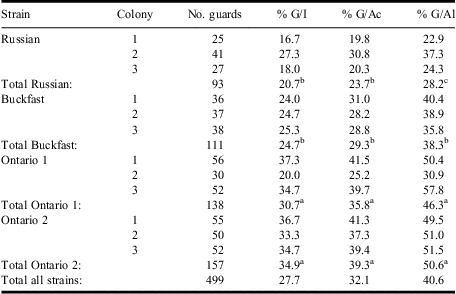
A total of 450 bees were introduced in the observation hives for each of the strains. Of these, 87.1%, 84.2%, 85.6%, and 88.7% were accepted for the Russian, Buckfast, Ontario 1 and Ontario 2 strains, respectively. However, at the time of observations, 73.3%, 64.4%, 66.2%, and 68.9% of the bees introduced were still present in the colonies for the above genotypes, respectively. Table 1 shows the total number and percentage of bees observed guarding in each colony for the different strains. Overall, 27.7%, 32.1%, and 40.6% of the introduced, accepted and live bees at the time of observations, were observed guarding on at least one occasion. Additionally, there were significant differences in percentage guarding between strains (P < 0.05).
Number and percentage of worker bees of four strains co-fostered in observation hives that performed guarding bouts at least once during 4 days of observation.
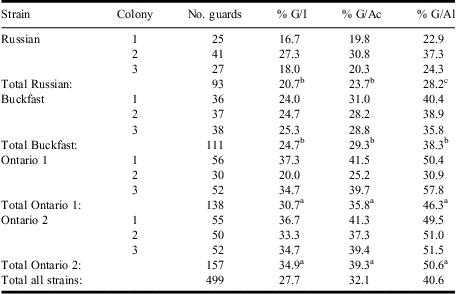
Percentage guarding was calculated from introduced (G/I), accepted (G/Ac), and bees alive at the time of observations (G/Al). A total of 150 individually tagged-bees of each strain were introduced in each colony. Different letters indicate significant differences between genotypes based on contingency table analyses (P < 0.05). Comparisons are only valid within columns.
The results of this study showed genotypic effects. A higher proportion of bees from the two Ontario strains performed guarding tasks than Buckfast or Russian bees. The differences were significant regardless of whether the number of introduced, accepted, or living bees is compared between strains, suggesting genotypic variability, based on the common environment shared by the test bees.
These results clearly conflict with results previously reported. Moore et al. (Reference Moore, Breed and Moor1987) found that, on average, no more than 14% of the worker population in a colony becomes guards, while in Table 1 it can be seen that the proportion of tagged bees guarding was much higher in all strains tested. There are a number of possible explanations for this discrepancy. It is unlikely that the strains studied were uniquely “high guarders” while the bees studied by Moore et al. (Reference Moore, Breed and Moor1987) were remarkably “low guarders”. It could be argued that the observer in this study failed to identify guards correctly, thereby inflating the percentages of guarding bees. However, guarding behaviour is easily distinguishable from other behaviours. Also, high numbers were consistently reported in different observation hives, on several different days; meaning that either this mistake was made consistently or the guards were properly identified. It could also be that the observation hive design or reduced colony population size, in contrast with the full colonies used by Moore et al. (Reference Moore, Breed and Moor1987), somehow affected the guarding behaviour of the introduced bees. This hypothesis would require further study. It is also possible that there were interactions between the introduced bees and the host colony, which may have in some way decreased the guarding threshold in the introduced bees, thus, making them more sensitive to guard than bees from the host colony. However, that possibility would have also occurred in previously published studies on the subject. Therefore, this potential explanation of our results and those of previous studies would require further experiments to verify. There are methodological differences between this study and the one by Moore et al. (Reference Moore, Breed and Moor1987). Firstly, the calculation of the percentages was performed not only based on the number of bees introduced, but also on the number of bees accepted and alive during observation days. The number of tagged bees accepted into the colonies was lower than the number of bees introduced in this study, and it is likely that this would be true for the study by Moore et al. (Reference Moore, Breed and Moor1987) as well. This would account for some of the difference between the numbers. Furthermore, not all of the bees that are introduced and accepted survive until guarding observations begin, as seen in this study. It is likely that some of these bees would have become guards, and therefore these bees should also be deducted when calculating the proportion of bees that guard. A previous study by Butler and Free (Reference Butler and Free1952) supports this difference. In their study, they marked 400 bees and returned them to their colonies. Of the introduced bees, 160 were observed, and of these 41 were seen guarding. Thus, the proportion of introduced bees seen guarding was 10.2% but the proportion of live bees seen guarding was 25.6%, a proportion of guards closer to what we found. The second methodological difference between our study and that of Moore et al. (Reference Moore, Breed and Moor1987) is the observation environment. In this study, guards were identified using an extended, transparent ramp running from the entrance of the hive to the exit at the building wall. This made it less likely that a guarding bee would be missed. Moore et al. (Reference Moore, Breed and Moor1987) used standard hives where only the most external bees were visible at the hive entrance. It is possible that some guard bees may not have been visible to the observers in the original study, accounting for another part of the difference between their study and the results found in this one.
The discrepancy between this study and previous studies, with respect to the proportion of bees that guard is not completely resolved by the data presented, but it shows a clear need for further research in this area.
Acknowledgements
The following people contributed in different ways in the experiments conducted: Paul G. Kelly, Janine McGowan, Nuria Morfín, Nick Edmonds, Katherine Unger, Judith Unger, Leslie Eccles, Hanan Gashout, and Mayhery Escobar. Gard W. Otis and Cynthia Scott-Dupree critically reviewed an earlier version of the manuscript. We are particularly grateful to the Natural Sciences and Engineering Research Council of Canada for funding this study.