

China's new institutional structure of economic governance, despite its extensive and continuous efforts over the past two decades, has been far from transparent. Often there are significant gaps between policies and their implementation, bureaucratic functions overlap, or co-ordination and enforcement procedures are not explicitly specified. Such ambiguities reflect the possible outcomes when state-controlled sectors embrace market-oriented institutional reforms in the era of globalization. As Jude Howell has commented: “At the heart of governance processes is the fundamental question of ‘who has the right to govern?’; ‘who has power and who has authority,’ and how are the two related?”
This article examines one crucial state sector, telecoms basic service,Footnote 1 and explains the actual roles and responsibilities of its regulatory institutions. In doing so, it demonstrates how the ownership agency State-owned Asset Supervision and Administration Commission (SASAC) acts as a “regulator,” not as an owner, and how the Communist Party maintains its political control over the sector. For clarification, this study defines regulation as not only the monitoring of compliance with rules and encouraging competition in markets, but also with the active structuring of competition (regulation-for-competition) to steer the economy. Regulation is thus likely to be “both constraining and enabling.”Footnote 2 The central argument of the article is that though each bureaucratic agency has its own function, government regulation for the telecoms service sector can be explained by the SASAC, not by the formally designated regulator the Ministry of Information Industry (Xinxi chanye bu 信息产业部, MII), now the Ministry of Industry and Information Technology (Gongye he xinxihuabu 工业和信息化部, MIIT). The subject is important in that the state regulation that the SASAC exercises in the telecoms business demonstrates how the Chinese state will remain critical in governing the most strategic state industries into the foreseeable future.
The notion of “regulation” is also central to discussion among prominent scholars and officials in mainland China. Though the problem of “political” independence is commonly accepted, Chinese scholars' evaluation of this diverges to a remarkable extent. While some highlight the ongoing progress towards market-oriented institutional creation, sceptics pay more attention to the continued institutional constraints despite the reform efforts.Footnote 3 For example, Zhang Xinzhu 张昕竹Footnote 4 insists that the creation of MII is evidence of successful regulatory transformation in the telecoms industry, because this shows the separation of the regulator from the firms.Footnote 5 Zhang contends that the MII has not collected any revenues from telecoms firms since management was separated from regulation in 1998.Footnote 6 In contrast, Zhou Qiren 周其仁Footnote 7 points to the structurally embedded “political obstacles” to the Chinese system of economic governance, such as the Party organs and continued tension between government and business.Footnote 8 Zhou argues that without substantial changes in the personnel among government officials and top executives of telecoms firms, all institutional reforms will remain perfunctory. Such debate is important in that it shows a disagreement among Chinese figures with regard to the depth and objectives of institutional reform.
Outside China, scholars have been keenly aware of the regulatory state type institutional designs and ideas envisaged in Chinese policies. Some believe that the building of a strong institutional framework is vital for effective reform in the state sector.Footnote 9 For example, Dali Yang has proclaimed that the efforts to rationalize administrative institutions are important steps towards “a modern limited government,”Footnote 10 which would usher in a buyer's market as the new mechanism of market governance. Others, however, highlight the constrained nature and function of regulatory institutions, resulting from their bureaucratic origins and fragmented authority.Footnote 11 As Margaret Pearson aptly notes, China's central leadership has rationalized political-economic structures, but these institutional reforms have not yet led to a remake of the Chinese party-state, at least in the key infrastructure industries, because of consistent state ownership, the power of comprehensive state commissions – such as the National Development and Reform Commission (Guojia fazhan gaige weiyuanhui 国家发展改革委员会, NDRC) and the SASAC – and the Communist Party.Footnote 12
These arguments, however, do not solve the puzzle of the telecoms service industry. If specialized regulatory agencies' authority is weak and contested as a result of bureaucratic and political constraints, who actually regulates the business of crucial state sectors such as telecoms, and why are such complexities happening in China's industrial regulation? During nine months of fieldwork between 2005 and 2008, I conducted interviews with more than 40 key Chinese specialists in the field of telecoms regulation and industrial policies.
The first section of the article examines the origin and context of the reforms in the telecoms service, and describes the evolution of the mechanism of state regulation. The next section discusses the institutional structure and system of regulation. I propose that the SASAC is a quasi-ownership agency and exerts real control over the market and players. The article then examines one empirical case to illustrate how the MII's regulatory power has been circumscribed by the SASAC. The conclusion reflects upon the theoretical implications of the argument.
The Origin and Context of Reform
The creation of the MII in 1998 and its accompanying market restructuring launched substantial reforms in the telecommunications sector. The reforms were affected not only by internal demands and changes but also by external forces, such as the requirements of World Trade Organization (WTO) accession and a global wave of regulatory reforms. Internally, the 1998 administrative reform that abolished or integrated several industrial ministries paved the way for a series of regulatory institutions in China's industrial economy. Externally, the most significant impetus was that one of the entry requirements for WTO membership is acceptance of the terms of the Basic Telecommunications Agreement,Footnote 13 which stipulates the immediate opening of the telecom service market to foreign investments and specifies the maximum ratio of the ownership of foreign firms within six years.Footnote 14 Moreover, incoming overseas telecom giants provided the government with an incentive to make indigenous operators large and strong enough to compete with foreign companies.
The reforms have evolved with the following features. First, the rise of the MII, replacing the Ministry of Post and Telecommunications (MPT), contributed to reducing the bureaucratic tensions between the MPT, the Ministry of Electronic Industry and the Ministry of Railways.Footnote 15 The second feature is the separation of government and business (zhengqi fenkai 政企分开). By completing the separation of China Telecom, the MII no longer interferes in the everyday business of telecom companies.Footnote 16 Lastly, the continued restructuring of the sector, such as the breaking-up of China Telecom, injected competition into the market. However, it was still dominated by China Telecom. For example, in the mobile services, the market share of China Unicom was 6 per cent in 1998, whereas China Telecom accounted for 94 per cent.Footnote 17
The MII-led first round of restructuring, in the wake of four different proposals, was finally approved by the State Council in 1999.Footnote 18 Its intention was not to introduce new players but to break up China Telecom, because the creation of new operators in the past had not been considered successful. There were numerous debates and suggestions from various bodies, but the focus was on how to split China Telecom up: horizontally or vertically. A horizontal break-up would involve a split into smaller local-unit telecom firms by region, allowing China Telecom to maintain its former comprehensive services. In contrast, a vertical split scheme highlighted the functional divisions of China Telecom that dominated fixed-line, mobile, satellite and paging services. By adopting a vertical break-up, China Telecom was divided into three companies, each with its own service area: China Mobile (wireless services); China Satellite (satellite business) and new China Telecom (fixed-line telephone and internet services).Footnote 19 Two additional basic service providers were launched in 2000: China Netcom and China Railcom. Both were designed to compete with China Telecom, but their target services were different: China Netcom operated internet service, IP telephony and other value-added services; China Railcom was in charge of local and long-distance fixed-line services.
China Telecom still accounted for more than 90 per cent of the market share in the local network service, so China Netcom and China Railcom lobbied for a second break-up of China Telecom. However, many telecom analysts and experts advised that either introducing new carriers or improving the regulatory mechanism would be more effective. In December 2001, the State Council adopted the MII's second-round split of China Telecom into China Telecom and China Netcom that merged the former China Netcom and Jitong Communications. Both provided a fixed-line service, but China Telecom was mainly given charge of the southern provinces, including lucrative Guangdong and Shanghai as well as Tibet and Gansu, while China Netcom provided services in the northern regions that encompassed Beijing, Tianjin and Liaoning.Footnote 20 Nevertheless, one telecom regulation expert maintained that such continuous break-up schemes would fail to bring about substantial competition unless the price was set in the open market, and if private and overseas companies were allowed to do business.
The most recent restructuring scheme was announced in May 2008 (see Table 1). By allowing operators to provide both fixed and mobile services, the government carefully orchestrates the market structure with three players: China Mobile, Telecom and Unicom.Footnote 21 According to the government's plan, the former fixed carrier, China Netcom, will be integrated into China Unicom that retains the GSM wireless network; the Unicom-run CDMA mobile service will be transferred to the dominant fixed operator China Telecom; and China Mobile will take over the other small fixed-line operator China Railcom.Footnote 22 The rationale appears to balance the overall competitiveness of the firms by merging weaker operators in each fixed and mobile market with stronger firms. One interview with an official in the MII's research institute confirms that the government wants to keep the strongest carrier and expects to raise the other firms' competitiveness.Footnote 23 In both fixed and mobile services, one carrier (such as China Mobile and Telecom) nearly dominates the markets, so the need to balance competition is growing. In effect, as three operators come to provide both fixed and mobile services, it is anticipated that not only will the formerly biased competition be adjusted, but consumers will also be able to enjoy more choices, and perhaps therefore lower fees.Footnote 24 It is believed that this is the first time that the MII, which gives priority to consumers' interests and market-oriented competition, has not opposed the SASAC's restructuring plan.
Comparison of the Telecom Regime

Sources:
Author's interviews at the Beijing University of Post and Telecommunications, the Development Research Centre of the State Council, the Chinese Academy of Social Science (Institute of Industry Economy, Institute of Law), Beijing (December 2005, January 2006, April–May 2008).
The Politics of Regulation in China's Telecoms Market
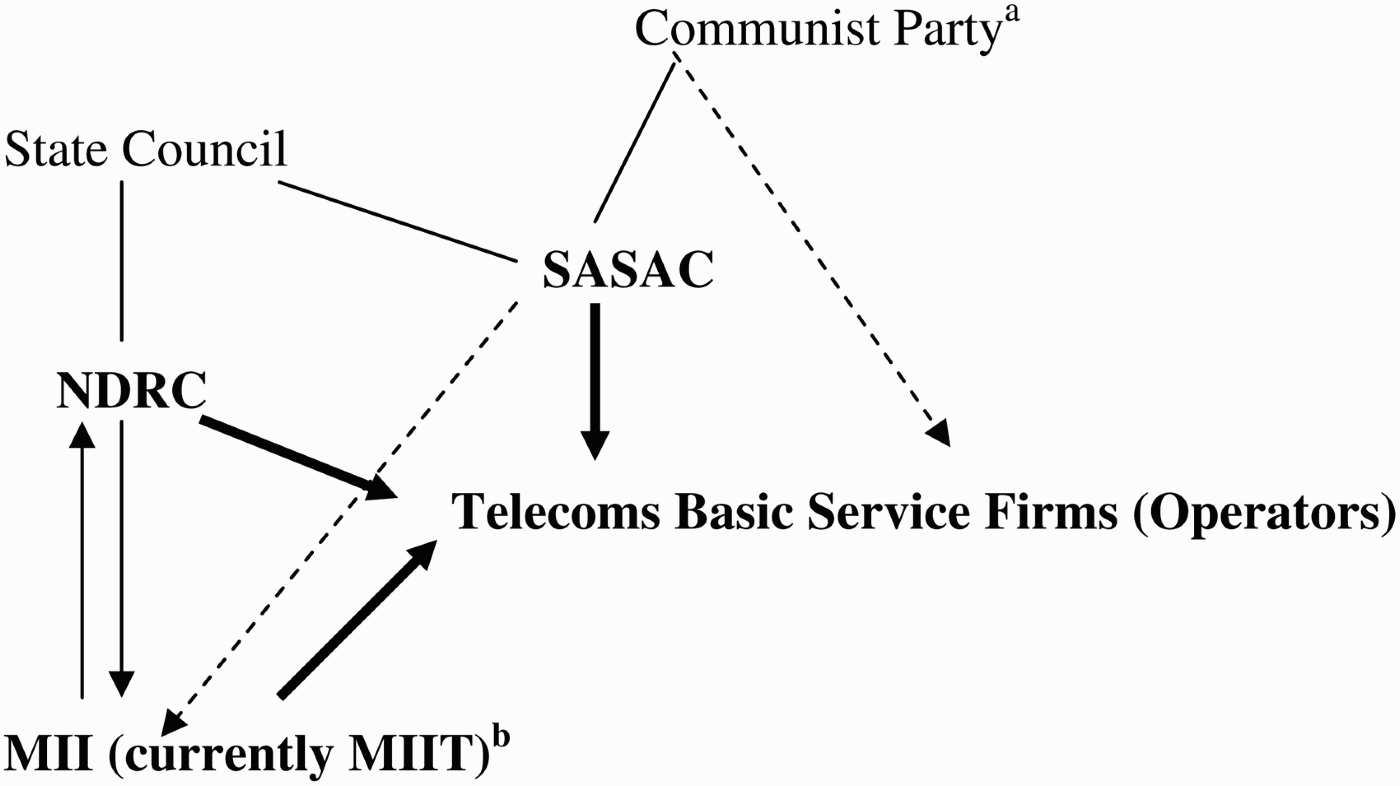
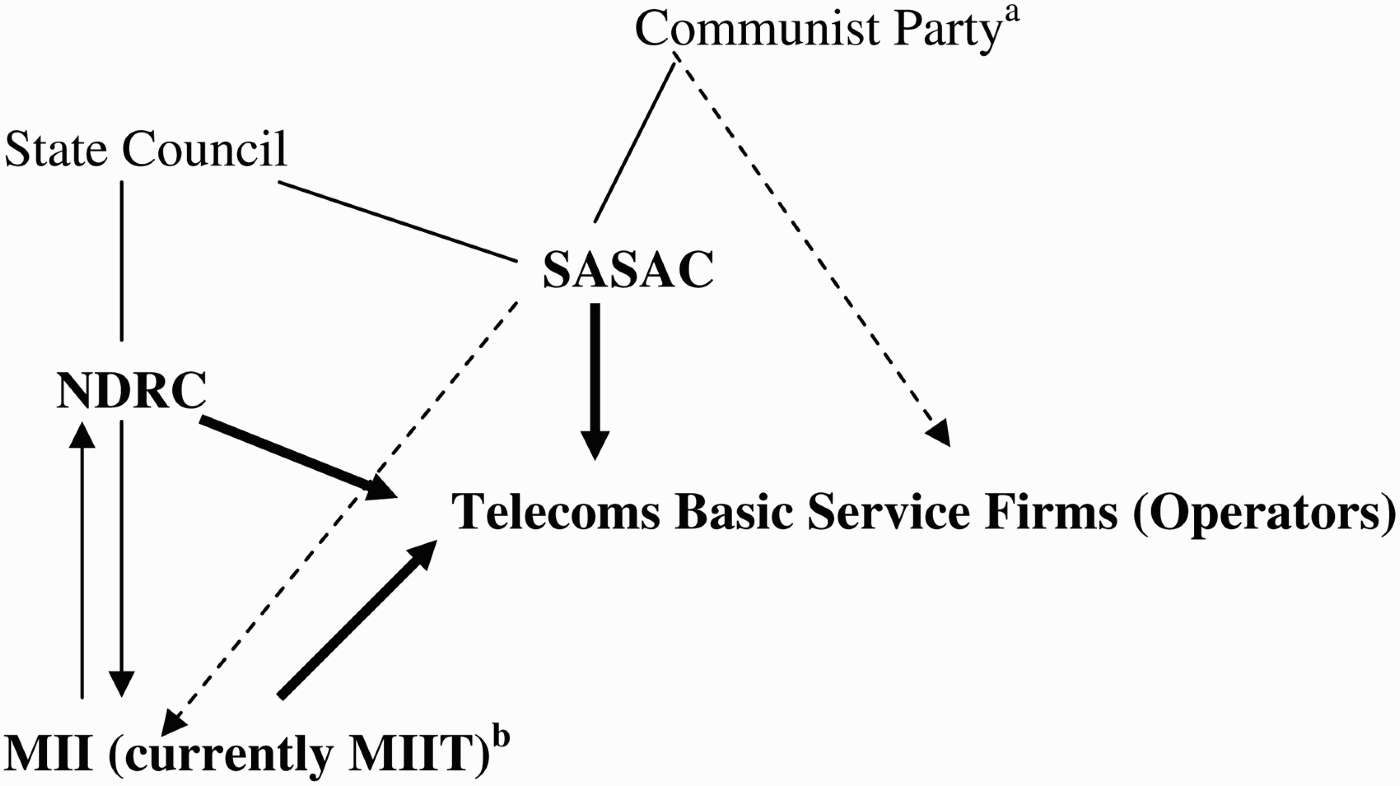
The Chinese system has been described as “complex, contradictory, and confusing.”Footnote 25 The telecoms regulatory regime is a good example. Some argue that “the decision-making process in China's telecoms industry has never been as complicated as in recent years because of the involvement of an increasing number of ministries.”Footnote 26 Beyond merely laying out the institutional structure and constraints that existing studies have already discussed,Footnote 27 this article explains how the SASAC, which is the ownership agency of the telecoms carriers, exerts substantial control over the market and business of the basic service. This section begins with an explanation of the roles and responsibilities of the MII, the NDRC, the Communist Party and the SASAC (see Figure 1). The analysis is focused on these four institutions because my interviews in Beijing confirm that they are the key agencies. The 2008 government reform that provides an opportunity to test this hypothesis on the MII's regulatory power is reviewed at the end.
Regulatory Structure for the Business of Telecoms Basic Service
The Ministry of information industryFootnote 28
The MII is the formally recognized regulatory institution (jianguan jiegou 监管结构) of the entire information industry sector which encompasses not only the telecoms service but also the electronic, information technology manufacturing and software sectors. Aiming to “promote the informatization (xinxihua 信息化) of the national economy and social service,”Footnote 29 the MII makes industrial and regulatory policies and takes charge of the allocation of resources to prevent duplicate investments or construction. Its proposals have played important roles in shaping the ideas and policy-making of top leaders, who have neither specialized knowledge nor market information. Arguably, the MII is the regulator for the entire information industry, but that does not imply that its authority is equally exercised within the sector. For the basic service, the MII outlines industrial policies, sets service fees and technical standards, and issues licences and rules. Placing a priority on consumer interests, the MII also oversees the service quality and market competition.Footnote 30 Yet, as indicated earlier, its regulatory power has been far from absolute, since it must negotiate with supra-regulatory bodies.Footnote 31 For example, disagreement about the caller-pay mobile phone schemeFootnote 32 between the MII and the SASAC has stalled decision-making for years. Since the caller-pay system is expected to “save each subscriber 20 to 30 per cent of their mobile fees,”Footnote 33 it has been actively pushed forward by the MII to protect consumers' interests. Some MII officials complained that it has been thwarted by the SASAC, which fears any loss of state assets resulting from the carrier's reduced profits.Footnote 34 Likewise, the MII's conventional jurisdiction over the service fee system has been contested by the SASAC in the name of securing state assets. In addition, the MII is not the sole agency to set prices and has to co-ordinate with the NDRC in considering macro-economic stability.
The National Development and Reform Commission
The government's chief co-ordination agency, the NDRC, reviews all policy proposals and rules drafted by the MII. On price setting, from the initial stage the NDRC and the MII collaborate, discuss and if necessary hold a public hearing. For instance, in February 2008, after hours of debates and public hearings, the MII and NDRC jointly announced “a price cut on mobile roaming service charges by between 54 per cent and 73 per cent depending on locality.”Footnote 35 Meanwhile, the director of the Price Office of the Economic Research Institute of the NDRC said that in order to push forward the implementation of the caller-pay charging system, “the NDRC and MII will work to fix a definite timetable.”Footnote 36 Though the MII is the main state agency responsible for setting the telecoms price, in May 2006 the NDRC announced that it would adopt a preferential policy for rural areas, relieving the burden on farmers who are paying a higher telecoms connection fee than urban residents.Footnote 37 Such a supra-regulatory institutional structure – including the SASACFootnote 38 which is further discussed below – is likely to restrain the MII's authoritative power of regulation. Yet, although the NDRC is often referred to as the “small State Council” among policy makers in Beijing, tremendous variation is found in its attempts at centralization.Footnote 39 In particular, the importance of telecoms firms' assets and profits to the national economy as well as their wholly centralized public ownership empowers the SASAC to play a principal role in the telecoms service market.Footnote 40
The Chinese Communist Party
The Party's involvement in the telecoms business has been never addressed in public, but not surprisingly it remains important in China's system of economic governance. Specifically, the Party relies on three channels: the Central Standing Committee of the Political Bureau, the Organization Department and the Party Committee. As is to be expected, the Central Standing Committee of the Political Bureau (Zhongyang zhengzhiju changwu weiyuanhui 中央政治局常务委员会), though invisible in most cases, is the final decision maker in key policies of market restructuring.Footnote 41 Second, regarding the personnel of the central state-owned enterprises (SOEs), both the Central Organization Department (Zhongzubu 中组部, OD) and the SASAC reserve the right to appoint top executives. While the SASAC lists this as one of its key responsibilities,Footnote 42 the OD acts on the authority of the Party's nomenklatura system which is a key instrument of Communist Party control over leadership selection in China.Footnote 43 According to the logic of the nomenklatura that “only lists the most important position (lingdao ganbu 领导干部),”Footnote 44 telecom firms' top executives are appointed, removed and rotated by the OD. Yet since the OD does not have sufficient knowledge of the candidates or the firms, it takes seriously the SASAC's “suggestions” (jianyi 建议), and this is why the SASAC is highly influential in personnel procedures.Footnote 45 Some even claim that the OD's personnel authority is close to “perfunctory,” for the SASAC is better informed about candidates through its daily oversight (jiandu 监督). However, the SASAC's suggestions have no binding force; the ultimate nominator OD may thus appoint other candidates outside the SASAC's list.Footnote 46
If the OD is the Party's external mechanism of political control, there is the Party Committee (Dangwei 党委) inside the firms.Footnote 47 Its core task is not only to supervise the Party members and organization of the firms, but to ensure that the policy directions and desires of the Party leadership are reflected in firms' business management. For the latter, the Party secretary of the committee at a firm often also chairs the board of directors.Footnote 48 The former China Netcom Party secretary,Footnote 49 Zhang Chunjiang, confirms that “my job is to ensure that the direction of our Communist Party is upheld within China Netcom.”Footnote 50 In fact, China Netcom, under Zhang's leadership, spearheaded the reform of corporate governance, creating a model for other large state firms by strengthening its board of directors and clarifying the roles of the firms' Party Committee in business management. This illustrates that such reform efforts are not necessarily designed to dilute the Party's political power in corporate governance. Moreover, though China, with listings in overseas stock markets, has introduced the Western concept of corporate governance (a board of directors), members of the board all but belong to the Party Committee. They are party-state controlled but internationally listed telecoms operators. The Party's dominance in key leadership positions is remarkable. For example, China's Telecom's CEO (zongzai 总裁), Wang Xiaochu, is both the chair (dongshizhang 董事长) of the board of directors and the Party secretary (dangzu shuji 党组书记).Footnote 51
Of course the Party's strong influence on strategic state firms is nothing new,Footnote 52 though there are some debates on its capacity in society.Footnote 53 However, the case of telecoms basic service regulation contributes not only to unveiling the power relations between the OD and the SASAC regarding leadership selection and appointment in central SOEs (whose importance to China's economy is fundamental and strategic), but also to showing how, despite such enthusiastic institutional reform efforts, the Party's system of control is maintained without substantial modifications.
The 2008 government restructuring
With the catch-phrase of “super-ministry reform” (dabuzhi gaige 大部制改革), in March 2008 Beijing embarked upon another governmental shake-up, seeking to “improve government efficiency, boost central authority, and eradicate maladministration including corruption.”Footnote 54 By merging ministries and commissions with overlapping functions, the newly restructured super-ministries are expected to facilitate efficient policy-making and implementation.Footnote 55 Notable changes include the creation of the Ministry of Transportation and the Ministry of Environmental Protection.Footnote 56 So far as the telecoms industry is concerned, the former regulator MII was transformed into a super-ministry, the Ministry of Industry and Information Technology.Footnote 57 This new agency integrates the MII's previous function with some work of “telecom and IT functions of the NDRC,”Footnote 58 the functions (except on nuclear power management) of the Commission of Science, Technology and Industry for National Defence, and the Information Office of the State Council.Footnote 59 The purpose is very clear: the Chinese leadership wants to make the best use of information technology for pushing further industrial development, and expects national information security to be better protected by integrating related ministries.Footnote 60 It is also expected to “smooth policy-making for telecoms standards, which has long been undermined by bickering between rival bureaucracies.”Footnote 61
The 2008 super-ministry reform has significant implications for telecoms regulation. The rise of MIIT shows the value that the government places on “industrial policy.” There is a popular perception among officials and scholars that the telecoms basic service has enough market competition, unlike other infrastructure sectors (such as electricity), although China Mobile and China Telecom tend to dominate the mobile and fixed-line markets, respectively.Footnote 62 Some argue that “China is still a developing country, so we need more development pushed by the government.”Footnote 63 Nevertheless, as to the creation of MIIT, one Chinese regulation expert complains that government officials have little understanding of the importance of market regulation in the telecoms sector.Footnote 64 As the new MIIT deals with electronics and machinery industries as well as information ones, telecoms regulation is likely to receive less attention than it did in the era of the MII. This raises the question of who really regulates the telecoms business.Footnote 65
Between owner and regulator: the SASAC in the telecoms service business
The SASAC was established as the ownership agency for central state firms in 2003.Footnote 66 However, in the telecoms basic service the SASAC does not play much of an ownership role in reality; rather, its regulatory functions appear to be more substantial and influential on the telecoms firms than on other state agencies.
Quasi-ownership agency. In theory, an owner of a firm has the rights to profits-after-tax, personnel and the making of the budget.Footnote 67 Yet in the case of telecoms basic service, the SASAC neither receives the net income nor controls directly the operators' budgeting process. Moreover, as discussed earlier, top executives are appointed by the Communist Party OD, not by the SASAC. This article thus proposes that the SASAC in telecoms regulation remains only a nominal owner of the operators. First, this “ownership” agency is not allowed to collect net income from the telecoms operators; its main function is to oversee if they pay the statutory 10 per cent of their revenue to the Ministry of Finance.Footnote 68 Accordingly, part of the operators' revenue flows back to the Ministry of Finance, not to the SASAC.Footnote 69 For the purpose of facilitating the development of the sector, the government allows the operators to keep and allocate the remaining net income autonomously, so that they can make best use of it as a source of reinvestment.Footnote 70 Secondly, and connected, the operators themselves hold direct control over the making of the budget. The financial department of each firm compiles the budget and the board of directors routinely approves it. Only after that is the budget reported to the SASAC, whose responsibility is to monitor the state firms' financial management, including balance and account. In other words, the SASAC does not take part directly in the making of the budget.Footnote 71 Lastly, as discussed above, in principle the SASAC is supposed to appoint top executives and senior managers of central SOEs, including those of all telecoms operators,Footnote 72 but its actual authority is strictly subordinated to the Communist Party Organization Department.
Regulator SASAC. What does “regulation” mean in this study? In the conventional view, it refers to monitoring the compliance of market actors with authoritative sets of rules.Footnote 73 More recently, government regulation also refers to the design and structure of competition in order to steer the economy,Footnote 74 so that a regulatory agency is likely to be more intrusive and exert direct influence on market actors than in the traditional context. In this study, regulation has both a conventional and a new connotation, which helps explain how and why the SASAC performs its regulatory authority in the business of the telecoms basic service.
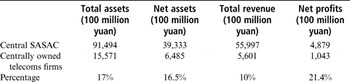
Monitoring business and leadership. The two goals of the SASAC's regulation are very clear: to secure crucial state assets from any loss or transfer to private and overseas ownership; and to monitor and evaluate the firms' top executives and their economic performance. To such ends, the SASAC's Bureau of Financial Supervision and Audit Evaluation oversees the carriers' finance and budget management following the firms' reports.Footnote 75 The boards of directors enact their own budgets, but central telecoms firms should report to the SASAC their total assets, revenue, net profits and their management.Footnote 76 The SASAC is not responsible for but supervises the telecoms firms' financial transactions with the Ministry of Finance because, as Table 2 demonstrates, they account for a significant share of state assets. The SASAC reviews the operator's large-scale investment plan, not only to prevent overlapping and needless investments in telecoms, which may bring about a loss of state assets, but also to ensure the efficient use of assets; it then assesses whether the plan is necessary and conforms to the national development plan and the firm's long-term strategy.Footnote 77
Telecoms Firms' Share of Central State Assets, 2004

Notes:
Central SASAC's assets account for 41% of all state assets (223,084,000 million yuan). For clarification, revenue and net income are “reported” to not possessed by the SASAC. The SASAC has not yet made data from 2005 available.
Source:
Zhongguo guoyou zichan jiandu guanli nianjian 2005 (China's State-owned Assets Supervision and Administration Yearbook 2005), pp. 594; 603–04.
This is part of the State Capital Management Budget (Guoyou ziben jingying yusan 国有资本经营预算) for better state asset management. It aims to improve efficiency in managing state capital, in order to facilitate the best allocation of state assets and enhance the system of state asset management.Footnote 78 For example, in 2006, the SASAC reconfirmed its absolute control (juedui kongzhili 绝对控制力) over the telecoms industry, as well as six other key sectors, all of which closely relate to the national economy and security.Footnote 79 One deputy director of the Research Institute of the SASAC argues that the state capital budget system is designed to prevent excessive investment in third-generation (3G) businesses and to encourage the building-up of long-term development and planning in telecom corporations.Footnote 80 The SASAC also regularly investigates and appraises the economic performance of the carriers. For example, through the first business management evaluation between 2004 and 2006, the SASAC ranked both China Mobile and China Telecoms as “a great achievement company” and gave China Unicom an award for “great technology innovation.”Footnote 81
In addition, the SASAC monitors the everyday life of leading cadres in order to recommend candidates with the right personal and professional credentials to the OD.Footnote 82 The leading cadres include the chairman of the board of directors, the Party secretary of the Party committee of the firms and the president. Such monitoring is also intended to prevent any embezzlement by leading cadres in the central SOEs. One scholar in Beijing points out that “this is why the top executives have been constantly rotated.”Footnote 83 According to Minxin Pei, the telecoms business in China is “a huge source of rent generation because it employs a large number of employees, invests massive capitals, and collects monopoly rents.”Footnote 84
Structuring competition. State agencies in “regulation-for-competition” actively design and structure competition to strengthen small numbers of targeted firms in specific sectors. As Pearson notes, “the idea that regulation is consistent with the promotion of competition is highly relevant in China's strategic industries, since a main goal of regulators is to structure competition.” Such an argument is most helpful in accounting for how the SASAC performs its regulatory authority in the telecoms basic service. One may argue that the SASAC is the main state agency responsible for restructuring the telecoms sector because it is the ownership agency for centrally owned state enterprises. It should be noted, however, that before the SASAC emerged in 2003, the MII planned and conducted the first and second restructurings in 1999 and 2002. Hence restructuring is not the intrinsic right only of an ownership agency. As the case of China's telecoms shows, it can also be performed by the regulator.
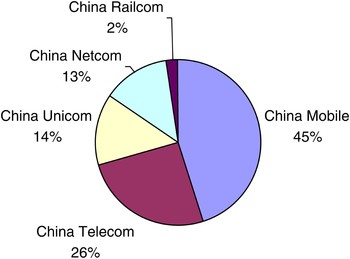
Moreover, there have been some shifts in the purpose of regulation since the latest restructuring. In both the first and second rounds, the main concerns were to break up China Telecom's monopoly and inject competition into the market. In consequence, the MII split China Telecom to create China Mobile, Netcom, Railcom and Satcom between 1999 and 2001.Footnote 85 However, as the 2008 revamp demonstrates,Footnote 86 the goal is now focused on strengthening three oligarchies, Mobile, Telecom and Unicom,Footnote 87 not ending China Mobile's dominant position.Footnote 88 Some claim that genuine competition is only possible by breaking up China Mobile, which tends to monopolize the market as the mobile service is rapidly replacing the fixed-line one (see Figure 2).Footnote 89 Yet the Chinese top leadership has a strong desire to keep the most profitable and competitive China Mobile going, convinced that this not only makes China Mobile internationally competitive but also raises the level of other indigenous operators.Footnote 90 The SASAC has reiterated the importance of and need for the restructuring of the telecoms market. For example, in April 2005, the head of the SASAC, Li Rongrong 李荣融, cited the problem of duplicate investments among the six telecoms firms and argued that this may become unfavourable for preparing the incoming 3G mobile communications services.Footnote 91 At the 2006 ordinance, Li reiterated the importance of restructuring large state-owned enterprises, especially in the telecom, electricity and civil aviation industries.Footnote 92
Revenue Share of China's Basic Telecoms Service, 2006

In addition, it is important to note that although both the MII and SASAC perform regulatory functions, they have different goals, subjects and contents of regulation. The SASAC's regulatory control is focused on “the business of centrally owned telecoms firms,” whereas the MII regulates and enhances the growth of the IT (including huge electronic manufacturing) and telecoms sectors, not confined to the basic service.Footnote 93 This implies that the MII regulates all types of telecoms companies, including small, overseas and private firms in the sector; for the MII, customers' interests, not state assets, come first. More importantly, among the SASAC's total profits of 754.69 billion yuan in 2006, four carriers (China Telecom, Netcom, Mobile and Unicom) contributed 104.73 billion yuan (13.9 per cent).Footnote 94 These operators' massive contribution to the telecoms sector and their strong central state ownership are likely to empower the SASAC in controlling the telecoms market. In other words, although the MII's scope of regulation is broad, its regulatory power is not necessarily stronger than that of the SASAC, which holds direct and considerable clout for the key market players.
Bounded Competition: the Telecoms Price (zifei)Footnote 95 Policy
Control over the price in infrastructure industries such as telecoms or electricity is critical to the Chinese top leadership, because it affects the management of crucial state assets.Footnote 96 The following discussion on the telecoms price war illustrates that the primary concern of state regulation is not protecting the interests of consumers but rather securing state assets. Such an emphasis hence offers ample opportunity for the SASAC to defy the MII's regulation on price.
Price competition started to emerge in early 2001 and reached a climax in June 2004, which in the end resulted in immediate government action to control the telecoms market. In fixed-line services, China Railcom kicked off by setting its service fee at half the rate China Telecom charged. The most intensive competition occurred in mobile services as the number of mobile subscribers grew more quickly than fixed-line users. The situation was escalated by aggressive price cuts by China Mobile and China Unicom, two major mobile operators. In April 2003, Guangzhou Unicom (a subsidiary of China Unicom) and Guangzhou Mobile (a subsidiary of China Mobile) adopted a local one-way tariff package which was contrary to the national two-way charge system.Footnote 97 Guangzhou Mobile consumers could enjoy free calls from the same network subscribers for a 20 yuan monthly fee; Guangzhou Unicom's GSM users paid a 10 yuan monthly fee and received free calls from other Unicom subscribers.Footnote 98
Besides cutting prices, the carriers took advantage of a variety of promotional packages to attract consumers. Telecom operators offered enticing promotions, such as free wireless service, multi-media messaging, and online games and chatting.Footnote 99 When the central SASAC dispatched a supervising panel to Guangzhou in order to investigate the state of the mobile service price wars in early 2004, Guangzhou Unicom's profits had decreased by 60 million yuan. The situation of Guangzhou Mobile was similar: one manager admitted that profit loss from the price wars in 2003 was 2.4 billion yuan.Footnote 100 Guangdong province has a prominent position in the business of telecom operators, accounting for one-sixth of the total profits. Hence, the price competition in Guangdong considerably affected the whole country's telecom fees.Footnote 101
Another catalyst to the mobile service fee cuts was the emergence of “Little Smart” (Xiaolingtong 小灵通) in 2001.Footnote 102 This is operated by China Telecom and China Netcom, whose original licence is for fixed-line services. Founded on fixed-line local network services, Xiaolingtong satisfied the demands of consumers through one-way service charges, affordable minute rates and monthly fees better than China Mobile and Unicom, the official mobile operators, did. The number of subscribers rapidly increased: by 2003, China Telecom had more than 20 million users and China Netcom had 15 million.Footnote 103Xiaolingtong users also accounted for 36 per cent of China Mobile's subscribers.Footnote 104 However, the Xiaolingtong service was unavailable in the major cities of Beijing, Shanghai, Tianjin and Guangzhou, in order to maintain China Mobile's and China Unicom's stock prices.Footnote 105
The 2004 telecom price wars quickly resulted in the MII and NDRC issuing a new administrative circular to implement stricter control over telecom prices.Footnote 106 The circular requires the headquarters of telecom corporations to tighten oversight over local firms. For price cuts, short-term promotions and tariff packages, both fixed-line and mobile local subsidiaries had to obtain permission from their headquarters. It was asserted that price cuts from excessive competition in mobile service markets are “vicious competition” (exing jingzheng 恶性竞争), because they could lead to the loss of crucial state assets. The central SASAC inspection showed that the price war between Guangzhou Mobile and Guangzhou Unicom caused their revenues for January 2004 to be considerably decreased. However, the meaning of “vicious competition” remains ambiguous. One telecoms regulation specialist, Chen Jinqiao 陈金桥,Footnote 107 argues that “fair” and “vicious” types of competition are not clearly defined.Footnote 108 Given that price is a key indicator of the market-based economy, the government needs to clarify when price competition is vicious, and how price competition relates to the loss of crucial state assets.
Responding to the government's claims on the problem of state asset loss, for instance, Zhou Qiren argues that “if something is overpriced, price cuts will not lead to losses of corporate assets. On the contrary, such cuts may increase corporate revenues as they will boost consumption of the service.”Footnote 109 Furthermore, one official in the NDRC calls for more price competition, arguing that its current level in China's mobile service is insufficient to renovate the system of telecom fees.Footnote 110 Some even warn that the state's unnecessary control over telecom pricing can turn into a new type of “administrative monopoly” (xingzheng longduan 行政垄断) in dealing with the natural monopoly industry. Such administrative monopoly reinforces the absolute power and position of regulatory institutions while obstructing the interests of consumers.Footnote 111
To some extent, telecom pricing in China is not based on market demand but is created by co-ordination among state institutions. One MII official acknowledged that the manner of regulatory control over telecom pricing is ill-suited to growing market forces. Moreover, the underlying force of price competition is not to meet market demand but to meet the planning needs of central state firms. For example, local telecom operators cannot cut their prices or supply a variety of promotional packages to attract potential customers, because these firms are annually assigned a target revenue and a number of subscribers to attain.
Conclusion
The evidence demonstrates that the ownership agency SASAC in China's telecoms service business plays the role of a regulator to secure and raise the value of crucial state assets. In other words, government regulation focuses not on correcting market failure by breaking down monopolies, but rather on steering the economy by establishing political control over key state firms and their assets. The regulatory framework for telecoms business appears to be highly ambiguous and involves several other institutions (such as the MII, the NDRC and the Communist Party). Yet the importance of state assets and profits from the telecoms basic service enables the SASAC to exert the primary influence over market actors and their business. Since the Party, the ultimate decision-maker in China's political and economic life, lacks professional knowledge of the sector, it relies on the ideas and information of government agencies. As a regulator, the SASAC not only closely oversees the operators' financial and managerial performance and their compliance with rules, but also actively structures a level playing field for competition. In other words, the norm of competition is encouraged by the MII, but the actual competition is co-ordinated and regulated by the SASAC. The 2008 government reform and telecoms restructuring verify these findings.
Arguments from the view of the independent regulator model tend to take for granted that China's telecoms regulator is the MII (now MIIT) despite its limitations and problems. Yet this study raises a question about such an undoubted premise about the agency of government regulation in China's telecoms service sector. The MII holds the right to control the price and emphasizes market-oriented competition, but such conventional regulatory power is significantly contested by the SASAC in the name of protecting state assets. If the MII lacks overarching authority, the issue of substantial regulation surfaces. Such a relaxed notion of regulation that embraces “all the efforts of state agencies to steer the economy”Footnote 112 offers possibilities beyond a specialized state-designated regulator.
My findings suggest that despite enthusiastic engagement with the benchmark model, there is a significant discrepancy between institutional design and institutional practice. At least in the telecoms basic service industry, such inconsistency arises from the fact that the Chinese leadership's main concern is not how to make market principles take root in the domestic economy, but how best to deal with crucial state assets by expanding and strengthening firms (you da you qiang) on the global stage. On many occasions, Chinese scholars or officials in Beijing openly admitted to such a widespread discrepancy in public policy implementation. Nevertheless, China's institutional reforms towards a market-oriented system of economic governance are likely to continue into the foreseeable future, but institutional gaps and ambiguities may impede greater transparency and accountability in building up the system of economic regulation.