Major depression is a common disorder in elderly people with the 1-month prevalence ranging from 2.0 percent in the community to 8.7 percent in primary care (2;5). Major depression in the elderly is associated with physical disability, impaired well-being, and high health service use and healthcare costs (4;11;22;29;37). Thus, it is important to have effective treatments for elderly depressed patients.
Antidepressant treatment is usually initiated as the first line of treatment, but may induce substantial side effects. Moreover, many patients prefer psychotherapy over antidepressant medication (40). Psychotherapy is mainly provided in specialized mental health clinics, but many older depressed patients are reluctant to accept treatment in such clinics (3). Therefore, psychotherapy should be made more easily available in primary care.
Interpersonal Psychotherapy (IPT) is recommended by several depression treatment guidelines (1;30). The format of IPT is suitable for elderly patients (23), and there is evidence that IPT is effective in the treatment of depressed elderly patients (15;41). Considering the increased healthcare costs associated with major depression in elderly people (11;22;37), it is important to have information on the cost-effectiveness of IPT in this group of patients. Lave et al. (21) found that IPT was associated with significantly greater effects and significantly higher costs in comparison with usual care in relatively young adults. We are not aware of any trials evaluating the cost-effectiveness of IPT in elderly primary care patients with major depression.
The objective of this article was to evaluate the cost-effectiveness of IPT delivered by mental health workers in primary care practices, for elderly patients with major depression identified by screening, in comparison with usual general practitioner (GP) care. The economic evaluation was conducted alongside a randomized controlled trial. Overall, the treatment effects of IPT at 6 months were modest in this trial and more pronounced in the subgroup of patients with more severe depression at baseline (41).
Methods
The randomized controlled trial was performed in twelve general practices in Amsterdam and surroundings, The Netherlands. The Medical Ethical Committee of the VU University Medical Center approved the study protocol. The methodological details of the trial are reported elsewhere (41).
Patient Selection
Patients were recruited from February 2002 to July 2003 using a two-stage screening procedure. Patients of 55 years and older who had recently visited their GP, were invited by mail to complete the fifteen-item version of the Geriatric Depression Scale (GDS-15) (34). Patients with a GDS-15 score of 5 or more were invited by a research assistant for further diagnostic examination. After consent, the research assistant administered the mood module of the PRIMary care Evaluation of Mental Disorders (PRIME-MD) (35). Patients who were diagnosed with major depression according to the PRIME-MD were eligible for the study. Exclusion criteria were treatment for depression at the time of screening, insufficient understanding of the Dutch language, and impaired cognitive functioning (Mini-Mental State Examination score <18). Randomization was performed by an independent research assistant at patient level using blocking by practice (blocks of four) and a table of random numbers.
Care as Usual Group
GPs were not notified about patient participation in the care as usual (CAU) group of the study. Patients who wanted treatment for their depression were advised to discuss this with their GP. Dutch GPs are encouraged to work according to the guidelines issued by the Dutch College of GPs (39). However, they are free to deviate from these guidelines and to organize care according to their own views.
Psychotherapy Group
IPT is a manual-based, time-limited therapy, with a focus on current interpersonal relationships (42). Six psychologists and nine psychiatric nurses provided IPT. All therapists were trained in a 2-day course, followed by group supervision sessions once every 2 weeks during a year, after which the frequency was reduced to once a month.
Patients were offered ten sessions of IPT over a period of 5 months. GPs of patients in the IPT group were asked to refrain from prescription of antidepressants and referral to other mental healthcare providers.
Clinical Outcome Measures
Trained, independent interviewers measured outcomes during interviews at 2, 6, and 12 months after baseline. Remission of depression was defined as a Montgomery Asberg Depression Rating Scale (MADRS) score of less than 10 (16;25). Response to treatment was defined as a decrease of more than 50 percent in MADRS score at 12 months compared with baseline. The MADRS was also used to assess changes in severity of depression. Recovery from depression was defined as absence of a PRIME-MD diagnosis of major depression at 12 months. Quality-adjusted life-years (QALYs) gained at 12 months follow-up were calculated by multiplying the time a patient spent in a particular health state with the utility based on EuroQol scores using Dutch and British tariffs (13;14;20). Transitions between health states were linearly interpolated.
Cost Measures
Cost data were collected from a societal perspective over 12 months using cost diaries. All direct and indirect costs were considered, because it is very hard to discern which costs are depression-related and which are not. If available, Dutch guideline prices were used to value resource use (28). Supplemental Table 1, listing the cost categories included in the economic evaluation and the prices used, is available at http://www.journals.cambridge.org/jid_thc. Medication costs were valued using prices of the Royal Dutch Society for Pharmacy (43). Costs of complementary medicine visits were based on prices from therapists. All costs were adjusted to the year 2003 using consumer price indices (36). We calculated the costs of absenteeism from paid work according to the friction cost approach (friction period 123 days) using the mean age- and sex-specific income of the Dutch population (19). A cost price for IPT was calculated using a bottom-up approach (Supplemental Table 2, available at http://www.journals.cambridge.org/jid_thc).
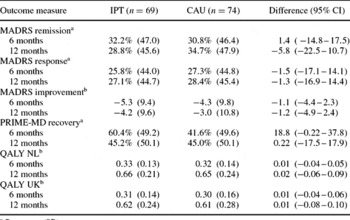
Clinical Outcomes after 6 and 12 Months

a Percentage (SD).
b Mean (SD).
IPT, interpersonal therapy; CAU, care as usual; CI, confidence interval; MADRS, Montgomery Asberg Depression Rating Scale; PRIME-MD, PRIMary care Evaluation of Mental Disorders; QALY NL = quality-adjusted life-year based on Dutch tariff; QALY UK = quality-adjusted life-year based on British tariff.
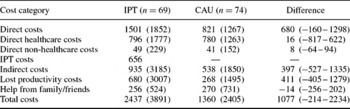
Mean (SD) Total Costs (€) and Differences in Mean Total Costs (95% CI) during Follow-up of 6 Months

CI, confidence interval; IPT, interpersonal therapy; CAU, care as usual.
Analysis
It was estimated that sixty patients per group were needed (α=.05 and β=.80) to detect a difference in remission of 25 percent. Taking 10 percent dropout into account, a total of 140 patients should be included. All analyses were performed according to the intention-to-treat principle. To get an impression of the depression-related costs, patients were asked to indicate whether resource use or absenteeism was related to their depression. In a secondary analysis, only depression-related costs at 12 months were included.
Multiple imputation (MI) was used to impute missing cost and effect data using the Multivariate Imputation by Chained Equations (MICE) procedure (38). To account for the non-normal cost distributions, cost data were imputed after log transformation and back transformed to their original scale after imputation. By MI, ten imputed data sets were created, each of which were analyzed separately. The results of the ten analyses were combined using Rubin's rules to produce pooled estimates of mean costs and effects, mean costs and effect differences, standard deviations, and confidence intervals (CIs) (32).
Confidence intervals for the mean differences in costs and uncertainty around the cost-effectiveness and cost–utility ratios were calculated using the percentile bootstrap method based on 2000 replications (10). The bootstrapped cost-effect pairs in the pooled data set were plotted on a cost-effectiveness plane.
Results
Between February 2002 and July 2003, 4,301 of 6,719 patients completed the GDS-15, of whom 834 screened positive. The PRIME-MD was completed by 667 patients of whom 293 patients had major depression. Of these, 88 were ineligible, mainly because of ongoing depression treatment. Of the 205 eligible patients, 143 agreed to participate in the trial. Sixty-nine patients were allocated to the IPT group and seventy-four patients to the CAU group. In total, 59 percent of the cost diaries was returned. Patients who returned no cost diaries were less depressed according to the MADRS than patients who returned one or more cost diaries. At baseline, there were no significant differences in patient characteristics between IPT patients and CAU patients (Supplemental Table 3, available at http://www.journals.cambridge.org/jid_thc).
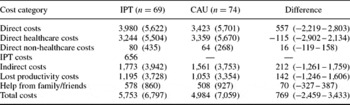
Mean (SD) Total Costs (€) and Differences in Mean Total Costs (95% CI) during Follow-up of 12 Months

CI, confidence interval; IPT, interpersonal therapy; CAU, care as usual.
Clinical Effectiveness
At 6 and 12 months, differences in remission and response rates based on the MADRS score were small and not statistically significant. Although patients in the IPT group improved somewhat more in MADRS score than patients in the CAU group both at 6 and 12 months, these differences were not statistically significant (Table 1).
At 6 months, 42 (60 percent) of the IPT patients and 31 (42 percent) of the CAU patients had recovered according to the PRIME-MD. The difference in recovery rate just failed to reach statistical significance (95 percent CI, −0.22 – 37.8). At 12 months of follow-up, the recovery rate in the IPT group was 45 percent (31 recovered patients) and also 45 percent in the CAU group (33 recovered patients). The difference in recovery rate at 12 months was not statistically significant (Table 4).
Costs Applied in the Economic Evaluation

Note. €1=$1.19.
a Price according to patient self.
b Price based on sex and age of patient.
ICU, intensive care unit.
The estimates of mean QALYs gained based on the Dutch tariff were somewhat higher than the estimates based on the British tariff. The difference in QALYs gained between the IPT and the CAU group was small and not statistically significant, and similar for both tariffs at both time points (Table 1).
Costs
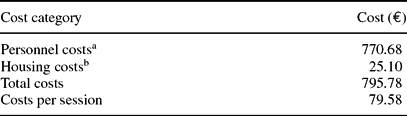
IPT patients received on average eight IPT sessions, which amounted to a mean cost of €656. Direct healthcare costs were the greatest contributor to total costs, followed by lost productivity costs due to work absenteeism at both 6 and 12 months. The great impact of lost productivity costs is remarkable, because more than half of the study patients were older than the pensionable age of 65 years in The Netherlands. At 6 and 12 months, mean total costs were, respectively, €1,077 and €769 higher in the IPT group, but these differences were not statistically significant. The costs of providing IPT formed a considerable part of the direct costs in the IPT group both at 6 months (44 percent) and at 12 months (16 percent) (Tables 5 and 6).
Cost Price of IPT per Treatment Cycle of Ten Sessions
a Time spent by IPT therapists on training, treatment, and administrative activities.
b Costs of the surgery and overhead costs (e.g., cleaning and telephone costs).
IPT, interpersonal therapy.
Baseline Characteristics of Patients Allocated to the IPT or CAU Group

Note. Values are numbers (percentages) unless stated otherwise.
IPT, interpersonal therapy; CAU, care as usual; MADRS, Montgomery Asberg Depression Rating Scale; GDS-15, 15 item Geriatric Depression Scale; CGI, Clinical Global Impression; UK, United Kingdom; NL, The Netherlands; MMSE, Mini-Mental State Examination.
Cost-Effectiveness and Cost–Utility Analyses
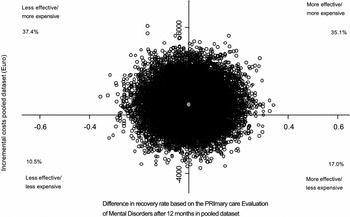
The cost-effectiveness plane for remission based on MADRS score after 6 months showed that IPT was not cost-effective in comparison with CAU. After 12 months, the IPT group experienced 6 percent less remissions based on MADRS score than the CAU group, whereas total costs were on average €769 higher, resulting in a negative incremental cost-effectiveness ratio (ICER) of −131. The nonsignificant differences in costs and effects were confirmed by the cost-effectiveness plane, in which most cost-effect pairs were located near the origin and distributed over all four quadrants (NE, 16 percent; SE, 7 percent; SW, 21 percent; NW, 56 percent).
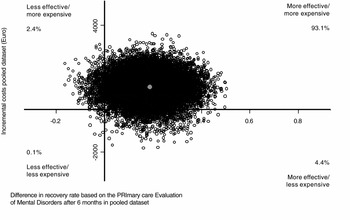
At 6 months, the IPT group experienced 19 percent more recoveries based on the PRIME-MD than the CAU group, while the mean total costs in the IPT group were €1,077 higher than in the CAU group. Thus, the ICER was €57 per 1 percent improvement in the number of recovered patients based on the PRIME-MD, which translates to €6,195 per extra recovered patient. Figure 1 presents the cost-effectiveness plane for recovery based on the PRIME-MD at 6 months, in which 93 percent of the cost-effect pairs was located in the northeast quadrant. At 12 months, the difference in recovery rate had decreased to 0.2 percent, while the mean total costs in the IPT group were €769 higher, resulting in an ICER of 353,585. Most cost-effect pairs were located near the origin of the cost-effectiveness plane and distributed over all four quadrants, indicating that IPT was not cost-effective compared with CAU (Figure 2).
Cost-effectiveness plane for the difference in recovery rates based on the PRImary care Evaluation of Mental Disorders after 6 months.

For all other outcomes at 6 and 12 months (response based on the MADRS, improvement in MADRS score, and QALYs based on the British and Dutch EuroQol tariff), IPT was not cost-effective in comparison with CAU.
Depression-Related Costs and Cost-Effectiveness Analyses
The total mean (SD) depression-related costs at 12 months as indicated by the patients themselves were €1,241 (2,870) and €424 (1,309), respectively, in the IPT and the CAU groups. The difference in total costs was €816, which was not statistically significant (95 percent CI, −151 – 1679). In none of the cost-effectiveness and cost–utility analyses incorporating only depression-related costs IPT was cost-effective in comparison with CAU.
Discussion
In this study, the provision of IPT in primary care was not cost-effective in comparison with CAU for elderly primary care patients with major depression. At 6 months, there was a large difference in recovery rate (PRIME-MD) between IPT and CAU, but not in any of the other outcome measures. At 12 months, there were no significant differences in clinical outcomes between IPT and CAU. Mean total costs in the IPT group were higher than in the CAU group at both 6 and 12 months, but these cost differences were not statistically significant. Although the difference in depression-related costs between the two treatment groups was not statistically significant, the relatively low depression-related costs in the CAU group may indicate low rates of depression treatment in this group.
Cost-effectiveness plane for the difference in recovery rates based on the PRImary care Evaluation of Mental Disorders after 12 months.

Lave et al. (21) found in their study that IPT was significantly more effective and expensive than usual care, whereas we found no significant differences in either costs or effects. In the study by Lave et al., patients were offered a maximum of 20 IPT sessions by experienced therapists, whereas in our study, patients were offered a maximum of ten IPT sessions by less-experienced therapists. However, provision of IPT by well-trained nurses improves the feasibility of incorporating psychotherapy in primary care. Finally, patients who were included in the study by Lave et al. were more severely depressed than the patients in our study. Katon et al. (17) evaluated the cost-effectiveness of a collaborative care program incorporating problem-solving treatment (a brief psychotherapy) for late-life depression in primary care. They showed that the collaborative care program was more effective than usual care without significant cost increases. Thus the (cost-)effectiveness of psychotherapy for elderly patients in primary care may be improved by incorporation in a collaborative care program.
It is suggested that screening mostly leads to detection of mildly depressed patients as opposed to patients who are recognized as being depressed by their GP (12). This finding was confirmed in our study. Despite that all patients were diagnosed as having major depression according to the PRIME-MD, most patients in our study were only mildly to moderately depressed according to their MADRS scores at baseline (18;24). It is likely that otherwise effective treatments, such as antidepressants and psychotherapy, are not as effective in mild depressions as in more severe depressions because the room for improvement is limited. A study validating the MADRS as research instrument in older depressed primary care patients, concluded that a MADRS score of ≥21 identifies depressed patients who need treatment (26). Using this criterion, more than half of the patients included in this study would have been too mildly depressed to benefit from depression treatment.
The effects of IPT in comparison with CAU were somewhat larger at 6 months than at 12 months. It seems plausible that IPT has more robust effects than CAU in the short-term, but that this effect is diluted at 1-year follow-up, because depression in elderly people often has a chronic and recurrent course (6). Future trials should, therefore, investigate the optimal duration of IPT, and the effects of maintenance treatments to sustain treatment effects gained in the acute treatment phase. The effect of maintenance treatment was already demonstrated in elderly secondary care patients with a history of recurrent depression (31).
A considerable amount of cost diaries was missing in this study. Recent studies have shown that simple procedures to handle missing data, like complete case analysis, can bias the cost estimates considerably and recommend MI to account for missing cost and effect data (8;27), because MI incorporates the uncertainty caused by estimating the missing data (33). Therefore, in this study we used MI to impute missing cost data (27). We imputed different cost-categories at the four different time points to use all available cost diaries.
Patients who returned no cost diaries were less depressed than patients who returned more than one cost diary. In milder depressions, there is less room for improvement, which leads to smaller effects, but it is hard to indicate how this may influence the effect difference. We expect that milder depressed patients have lower mean healthcare costs. Because the IPT costs are high and, thus, weigh relatively heavier when the overall costs are lower, we expect that the cost difference stays equal or becomes larger.
Our study was underpowered to detect relevant differences in costs, which is reflected in wide confidence intervals for cost differences. This is a common problem in “piggy back” economic evaluations. Because the distribution of cost data typically is heavily skewed, very large numbers of study patients are needed to detect relevant cost differences. It is generally considered unethical to increase study sizes beyond the level needed to prove clinical effectiveness (7). Despite the low power of many economic evaluations, the focus should be on estimation of cost-effectiveness even when either cost or effect differences are not statistically significant. The low power of the study will then be reflected in the wide confidence intervals (7;9).
In conclusion, based on these results, provision of IPT to elderly primary care patients with major depression who were identified by screening, was not cost-effective in comparison with CAU both at 6 and 12 months.
POLICY IMPLICATIONS
We recommend that future research focuses on patient groups that may especially benefit from IPT in primary care, for example patient selection based on the duration and severity of depressive symptoms. Evidence is also needed on treatments that have more robust effects, both in the acute and in the maintenance phase of treatment. The cost-effectiveness of psychotherapy in primary care may also be improved by incorporating psychotherapy in collaborative care models.
CONTACT INFORMATION
Judith E. Bosmans, PhD (judith.bosmans@falw.vu.nl), Junior Researcher, Health Technology Assessment Unit, Institute for Research in Extramural Medicine, VU University Medical Center, Van der Boechorststraat 7, 1081 BT Amsterdam, The Netherlands
Digna J. F. van Schaik, MD, PhD (a.van.schaik@ggzba.nl), Senior researcher, Department of Psychiatry, Institute for Research in Extramural Medicine, VU University Medical Center, Van der Boechorststraat 7; Psychiatrist, Mood Disorders Program, GGZ Buitenamstel, AJ Ernststraat 887, 1081 HL Amsterdam, The Netherlands
Martijn W. Heymans, PT, PhD (mw.heymans@vumc.nl), Postdoctoral Researcher, Harm W. J. van Marwijk, MD, PhD (hwj.vanmarwijk@vumc.nl), Assistant Professor, Hein P. J. van Hout, PhD (hpj.vanhout@vumc.nl), Assistant Professor, Department of General Practice, Martine C. de Bruijne, MD, PhD (mc.debruyne@vumc.nl), Senior Researcher, Department of Public and Occupational Health, Institute for Research in Extramural Medicine, VU University Medical Center, Van der Boechorststraat 7, 1081 BT, Amsterdam, The Netherlands