Introduction
Soybean being packed with protein and several nutraceutical components such as isoflavones, tocopherols, soyasaponins and lecithin is gaining recognition as a ‘health-food’ that can combat both malnutrition and stave off the onset of cardiovascular diseases, diabetes and breast and uterus cancers (Alamu et al., Reference Alamu, Popoola and Maziya-Dixon2018; Pabich and Materska, Reference Pabich and Materska2019; Hertzler et al., Reference Hertzler, Lieblein-Boff, Weiler and Allgeier2020; Omar et al., Reference Omar, Kalra, Putri, Elwakeel, Kaul and Wadhwa2020; Orman et al., Reference Orman, Johnson, Comander and Brockton2020; Rizzo, Reference Rizzo2020). Barring South Eastern countries where soy-products are the staple diet, in the rest of the world human consumption of soybean through processed products is meagre. The two most formidable constraints that deter the utilization of soybean in food uses in several countries are antinutritional factors, namely, trypsin inhibitor and off-flavour generating lipoxygenase present in soybean seeds. About 80% of trypsin inhibitor activity in soybean is attributed to Kunitz trypsin inhibitor (KTI) (21 kDa) which affects protein digestibility and is known for causing growth inhibition, pancreatic hypertrophy and hyperplasia in animals. Furthermore, the international trading of soybean meal, which accounts for 60% of animal feed, is regulated by the stringent norms for level of urease index, the indicator of the concentration of trypsin inhibitor in the commodity. Off-flavour associated with soy products is attributed to soybean seed lipoxygenase, which acts upon the polyunsaturated fatty acids. Lipoxygenase in soybean seed exists in three isozymic forms, viz. lipoxygenase-1, lipoxygenase-2 and lipoxygenase-3 which are controlled by single dominant genes Lox1, Lox2 and Lox3, respectively. Lox1 and Lox2 are present on chromosome 13 (LGp F) while Lox3 is located on chromosome 15 (LGp E of the soybean linkage map). These isoforms differ in their molecular weight and pH optima for their activities. Of the three isozymic forms, lipoxygenase-2 is the major contributor to off-flavour in soy products, although its concentration in seed is less compared to the other two isozymes (Davies et al., Reference Davies, Nielsen and Nielsen1987; Wilson, Reference Wilson and Piazza1996; Fukushige et al., Reference Fukushige, Wang, Simpson, Gardner and Hildebrand2005).
Both KTI and lipoxygenase-2 are heat labile, however their thermal inactivation incurs an extra cost and affects the solubility and functionality of proteins. Thus, genetic elimination of both these undesirable parameters from soybean is essential to enhance the utilization of soybean in food uses. KTI gene is controlled by five codominant alleles namely, Ti a, Tib, Tic, Tid, and fifth is null allele ti. This gene of a null allele of KTI is located on chromosome 8 (LGp A2 of the soybean linkage map). KTI null allele specific and KTI linked simple sequence repeat (SSR) marker (Satt228, 154.11 cM, LGp A2) have already been reported (Moraes et al., Reference Moraes, Soares, Colombo, Salla, de Almeida Barros, Piovesan, de Barros and Moreira2006; Rani et al., Reference Rani, Kumar, Mourya, Singh and Husain2011). SSR marker Satt656 (135.12 cM, LGp F) has been identified to be tightly linked to the Lox2 allele in the mapping population generated by crossing Indian soybean varieties with PI596540/PI086023 (Kumar et al., Reference Kumar, Rani and Rawal2014). Null allele specific markers for Lox2 were also already reported by Reinprecht et al. (Reference Reinprecht, Luk-Labey, Yu, Poysa, Rajcan, Ablett and Peter Pauls2011) and Shin et al. (Reference Shin, Van, Kim, Lee, Jun and Lee2012). Deploying null allele-specific marker for KTI several KTI-free soybean genotypes have been developed in India (Rani and Kumar, Reference Rani and Kumar2015). Similarly, using null allele specific marker for Lox2 and tightly linked SSR marker for Lox2, several lipoxygenase-2 free soybean genotypes have been developed in India (Kumar et al., Reference Kumar, Rani and Rawal2013a, Reference Kumar, Rani, Rawal and Husain2013b; Rani et al., Reference Rani, Kumar, Shukla, Jha and Rawal2016; Rawal et al., Reference Rawal, Kumar, Rani and Gokhale2020). However, we felt that it was important to pyramid null form of KTI and Lox2 in the same genetic background to develop the ideal food-grade soybean genotype for the soy processing industry. The present investigation was carried out to stack null alleles of Lox2 and KTI gene into the genetic background of two high-yielding soybean varieties of Central India through marker assisted backcross breeding.
Materials and methods
Recipient genotype
Two KTI free soybean genotypes (BC3F4) derived from two Indian soybean varieties, namely, ‘JS97-52’ and ‘NRC7’ through marker assisted backcrossing were selected for the introgression of null allele of the Lox2 gene. These genotypes were developed at ICAR-Indian Institute of Soybean Research, Indore, Madhya Pradesh, India. JS97-52 derived KTI free genotype (JKTIF) was developed from JS97-52 (recipient) × PI542044 (donor for a null allele of KTI) (Kumar et al., Reference Kumar, Rani, Rawal and Mourya2015). ‘JS97-52’ is a high yielding cultivar in Central India developed from PK327 × L129. It is tolerant to waterlogging conditions and several diseases, such as yellow mosaic virus disease, rhizoctonia, bacterial pustule, charcoal rot, target leaf spot and Cercospora leaf spot. ‘PI542044’ was procured from the United States Department of Agriculture (USDA). Another recipient parent, NRC7 derived KTI free genotype (N7KTIF) was developed from NRC7 × NRC101. ‘NRC7’ is bold seeded, drought-tolerant variety and shows resistance to bacterial pustules, pod-shattering and Myrothecium leaf spot selected from S69-96. ‘NRC101’ is the first ever KTI free advanced breeding line developed from the cross Samrat × PI542044 in India (Rani and Kumar, Reference Rani and Kumar2015).
Donor genotype
Soybean genotype ‘NRC109’ developed at ICAR-Indian Institute of Soybean Research, Indore was used as donor parent for introgression of null allele (lox2lox2) of Lox2 gene in both N7KTIF and JKTIF soybean lines. NRC109 was developed from the Samrat × PI086023 through marker assisted forward breeding (Rani and Kumar, Reference Rani and Kumar2016). ‘Samrat’ is the farmers' variety being cultivated in Central India while ‘PI086023’ is a donor for null allele of Lox2 and is a germplasm line procured from the USDA.
Molecular markers, DNA isolation and PCR amplification
To identify the plants carrying null alleles of KTI and Lox2 gene, gene-specific marker for null allele of KTI (Moraes et al., Reference Moraes, Soares, Colombo, Salla, de Almeida Barros, Piovesan, de Barros and Moreira2006; Kumar et al., Reference Kumar, Rani and Rawal2013a, Reference Kumar, Rani, Rawal and Husain2013b) and null allele of Lox2 gene (Shin et al., Reference Shin, Van, Kim, Lee, Jun and Lee2012) were deployed. SSR markers, Satt228 tightly linked to Ti locus (Rani et al., Reference Rani, Kumar, Mourya, Singh and Husain2011) and Satt656 tightly linked to Lox2 locus (Kumar et al., Reference Kumar, Rani and Rawal2014) were used for the identification of homozygous recessive (titilox2lox2) plants (Table 1).
Oligonucleotide sequences of molecular markers used for foreground and background selection

Genomic DNA was extracted from young leaves following the cetyl trimethyl ammonium bromide method (Doyle and Doyle, Reference Doyle and Doyle1990). DNA was purified and quantified using a spectrophotometer. The final concentration was adjusted to ~25 ng/μl.
Polymerase chain reaction (PCR) was carried out using a thermocycler (LifePro Bioer). The reaction mixture (10 μl) for genomic DNA amplification contained 2 μl DNA (~25 ng/μl), 1 μl PCR 10× buffer, 1.1 μl MgCl2 (25 mm), 0.1 μl dNTPs (25 mM), 0.5 μl each forward and reverse SSR primers (30 ng/μl), 0.068 μl Taq DNA polymerase (5 units/μl) and 4.732 μl molecular-grade water. For PCR amplification of null allele specific marker for KTI, SSR marker Satt228 linked to Ti locus and Satt656 linked to Lox2 locus, DNA was denatured initially at 95°C for 4 min followed by 35 cycles each consisting of denaturation at 94°C for 1 min, primer annealing at 55°C for 1 min and primer elongation at 72°C for 1 min. Final elongation was carried out at 72°C for 10 min. For the amplification of Lox2 null allele specific marker touchdown PCR program as reported by Shin et al., (Reference Shin, Van, Kim, Lee, Jun and Lee2012) was employed with slight modification. Amplified products from gene specific markers were resolved on 2% agarose gel, while PCR products amplified through the SSR marker were resolved on 3% metaphor agarose gel. The images were analysed in the Gel documentation unit (Syngene).
Backcrossing
Staggered sowing of recipient genotypes i.e. N7KTIF and JKTIF, and donor genotype (NRC109) was done due to the difference in days-to-flowering of the recipient and donor parent genotypes to synchronize the flowering stage. Crosses were effected between the parents by transferring the pollens from NRC109 to the stigma of recipient genotypes to generate F1 seeds. True F1 plants were confirmed using Lox2 null allele specific marker. These plants were advanced to F2 generation for identification of homozygous recessive plants (titilox2lox2) using null allele specific marker for KTI and Lox2, and linked SSR markers Satt228 and Satt656 for KTI and Lox2, respectively, in both the parental combinations.
Homozygous recessive F2 plants (titilox2lox2) were backcrossed to respective recipient genotypes to obtain first backcross generation. Selected BC1F1 individuals were subjected to background selection. In the next generation, BC1F2 homozygous recessive (titilox2lox2) plants carrying maximum recurrent parent genome content (RPGC) were used as male plants for effecting BC2F1 generation. BC2F1 individuals having null allele for the Lox2 gene and with the highest percentage of RPGC were selfed. Homozygous recessive BC2F2 plants with maximum percentage of RPGC were selected as introgressed lines.
Assessment of RPGC
RPGC for an individual plant was surveyed through a set of polymorphic SSR markers (loci) using GGT2.0 software (Berloo, Reference Berloo2008). A separate locus file has been prepared for parental combination 1 and 2, by allotting a score of ‘2’ to homozygous locus for recurrent parent, score of ‘1’ to heterozygous locus and score of ‘0’ to homozygous locus for donor parent.
Agronomic parameters
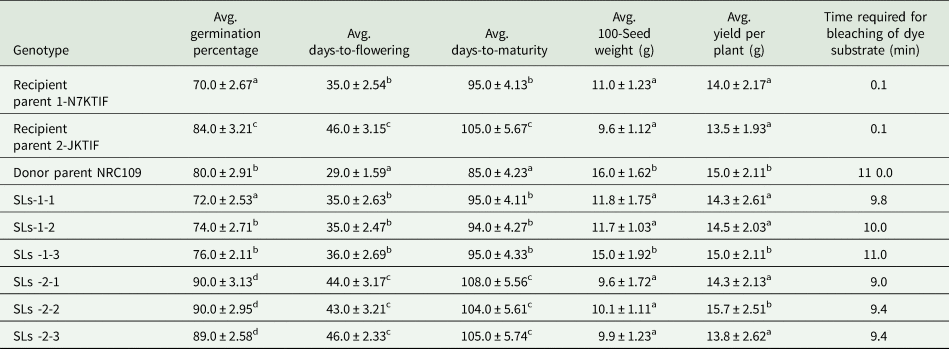
Seeds of three stacked lines (SLs) with maximum RPGC percentage from each of the parental combination 1 and 2 were sown in a plot of 3 m length with row-to-row distance of 45 cm and plant-to-plant distance of 5 cm in randomized block design in triplicates in the cropping field of ICAR-Indian Institute of Soybean Research, Indore, Madhya Pradesh, India. Days-to-flowering and harvest maturity were recorded. Hundred seed weight was determined by weighing 100 seeds of individual plants of each stacked line from each replicate. Similarly, yield per plant of SLs from each of the three replicates was recorded. For germination percentage, 100 seeds from each of the replicates were sown in the field and the total number of seedings emerge after 48 h in each replicate were calculated as follows: Total number of seedlings emerge divided by total number of seeds sown multiplied by 100. Average 100-seed weight, average yield per plant and germination percentage of each genotype are given in Table 2.
Comparison of agronomic parameters and dye bleaching test of BC2F2 lines generated from N7KTIF × NRC109 and JKTIF × NRC109

The data are expressed as mean ± standard deviation. Mean followed by the same superscript within the same column are not significantly different at P ≥ 0.05 probability. SLs-1 and SLs-2 are BC2F2 lines generated from N7KTIF × NRC109 and JKTIF × NRC109, respectively.
Phenotyping
Qualitative estimation of Lox2 isozyme and KTI
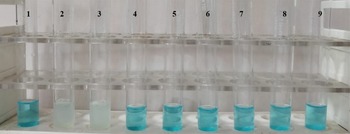
Soybean flour of recurrent parent 1 (NRC7), recurrent parent 2 (JS97-52), donor parent NRC109 and BC2F2 SLs derived from parental combination 1 and 2 were subjected to dye bleaching assay as reported by Suda et al., (Reference Suda, Hajika, Nishiba, Furuta and Igita1995). Five seeds from each plant were analysed to confirm the phenotype. For this purpose, 5 mg soybean flour from each seed was weighed into a test tube and mixed with 0.5 ml of distilled water. The mixture was stirred lightly and allowed to stand for 3 min. Dye-substrate solution was prepared for 20 samples by mixing 154.25 mg of dithiothreitol, 25 ml of 200 mM sodium phosphate buffer (pH 6.0), 5 ml of 100 μM methylene blue dye, 5 ml of 10 mM sodium linoleate substrate and 5 ml of acetone in a 100 ml glass-stoppered bottle. After 3 min, 2 ml of the dye-substrate solution was added in the test tube containing the sample, and the time required for the change in blue colour of the solution for each sample was recorded.
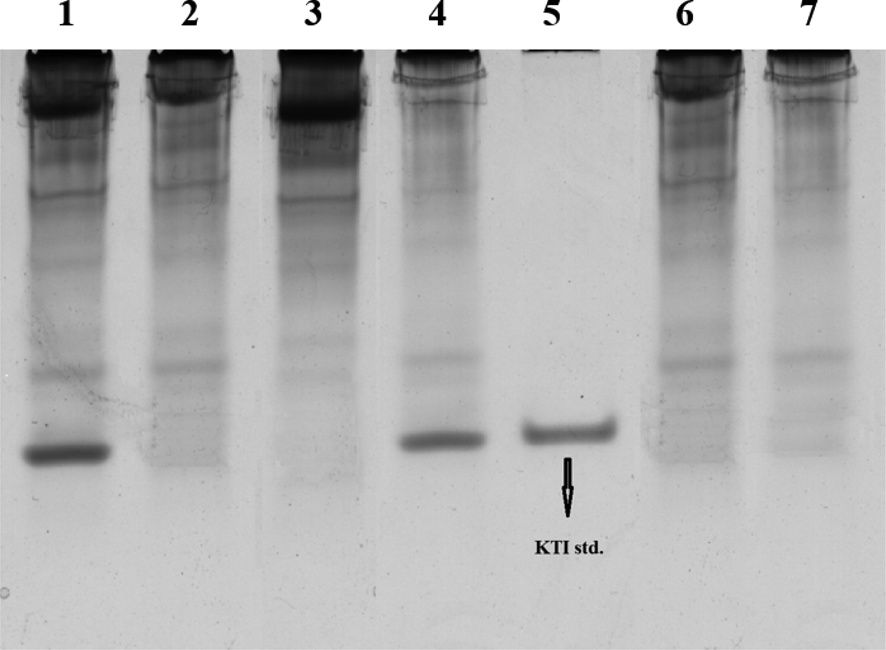
For confirmation of the absence of KTI polypeptide, seeds of BC2F2 SLs developed form parental combination 1, parental combination 2, recurrent parents and donor genotype were phenotyped using polyacrylamide gel electrophoresis (PAGE). Finely ground flour (50 mg) of each genotype was incubated in 1 ml Tris-HCl buffer (pH 8.0) for 30 min in a shaker incubator at room temperature and centrifuged at 12 000 rpm for 10 min. The supernatant was collected and mixed with bromophenol blue dye in a 7 : 3 ratio. A fixed volume of 10 μl of each sample was loaded in a separate lane of 10% polyacrylamide gel in a vertical electrophoresis unit at 70 mA current for 30 min. Standard KTI protein was run in a separate lane. Subsequently, gel was stained with aqueous solution of 0.25% coomassie brilliant blue followed by de-staining using methanol: water: acetic acid (45 : 45 : 10).
Results
Parents N7KTIF, JS97-52 derived KTI-free genotype (JKTIF) and NRC109 (Lox2 free) were surveyed across 20 chromosomes using 600 SSR markers by selecting at least one SSR marker within 5 cM distance. Two hundred thirty-nine polymorphic SSR markers were observed for the parental combination 1 (N7KTIF × NRC109) revealing 39.83% polymorphism. Parental combination 2 (JKTIF × NRC109) exhibited 40.16% polymorphism as 241 of the 600 SSR markers surveyed were found to be polymorphic. Crosses were effected between both the parental combinations for the introgression of null allele of Lox2 in KTI-free genotypes.
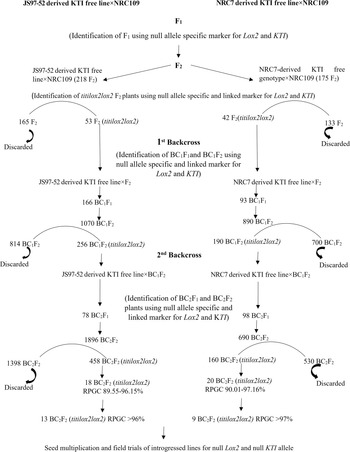
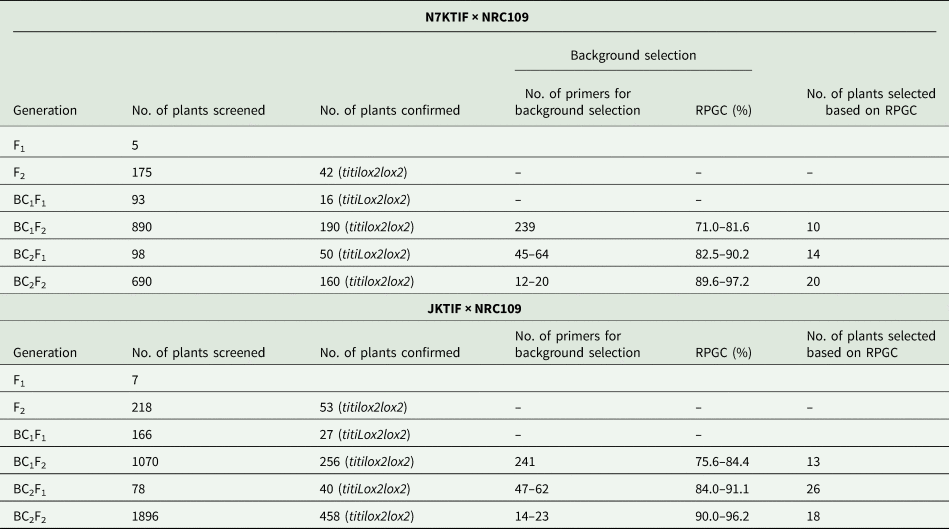
Foreground and background selection at two backcross generations were carried out as depicted in Table 3 and Fig. 1. Screening of F1 plants using a null allele specific marker for Lox2 led to the identification of five and seven true F1 plants (TitiLox2lox2), which were selfed to obtain F2 generation of 175 and 218 plants for parental combination 1 (N7KTIF × NRC109) and parental combination 2 (JKTIF × NRC109), respectively. These plants were screened through null allele specific markers for Lox2 and KTI locus. Plants carrying null alleles for both traits were further genotyped using linked SSR marker Satt228 (Chr 8, LGp A2, 154.11 cM) and Satt656 (Chr13, LGp F, 135.12 cM) for Ti and Lox2 gene, respectively. This resulted in the identification of 42 and 53 F2 homozygous plants recessive for both the traits (titilox2lox2) for parental combination 1 and parental combination 2, respectively.
Schematic representation of marker assisted backcross selection for stacking of null lipoxygenase-2 and KTI gene in JS97-52 and NRC7.

Foreground and background selection
First backcross generation
Homozygous recessive F2 plants (titilox2lox2) were used as male parents to pollinate recurrent parent from parental combination 1 and parental combination 2 to obtain BC1F1 generation. Ninety-three and 166 BC1F1 individuals obtained from parental combination 1 and parental combination 2 were subjected to foreground selection using Lox2 null allele specific marker, resulted in the identification of 16 and 27 true BC1F1 plants (titiLox2lox2) for the corresponding parental combination, respectively. These plants were selfed to obtain BC1F2 seeds. BC1F2 population was raised and screened using null allele specific marker for KTI and Lox2 gene. Plants carrying null alleles for KTI as well as Lox2 were further genotyped using tightly linked to SSR marker Satt656 for Lox2 gene and Sattt228 marker tightly linked to Ti locus, leading to the identification of 190 and 256 homozygous recessive (titilox2lox2) plants for parental combination 1 and parental combination 2, respectively. Of these, BC1F2 homozygous recessive plants similar to the recipient parent were selected and surveyed for first background selection using 239 and 241 polymorphic SSR markers for parental combinations 1 and 2, respectively. These morphologically recurrent parent-like homozygous recessive plants (titilox2lox2) revealed RPGC in the range of 71.0–81.6% and 75.6–84.4%, for parental combinations 1 and 2, respectively (Table 3).
Details of foreground and background selection in different generations in two crosses viz. NRC7 derived KTI free genotype (N7KTIF) × NRC109 and JS97-52 derived KTI free genotype (JKTIF) × NRC109

RPGC, recurrent parent genome content.
Second backcross generation
Ten and 13 BC1F2 homozygous recessive plants obtained for parental combination 1 and parental combination 2, with RPGC exceeding 81 and 84%, respectively, were used as male parents to effect the second backcross (BC2). Foreground selection using null allele specific marker for Lox2 led to the confirmation of 50 and 40 true BC2F1 plants for parental combination 1 and parental combination 2, respectively. These plants were subjected to the background selection using SSR markers which were heterozygous in the previous backcross generation (BC1F2). The range of RPGC of BC2F1 was 82.5–90.2% and 84.0–91.1% for parental combination 1 and parental combination 2, respectively. Among these, 14 and 26 plants from parental combinations 1 and 2, respectively, were morphologically similar to their respective recurrent parents and showed RPGC exceeding 90%. These plants were selfed and raised to obtain 690 and 1896 BC2F2 plants for parental combination 1 and parental combination 2, respectively, which were further screened with null allele specific marker for KTI and Lox2 gene. Plants carrying null alleles of the Lox2 gene and Ti locus were subsequently surveyed using Satt656 (tightly linked to Lox2) and Satt228 (tightly linked to Ti locus) led to the identification of 160 and 458 BC2F2 plants homozygous recessive for both the undesirable traits (titilox2lox2) for parental combination 1 and parental combination 2, respectively. Of these, 20 and 18 plants morphologically similar to recurrent parents were subjected to background selection using 12–20 and 14–23 polymorphic SSR markers, which were heterozygous in the BC2F1 generation. This revealed 89.6–97.2% and 90.0–96.2% RPGC for parental combination 1 and parental combination 2, respectively. Finally, nine homozygous recessive plants (titilox2lox2) exhibiting RPGC more than 97% from parental combination 1 while 13 homozygous recessive plants (titilox2lox2) exhibiting RPGC more than 96% from parental combination 2, respectively, were selected as SLs for null Lox2 and null KTI allele for seed multiplication and field trials.
Carrier chromosome analysis
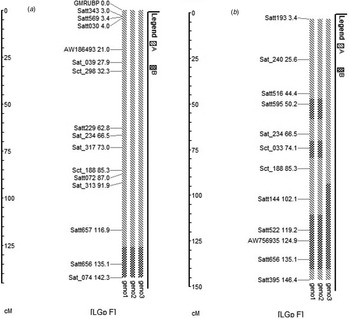
Recovery of recurrent parent genome in the selected BC2F2 lines from both the parental combinations was assessed through GGT2.0 (Berloo, Reference Berloo2008) and the results are depicted in Figs 2(a) and (b) for parental combinations 1 and 2, respectively. For the analysis of RPGC in three BC2F2 homozygous recessive lines (titilox2lox2) with RPGC >97% from N7KTIF × NRC109 and three lines from JKTIF × NRC109 with RPGC > 96%, 16 and 12 polymorphic SSR markers were surveyed on LGp F (chr 13), respectively (Fig. 2).
Graphical genotyping of selected lines in BC2F2 generation of (a) NRC7 derived KTI free line × NRC109 (geno1: SLs-1-1, geno2: SLs-1-2, geno3: SLs-1-3) and (b) JKTIF × NRC109 (geno1: SLs-2-1, geno2: SLs-2-2, geno3: SLs-2-3), on carrier chromosome 13 (LGp F) through GGT 2.0 (Berloo Reference Berloo2008).  A: recurrent parent and
 B: donor parent.

With respect to parental combination 1 (Fig. 2(a)), Sat_074 (142.30 cM) and Satt656 (135.10 cM, start 41884999–end 41885028) tightly linked loci to Lox2 (Kumar et al., Reference Kumar, Rani and Rawal2014) on LGp F (chr 13) were inherited from the donor parent (NRC109) in all the three SLs. Further, Satt684 locus (chr 5, 3.54 cM, start 1800423-end 1800473) was also inherited from the donor parent in all the three SLs. In addition to these, in SLs-1-3 locus Sct_191 (92.99 cM, LGp C1) was not inherited from recurrent parent. SLs-1-1 and SLs-1-2 showed 98.8% RPGC, while SLs-1-3 exhibited 97.3% RPGC.
In parental combination 2, JKTIF × NRC109 (Fig. 2(b)), Satt656 (135.10 cM, start 41884999-end 41885028), Satt522 (119.19 cM, start 38955478-end 38955525) and AW756935 (124.88 cM, start 40160796-end 40160849) loci tightly linked to Lox2 on LGp F (chr 13) were inherited from donor parent in all the three SLs. One of the lines (SLs-2-3) showed 97.5% RPGC as Satt144 (102.1 cM, start 36462969-end 36463022) on the carrier chr 13 of this line was found to be inherited from the donor parent. In the other two SLs, SLs-2-1 and SLs-2-2, loci Sct_033 (74.13 cM, start 30739608-end 30739666) and Satt595 (50.24 cM, start 23115023-end 23115064) on chr 13, and Satt687 locus (LGp B2, 113.61 cM, start 49404136-end 49404162) on chr 8 were not inherited from recurrent parent. These two lines exhibited 96.9% RPGC.
Agronomic parameters
Comparison of agronomic parameters of BC2F2 SLs developed from N7KTIF × NRC109 and JKTIF × NRC109 is presented in Table 2. The values of germination percentage, days-to-flowering, days-to-maturity, 100-seed weight and yield per plant were slightly higher or at par compared to the respective recurrent parents in both the combinations.
KTI and Lox2 in the SLs
KTI standard band was not observed in BC2F2 SLs developed from parental combinations 1 and 2 similar to the recurrent parents, confirmed the absence of KTI polypeptide in the developed genotypes (Fig. 3). For confirmation of the absence of Lox2 in the developed SLs, dye bleaching test was performed. In case of both the recurrent parents i.e. N7KTIF and JKTIF, the dye-substrate solution was bleached immediately within 30 s. With respect to the null Lox2 free donor parent ‘NRC109’, the bleaching of dye-substrate solution was not observed even after 9 min. Similarly, in case of BC2F2 SLs derived from parental combinations 1 and 2, bleaching of dye-substrate solution was also not observed in the same time period (9 min). Stability of blue colour of dye substrate confirmed the absence of Lox2 in the lines stacked for nulls of both Lox2 and KTI from both the parental combinations (Fig. 4, Table 2).
Native PAGE analysis of KTI in BC2F2 lines stacked for null alleles of KTI and Lox2 derived from N7KTIF × NRC109 and JKTIF × NRC109. Lane 1: NRC7 (KTI +ve), lane 2: SLs-1-1, lane 3: SLs-1-2, lane 4: JS97-52 (KTI +ve), lane 5: KTI Std (2 ug), Lane 6: SLs-2-1, lane 7: SLs-2-2.

Colour online. Qualitative estimation of Lox2 using dye bleaching assay in BC2F2 lines generated from N7KTIF × NRC109 and JKTIF × NRC109. Tube 1: NRC109 (donor parent), tube 2: N7KTIF, Tube 3: JKTIF, Tube 4: SLs-1-1; Tube 5: SLs-1-2; Tube 6: SLs-1-3, Tube 7: SLs-2-1, Tube 8: SLs-2-2, Tube 9: SLs-2-3.

Discussion
Being one of the most economical sources of protein (approximately 40%), soybean has the potential to combat protein malnutrition in developing countries. Although, the consumption of soybean in food uses can be augmented by developing commercial varieties genetically free from both antinutritional factors, KTI and off-flavour generating lipoxygenase-2. Therefore, globally development of specialty soybean free from KTI and lipoxygenases is the major objective in quality improvement of soybean. In Korea, Lee et al., (Reference Lee, Hwang, Velusamy, Ha, Kim, Kim, Ahn, Kang and Kim2014) developed triple null lipoxygenase mutant line ‘H70’ by irradiating cultivar ‘Hwanggum’ with gamma rays (250 Gy), while Kang et al., (Reference Kang, Choi, Chae and Chung2020) reported a black soybean line free from lipoxygenases, KTI and lectin through conventional breeding using four parents ‘Gaechuck#1’ (Lox2, Lox3 and KTI free), ‘Jimpum#2’ (Lox1, Lox2, Lox3 and KTI free), ‘12N1’ (Lox1, Lox2, Lox3 and KTI free) and ‘Le-16’ (lectin free). In China, Wang et al., (Reference Wang, Huaqin, Zhang, Yang, Yan, Zhang, Song and Guan2020) developed triple null lipoxygenase lines, ‘GmLox-28’ and ‘GmLox-60’ using CRISPR-associated protein 9 strategy. In India, the first ever KTI free genotypes, namely NRC101 and NRC102 were developed from the cross combination Samrat × PI542044 (Rani and Kumar, Reference Rani and Kumar2015). Subsequently, KTI free soybean variety ‘NRC127’ developed from JS97-52 × PI542044 was released for commercial cultivation (ICAR-Indian Institute of Soybean Research, 2018). In the present investigation, null allele of Lox2 was introgressed from NRC109 (lox2lox2) genotype, in high yielding null KTI genotypes derived from JS97-52 and NRC7 through a marker assisted backcross selection approach. Gene specific markers for Lox2 and KTI were deployed for the confirmation of F1 generation. In the subsequent generations of F2, BC1F1, BC1F2, BC2F1 and BC2F2, besides gene specific marker codominant linked SSR marker Satt656 and Satt228 for Lox2 and KTI, respectively, were used for the selection of plants carrying null alleles of both genes. Background selection performed in BC1F2, BC2F1 and BC2F2 generations enable the speedy recovery of recurrent parent (JS97-52 and NRC7) genome. After two backcrosses, 9 and 13 lines stacked for nulls of KTI and Lox2 and morphologically similar to recurrent parent were selected in parental combinations 1 and 2 exhibited RPGC content 97 and 96%, respectively. Through the conventional plant breeding, this percentage of recurrent parent genome recovery would have been possible only after 4–5 backcrosses. Data in Table 2 also showed that yield of these lines was significantly at par or slightly higher than the recurrent parent. These results are similar to the one obtained in an earlier study with regards to the introgression of null allele of KTI in Indian soybean variety JS97-52 (Kumar et al., Reference Kumar, Rani, Rawal and Mourya2015) and introgression null allele of lipoxygenase-2 in JS97-52 from PI596540, null Lox2 parent (Rawal et al., Reference Rawal, Kumar, Rani and Gokhale2020). Rawal et al., (Reference Rawal, Kumar, Rani and Gokhale2020) employed 150 SSR markers for background selection reported 72.83% RPGC in BC1F1 and 94.33–96.66% RPGC in BC2F2. In the present study, soybean lines stacked for null alleles of both KTI and Lox2 exhibited RPGC more than 97% in parental combination 1 and greater than 96% in parental combination 2.
For confirmation of the absence of KTI and Lox2 polypeptide in the SLs, phenotyping was performed using PAGE and dye bleaching test, respectively. All the BC2F2 SLs derived from parental combinations 1 and 2 were agronomically at par with the respective recurrent parents in germination percentage, days-to-flowering, days-to-maturity and 100-seed weight (Table 2). With regard to germination percentage, SLs derived from parental combination 1 (SLs-1) namely, SLs-1-1, SLs-1-2 and SLs-1-3, and from parental combination 2 (SLs-2) namely, SLs-2-1, SLs-2-2 and SLs-2-3 showed improved germination percentage compared to their respective recurrent parents. The significant increase in germination percentage of the SLs compared to their respective recurrent parent may be the result of removal of Lox 2 gene. Recently, Rawal et al., (Reference Rawal, Kumar, Rani and Gokhale2020) reported improved germination percentage in Lox2 free BC3F3 lines developed using marker assisted plant breeding. Zilic et al., (Reference Zilic, Milivojevic, Sobajic and Maksimovic2006) also reported 23% higher germination in the lipoxygenase free soybean genotype ‘Goyou Kurakake’ compared to the normal soybean cultivar Williams 82.
Conclusion
Genetic elimination of KTI and Lox2 from soybean seeds is critical for the development of genotypes suitable for food processing. Plant breeders in several countries have developed soybean genotypes free from either KTI or Lox2. However, reports concerning the combining of the nulls of both KTI and Lox2 in the same genetic background are very limited. In the present study, soybean lines were stacked with null KTI and null Lox2 traits through marker assisted breeding expeditiously. These food-grade soybean genotypes would not require boiling or moist heating for inactivation of KTI. Besides, soy products processed from these genotypes would have reduced off-flavour due to the absence of lipoxygenase-2.
Supplementary material
The supplementary material for this article can be found at https://doi.org/10.1017/S0021859621000526
Financial support
The study was carried out under the research project (Sanction number 102/IFD/SAN/3094/2015-2016) financed by the Department of Biotechnology, Ministry of Science and Technology, India.
Conflict of interest
None.