Introduction
Intimate partner violence (IPV) is a global public health and human rights problem. It has been associated with a range of health problems. Substantial proportions of physically assaulted women sustain injuries ranging in severity from bruises to fractured bones (Koeing et al., 2003; Dalal, Reference Dalal2008) and exhibit various symptoms of psychological morbidity manifested in depression, anxiety and post-traumatic stress disorder (Koss, Reference Koss1990; Golding, Reference Golding1999; Tjaden & Thoennes, Reference Tjaden and Thoennes2000; Aidoo & Hapham, Reference Aidoo and Hapham2001; Petersen et al., Reference Petersen, Gazmararian and Clark2001; Tolman & Rosen, Reference Tolman and Rosen2001; Campbell, Reference Campbell2002; Campbell et al., Reference Campbell, Jones, Dienemann, Kub, Schollenberger and O'Campo2002; Heise & Garcia-Moreno, Reference Heise, Garcia-Moreno, Krug, Dahlberg and Mercy2002; Mayeya et al., Reference Mayeya, Chazulwa, Mayeya, Mbewe, Magolo, Kasisi and Bowa2004; Plichta, Reference Plichta2004). Besides physical and psychological problems, female victims of IPV, to a higher degree than their peers in non-abusive intimate relationships, resort to health risk behaviours such as unhealthy feeding habits, substance abuse, alcoholism and suicidal behaviours (Silverman et al., Reference Silverman, Raj, Mucci and Hathaway2001; Heise & Garcia-Moreno, Reference Heise, Garcia-Moreno, Krug, Dahlberg and Mercy2002; Plichta, Reference Plichta2004; Roberts et al., Reference Roberts, Auinger and Klein2005). Furthermore, evidence suggests that abused women of reproductive age encounter reproductive health problems including irregular access to and use of contraceptives, terminated pregnancies, undesired pregnancies, child loss during infancy and greater use of community and health care services than their peers in non-violent intimate relationships (Jejeebhoy, Reference Jejeebhoy1998; WHO, 2002; Kishor & Johnson, Reference Kishor and Johnson2004; Garcia-Moreno et al., Reference Garcia-Moreno, Jansen, Ellsberg, Heise and Watts2005). It remains unclear, however, whether this is a reflection of loss of self-confidence or whether they are in fact victims of social and institutional marginalization.
Intimate partner violence is one of the factors associated with women not being able to use or access contraceptives (Silverman et al., Reference Silverman, Gupta, Decker, Kapur and Raj2007; Fanslow et al., Reference Fanslow, Whitehead, Silva and Robinson2008; Williams et al., Reference Williams, Larsen and McCloskey2008). A number of social, psychological and emotional factors may influence the use of contraceptives among women who have experienced IPV. Teitelman and his colleagues (Teitelman et al., Reference Teitelman, Ratcliffe, Morales-Aleman and Sullivan2008) found that young, sexually active women who did not experience IPV were more likely to consistently use condoms compared with their abused counterparts. Similar to this study, other studies have shown that women in violent relationships are less likely to use condoms because of increased risk of verbal or emotional abuse (Fanslow et al., Reference Fanslow, Whitehead, Silva and Robinson2008). A 2007 study by Silverman and his colleagues showed that women who experience IPV had reduced control over their reproductive choices and potentially reduced access to family planning or other fertility control resources (Silverman et al., Reference Silverman, Gupta, Decker, Kapur and Raj2007). In contrast to studies showing a negative relationship between contraception and IPV, Alio et al. (Reference Alio, Daley, Nana, Duan and Salihu2009) and Okenwa et al. (Reference Okenwa, Lawoko and Jansson2011) found a positive association between IPV and contraceptive use in Africa. They found that modern contraception is used more commonly among those women who experience IPV, as opposed to the use of traditional or folkloric contraceptive methods. Likewise, a study from New Zealand demonstrated that abused women were more likely to use contraception than non-abused women (Fanslow et al., Reference Fanslow, Whitehead, Silva and Robinson2008).
Bangladesh has a population of about 150 million (population density 920 persons/km2) and average per capita income of US$599 (UNDP, 2007a). This per capita income figure is mainly due to remittances from citizens working abroad. Bangladesh ranks 140th in the Human Development Index (UNDP, 2007a, b); ranks 93th among 108 developing countries on the Human Poverty Index and is struggling to get out of poverty (UNDP, 2007a). Considering the socioeconomic and population situation, contraception in Bangladesh should be high on the agenda of policymakers (BDHS, 2007). There are limited data on factors influencing women's contraceptive choices. Considering the high prevalence of IPV against women in Bangladesh (Koeing et al., 2003; Silverman et al., Reference Silverman, Gupta, Decker, Kapur and Raj2007; Dalal et al., Reference Dalal, Rahman and Jansson2009) it is important to study and understand the relationship between contraception use and IPV in Bangladesh. Recently data from the WHO multi-country Study on Women's Health and Domestic Violence (Abramsky et al., Reference Abramsky, Watts, Garcia-Moreno, Devries, Kiss and Ellsberg2011) showed higher education and higher socioeconomic stautus to have a protective effect on IPV. Some experts have studied contraception use in Bangladesh in the context of clinical issues such as birth rate, and attitudes such as son preference or women empowerment (Koeing et al., 1997; Hawkes et al., Reference Hawkes, Morison, Foster, Gausia, Chakraborty, Weeling and Mabey1999; Bairagi, Reference Bairagi2010). A 2007 study by Silverman and colleagues (Silverman et al., Reference Silverman, Gupta, Decker, Kapur and Raj2007) showed that numerous negative sexual and reproductive health outcomes, such as unwanted/unintended pregnancies, are associated with IPV. Considering the importance of the contentious relationship between IPV and contraception use by women shown in other countries, this study attempts to explore the association between IPV and contraception use among women in Bangladesh. Because IPV can lead to negotiation challenges and therefore lesser use of contraceptives, a negative association is expected between contraception use and victims of IPV.
Methods
The current study was part of the fifth Bangladesh Demographic and Health Survey (2007 BDHS), which was a nationally representative household survey using a structured questionnaire (BDHS, 2007). The survey was conducted in all six divisions of the country: Barisal, Chittagong, Dhaka, Khulna, Rajshahi and Sylhet. Multi-stage cluster sampling was used based on the 2001 population census. Initially, in total, 361 sample clusters (227 in rural areas and 134 in urban areas) were selected from these six divisions. Thereafter household listing operation was carried out in all selected clusters known as primary sample units (PSUs) from January to March 2007. In the next phase, 30 households were selected from each PSU, using an equal probability systematic sampling technique in relation to the 2001 population census. From the sample clusters 10,819 households were initially selected for the survey.
All ever-married women in the reproductive age group (15–49 years) who slept in the selected households the night before the survey were eligible for the survey. Finally, 10,400 households were selected for the study. From the selected households, 11,178 eligible women aged 15–49 were identified and finally 10,996 were interviewed (response rate of 98.4%). More details of data collection are reported in the Bangladesh Demographics and Health Survey (BDHS, 2007).
The BDHS 2007 obtained detailed information on demographic characteristics and other salient health issues such as marriage, fertility, use of family planning methods, nutrition, maternal and child health, HIV/AIDS and other sexually transmitted infections (STIs) and issues related to domestic violence.
Variables of interest
The main target variables were two sorts of intimate partner violence against women and contraception use. The types of violence were physical violence, i.e. whether husband ever pushed, ever shook, threw something, ever slapped, punched with fist or something harmful, ever kicked or dragged, ever tried to choke or burn or ever threatened with a knife/gun or other weapon, and sexual violence, i.e. whether husband ever physically forced sex when the respondent did not want it. For the contraception use variable, respondents were asked whether they had ever used any contraceptive method. Questions were also included about current use of methods with four options: no use of any method, folkloric methods, traditional methods and modern methods.
Eliciting factors
The demographic variables were: age (5-year groups: 15–19, 20–24, 25–29, 30–34, 35–39, 40–44 and 45–49); place of residence (rural or urban); education (no education, primary education, secondary education and higher education); religion (Muslim and non-Muslim); economic status (wealth index constructed from data on household assets including dwelling characteristics such as source of drinking water, sanitation facilities, construction materials and ownership of durable goods such as telephones, televisions and bicycles (Gwatkin et al., Reference Gwatkin, Rutstein, Johnson, Pande and Wagstaff2000)). The wealth index was developed by Rustein and his colleagues as an indicator of the level to measure inequalities in household income, use of health services and health outcomes (Rustein et al., 2000). Wealth index has five quintiles: poorest, poorer, middle, richer and richest.
Statistical analysis
Prevalence estimates were calculated to reflect contraception use and IPV exposure of women. The proportions and chi-squared test were used to examine the cross-relationships between dependent (contraceptive and IPV) and independent variables (demographic characteristics). Multivariate logistic regression analysis was employed to study the potential association between contraceptive use and demographic variables and exposure to IPV (physical and sexual violence). Due to the large sample size confidence intervals (CIs) were measured at the 99% level. Data were analysed using SPSS version 18.0.
Ethical considerations
The survey received ethical approval from the Institutional Review Board of Opinion Research Corporation (ORC), Macro International Incorporated. Informed consent was obtained from the participants prior to interview, and the right to withdraw was emphasized throughout the survey.
Results
Of the 10,996 respondents 79% women had used some method of contraception. Forty-three per cent of all women were using modern methods, 8% were using traditional methods, 29% were non-users but intended to use and 20% women were non-users and never intended to use any contraceptive methods.
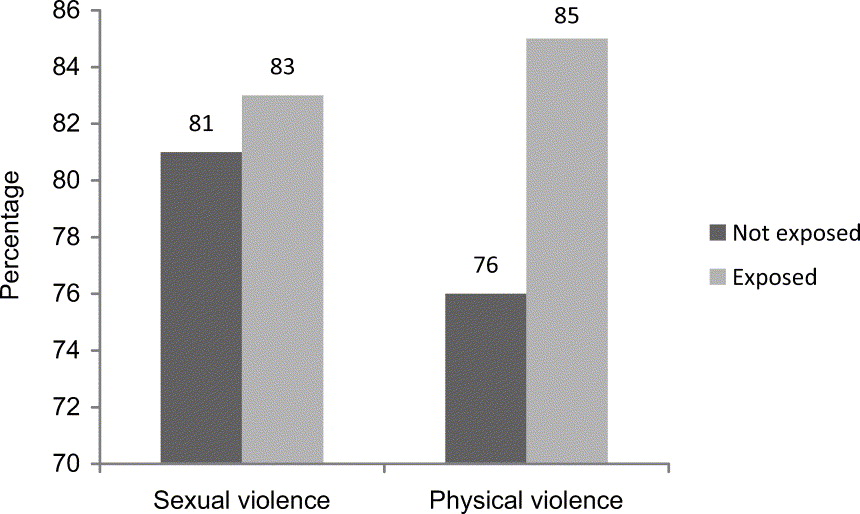
Among the respondents a total of 4467 women responded to the question regarding IPV. Almost half of the respondents (48%) were victims of physical violence, while 11% had experienced sexual abuse from their husbands. Women (85%) experiencing physical IPV used more contraceptives compared with those (78%) who did not experience such problems (χ 2p<0.001). On the other hand, for sexually abused women the χ 2 test did not reveal any significant result.
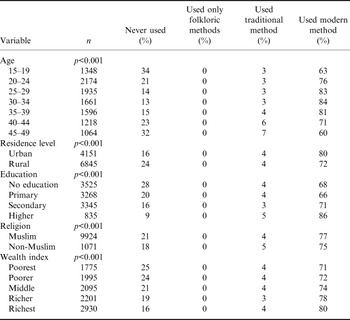
As indicated in Table 1 , modern contraceptive use is greatest (>80%) amongst the 25–39 year age group. The rate is lowest in the older age group (45–49 years; 60%) and highest in the 30–34 year age group (84%). Contraceptive use is low in the 15–19 year age group (63%). More women in urban areas use modern methods (80%) compared with their rural counterparts (72%). Level of education is a predictor for contraceptive use. Sixty-eight per cent of women with no education reported using modern methods, whilst 86% of women with a higher education reported using modern methods. Furthermore, there is a proportional increase in modern method use as education level increases (68% in no education to 86% in higher education). In addition, women with no education were more likely to report not having ever used contraception, compared with their educated counterparts (28% and 9% respectively). Religion is not a predictor of modern contraceptive use amongst Muslim and non-Muslim people (75% vs 77%). With regards to economic status, as the wealth index increases, so does use of modern methods, hence wealth index is a predictor of modern contraceptive use (71% in poorest to 78% in richest, p<0.001).
Demographic characteristics of women by contraceptive method use

p-values are of χ 2 tests.
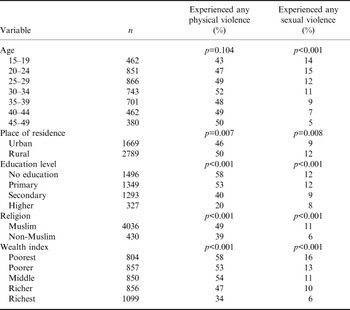
Table 2 indicates a steady increase in physical violence against women from the age of 15 to 34 (p=0.081). Thereafter, there seems to be plateau. There is a slight increase in sexual violence from age 15 to age 24, but there is a steady decline thereafter (p<0.001). Place of residence is a predictor of both physical and sexual violence. Women living in rural areas suffered more from both physical and sexual violence. As indicated in Table 2, 46% of women in urban areas reported physical violence, compared with 50% in rural areas (p=0.007); whilst 12% of women in rural areas reported sexual violence compared with 9% in urban areas (p=0.008). Education was a significant predictor (p=0.000) for both physical and sexual violence. There was a steady decline in the percentage of women reporting experiences of violence as education levels increased. Women with no education (58%) were more likely to have experienced physical violence than those with the highest education level (20%). With regards to religion, being a Muslim was a strong predictor of all experiences of violence. Almost twice as many Muslim women (11%) reported having experienced sexual violence, as opposed to only 6% of non-Muslim women (p<0.001); whilst 49% of Muslims reported having experienced physical violence compared with 39% of non-Muslims (p<0.001). The wealth index is also a significant predictor of experience of both types of violence, there being a steady decline in both types with increasing wealth. Table 2 indicates that 58% in the poorest range reported experiencing physical violence, whilst 34% of their richest counterparts reported experiencing the same violence (p<0.001). Furthermore, 16% of the poorest group reported having experienced sexual violence, compared with only 6% of the richest (p<0.001).
Demographic characteristics of women by exposure to IPV

p-values are of χ 2 tests.
Figure 1 shows the use of contraception in relation to exposure to any physical or sexual violence. Women exposed to physical violence used more contraceptives (85%) than their non-exposed peers (76%). On the other hand, women exposed to sexual violence (83%) used a slightly higher proportion of contraception than non-exposed women (81%).
Use of contraception in relation to exposure to IPV.
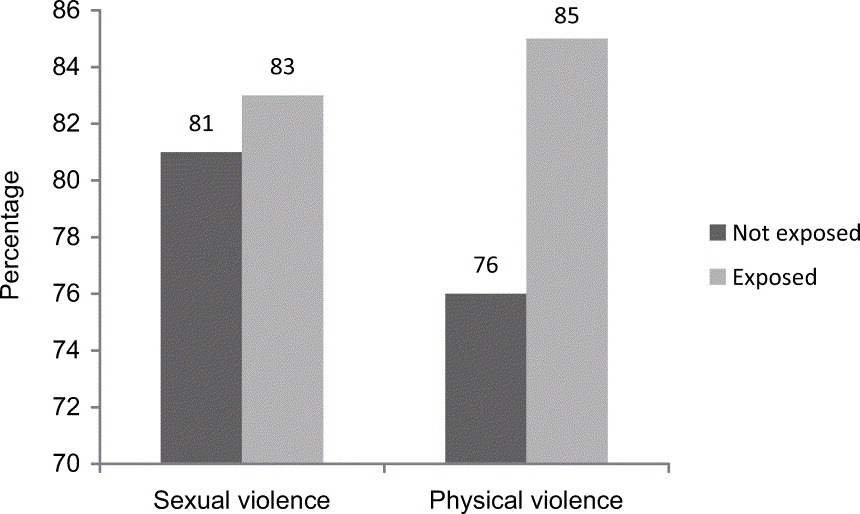
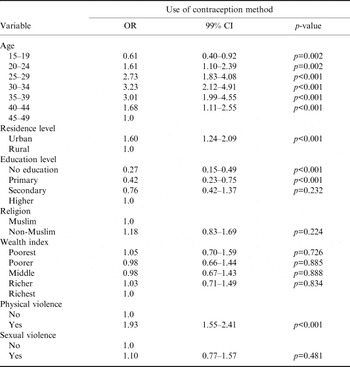
Table 3 shows the association between contraceptive use, demographic characteristics and experience of IPV. Women aged 20–44 were more likely to use contraceptives than women aged 45–49. Women in their early twenties were the most likely to use contraception. Urban women (OR 1.60, CI 1.24–2.09) were more likely to use contraceptives compared with their rural peers. Uneducated (OR 0.27, CI 0.15–0.49) and primary educated (OR 0.42, CI 0.23–0.75) women were less likely to use contraceptives compared with their higher educated peers. In the multivariate logistic regression, religion and economic status were not significant predictors of contraceptive use.
Association between demographic characteristics, IPV and contraceptive use from multivariate logistic regression

Reference category denoted by 1.0.
Women exposed to physical violence were almost two times (OR 1.93, CI 1.55–2.41) more likely to use contraceptives compared with their non-abused peers. When controlling for all confounding variables, exposure to sexual violence expressed no significant relation to the use of contraception.
Discussion
This study examined the association between use of contraception and IPV in a nationally representative sample of women of child-bearing age in Bangladesh. Almost half of the respondents were victims of physical violence, while one in every ten women had experienced sexual violence from their husbands. The findings are the same as those of previous studies in Bangladesh, including small-scale studies and a WHO multi-country study (WHO, 2005; Dalal et al., Reference Dalal, Rahman and Jansson2009). This study demonstrates that women in Bangladesh who experienced intimate partner violence used more contraceptives (85%) than those who did not experience such problems (76%). This study has similar findings to others conducted in Africa and New Zealand (Roberts et al., Reference Roberts, Auinger and Klein2005; Fanslow et al., Reference Fanslow, Whitehead, Silva and Robinson2008; Alio et al., Reference Alio, Daley, Nana, Duan and Salihu2009): women exposed to IPV were found to be more likely to use contraception in these settings. The majority of the women in this study reported contraception use at some point in their reproductive lives. However, higher contraceptive use was found amongst women experiencing physical IPV, in spite of the other associations in abused women that may have been expected to lead to lower contraceptive use (e.g. lower education level, lower wealth and rural residence).
The highest percentage of modern contraceptive use was in the 25–39 year age group. This is the prime reproductive age of women, and women in this age group clearly want to avert pregnancies. Furthermore, the aversion of pregnancies could be linked to not wanting to have children in unfavourable conditions. No woman in the study in Bangladesh used folkloric methods, whilst a previous study indicated that African women still use these methods (Alio et al., Reference Alio, Daley, Nana, Duan and Salihu2009).
Contraceptive use was found to be low in the 15–19 year age group. Here, women are getting married or are entering relationships, and since it is culturally acceptable to have children soon after marriage in Bangladesh, there is low use of contraception. This younger age group did not report having experienced IPV as much as older age groups, and the fact that they still feel safe with their partners may strongly influence the fact that do not feel the need to use contraception and avoid pregnancy. Unlike these younger women, middle-aged abused women may purposely go out of their way to avoid pregnancies so their children are not born into unsafe home environments.
Level of education is a predictor of both traditional and modern contraceptive use. The higher the level of education the more likely women are to use contraception, particularly modern contraception. This difference could partly be due to the empowerment of educated women through economic independence, usually resulting from increased education levels. In addition, women with no education were more likely to report not having ever used contraception, compared with their educated counterparts (Bairagi, Reference Bairagi2010).
In the bivariate analysis, wealth index was a significant predictor of modern contraceptive use. However, in the multivariate analysis considering the confounding effects of all predictor variables, wealth index emerges as a non-significant predictor of contraceptive use. More women in urban areas used modern method of contraception compared with their rural counterparts. This could be because women in urban areas have easier access to modern contraceptives than women in rural areas in Bangladesh (Koeing et al., 1999). Furthermore, place of residence is a predictor of physical and sexual violence. More women in rural areas reported physical and sexual violence compared with women in urban areas. There could be multiple reasons for this, including women in rural areas accepting that sexual violence is part of life and accepting it as ‘normalization of violence’ (Dalal, Reference Dalal2008). Education was a significant predictor of experience of violence. As education levels increased, there was a decline in experiences of violence. Reasons are many, including women who are educated being able to negotiate with their husbands (Dalal et al., Reference Dalal, Rahman and Jansson2009), having multiple resources available to better understand their rights and situations and knowing when they are being assaulted or abused. Educated women are more likely to demand their rights than their non-educated/lower educated counterparts and leverage on their information and knowledge. Additionally, education increases the chances of finding higher paying jobs, leading to greater economic independence and subsequently the option to leave abusive partners. With regards to religion, being a Muslim was a great predictor of all experiences of violence. The current findings support previous findings from Bangladesh, but with nationally representative samples (Koeing et al., 2003; Garcia-Morena et al., Reference Garcia-Moreno, Jansen, Ellsberg, Heise and Watts2005; Dalal et al., Reference Dalal, Rahman and Jansson2009). Similar to studies conducted by Alio et al. (Reference Alio, Daley, Nana, Duan and Salihu2009), Fanslow et al. (Reference Fanslow, Whitehead, Silva and Robinson2008) and Okenwa et al. (Reference Okenwa, Lawoko and Jansson2011), women who experienced IPV exhibited a greater likelihood of using contraceptives.
Reasons for increased contraception use among women who experienced IPV may be multi-fold. Unfavourable settings for future offspring may partly explain why these women seek out contraception at higher rates than those women in safer relationships. Bangladesh's strong efforts around family planning may also be facilitating access to contraception for all women, even those in violent relationships (BDHS, 2007). This increased availability of family planning services increases the options for these battered women to seek outside help and empowerment.
One weakness of the study is its reliance on retrospective reports, which may have led to under-reporting of both experience of IPV and contraceptive use. In addition, the reported associations between IPV and contraceptive use are for lifetime exposure to IPV, rather than relationship specific. The results could have been different and less diluted if only recent abuse (in the past year) had been considered; this deserves further study. As a consequence, and as a general limitation of cross-sectional studies, it is not possible to demonstrate a causal link from the findings; rather they provide an indication of the associations between contraception and IPV. Nonetheless, the study signals important directions for future policy and practice.
Conclusion
This study provides evidence for a positive link between contraceptive use and IPV, with physical violence being an eliciting factor for a higher level of contraception use among women in Bangladesh. A qualitative study is recommended to identify the reasons for this. The findings emphasize the importance of screening and identification of IPV at health care centres. A possible reason why abused women may have higher contraception use than non-abused women is their desire to avert pregnancy under unfavourable conditions. Health care providers could, as standard practice, learn to screen for and identify IPV victims during visits for contraceptive use. The study's identification of urban and rural differences has policy implications for service delivery and planning. Nationwide interventions could focus on screening women for IPV during contraception-related visits, and in this way determine the appropriate method for a women's family planning needs and also refer these women to appropriate support centres if assault is identified. Future research should address uncertain patterns in contraception use among victims of intimate partner violence in different countries.
Acknowledgment
The authors would like to acknowledge Measure DHS and its staff for giving permission to use the data used in this research.