Although Mexico is a democracy at the national level, some Mexican states are still regarded as authoritarian enclaves (Behrend and Whitehead Reference Behrend and Whitehead2016; Benton Reference Benton2007, Reference Benton2009, Reference Benton2012; Cornelius Reference Cornelius1999, Reference Cornelius2000; Durazo Reference Durazo2010; Gibson Reference Gibson2013; Giraudy Reference Giraudy2010, Reference Giraudy2013, Reference Giraudy2015; Lawson Reference Lawson2000; Schedler Reference Schedler2006, Reference Schedler2010, Reference Schedler2013). This article aims to find out why some authoritarian enclaves have gone through an executive turnover while others have not. More specifically, it compares states that had authoritarian regimes in 2010, where the first turnover in the governor’s office happened that year, and states with authoritarian regimes in which no turnover took place in that election.Footnote 1
In the literature, there is wide agreement that authoritarian enclaves in democratic national polities are more frequent in federal than in unitary regimes (Behrend Reference Behrend2012; Durazo Reference Durazo2010; Gervasoni Reference Gervasoni2005; Gibson Reference Gibson2013). Moreover, several authors argue that national and subnational regimes that combine regular elections—usually neither fair nor free—with authoritarian features are characteristic of recent democratization processes from the so-called third wave (e.g., Diamond Reference Diamond1999, Reference Diamond2002; Zakaria Reference Zakaria1997). Mexico is both a federal system and a third wave democracy. Thus, there are reasons to expect subnational regime variations across the country.
In 2010, five gubernatorial elections took place in which the Partido Acción Nacional (PAN) and the left built electoral alliances: Durango, Hidalgo, Oaxaca, Puebla, and Sinaloa. In these five states, the political regimes presented authoritarian features. Moreover, the PRI, the former hegemonic party, had never lost a governor’s election there since its founding in 1946. So these states are comparable in a “most similar systems” design (Gerring Reference Gerring2012; Przeworski and Teune Reference Przeworski and Teune1970). In three of the five cases, the PRI lost: Oaxaca, Puebla, and Sinaloa (turnover set), while in the other two it won: Durango and Hidalgo (no-turnover set) (1). Why did the electoral outcome differ in similar cases that had elections at the same time? This analysis includes all the states where the PAN and the left formed an alliance, which avoids the methodological risks associated with selecting on the dependent variable (Geddes Reference Geddes2003).
Turnover and No-Turnover States

The main argument of this article is that the outcome of each gubernatorial election—turnover or no turnover—depended on the behavior of the elites, both the authoritarian elite and the opposition elite. The PRI lost when the authoritarian elite fractured and simultaneously—that is, in the same election—the opposition competed as a unified front, including the groups that had defected from the PRI. Conversely, when the authoritarian elite remained cohesive and a significant opposition party did not join the opposition alliance—that is, when the opposition did not contend as a unified front—the PRI managed to remain in power.
This article focuses on turnovers as a specific outcome, not on democratization as a broad outcome. The relationship between turnovers and democratization is far from straightforward (Behrend and Whitehead Reference Behrend and Whitehead2016; Ziegfeld and Tudor Reference Ziegfeld and Tudor2017). This article assumes that turnovers tend to open wider possibilities for democratization to happen. However, these possibilities do not necessarily crystallize into actual democratization.
This argument joins the literature that attributes progress toward electoral democracy to the behavior of the elites (O’Donnell Reference O’Donnell1993; O’Donnell and Schmitter Reference O’Donnell and Schmitter1986; Przeworski Reference Przeworski1991). However, in contrast with extant work, which is usually limited to the analysis of the impacts of authoritarian elite fracture on democratic advancement, this article also focuses on the unification of the opposition, a dimension practically absent in existing scholarship. As far as recent evidence from Mexico goes, the unification of the opposition is decisive for turnovers to happen in authoritarian enclaves.
Regarding the drivers of Mexico’s democratization, this article broadly agrees with Langston (Reference Langston2002, Reference Langston2006), Magaloni (Reference Magaloni2006, Reference Magaloni2008), Magaloni and Kricheli (Reference Magaloni and Kricheli2010), and Ibarra-Rueda (Reference Ibarra-Rueda2013) on the relevance elite ruptures had, at both the national and the subnational levels. However, it differs in considering the behavior of the opposition elites, and more specifically their unification. Giraudy (Reference Giraudy2010, Reference Giraudy2013, Reference Giraudy2015) and Rebolledo (Reference Rebolledo2012) also make elite-centered arguments regarding authoritarian enclaves in Mexico, but they focus on why authoritarian enclaves persist, not on why they change.
In short, the literature on elites and democratization of Mexican authoritarian enclaves in particular, and the established literature on elites and democratization more broadly, tends to share a common limitation: emphasizing the processes that the authoritarian elite must undergo for turnovers to happen and underplaying the role of the opposition elites toward that same outcome. In other words, this literature suggests that the fracture of the authoritarian elite drives the diminishing of authoritarian conditions, almost regardless of what the opposition does.
Recently, some scholarship has questioned this argument and consequently has emphasized the role of the opposition in authoritarian enclaves. For example, Montero (Reference Montero2010) explains the advance of the left in Brazil’s Northeast by highlighting the importance of party-building strategies and elite alliances. Similarly, Durazo (Reference Durazo2016), in his study of democratization in Bahia, Brazil, and Oaxaca, Mexico, does not limit his focus to analyzing the strategies of the authoritarian elite to remain in power but also addresses the formation of the opposition. Ziegfeld and Tudor (Reference Ziegfeld and Tudor2017) use the case of India to show how, in enclaves of single-party dominance within competitive national democracies, the opposition, and not the dominant party, could be—paradoxically—the decisive factor in sustaining such dominance. This article joins this side of the debate and aims to move the literature one step further, showing that in order for turnovers in authoritarian enclaves to happen, it is crucial to see both the fracture in the authoritarian elite and the unification of the opposition.
Methodologically speaking, this article addresses the authoritarian elite fracture and the unification of the opposition in the same detail, and uses a double lens: one focused on the authoritarian elite and the other on the opposition alliance. As the analysis will show, neither one of these factors alone is sufficient for turnovers to happen, in contrast to what the established literature suggests.
Another limitation of the literature is that it does not sufficiently address the organizational characteristics of the defecting group, especially its leadership and political entrepreneurship, and the implications of these characteristics for the overall outcome, turnover or not. On this point, this article argues that the defecting group, to be successful in achieving turnover, must have a distinct elder statesman, as well as a political entrepreneur who could possibly become the candidate of a unified opposition with a fair chance of winning the gubernatorial election.
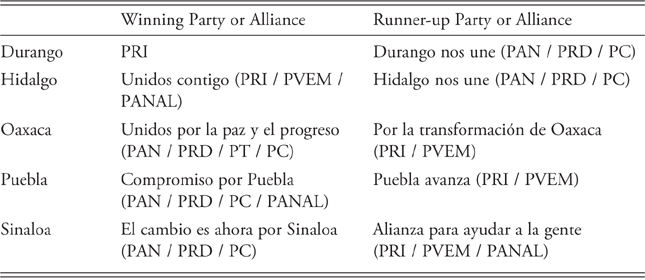
I speak generically of alliances between the PAN and the left because in all the cases under study, at least one leftist party joined the alliance—the Partido de la Revolución Democrática (PRD), the Partido Convergencia (PC), or the Partido del Trabajo (PT). However, the specific configuration of the alliances varied among states (see table 1). The PRI allied with the Partido Verde Ecologista de México (PVEM) in all the states except Durango, where the two parties competed on their own. In Hidalgo and Sinaloa, the Partido Nueva Alianza (PANAL) joined the PRI-PVEM alliance. Table 1 shows the winning and runner-up party or alliance in each of the five cases, including the official name under which they contended in the cases in which there were alliances. Reyes (Reference Reyes2011) shows that these alliances were negotiated and agreed on by the parties’ national committees, not the local committees.
Winning and Runner-up Parties or Alliances by State

Source: Data from Reynoso Reference Reynoso2011
This article proceeds to define what is understood by authoritarian enclaves, why these five states can be considered as such, and what logic of comparison is used in the analysis. It analyzes the particularities of the elite fracture in the three states where it happened, focusing especially on why it occurred and the organizational features of the defecting group. Then it explores the conditions that enabled a unified opposition to form and the importance of this element for the turnover/no turnover outcome. The article concludes by assessing the theoretical implications of the developed argument, the methodological lessons of this study, and the future of this research agenda and Mexico’s democratization.
Concepts and Methods
The Oxford English Dictionary defines enclave as “a place or group that is different in character from those surrounding it.” This definition is in line with several political scientists’ notion of authoritarian enclaves: authoritarian regimes in a local or regional unit that is inside a national democracy. But the literature does not include a clear definition. Cornelius (Reference Cornelius1999) was the first to use the term authoritarian enclave in the study of Mexican democratization.
This article’s definition of authoritarian enclaves follows Linz’s definition of authoritarianism:
Political systems with limited, not responsible, political pluralism, without elaborate and guiding ideology, but with distinctive mentalities, without extensive nor intensive political mobilization, except at some points in their development, and in which a leader or occasionally a small group exercises power within formally ill-defined limits but actually quite predictable ones.
(Linz Reference Linz2000, 159).However, these authoritarian regimes are of a specific kind: since they are inside a democratic national polity, they must hold regular elections with at least formal competitiveness assured. Hence, they are what Levitsky and Way (Reference Levitsky and Way2010) call competitive authoritarianisms. According to these authors,
What distinguishes competitive authoritarianism from democracy … is the fact that incumbent abuse of the state violates at least one of three defining attributes of democracy: (1) free elections, (2) broad protection of civil liberties, and (3) a reasonably level playing field.
(Levitsky and Way Reference Levitsky and Way2010, 7)Building on these conceptual elements, for purposes of this article, an authoritarian enclave is understood as a state-level authoritarian regime, inside a national democratic regime, in which the abuse of the state by the authoritarian elite violates at least one of Levitsky and Way’s three attributes of democracy.
In 2010, the year of the gubernatorial elections under study, the states of Durango, Hidalgo, Oaxaca, Puebla, and Sinaloa were authoritarian enclaves. To support this claim, I traced their political processes from 1992 to 2010. The year 1992 was the first time since the start of the Mexican democratization in 1988 that these states conducted a governor’s election.Footnote 2
According to Levitsky and Way (Reference Levitsky and Way2010), the attribute of free elections is violated either when a candidate is excluded from competing, it is impossible for the opposition to campaign, or there is massive fraud. None of these three situations was documented between 1992 and 2010 in the five states under study. Nonetheless, the other two attributes of democracy, protection of civil liberties and level playing field, were violated in all five states.
In Durango, Palacios and Marín (Reference Palacios and Marín1997) documented the open intervention of the state bureaucracy in favor of the PRI in the 1994 federal election. More recently, Solís and Balderas (Reference Solís and Balderas2009) have shown that freedom of expression and freedom of the press have deteriorated in the state, even resulting in the killing of journalists. Regarding the “playing field,” the 2010 gubernatorial election was clearly unfair. The media favored hugely the candidate of the incumbent party, and on the day of the election there were ballot urn thefts, inconsistencies in casting ballots, and open violence against the opposition (León Reference León2011).
In Hidalgo, according to Vargas (Reference Vargas2011b) and Hernández and Hernández (Reference Hernández and Hernández2012), access to the media in the 2010 gubernatorial election was extremely unequal, strongly favoring the PRI candidate. Furthermore, civil liberties were violated when the media stigmatized Xóchitl Gálvez, the opposition candidate, for her indigenous origins (Hernández and Hernández Reference Hernández and Hernández2012; Vargas Reference Vargas2011b). In the months before the election, Hernández and Hernández (Reference Hernández and Hernández2012) and Reyes (Reference Reyes2011) show, the state government created a broad clientelistic network and used it to support the official candidate and even to coerce suffrage. In addition, Vargas (Reference Vargas2011a) points out that the state-level electoral institute was very weak and unable to punish these widespread illegalities.
In Oaxaca during the 1992 campaign, Santiago (Reference Santiago1993) found anomalies in the voter registration process, pressures to vote for the official candidate exerted by the poll workers, last-minute changes in the location of the polls, clientelism, and manipulation of the state-level electoral institute. Cornelius (Reference Cornelius2002) found similar practices in the state during the 2000 federal election. In the 2004 governor’s election, the defeated candidate, Gabino Cué, denounced inconsistencies in the ballot counting. His claims were supported by thousands of citizens who took to the streets (Salim and Patio Reference Salim and Patio2004).
During the tenure of Ulises Ruiz as governor of Oaxaca (2004–10), the government cracked down on independent media, civil society organizations, and social movements in an unprecedented manner (Correa-Cabrera Reference Correa-Cabrera2013; Sotelo Reference Sotelo2008). There were break-ins at newspaper offices, ruthless repression of protestors, and persecution of opposition leaders. In 2006, the conflict between the state government and its social adversaries, especially the Asamblea Popular de los Pueblos de Oaxaca (APPO), was so acute that even the minimal conditions of governance were lost in the state capital. Opposition groups took over the capital’s downtown, and the local police were unable to evict them. In this setting, the federal government, through the policía federal, had to intervene. According to figures provided by Solís and Balderas (Reference Solís and Balderas2009), from 2007 to 2009 there were 63 acts of aggression against freedom of expression in the state. Correa-Cabrera (Reference Correa-Cabrera2013) observed widely extended clientelism in the 2010 gubernatorial election.
During the 1990s, Puebla was one of the states where the leftist opposition was most heavily repressed by the national authoritarian regime. In fact, several of its members were killed (Schatz Reference Schatz2011). For this period, Cornelius (Reference Cornelius2002), Reynoso (Reference Reynoso1998), and Valdiviezo (Reference Valdiviezo2000) reported electoral unfairness due to illegalities committed during election days and a biased management of public expenditures. During the administration of Mario Marín (2005–11), the governor planned and organized the illegal capture of the journalist Lydia Cacho. The governor’s involvement was uncovered months afterward, when phone conversations were leaked. Cacho was investigating a network of child trafficking that involved people closely related to the governor (Cacho Reference Cacho2008).
In the fifth state under study, Sinaloa, in the 1992 election, the defeated candidate, Emilio Goicoechea, presented proof of vote buying, illegal mobilization of voters, and anomalies in the voter registration process (Alvarado Reference Alvarado and Loyola1997; Durand Reference Durand1994). Rodelo (Reference Rodelo2009) and Solís and Balderas (Reference Solís and Balderas2009) show how, from 2005 to 2010, freedom of the press in the state decreased, due partly to threats from organized crime and partly to pressure from governmental agencies.
Besides taking place in authoritarian enclaves, the 2010 gubernatorial races in the five states had two additional features that strengthen their comparability: the PRI had never lost before, and the PAN and the left formed electoral alliances. For all these reasons, the five cases are comparable in a most similar systems design (Gerring Reference Gerring2012; Przeworski and Teune Reference Przeworski and Teune1970).
Fractures in the Authoritarian Elite and the Logic of Defection
This article argues that the fracture of the authoritarian elite is critical for a turnover to take place. In the three cases in which turnover occurred, the elite divided and the defecting group joined a unified opposition. The defection occurred after the exiting group did not receive the candidacies it expected, which were monopolized by another faction of the party, headed by the incumbent governor.
These elite fractures took place in a context characterized by a progressive weakening of the PRI and an equally gradual strengthening of the opposition. The members of the excluded group decided to exit and go over to the opposition because they believed this path could lead them to the governor’s office. This progressive weakening trend made defecting more attractive when the group was not given what it expected.
Additionally, all the defecting groups shared some organizational characteristics that contributed significantly to the three turnovers. Those that left were well organized, had an elder statesman, and included a well-known political entrepreneur who could become a competitive candidate. This elder was, in all cases, a former governor, a politician with no formal power but who had had power in the past, and who continued to have political influence, especially oriented toward benefiting his political supporters. The political entrepreneur is understood as an active politician whose career is ascending, with clear possibilities of turning into a competitive candidate for governor, and who is seeking electoral opportunities.
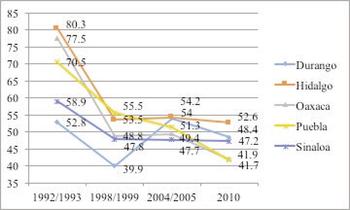
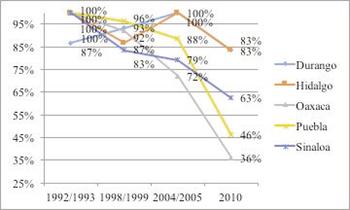
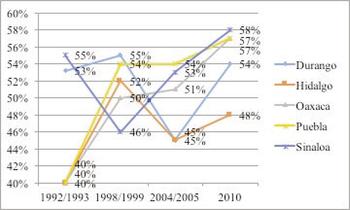
As shown in figure 1, in the turnover set, the PRI had been experiencing a long-term vote decline in gubernatorial elections. The same trend is visible in the percentage of majoritarian districts won by the party (figure 2). Although these declines also happened in the no-turnover set, they were less pronounced in the latter. The reverse side of these trends was the strengthening of the opposition.
Vote Percentage of the PRI Candidate for Governor

Percentage of Majority Districts Won by the PRI

In sum, this context made the possibility of defecting attractive. From a decision game theory perspective, this can be explained with Hirschman’s classic argument (Reference Hirschman1970): when there is low competition, the discontented members of an organization—in this case the PRI—tend to use exclusively the voice mechanism, pressuring for change. However, when there is high competition, the exit mechanism, defecting, becomes attractive. The attraction increases even more when the potential benefits of defecting surpass the benefits of being loyal to the organization. Langston (Reference Langston2002, Reference Langston2006), Magaloni (Reference Magaloni2006, Reference Magaloni2008), Magaloni and Kricheli (Reference Magaloni and Kricheli2010), and Ibarra-Rueda (Reference Ibarra-Rueda2013) have applied this logic to explain other Mexican defection cases, and it is also valid here.
In the three states of the turnover set, a group inside the authoritarian elite did not receive the candidacies it expected. When this happened, they exited the elite and joined the opposition. In Hidalgo, by contrast, the authoritarian elite did not split, and the candidate of the opposition alliance was a longtime militant of the PAN, Xóchitl Gálvez. This nonsplit of the authoritarian elite explains the lack of turnover in this state. In Durango, there was defection from the authoritarian elite but no turnover. The reasons behind this outcome are that the opposition did not remain unified and that the defecting group was not as well organized.
For the defecting group, being well organized means being structurally unified—not composed only of scattered actors brought together by a political juncture—as well as having an elder statesman and a political entrepreneur. In Mexico, governors cannot be re-elected. Therefore, the way they can maintain power after leaving office is by consolidating a political group during their tenure and then trying to benefit their political supporters to win candidacies. In Mexican authoritarian enclaves, incumbent governors have enormous weight in the selection of their party’s candidates, attempting to maintain power through these candidacies. This creates conditions for a clash between former governors and the incumbent governor. Such conflicts erupted in the three states where there was turnover. By contrast, in Hidalgo, where there was no turnover, the authoritarian elite managed to remain unified and limited the possibilities of being displaced. Durango took another path to the no-turnover outcome: the opposition did not run as a unified group or manage to attract an elder from the authoritarian elite.
In Oaxaca, the defecting group was led by former governor Diódoro Carrasco, and its political entrepreneur was Gabino Cué, who became the candidate of the opposition alliance. This group’s defection from the PRI took place in 2002, when Cué was not given the PRI candidacy for mayor of Oaxaca City. He was blocked from being the PRI’s nominee because of animosities between the leader of his group, Carrasco, and the incumbent governor, José Murat. After that, Cué joined the PC, ran as its candidate for mayor of Oaxaca City, and won. In the 2004 gubernatorial election, Cué was one of the opposition candidates, but the opposition did not contend together, and he lost against the PRI candidate, Ulises Ruiz. In 2010, Cué finally won the governorship, beating the PRI candidate, Eviel Pérez.
In Puebla, the defecting group had consolidated during the tenure of Governor Melquíades Morales, and its political entrepreneur was Rafael Moreno Valle. Moreno Valle left the PRI after he was blocked from obtaining a senate candidacy for the 2006 election. He and his group joined the PAN, which made him its candidate for the Senate. Moreno Valle won the election and became a senator. The reason Moreno Valle was blocked from the candidacy in 2006 was a dispute between former governor Morales, the elder statesman of Moreno Valle’s group, and the incumbent governor, Mario Marín. In 2010, Moreno Valle won the gubernatorial election, beating the PRI candidate, Jesús López, who was part of Marín’s faction.
In Sinaloa, the defecting group formed under the leadership of former governor Juan Millán and had as its political entrepreneur Mario López. López defected from the PRI just months before the 2010 governor’s election, when the incumbent governor, Jesús Aguilar, supported his ally Jesús Vizcarra to be the PRI candidate instead of López. Consequently, López joined the opposition, became its candidate, and defeated Vizcarra.
Durango experienced defection but not turnover, partly because the opposition was not unified and partly because the defecting group itself was not as well organized. In fact, Durango is the only state in which the defecting group did not have a former governor as its elder. It did have a political entrepreneur, José Rosas, who left the PRI at the beginning of the electoral year after accusing the incumbent governor, Ismael Hernández, of controlling the nomination process. In the 2010 gubernatorial election, Rosas competed against the PRI candidate, Jorge Herrera, who was very close to Governor Hernández, and lost.
A Unified Opposition: Negotiating Beyond Ideologies
For the opposition to become unified, another factor is needed that is also elite-centered: elite negotiations. In the five cases in question, the opposition comprised electoral alliances between the PAN and the left, but the specific configurations of these alliances differed in each state. Opposition cohesion was missing in Durango because the PT did not join the opposition alliance, and this contributed significantly to the no-turnover outcome.
In the five cases, alliances were a consequence of negotiations between the national elites of the opposition parties. Reyes (Reference Reyes2011) shows that after the PAN’s poor performance in the legislative elections of 2009, the party’s national committee decided to explore new strategies to weaken the PRI. Among the chosen strategies was the consolidation of electoral alliances with the left. Reyes (Reference Reyes2011) also argues that among the left parties, the positions regarding the alliances with the PAN were diverse.
In the end, several parties decided to join. However, the PT was, at the time, very close to Andrés Manuel López Obrador, the most important leader of the Mexican left. López Obrador harshly criticized the alliances, and consequently the PT did not join them. The only case in which the PT did join was Oaxaca, where the opposition candidate, Gabino Cué, was, according to Reyes (Reference Reyes2011), close to López Obrador. The PT’s refusal to join the opposition alliance in Durango had a significant impact on the electoral outcome, due to the party’s relevance in the state’s party system, in contrast to what happened in the other states.
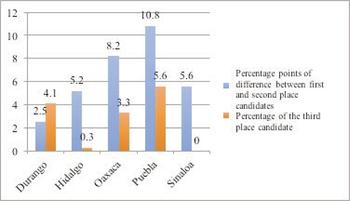
In the three states where turnover occurred, all the significant opposition parties entered the alliance. Significant opposition parties are understood as those that, when running on their own, receive a percentage of the vote that is bigger than the difference between the first- and second-place candidates. Arithmetically, the acceptance or refusal of a significant opposition party to join the opposition alliance is the difference between having turnover or no turnover, respectively. As Gerring (Reference Gerring2005) has noted, in certain situations, minor political parties can produce macroeffects. As figure 3 shows, the opposition alliances were so encompassing in the states where there was turnover that no significant opposition party remained outside them, which opened the path for the turnover to happen.
Percentage Point Difference Between First- and Second-Place Candidates, and Percentage of Third-Place Candidate

The unification of the opposition is relevant for a turnover to happen because it allows an aggregation into one single anti-PRI front of the participating parties’ resources and a sum of votes the day of the election. Alternatively, there are cases in which the aggregation of parties’ resources might occur but the votes do not add up, since the potential voters withdraw their support because of the alliance. In the three cases in which all the significant opposition parties entered the alliance, a combination of resources and votes did happen. For the PRI, this meant the end of the advantage it usually has of competing in the center of two oppositions—one to the right and one to the left—from which it has derived enormous benefits in the past, as Greene (Reference Greene2007) has shown.
In Durango, the opposition was not unified because the PT decided not to join the alliance. The PT is a relatively small, radical left party in the Mexican party system as a whole, but it is relevant in Durango’s party system. In fact, the party was born in Durango, and was built on the base of local social movements. The PT is believed to have received resources that helped its growth during the tenure of Carlos Salinas as president of Mexico (1988–94), especially due to the influence of the president’s brother Raúl (Gómez Tagle Reference Gómez Tagle2011; González Reference González1998; Palacios Reference Palacios and Marín1998; Palacios and Marín Reference Palacios1998; Peschard Reference Peschard and Loyola1997).
The no-turnover in Durango can be explained with Greene’s (Reference Greene2002, Reference Greene2007) framework. Studying Mexico’s national democratization, Greene shows that despite the advantages that the opposition could have derived from unifying in several cases, alliances between the PAN and the left were rare, given their polarized economic policy positions (Madrid Reference Madrid2010; Weyland Reference Weyland2004; Weyland et al. Reference Weyland, Madrid and Hunter2010). In Durango, the ideological distance between the PAN and the PT made it difficult for the latter to join the opposition. Therefore, without an opposition alliance, voters could not support the opposition as a whole and had to vote for only one side of the ideological spectrum, giving the PRI a competitive advantage. Furthermore, as Greene (Reference Greene2007) argues, since the PRI is ideologically positioned in the center of the two main oppositions, it tends to be easier for it to maximize its electoral performance, due to its proximity to the median voter.
In the states where there was turnover, electoral turnout was higher than in those where there was not, with an impressive increase compared to the previous election (figure 4). Traditionally, the PRI is the party with stronger party voters (Ortega et al. Reference Ortega, Somuano and Ruiz2011). When turnout is high in a state, as it was in Oaxaca, Puebla, and Sinaloa, the relative weight of the strong party voters decreases and the opposition’s chance of victory increases. It is beyond the scope of this article to establish whether the high probability of a turnover stimulated the turnout, but it is important to point out how it diminished the relative weight of the authoritarian elite’s voter mobilization capacities.
Turnout in Gubernatorial Elections

Conclusions
Scholars have used several approaches to explain subnational political regime variances in recently democratized countries. This article favors a clearly political approach, focused on the elites and their behavior. The main theoretical implication of this article is to avoid an exclusive focus on the authoritarian elites when explaining turnovers in authoritarian enclaves, as the literature usually does, and to include the role of the opposition elites in the analysis.
One important finding is that the behavior of either elites alone does not explain turnovers in these cases, and that for turnovers to happen, this rupture should appear jointly with the unification of the opposition, including the groups that defected from the authoritarian elite. In this regard, the literature on elites and democratization of Mexico’s national and subnational authoritarian regimes (Langston Reference Langston2002, Reference Langston2006; Magaloni Reference Magaloni2006, Reference Magaloni2008; Magaloni and Kricheli Reference Magaloni and Kricheli2010; and Ibarra-Rueda Reference Ibarra-Rueda2013), and the literature on elites and democratization more broadly (O’Donnell Reference O’Donnell1993; O’Donnell and Schmitter Reference O’Donnell and Schmitter1986; Przeworski Reference Przeworski1991), should reevaluate the importance of the unification of the opposition for turnovers and democratization to happen. As the study of these cases shows, future research should be aware that an excessive emphasis on the authoritarian elite and an underplay of the behavior of the opposition elites is analytically limiting. Methodologically speaking, these findings highlight the need to have a double analytical lens: one focused on the authoritarian elite and the other on the opposition elite.
In the Mexican transition to democracy, the impact of the federal regime on the logic of democratization has varied over time. In the first years after democratization started in 1988, the autonomy that federalism gave to the states allowed many of them to see turnovers before the presidency itself turned over in 2000. For this reason, some authors claimed that democratization in Mexico moved from the regions to the center (Alonso and Gómez Tagle Reference Alonso and Tagle1991; Lujambio Reference Lujambio2000). However, more recently, that same autonomy of the states has enabled the survival in power of authoritarian elites, even though the country is democratic. This insight might also be applicable to other federal countries that have recently transitioned to democracy.
Another methodological insight for future analyses of federalism is to prioritize factors that are endogenous to the states when trying to find explanations for subnational regime variation. These endogenous factors seem to be, at least in principle, more explanatory than national processes. In other words, the greater autonomy of the states implied in federalism causes state-level politics and institutions to be influenced more by what happens within the borders of the state than by what happens outside them.
The findings of this article have been strengthened by the results of the seven gubernatorial elections between 2011 and 2017 in states where the PRI had never lost. In 2012, a former member of the PRI, Arturo Núñez, candidate of a wide alliance of leftist parties, headed the first gubernatorial turnover in Tabasco; the PAN was not a significant opposition party in that election. In 2016, alliances between the PAN and the left were made in four states with authoritarian features and where the PRI had never lost: Durango, Quintana Roo, Tamaulipas, and Veracruz. The opposition alliance won in all four.
The winning candidate in all the cases except Tamaulipas was a former member of the PRI who was the political entrepreneur of a group that defected from the authoritarian elite. In Tamaulipas, the winning candidate, Francisco Cabeza de Vaca, was a longtime PAN member. The size of the opposition alliance varied from one state to the other, especially because of the ascent of the new leftist party Movimiento de Regenación Nacional (MORENA) since 2014, which has changed the configuration of Mexico’s party system. MORENA has grown attached to the charismatic figure of Andrés Manuel López Obrador and has rejected alliances with the established parties. However, in all the cases, wide alliances were formed nevertheless. In 2017, gubernatorial elections took place in Coahuila and Estado de México. In both states, the authoritarian elite did not break and the opposition did not contend together, and there was no turnover.
Certainly, the explanation for gubernatorial turnovers presented here has not been the only one in Mexico’s history. For turnovers that took place before 2010, a multiplicity of causes have been claimed. However, from 2010 on, elite fracture, defection of groups from the authoritarian elite to the opposition, and opposition unification have preceded a significant proportion of turnovers. The question that follows is why variables that were not relevant to explain gubernatorial turnovers in the past have turned crucial from 2010 to today.
Important theoretical questions also follow from this research. Can turnovers that involve, as a critical actor, a group defecting from the authoritarian elite be the starting point of an authentic democratization process in a state? Can they open a path toward a liberal, pluralist, representative democracy? In other words, can a political group that was forged within the authoritarian elite and that for years benefited from the authoritarian regime engage in the advancement of democracy? The answer seems to be no. In 2016, the PRI recovered Oaxaca and Sinaloa, which shows the failure of the first non-PRI administrations. Puebla did not do well, either: from the turnover in 2010 to 2015, its Democratic Development Index dropped from a low 3.6 to an even lower 3 on a 10-point scale (PoliLat et al. 2015).
In short, in the three turnover cases reviewed in this article, it seems that turnovers did not lead to a deep and comprehensive democratization process. Therefore, if the main path to recent turnovers in authoritarian enclaves in Mexico, authoritarian elite fractures and unified oppositions, is not leading to more democratic subnational regimes, how can authoritarian enclaves be transformed into good-quality local democracies?