Introduction
Rumination is a process in which ingesta is regurgitated from the ruminoreticulum into the mouth, chewed and then swallowed. This process breaks down herbivorous food and contributes to a healthy ruminal environment. Although there are discrepancies between studies (Wang et al., Reference Wang, Diao, Hu, Bi, Piao, Jiang, Sun, Li and Tu2022), calves are thought to begin ruminating at approximately 2 weeks of age. As calves spend more time eating solid feeds, the duration of rumination increases rapidly so that by adulthood, cattle spend approximately 30% of their day ruminating.
Monitoring and analysing the time dairy cows spend ruminating has become a valuable tool in animal behaviour research. Rumination data, often collected using automated sensors, provide insight into the animals’ daily time budgets – that is, how they allocate time to various activities such as feeding, resting and ruminating. These behavioural patterns are sensitive to environmental and managerial factors. Changes in rumination have been used with other behaviours to detect health events such as lameness, subclinical ketosis and onset of calving. Hence, rumination appears to be a useful indicator of health in dairy cattle (Weary et al., Reference Weary, Huzzey and von Keyserlingk2009). Quantifying rumination in young dairy calves may be important for both on-farm monitoring and research to clarify how rumination is affected by feeding, housing and social contacts.
Measuring rumination by visual observation can be time consuming (e.g. every 5 min for >24 h). For example, in young calves rumination is short lasting, and may occur sporadically for the first few weeks of life. To reliably capture rumination, video equipment and reliable observers are needed. On-animal devices that can automatically record individual animal behaviours, including rumination (e.g. Heattime HR, CowManager SensOor and the Nedap rumination sensor® [NRS]), may be a more efficient and cost-effective solution.
Nedap Livestock Management (Groenlo, The Netherlands) manufactures NRS within their Nedap COWcontrol™ system. NRS is a three-axis accelerometer that records rumination activity based on the repeated movement of the jaw during regurgitation and chewing of the bolus in both lying and standing positions (Borchers et al., Reference Borchers, Gavigan, Harbers and Bewley2021). The system automatically generates individual animal output on rumination time as daily percentage (e.g. 30% spent ruminating) based on a static algorithm and has been validated for adult cattle but not calves. The aim of this study was to validate the NRS for dairy calves at 4 and 8 weeks of age by comparing the output from the NRS to time spent ruminating as measured from video analysis. We predicted that the sensor would not be accurate at 4 weeks of age, but by 8 weeks of age, the sensor would accurately record rumination behaviour in the calves due to increased rumination and better sensor fit.
Material and methods
All experimental procedures were conducted in accordance with the regulations controlling experiments/procedures on live animals in Norway, and the study complied with the Norwegian policies relating to animal ethics. The current study was performed as part of the SUCCEED project (Research Council Norway No. 310728).
Eight Norwegian Red dairy calves were raised in a cow-directed cow-calf-contact system such that cows could visit their calves through a smartgate. Calves had free-access to a straw-bedded creep-feeding area and a rubber-slatted floor meeting area where they could interact with visiting cows. Cows and calves experienced a gradual separation process where the smartgate was programmed to restrict the cows’ entry to the meeting area. Calves could freely interact with visiting cows until 33 days of age, at which point access by cows to the meeting area was restricted to 12 h (11.00–23.00). Access was further restricted at 47 days of age (cows could visit 6 h/day: 11.00–17.00) and 61 days of age (cows could no longer visit). Hence, cows visited the meeting area according to the age of their own calf during the 24 h recording periods. From 33 to 68 days of age calves had access to 12 L/day of fresh milk from an automatic calf feeder. Throughout the study, calves had ad libitum access to hay, silage and concentrate on the feeding table at the front of the calf creep, and water from a drinking bowl.
Each calf was fitted with an NRS around its neck from 3 to 9 weeks of age.
Two cameras (Bravida Norway, Hikvision DS-2CD2186G2-I (2.8 mm)(C) 4K AcuSense Dome Darkfighter IR – Last Mile AS) were placed approximately 4 m above the creep and meeting area and recorded the animals 24 h/day. From these video recordings, the time focal calves spent ruminating/24 h was scored at two time points. To minimize the number of observation days, the timing of the observations was decided based on the median calf age of the batch. When calves were 28 (±5) and 58 (±5) days of age, four trained observers continuously recorded the time calves spent ruminating (from the video recordings) using the free, open-source event-logging software BORIS (version 8.0.13, Friard and Gamba, Reference Friard and Gamba2016). Rumination was defined as rhythmic chewing movements, including pauses for swallowing and regurgitation. A rumination bout was considered to have ended if rumination paused for >10 s. Each collar was inspected twice a week to verify the NRS was correctly positioned. To ensure inter-observer reliability, all four observers scored a range of behaviours in the same 2-h recording period. All observers reached an inter-observer agreement of kappa >0.8.
Statistical analyses were performed using Stata v17.0 (StataCorp, USA). The time focal calves spent ruminating (as recorded from the video footage) was divided by 24 h to calculate the daily percentage and thus compare to the NRS outputs. At the two time points, we calculated the mean and SD of daily rumination time, based on 24 h recordings from both video observations and the rumination collar, respectively. To investigate the agreement between the video observations and rumination collar outputs, the Wilcoxon signed-rank test, the Spearman’s rank correlation and the concordance correlation were calculated. The cut-offs indicating weak, medium and strong correlations applied in this study align with the levels established by Schober et al. (Reference Schober, Boer and Schwarte2018).
Results
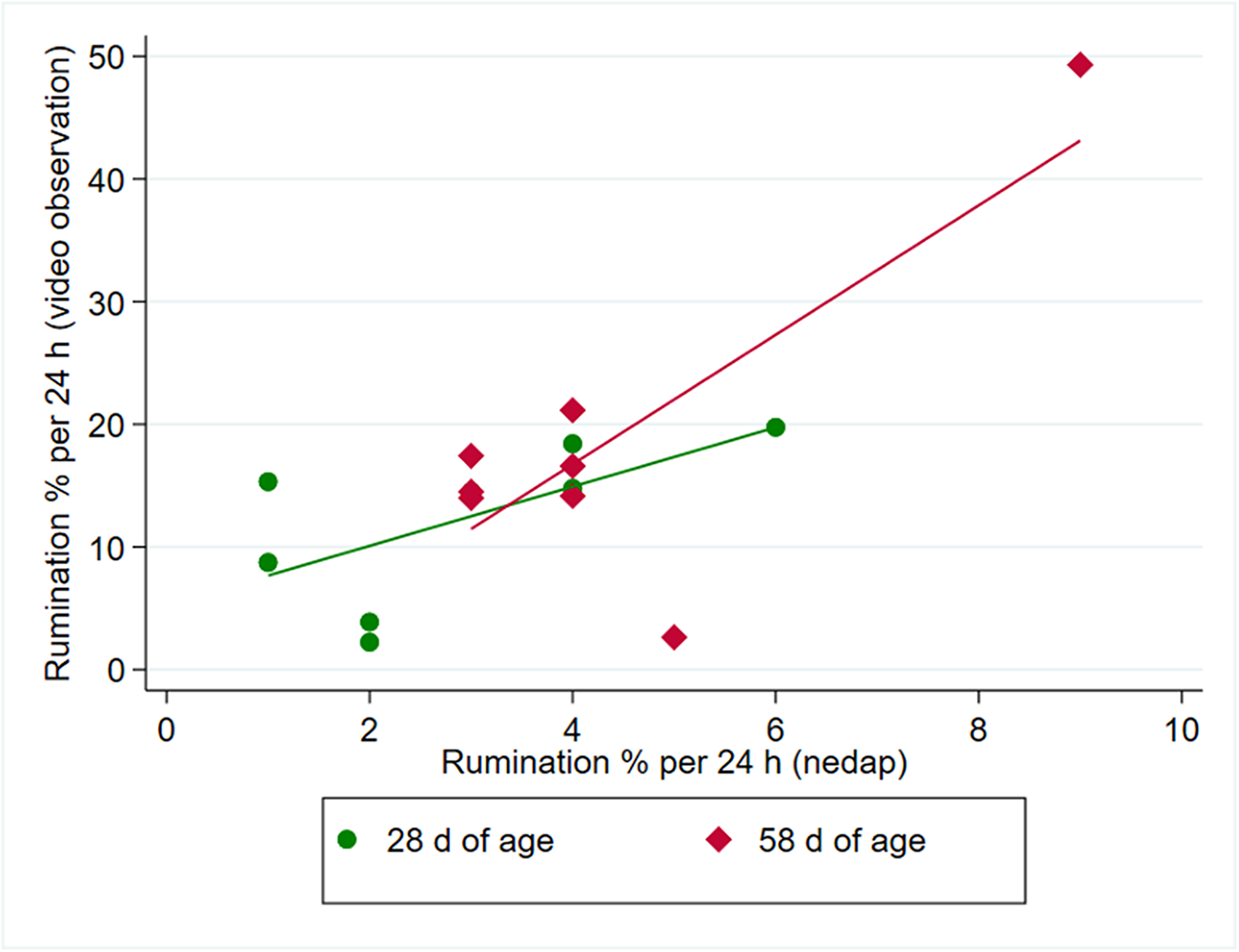
According to the NRS, calves spent on average 2.9 ± 1.7% of the observation day ruminating at 28 days of age and 4.4 ± 2.0% of the observation day ruminating at 58 days of age. Based on video observation, calves spent on average 12.2 ± 6.5% of the observation day ruminating at 28 days of age and 18.7 ± 13.5% of the observation day ruminating at 58 days of age (Table 1). The NRS significantly underestimated rumination by 76.2% at 28 days of age (z = 2.52, exact p = 0.008) and 76.5% at 58 days of age (z = 2.38, exact p = 0.02). The within and between calf variation in time spent ruminating was high.
Daily rumination time (%) for eight Norwegian red dairy calves at 28 and 58 days of age according to the NRS and continuous behavioural observation by four trained observers using video footage

NRSs were fitted around each calf’s neck from 3 to 9 weeks of age, and video footage was recorded by cameras positioned above the calf creep and contact area.
Video observation and NRS data showed a Spearman’s rank correlation coefficient of 0.58 at 28 days of age and 0.63 at 58 days of age, indicating a moderate correlation (Schober et al., Reference Schober, Boer and Schwarte2018). However, the concordance correlation coefficient was low (CCC = 0.01 (n.s.)) at both 28 and 58 days of age (Fig. 1).
Scatter and line chart showing individual Norwegian red calves’ (n = 8) daily rumination time (%) according to the Nedap rumination sensor® (NRS) and continuous behavioural observation by four trained observers using video footage at 28 and 58 days of age. NRSs were fitted around each calf’s neck from 3 to 9 weeks of age, and video footage was recorded by cameras positioned above the calf creep and contact area.

Discussion
Consistent with our predictions, the NRS was moderately correlated with calf rumination behaviour at 28 and 58 days of age such that time spent ruminating increases with age. However, the NRS underestimated the duration of time calves spent ruminating at both ages.
Several studies have aimed to validate rumination sensors in adult dairy cattle, often reporting medium and high levels of correlation. For example, Elischer et al. (Reference Elischer, Arceo, Karcher and Siegford2013) reported a significant but moderate Pearson’s correlation (R = 0.65) between the AMS rumination monitors and live observation. Similar levels of Pearson’s correlation were also reported for the CowManager SensOor by Borchers et al. (Reference Borchers, Chang, Tsai, Wadsworth and Bewley2016) (R = 0.69, CCC = 0.59) and Pereira et al. (Reference Pereira, Heins and Endres2018) (R = 0.72, CCC = 0.71). Other sensors have received higher correlations, including the Heattime HR system (R = 0.93) (Schirmann et al., Reference Schirmann, von Keyserlingk, Weary, Veira and Heuwieser2009). The NRS was also found to have a high correlation with direct observation (R = 0.92, CCC = 0.92) in adult cattle (Borchers et al., Reference Borchers, Gavigan, Harbers and Bewley2021).
To our knowledge, only two studies have attempted to validate sensors to capture rumination in young animals. Burfeind et al. (Reference Burfeind, Schirmann, von Keyserlingk, Veira, Weary and Heuwieser2011) concluded that Heattime HR (audio-based recordings) can reliably record rumination when animals were 9 months of age or older. Hill et al. (Reference Hill, Suarez-Mena, Hu, Dennis, Schlotterbeck, Timms and Hulbert2017) reported that the CowManager SensOor’s (motion-related recordings) were not valid for 4-week old calves but was found to accurately capture rumination when calves were weaned at approximately 6 weeks of age. Neither the Heattime HR nor the CowManager SensOor’s accurately record the early behaviour of a calf. During the pre-weaning period, farmers make many health and feeding decisions; thus, a tool to capture behavioural deviations may facilitate early decision-making, or detection of ill health.
While no clear or systematic explanation was identified, several factors may account for the discrepancy between the continuous behavioural observations and the NRS data. Compared to cows, calves have smaller necks, and the collar may be too loose, thus causing it to move or be poorly placed. For example, perhaps the NRS was too low on the calf neck for the sensor to correctly capture the rumination movements. Calves also grow rapidly, and their size changes continuously. It could also be that calves, given their motivation for social lying, ruminate with the sensor in contact with another animal, against the feeding bunk or another surface. Yet another explanation can be that calves are more active than cows and have shorter and more unpredictable rumination bouts. These are all factors that could potentially affect the accuracy of the rumination collar.
The accuracy of the video data may also be limited by several factors. Rumination is a discreet behaviour that may be difficult to detect. Also, intense and long viewing sessions may cause observer fatigue and inconsistent data recording. Additionally, there may at times be visibility issues with calves turning away or being partially obstructed by pen structures or other animals, making it difficult to reliably detect jaw movements, potentially leading to underreporting of rumination behaviour.
We used the median batch age to ensure all calves were observed on the same date; however, there were 10 days between the youngest and oldest calves in the batch. In the first 6 months of life, calves spend increasing amounts of time ruminating such that by 2 months of age calves ruminate approximately 6 h/day and by 6 month-old calves may ruminate 9 h/day. As calves are developing this behaviour, there are likely individual differences for time spent ruminating at different ages. The age differences in our experiment may have affected how much time we recorded ruminating, but as we were comparing recording method within calves, the age differences should not have affected correlations.
For applications focused on monitoring individual animals over time, such as detecting health changes, consistency in measurement is more important than absolute accuracy. In such cases, the NRS may offer some practical value. However, further development is needed before the NRS can be used for reliably measuring rumination in young dairy calves. More specifically, accuracy needs to be tested after ensuring correct collar placement, while taking into account within- and between-calf variation, calf size and growth and changing rumination patterns. It is also necessary to explore how different calf behaviours, e.g. lying down, standing and feeding, impact collar accuracy. Finally, as only algorithms for adult cows have been developed and validated, algorithms allowing for the young calves’ short and random rumination bouts need to be established.
Although automated recordings from precision livestock farming tools can save observation time, our results indicate that the NRS may not yet accurately measure rumination in young dairy calves.
Acknowledgements
We thank the Agriculture and Food Industry Research Funds (FFL/JA, project number 310728, The Research Council of Norway) for financing the study, and we thank participating industry partners and research institutions for own contributions. We are grateful for the staff members of the Norwegian University of Life Sciences (NMBU) Livestock Production Research Centre for managing the animals during the study.