Introduction
Cold, clear streams, old-growth forests and interdisciplinary, place-based enquiry characterise the H.J. Andrews Experimental Forest (HJA) in the Oregon Cascades, one of 26 sites in the National Science Foundation-funded Long-Term Ecological Research (LTER) network. At the HJA, ecological research is complemented by a long-running arts and humanities residency programme, hosted in collaboration with the Spring Creek Project for Ideas, Nature and the Written Word at Oregon State University. These residencies encourage a similar long-view engagement with a place to contribute to an ongoing conversation about the ways we observe, participate in and understand appropriate relationships with forest ecosystems (see http://andrewsforestlog.org/).
Outreach and education are central to the LTER mission. Towards this end, we have developed an environmental science, arts and humanities (eSAH) interpretation of the Discovery Trail (DT), a ½-mile loop trail, to reflect the site’s dual commitments to scientific and creative enquiry. The 10-stop digital curriculum for middle and high school learners includes audio recordings, short videos and reflective activities to both increase knowledge about the place and environmental science while also guiding learners to reflect on their own relationships with place. Our research explores the question: What are the impacts of a 1-day environmental science, arts and humanities (eSAH) field trip on place relationships? Most research on place relationships focuses on longer-term engagement with particular landscapes, and there is little empirical work on eSAH outcomes. Our project addresses both of these research opportunities to explore short-term place enquiry on place relationships guided by an eSAH intervention.
In 2017, we launched the iPad curriculum with two high school environmental science classes. This article unpacks pilot data from these field trips (n = 26), including (a) digital pre–post and formative assessment and (b) hard copy post-experience questionnaires (open-ended and Likert-style questions). Results demonstrate two kinds of place relationships emerged in response to the trail experience: (1) a passive place relationship, whereby learners felt cared for by the place, but did not express agency in the place relationship and (2) an active place relationship, whereby learners take responsibility for the place relationship as active participants, expressing an intention to care for the forest. These exploratory data provide insight into the student experience and illuminate a framework for understanding place relationships in the context of short-term interdisciplinary field learning experiences.
Background
The DT experience
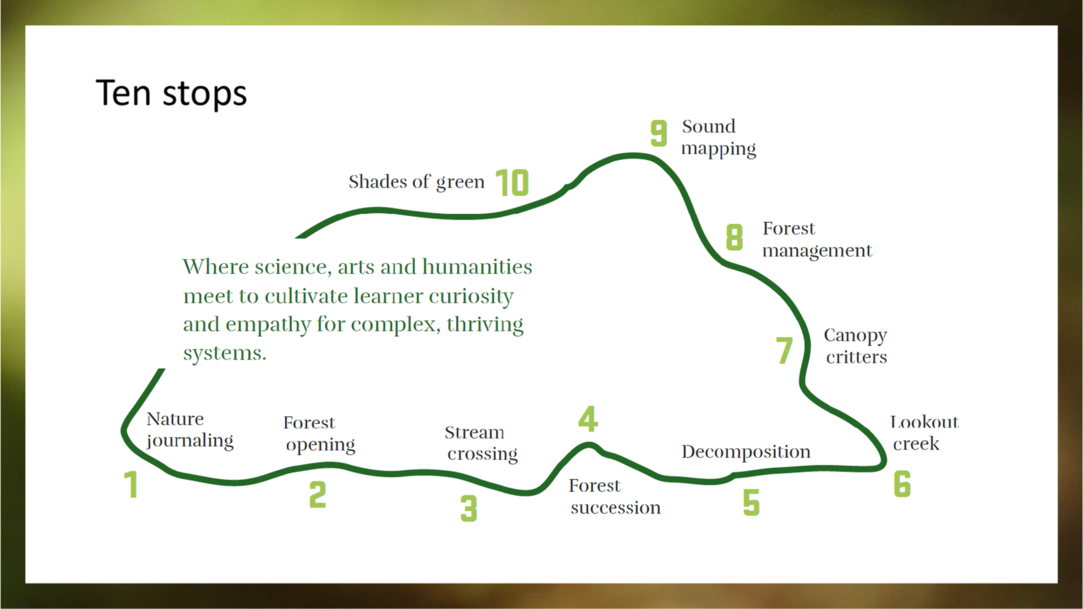
The DT curriculum blends HJA environmental science content with creative work from writers and artists in the residency programme, as well as reflective, imaginative (e.g., imagining different perspectives, scales and future scenarios), observational, creative (e.g., related to visual art and creative writing) and meditative activities, which use voice narration to guide learners to put the iPads down and engage the forest without technology. Each enquiry-driven, participatory stop includes both scientific and arts or humanities content (see Figure 1). For example, students watch a video about Northern spotted owls, then draw comic strip images imagining the lives of owls in the forest; listen to an interview about songbirds and sound in ecological research, then create their own sound maps and view images of artist Leah Wilson’s study of colour in HJA watersheds, then conduct their own investigation of the colour green along the trail. Digital interpretation allows learners to view the landscape across seasons and scale; it also accommodates more school groups than site staff can otherwise support. Groups of up to three learners share an iPad. Up to 30 students can participate on the trail at one time. The HJA hosts three to five field trips each fall and spring.
Map of the 10-stop Discovery Trail.

Field trips are greeted by the staff, who read a poem about the forest written by a visiting writer. Students then gather at the trailhead, where they are released one at a time on a ¼-mile silent walk. They are directed to stay several steps apart from each other and refrain from speaking or using technology, so they can attend to the sensory experience of the landscape. The poem and the sensory walk set the tone for the eSAH DT experience by providing the language of creative writing and the physical experience of reflexivity as a lens through which to interact with the landscape. As Eisner (Reference Eisner2002) explains, ‘one very important aim of arts education is to help students… acquire an ability to frame virtually any aspect of the world esthetically’ (p. 232). Weaving creative and reflective activities into the entire DT experience primes the students to engage the trail through this perspective, thereby using eSAH to help ‘students forge a deeper connection to the environment and witness nature through a more engaged lens’ (York, Reference York2014, p. 110).
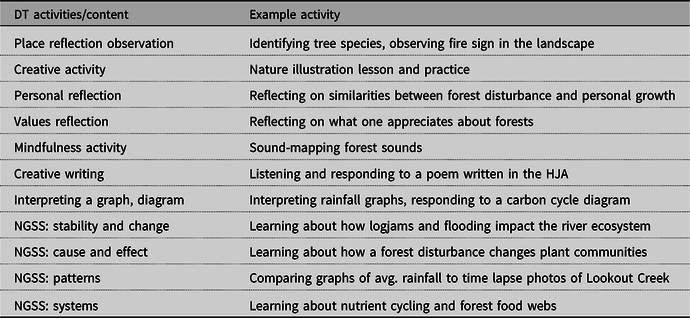
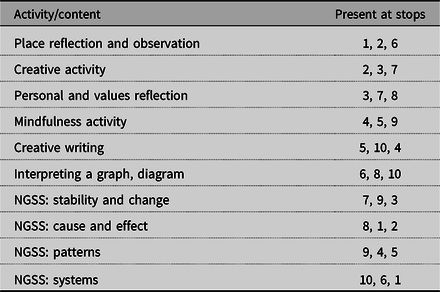
After debriefing the sensory walk, small groups of students are led to their interpretive stops. Trail stops take up to 20–30 min each; therefore, groups complete three to four stops per visit (Figure 1) for a 90-min trail experience. While each stop is unique, each three-stop experience shares similar modes of engagement (Tables 1 and 2), including (a) values reflection; (b) observation of forest dynamics; (c) graph or diagram interpretation; (d) meditative and creative activities and (e) either listening to or reading creative or narrative writing (poems, indigenous story, or literary essay). Each stop grouping also includes content aligned with the Next Generation Science Standards crosscutting concepts related to (a) stability and change, (b) cause and effect, (c) patterns and (d) systems (NRC, 2011). Groups finish together with a reflective activity and post-trip questionnaire.
Discovery Trail activities and content

Content/activities represented at the Discovery Trail interpretive stops

Sense of place and the field trip experience
Sense of place describes sentimental, psychological and activity-based connections to place (Kudryavtsev, Stedman, & Krasny, Reference Kudryavtsev, Stedman and Krasny2012). Different disciplines describe the sense of place in nuanced ways, but place attachment is often used as a proxy for a sense of place, describing an emotional relationship with a specific place developed over time (Ardoin, Reference Ardoin2006; Pierce, Reference Pierce2017). Scholars suggest that a different type of sense of place is possible in short-term place immersions (Wattchow & Brown, Reference Wattchow and Brown2011). For example, deliberate place investigations can ask one to become curious about their surroundings from multiple perspectives (e.g., up close, far away; through the lens of different user groups or species; across time, etc.). Field trip experiences can invite learners to make comparisons between the field trip site and their own special places, illuminating similarities across places and their role(s) in them. This kind of engagement mirrors Wattchow and Brown’s (Reference Wattchow and Brown2011) discussion of a visitor’s place awareness, whereby one becomes an empathetic insider of a place. This role requires ‘a willingness to open oneself to the significances of a place…. [and to] understand that place as rich in meaning, and hence to identify with it […and to] see and understand places in themselves’ (Relph, Reference Relph1976, p. 55). Through this framing, field trips can guide participants to take the awareness they gain in special places — for example, the HJA, or other sites that inspire wonder — back into their everyday places (see Moore, Reference Moore2004). In this way, field trip investigations can facilitate curiosity about what it means to be a responsible visitor and inhabitant of all places.
Place-based education and the DT experience
Place-based education is an experiential, problem-focused pedagogy that considers the historical, social, ecological and political dynamics of a specific place (Gruenewald, Reference Gruenewald2003a; Israel, Reference Israel2012; Sobel, Reference Sobel2008). Place-based curricula often encourage exploration through sensory engagement, close observation and student-driven enquiry (Dickinson, Reference Dickinson2011; Preston, Reference Preston2015). Attention both to individual agency and the complex dynamics of place can facilitate civic attitudes or personal responsibility for the place (Ardoin, Reference Ardoin2006; Gruenwald, Reference Gruenwald2003b; McInerney, Smyth, & Down, Reference McInerney, Smyth and Down2011). The DT experience reflects these goals. Each stop is developed around the ecological processes and management of the forest. Stops use enquiry about trail locations to facilitate learning from concrete experience, then guide students to more abstract conceptualisation both about place and one’s role in it, a key feature of experiential learning pedagogy (Kolb, Reference Kolb1984).
Affective learning and the DT
In the 1970s, the Tbilisi Declaration identified two goals of environmental education: (1) knowledge about complex interactions between natural and human environments and (2) attitudes and values that allow learners to responsibly respond to environmental problems (UNESCO, 1978). Since this foundational report, much environmental education research has focused on responsible environmental behaviour (REB). While behaviour change is a lofty goal for short-term education programmes, and certainly not a straight-line outcome from knowledge and attitudes (Kollmus & Agyeman, Reference Kollmus and Agyeman2002), scholars agree that REB depends on both cognitive and affective outcomes (Newman & Fernandes, Reference Newman and Fernandes2016). While research on experiential learning demonstrates both cognitive and affective impacts, outcomes related to sensory and emotional engagement have been shown to be most impactful (Behrendt & Franklin, Reference Behrendt and Franklin2014; Rebar, Reference Rebar2010). We are not studying behaviour change on the DT, but we are interested in a sense of place development, which is associated with the desire to act on behalf of a place (Kudryavtsev et al., Reference Kudryavtsev, Stedman and Krasny2012). Therefore, behaviour change and sense of place outcomes are connected (Ramkissoon et al., Reference Ramkissoon, Weiler and Smith2012; Walker & Chapman, Reference Walker and Chapman2003). The DT experience aims to foster this emotional connection to place and content through individual and group experiences, personal reflection and the integrated eSAH curriculum.
Environmental science, arts and humanities
Scholars argue that arts education facilitates an empathetic perspective, an affective outcome. Learners are often invited to share their feelings in the process of making or responding to art and story in ways they are not when learning science (Davis, Reference Davis2008); doing so can open important imaginative and relational channels that facilitate learning (York, Reference York2014). When place is presented as a relational other, arts and humanities education can encourage students to attend to the textures, seasons and health of that landscape in ways similar to how they might consider the wellbeing of another person. College-level humanities courses have demonstrated a comparable emotional investment in the wellbeing of self, others and the landscape (Algona & Simon, Reference Algona and Simon2010; Johnson & Frederickson, Reference Johnson and Frederickson2000). Similar outcomes related to empathy, awareness and sensitivity have been demonstrated when arts and humanities content is integrated into the medical school curriculum (Reilly, Ring, & Duke, Reference Reilly, Ring and Duke2005, pp. 251–252). Arts education in tandem with environmental education appeals to diverse learners across abilities, learning styles and interests (Deasy, Reference Deasy2002); through sensory engagement and authentic experience, nesting arts and environmental education can facilitate retention and recall (Land, Reference Land2013) and nurture both spatial and natural intelligence, two primary pathways to learning (Staples, Larson, Worsley, Green, & Carroll, Reference Staples, Larson, Worsley, Green and Carroll2019).
In effect, eSAH integration invites the whole learner (Burns, Reference Burns2015) into the experience, allowing cognition and affect to work in tandem (Subbiondo, Reference Subbiondo2011). On the DT, these impacts are nested in natural history, ‘a practice of intentional focused attentiveness and receptivity to the more-than-human world’ (Fleischner, Reference Fleischner2011), which can facilitate empathetic awareness (Cooper, Reference Cooper2000). While little empirical research explores the integration of eSAH content in environmental science or field-based learning, evidence suggests that incorporating approaches like narrative, values reflection, aesthetic appreciation, art practice and creative imagining alongside place-based ecology and natural history can foster emotional connections to place and the natural world (Goralnik & Nelson, Reference Goralnik and Nelson2015, Reference Goralnik and Nelson2017; Graham, Reference Graham2007; Staples et al. Reference Staples, Larson, Worsley, Green and Carroll2019; York, Reference York2014).
Methods
In fall 2017, we hosted two high school environmental science classes (n = 47) on the DT. This article includes data from all students who granted consent (n = 26) (Oregon State University exempt determination IRB #7428). All students were 15–18 years old. On each trip, we collected (a) pre–post and formative assessment on the iPads and (b) hard copy post-trip questionnaires (open-ended and Likert-style questions). We also conducted participant observations, whereby an on-trail observer recorded student conversations, group dynamics and engagement indicators during the learning experience. Additionally, though not included in this analysis, we also collected student collaborative drawings of the field trip experience. Student groups created these drawings to describe their trail learning to the rest of the class during a final debrief.
Since the pre/post and formative assessments were conducted via iPad, when students were already in groups, questions were designated for either individual or group response. Students were prompted to enter their names for individual questions, so participant responses could be tracked across the experience. Participant observation field notes observed that students gave each other space and quiet to respond to individual iPad questions.
Data analysis was guided by a constructivist eco-phenomenological methodology. Eco-phenomenology extends the phenomenological tradition of studying phenomena, or appearances, beyond human experience and into the material world by pursuing the elimination of mind–body and human–nature dualisms (Walsh, Reference Walsh2013). This enquiry is driven by the belief that humans are embedded within the natural world; therefore, attempts to understand the human experience require coupled investigation of both person and place. Similarly, intellectual engagement with the world ought to be grounded by bodily engagement in that world (Zealand, Reference Zealand2007). The emphasis on physical experience and place perception as a way to bridge dualisms aligns eco-phenomenology with the objectives and experience of the DT. Our assessment tools ask learners to consider their physical experience on the trail as a form of learning, and the content of the stops situates their cognitive learning in their felt experience in place. As well, the format of the experience is designed to foster both an individual and a group experience, alongside directed attention to the ‘perspective’ of the forest itself. Bridging these different perspectives through both creative and cognitive engagement aims to soften dualistic boundaries.
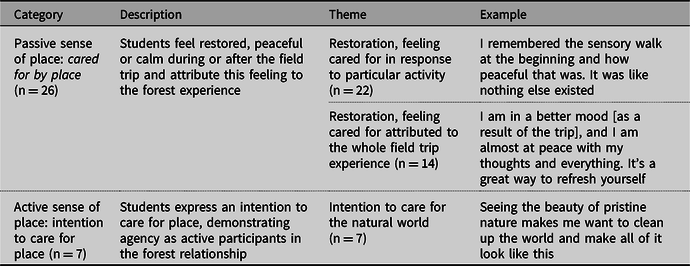
We conducted an emergent thematic analysis of the qualitative data (Hesse-Biber & Leavy, Reference Hesse-Biber and Leavy2008), coding all open-ended responses inductively, then grouping emergent codes into themes. These themes were grouped into like categories to describe the place relationships we saw emerging in the data. The analytical process was iterative; several times we thought we understood the major themes and relationships between them, only to find our scheme did not represent the whole data set or capture the broad student experience. We kept returning to a persistent observation of the word ‘care’ across the narrative data, as well as consistent use of the language of calm, peaceful and refreshed in student responses, used across contexts and purposes to describe the impacts of the field trip experience. This observation led us to re-code all open-ended responses with a focus on care, relationships, place, wellbeing and responsibility. With this revised codebook, we deductively re-coded all of the data, leading to the themes and categories in Table 3.
Codebook example for open-ended responses

We also calculated the frequency of the Likert-scale responses from the post-experience questionnaire relevant to this focus on care, relationships, place, wellbeing and responsibility. This quantitative analysis validates our qualitative results. One author was the primary coder; she met weekly with another author over the course of a year to co-code data, discuss observations, detail findings and interpret results.
Results
Results revealed two types of place relationships that emerged as a result of the DT experience: (1) a passive place relationship, whereby learners express a sense of restoration as a result of the place experience, or a recognition of being cared for by place and (2) an active place relationship, whereby learners express a responsibility or intention to care for the place, expressing agency in the place relationship.
Qualitative analysis
Passive place relationship
Every student (n = 26) reported feeling restored by some or all of the DT experience, demonstrating a positive physical and emotional response to the field trip they attributed directly to the forest experience. These relationships were utilitarian, in that the forest provided something — a sense of calm or feeling cared for — to the students. Codes used to identify this category, taken directly from student language, include calm, peaceful, quiet, mood shift, relaxed, nice, refreshed, rejuvenated, pure and free.
Many students attributed these feelings of restoration to the silent sensory walk, the only trail activity where they are asked to reflect on the specific experience, rather than on the holistic DT experience, which explains why much the data references this part of the trail. Following the silent sensory walk, students were asked: How did it feel to walk alone in the forest? Please share three words. Twenty-one (of 26) participants used words that directly described restoration and calm, for example: ‘calming, refreshing, nice’. Only one student did not have a positive experience on the sensory walk, sharing the words: ‘hungry, tired, out of breath’. But this same student did have a restorative experience on the trail as a whole. In response to the post-trip questionnaire multiple-choice question: What do you most value about the forest?, this student chose: beauty from a list of provided responses (e.g., wood products, shade, clean water, carbon storage, peace and quiet, beauty, hiking and camping, inspiration, the place for plants or animals to thrive, etc.) and explained, ‘because it makes you calm’. Across the student responses, beauty was consistently mentioned as the reason students felt cared for by the forest, providing them entrance to an enjoyable forest experience and positive feelings about the place.
Sensory engagement with the wider trail experience also sparked feelings of restoration. A number of students attributed calm feelings to specific interpretive stops, including sound mapping and searching for shades of green, which drew attention to the role of particular senses in participating with the landscape. Other students associated these feelings with more general sensory engagement with place, for example, feeling cool temperatures or hearing rushing water during their time on the trail. Finally, many students described the field trip experience in its entirety as relaxing or reported that they learned how to be relaxed as a result of the experience. For example, in open-ended responses about what they value most about the forest, 10 (of 26) students referred to restoration, calm and care. One wrote, ‘I love trees and the peace of being alone with my thoughts’. Another shared, ‘Really, it’s the beauty of the forest that makes it peaceful and relaxing’. Similarly, in response to the post-trip reflection questions: (1) What do you remember about the Discovery Trail experience? and (2) Please share 1 word to describe your experience on the Discovery Trail, students (n = 10 and 11, respectively) shared words like ‘calm’, ‘peaceful’, ‘tranquil’ and ‘relaxing’. As a follow-up, students were then asked: Describe the moment that captures the word you chose. The responses demonstrated poetic and reflective language that mirrored the eSAH content of the trail. For example, one student shared: ‘Rejuvenating. Cool breeze flowing through the trees, chilling my face. Warm vibrant sunlight hitting my body’. Another wrote: ‘Peaceful. Standing in the spot where you can see the water when the light was breaking through the shade’.
Active place relationship
Seven of 26 (27%) participants transcended the passive place relationship by recognising the forest as an ‘other’ worthy of care or respect. Codes in this category include care, caring, preserve, maintain, treat better, respect, more involved, clean and help. Learners demonstrated this agency in response to open-ended questions on the post-trail questionnaire. In response to the question: One of the themes on the trail is place: Observing place, learning about place, understanding relationships in place and attending to our impacts to place. How did the trail experience help you think about or understand the place in a new way?, Seven students expressed an intention to care for the place, forests, nature or ecosystems. For example, one student shared that the experience ‘made me think what a beautiful place we live in and that we should keep our forest healthy… and respect [it]’. Beauty was a motivating factor for a number of students’ intention to care; to them, protecting a place means to keep it beautiful. Maintaining cleanliness and safety was also another motivator for an intention to care. One student shared that the DT experience ‘made me realise how taking care of the environment provides a safe place for all animals and plants’. Another wrote, ‘My home is clean so I should keep the forest clean, too’. Other reasons used to justify an intent to care for the forest or place include ensuring forest health, limiting forest harvest, using only what we need and reducing human impacts.
This burgeoning sense of responsibility moves the forest relationship beyond one of the services towards an ethical calling to do what is right by extending care and wellbeing to more-than-human nature. Likert responses on the post-trail questionnaire support these observations. When asked to list the extent to which they agree or disagree with the statement: The Discovery Trail experience increased my appreciation for forests, 17 participants (67%) agreed or strongly agreed. When asked to list the extent to which they agree or disagree with the statement: The Discovery Trail experience increased my appreciation for the living things in forests, 16 participants (60%) agreed or strongly agreed. Based on an ecological ethic of care, appreciation is a pre-condition for respect (Hill, Reference Hill1994), and respect is a prior commitment necessary for care (Engster, Reference Engster2005). The students’ appreciation of beauty expresses an element of specialness, something they value and appreciate about the forest. This value becomes the motivator for their intention to act in caring ways. Therefore, the Likert responses, which give insight into the students’ appreciation, illuminate a possible bridge between a passive and an active sense of place. While standalone Likert responses do not have descriptive strength, they do highlight important self-report data about the broad student experience that support the qualitative observations.
Discussion
These findings are important for environmental education scholarship in three ways. First, the most sense of place literature suggests that repeated interactions with place are necessary to cultivate emotional attachments to place (Kudryavtsev et al., Reference Kudryavtsev, Stedman and Krasny2012; Semken et al., Reference Semken, Freeman, Watts, Neakrase, Dial and Baker2009). There is little research on the sense of place impacts during short-term place investigations. Our research begins to address this gap. Short-term place engagement can impact place relationships in ways that might lead to learner awareness of being ‘placed’, or cognizant of being in relationship with places more widely. This includes a potential recognition of the kinds of responsibilities relationships of this nature might demand. While little research explores these outcomes empirically, the scholarship does suggest deepened place relationships as a result of place-based experiential learning (see Ardoin, Reference Ardoin2006; Semken & Freeman, Reference Semken and Freeman2008). We suggest that the passive and active place relationships we observed on the DT describe the types of experiences this literature suggests might contribute to a wider sense of place.
Second, little empirical work explores eSAH curricula on learning about and engaging with place, even as eSAH activities are expanding across universities, agencies and nonprofits for outreach, engagement and informal education (Ellison et al., Reference Ellison, LeRoy, Landesberen, Bosanquet, Buckly Borden, CaraDonna and Wysong2017; NAS, 2018). The LTER network specifically has a long relationship with eSAH activities, though research on the impact of this activity is recent (Goralnik, Nelson, Gosnell, & Ryan, Reference Goralnik, Nelson, Gosnell, Ryan and Rozzi2015; Goralnik, Nelson, Gosnell, & Leigh Reference Goralnik, Nelson, Gosnell and Leigh2017). Despite the limited empirical investigation of eSAH, the literature suggests that deep interdisciplinary environmental learning — for example, integrated science, arts and humanities — can catalyze important cognitive, moral and affective growth (Goralnik & Nelson, Reference Goralnik and Nelson2015; Staples et al. Reference Staples, Larson, Worsley, Green and Carroll2019). Incorporating arts and humanities approaches like creative narrative, visual art and/or values reflection alongside experiential science-driven enquiry can foster emotional attachment to both human and nonhuman communities (Goralnik & Nelson, Reference Goralnik and Nelson2011; Treanor, Reference Treanor2014; York, Reference York2014). Scholars across disciplines argue that sensory-rich experiences can inspire learners to connect to place and cultivate virtues like respect, empathy and care (Dickinson, Reference Dickinson2011; Gruenewald, Reference Gruenewald2003a). Our research is the first attempt we have identified that explores the implications of eSAH curricula directly. We hope this contribution opens the door to more work in this area.
Finally, digital curriculum is an innovative way to engage learners, providing opportunities for a rich, well-rounded and dynamic group experience. The iPads provide opportunities for non-invasive assessment and data collection; they also provide a solution to limited site staff capacity. Digital technology can provide meaningful field experiences for learners with disabilities (see Atchinson, Reference Atchinson2011), as well as support a number of learning benefits, including individualisation, portability, information sharing, motivation and understanding (Kacoroski, Liddicoat, & Kerlin, Reference Kacoroski, Liddicoat and Kerlin2016; McClain & Zimmerman, Reference McClain and Zimmerman2016). There is some concern, though, about the limitations of technology in learning environments (Mohammed, Reference Mohammad2019). One can also imagine reactions to the use of technology in field-based contexts in particular. This suggestion is supported by little empirical research (McCLain & Zimmerman, Reference McClain and Zimmerman2016), and a recent study of an iPad-mediated outdoor learning experience in fact showed the opposite: students were distracted by nature away from the iPads, rather than vice versa (Kacoroski et al., Reference Kacoroski, Liddicoat and Kerlin2016). Our results, while preliminary, provide evidence that digital learning in a remote context can facilitate meaningful relationships with place. A deeper investigation is necessary to understand how this engagement compares to the same experience without technology.
Limitations and future research
The exploratory nature of our research limits our ability to identify which aspects of the curriculum or place experience catalyse particular emotional responses. Additionally, results from our small participant sample are not generalisable. Challenges with the consent/assent process limited the data available for use in the study. We have addressed these logistical hurdles. Working with the iPads also presented some challenges. Typing on a digital keyboard can be time-consuming, likely discouraging some level of response detail. We have streamlined the trail enquiry, including more multiple-choice and fewer open-ended questions. We expect this change will lead to more developed narrative responses in the future.
Conclusion
Field trip investigations provide an opportunity to explore the impacts of short-term place investigation, including the development of an awareness of place as relational other. This is an outcome that requires learners both to study a place and also feel something in that place. A curriculum that bridges science, arts and humanities (eSAH) can foster this integrated cognitive and affective experience.
As learners develop an awareness of being placed — exploring what they value, imagining through multiple perspectives, comparing observations across places and gaining an awareness that place is not just background, but a storied context they participate in — they cultivate important skills and empathy that can transcend the field trip experience. We contend that this kind of field trip-initiated relationship can prime learners for deeper and more emotionally invested place relationships with their own places. Our findings describe two primary place relationships that emerged as a result of an eSAH field learning experience: passive and active place relationships, describing learner awareness of place as an entity that either provides for their wellbeing (passive) or for whom they feel compelled to care for (active). We did not collect background information on students’ previous experience in landscapes similar to the HJA, but we suspect that place relationships occur on a continuum, and that certain background factors provide the receptivity necessary to transcend passive place relationships to the more ethically motivated active place relationships. In this vein, we suggest that repeat learning experiences of this kind, whereby place is engaged as a relational other with opportunity for reflection, creative imagining and intellectual engagement, might facilitate deeper emotional connectivity with places in general over time. More research is necessary to explore the trajectory of place relationships and their connection to a sense of place.
For students to experience any kind of peace or restoration on a field trip experience is encouraging, not just for the place relationship development this suggests but also because a sense of restoration in nature is tied to more effective information processing, attention and memory (Berman, Jonides, & Kaplan, Reference Berman, Jonides and Kaplan2008; Kaplan, Reference Kaplan1995), all the important learning outcomes. That more than 25% of our participants experienced something even richer, demonstrating ethical growth by expressing agency for the care of the place, is exciting. While more research is needed, our study suggests that deeply interdisciplinary short-term place investigation is one way to achieve these outcomes. Short-term experiences in place can be impactful, especially when we attend not just to what students are learning, but how they are encouraged to be learners and observers. A focus on self-directed, interdisciplinary, sensory-rich experiences can shift the ways students engage with places and landscapes more generally.
Acknowledgements
We conducted this research at H.J. Andrews Experimental Forest, which is funded by the US Forest Service, Pacific Northwest Research Station. We would also like to acknowledge Adam Kennedy, whose work with the digital curriculum and database management made this project possible, and Ginny White, Chris Smith and Matt Viehdorfer, who developed the application and database for the digital curriculum.
Financial Support
We appreciate the support of an anonymous donor to the Discovery Trail.
Conflicts of Interest
None.
Lissy Goralnik is an Assistant Professor of environmental studies in the Department of Community Sustainability at Michigan State University. Her work lies at the intersection of environmental ethics, experiential learning, and community engagement, with a focus on environmental science, arts, and humanities intersections; place studies; and wellbeing. She has been leading environmental education research on the Discovery Trail since 2013.
Sarah Minette Kelly is the Outdoor School Director at Whole Earth Nature School in Eugene. She creates and provides inclusive, trauma-informed programming to inspire students to connect with and care for self, others and environment, working within a larger movement to dismantle unjust systems impacting youth, marginalised communities and nature. Sarah coordinated Discovery Trail field trip logistics and conducted research on the student experience while pursuing her M.A. in Environmental Arts & Humanities from Oregon State University in 2016 through 2018.
Kari O’Connell is a Senior Researcher at the STEM Research Center at Oregon State University. Her research focuses on authentic field learning experiences, from K-12 students through undergraduate level, with a specific emphasis on access and inclusion. She has been involved with the Schoolyard LTER program at the Andrews Forest since 2008 and is currently PI of the Undergraduate Field Experiences Research Network
Michael Paul Nelson holds the Ruth H. Spaniol Chair in Renewable Resources and is the Professor of Environmental Ethics and Philosophy at Oregon State University. He serves as the Lead Principal Investigator for the HJ Andrews Experimental Forest Long-Term Ecological Research Program.
Mark Schulze is the H.J. Andrews Experimental Forest Director. His research training is in forest ecology. He has been involved in the development of the Discovery Trail since 2011.