Introduction
Evidence regarding the potential advantages of earlier intervention for psychotic disorders comes primarily from correlational research examining whether outcomes for patients are related to the length of the delay between the onset of their symptoms and initiation of treatment. The period of time between the onset of clear psychotic symptoms and beginning appropriate treatment is generally referred to as the duration of untreated psychosis (DUP), while delay between the onset of any earlier, non-psychotic signs of illness and treatment is called duration of untreated illness (DUI) (Norman et al. Reference Norman, Townsend and Malla2001; Keshavan et al. Reference Keshavan, Haas, Miewald, Montrose, Reddy, Schooler and Sweeney2003; Crumlish et al. Reference Crumlish, Whitty, Clarke, Browne, Kamali, Gervin, McTigue, Kinsella, Waddington, Larkin and O'Callaghan2009; Owens et al. Reference Owens, Johnstone, Miller, Macmillan and Crow2010).
Perkins et al. (Reference Perkins, Gu, Boteva and Lieberman2005) completed a meta-analysis of cross-sectional and longitudinal studies relating DUP to later measures of symptoms, functioning, brain morphology and/or neurocognition. They concluded that DUP was associated with level of global psychopathology, positive and negative symptoms and functional outcomes after treatment. Marshall et al. (Reference Marshall, Lewis, Lockwood, Drake, Jones and Croudace2005) note that prospective studies provide the best evidence concerning any link between DUP and treatment outcome because they are likely to provide more reliable estimates of DUP based on information collected at first presentation and are less likely to be biased towards inclusion of patients whose illness takes a more chronic course. The meta-analysis of prospective studies by Marshall et al. (Reference Marshall, Lewis, Lockwood, Drake, Jones and Croudace2005) showed a consistent association between DUP and symptom and functioning outcomes up to 12 months, but the authors noted the paucity of research on longer-term outcomes. Examining DUP as a predictor of outcomes at up to 5 years is particularly important, given evidence that the first 3–5 years may constitute a critical period determining long-term outcomes (Birchwood et al. Reference Birchwood, Todd and Jackson1998; Linszen & Birchwood, Reference Linszen, Birchwood, Birchwood, Fowler and Jackson2000; Crumlish et al. Reference Crumlish, Whitty, Clarke, Browne, Kamali, Gervin, McTigue, Kinsella, Waddington, Larkin and O'Callaghan2009).
Since the publication of these meta-analyses there have been several reports concerning the relationship between treatment delay and outcomes assessed 5 or more years after initiation of treatment. Harris et al. (Reference Harris, Henry, Harrigan, Purcell, Schwartz, Farrelly, Prosser, Jackson and McGorry2005), in an 8-year follow-up of a large sample of first-episode patients, found DUP to be related to quality of life, level of functioning and positive but not negative symptoms. Boden et al. (Reference Boden, Sundstrom, Lindstrom and Lindstrom2009) found DUP to be related to symptom remission and functioning at 5 years of follow-up, in a group of first-episode patients, but Bertelsen et al. (Reference Bertelsen, Jeppesen, Petersen, Thorup, Øhlenschlaeger, Le Quach, Østergaard Christensen, Krarup, Jørgensen and Nordentoft2009), reporting on the OPUS trial, did not find a relationship of DUP to symptom remission at 5 years of follow-up. Crumlish et al. (Reference Crumlish, Whitty, Clarke, Browne, Kamali, Gervin, McTigue, Kinsella, Waddington, Larkin and O'Callaghan2009) found DUP to be related to positive symptoms at 8 years of follow-up, but not general functioning as assessed by the Global Assessment of Functioning (GAF) or occupational functioning. White et al. (Reference White, Stirling, Hopkins, Morris, Montague, Tantam and Lewis2009) found DUP to predict composite symptom levels but not functioning at 10 years in a group of 69 first-episode patients. While several studies have found DUP to predict symptomatic outcomes (particularly positive symptoms) at ⩾5 years of follow-up, there is less evidence for its relationship to level of functioning. In short, there continues to be some inconsistency in findings concerning the relationship of DUP to longer-term treatment outcomes. In addition, Crumlish et al. (Reference Crumlish, Whitty, Clarke, Browne, Kamali, Gervin, McTigue, Kinsella, Waddington, Larkin and O'Callaghan2009), Harris et al. (Reference Harris, Henry, Harrigan, Purcell, Schwartz, Farrelly, Prosser, Jackson and McGorry2005) and Keshavan et al. (Reference Keshavan, Haas, Miewald, Montrose, Reddy, Schooler and Sweeney2003) have reported that DUI is superior to DUP in predicting negative symptoms or functioning at 2- to 8-year follow-ups.
It is also important to examine if any relationship between treatment delay and outcomes could be as the result of an association with other pre-treatment characteristics. For instance, if gender or pre-morbid adjustment were to be found to covary with treatment delay and outcome, it might suggest that any association between DUP and aspects of recovery is non-causal and can be explained by these variables. In addition to gender and pre-morbid adjustment, there has been interest in examining other early circumstances such as socio-economic status, age or mode of onset, severity of symptoms at presentation, education and presence of substance abuse as possible confounds in any relationship of treatment delay to outcome (Perkins et al. Reference Perkins, Gu, Boteva and Lieberman2005; Compton et al. Reference Compton, Chien, Leiner, Goulding and Weiss2008; Owens et al. Reference Owens, Johnstone, Miller, Macmillan and Crow2010).
In this paper we report on the relationship of both DUP and DUI to several dimensions of outcome after 5 years of treatment in an early intervention program. In order to examine the possible differential relationship of DUP and DUI to positive symptoms, negative symptoms and functioning we included measures of each of these variables. In addition to a widely used global assessment of occupational and social functioning, we included two more objective indicators of functioning at 5 years. Consistent with past recommendations (Marwaha & Johnson, Reference Marwaha and Johnson2004), we used the number of weeks during the fifth year of follow-up that the individual was engaged in full-time, competitive employment or full-time studies. As a further objective measure of functioning, we used number of weeks receiving a disability pension.
Method
Sample
Participants were recruited from successive admissions to the Prevention and Early Intervention Program for Psychoses (PEPP) in London, ON, Canada in the period between March 1997 and February 2002. PEPP is designed to treat primarily non-affective psychotic disorders in individuals who have not previously received treatment for a period of 4 weeks or more. The assessment and treatment protocols utilized during the first 2 years of treatment in PEPP are described elsewhere (Malla et al. Reference Malla, Norman, McLean, Scholten and Townsend2003; http://www.PEPP.ca). At the end of 2 years, patients generally graduate to a less intense form of treatment intervention, but are seen regularly by a psychiatrist and/or case manager, who monitor patients' progress and can facilitate access to additional services of PEPP if required.
Criteria for recruitment were having a psychotic disorder, not having received previous treatment with an antipsychotic for 4 weeks or longer, and living within the catchment areas of the Program. A total of 188 participants were recruited at entry into treatment and provided informed consent as approved by the University of Western Ontario Ethics Board for Health Sciences Research. The letter of information and consent included agreement to be followed up for outcome assessments regardless of whether they continued to receive treatment in PEPP.
Measures and procedures
Information regarding demographics, pre-morbid adjustment, age of onset, DUP and DUI was collected at the time of admission. Assessments of symptoms and functioning took place at admission and annually thereafter.
Information regarding onset and treatment delay was obtained using a structured interview (Norman & Malla, Reference Norman and Malla2002), which includes items from the Interview for the Retrospective Assessment of Onset of Schizophrenia (Häfner et al. Reference Häfner, Riecher-Rössler, Hambrecht, Maurer, Meissner, Schmidtke, Fatkenheuer, Loffler and van der Heiden1992). This interview was administered to patients and (in 88% of cases) at least one collateral source, usually a family member living with the patient around the time of admission. Age of onset of psychosis was identified by the age at which clear symptoms of psychosis emerged. These symptoms had to qualify for a rating >2 on the SAPS global items for hallucination, delusion or thought disorder.
DUP was identified as the period of active psychosis experienced before initiation of treatment. Onset of psychosis was estimated at least to a specific month. We defined treatment as initiation of antipsychotic medication of a dosage and for a period of time (4 weeks) that should lead to a significant response in most patients. DUI was estimated as the period of time between the onset of any noticeable changes in behavior leading up to psychosis and initiation of treatment. Such changes usually reflected impaired role functioning, social withdrawal, mood changes, irritability, sleep disturbance, etc. (Norman et al. Reference Norman, Scholten, Malla and Ballageer2005b).
Mode of onset is typically defined in terms of the length of time between initial behavioral changes or anomalies and onset of clear psychotic symptoms (Jablensky et al. Reference Jablensky, Sartorius, Ernberg, Anker, Korten, Cooper, Day and Bertelsen1992; Harrison et al. Reference Harrison, Croudace, Mason, Glazebrook and Medley1996; Perkins et al. Reference Perkins, Gu, Boteva and Lieberman2005; Morgan et al. Reference Morgan, Abdul-Al, Lappin, Jones, Fearon, Leese, Croudace, Morgan, Dazzan, Craig, Leff and Murray2006; Compton et al. Reference Compton, Chien, Leiner, Goulding and Weiss2008), with a period of ⩽1 month being classified as acute and >1 month as insidious. In the current study, we based this distinction on the period of time between the onset of first noticeable changes and onset of psychosis.
Level of education of the patient was rated on an 18-point scale from 0, indicating not having completed grade school, to 18, indicating having completed a graduate or professional degree. Parent socio-economic status was indexed as the highest of paternal or maternal occupational prestige using the index developed by Goyder & Frank (Reference Goyder and Frank2007) for occupations in Canada.
Pre-morbid adjustment was assessed using the Premorbid Adjustment Scale (PAS; Cannon-Spoor et al. Reference Cannon-Spoor, Potkin and Wyatt1982). We used information provided by the patients and (in 92% of cases) family members or others familiar with the patient's development and behavior. The PAS includes ratings of pre-morbid adjustment for childhood (up to age 11 years), early adolescence (age 12–15 years), late adolescence (age 16–18 years) and adulthood (age ⩾19 years). The academic (scholastic performance and adaptation to school) and social (sociability and withdrawal, peer relationships, and psycho-sexual adjustment) components of pre-morbid adjustment can show different patterns of relationship to clinical presentation and course of psychotic disorders (Silverstein et al. Reference Silverstein, Mavrolefteros and Close2002; Norman et al. Reference Norman, Malla, Manchanda and Townsend2005a; Monte et al. Reference Monte, Goulding and Compton2008). Because schizophrenia spectrum disorders usually have their onset in late adolescence or early adulthood, we did not include ratings for this period in any of our analyses to avoid confounding of pre-morbid adjustment and onset of illness. When psychosis emerged during early adolescence, that period was also omitted from PAS scores. Consistent with the usual scoring procedures, scores for the academic and social domains were divided by the maximum possible score resulting in an index varying between 0 and 1, with higher scores indicating poorer adjustment.
Substance use was indexed by the presence of a co-morbid diagnosis of substance abuse or dependence at the time of presentation or during the first year of treatment. Both primary diagnosis of a psychotic disorder and presence of co-morbid substance abuse were based on the Structured Clinical Interview for DSM-IV (First et al. Reference First, Spitzer, Gibbon and Williams1995) carried out at admission and repeated 1 year later.
Symptoms were assessed using the Scale for the Assessment of Positive Symptoms (SAPS; Andreasen, Reference Andreasen1984) and Scale for the Assessment of Negative Symptoms (SANS; Andreasen, Reference Andreasen1983). These were initially completed with reference to the 1 month prior to entry into PEPP and at annual follow-up with reference to the previous 1 month. Ratings were completed on the basis of an in-depth, semi-structured interview with the patient supplemented by information from the patient's case manager, psychiatrist and clinical records. In addition, beginning at the third year of follow-up, the Life Chart Schedule (WHO, 1992; Sartorius et al. Reference Sartorius, Gulbinat, Harrison, Laska and Siegel1996) was completed, which allowed us to chart level of symptoms on a continuous basis throughout the year. Some recent studies examining the role of treatment delay in predicting long-term symptom outcomes have used a categorical measure of symptom remission/recovery (Bertelsen et al. Reference Bertelsen, Jeppesen, Petersen, Thorup, Øhlenschlaeger, Le Quach, Østergaard Christensen, Krarup, Jørgensen and Nordentoft2009; Boden et al. Reference Boden, Sundstrom, Lindstrom and Lindstrom2009). Others (Bottlender et al. Reference Bottlender, Sato, Jager, Wegener, Wittmann, Strauss and Moller2003; Harris et al. Reference Harris, Henry, Harrigan, Purcell, Schwartz, Farrelly, Prosser, Jackson and McGorry2005; White et al. Reference White, Stirling, Hopkins, Morris, Montague, Tantam and Lewis2009) have used continuous measures of symptom severity or both categorical and continuous measures (Ropcke & Eggers, Reference Ropcke and Eggers2005; Crumlish et al. Reference Crumlish, Whitty, Clarke, Browne, Kamali, Gervin, McTigue, Kinsella, Waddington, Larkin and O'Callaghan2009). We elected to use both, using the criteria proposed by Andreasen et al. (Reference Andreasen, Carpenter, Kane, Lasser, Marder and Weinberger2005) to define remission. These criteria define remission as having scores of ⩽2 on the SAPS global scales reflecting delusions, hallucinations, positive formal thought disorder and bizarre behavior, and the SANS global ratings of affective flattening, avolition-apathy, anhedonia-asociality and alogia over at least the previous 6-month period. In addition, we calculated whether patients had met criteria for remission of positive and negative symptoms separately. For the continuous measure of symptom severity, we calculated the total of global scores on each of the SAPS and SANS. Given controversy concerning the status of attention difficulties as a negative symptom, we omitted the attention global scale of the SANS (Andreasen et al. Reference Andreasen, Carpenter, Kane, Lasser, Marder and Weinberger2005; Blanchard & Cohen, Reference Blanchard and Cohen2006; Kirkpatrick et al. Reference Kirkpatrick, Fenton, Carpenter and Marder2006).
Level of functioning during the fifth year of follow-up was assessed using the Social and Occupational Functioning Scale (SOFAS; Goldman et al. Reference Goldman, Skodol and Lave1992). The SOFAS focuses on level of social and occupational functioning but does not include severity of symptoms (Hay et al. Reference Hay, Katsikitis, Begg, Da Costa and Blumenfeld2003). Additional indices of functioning during the fifth year were derived from the Life Chart Schedule and these included weeks of full-time competitive employment or full-time studies, and weeks receiving a disability pension for a mental disorder.
Assessments of predictor variables, such as DUP, DUI, mode of onset and pre-morbid adjustment, were completed by two research staff with many years of experience in assessment of psychosis. Symptom ratings were completed by psychiatrists or research staff, who were blind with reference to the predictor variables. The inter-rater reliability for the two raters assessing pre-morbid adjustment and treatment delay was assessed on 15 patients. For outcome measures inter-rater reliability was established for the six raters on 21 cases. For aggregate scores reported here all intra-class coefficients were at least 0.80.
Statistical methods
Descriptive statistics were used to characterize the sample. Bivariate relationships between predictors and outcomes were examined using the Pearson correlation for continuous variables, or the point bi-serial correlation. The independent contribution of predictors to outcomes was assessed using regression analysis.
Results
Of the 188 individuals recruited, 132 (70.2%) completed the 5-year follow-up. Of the subjects, 38 dropped out of the study within the first 2 years of intensive treatment and 18 during the 3 years of stepped-down care. Of the 132 assessed at 5 years of follow-up, 13 had dropped out of treatment, but remained in the follow-up sample. There were no significant differences between those retained and not retained in demographic characteristics or clinical presentation.
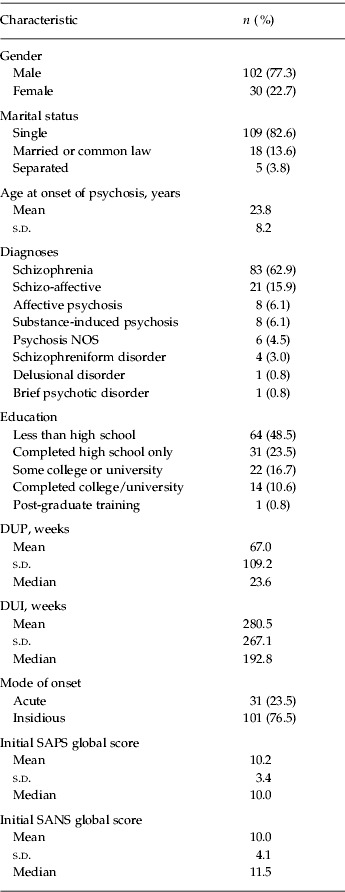
Characteristics of the sample are summarized in Table 1. The sample is predominantly male and over 80% schizophrenia spectrum disorder. Although PEPP is intended primarily to treat non-affective psychosis, there is often uncertainty about diagnosis at time of entry; and, if over time it becomes apparent that the patient has an affective psychosis, he/she remains in the program. Hence at 1 year 6% had a diagnosis of an affective psychosis. The mean DUP was 67.0 weeks (median of 26.7 weeks) and for DUI the values were 280.5 and 192.8 weeks, respectively. The distributions were positively skewed. A log10 transformation was most effective in approximating a normal distribution for DUP, whereas a square root transformation was more effective for DUI. Occasionally, data related to a variable could not be ascertained with confidence, resulting in final sample sizes for specific analyses ranging between 122 and 132.
Characteristics of sample (n=132)

s.d., Standard deviation; NOS, not otherwise specified; DUP, duration of untreated psychosis; DUI, duration of untreated illness; SAPS, Scale for the Assessment of Positive Symptoms; SANS, Scale for the Assessment of Negative Symptoms.
Data are given as number of subjects (percentage), mean and s.d. or median.
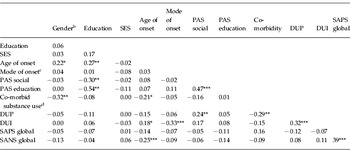
Table 2 shows that the predictors were not highly inter-correlated. Women had a later age of onset than men and were less likely to have co-morbid substance use or dependence. High educational achievement was correlated with a later age of onset and better pre-morbid adjustment. Symptoms at presentation were generally independent of other predictors, except for a negative correlation between age of onset and level of negative symptoms. DUP and DUI showed a modest correlation. Patients with better pre-morbid social adjustment and with substance abuse or dependence had shorter DUP. A longer DUI was associated with older onset age and a more insidious mode of onset of psychosis.
Correlations between predictionsFootnote a

SES, Socio-economic status; PAS, Premorbid Adjustment Scale, DUP, duration of untreated psychosis; DUI, duration of untreated illness; SAPS, Scale for the Assessment of Positive Symptoms; SANS, Scale for the Assessment of Negative Symptoms.
a For SES, DUP, DUI, SAPS global and SANS global, higher scores indicate greater status, treatment delay or symptoms. For PAS indices, higher scores indicate poorer pre-morbid adjustment.
b 0=Male; 1=female.
c 0=Insidious; 1=acute.
d 0=No co-morbidity; 1=co-morbidity.
* p<0.05, ** p<0.01, *** p<0.001.
At 5 years, two-thirds of individuals met criteria for remission of positive symptoms and half of the sample met criteria for remission of negative symptoms. Criteria for remission of both positive and negative symptoms were met by 42.4% of participants. With respect to the continuous measures of symptoms at 5 years of follow-up, the mean score on the total of SAPS global scores was 2.02 (s.d.=2.78) and for the SANS the mean was 5.16 (s.d.=3.79). The mean SOFAS score was 61.5 (s.d.=15.7). Just over 50% of patients received no psychiatric disability pension during the fifth year of follow-up, with the mean number of weeks on disability for the sample being 21.5 (s.d.=24.9) weeks. Occupational activity was calculated as the number of weeks that an individual was in full-time competitive employment or full-time studies. Just over 50% of the sample had no full-time employment and 18.4% had full-time employment throughout the year. For the entire sample, the mean number of weeks of full-time employment was 16.2 (s.d.=21.4) weeks.
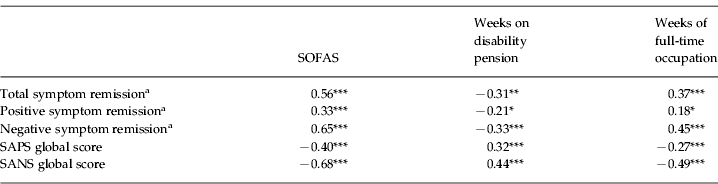
Table 3 shows the relationship of symptom outcomes to measures of functioning. Total symptom remission was significantly correlated with each of the functional measures, ranging from 0.56 with SOFAS scores to 0.31 with weeks on disability pension. When we compare the correlated correlation coefficients (Meng et al. Reference Meng, Rosenthal and Rubin1992), we find that negative symptoms show a greater inverse correlation with SOFAS than do positive symptoms regardless of whether we use the categorical remission of symptoms (Z=3.61, p<0.01) or continuous symptom measures (Z=3.79, p<0.01). Similarly, greater negative symptoms were more highly related to fewer weeks of full-time occupation than were positive symptoms (Z=2.66, p<0.05 for both remission category and continuous score). Indices of both positive and negative symptoms were significantly related to weeks on a disability pension.
Pearson correlations of symptom and functional outcomes

SOFAS, Social and Occupational Functioning Scale; SAPS, Scale for the Assessment of Positive Symptoms; SANS, Scale for the Assessment of Negative Symptoms.
a 0=Not in remission; 1=in remission.
* p<0.05, ** p<0.01, *** p<0.001.
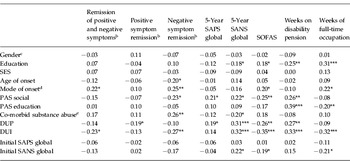
Table 4 shows the correlations between the predictor variables and outcomes at 5 years. Although total symptom remission is correlated with both acute mode of onset and shorter DUI, this pattern appears to be primarily reflecting the association between these early characteristics and remission of negative symptoms. DUP, not DUI, is correlated with remission of positive symptoms or SAPS score at 5 years. With respect to increased likelihood of negative symptom remission, in addition to acute onset, and shorter DUI, other correlates are older age of onset, presence of substance abuse at presentation and good pre-morbid social adjustment. When we examine SANS scores rather than meeting criteria for remission, the patterns of predictors change. Higher SANS scores are correlated with less education, poor pre-morbid social adjustment, absence of substance abuse, longer DUP and DUI and higher SANS scores at presentation. Both shorter DUP and DUI show significant bivariate correlations with better SOFAS scores as do better pre-morbid social adjustment and more education. More weeks on disability pension during the fifth year of follow-up show bivariate relationships with longer DUP and DUI, lower education level, and poor social and educational pre-morbid adjustment. Shorter DUI (but not DUP) and acute onset are associated with more weeks of competitive employment. A stronger educational background at presentation, as indexed by either education level achieved or scores on the PAS educational adjustment subscale, as well as an acute mode of onset and a lower level of negative symptoms at presentation also correlate with weeks of full-time employment.
Pearson correlations of initial characteristics with outcomes at 5 yearsFootnote a

SAPS, Scale for the Assessment of Positive Symptoms; SANS, Scale for the Assessment of Negative Symptoms; SOFAS, Social and Occupational Functioning Scale; SES, socio-economic status; PAS, Premorbid Adjustment Scale; DUP, duration of untreated psychosis; DUI, duration of untreated illness.
a For SES, DUP, DUI, SAPS global and SANS global, higher scores indicate greater status, treatment delay or symptoms. For PAS indices, higher scores indicate poorer pre-morbid adjustment.
b 0=Not in remission; 1=in remission.
c 0=Male; 1=female.
d 0=Insidious; 1=acute.
e 0=No co-morbidity; 1=co-morbidity.
* p<0.05, ** p<0.01, *** p<0.001.
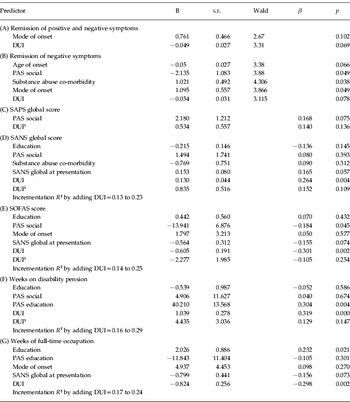
To investigate the independent relationship of predictors to outcomes, we carried out logistic regression analyses for the binary measures of total symptom remission and remission of negative symptoms and linear regression for each of the SAPS, SANS and SOFAS scores, as well as weeks on disability and weeks of occupational activity. The predictors included all and only those showing bivariate relationships with the relevant outcomes.
Table 5 provides more evidence of DUI rather than DUP being an independent predictor of outcomes. After controlling for other presenting characteristics, DUI is a predictor of scores on the SANS and SOFAS, as well as the number of weeks on disability and weeks of full-time employment. In addition, its regression weights in predicting total remission of symptoms and remission of negative symptoms approach statistical significance.
Prediction of 5-year outcomes

s.e., Standard error; DUI, duration of untreated illness; PAS, Premorbid Adjustment Scale; SAPS, Scale for the Assessment of Positive Symptoms; DUP, duration of untreated psychosis; SANS, Scale for the Assessment of Negative Symptoms; SOFAS, Social and Occupational Functioning Scale.
We repeated the regression analyses in a sample restricted to those with schizophrenia spectrum disorder (schizophrenia, schizo-affective disorder and schizophreniform disorder). The pattern of findings with respect to prediction of 5-year outcomes was similar to that in Table 5.
To assess the relative importance of treatment delay in predicting level of negative symptoms and SOFAS and weeks on disability pension, we examined the change in R 2 when DUI was added to the regression equation. The values in Table 5 show that DUI added 7–13% to the variance explained.
Discussion
We have presented the findings of a 5-year prospective study of the role of treatment delay, as indexed by both DUP and DUI, in predicting outcomes. In addition to symptoms, our outcome measures include the SOFAS and number of weeks on a disability pension and weeks of full-time, competitive employment or studies in the fifth year of follow-up. Assessment of outcomes were made blind of indices of treatment delay and our retention rate compares favourably with those of other recent prospective studies of first-episode patients (Harris et al. Reference Harris, Henry, Harrigan, Purcell, Schwartz, Farrelly, Prosser, Jackson and McGorry2005; Bertelsen et al. Reference Bertelsen, Jeppesen, Petersen, Thorup, Øhlenschlaeger, Le Quach, Christensen, Krarup, Jørgensen and Nordentoft2008; Addington & Addington, Reference Addington and Addington2009; Crumlish et al. Reference Crumlish, Whitty, Clarke, Browne, Kamali, Gervin, McTigue, Kinsella, Waddington, Larkin and O'Callaghan2009). Distributions of DUP, DUI and acuity of onset are similar to earlier reports using similar methodology (e.g. Häfner & an der Heiden, Reference Häfner and an der Heiden1999; Häfner, Reference Häfner2000) and rates of symptom remission are comparable with those from a recent long-term follow-up of patients of a specialized early intervention service (Henry et al. Reference Henry, Amminger, Harris, Yuen, Harrigan, Prosser, Schwartz, Farrelly, Herrman, Jackson and McGorry2010).
The correlation we report between DUI and DUP is much lower than the r=0.82 reported by Crumlish et al. (Reference Crumlish, Whitty, Clarke, Browne, Kamali, Gervin, McTigue, Kinsella, Waddington, Larkin and O'Callaghan2009). The DUI calculated by Crumlish et al. (Reference Crumlish, Whitty, Clarke, Browne, Kamali, Gervin, McTigue, Kinsella, Waddington, Larkin and O'Callaghan2009) appears to have consisted of roughly equivalent parts DUP and non-specific early signs. On the other hand, in our DUI index and those of Harris et al. (Reference Harris, Henry, Harrigan, Purcell, Schwartz, Farrelly, Prosser, Jackson and McGorry2005) and Keshavan et al. (Reference Keshavan, Roberts and Wittmann2006), the pre-psychosis component was much greater than that of DUP. This may explain the lower correlation between the delay indices in the current study. We cannot tell whether these differences reflect variation in methodology or differences in samples.
Although there was a significant relationship between DUP and level of positive symptoms at 5 years, it accounted for less than 4% of the variance in SAPS score. Furthermore, the role of DUP in predicting positive symptoms was no longer significant when social pre-morbid adjustment was controlled. There have been past reports suggesting a decline in the strength of the relationship between DUP and positive symptoms as the period of follow-up is extended. For instance, Addington et al. (Reference Addington, Van Mastrigt and Addington2004) noted a weakening of the relationship between DUP and positive symptoms between 12 and 24 months of follow-up. Similarly, a contrast of reports by Jeppesen et al. (Reference Jeppesen, Petersen, Thorup, Abel, Ohlenschlaeger, Christensen, Krarup, Jorgensen and Nordentoft2008) and Bertelsen et al. (Reference Bertelsen, Jeppesen, Petersen, Thorup, Øhlenschlaeger, Le Quach, Østergaard Christensen, Krarup, Jørgensen and Nordentoft2009) from the OPUS trial suggests a weakening of the relationship between DUP and symptoms over time.
In general, DUI was a more robust predictor of several treatment outcomes. It showed bivariate correlations with total remission of symptoms, indices of negative symptoms, global ratings of social and occupational functioning as well as utilization of a disability pension and extent of full-time competitive occupation or studies. In all cases, except the total remission of symptoms and the remission of positive symptoms, DUI remained a significant independent predictor when other initial characteristics were statistically controlled. Relevant bivariate correlations and increments in variance explained in regression analyses suggest that DUI generally explains around 10% of the variance in treatment outcomes.
There has been particular interest in the role of pre-morbid adjustment in explaining any relationship between treatment delay and outcome. This has been examined primarily with reference to DUP (Larsen et al. Reference Larsen, Moe, Vibe-Hansen and Johannessen2000; Verdoux et al. Reference Verdoux, Liraud, Bergey, Assens, Abalan and van Os2001). On the whole, past findings suggest that the relationship between DUP and positive symptoms at follow-up is independent of pre-morbid adjustment (Marshall et al. Reference Marshall, Lewis, Lockwood, Drake, Jones and Croudace2005). On the other hand, Jeppesen et al. (Reference Jeppesen, Petersen, Thorup, Abel, Ohlenschlaeger, Christensen, Krarup, Jorgensen and Nordentoft2008) report that the relationship between DUP and negative symptoms at follow-up may be confounded by pre-morbid adjustment. In the current data pre-morbid adjustment, particularly social pre-morbid adjustment, showed bivariate relationships with negative symptoms, SOFAS score and use of disability pension. Educational pre-morbid adjustment was correlated with weeks on disability pension and full-time occupation. Although there was evidence that social pre-morbid adjustment was an independent predictor criterion for remission of negative symptoms at 5 years, whereas DUI was not, the role of DUI in predicting SANS global score, SOFAS, weeks on disability pension and weeks of full-time occupation was not confounded by pre-morbid adjustment.
Could the failure to find a significant relationship between DUP and some 5-year outcomes reflect a truncated distribution of DUP? Do members of our sample have particularly short DUPs? There is wide variation in the distribution of DUP reported across studies, and it is difficult to determine the extent to which this reflects differences in measurement procedures or differences in samples (Norman & Malla, Reference Norman and Malla2001). Our distribution does not appear particularly truncated in comparison with many other reports based on samples from non-early intervention programs including those that found a relationship between DUP and outcomes (e.g. Drake et al. Reference Drake, Haley, Akhtar and Lewis2000; Clarke et al. Reference Clarke, Whitty, Browne, McTigue, Kamali, Gervin, Kinsella, Waddington, Larkin and O'Callaghan2006) and our findings regarding the relationship of DUP and DUI to longer-term outcomes are comparable with another study based on a non-specialized program (Crumlish et al. Reference Crumlish, Whitty, Clarke, Browne, Kamali, Gervin, McTigue, Kinsella, Waddington, Larkin and O'Callaghan2009). Furthermore, there is very limited evidence that the efforts of early intervention programs, including ours, to reduce treatment delay are effective in changing the distribution of DUP (Malla et al. Reference Malla, Norman, Scholten, Manchanda and McLean2005; Lloyd-Evans et al. Reference Malla, Norman, Scholten, Manchanda and McLean2011).
Our findings concerning the role of DUP and DUI in predicting outcomes are consistent with three earlier reports. Keshavan et al. (Reference Keshavan, Haas, Miewald, Montrose, Reddy, Schooler and Sweeney2003), Harris et al. (Reference Harris, Henry, Harrigan, Purcell, Schwartz, Farrelly, Prosser, Jackson and McGorry2005) and Crumlish et al. (Reference Crumlish, Whitty, Clarke, Browne, Kamali, Gervin, McTigue, Kinsella, Waddington, Larkin and O'Callaghan2009) found DUI to be a better predictor of negative symptoms and/or functioning at follow-up. Our results extend these findings to objective measures of functioning such as use of disability pension and weeks of employment. Our current data are also consistent with the model presented by Häfner and associates (Häfner & an der Heiden, Reference Häfner and an der Heiden1999; Häfner, Reference Häfner2000), which emphasizes the importance of the often lengthy period of negative and non-specific symptoms prior to the onset of psychosis in bringing about deficits in functioning. As others have noted, DUI may be a trait-like marker for poor outcome rather than having a causal influence on long-term functioning (Keshavan et al. Reference Keshavan, Roberts and Wittmann2006; Crumlish et al. Reference Crumlish, Whitty, Clarke, Browne, Kamali, Gervin, McTigue, Kinsella, Waddington, Larkin and O'Callaghan2009). The current findings show that DUI predicts functioning in a 5-year follow-up independently of other indices of early course and accounts for around 10% of the variance in such outcomes. This suggests that we should seriously consider the possibility of a causal influence.
These findings indicate that while earlier intervention for psychotic symptoms may help improve treatment outcomes as assessed by positive symptoms, the proportion of variance accounted for by the timing of the intervention may decline over time. This does not necessarily detract from the importance of specialized early intervention programs for psychosis as the potential benefits of such efforts may be more influenced by the content of intervention rather than timing (Malla & Norman, Reference Malla and Norman2001; Brabban & Dodgson, Reference Brabban and Dodgson2010; Singh, Reference Singh2010).
Providing definitive proof of causation usually involves assessing the impact of interventions. In the current context this approach confronts practical and conceptual challenges. While the mental health field has effective interventions for anxiety and depression, which are common in the pre-psychosis period (Norman et al. Reference Norman, Scholten, Malla and Ballageer2005b), interventions to reduce negative symptoms are more problematic (Erhart et al. Reference Erhart, Marder and Carpenter2006). Furthermore, there needs to be clarity concerning our objectives with respect to DUI. The objective is unlikely to be simple reduction in DUI by speeding up the occurrence of psychosis and its treatment. On the other hand, perhaps any cumulative effect of DUI on functional outcomes is as much influenced by the severity or disruptiveness of these early changes as their duration. This suggests the possibility that the prompt delivery of psychosocial interventions designed to ameliorate functional impairments and symptoms may have long-term benefits independently of any impact on the development or severity of psychotic symptoms (Häfner, Reference Häfner2000; Singh, Reference Singh2010).
Acknowledgements
This research was supported by grant no. 57925 from the Canadian Institutes of Health Research.
Declaration of Interest
None.