


Introduction
Determining when airborne infection isolation (AII) can be safely discontinued in patients with suspected pulmonary tuberculosis (TB) remains a common challenge for Infection Prevention and Control (IPC) programs. Reference Diel, Nienhaus, Witte and Ziegler1,Reference Manzoor, Rhee, Baker and Klompas2 Current Centers for Disease Control and Prevention (CDC) recommendations allow discontinuation of AII when a diagnosis of TB is unlikely and after three negative smears for acid-fast bacilli (AFB) have been obtained from respiratory specimens, or when an alternative diagnosis adequately explains the clinical presentation. Reference Jensen, Lambert, Iademarco and Ridzon3 In practice, the microbiologic criteria (three negative AFB smears) alone are commonly applied. However, the imperfect sensitivity of AFB smear microscopy, particularly among immunocompromised individuals, and transmission risk in smear-negative individuals with pulmonary TB, Reference Yang, Pan and Lee4 has led some institutions to adopt more conservative discontinuation practices. Reference Thomas, Bello and Seto5,Reference Davidson, Chesen, Kumar and Shayowitz6 At our tertiary-care center, which cares for a large population of patients with malignancy, transplantation, and other causes of advanced immunosuppression, AII is discontinued only after an explanatory alternative infectious or noninfectious diagnosis has been established, even when microbiologic criteria (three negative AFB smears) have been met. Although this approach prioritizes prevention of nosocomial TB transmission, it may also prolong isolation duration and increase resource utilization. In low-TB-incidence settings such as ours, the optimal balance between maximizing patient safety and minimizing unnecessary isolation remains uncertain.
To assess the potential tradeoff between safety and efficiency, we aimed to quantify the difference in duration of TB AII following a microbiology-based approach compared with our institution’s more restrictive practice.
Methods
Study design and setting
We conducted a retrospective observational study among patients admitted to UPMC Presbyterian Shadyside between January and December 2024. This study was approved by the UPMC Quality Review Committee as a quality improvement project.
We included all patients with clinically suspected pulmonary TB who were placed in AII during a hospital admission in 2024 and for which the IPC team was aware. If a patient was admitted more than once during the study period, we included the first admission only. Data was obtained by reviewing the IPC investigation records and electronic medical records of patients listed in the IPC database.
AII discontinuation criteria
To quantify the impacts of differing criteria on AII duration, we calculated the duration of precautions defined by the following discontinuation strategies. Under our observed institutional practice, the alternative diagnosis approach, AII was discontinued when an alternative infectious or non-infectious diagnosis explaining the clinical presentation had been established by the clinical team caring for the patient, regardless of the number of negative AFB respiratory smears performed. For the three-AFB approach, fulfillment of microbiologic criteria for TB exclusion and discontinuation of AII was met with three consecutive negative respiratory AFB smears (sputum or bronchoalveolar lavage) collected at least 8 hours apart, including at least one early-morning specimen. For patients who had already met microbiologic criteria before hospital admission but were subsequently placed on AII, the microbiologic criteria–based AII duration was recorded as 0 days. Because not all patients are able to produce three respiratory specimens, we also defined a hybrid approach: AII duration was defined as the earlier date either the alternative diagnosis or three-AFB criteria were met. For all three approaches, AII duration was calculated as the number of isolation days between initiation of AII (or hospital admission, whichever occurred later) and the date AII would be discontinued using the specific definition. Nucleic acid amplification testing (NAAT) is used only for AFB smear-positive respiratory specimens, and is not considered in the determination of precaution duration.
TB transmission risk
We also evaluated whether discontinuation of AII among patients diagnosed with pulmonary TB using either the three-AFB or hybrid approaches would have resulted in potential healthcare transmission.
Statistical methods
For all alternative approaches, the differences in AII duration relative to the alternative diagnosis approach were calculated and summarized descriptively. Stata version 18.0 was used for statistical analysis (StataCorp, College Station, Texas, USA).
Results
Pulmonary TB was considered for 97 patients during the study period, among which 17 patients (17.5%) were unable to produce sputum and did not submit a respiratory specimen, 17 (17.5%) submitted one sample, 11 (11.3%) submitted two samples, and 52 (53.6%) submitted three samples. Among the 80 patients with ≥1 respiratory specimen, all respiratory smears were negative for AFB in 70 (87.5%) patients and 10 (12.5%) patients had at least one positive smear.
Four patients (4.1%) had culture-confirmed pulmonary TB, including two with concomitant extrapulmonary disease. All four had three respiratory AFB smears, among which three (75%) patients had three positive smears and one (25%) patient had a single positive smear. All of these had a positive NAAT result. Regardless of the approach to discontinuation of precautions, each patient would have remained in AII through the time of diagnosis.
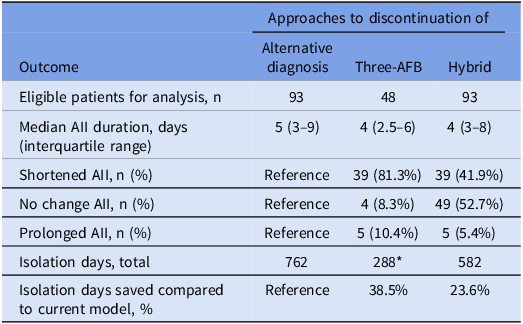
Among the 93 (95.9%) patients who received a diagnosis other than TB, the median isolation duration under the alternative diagnosis approach was 5 days (interquartile range [IQR], 3–9 d). The median (IQR) duration of isolation applying the three-AFB and hybrid approaches were 4 (2.5–6) days and 4 (3–8) days, respectively. The three-AFB and hybrid approaches shortened AII duration in 81% and 42% of evaluable cases, respectively, and reduced the total number of isolation days by 23%–39% (Table 1).
Airborne isolation duration for patients without pulmonary tuberculosis

Table 1. Long description
The table compares three approaches to discontinuation of airborne isolation for patients without pulmonary tuberculosis. It has 8 rows and 4 columns. The columns are labeled Outcome, Alternative diagnosis, Three-AFB, and Hybrid. The rows are labeled Eligible patients for analysis, n; Median AII duration, days (interquartile range); Shortened AII, n (%); No change AII, n (%); Prolonged AII, n (%); Isolation days, total; Isolation days saved compared to current model, %. Row 1: Eligible patients for analysis, n; Alternative diagnosis, 93; Three-AFB, 48; Hybrid, 93. Row 2: Median AII duration, days (interquartile range); Alternative diagnosis, 5 (39); Three-AFB, 4 (2.56); Hybrid, 4 (38). Row 3: Shortened AII, n (%); Alternative diagnosis, Reference; Three-AFB, 39 (81.3%); Hybrid, 39 (41.9%). Row 4: No change AII, n (%); Alternative diagnosis, Reference; Three-AFB, 4 (8.3%); Hybrid, 49 (52.7%). Row 5: Prolonged AII, n (%); Alternative diagnosis, Reference; Three-AFB, 5 (10.4%); Hybrid, 5 (5.4%). Row 6: Isolation days, total; Alternative diagnosis, 762; Three-AFB, 288; Hybrid, 582. Row 7: Isolation days saved compared to current model, %; Alternative diagnosis, Reference; Three-AFB, 38.5; Hybrid, 23.6.
Note. AFB, acid fast bacilli; AII, airborne infection isolation.
*Total isolation days for these 48 patients according to alternative diagnosis criteria was 468 days.
Discussion
In this quality improvement study among patients with suspected pulmonary TB under AII, using the three-AFB and hybrid approaches would have reduced isolation days in non-TB patients without additional transmission risk in patients diagnosed with pulmonary TB compared to our current alternative diagnosis approach. The median duration of AII under the alternative diagnosis approach was 5 days for non-TB patients and 4 days for both the three-AFB and hybrid approaches. For non-TB patients, AII duration would have been shorter in 81.3% and 41.9% of patients under the three-AFB and hybrid approaches, respectively. Four (2.1%) patients were given a diagnosis of pulmonary TB, none of whom would have undergone erroneous discontinuation of AII under any of the evaluated discontinuation approaches.
Our findings suggest that a microbiologic discontinuation strategy could reduce AII duration. Although we did not observe premature discontinuation of precautions among confirmed TB cases, the sample size limits confidence in this finding. The practical impact of this strategy is limited by the fact that only half of patients in our cohort completed a three-specimen evaluation. Thus, although microbiologic criteria shortened isolation in most eligible patients, nearly half of the study population would not have qualified for this approach. Although the three-AFB approach maximizes opportunities for earlier isolation discontinuation, it does not account for the risk of smear-negative pulmonary TB which contributes to transmission. In contrast, the benefits of AII reduction were substantially attenuated under the hybrid approach, which more closely reflects current CDC recommendations by incorporating both microbiologic findings and clinical assessment.
At our institution, clinical suspicion for TB and identification of an alternative diagnosis remains central to decisions regarding AII discontinuation. An algorithm that incorporates NAAT may help support earlier discontinuation of isolation, particularly in paucibacillary disease and immunocompromised hosts who may initially have negative AFB smears. Reference Luetkemeyer, Firnhaber and Kendall7,8 Furthermore, although published studies have attempted to define risk prediction models, a pragmatic approach may still be needed. Reference Rakoczy, Cohen and Nguyen9,Reference Dugdale, Zachary and Craig10 Future studies should evaluate whether integrating molecular diagnostics into discontinuation algorithms can safely reduce isolation duration while maintaining protection against nosocomial TB transmission.
Acknowledgements
None.
Financial support
None reported.
Competing interests
All authors report no conflicts of interest relevant to this article.

 Open access

