Introduction
Considerable efforts have been directed at identifying the male traits upon which mating preferences are based, but less attention has been paid to factors unrelated to male traits that influence the expression of female preferences. Such factors may be divided into those extrinsic to the female, i.e. environmental conditions, and those intrinsic to the female, i.e. age, experience, or genetic makeup (Mautz and Sakaluk Reference Mautz and Sakaluk2008). Extrinsic factors that have been shown to influence female mate choice include the risk of predation (Hedrick and Dill Reference Hedrick and Dill1993; Csada and Neudorf Reference Csada and Neudorf1995), ambient light (Gamble et al. Reference Gamble, Lindholm, Endler and Brooks2003), and seasonal changes (Borg et al. Reference Borg, Forsgren and Amundsen2006). Intrinsic factors that influence how females choose their mates include female condition (Luttbeg et al. Reference Luttbeg, Towner, Wandesforde-Smith, Mangel and Foster2001; Hunt et al. Reference Hunt, Brooks and Jennions2005), reproductive state (Lynch et al. Reference Lynch, Rand, Ryan and Wilczynski2005), hormonal state (Lynch et al. Reference Lynch, Crews, Ryan and Wilczynski2006), and female age and mating history (Forslund and Part Reference Forslund and Part1995; Prosser et al. Reference Prosser, Murray and Cade1997; Moore and Moore Reference Moore and Moore2001; Martin and Hosken Reference Martin and Hosken2002; Mack et al. Reference Mack, Priest and Promislow2003).
Age represents special case because this is known to strongly influence mating preferences. As females age, their reproductive investment is expected to decline and selection pressure on choosiness is expected to weaken (Futuyma Reference Futuyma1998). Such females are expected to be less selective of prospective mates as they get older. Numerous models have discussed the role of male age in influencing mate choice by female. Good genes models or viability indicator models of age-related mate choice predict that females should prefer older males as mates (Trivers Reference Trivers1972; Halliday Reference Halliday1978, Reference Halliday1983; Manning Reference Manning1985) because they have demonstrated survival ability or because their signals are potentially more revealing (Kokko and Lindström Reference Kokko and Lindström1996; Kokko Reference Kokko1997; Proulx et al. Reference Proulx, Day and Rowe2002). Such models argue that females use age as a reliable signal of male quality and that by mating with older males, they gain indirect benefits through the production of higher-quality offspring. The choice for older males by females in insects has been well documented (Hasselquist et al. Reference Hasselquist, Bensch and Von Schantz1996; Sundberg and Dixon Reference Sundberg and Dixon1996); however, there are some contrary reports (Petrie Reference Petrie1993; Olsson and Madsen Reference Olsson and Madsen1995; Pérez-Staples et al. Reference Pérez-Staples, Martínez-Hernández and Aluja2010).
Models proposed by Hansen and Price (Reference Hansen and Price1995) and Beck and Powell (Reference Beck and Powell2000) on mate choice by female are contrary. They suggest the selection of middle-aged males as mates by the female. Females mating with intermediate-aged and younger males gain direct benefits through increased fertility (Jones et al. Reference Jones, Balmford and Quinnell2000) and/or indirect benefits via improved offspring viability (Price and Hansen Reference Price and Hansen1998). Age-related decline in mating and fertilisation success have been reported in a wide range of species (Price and Hansen Reference Price and Hansen1998; Jones et al. Reference Jones, Balmford and Quinnell2000; Kidd et al. Reference Kidd, Eskenazi and Wyrobek2001; Bonduriansky and Brassil Reference Bonduriansky and Brassil2002; Omkar et al. Reference Pandey, Rastogi and Mishra2010). Although many studies have explored female-based choice for male age and looked at the consequences for choosy females, few have explored simultaneously the impact of male and female age for fecundity and fertilisation success. It is this simultaneous approach that makes the present study different from most previous studies on mate choice.
For the study, we have selected parthenium beetle, Zygogramma bicolorata Pallister (Coleoptera: Chrysomelidae), a model biocontrol agent used for the management of pernicious weed, Parthenium hysterophorus Linnaeus (Asteraceae; Dhileepan et al. Reference Dhileepan, Setter and McFadyen2000). Despite multiple studies on mate choice, the question of how mate age influences mate choice remains unanswered. Since there are no previous studies on this aspect in Z. bicolorata and no clear outline on the best mate age (experimentally as well as hypothetically based on the above mentioned models), we did the study with the assumption that individuals of all ages will be equally preferred as mates. The aim of the present study was first, to assess whether mate preference was influenced by age of the potential mates; second, to assess the relative role of male and female age on fecundity and fertilisation success (direct benefits); and third, to explore the relative importance of male and female age for the development and survival of offspring (indirect benefits).
Materials and methods
Study species
Zygogramma bicolorata is a potential biocontrol agent of Parthenium. It was first introduced in Queensland, Australia in 1980 (Dhileepan and McFadyen Reference Dhileepan and McFadyen1997) and in India in 1983 (Jayanth and Nagarkatti Reference Jayanth and Nagarkatti1987). In India, it resulted in significant reduction in Parthenium density in the area of release (Jayanth and Visalakshy Reference Jayanth and Visalakshy1996) and has since then spread widely. The total developmental period (duration from the eggs to adult emergence) of Z. bicolorata is 32.0 ± 1.0 days at 27°C. When newly emerged adults were paired for a lifetime and allowed to mate at freewill, longevity of male Z. bicolorata was 61.0 ± 3.0 days, while for the female it was 76.9 ± 2.1 days (Omkar et al. Reference Rastogi and Pandey2008). Polyandrous females of Z. bicolorata had higher reproductive performance than monandrous ones, and offspring of polyandrous females allowed mate choice developed fastest (Omkar and Pandey Reference Pandey2010).
Establishment of stock culture
Adults of Z. bicolorata collected from University campus, Lucknow, India were brought to the laboratory to establish stock in Environmental Test Chamber (CH-6S, Remi Instruments, Mumbai, India) at 27 ± 1 °C, 65% ± 5% relative humidity, and 14 light hours:10 dark hours. They were sexed and paired, with females being significantly larger than the males. Eggs laid by these pairs were separated and observed for hatching. The hatched instars were reared in transparent plastic Petri dishes (9.0 × 2.0 cm) on fresh leaves of P. hysterophorus as a food source until pupation. The leftover leaves were removed and fresh ones provided daily. The fully grown instars were transferred to plastic beakers (9.0 × 6.5 cm) filled with moist sand for pupation. Newly emerged adults were isolated and placed individually in Petri dishes.
Experiments
(A) Influence of age on mate choice
Unmated male and female adults of Z. bicolorata of varying age groups (young: 10–15 days, middle age: 30–35 days, and old: 50–55 days) were collected from the stock. To observe the mate choice in relation to age, one male was grouped in a Petri dish (9.0 × 2.0 cm) with three females, one from each age group. The same experiment was also done in the reverse order; i.e., one female with three males, one from each age group. The adults were differentiated with white dots (1, 2, or 3) placed on elytra. The number of dots was rotated from replica to replica to avoid a confounding effect of dots on mate choice. In each treatment, the groups were observed for the absence/occurrence of mating for 30 minutes. Abiotic and biotic conditions of experiments were similar to that of stock. Thirty replicates were carried out. Each beetle was used only once in the experiment. In none of the above replicates were active intrasexual interactions observed that might affect mate choice.
(B) Influence of age on reproductive attributes
All nine possible sets of mating pairs as described for the previous experiment were set up to determine daily oviposition: young female × young male (set 1), young female × middle-aged male (set 2), young female × old male (set 3), middle-aged female × young male (set 4), middle-aged female × middle-aged male (set 5), middle-aged female × old male (set 6), old female × young male (set 7), old female ×middle-aged male (set 8), and old female × old male (set 9). Each pair was allowed to mate only once after which the male was removed. Daily oviposition for the next 20 days (considered as fecundity) and number of larvae hatched were recorded in 10 replicates of each set.
(C) Influence of age on development and survival of offspring
A total of 500 hundred eggs (50 eggs per female) of Z. bicolorata per treatment were collected from experiments (B), placed at 27 °C on freshly cut Parthenium leaves. Egg hatch was recorded and the neonate larvae were placed in Petri dishes along with fresh excised leaves. Dried leaves were replaced daily with fresh ones. The instars were observed for moulting. Number of instars surviving each moult and the duration of each instar were recorded every 24 hours. Fully grown grubs were transferred from Petri dishes to plastic glass beakers (6.5 × 9.5 cm) filled with moist sand for pupation.
Statistical analysis
The percentage of mating incidences at different adult ages was analysed using chi-square (χ2) goodness-of-fit test based on assumption that all ages of male and female will be equally preferred by mates. Total development period was calculated by adding up the incubation period, durations of first, second, third, and fourth instars, and pupae. Percentage larval survival (%) and percentage pupal survival were calculated. Data on fecundity, development, and survival (dependent factors) were subjected to a two-way analysis of variance (ANOVA) with female and male age as independent factors followed by Tukey's post hoc honest significance test at 5% level using statistical software MINITAB-13.1 (Minitab Inc., State College, Pennsylvania, United States of America).
Results
(A) Influence of age on mate choice
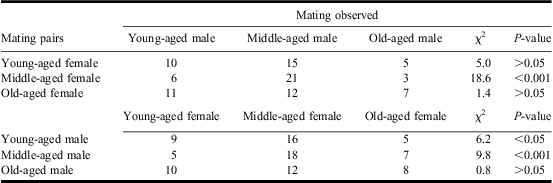
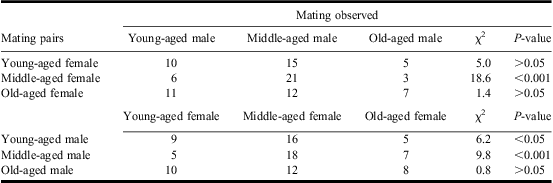
The results revealed that middle-aged males were preferred as mates over young- and old-aged males by middle-aged females (χ2 = 18.6, P < 0.001) (Table 1). Older (χ2 = 1.4, P > 0.05) and young females (χ2 = 5.0, P > 0.05) did not show any significant preference for males of any particular age, though they mated more with middle-aged males (Table 1). A significant mate preference for middle-aged females was found in middle-aged males (χ2 = 9.8, P < 0.001), while younger males (χ2 = 6.2; P < 0.05) showed a bias against old females and no preference for middle-aged females. Older males did not show significant (χ2 = 0.8, P > 0.05) mate choice between females of different ages.
Age-dependent mating incidence in Zygogramma bicolorata (n = 30) in different age combinations.
(B) Influence of age on reproductive attributes
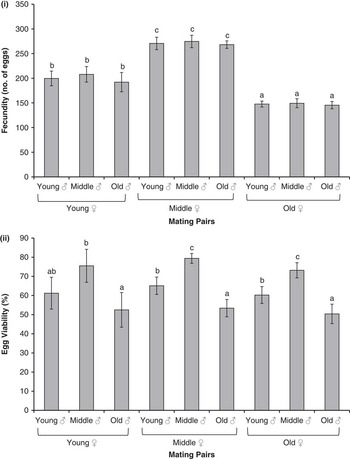
The results revealed that fecundity of Z. bicolorata was significantly influenced by female age (F = 74.29, P < 0.001, df = 2, 89) but not by male age (F = 0.37, P > 0.05, df = 2, 89). The interaction between female and male age was statistically insignificant (F = 0.06, P > 0.05, df = 4, 89). Middle-aged females were found to be the most fecund, while the old-aged females were least fecund (Fig. 1). The comparison of individual means of fecundity revealed that there was no statistically significant difference within the mating pairs formed by young females; i.e., fecundity was not affected by male age. Similar observations were also recorded for middle- and old-aged females.
Effect of age-based pairing in Zygogramma bicolorata on (i) fecundity and (ii) percent egg viability. Values are Mean ± SE. Same letters shows insignificant differences among individual means at P > 0.05.

The percentage egg viability of the mating pairs differed significantly in relation to male age (F = 12.04, P < 0.001, df = 2, 89). However, effect of female age (F = 0.45, P > 0.05, df = 2, 89) and the interaction of the two independent factors (F = 0.02, P > 0.05, df = 4, 89) was found to be insignificant. Maximum viability was observed in middle-aged males, while old males had the lowest viability estimates (Fig. 1).
(C) Influence of age on development and immature survival of offspring
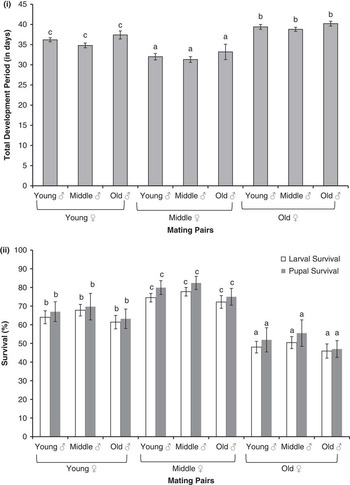
The two-way ANOVA revealed that total developmental period of offspring of different mating pairs of Z. bicolorata was significantly influenced by the age of female (F = 71.52, P < 0.001, df = 2, 89) and male (F = 5.26, P < 0.01, df = 2, 89); however, the interaction term of male and female age had no significant influence (F = 0.16, P > 0.05, df = 4, 89). Progeny of middle-aged females developed more quickly than those produced by young females, which in turn developed more quickly than those produced by old females.
Percentage larval survival of offspring of different mating pairs of Z. bicolorata was significantly influenced by female age ([F = 51.03, P < 0.001, df = 8, 89]; Fig. 2) but not by male age (F = 2.21, P > 0.05, df = 2, 89). Maximum percentage larval survival was recorded for the offspring of middle-aged females, and minimum for offspring of females of old-aged group. The individual means of percentage larval survival did not differ significantly within the matings of young females with males of different ages. Similar trends were also recorded in middle- and old-aged females.
Effect of age-based pairing in Zygogramma bicolorata on (i) total development period and (ii) percent larval and pupal survival. Values are Mean ± SE. Same letters shows insignificant differences among individual means of a parameter at P > 0.05.

Percentage pupal survival of offspring of different mating pairs was also influenced by female age (F = 16.46, P < 0.001, df = 8, 89) but not male age (F = 1.77, P > 0.05, df = 2, 89; Fig. 2). Similar trends were observed in percentage pupal survival as in percentage larval survival.
Discussion
The study demonstrated that both male and female of Z. bicolorata exhibit mate choice under laboratory conditions in a Petri dish environment. The mating trials revealed that middle-aged adults showed most discrimination in choosing mates and middle-aged mates were selected most frequently. Our results indicate that the males gain benefit from mating with middle-aged female via the fecundity of their mates and females benefit from an increased egg viability sired by middle-aged males.
In the present study, it was evident that the number of matings occurring with middle-aged males was higher in females of all age groups; i.e., young, middle, and old-aged groups, though significant preference was evident only in the middle-aged females. This result has been found previously in a number of other insects (Price and Hansen Reference Price and Hansen1998; Jones et al. Reference Jones, Balmford and Quinnell2000; Jones and Elgar Reference Jones and Elgar2004; Wedell and Ritchie Reference Wedell and Ritchie2004; Beck and Promislow Reference Beck and Promislow2007) and supports several theoretical models (Hansen and Price Reference Hansen and Price1995, Reference Hansen and Price1999; Kokko Reference Kokko1998; Beck and Powell Reference Beck and Powell2000). Trade-off model of Beck et al. (Reference Beck, Shapiro, Choksi and Promislow2002) suggested that females should prefer to mate with intermediate-aged males as they have the highest reproduction values for fitness, and are of higher genetic quality than older males. In contrast to the present study, females of Drosophila pseudoobscura Frolova and Astaurov preferred to mate with old males and accepted older males faster than young males (Avent et al. Reference Avent, Price and Wedell2008) as was also suggested by the ‘viability indicator’ models of Kokko and Lindström (Reference Kokko and Lindström1996, Reference Kokko and Lindström1997) and Proulx et al. (Reference Proulx, Day and Rowe2002).
The above arguments of better genetic quality are supported by the significant influence of age of male mates on percentage egg viability. Mating with middle-aged males resulted in significantly higher number of viable eggs. Old males exhibit a significant reduction in the number of viable eggs. The present findings closely agree with those reported in the seed beetle Callosobruchus maculatus (Fabricius) (Coleoptera: Chrysomelidae) (Ofuya Reference Ofuya1995); Drosophila serrata (Malloch) (Diptera: Drosophilidae) (Hercus and Hoffmann Reference Hercus and Hoffmann2000); Dermestes maculatus (De Geer) (Coleoptera: Dermestidae) (Jones and Elgar Reference Jones and Elgar2004); the bulb mite, Rhizoglyphus robini Claparede (Arachnida: Acaridae) (Radwan et al. Reference Radwan, Michalczyk and Prokop2005); and the oriental beetle, Exomala orientalis (Waterhouse) (Coleoptera: Scarabaeidae) (Wenninger and Averill Reference Wenninger and Averill2006). This decline in fertilisation success in matings between the young- and old-aged pairs of parthenium beetle recorded in present study may possibly be ascribed to differences in sperm quantity. Young males probably transfer significantly lower quantities of sperm than those of intermediate age. Similarly, old males are also likely to transfer less sperm than their intermediate age rivals (Hale et al. Reference Hale, Elgar and Jones2008). It is also likely that the quality of sperm may also differ with age, old-aged males having less viable and less motile sperms.
This study also evaluated male mate choice, a relatively less studied aspect. Although the preference for middle-aged females was more prominent among the middle-aged males, it was not so evident in the younger and older males. The younger males were more biased against the older females, rather than towards the middle-aged ones. Theoretically, males should prefer those females that tend to maximise their expected fertilisation success from each mating. Such preferences tend to favour females with a phenotype associated with high fecundity (Bonduriansky Reference Bonduriansky2001). This could be the probable reason that middle-aged females were preferred as mates by middle-aged males. Similar findings were also documented earlier (Polak et al. Reference Polak, Starmer and Barker1998; Bateman and Ferguson Reference Bateman and Ferguson2004). However, it is also largely accepted that the males are less likely to forego any mating opportunity since their fitness is determined by the number of offspring they sire.
The better suitability of middle-aged females as mates is evident in terms of the reproductive as well as offspring fitness. Pairs having middle-aged females laid the maximum number of eggs. This is probably due to the fact that their ages at the time of mating play a significant role in capability of females to lay higher number of eggs. The reproductive value of females is expected to decline with old age because selection is weak in older females (Futuyma Reference Futuyma1998).
The total developmental period of offspring of middle-aged females was found to be the shortest. The present finding is in conformity with the finding in C. maculatus (Fox Reference Fox1993; Fox et al. Reference Fox, Bush and Wallin2003), where similar effect of age on the development period of offspring was reported. Offspring of old females developed slowest and recorded highest developmental duration. The present finding corroborates the findings in Drosophila melanogaster Meigen (Mills and Goldstein Reference Mills and Goldstein1985); stink bugs, Podisus nigrispinous (Dallas) and Podisus maculiventris (Say) (Hemiptera: Pentatomidae) (Mohaghegh et al. Reference Mohaghegh, Clercq and Tirry1998); and a cockroach, Nauphoeta cinerea (Olivier) (Blattodea: Blaberidae) (Moore and Harris Reference Moore and Harris2003). The results could be explained by the probability of increased incidence of mutations at old age, which may have been passed on to her eggs. The occurrence of mutations has also been suggested in various ageing theories, especially the mutation accumulation theory (Medawar Reference Medawar1952), which states that deleterious mutations that exert their effects late in life would tend to accumulate (Hamilton Reference Hamilton1966; Partridge and Barton Reference Partridge and Barton1993; Pletcher and Curstinger Reference Pletcher and Curstinger1998).
Larval survival of offspring was also influenced by maternal age. Offspring of middle-aged females had highest larval survival. This might possibly be due to their faster development, which probably resulted in their better chances of survival than offspring of other parents. Another reason for the lower survival of offspring of older females could be the accumulation of genetic abnormalities in the eggs as well as sperms (Crow Reference Crow1997; Jung et al. Reference Jung, Schuppe and Schill2003). The findings of the other studies supporting our results were documented in Drosophila species (Hercus and Hoffmann Reference Hercus and Hoffmann2000), C. maculatus (Fox et al. Reference Fox, Bush and Wallin2003), and Sitophilus oryzae (Linnaeus) (Coleoptera: Curculionidae) (Opit and Throne Reference Opit and Throne2007).
The percentage pupal survival was also strongly influenced by maternal age. The offspring of middle-aged females had highest pupal survival. The present finding also agrees with those in C. maculatus (Wasserman and Asami Reference Wasserman and Asami1985), D. serrata (Hercus and Hoffmann Reference Hercus and Hoffmann2000), S. oryzae (Opit and Throne Reference Opit and Throne2007), and Cheilomenes sexmaculata (Coleoptera: Coccinellidae) (Singh and Omkar Reference Singh2008).
It may be concluded that: (i) highest percentage incidence of mating between middle-aged females and middle-aged males suggests them as preferred mates; (ii) mating with middle-aged females and males resulted in highest fecundity and egg viability, respectively; (iii) total developmental period of immature stages was shortest for offspring of middle-aged females and longest for offspring of old-aged females; (iv) maximum larval and percentage pupal survival was recorded for the offspring of middle-aged females, while minimum was in old-aged females; and (v) middle-aged beetles may be used for mass multiplication to produce offspring with better developmental and survival attributes. Also, this study gives a guideline for mass release of the beetle under field conditions and it is advised that a greater number of middle-aged individuals should be released to improve chances of faster population increase.
Acknowledgements
The authors thank two anonymous referees for their insightful suggestions, which helped improve the manuscript. The second author is thankful to the Department of Higher Education, Government of Uttar Pradesh, Lucknow, India for providing financial assistance under the Centre of Excellence programme.