Implications
We investigated responses of Boer goats to saline drinking water in a free-choice system. Such a free-choice system is similar to natural range conditions where choices between different water sources may be required. Goats demonstrated their capacity to differentiate between various salt concentrations and balanced their sodium intake from water and feed without adverse effects on health. Compared with two-choice preference tests, the present free-choice protocol allows the evaluation of how quickly animals are able to adjust their salt ingestion by self-selection as well as the change in their acceptance of saline water over time.
Introduction
Salt (NaCl) is an essential element in animal diets (Suttle, Reference Suttle2010). Sodium (Na+) is the main cation in interstitial fluids and plays a dominant role in regulating body fluid homoeostasis, nerve function, body temperature maintenance, absorption of chlorine, amino acids, glucose and water (National Research Council (NRC), 2007; Suttle, Reference Suttle2010). In drinking water, the amount of sodium chloride can vary enormously depending on its source, from virtually none in some streams to high concentrations from deep wells or boreholes (Underwood, Reference Underwood1981). However, prolonged ingestion of salt concentrations of 1.5% to 2% and greater from saline drinking water causes a reduction in food intake and increases mortality in sheep (Peirce, Reference Peirce1957; Wilson, Reference Wilson1966b; Wilson and Dudzinski, Reference Wilson and Dudzinski1973). Salt tolerance has been found to be related to many factors such as mineral concentrations in the diet, physiological adaptation, thermal stress and even foetal programming (e.g. review by Digby et al., Reference Digby, Chadwick and Blache2011). Studies also revealed a different sensitivity of salt intake according to the source of intake, with higher salt tolerance from food than from drinking water, indicating that different physiological responses are involved (Wilson, Reference Wilson1966b; Mdletshe et al., Reference Mdletshe, Chimonyo, Marufu and Nsahlai2017). This observation may be partly explained by the fact that nutrients dissolved in water are absorbed much faster than nutrients from solid food (Sherwood et al., Reference Sherwood, Klandorf and Yancey2005). In order to avoid high salt concentration in body fluids, one major adaptive response is to consume more water and to increase salt excretion through urine (Wilson and Dudzinski, Reference Wilson and Dudzinski1973). However, this adaptive response is compromised when only saline water is available because drinking more water would add to the salt load.
It is postulated that animals possess innate regulation mechanisms that allow them to select a balanced diet according to their nutrient requirements (Fedele et al., Reference Fedele, Claps, Rubino, Calandrelli and Pilla2002). There is evidence based on choice experiments that this occurs in sheep (Kyriazakis and Oldham, Reference Kyriazakis and Oldham1993), goats (Fedele et al., Reference Fedele, Claps, Rubino, Calandrelli and Pilla2002) or laying hens (Emmans, Reference Emmans1977). So far there are few studies describing taste responses and thresholds to saline drinking water in goats (Bell, Reference Bell1959), sheep (Goatcher and Church, Reference Goatcher and Church1970a and 1970b) and cattle (Bell and Williams, Reference Bell and Williams1959) using a two-choice preference test (Patton and Ruch, Reference Patton and Ruch1944). However, this situation is not comparable with natural range conditions where choices between different water sources may be required. Zhang et al. (Reference Zhang, Cao, Rubenstein, Zang, Songer, Leimgruber, Chu, Cao, Li and Hu2015) described that equids adapt their drinking behaviour in desert areas where water points of differing salinity levels (5‰ to 11‰) were available. Although Przewalski horses mainly used the low salinity water resources, the khulan consumed water from all water points.
In our study, we designed a free-choice situation close to natural conditions where goats had free access to fresh water along with four different concentrations of salted water. The aim of the study was to evaluate the capacity of goats to choose when different sources of saline or fresh water are offered simultaneously. To our knowledge, comparable free-choice studies on saline water concentrations have not been reported. Properties of the water may stimulate the senses (e.g. smell and taste) and enable the animal to anticipate possible post-ingestive effects of the saline water (Fedele et al., Reference Fedele, Claps, Rubino, Calandrelli and Pilla2002). We focussed on how quickly the animals were able to adjust their choice to manage their salt intake and whether they were able to avoid excessive salt ingestion by timely adjustments in their selection.
Material and methods
Animals and management
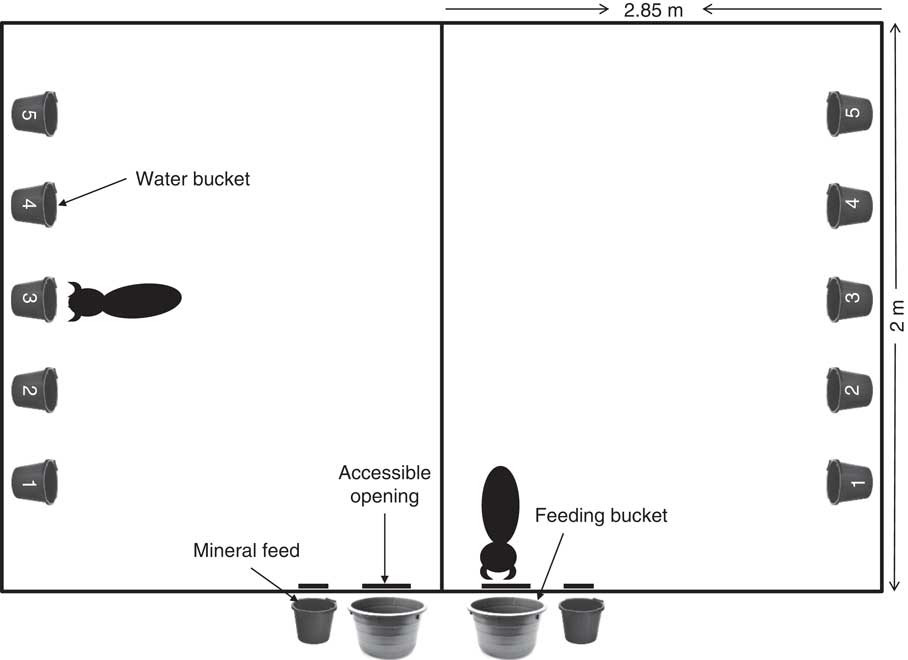
The experiment was conducted in two test runs at the Department of Animal Sciences, University of Göttingen, Germany in spring 2017. In each test run, the same experimental procedure was followed with six Boer goats for 4 weeks. In total, 12 non-pregnant female Boer goats aged between 1 and 8 years with an average BW of 46.4±8.3 kg were involved. Animals originated from the breeding herd of the Department. Animals were transferred to the experimental pens 1 week before the start of the trial for acclimatization. Three identical rooms, subdivided into two individual pens (2.85×2 m) with a controlled environment were used. Straw was provided as bedding material. Each pen was equipped with one feed trough (diameter 53 cm), and five identical water buckets (diameter 28 cm, 10 l capacity), which were placed side by side along the wall numbered from 1 (closest to the feed trough) to 5 (Figure 1). Throughout the experimental period, goats had access to cut hay and water ad libitum. In addition, a mineral supplement (Solan 178 Mineralfutter für Schafe and Zeigen®; Solan Kraftfutter Schmalwieser GesmbH, Bachmanning, Austria; ingredients per kilogram: Calcium 25.00%, Phosphorus 5.00%, Sodium 5.60%, Magnesium 2.30%, Vitamin A 800 000 I.E., Vitamin D3 85 000 I.E., Vitamin E 3 000 mg, Manganese as manganese oxide 1.850 mg, Zinc as zinc oxide 5 900 mg, Iodine as calcium iodate 55 mg, Selenium as sodium selenite 40 mg and Cobalt as cobalt carbonate 30 mg) was offered in a separate bucket at the amount of 25 and 30 g/day in young and old goats, respectively. The ambient temperature (°C) and relative humidity (%) in each room were recorded continuously at 20-min intervals with miniature data loggers (iButton DS1923L-F5#, resolution: 0.0625°C; Maxim Integrated Products, Sunnyvale, CA, USA) placed at the height of 1.0 m from the floor. The daily average ambient temperature (T a) and relative humidity were 19.3±0.9°C and 41.0±7.9% in a test run 1 and 20.0±1.1°C and 40.6±6.5% in run 2, respectively. The stables were equipped with windows to provide natural light. The light schedule was maintained constant at 14 h light: 10 h dark, with artificial lighting from 0630 until 2030 h.
Positions of feeding (big black bucket for hay and a small bucket for a mineral feed at the outside of pens accessible by openings) and drinking water buckets (five small black buckets at the inside of the pens) in the experimental pens for Boer goats.

The study was conducted in two phases. In the control phase, only tap water was supplied for 1 week, and water intake from each bucket was measured. Each animal received the same amount of water in its five buckets in order to habituate to the following choice situation. In the subsequent treatment phase of 3 weeks, fresh water and four different concentrations (0.75%, 1.0%, 1.25% and 1.5% NaCl) of saline water were offered simultaneously. Goats could choose freely among all buckets in their pen. The average sodium content of tap water was 7.55 mg/l. For the preparation of saline water, salt (Esco Siede-Speisesalz, Hannover, Germany) with 99.8% NaCl purity was used and added at defined amounts to tap water. The water buckets were replenished with test solutions daily, and the positions of the concentrations were changed daily at random in order to avoid a bias due to position effects.
Body weight, body condition score, water and feed intakes
Individual BW was recorded on a weekly basis in the morning before feeding with a mobile scale (Salter Brecknell LS300, capacities: 300 kg, resolution: 0.2 kg; Salter Brecknell, Smethwick, West Midlands, UK). The body condition score (BCS, scale: 1=emaciated, 5=obese with 0.5 increments) was assessed weekly as described by Villaquiran et al. (Reference Villaquiran, Gipson, Merkel, Goetsch and Sahlu2007). Individual water intake from each bucket was recorded daily at 0830 h using an electronic scale (Sartorius model CP 34 000; Sartorius AG, Göttingen, Germany) as well as the corresponding NaCl concentration and the position of the bucket. The daily amount of test solution consumed was expressed as a percentage of the total fluid intake from all water buckets. A control bucket was placed in the stable and re-weighed daily to estimate the water loss by evaporation, and the total daily drinking water intake (TDWI) was corrected accordingly. The total water intake (TWI) was determined as the sum of TDWI and the water content in consumed food. The cut hay was offered at 0800 h, and the feed buckets were refilled twice per day. Feed consumption was determined daily by re-weighing. Feed intake was also expressed as intake per kg BW0.75, and water intake as intake per kg BW0.82 since water use by animals is related to the live weight of animals to the power of 0.82, as water is used in the body for intermediary metabolism and also for evaporative cooling (Wilson, Reference Wilson1989).
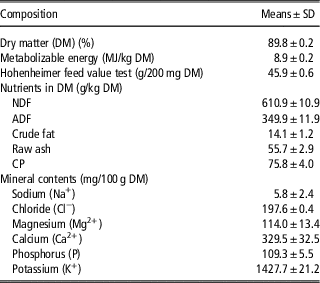
Hay samples were collected weekly. Ground samples (1-mm screen) were analysed using standard methods (Verband Deutscher Landwirtschaftlicher Untersuchungs- und Forschungsanstalten (VDLUFA), 2012; all values summarized in Table 1) for dry matter (DM) (VDLUFA method 3.1), ash (method 8.1), CP (method 4.1.2 – Dumas; Elementar VarioMAX CN, Langenselbold, Germany), ether extracts (method 5.1.1), NDF and ADF (expressed without residual ash – NDFom and ADFom, methods 6.5.1 and 6.5.2; Ankom Fiber Analyzer 220, Macedon, NY, USA). The metabolizable energy was estimated using prediction equations for ruminants (Gesellschaft für Ernährungsphysiologie/Society of Nutrition Physiology, 2009), including values from Hohenheim gas test (Menke et al., Reference Menke, Raab, Salewski, Steingass, Fritz and Schneider1979; VDLUFA method 25.1). For the feed and water, Na and Cl were determined from aqueous extract using ion chromatography with conductivity detection (LUFA 10.5.2) (Dionex DX-100; Sunnyvale, CA, USA). For Ca, Mg, P and K analyses, samples were ashed and dissolved in HCl. Ca, Mg and K were measured via atomic absorption spectroscopy (Varian SpectrAA-300, Palo Alto, CA, USA) and P was measured photometrically. Individual mineral feed intake was determined by re-weighing the residual of the mineral supplement at the end of the week with a scale (Sartorius Practum 5101-1S; Sartorius Lab Instruments GmbH, Göttingen, Germany). Total sodium (Na+) intake was determined as the sum of the amount of sodium consumed from hay, mineral supplement, fresh and saline drinking water.
Chemical composition of hay supplied (means±SD) to Boer goats during the experiment

Statistical analysis
The results from earlier studies showed a higher salt sensitivity in young compared with adult sheep (Wilson and Dudzinski, Reference Wilson and Dudzinski1973). In order to take into account a possible age effect, goats were classified as young (N=8) or adult (N=4) when younger or older than 2 years, respectively. Statistical analyses of all recorded data were performed using the MIXED procedure of the computer software package Statistical Analysis System (SAS version 9.3). Weekly averages were calculated for DM intake, TDWI, TWI and saline water intake. In addition, the amount of each test solution consumed (experimental weeks 2 to 4) was expressed as a percentage of the total fluid intake from all containers. For all traits, with the exception of water intake during the experimental phase when different salt concentrations were offered, the model included the fixed effects of test run, week, age, their interactions and the random effect of the animals. Model (1) was:
 $$\eqalignno{Y_{{ijklm\,{\equals\,}}} \mu &{\plus}R_{i} {\plus}W_{j} {\plus}A_{k} {\plus}\left( {R{\times}W} \right)_{{ij}} {\plus}\left( {W{\times}A} \right)_{{ik}} \cr&{\plus}\left( {R{\times}A} \right)_{{ik}} {\plus}G_{l} {\plus}e_{{ijklm}} $$
where Y ijklm is the observation value; μ the overall mean; R i the run (i=1, 2); W j the week (j=weeks 1 to 4); A k the age (k=young, old); interactions (R×W), (W×A), (R×A); G l the random effect of the goats; e ijklm the random error.
The following model (2) was used for sodium intake throughout the experiment:
 $$Y_{{ijklm\,{\equals\,}}} \mu {\plus}R_{i} {\plus}P_{j} {\plus}A_{k} {\plus}\left( {R{\times}P} \right)_{{ij}} {\plus}\left( {P{\times}A} \right)_{{ik}} {\plus}G_{l} {\plus}e_{{ijklm}} $$
where Y ijklm is the observation value; μ the overall mean; R i the run (i=1, 2); P j the phase (j=control, treatment); A k the age (k=young, old); interactions (R×P), (P×A); G l the random effect of the goats; e ijklm the random error.
For water intake during the experimental phase, the following model (3) was used:
 $$\eqalignno{ Y_{{ijklmno\,{\equals\,}}} \mu &{\plus}R_{i} {\plus}C_{j} {\plus}A_{k} {\plus}W_{l} {\plus}B_{m} {\plus}\left( {W{\times}A} \right)_{{kl}} \cr &{\plus}\left( {C{\times}W} \right)_{{jl}} {\plus}\left( {C{\times}A} \right)_{{jk}} {\plus}\left( {C{\times}B} \right)_{{jm}} {\plus}\left( {R{\times}C} \right)_{{ij}} \cr &{\plus}{\rm } \left( {R{\times}A} \right)_{{ik}} {\plus}\left( {R{\times}B} \right)_{{im}} {\plus}\left( {C{\times}W{\times}A} \right)_{{jlk}} {\plus}G_{n} \cr &{\plus}e_{{ijklmno}} $$
where Y ijklmno is the observation value; μ the overall mean; R i the run (i=1, 2); C j the concentration (1 to 5); A k the age (k=young, old); W l the week (l=week 2 to 4); B m the bucket position (m=1 to 5); interactions (W×A), (C×W), (C×A), (C×B), (R×C), (R×A), (R×B), (C×W×A); G n the random effect of the goats; e ijklmno the random error. All values were presented as least squares means±SEM. The significance level was set at P<0.05.
Results
Body weight, body condition score, feed and water intakes
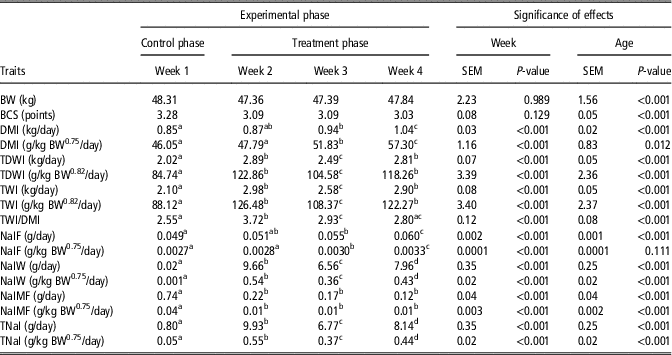
Body weight remained constant during the entire experiment (P=0.99), while there was a tendency for a decrease in BCS (P=0.13) (Table 2). Older goats showed significantly (P<0.001) higher BW and lower BCS (52.8±10.9 kg and 2.5±0.2 points) than young goats (42.7±2.9 kg and 3.7±0.3 points). Dry matter intake (g/kg BW0.75 per day) increased significantly during the experiment (P<0.001). Food consumption was higher (P=0.012) in old goats compared with young animals (52.3±12.8 g/kg BW0.75 per day v. 49.2±9.1 g/kg BW0.75 per day). Similarly, older goats had a significantly (P<0.001) higher TWI (129.3±41.0 g/kg BW0.82 per day) compared with young goats (93.3±23.6 g/kg BW0.82 per day). In the control phase (week 1) when only fresh water was offered, TDWI (g/kg BW0.82 per day) and TWI (g/kg BW0.82 per day) were significantly (P<0.001) lower than in the successive weeks. Both TWI and TDWI increased in week 2 when goats first received different concentrations of saline water along with fresh water (Table 2).
Average BW, body condition score (BCS), daily feed, water and sodium intake for control (week 1) and treatment (weeks 2 to 4) phases in Boer goats (N=12) corrected by body mass

DMI=dry matter intake; TDWI=total drinking water intake; TWI=total water intake; NaIF, NaIW and NaIMF=sodium intake from the feed, water and mineral feed, respectively; TNaI=total sodium intake.
a,b,c,dMeans within the same row with different superscripts differ significantly by P<0.05.
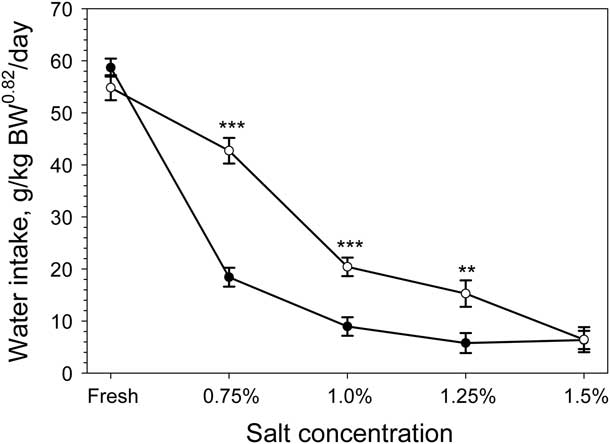
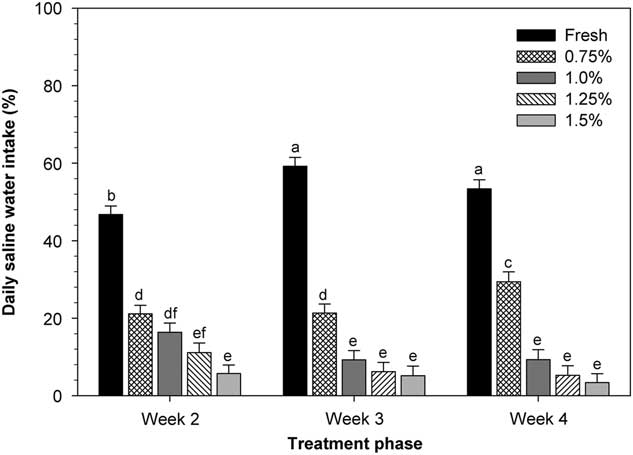
The responses to saline drinking water in a simultaneous choice situation are given in Figure 2. Across the treatment phase, salt water consumption was significantly (P<0.001) higher in adult (27.9±31.5 g/kg BW0.82 per day) than in young goats (19.6±27.1 g/kg BW0.82 per day). Young and old goats consumed similar amounts of fresh water (58.7±27.1 g/kg BW0.82 per day and 54.8±33.6 g/kg BW0.82 per day, respectively). However, young goats avoided the intake of saline water more strictly than older animals. Across both age groups, saline water intake was continuously reduced for increasing salt concentrations. Figure 3 depicts the development of daily saline water intake, expressed as a percentage of TDWI. Throughout the treatment phase, all goats had a significant preference for fresh water (0% salt) over saline water. At the first confrontation with the simultaneous choice situation (week 2), animals did not differentiate between the salt concentration of 0.75% and 1.0%. However, with proceeding treatment (weeks 3 and 4), animals clearly distinguished saline water concentrations and preferred the 0.75% salt concentration.
Daily fresh and saline water intake in young (N=8, 1 to 2 years, filled circles) and old (N=4, 2 to 8 years, open circles) Boer goats in a free-choice system across treatment phases (3 weeks; see text for details). Goats had the choice between fresh and four different concentrations of saline water. **P<0.01; ***P<0.001 for comparison between ages for respective salt concentration.

Daily fresh and saline water intake (% of total drinking water intake) of Boer goats (N=12) in a free-choice system during the treatment phase (weeks 2 to 4). Animals could choose between five buckets; one with fresh water and four with increasing concentrations of NaCl in drinking water. a,b,c,d,e,fSignificant differences between intake of salt concentrations across weeks, P<0.05.

Sodium (Na+) intake
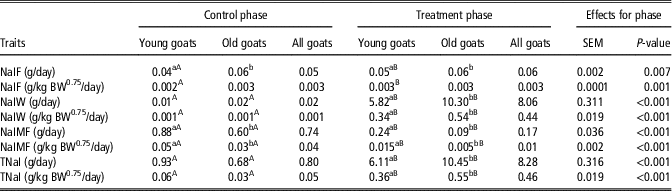
Total sodium (Na+) intake from the feed, water and mineral feed differed significantly (P<0.001) across the whole experiment. Due to the exclusive provision of fresh water in week 1 (control phase), Na+ intake in this week was significantly lower than in weeks 2 to 4 when different concentrations of saline water were provided (Tables 2 and 3). Across the entire experiment, young goats had a significantly (P<0.001) lower total sodium intake (4.8±4.1 g/day) compared with older goats (8.0±6.7 g/day).
Influence of age of Boer goats on daily sodium (Na+) intake in control (only fresh water) and treatment (different concentrations of saline water) phases

NaIF, NaIW and NaIMF=sodium intake from the feed, water and mineral feed, respectively; TNaI=total sodium intake.
abSignificant differences between ages within one row P<0.05.
ABSignificant differences between treatment within one row P<0.05.
Discussion
In our study, Boer goats quickly adjusted their salt ingestion in a free-choice design when fresh water and different concentrations of salinated water were offered simultaneously. Our results suggest that Boer goats can balance salt intake from saline water without health impairment when they have free access to fresh water.
Sodium (Na+) intake
In the control phase when only fresh water was offered, the total sodium intake of the goats ranged between 0.68±0.34 and 0.93±0.40 g/day and compares well with the maintenance recommendation of 0.75 to 0.95 g/day (40 to 50 kg BW goats) given by NRC (2007). During the treatment phase, however, the sodium intake of the goats sharply increased to values between 6.77±4.53 and 9.93±5.90 g/day is 8 to 11 fold higher than the daily requirement. It has been shown that herbivores possess a specific appetite for sodium (Denton and Sabine, Reference Denton and Sabine1961) and if sodium is provided ad libitum, animals tend to consume more than they need. The highest Na+ ingestion was observed in the 1st week of the free-choice situation and decreased in the subsequent weeks. These observations suggest a learning effect in the regulation of Na+ intake, similar to results from a free-choice system of diets in goats (Fedele et al., Reference Fedele, Claps, Rubino, Calandrelli and Pilla2002). Interestingly, goats decreased their Na+ intake significantly via the mineral feed in the free-choice phase. Similarly, higher sodium intake from water decreased the intake of sodium from a mineral supplement in dairy cows (Smith et al., Reference Smith, Lengemann and Reid1953) and sheep (Langbein et al., Reference Langbein, Scheibe and Eichhorn1998). Our results indicate the animals’ capacity to balance their sodium intake from different sources and confirm the observation that salt intake from feed and fluids involve different physiological responses in the animal (Wilson, Reference Wilson1966b; Masters et al., Reference Masters, Rintoul, Dynes, Pearce and Norman2005; Digby et al., Reference Digby, Chadwick and Blache2011). This difference in ingesting salt in feed or drinking water may be partly explained by the fact that nutrients dissolved in water are absorbed much faster than nutrients from solid food (Sherwood et al., Reference Sherwood, Klandorf and Yancey2005). It seems that the capacity to self-select drinking water with different sodium contents was not perfect because total salt ingestion was higher in the treatment phase than in the control phase. However, present duration of 3 weeks might have been too short for the adaptive behavioural and physiological responses to be expressed fully.
Water intake
Total water consumption increased with saline water ingestion, which is in agreement with previous findings for saline water intake in sheep (Peirce, Reference Peirce1957; Wilson and Dudzinski, Reference Wilson and Dudzinski1973), rusa deer stags (Kii and Dryden, Reference Kii and Dryden2005) as well as fallow and red deer (Ru et al., Reference Ru, Fischer, Glatz and Bao2004). Similarly, excess sodium in the diet increased water consumption in all aforementioned species and also in poultry (Mongin, Reference Mongin1981) resulting in higher volume and moisture contents of excreta. In the present free-choice design, Boer goats also had the opportunity to consume fresh water, which might have balanced the intake of sodium from saline drinking water and avoided an increase in water content of body fluids. Several studies showed that excess sodium intake is principally regulated in the kidneys by control of reabsorption of sodium, changes in the active transport and the membrane permeability (Suttle, Reference Suttle2010) and by increasing renal sodium excretion through urine and skin (Wilson, Reference Wilson1966b; Suttle Reference Suttle2010). A key physiological response to high salt ingestion is to increase water intake. However, this adaptive reaction is compromised when only saline drinking water is available, as it increases salt load in the body fluids. In such cases, the animals have limited other adaptive responses to draw upon, beyond the excretion of increased amounts of salt via urine and a reduction of feed and water intake. We did not observe any clinical signs such as diarrhoea, general weakness or any nervous symptoms that may accompany excessive salt intake in drinking water (Peirce, Reference Peirce1957; Kii and Dryden, Reference Kii and Dryden2005). Accordingly, Boer goats appear to be able to balance their excess sodium intake by preferring fresh water or saline water with the lowest salt concentration and remained within a physiologically acceptable range.
Salt sensitivity
Fresh water intake was significantly higher compared with saline water intake underlining the ability of goats to distinguish between fresh and different concentrations of saline water. The choice of goats for saline water was variable with a preference for lower concentrations, whereas salt concentrations of 1% to 1.5% were clearly rejected. Pygmy goats and cattle showed strong preferences for 1.25% saline water, while sheep and normal goats remained indifferent when sufficient sodium was provided in their diet (Goatcher and Church, Reference Goatcher and Church1970b). In our experiment, the lowest saline water intake (less than 20% of TWI) was recorded with 1.25% and 1.5% of salt concentration, indicating a rejection threshold (Goatcher and Church, Reference Goatcher and Church1970a). Similar preferences for low salt concentrations of 0.85% and 1.25% were found for goats and sheep by Goatcher and Church (Reference Goatcher and Church1970b), whereas their estimated rejection threshold of 3.12% to 3.50% was higher than in our study. However, the approach used by Goatcher and Church (Reference Goatcher and Church1970a and 1970b) is not fully comparable with our study as their two-choice preference tests evaluate the short-term taste discrimination, whereas the present free-choice system allows insight into long-term preferences for saline drinking water.
Influence of age on sodium (Na+) intake
In our free-choice system, sensitivity responses of goats to saline drinking water varied with their ages. Young goats showed a higher sensitivity to saline water with a lower rejection threshold at 0.75% salt concentration (Figure 2). A similar lower salt tolerance was found in growing sheep ingesting salt from both food and drinking water (Wilson and Dudzinski, Reference Wilson and Dudzinski1973). Our results might be explained by a better learning capacity of young goats to find the fresh water in a choice situation. However, physiological explanations appear more plausible. Salt taste receptors are more sensitive in younger animals (Grzegorczyk et al., Reference Grzegorczyk, Jones and Mistretta1979) and children (Fukunaga et al., Reference Fukunaga, Uematsu and Sugimoto2005), and allow a more differentiated choice between saline water concentrations. On the other hand, younger animals contain a higher percentage of body water (Riek and Gerken, Reference Riek and Gerken2010), which may enhance the transport of Na+ to cell tissues and activate respective regulation mechanisms at lower salt ingestion than in older animals.
Dry matter intake, BW and body condition score
Dry matter intake increased gradually when goats had access to both saline and fresh water. This increase may be caused by increasing palatability of feed (Grovum and Chapman, Reference Grovum and Chapman1988) and enhanced digestion due to stimulated microbial activities in the rumen when drinking water supplemented with small amounts of salt is ingested. Similarly, Kattnig et al. (Reference Kattnig, Pordomingo, Schneberger, Duff and Wallace1992) found that food intake tended to be higher in Holstein steers when 0.23% saline water was supplied. Studies in sheep and rusa deer (Wilson and Dudzinski, Reference Wilson and Dudzinski1973; Kii and Dryden, Reference Kii and Dryden2005) also support these results. Feed intake was not affected by 1.5% salt water concentrations in sheep (Peirce, Reference Peirce1957) and deer (Ru et al., Reference Ru, Fischer, Glatz and Bao2004). However, water containing 2% or more salt leads to a severe reduction in food intake (Peirce, Reference Peirce1957; Wilson, Reference Wilson1966b). Similarly, high salt concentrations (20%) in diets resulted in reduced feed intake in sheep (Wilson, Reference Wilson1966b; Masters et al., Reference Masters, Rintoul, Dynes, Pearce and Norman2005). On the other hand, the intake of halophytic plants such as Atriplex (saltbush) and Kochia (bluebush) (Wilson, Reference Wilson1966a) was improved with the availability of fresh water. Saline drinking water had little effect on BW and BCS of our experimental goats. Similar results were found by Peirce (Reference Peirce1957) in sheep receiving salt concentration up to 1% in drinking water. The tendency for lower BCS found in the treatment phase could indicate that water retention may have contributed to constant BW (Masters et al., Reference Masters, Rintoul, Dynes, Pearce and Norman2005).
Free-choice system
Earlier studies applied a two-choice preference test for saline water (Goatcher and Church, Reference Goatcher and Church1970a) with increasing or decreasing concentrations (Patton and Ruch, Reference Patton and Ruch1944). To our knowledge, the present study is the first report of a free-choice system for salt concentrations in drinking water in ruminants. We observed a marked shift in preferences of saline water during the course of the experiment with the rejection threshold becoming lower with prolonged exposure. Apparently, there are different behavioural and physiological mechanisms between salt ingestion in feed and drinking water influencing the animals’ choices. In the 1st week, goats had to learn that the buckets contained different saline water concentrations. In experiments of Langbein et al. (Reference Langbein, Siebert, Nürnberg and Manteuffel2007) dwarf goats showed a remarkable learning capacity to solve complex learning tasks. Occasional video observations in our study revealed that goats tested the solutions from the different buckets before they made a final decision.
It is obvious that Na+ intake needs to be regulated by the animal because it is the major extracellular element influencing osmolarity of body fluids. Its important role may also explain the fact that it can be quantified sensorically by the animal. Despite this sensory capacity, the additional offer of sodium in water led to a considerably higher (approximately 10×) sodium intake in this trial, and it poses the question why goats did not down regulate their sodium intake via reducing the intake of water containing sodium. An explanation may be that while goats were accustomed to regulate Na+ intake from solid feeds, they were far less trained to regulate Na+ intake from water. Against this background, some adaptation time seems comprehensible even for a nutrient that can be detected by the animal directly. In addition, any regulation via sensory detection must not be considered perfect but has rather been developed to prevent excessive ingestion of amounts of osmotically highly effective amounts of sodium. The fine adjusting of daily sodium ingestion will still involve learning and physiological feedback from ingested Na+. Despite its significance for osmolarity of body fluids, ruminants are considered very tolerant to high sodium intakes as long as free access to fresh water is available. In fact, animals in this trial were always well beyond the limits communicated as having the potential to influence the performance of an animal negatively, for example, 9% sodium in DM (Jeroch et al., Reference Jeroch, Drochner and Simon2007) or 4% sodium in DM (NRC, 2007).
Conclusions
The results of our study suggest that goats are able to balance their sodium intake through water in a free-choice system. Compared with two-choice preference tests, the present free-choice protocol allows the evaluation of how quickly animals are able to adjust their salt ingestion by self-selection as well as the change in their acceptance of saline water over time. After only 1 week of exposure, goats had developed a stable preference. However, it remains open to question, whether the salt intake was regulated by post-ingestive mechanisms only as suggested by Fedele et al. (Reference Fedele, Claps, Rubino, Calandrelli and Pilla2002) in their choice system of diets. The higher rejection of saline water ingestion in young goats suggests at least some involvement of intake regulation via taste sensitivity.
Acknowledgements
The authors thank J. Dörl and U. Vehlow (Department of Animal Sciences, University of Göttingen) for their technical assistance. This research was supported by a scholarship of the German Academic Exchange Service (DAAD) to R. A. R.
Declaration of interest
The authors declare no conflict of interest.
Ethics statement
Procedures performed in our study were in accordance with the German animal ethics regulations and approved by the State Office of Lower Saxony, Germany for Consumer Protection and Food Safety (ref. no.: 33.9-42502-04-16/2310).
Software and data repository resources
The data used during the current study are deposited at the Division of Livestock Ecology, Department of Animal Sciences, University of Göttingen, Germany.