INTRODUCTION
Disruption of pollination mutualisms resulting from anthropogenic disturbance can lead to reduced seed set (Aizen & Feinsinger Reference AIZEN and FEINSINGER1994), an increased risk of extinction (Bond Reference BOND1994) and a cascade of effects throughout entire ecosystems (Anderson et al. Reference ANDERSON, KELLY, LADLEY, MOLLOY and TERRY2011, Pauw Reference PAUW2007, Sekercioglu Reference SEKERCIOGLU2011). Understanding plant–pollinator relationships is vital for identifying plant species at risk of reproductive failure. Across much of Africa, studies on pollination relationships are lacking (Rodger et al. Reference RODGER, BALKWILL and GEMMILL2004).
Theory predicts that not all plant species will be equally affected by disruption to their pollinator mutualisms because certain traits confer resilience to pollinator loss (Aguilar et al. Reference AGUILAR, ASHWORTH, GALETTO and AIZEN2006, Bond Reference BOND1994). Self-compatible plants capable of autonomous self-fertilization are least dependent on pollinators while in contrast, self-incompatible, obligate outbreeders are entirely dependent on their pollinator mutualists. The more specialized the pollination mutualism, the more vulnerable it is to disruption through anthropogenic activity (Johnson & Steiner Reference JOHNSON and STEINER2000). Recently, the credibility of pollination syndromes as a means of predicting plant–pollinator relationships has been questioned as studies have revealed a wider suite of pollinators than the pollination syndrome would suggest (Hingston & McQuillan Reference HINGSTON and McQUILLAN2000, Kelly et al. Reference KELLY, LADLEY, ROBERTSON, NORTON, Young and Clarke1996, Reference KELLY, LADLEY, ROBERTSON, ANDERSON, WOTTON and WISER2010; Ollerton Reference OLLERTON1998, Pauw Reference PAUW1998, Robertson et al. Reference ROBERTSON, LADLEY and KELLY2005).
In this study we aim to describe the plant–pollinator mutualism of three loranthaceous Afromontane forest mistletoes occurring in the Ngel Nyaki Forest Reserve, Nigeria, and determine whether these three species differ in breeding system and the strength of their pollinator mutualisms. From these data we will predict their relative vulnerability to reduced pollinator abundance and/or diversity.
Self-compatibility is common within the Loranthaceae, however the capacity to self-pollinate is rare and outbreeding is considered the norm (Aizen Reference AIZEN2005, Azpeitia & Lara Reference AZPEITIA and LARA2006, Bernhardt et al. Reference BERNHARDT, KNOX and CALDER1980, Docters van Leeuwen Reference DOCTERS VAN LEEUWEN1954, Ladley et al. Reference LADLEY, KELLY and ROBERTSON1997). Most African Loranthaceae display some form of explosive flower opening (Evans Reference EVANS1895) but exhibit wide diversity in terms of the floral characteristics and signals presented to pollinators (Kirkup Reference KIRKUP, Polhill and Weins1998, Polhill Reference POLHILL, Holm-Nielsen, Nielsen and Balslev1989). Explosive opening is typically obligate, where the flower cannot open unless visited by a biotic agent and is an adaptive strategy for specialized pollination by birds (Docters van Leeuwen Reference DOCTERS VAN LEEUWEN1954, Feehan Reference FEEHAN1985, Ladley et al. Reference LADLEY, KELLY and ROBERTSON1997). Flower opening takes place in either one or two stages (Feehan Reference FEEHAN1985, Kirkup Reference KIRKUP1993). Two-stage flowers open further at the second touch of the pollinator and it is not until the second stage that the anthers are forced to shed their pollen explosively (Kirkup Reference KIRKUP1993, Ladley & Kelly Reference LADLEY and KELLY1995). Success in the two steps of the pollination process, flower opening and pollen deposition, can be independent with success at one step not necessarily ensuring success at the other (Robertson et al. Reference ROBERTSON, LADLEY and KELLY2005).
The specific objective of this study was to determine whether traits such as breeding system and plant–pollinator mutualism strength could be used to predict whether three common and sympatric species of loranthaceous mistletoes (Globimetula braunii, Agelanthus brunneus and A. djurensis) are likely to differ in their response to changes in pollinator abundance and/or diversity. Reduced pollinator abundance and diversity is a common response to habitat degradation and fragmentation (Ewers & Didham Reference EWERS and DIDHAM2006, Potts et al. Reference POTTS, BIESMEIJER, KREMEN, NEUMANN, SCHWEIGER and KUNIN2010), both of which are ongoing within Ngel Nyaki Forest Reserve (Chapman et al. Reference CHAPMAN, OLSON and TRUMM2004). We hypothesize: pollen limitation and reduced fruit/seed set will be more severe in species (1) with only one or a small assemblage of pollinators relative to species with a wide range of pollinating taxa and (2) exhibiting a dependence on pollinators relative to species which have self-opening flowers and are self-compatible.
STUDY SITE AND SPECIES
Ngel Nyaki Forest Reserve is located between 1400–1600 m asl on the Western Escarpment of the Mambilla Plateau, in Taraba State, Nigeria (7°14′N, 11°04′E). The reserve is approximately 46 km2 in area, c. 7.2 km2 of which comprises the most floristically diverse submontane forest in Nigeria (Chapman & Chapman Reference CHAPMAN and CHAPMAN2001).
The climate of the Mambilla Plateau is highly seasonal. Mean annual rainfall is c. 1800 mm, falling almost entirely during the rainy season from April to October (Nigerian Montane Forest Project rainfall data). Mean monthly maximum and minimum temperature for the rainy and dry season are 26°C and 13°C, and 23°C and 16°C, respectively (Upper Benue River Basin records).
The reserve is comprised of remnant forest fragments and is under ongoing pressure from subsistence farming. Immediate threats are trampling and overgrazing by Fulani cattle and the annual burning of grassland and savanna along the forest perimeter (Chapman et al. Reference CHAPMAN, OLSON and TRUMM2004).
Mistletoe species
The three Loranthaceae species studied in this contribution (Globimetula braunii (Engl.) Danser, Agelanthus brunneus (Engl.) Balle & Hallé and Agelanthus djurensis (Engl.) Polhill & Wiens are endemic to tropical Africa. All Globimetula species are described as having two-stage explosively opening flowers whilst Agelanthus have a one-stage explosive mechanism (Kirkup Reference KIRKUP1993, Polhill & Wiens Reference POLHILL and WIENS1998). African Loranthaceae often occur most abundantly along forest edges (Polhill Reference POLHILL, Holm-Nielsen, Nielsen and Balslev1989). Within the study site all three species occur interdispersed along the edges of the forest fragments and less frequently high in the canopy of the forest interior.
Sunbirds (Nectariniidae)
Sunbirds are a large guild of passerines ranging in size from about 5 to 45 g (Cheke & Mann Reference CHEKE and MANN2001). They have a distinct long, slender and decurved bill used to feed on nectar, insects and spiders. The majority of the group is concentrated in Africa, where 88 species in 11 genera are currently recognized (Cheke & Mann Reference CHEKE and MANN2001). Despite the adaptation that many sunbirds have made to human-modified landscapes, the majority of species in tropical Africa are recorded in primary forest (Borrow & Demey Reference BORROW and DEMEY2001, Cheke & Mann Reference CHEKE and MANN2001). Sunbirds visit species from approximately 59% of subtropical and tropical African plant families, but particularly members of the Fabaceae and Loranthaceae (Fleming & Muchhala Reference FLEMING and MUCHHALA2008).
METHODS
Plant selection
Individual plants used in this study were selected on the basis that they carried sufficient early flower buds and were accessible with a ladder (along the forest edge and within 4 m of the ground). Work on Loranthaceae in New Zealand showed that pollination of plants < 4 m from the ground did not differ from those higher in the canopy (Robertson et al. Reference ROBERTSON, LADLEY and KELLY2008). All three plant species were sampled along the forest edge where they predominantly occur and it is anticipated that they will be equally exposed to any potential edge effects (Murcia Reference MURCIA1995).
Flower visitors
Flower visitation observations were carried out on a total of 10 G. braunii plants from 20 November 2007–2 December 2007, eight A. brunneus plants from 3 January 2008 to 20 January 2008 and four A. djurensis plants from 23–24 November 2008, during the peak flowering period of all observation plants. All observations were carried out during the dry season when weather conditions were warm with little wind.
Two G. braunii, one A. brunneus or four A. djurensis plants were observed per day. Prior to the start of observation (around sunrise at 6h00), on each plant the number of ripe buds and open flowers within a designated field of view, referred to here as the ‘focal area’, was recorded. The size of the focal area varied among plants and was delimited with the aim of achieving a clear field of view to several branches bearing many ripe buds and freshly opened flowers.
All plants were observed through Nikon 9 × 40 binoculars. Each of the ten G. braunii plants were observed for four 10-min intervals per day between each of 06h00–09h00, 11h00–14h00 and 15h00–18h00 on two consecutive days, resulting in a total observation time of 240 min per observation plant. Each of the eight A. brunneus plants were observed for eight 10-min intervals between the same time periods but on the same day, resulting again in 240 min of observation per plant. Two A. djurensis plants were observed concurrently for four 10-min intervals between 07h00–08h00 and 15h00–16h00, whilst another pair was observed immediately after; between 08h00–09h00 and 16h00–17h00. On day two, the time intervals were swapped around so the second pair was observed first during both time intervals. This resulted in a total observation time of 160 min per plant for A. djurensis. The length of time each bird spent within the focal area was recorded. Insect visitors to all plants were recorded.
All A. djurensis observation plants were checked for visitation by an unidentified Vespinae wasp species, as were an additional four plants used for pollination treatments. Actual flower visits and time spent within the focal area were not recorded for wasps because the observation stations were too far from the focal plant, in order to not disrupt bird visits.
All avian flower visitors were identified on site using a field guide (Borrow & Demey Reference BORROW and DEMEY2001), whilst insect specimens were photographed using a Canon Power Shot A640 camera and later identified to family level (R. Didham pers. comm.). Footage of sunbirds foraging on G. braunii flowers was also obtained using a Canon handheld digital video camera.
Breeding system and dependence on pollinators
Fruit set and its dependence upon pollinators were tested with tagged buds subjected to a range of pollination treatments. The treatments were: (1) Bagged – ripe unopened buds were enclosed inside a 50 × 40-cm nylon bag (0.5-mm mesh) to exclude all pollinators and ascertain whether buds were capable of self-opening and/or autonomous selfing or apomixis. The bag remained secured until the ovary either aborted or began swelling; (2) Caged – a wire cage with a mesh size of 2 × 2.5-cm was secured around ripe unopened buds to exclude avian pollinators but allow insect pollinators access. The cage remained secured until the ovary either aborted or began swelling. Previous studies have found no significant effect of the cages on insect visitation rates to mistletoe flowers (Robertson et al. Reference ROBERTSON, LADLEY and KELLY2005); (3) Natural – ripe buds were tagged and left accessible to all pollinators to quantify natural flower opening and fruit set; (4) Hand-selfed – ripe unopened buds were hand-opened and pollen from at least four flowers on the same plant was applied to the stigma using a fine paintbrush to test for self-compatibility. Flowers were then enclosed inside a bag to prevent cross-pollination. Hand self-pollination was repeated 2 d later, then the bag left in place until the ovary either aborted or began swelling; (5) Hand-crossed – ripe buds were tagged, hand-opened and cross-pollinated using a cocktail of pollen from flowers on at least four nearby plants. The next day cross-pollination was repeated. Flowers were left unbagged.
The five treatments were applied to ten flowering G. braunii plants, five A. brunneus plants and eight A. djurensis plants (four of which were those used for pollinator observations). Thus, the total number of buds tagged was 500 for G. braunii, 250 for A. brunneus and 400 for A. djurensis.
Following pollination treatment, each ripe bud was revisited every few days to monitor whether it opened and whether it set fruit. Four flower buds observed to contain a lepidopteran larva were excluded from the data for analyses. A flower was considered to have successfully set fruit if the developing ovary remained on the plant > 8 wk for G. braunii, > 4 wk for A. brunneus and > 5 wk for A. djurensis. These time spans were selected by identifying the development period beyond which the majority of early fruit failures ceased and reflects the variation in fruit development times between species.
For G. braunii, a further experiment was carried out to test whether excluding all pollinators had an effect on number of days a flower bud remained unopened in the ripe condition before self-opening. A total of 25 bagged and 32 unmanipulated G. braunii buds distributed across three different plants were followed daily and the number of days from when the bud first became ripe until when it was first observed open was recorded. Where buds were observed as open before achieving full ripeness, this was recorded as 0 days in ripe condition.
Data analysis
To examine the possible effect of time of day on the time pollinators spent within the focal area, a generalized linear mixed-effects model with exponential response distribution was fitted for each species. The response variable was total time with visitors in plant (per 80-min observation period). In the full model, plant was entered as a random effect and time of day as the fixed effect.
For comparisons between mistletoe species, the total time spent in the focal area of each plant during each 80-min observation period was converted to an hourly rate per flower by dividing the time spent by the number of ripe buds and open flowers within the focal area. This calculation provides an estimate of the attention each flower would likely receive by pollinators per hour, following Robertson et al. (Reference ROBERTSON, KELLY, LADLEY and SPARROW1999, Reference ROBERTSON, LADLEY and KELLY2005). Visits for G. braunii were combined from day one and day two, and visitation rates per 80-min observation period were calculated using the average number of ripe buds and flowers between the two days.
To examine the effect of pollination treatment on (1) flower opening and (2) fruit set, generalized logistic linear mixed-effects models were fitted. The response variables were (1) flower opened or unopened, and (2) successful fruit set or failure. Where the fate of the bud was unknown, data were not included in the analysis. In the full model, plant was entered as a random effect and the fixed effects were species and treatment. An interaction between species and treatment was also included to test for differences between species in the effect of treatment on flower opening or fruit set.
A pollen limitation index (PLI) was calculated for each mistletoe species using the formula PLI = 1 − (Pn/Px), where Pn is the per cent fruit set of naturally pollinated flowers and Px is the per cent fruit set by plants that received hand-crossed pollen. A PLI of 0 indicates no pollen limitation in the population studied, whereas a PLI of 1 indicates complete pollen limitation (Larson & Barrett Reference LARSON and BARRETT2000).
To examine the effect of excluding pollinators through bagging on number of days a flower bud remained unopened in the ripe condition (for G. braunii only) a generalized logarithmic mixed-effects model was fitted. The response variable was time until open. In the full model, plant was entered as a random effect and the fixed effect was treatment.
All the models were fitted within Bayesian framework. Standard non-informative priors were used in all models: N(0, 1000−2) for all the fixed-effect sizes and N(0, τ) for the random effects, with the precision τ assigned a standard non-informative prior Gamma (0.001, 0.001). All the models were estimated using the WinBUGS software (Lunn et al. Reference LUNN, THOMAS, BEST and SPIEGELHALTER2000). In each case 10 000 burn-in was deemed sufficient and a further 40 000 iterations were used for monitoring. The convergence was assessed visually. Posterior means and 95% credible intervals were evaluated for all the parameters of interest, and the Deviance Information Criteria (DIC) was used for model comparison. (The smaller DIC corresponding to the better model fit. The WinBUGS manual suggests that a difference of 10 units definitely rules out the comparatively worse model.)
RESULTS
Flower visitors
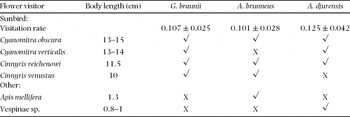
Four species of sunbird from two genera were observed visiting mistletoe flowers; Cyanomitra obscura (western olive sunbird), Cyanomitra verticalis (green-headed sunbird), Cinnyris reichenowi (northern double-collared sunbird) and Cinnyris venustus (variable sunbird) (Table 1). The honey bee (Apis mellifera) and a small social wasp species (subfamily: Vespinae) were also observed to visit the flowers of A. brunneus and A. djurensis respectively (Table 1).
Mean visitation rates (all sunbirds combined, S per flower h−1 ± SE) and species of flower visitors observed at each of the three mistletoe species Globimetula braunii (n = 10 plants), Agelanthus brunneus (n = 8) and Agelanthus djurensis (n = 4) in Ngel Nyaki Forest Reserve. √ = observed, X = not observed.

There was no evidence for the time-of-day effect on the length of time sunbirds spent foraging within the focal area for either Agelanthus sp. given that the DIC for the full model did not markedly differ from that for the null model: 168 compared with 166 for A. brunneus and 105 compared with 110 for A. djurensis. For Globimetula braunii, there was a small time-of-day effect with sunbirds spending slightly longer foraging in the morning.
All eight A. djurensis study plants were visited by Vespinae wasps. Closer investigation of the wasps on A. djurensis flowers revealed they were harvesting pollen from unopened flowers by curling their body around the flower tip and prising open the corolla lobes with their legs and mandibles, just enough to clean the newly exposed anthers of their pollen. Two A. brunneus plants were visited by Apis mellifera which robbed nectar from the flowers.
Breeding system and dependence on pollinators
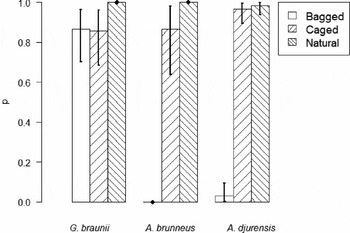
There was evidence for the effect of treatment on mistletoe flower opening and for its variability between species as shown by the best-fit model being the full model containing the effect of species, treatment and an interaction between species and treatment. This shows that the three mistletoes exhibited quite different pollination biology. The flowers of G. braunii are able to self-open in the absence of pollinators, but have a significantly higher probability of opening when bird pollinators have access (Figure 1). There was no significant difference in the proportion of flowers opened between the bagged and caged treatment (Figure 1) showing that insects do not contribute significantly to flower opening in G. braunii. The time a ripe G. braunii bud took to open was considerably longer under bagged conditions than natural conditions as shown by the fact that the model containing treatment effects was a significantly better fit to the data than the null model (DIC 253 compared with 285). When buds were enclosed within a bag to exclude all pollinators, ripe buds remained unopened for an average of 8.6 d (95% CI = 5.4–14.1 d) before self-opening. In contrast, under natural conditions ripe buds opened after 1.7 d (95% CI = 1.1–2.6 d).
Estimated probability of a flower opening under bagged, caged and natural treatments within Ngel Nyaki Forest Reserve, Nigeria, for Globimetula braunii, Agelanthus brunneus and Agelanthus djurensis. Bars show the posterior mean probability of opening (p) and the corresponding 95% credible interval.

In contrast to G. braunii, flowers of A. brunneus and A. djurensis almost never opened within bags indicating that the flowers of these species do not self-open (Figure 1). The probability of a flower opening under natural conditions was only slightly higher than the probability of a flower opening within a cage for both Agelanthus spp. (Figure 1). This indicates that insects alone are opening the flowers of these two mistletoes as effectively as when sunbirds also have access.
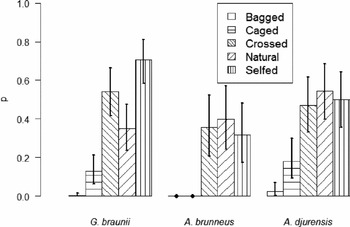
The effect of treatment on fruit set differed between the three mistletoe species as shown by the best-fit model being the full model containing the effect of species, treatment and an interaction between species and treatment. Fruits were almost never produced inside bags indicating that the flowers of these mistletoes are not capable of autonomous self-fertilization (Figure 2). This was despite an average of 66% of G. braunii flowers self-opening and hand pollinations revealing high self-compatibility in all three species (Figure 2). There was a very low probability of plants producing fruits inside cages where only insects had access (Figure 2). Hand-pollinated flowers of Globimetula braunii had significantly higher fruit set than those under natural conditions (Figure 2). This indicates that in the years studied, G. braunii was pollen limited with a mean PLI of 0.504. Neither of the Agelanthus spp. were pollen limited, both with a mean PLI of 0.
Estimated probability of a flower setting fruit under bagged, caged, crossed, natural and selfed treatments within Ngel Nyaki Forest Reserve, Nigeria, for Globimetula braunii, Agelanthus brunneus and Agelanthus djurensis. Bars show the posterior mean probability of fruit set (p) and the corresponding 95% credible interval.

DISCUSSION
Our results demonstrate that sunbirds are essential to the effective pollination of all three mistletoe species included in this study. However, the details of the mutualism differed between the two genera.
Role of insects for pollination (flower opening and reproduction)
Insects were never observed visiting the flowers of Globimetula braunii and did not play a significant role in flower opening as confirmed by the exclusion experiments where approximately the same number of flowers opened when all pollinators were excluded relative to when insects had access. In contrast the honey bee (Apis mellifera) and a species of social wasp (subfamily: Vespinae) were observed visiting the flowers of A. brunneus and A. djurensis respectively. Whilst honeybees were only observed robbing nectar from the flowers of A. brunneus, the Vespinae wasps were observed opening flowers of A. djurensis by prising open the corolla lobes with their legs and mandibles to harvest pollen. However, despite insects not being observed opening the flowers of A. brunneus, the exclusion experiments showed insects played a significant role in opening flowers of both Agelanthus spp. Flower opening of explosive bird-pollinated mistletoe flowers by invertebrates has, to our knowledge, only been recorded once elsewhere. The small native solitary bees Hylaeus agilis and Leioproctus pango have been observed prising open the flowers of Peraxilla tetrapetala and P. colensoi in New Zealand (Donovan Reference DONOVAN2007, Kelly et al. Reference KELLY, LADLEY, ROBERTSON, EDWARDS and SMITH1996, Robertson et al. Reference ROBERTSON, LADLEY and KELLY2005). In contrast to the New Zealand system where these insects frequently effect pollination (Kelly et al. Reference KELLY, LADLEY, ROBERTSON, EDWARDS and SMITH1996, Ladley et al. Reference LADLEY, KELLY and ROBERTSON1997, Robertson et al. Reference ROBERTSON, LADLEY and KELLY2005), flower-opening by insects in our study area only rarely resulted in successful pollination.
Role of birds for pollination (flower opening and reproduction)
Four sunbird species (Cyanomitra obscura, C. verticalis, Cinnyris reichenowi and C. venustus) were observed visiting the flowers of the Ngel Nyaki mistletoes, with all four species visiting G. braunii, and three to each of the Agelanthus species.
While Globimetula braunii flowers were able to self-open in the absence of pollinators, bird visitation resulted in significantly more flowers being opened and at a faster rate. In contrast, neither of the Agelanthus spp. were able to self-open and birds did not significantly increase flower opening relative to insects-only. While all four sunbird species visited open mistletoe flowers, it was only the largest two species from the genus Cyanomitra, C. obscura and C. verticalis, with the longest, heaviest bills (Cheke & Mann Reference CHEKE and MANN2001) which were observed opening them. Previous studies of Loranthaceae have shown flower-opening to be related to pollinator size, a relationship which can be explained by an increased selection pressure on larger birds associated with their higher energetic requirements (Gill & Wolf Reference GILL and WOLF1975). Because the majority of pollen is released explosively from the anthers onto pollinators during flower opening, C. obscura and C. verticalis are also the only two sunbird species likely to pollinate effectively. Moreover as only C. obscura was observed with large amounts of pollen on its crown feathers it may be the only effective pollinator. Future work quantifying pollen removal and deposition will confirm the contribution to pollination by each sunbird species.
The fact that the flowers of A. brunneus never set fruit when birds were excluded and for G. braunii and A. djurensis only rarely, illustrates that effective pollination and fruit set in all three species was dependent on a single guild of at most three to four closely related sunbird species.
Limiting processes for reproduction, differences among species
Of the three Ngel Nyaki mistletoes included in our study only G. braunii was pollen limited (PLI = 0.504). This was unexpected because G. braunii had the largest assemblage of sunbird pollinators and was not dependent on biotic agents for flower opening.
However, despite self-compatibility, all three species in this study lacked autonomous self-fertilization and were dependent on biotic pollination. Consequently, the self-opening flowers of G. braunii do not necessarily lead to pollination and several subsequent visits by pollinators may be required to deliver sufficient pollen. For example in New Zealand the flowers of Peraxilla tetrapetala and P. colensoi often fail to receive any pollen grains on the stigma during opening and rely on subsequent accumulation of pollen over 6–7 d after flower opening for successful pollination (Robertson et al. Reference ROBERTSON, KELLY, LADLEY and SPARROW1999, Reference ROBERTSON, LADLEY and KELLY2005). Furthermore, because the majority of pollen is released explosively from the anthers onto pollinators during flower opening, self-opening may actually be detrimental to the male reproductive success of G. braunii.
In New Zealand Loranthaceae, pollen-limitation has been attributed to a decline in pollinating bird species as a result of predation by introduced mammals (Anderson et al. Reference ANDERSON, KELLY, LADLEY, MOLLOY and TERRY2011, Kelly et al. Reference KELLY, BRINDLE, LADLEY, ROBERTSON, MADDIGAN, BUTLER, WARD-SMITH, MURPHY and SESSIONS2005, Robertson et al. Reference ROBERTSON, KELLY, LADLEY and SPARROW1999). In the Patagonian loranth Tristerix corymbosus, pollen limitation during winter flowering results from seasonally reduced visitation by hummingbirds (Aizen Reference AIZEN2003). For G. braunii at Ngel Nyaki, it may be that during peak flowering in December, the sunbirds were foraging on other more energetically rewarding resources ‘distracting’ them from G. braunii (Campbell Reference CAMPBELL1985, Gross Reference GROSS1996, Gross & Werner Reference GROSS and WERNER1983, Murphy & Kelly Reference MURPHY and KELLY2001). A large canopy tree Anthonotha noldeae (Fabaceae) was in full flower at this time and large numbers of sunbirds were observed to be foraging on its flowers in the vicinity of mistletoes (K. Weston, pers. obs.). However, sunbird visitation rates to G. braunii were similar to those of the non-pollen limited Agelanthus spp., with 0.11 s per flower h−1 equating to about 14 s of visitation time per flower over its lifetime. Such visitation rates are also similar to those recorded for the New Zealand loranth Peraxilla colensoi, which was not pollen limited (Robertson et al. Reference ROBERTSON, KELLY, LADLEY and SPARROW1999).
It is possible that the less-specialized actinomorphic (radially symmetric), two-stage-opening flowers of Globimetula comprise a less-efficient pollination mechanism than that of the Agelanthus spp., rendering G. braunii more sensitive to pollinator disruption. The brief period of nectar production by G. braunii flowers after opening relative to the Agelanthus spp. (2 d vs 5–9 d) (Weston Reference WESTON2009) may also limit ongoing visitation to already open flowers, resulting in the lower female reproductive success of G. braunii relative to the Agelanthus spp. The size and density of the three mistletoe populations should also be assessed to investigate the effects of population spatial structure on reproductive ecology.
We predicted that pollen limitation and reduced fruit/seed set would be more severe in species with a relatively smaller assemblage of pollinators and exhibiting greater dependence on pollinators for flower opening and reproduction. Consequently, our results were contrary to those predictions. Only G. braunii demonstrated pollen limitation, and this species had the largest assemblage of sunbird pollinators. Furthermore, G. braunii was the only species found to have self-opening flowers. Therefore, given our assessments of the plant–pollinator mutualism and breeding system of these mistletoe species, we were unable to accurately predict which species were most vulnerable to reproductive failure.
The pollination limitation revealed in G. braunii may be an early indication of mistletoe–pollinator mutualism breakdown in Ngel Nyaki forest. Due to the high incidence of mistletoe–animal interactions, it seems likely that disruption to these mutualisms will have cascading effects within the West African montane forest ecosystem. Rather than perpetuating the common viewpoint that mistletoes are destructive weeds, we suggest that the mistletoes in these ecosystems should be considered as indicators of habitat condition and functioning.
Limitations
This study was limited to plants located along the forest edge and consequently the observed interactions may have been biased by edge effects (Murcia Reference MURCIA1995). A recent literature review of edge effects on plant reproduction classified species as showing a significant negative effect, no effect, or a significant positive effect and found 69% of species showed some effect, the majority of which were negative (Burgess et al. Reference BURGESS, KELLY, ROBERTSON and LADLEY2006). Studies of the New Zealand Loranthaceae Peraxilla tetrapetala have shown higher fruit set in plants growing along forest edges attributed to higher visitation rates by birds and bees (Burgess et al. Reference BURGESS, KELLY, ROBERTSON and LADLEY2006, Kelly et al. Reference KELLY, LADLEY, ROBERTSON, NORTON, Young and Clarke2000). In order to remove any such bias it would be valuable to study plants high within the canopy of the forest interior to compare pollen-limitation in those plants to that recorded for the edge-dwelling plants included in this study.
The small sample size of plants for pollinator observations in this study may not provide a full representation of the pollinator community. This consideration is particularly relevant given that the exclusion experiments indicated flower opening by insects for one species, A. brunneus, where insects were not recorded visiting flowers throughout observations. Further observations of flowering plants within the study area would be valuable. Furthermore, the pollination treatments in this study were only applied during one season at Ngel Nyaki forest. It would be beneficial to conduct these experiments over several consecutive years to account for any differences in plant responses between flowering seasons.
ACKNOWLEDGEMENTS
We thank Usman Usuf and other staff of the Nigerian Montane Forest Project for invaluable field assistance. We are grateful to the Taraba State Forest Service for their invitation and permission to conduct research. Financial support came from The North of England Zoological Society, Nexen Nigeria Inc., A. P. Leventis Foundation and the Foundation for Research, Science and Technology under contract CO9X0503. Special thanks to Roger Polhill for helpful discussions on African mistletoes and to Steve Johnson and an anonymous referee for suggesting improvements to the manuscript.