Introduction
Sources of energy and protein have been the major components in the costs of quail diets and therefore must be in sufficient quantities to meet peak performance needs. However, data in the literature regarding the crude protein (CP) requirement in diets for meat quails are discrepant. For example, Oliveira (Reference Oliveira2001) found that quail performance was not influenced by the reduction in CP from 26 to 20%. According to Pinto et al. (Reference Pinto, Ferreira, Albino, Gomes and Vargas2002), meat quails in the initial and growth phases should receive diets with 24% CP; Fridrich et al. (Reference Fridrich, Valente, Felipe-Silva, Silva, Corrêa, Fontes and Ferreira2005) established 24.6% CP as the maintenance requirement for European quails from 28 to 42 days of age. The differences in these findings may be attributed to variations in the experimental conditions, especially in the thermal environment. The minimum use of energy available for homeothermy maintenance is reached when animals are kept in thermoneutral conditions, which for meat birds in the growth phase is approximately 25–26 °C (Pinto et al., Reference Pinto, Donzele, Ferreira, Albino, Soares and Pereira2003; DeShazer et al., Reference DeShazer, Hahn, Xin and DeShazer2009; Silva et al., Reference Silva, Jordão Filho, Costa, Lacerda, Vargas and Lima2012; Del Vesco et al., Reference Del Vesco, Gasparino, Grieser, Zancanela, Gasparin, Constantin and Oliveira Neto2014). Thus, it is important to determine the nutrient requirements under such conditions to find the maximum animal response.
Protein nutrition can be adjusted to the animal's requirement with the use of industrial amino acids, permitting the reduction of CP levels in the diet. The reduction in CP levels that met the promoted limiting amino acid requirements improved the performance in broilers (Miranda et al., Reference Miranda, Vieira, Favero, Angel, Stefanello and Nogueira2015), laying hens (Alagawany et al., Reference Alagawany, El-Hack, Farag, Tiwari, Sachan, Karthik and Dhama2016) and Japanese quails (Cavalcante, Reference Cavalcante2013). In one of the few studies that included meat quails, Silva et al. (Reference Silva, Silva, Jordão Filho, Ribeiro, Costa and Rodrigues2006) recommended the levels of 19.2% CP supplemented with 0.9% methionine + cystine (Met + Cys) and 0.95% lysine (Lys). Because the limiting order of amino acids is not yet well clarified for meat quails, other amino acids can promote different responses under conditions of protein restriction, highlighting the need for more research that includes this focus. The objective of this study was to evaluate the effect of CP reduction, with and without the supplementation of limiting amino acids, on the performance and carcass characteristics of meat quails in the growth phase (22–42 days of age) that were housed in a thermoneutral environment.
Method
Animals, management and experimental design
The experiment was conducted at the Bananeiras city, PB, Brazil (06°45′S, 35°38′W, 520 m altitude). A total of 324 male European quails (Coturnix coturnix coturnix) from 22 to 42 days of age, with initial weight of 134 ± 3.4 g, were used in the study and randomly allocated into nine treatments (nutritional plans) with six replications and six quails per experimental unit. The quails were housed in 54-cage galvanized wire batteries 67 × 37 × 20 cm (length × width × height) fitted with feeders and drinkers and received artificial lighting for 24 h from 200-watt fluorescent lamps. Air temperature and relative humidity inside the room were maintained at 26 °C and 75%, respectively; both were monitored daily using a thermohygrometer (model 766401000, Incoterm®; accuracy: ±0.35 °C for temperature and ±0.25% for relative humidity) placed in the centre of the room at 1.20 m above the ground and were controlled through ventilation, exhaustion and air conditioning systems.
Experimental diets
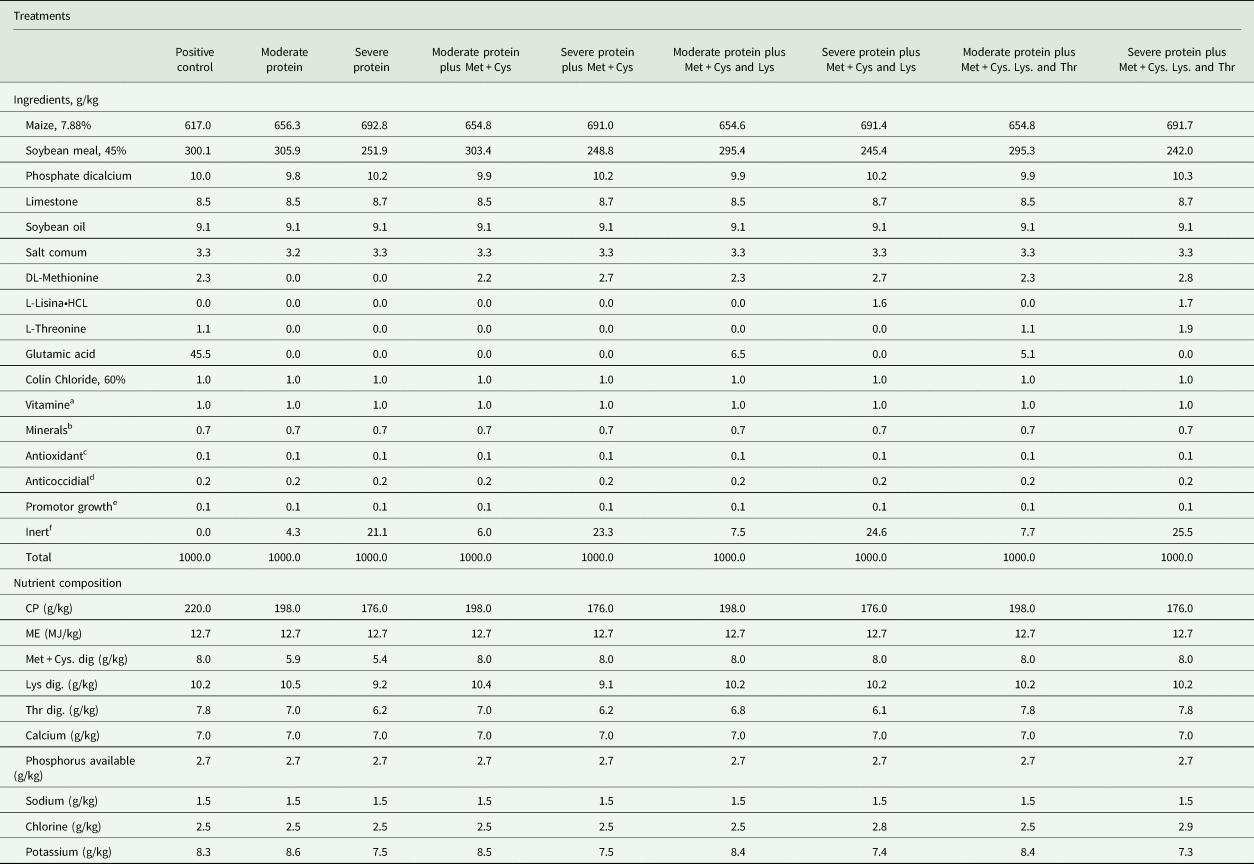
Isoenergetic diets (12.76 MJ of metabolizable energy [ME]/kg) were formulated based on the positive control (T1), which met 100% of the nutritional requirements recommended by Silva and Costa (Reference Silva and Costa2009). The other treatments were differentiated according to the CP reduction level and amino acid supplementation (AS), namely moderate reduction (T2-10% reduction in CP, without AS), severe reduction (T3-20% reduction in CP, without AS), moderate reduction + Met + Cys (T4-10% reduction in CP and AS with Met + Cys), severe reduction + Met + Cys (T5-20% reduction in CP and AS with Met + Cys), moderate reduction + Met + Cys + Lys (T6-10% reduction in CP and AS with Met + Cys + Lys), severe reduction + Met + Cys + Lys (T7-20% reduction in CP and AS with Met + Cys + Lys), moderate reduction + Met + Cys + Lys + threonine (Thr) (T8-10% reduction in CP and AS with Met + Cys + Lys + Thr) and severe reduction (T9-20% reduction in CP and AS with Met + Cys + Lys + Thr; Table 1). Water and feed were provided freely; feed leftovers on the ground were collected daily and summed with the leftovers in the feeders.
Ingredients of diets and values calculated of the nutritive composition of diets for European quail from 22 to 42 days of age

a Vitamin premix per kilogram of diet: Vitamin A, 10 000 000 U.I.; vitamin D3, 2 500 000 U.I.; vitamin E, 6000 U.I.; vitamin K, 1600 mg; vitamin B12, 11 000; niacin, 25 000 mg; folic acid, 400 mg; pantothenic acid, 10 000 mg.
b Mineral premix provided per kilogram of diet: Mn (from MnSO4⋅H2O), 65 mg; Zn (from ZnO), 100 mg; Fe (from FeSO4⋅7H2O), 100 mg; Cu (from CuSO4⋅5H2O), 16 mg; I [from Ca (IO3)2⋅H2O], 1.5 mg; Se, 0.30 mg.
c Antioxidant = BHT, 10 g; vehicle quantity sufficient to 1000 g.
d Anticoccidial = Coban.
e Promotor growth of Gram-positive = enradin = 100 g/ton.
f Washed sand.
Performance and carcass assessment
To calculate the live weight (g) and weight gain (g/day), the quails were individually weighed on days 22 and 42; feed intake (g/day) and feed conversion (g/g) were obtained from the difference in feed provided and the leftovers in buckets and feeders, and from the relationship between feed intake and weight gain, respectively. After 12 h of food fasting, two quails per experimental unit were selected according to the mean weight (10%) and were sacrificed by the cervical dislocation method, then plucked and eviscerated to obtain the absolute (g) and relative (%) weights of the carcass, prime cuts (breast and leg) and edible organs (heart, liver and gizzard); the relative weight was calculated as organ weight/bird weight × 100.
Statistical analysis
The normality of the data was verified via the skewness and kurtosis coefficients. Analyses using the least-squares method were conducted to test the effect of the nutritional plans on the performance and carcass variables, using SAS version 9.3 (SAS Inst. Inc., Cary, NC, USA). Means were compared using the Student–Newman–Keuls (SNK) test. The minimum confidence level was P < 0.05.
Results
Performance
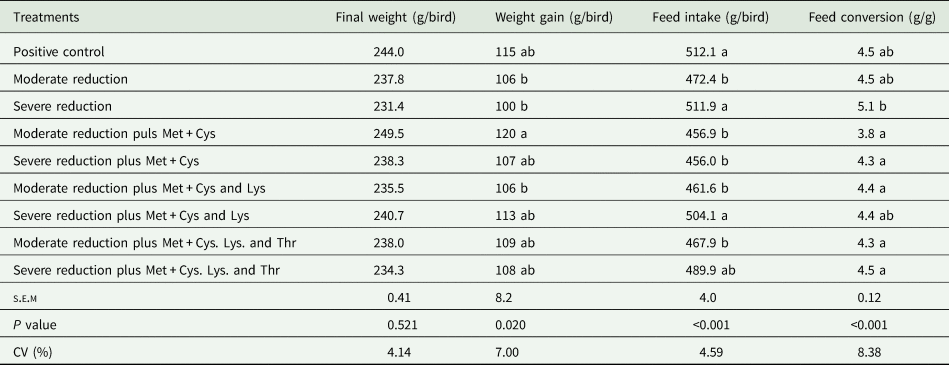
The reduction in CP in the diet that met or not the primary essential amino acid requirements did not influence the final weight (P = 0.521) of European quails; however, the weight gain (P = 0.020), feed intake (P < 0.001) and feed conversion (P < 0.001) were influenced (Table 2). Quails fed diets with moderate or severe CP reduction, or when the diet with moderate reduction met the Met + Cys and Lys requirements, had lower weight gain. Severe and moderate protein reduction meeting the Met + Cys, Lys and Thr requirements resulted in weight gain equivalent to the weight gain of the control treatment. The largest weight gain was observed in quails that received diets with moderate protein reduction and met the Met + Cys requirements.
Final weight, weight gain, feed intake and feed conversion of European quails at 42 days of age receiving protein-reduced diets
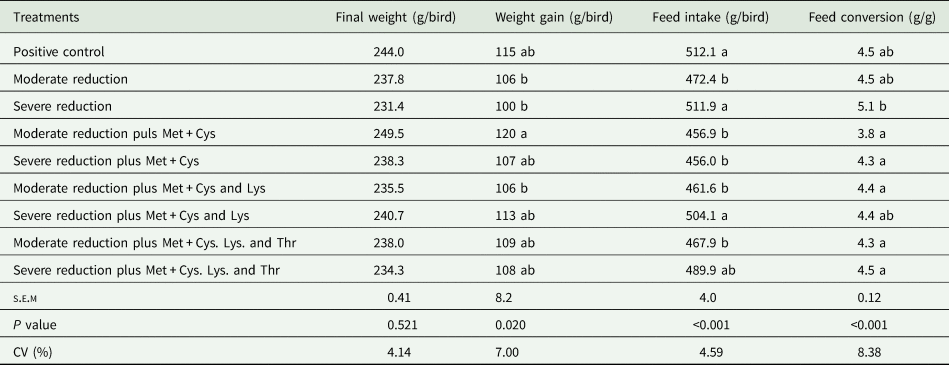
Means in the same column followed by different letters are different from each other by the SNK test (P < 0.05).
Quails that received the control diet and diets with severe CP reduction that met or not the Met + Cys and Lys requirements consumed a greater amount of feed. The other protein levels meeting the requirements of these amino acids led to equivalent feed intake. Higher feed intakes were observed in quails that received diets with a severe reduction in CP that met or not the Met + Cys and Lys requirements and in quails that received the control diet. The severe reduction in CP led to inferior feed conversion. However, when this level of CP was supplemented to meet the Met + Cys, Lys and Thr requirements, the feed conversion was equivalent to that of the quails that received diets with moderate CP reduction meeting or not the limiting amino acid requirements and the control diet.
Carcass
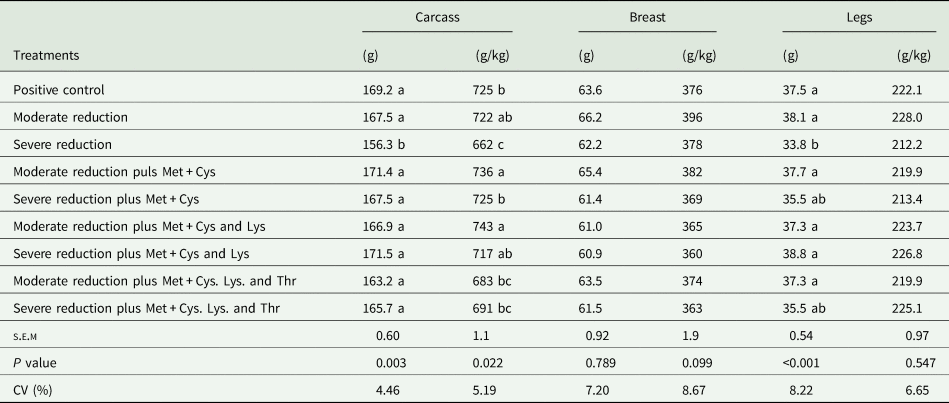
Protein reduction influenced the carcass weight (P = 0.003), carcass yield (P = 0.022) and leg weight (P < 0.001). The breast weight (P = 0.789), breast yield (P = 0.099) and leg yield (P = 0.547) were not influenced by protein reduction (Table 3). The diet with severe CP reduction not meeting the requirements of the most limiting amino acids limited the carcass weight and yield and the leg weight. However, when this diet was supplemented with the most limiting amino acids, the carcass weight was equivalent to that of the other treatments with protein reduction and the control treatment. The diets with moderate CP reduction meeting or not the Met + Cys requirement, or meeting the Met + Cys and Lys requirement, led to the greatest carcass yield and leg weight, which were equivalent to the control treatment.
Weight (g) and yield (g/kg) of carcass, breast and legs of European quails at 42 days of age receiving protein-reduced diets

Means in the same column followed by different letters are different from each other by the SNK test (P < 0.05).
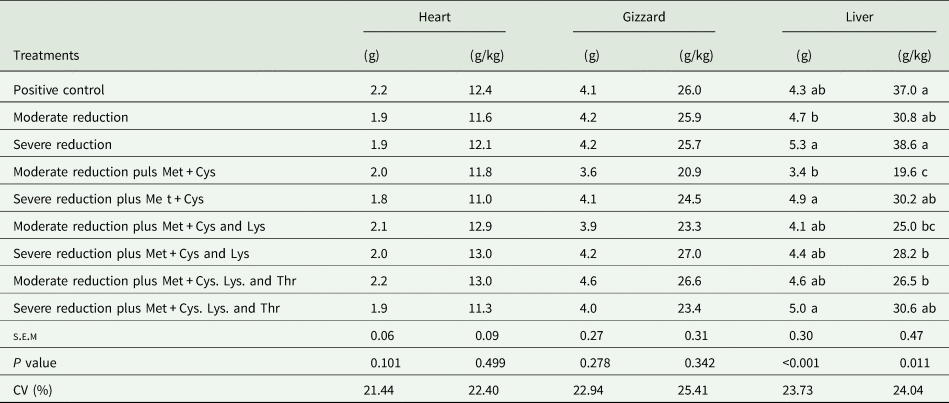
The protein reduction influenced the weight (P < 0.001) and yield (P = 0.011) of the liver. The weight (P = 0.101) and yield (P = 0.499) of the heart and gizzard (P = 0.578) were not affected (Table 4). The severe reduction of CP meeting or not the Met + Cys and Met + Cys, Lys and Thr requirements resulted in quails with a greater liver weight. With respect to income, the severe CP reduction provided results equivalent to the control treatment. A lower yield of the liver was observed in quails that received a diet with moderate CP reduction meeting or not the limiting amino acid requirements.
Weight (g) and yield (g/kg) of edible organs of European quails at 42 days of age receiving with protein reduction diets

Means in the same column followed by different letters are different from each other by the SNK test (P < 0.05).
Discussion
Diets with protein reduction not meeting the requirements for the most limiting amino acids negatively influence the performance of the quails. However, it is observed that supplementation with the crystalline sources of the amino acids is able to improve the performance of the quails. The quails do not have CP requirements per se, but rather there are essential amino acids that comprise CP and there is an amount of nitrogen that is sufficient for the synthesis of non-essential amino acids (Lima et al., Reference Lima, Costa, Guerra, Silva, Rabelo, Miglino, Nogueira and Pinheiro2012). For this reason, the CP levels must be balanced and sometimes the supplementation with crystalline amino acids must be performed to meet the requirements of the most limiting amino acids and for the performance to not be affected.
The diet with the moderate reduction in CP meeting the requirement for the first limiting amino acid for quails (Met) led to the best performance results and the largest carcass and leg yields. However, this reduction does not seem to be sufficient to cause Lys and Thr deficiency. On one hand, regardless of when these two amino acids were supplemented in the diets with this level of CP, the performance and carcass yields of quails provided such diets were similar. On the other hand, the severe reduction in CP led to the worst performance and lower carcass yield compared to the performance of quails that received diets with moderate CP levels and that met the amino acid requirements. However, when diets with severe CP reduction were supplemented and met the Met + Cys requirements individually or when they were combined with Lys and Thr, the performance was improved. According to Silva el al. (Reference Silva, Silva, Jordão Filho, Ribeiro, Costa and Rodrigues2006), considering the performance results, it can be stated that the supplementation with Met + Cis allowed a reduction from 24 to 19.2%, without affecting the performance characteristics of the birds. Despite the higher requirement of protein diets for the normal growth of quails (Shim and Vohra, Reference Shim and Vohra1984), diets with lower protein content and a better balance of amino acids seem to favour the performance of these birds.
According to our results, the fulfilment of the Met + Cys requirements is the most important factor when the CP levels are reduced. The order of limiting amino acids for quail is still not well defined; it is known that in maizemeal-based diets, the first limiting amino acid for quail is Met (Mandal et al., Reference Mandal, Elangovan, Tyagi, Tyagi, Johri and Kaur2005; Parvin et al., Reference Parvin, Mandal, Singh and Thakur2010; Cavalcante, Reference Cavalcante2013). Cavalcante (Reference Cavalcante2013) defined Lys as the second limiting amino acid for Japanese quail in the growing phase (1–42 days) that received diets with a higher proportion of maize and soybean. This author assessed eight different diets, where each met the Met + Cys requirements combined with meeting a second amino acid requirement. The quails that received the diet that met only the Met + Cys requirements exhibited satisfactory performance; however, the quails that received a diet meeting the Met + Cys and Lys requirements exhibited improved performance.
The reduction in CP levels accompanied by meeting the essential amino acids requirements via supplementation with crystalline sources promotes better performance in broilers (Miranda et al., Reference Miranda, Vieira, Favero, Angel, Stefanello and Nogueira2015), laying hens (Alagawany et al., Reference Alagawany, El-Hack, Farag, Tiwari, Sachan, Karthik and Dhama2016) and Japanese quails (Cavalcante, Reference Cavalcante2013). The improved performance is accompanied by cost reductions with ingredients that are CP sources (Burley et al., Reference Burley, Patterson and Elliot2013), a reduction in energy expenditure by the animal for the excretion of excess dietary nitrogen (MacLeod, Reference MacLeod1997) and a consequent reduction in the nitrogen load in the environment (Roberts et al., Reference Roberts, Xin, Kerr, Russell and Bregendahl2007).
In our study, a thermoneutral environment was maintained so that there was no interference in the response of the quails. Zaman et al. (Reference Zaman, Mushtaq, Nawaz, Mirza, Mahmood, Ahmad, Babar and Mushtaq2008) stated that CP levels in the diet have a direct relationship with an animal's response under climate stress conditions (heat or cold), and CP levels have higher thermogenic effects compared with other nutrients. Diets with high protein content can represent a greater caloric increment in relation to diets with reduced levels of CP, resulting in a net loss of energy that could be used for muscle tissue deposition (Sakomura and Rostagno, Reference Sakomura and Rostagno2007). Thus, we can infer that temperature did not have an effect on the bird responses in our study.
The highest and lowest CP levels influenced feed intake. Quails that received diets with 22% CP and diets with severe CP reduction exhibited higher feed intake. Alternatively, a moderate reduction in CP caused lower feed intake. Silva et al. (Reference Silva, Silva, Jordão Filho, Ribeiro, Costa and Rodrigues2006) observed that feed intake was greater when European quails between 22 and 42 days of age received diets with a higher CP level and when the CP was reduced and combined with the supplementation of crystalline amino acids. These effects may be related to the present levels of amino acids in the diets. The levels of amino acids present in plasma play a role in appetite control and thus signal satiety (Kumta and Harper, Reference Kumta and Harper1961).
The carcass and prime cut yields reflected the performance of the quails. The severe reduction in CP negatively influenced the carcass yield but did not affect the breast weight and yield. The results of our study corroborate those of Móri et al. (Reference Móri, Garcia, Pavan, Piccinin and Pizzolante2005), who evaluated four genetic groups of meat quails fed diets with 24% CP and a supplementation of Met and Lys. Silva (2006) found no significant difference in the breast yield in quails fed diets with 21.6 and 19.2% CP supplemented or not with Met and Lys. Similarly, Vasconcellos et al. (Reference Vasconcellos, Fontes, Vidal, Lara, Rodrigues and Vasconcelos2010) found no influence of CP levels (18, 20, 22, 24 and 26%) on broiler body weight and carcass weight and yield.
The CP levels seem to have no influence on the edible organs, except the liver. In our study, lower liver weight and yield were observed in animals that received diets with a moderate reduction in CP and Met supplementation. The liver is an organ that, among other functions, is directly related to protein metabolism. Thus, any imbalance in proteins, in the present case, the excess, will be accompanied by an increase in the metabolic rate in this organ.
Conclusion
It is observed that supplementation with the crystalline sources of the amino acids is able to improve the performance of the quails, is the fulfilment of the Met + Cys requirements and is the most important factor when the CP levels are reduced. In our studies, diets with 17.5% CP and supplemented with Met + Cys, Lys and Thr meet the requirements of quails, thus generating a limiting amino acid requirement, so they are recommended for meat quails from 22 to 42 days old housed in a thermoneutral environment.
Financial support
This research received no specific grant from any funding agency, commercial or not-for-profit sectors.
Conflict of interest
The authors declare that they have no conflict of interest.
Ethical standards
The research project was approved by the ethics and animal use committee (CEUA) of the Federal University of Paraíba.