Introduction
Does the presence of a constitutional court within an Islamic law state (ILS) encourage acceptance of the jurisdiction of the International Court of Justice (ICJ)?Footnote 1 ILS have their own, partly distinctive way of conceptualizing justice and law in the domestic as well as international realms. This article argues and demonstrates empirically that in the context of ILS, the relationship between domestic constitutional oversight and support for the ICJ hinges on the quality—specifically, judicial independence—of domestic constitutional courts.
Some literature suggests that ILS are a hard case for international law and its institutions owing to either tensions between Islamic and international law (Westbrook Reference Westbrook1992–93; Tibi Reference Tibi1994) or the association of public international law with orientalist, colonial history (Allain Reference Allain2004). By way of illustration, when compared with other states, ILS are less likely to accept the jurisdiction of the ICJ, and they are known for placing Islam-related reservations on their international commitments (Mitchell and Powell Reference Mitchell and Justyna Powell2011; Moosa Reference Moosa2016; Saeed Reference Saeed2018).Footnote 2 Yet, there is also literature showing that the Islamic legal tradition is not ab initio incompatible with international law and that some legal features within ILS draw these states to certain aspects of the global order (Al-Dawoody Reference Al-Dawoody2011; Al-Khasawneh Reference Al-Khasawneh, Frick and Müller2013; Fraser Reference Fraser, Fraser and McGonigle Leyh2020; Powell Reference Powell2020, Reference Powell2022). Despite some differences, there is a partial synergy between the Islamic legal tradition and international law (Zoli, Bassiouni, and Khan Reference Zoli and Khan2017). This affinity, if explicitly expressed in ILS’s domestic legal systems, pulls these states to international institutions (Powell Reference Powell2020). Indeed, ILS’s domestic legal systems are intrinsically hybrid and combine Islamic and secular legal institutions. Thus, the nature and character of these legal systems cannot be reduced merely to Islamic law components. This article sits firmly in the latter framework and builds specifically on Powell’s (Reference Powell2015, Reference Powell2020) work. While recognizing differences between international and Islamic law, we argue that points of similarity between inherently hybrid ILS domestic legal systems and international law are key for understanding ILS’s relationship with international legal institutions.Footnote 3 Importantly, we extend this framework to an unexplored context, domestic constitutional oversight. Furthermore, our contribution takes the affinity argument beyond its mere focus on the presence of shared legal features to their institutional design (de jure constitutional language dedicated to a constitutional court) and implementation (de facto judicial independence). Empirically, we contribute new data on the measurement and embeddedness of constitutional courts in ILS.
Although debates about the usefulness of constitutional courts are a mainstay in many ILS’s domestic political rhetoric (Mallat Reference Mallat2006; Choudhry and Glenn Bass Reference Choudhry and Glenn Bass2014; Pickard Reference Pickard, Biagi and Frosini2015), we know little about these institutions’ effects on ILS views of the global order. In comparison with other states, since the end of the Cold War, ILS are as likely to have a constitutional court but less likely to have domestic courts with high levels of judicial independence.Footnote 4 We argue that when copresent, these legal features—a constitutional court and high judicial independence—draw ILS to certain aspects of international law. It is reasonable to expect that the presence and status of a constitutional court within a domestic jurisdiction signifies a state’s commitment to the notion of rule of law in the domestic realm.Footnote 5 Is it possible that this domestic attitude toward constitutional oversight translates to respect for international courts? We consider this argument in the context of ILS’s commitments to the main judicial organ of the United Nations, the ICJ.
Arguably, constitutional courts—and their level of judicial independence—provide critical points of juncture between the lived, domestically practiced Islamic legal tradition and international courts. In a domestic legal system, a constitutional court espouses the idea that all subconstitutional laws are subject to constitutional oversight by an independent judicial body. Simply put, all laws must be in congruence with the supreme law of any domestic legal system: a constitution (Ginsburg Reference Ginsburg2003; Kumm Reference Kumm2005; Hirschl Reference Hirschl2010, 72; Michelman Reference Michelman, Ginsburg and Dixon2011). At the most basic definitional level, the concept of constitutional review is, as Stone Sweet (Reference Stone Sweet2000, 21) describes, “the authority of an institution to invalidate the acts of government.” Globally, constitutional review has become a norm of democratic, rule of law–oriented constitutional design. Out of 191 constitutional systems, 158 include some formal provision for constitutional review, 79 of which have designated bodies called constitutional courts, tribunals, or councils (Ginsburg and Moustafa Reference Ginsburg and Moustafa2008).
The role of constitutional courts in ILS’s recent politics cannot be overestimated, especially in light of the Arab Spring. Constitutional courts are becoming more prevalent in the Middle East and North Africa (MENA) as governments are attempting to signal their commitment to the rule of law. What is more, arguably “the success of constitutional courts is closely tied to the success of constitutional democracy in the region” (Choudhry and Glenn Bass Reference Choudhry and Glenn Bass2014, 9).Footnote 6 According to Bahrain’s Constitutional Court secretary-general, Fat’hi Kemicha, “Constitutional courts are a prerequisite of healthy democratic development and the indispensable guardians of democratic values” (Toumi Reference Toumi2005). Importantly, this trend extends to other ILS, beyond the MENA region. As Siregar (Reference Siregar2013) argues, “The quality of our democracy and rule of law leaves a lot to be desired. The Constitutional Court is crucial in determining what kind of democracy Indonesia will become, due to the gap between what the 1945 Constitution tries to achieve and what is possible given the current political maturity of various parties.” If, arguably, independent constitutional courts are a catalyst for beneficial change in these societies, might they also shape ILS’s views of institutionalized international law?
This article proceeds as follows. First, we discuss the importance of constitutional courts and the Islamic legal tradition in the context of ILS. Next, we highlight the links between domestic constitutional oversight via a constitutional court and the unique role of the ICJ in international law. The next section introduces our argument and hypothesis. Subsequent sections present the data and empirical findings.
Constitutional Courts and the Supremacy of Law in ILS
ILS’s domestic legal systems are not monolithic but inherently hybrid. Although many of these legal systems are partially based on principles of civil and common law, Islamic law—as interpreted and implemented by those in power—plays a role in state governance.Footnote 7 This reality shapes ILS’s international preferences, including attitudes vis-à-vis the ICJ. Of course, the influence of Islamic law does not mean that other factors, such as cost-benefit calculations or power, do not play a role. Indeed, these influences affect ILS and non-ILS alike. Yet, any study of the relationship between judicial oversight at the domestic and international levels is especially complex in the context of ILS, since it must consider the intricate domestic interplay between Islamic law and secular law (Conforti Reference Conforti1993; Nollkaemper Reference Nollkaemper2006; Zartner Falstrom Reference Zartner Falstrom2006; Powell Reference Powell2013a, Reference Powell2013b; Zartner Reference Zartner2014).
In principle, institutionalized constitutional oversight, in ILS and elsewhere, rests not only on the notion of hierarchy of laws but also on supremacy of law.Footnote 8 Thus, in a domestic jurisdiction, a specific institution is endowed with the power of ensuring that all laws and all actors—including the state itself—move harmoniously under the care of the constitution.Footnote 9 Yet, each ILS exemplifies a distinct method and degree of Islamic law’s inclusion in the domestic legal system on the constitutional and subconstitutional level. As Otto (Reference Otto and Otto2010, 26) writes, historically “the modalities of incorporation differed hugely.” There are marked differences in the actual operation of Islamic law and in its balance vis-à-vis secular law (Feldman Reference Feldman2008; Emon Reference Emon2012; Powell Reference Powell2020, Reference Powell2022; Powell et al. Reference Powell, Christian McDowell, O’Brien and Oksasoglu2021).Footnote 10 As Mallat (Reference Mallat2007, 5) explains with reference to Middle Eastern ILS in particular, the religious characteristic of Islamic law “results in a ladder of value-judgments which are inherently opposed to a universal divide between law and non-law, or legality and illegality.”
In the context of our argument, it is therefore essential to recognize that the role that Islamic law plays in shaping these states’ legal commitments in the international arena varies.Footnote 11 In sum, each of these domestic legal systems provides a unique legal environment for domestic constitutional courts and—what is crucial to our argument—for ILS’s attitudes toward the global order. A constitutional court may accommodate or promote precepts of Islamic law.Footnote 12 In such cases, some of the key legitimating sources of the domestic constitutional oversight—inherently religious Islamic law—and those of international constitutional oversight, secular international law, are different from one another.Footnote 13 The ICJ, as other international courts, does not apply any religious laws in its jurisprudence, whereas ILS are, by definition, hybrid legal systems in which Islamic law is a core, and in some cases dominant, source of law.Footnote 14 All sources of international law are secular in nature, even if indirectly informed by Christian principles (O’Connell Reference O’Connell2008; Diehl and Ku Reference Diehl and Ku2010; Chinkin and Kaldor Reference Chinkin and Kaldor2017). Although it can be shaped and exploited by ILS’s governments and balanced by secular domestic laws, Islamic law is a mainstay of ILS’s domestic laws and institutions, including some constitutional courts. One could make the argument, therefore, that domestic institutionalization of constitutional oversight may not translate into acceptance of the ICJ’s jurisdiction in ILS where Islamic law plays a meaningful role in domestic constitutional courts and their jurisprudence.
It is also possible that the mere presence of a constitutional court creates familiarity and comfort with international constitutional oversight, provided that it does not contradict Islamic law. Indeed, much of the Islamic legal tradition is compatible with international law (An-Na’im Reference An-Na`im2008; Al-Dawoody Reference Al-Dawoody2011; Bassiouni Reference Bassiouni2014; Powell Reference Powell2020). Additionally, there is much about the conception of constitutional oversight that is concordant with notions of justice inherent to Islamic law. As Abou El Fadl (Reference El Fadl, Grote and Röder2012, 61) writes, “To the extent that constitutionalism avoids the excesses and corruptions of power by placing strict limits upon government and carefully restraining and defining the powers of rulers, this is both just and virtuous and completely consistent with the objectives of Shari’ah.”
Regardless of whether Islamic law informs the jurisprudence of a constitutional court, the presence of strong constitutional courts in ILS, anchored in explicit constitutional language, can effectively influence a country’s rule of law at the domestic level. To be sure, there are valid arguments that a constitutional court does not automatically improve the quality of rule of law. For example, the constitutional court could simply be a tool of the ruling elite and adjudicate only in a way that is endorsed by the political leadership.Footnote 15 This was the case in Sudan and Egypt before the Arab Spring, when the ruling elites attempted to use law and state institutions to further their own interests (Moustafa Reference Moustafa2007; Massoud Reference Massoud2013; Stilt Reference Stilt, Simpser and Ginsburg2013). At the same time, if the court has the authority and political will to act independently, it provides a means for people to question the constitutional legitimacy of subconstitutional legislation.
In ILS, constitutional discourse can challenge laws—both secular and Islam-based laws—that might contravene the constitution. Waheedi and Stilt (Reference Waheedi, Stilt, Delaney and Dixon2018) show that models of judicial review in Muslim-majority states lie along a spectrum ranging from secular judicial review, as in Egypt and Kuwait, to largely Islamic judicial review, as in Iran and Saudi Arabia.Footnote 16 Even in the “secular” model of judicial review, religious laws form an influential segment of the domestic legal system, and the constitutional court is charged with their interpretation. For example, in Morocco, Islamic law is most prominently found in the codified family law, the Mudawwana (Buskens Reference Buskens and Otto2010). At the same time, in 2017, the Moroccan Constitutional Court ruled that a new law concerning gender parity and discrimination was not unconstitutional, contrary to claims by some members of the parliament (BBC Monitoring Middle East 2017). Although the case did not explicitly address religious law, the Mudawwana codifies matters such as marriage, divorce, and inheritance that have a firm basis in religious rules, including distinctions between genders. In Malaysia, freedom of religion is constitutionally guaranteed, and Islam is the religion of the federation, although sharia is listed neither as a source nor as the primary source of legislation (Harding Reference Harding and Otto2010). The legal infrastructure for Islamic law is predominantly handled by Islamic courts for personal status law for Muslims and is additionally complex owing to different state laws within the federation. For instance, as Harding (Reference Harding and Otto2010, 519), notes, “hudud [Islamic criminal] law is on the statute book in two states, but … is opposed by the Federal Government, and is probably unconstitutional.”
One key example of a state with a unique balance between court independence and the incorporation of Islamic law is Egypt, where constitutional reforms in 1979 expanded the authority of the Supreme Constitutional Court and ensured the Court’s independence. This establishment of the Court’s judicial review has effectively curtailed the scope of the 1980 amendment that enshrines sharia as the principal source of legislation (Hirschl Reference Hirschl2004). Over time, the Egyptian constitutional system became a model on how a religious country can “accommodate everyone without any discrimination against anyone on the basis of religion” (Sherif Reference Sherif, Grote and Röder2012, 128). Egypt’s opposition parties and human rights groups have used the Court to challenge electoral laws and pursue rights protections. More generally, the Court has been at the forefront of debates over political rights, equal protections under the law, freedom of speech, and questions pertaining to Egypt’s international obligations (Bälz Reference Bälz, Cotran and Yamani2000). Despite the country’s pre–Arab Spring authoritarian context, the Court “did not advance the regime’s interests in a straightforward and unambiguous fashion” (Moustafa Reference Moustafa2007, 6). This brings us back to our initial research question about the conditions under which we might expect to find a relationship between a domestic constitutional court and acceptance of the ICJ’s jurisdiction.
International Courts and Domestic Constitutional Courts
International courts are different from other international institutions because of their fundamentally legal nature. They operate according to legal processes, engage in legal reasoning, interpret legal rules, and issue decisions with legal ramifications (Merrills Reference Merrills2017). As the UN’s principal judicial organ, the ICJ has jurisdiction over “all legal disputes.”Footnote 17 Thus, explanations of states’ acceptance of the ICJ’s jurisdiction must give sufficient attention to the role of domestic legal systems. The literature on comparative international law shows that states conceptualize the global order—including international courts, treaties, and so on—via the lens of their domestic legal tradition, legal institutions, culture, and customs (Powell and Staton Reference Powell and Staton2009; Huneeus, Couso, and Sieder Reference Huneeus, Couso, Sieder, Couso, Huneeus and Sieder2010; Huneeus Reference Huneeus2011, Reference Huneeus2016; Sandholtz Reference Sandholtz2015; Aust and Nolte Reference Aust and Nolte2016; Alter Reference Alter, Delaney and Dixon2018; Roberts et al. Reference Roberts, Stephan, Verdier and Versteeg2018). As Zartner Falstrom (Reference Zartner Falstrom2006, 344) writes, the manner in which states orient themselves toward international law hinges partially on “a state’s historical legal tradition and how this legal tradition shapes the legal culture and institutional structures within each state.”Footnote 18 When determining whether to support an international court, states use their domestic legal systems as guides about a court’s future performance and practical jurisprudence. Consequently, “similarity between a domestic legal tradition and an international court allows a state to better understand the intricate rules of international adjudication, allows a state to predict the outcome of the in-court proceedings better, and causes a state to feel more comfortable with international dispute resolution” (Mitchell and Powell Reference Mitchell and Justyna Powell2011, 74).
Whether domestic institutionalization of constitutional oversight signals acceptance of the ICJ’s jurisdiction raises the question about the ICJ’s function as an international adjudicator. Specifically, do domestic constitutional courts and the ICJ serve similar purposes or—more importantly—signal similar values? A growing literature suggests that international and domestic courts share more similarities than previously recognized. In particular, these institutions develop their review authority in similar ways (Staton and Moore Reference Staton and Moore2011; Lupu and Voeten Reference Lupu and Voeten2012; Roisman Reference Roisman2015; Alter, Helfer, and Madsen Reference Alter, Helfer and Madsen2016). The UN Charter (Art. 93) declares that “all Members of the United Nations are ipso facto parties to the Statute of the International Court of Justice.” Although the charter is not a constitution sensu stricto, it has evolved into something more than a standard treaty owing to its supremacy and reach (Doyle Reference Doyle, Shapiro and Lampert2014). According to de Wet (Reference de Wet2004), the normative framework of the UN Charter makes it effectively the constitution of the international legal order, despite the fact that the charter differs from domestic constitutions and, as discussed below, the ICJ differs from domestic constitutional courts.
Alter (Reference Alter2014, Reference Alter, Delaney and Dixon2018) contends that many international courts do in fact conduct constitutional review of state action. Sandholtz (Reference Sandholtz2020) explains how regional and international human rights courts, through their references to one another, contribute to a decentralized, global rights-based constitutionalism. While our article focuses on the ICJ, we should like to briefly discuss other international courts that are part of the rich conversation about the role of international courts and global constitutionalism. The argument of constitutionalization on the international level has been somewhat of a mainstay in the literature devoted to international human rights instruments (Gardbaum Reference Gardbaum2008). Arguably, the Inter-American Court of Human Rights (IACHR) plays a role of a constitutional court for Latin America (Dulitzky Reference Dulitzky2015; Giannino Reference Giannino2019; Bogdandy and Urueña Reference Bogdandy and Urueña2020). In the Inter-American Human Rights system, conventionality control is the legal obligation that requires parties to the American Convention on Human Rights to interpret domestic law in accordance with the inter-American corpus juris (González-Domínguez Reference González-Domínguez2018). Dulitzky (Reference Dulitzky2015, 47) situates the IACHR on top rather than as a subsidiary or a complementary institution to national legal systems. The strong position of the IACHR in the system is justified by the Court’s ability to demand that national judges apply the American Convention on Human Rights over domestic legislation. Interestingly, some national constitutions of Latin American states underline the constitutional status of the American Convention (Giannino Reference Giannino2019, 10). Similarly, the European Court of Human Rights (ECHR) is in a sense a constitutional court for Europe (Weiler and Wind Reference Weiler, Wind, Weiler and Wind2003; Stone Sweet Reference Stone Sweet2009; Stone Sweet and Ryan Reference Stone Sweet and Ryan2018).
Of course, although the broad comparison between international courts and domestic constitutional courts is certainly useful and is not without precedent in the scholarship, it has important limits. Indeed, whereas the main prerogative of a domestic constitutional court is to invalidate laws that are unconstitutional, many international courts cannot revoke national legislation. It is also crucial to note that the UN Charter is silent on the matter of judicial review (Watson Reference Watson1993). As noted in the ICJ’s “Certain Expenses” advisory opinion, proposals to give the Court the role of interpreting the UN Charter were ultimately rejected during the drafting process of the advisory opinion request.Footnote 19
We recognize that the ICJ does not enjoy an equivalent status to that of the ECHR or IACHR. Indeed, although ICJ’s decisions in contentious cases are binding on the parties, acceptance of compulsory or compromissory jurisdiction of the Court is voluntary. Consequently, the relationship between the ICJ and domestic jurisdictions—and thus, domestic courts—is quite different. Yet, the ICJ has the authority to adjudicate on whether a state’s actions are inconsistent with the state’s international legal obligations. Given the conclusions of the “Certain Expenses” advisory opinion, the Court ultimately judges the legality, rather than the constitutionality, of state actions, even where questions pertinent to the UN Charter are considered. The ICJ’s role is to clarify what international law is in the context of specific cases. As Judge Lachs put it, the ICJ is “the guardian of legality for the international community as a whole, both within and without the United Nations.”Footnote 20 The Court is charged to “state the law,” and it can do so only on the basis of law and not politics.Footnote 21 The sources of international law are exhaustively enumerated in Article 38(1) of the Statute of the Court and include international conventions, treaties, international custom, general principles of law recognized by civilized nations, judicial decisions, and the teachings of the most highly qualified publicists. Despite no formal hierarchy between international courts, the position of the ICJ as the principal judicial organ of the UN makes it in reality “the pre-eminent inter-state forum” (Shaw Reference Shaw2017, 850). In fact, some have suggested that the jurisdiction of the ICJ should be increased to include a consultative or referral role, empowering the Court to advise not only states but also other international dispute resolution forums (Boisson de Chazournes Reference Boisson de Chazournes2017; Shaw Reference Shaw2017, 850).
Although there are some important parallels between aspects of domestic constitutional courts and those of the ICJ, the case that the ICJ exercises the function of a constitutional court at the international level is rather strained.Footnote 22 The Court’s inherently dual jurisdiction—in advisory and contentious cases—resembles in this regard the IACHR (Dwyer Reference Dwyer1990; Pasqualucci Reference Pasqualucci2012).Footnote 23 Whereas other international courts with global reach such as the International Criminal Court or the World Trade Organization Dispute Settlement system have jurisdiction over specific predefined sets of legal rules, the ICJ potentially has adjudicative jurisdiction over all legal disputes. In this context, we also wish to highlight that the international human rights courts discussed above are, for the most part, not pertinent to ILS. There are no such regional institutions in the Middle East and Asia—the locus of most ILS (Sandholtz Reference Sandholtz2020). In that sense, our study takes the conversation about parallels between international and domestic constitutional courts beyond human rights courts to the main judicial organ of the UN. We do so, recognizing that to an extent our analysis has largely an exploratory character. We contend that the presence and status of a constitutional court within a domestic jurisdiction signifies a state’s commitment to the notion of rule of law.
ILS, Domestic Constitutional Courts, and the ICJ
We argue that ILS with a constitutionally embedded, independent domestic constitutional court are more likely to accept ICJ jurisdiction than ILS without such a constitutional court. All else equal, more often than not, the existence of a domestic constitutional court signifies a state’s commitment to the notion of rule of law in the domestic realm.Footnote 24 Arguably, domestic respect for rule of law translates to respect for the international rule of law.Footnote 25 It is safe to say that a state’s domestic legal system institutionalizes and, to some extent, exposes the state’s societal beliefs about conflict management, international law, justice, and so on. The general framework expressed by the domestic legal system, as well as specific domestic institutions—in our case, a constitutional court in tandem with judicial independence—provides a good indication of the ILS’s preferences toward international dispute resolution and international rule of law (Powell Reference Powell2020; Powell and Wiegand Reference Powell2021b). Reflective of a good domestic constitutional court, an international court as an inherently legal institution should embody the international rule of law (Helfer and Slaughter Reference Helfer and Slaughter1997).Footnote 26 The ICJ, according to its statute, engages in high-quality legal reasoning and makes decisions on the basis of law, not power. The main reason any state accepts the jurisdiction of an international court is that the state’s domestic values align with those of an international court. With regard to international adjudication, as the scholarship demonstrates, states’ actions in the international arena reflect their domestic ideological and legal biases (Slaughter Reference Slaughter1995; Simmons Reference Simmons2009). After all, governments are likely to use international adjudicators with which they can, in essence, agree on rule-of-law principles. In other words, ILS with constitutional courts and a high level of judicial independence exhibit an overall orientation toward the rule-of-law principle that predisposes them to accept the ICJ jurisdiction as a means of promoting international rule of law.
The position and function of a constitutional court is usually regulated by a constitution. Explicit and detailed constitutional regulation is—more often than not—an additional indicator of an ILS’s commitment to the rule of law. However, some constitutional provisions may also be purely aspirational. Any constitution provides a base, although at times theoretical, that creates constraints on the state. Some constitutional courts, although anchored in constitutional language, may operate under political pressures and thus are neither fully independent nor effective. Consequently, constitutionally enshrined and simultaneously independent constitutional courts signify an ILS’s commitment to domestic rule of law. It is those ILS, we argue, that are more likely to accept the jurisdiction of the ICJ.
Based on the analysis above, we suggest the following hypothesis:
Hypothesis. ILS with an independent constitutional court are more likely to accept the jurisdiction of the ICJ than ILS with no constitutional court or ILS with a constitutional court that is not independent.
Data and Method
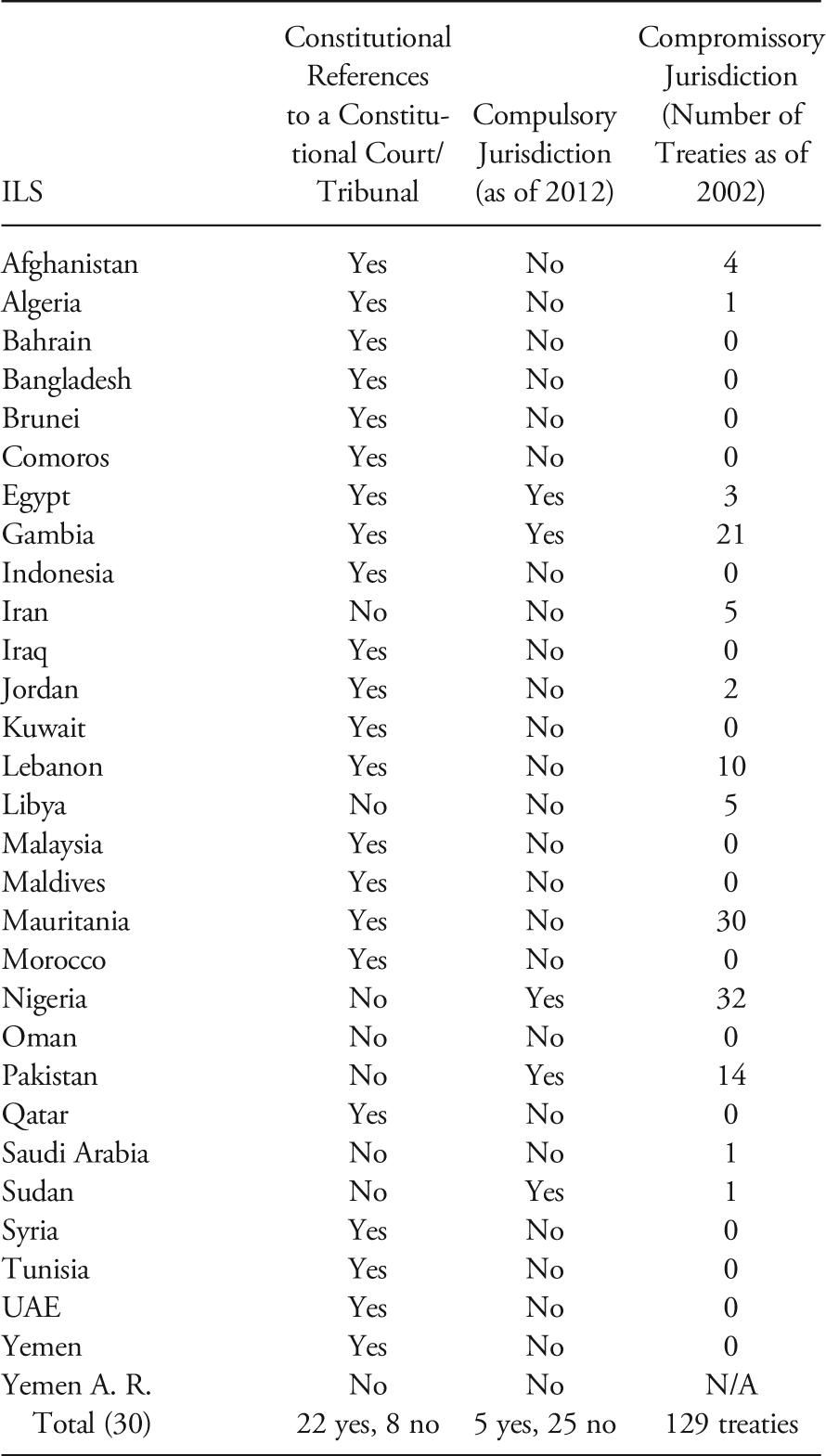
We analyze data on ILS’s acceptance of the ICJ’s jurisdiction since the dissolution of the Court’s predecessor, the Permanent Court of International Justice, in 1946. The unit of analysis is the state-year, and our two dependent variables—Compulsory Jurisdiction and Compromissory Jurisdiction—are the primary methods through which states accept the jurisdiction of the ICJ.Footnote 27 The first and most comprehensive method is the acceptance of the compulsory jurisdiction of the Court. Per Article 36 of the ICJ Statute, a state may declare its recognition of the Court’s jurisdiction as compulsory at any time (ICJ Statute, Art. 36, para. 2). The second method is via compromissory clauses in treaties, through which states accept the jurisdiction of the Court for specific disputes or questions as outlined in a bilateral or multilateral treaty. We employ data from Powell (Reference Powell2020, 218). Compulsory Jurisdiction is a dichotomous variable that is coded as 1 if a state accepts the compulsory jurisdiction of the Court in a given year, with or without reservations, and 0 if it does not.Footnote 28 Compromissory Jurisdiction is a count variable of treaty memberships with compromissory clauses for each ILS-year. We opt for a state-year unit of analysis because each year, states may choose to accept or reject the jurisdiction of the ICJ.Footnote 29 The panel structure of the data allows us to capture change in ILS’s relationship with the ICJ over time, for instance, through the addition of compromissory clauses in new treaties or removal of an optional clause declaration. Table 1 outlines ILS’s acceptance of the ICJ’s jurisdiction in the most recent year available in Powell’s (Reference Powell2020) data. As of 2012, five ILS accept the compulsory jurisdiction of the ICJ, and as of 2006, 13 are party to 129 compromissory clause treaties.Footnote 30
Islamic Law States, Constitutional Courts, and the ICJ

The main independent variable, Constitutional Court, captures the embeddedness of a constitutional court or tribunal in an ILS’s constitution. We collected original data on ILS’s constitutions and major constitutional amendments in effect between 1946 and 2012 (a total of 105 documents). To adequately measure the court’s importance, the Constitutional Court variable not only gauges whether a constitution mentions a constitutional court but also takes into consideration the prevalence of constitutional language devoted to the court. Our index, constructed via principal component analysis (PCA), comprises three indicators: Court Presence, Number of Mentions, and Word Count. The Court Presence dichotomous indicator measures whether a constitution references a constitutional court or a judicial organ charged with constitutional oversight. The Number of Mentions indicator counts the number of times the constitutional court or a similar judicial organ is referenced in the constitution, excluding headers and tables of contents. The Word Count indicator is a word count of the relevant section of the constitution dedicated to such a court.Footnote 31 Because of correlation between these three indicators, our Constitutional Court variable provides an empirically adequate measure of a constitutional court’s presence in ILS’s constitutions.Footnote 32
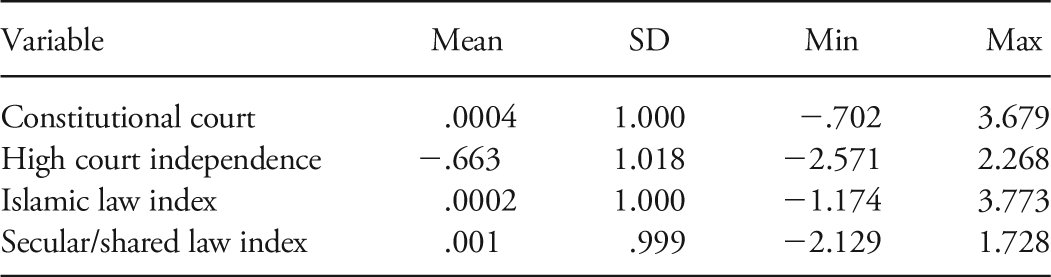
Our hypothesis suggests that the effect of a constitutional court on an ILS’s willingness to accept the ICJ’s jurisdiction is conditional on the constitutional court’s independence. The High Court Independence variable is based on the Varieties of Democracy’s (V-Dem) high court independence variable, which captures how frequently judicial decisions of high courts merely reflect government wishes in cases salient to the government (Coppedge et al. Reference Coppedge and Gerring2018a, 148; Pemstein et al. Reference Pemstein, Marquardt, Tzelgov, Wang, Krusell and Miri2018).Footnote 33 This variable is based on a coding scale in which the lowest score indicates that the high court always reflects government wishes “regardless of its sincere view of the legal record” and the highest score indicates that it never does.Footnote 34 High courts can also be rated as “usually” reflecting government wishes, doing so “about half the time” or “seldom” (Coppedge et al. Reference Coppedge and Gerring2018a, 153). Importantly, this variable captures not only the de jure presence of a constitutional court but de facto judicial decision-making—the court’s ability to issue autonomous legal decisions. In our sample, High Court Independence scores range from −2.571 to 2.268 (table 2), which means that substantively, our ILS sample covers the full range of possible High Court Independence levels, from “always” reflecting government wishes to “never” doing so.Footnote 35 The mean High Court Independence score is −0.663, which suggests that on average, ILS have high courts that reflect government wishes in spite of the court’s view of the matter between “usually” and “about half the time.”Footnote 36
Descriptive Statistics for Main Variables

We control for several factors that are likely to affect ILS’s attitudes toward the ICJ. The literature suggests that the relationship between Islamic law–based domestic laws and secular laws in an ILS’s domestic legal system shapes these states’ international behavior, specifically vis-à-vis international courts (Powell Reference Powell2020). In general, certain secular features such as constitutional mentions of rule of law or commitment to peaceful resolution or settlement of disputes, among others, are inherent to international law and ILS’s domestic legal systems. Consequently, these laws, if indeed inserted in an ILS’s domestic legal system, constitute an important point of interrelatedness between the ILS and international courts. Harking back to the point raised earlier in the article, it is incorrect to assume that Islamic law, in its entirety, is likely to keep ILS from engaging with international law. Merely, certain Islam-based domestic laws may dampen the ILS’s willingness to accept the ICJ’s jurisdiction (Powell Reference Powell2016). Our analyses include two indices—Islamic Law Index and Secular/Shared Law Index—that capture Islamic and shared/secular constitutional characteristics.Footnote 37 We obtained data for the construction of these indexes from Powell (Reference Powell2020, 183–82).Footnote 38 The Islamic Law Index reflects the presence of Islamic law–related constitutional provisions: constitutional references to sharia/Islam, sharia-based education, customary law, supremacy of sharia, holy oath, and Muslim head of state requirement.
The Secular/Shared Law Index reflects the secular/shared law features of ILS’s constitutions. The individual indicators include rule of law, peaceful resolution of disputes, education in constitution, secular courts, and women in the judiciary. Most of these indicators code whether a particular feature is regulated by a constitutional provision. The last two indicators—secular courts and women in the judiciary—capture characteristics of ILS’s subconstitutional legal system.Footnote 39 Table 2 provides descriptive statistics for the four main indicators and indices used in our analyses.
Our remaining control variables include Capabilities, Electoral Democracy, Treaty Commitments, and Time. Capabilities is a measure of state power that is based on the Composite Index of National Capabilities (CINC) index (Singer, Bremer, and Stuckey, Reference David, Bremer, Stuckey and Russett1972). The political science and international law scholarship devoted to international legal institutions demonstrates that when faced with a dispute, states with less material power hope that international courts will protect them from their more powerful adversaries (Scott Reference Scott and Klein2014; Powell and Wiegand Reference Powell, McLaughlin Mitchell and Vasquez2021a). International lawyers have observed that “using binding dispute resolution mechanisms often provides small states with a means to break a cycle of entrenchment from frustrated negotiations” and a “means for small states to gain leverage and redress power imbalances” (Finizio Reference Finizio, Butler, Lein and Salim2018, 15). The Capabilities variable is a scale ranging from 0.00000024 to 0.38, with higher numbers indicating higher national capabilities, measured as an average of six demographic, economic, and military indicators.Footnote 40 For the Electoral Democracy variable, we employ the V-Dem’s Electoral Democracy index, which ranges from 0 to 1, with 0 representing the lowest level of electoral democracy and 1 the highest level.Footnote 41 The relationship between regime type and states’ use of international dispute resolution is far from settled (Simmons Reference Simmons and Diehl1999; Mitchell, Kadera, and Crescenzi Reference Mitchell, Kadera, Crescenzi, Bercovitch and Gartner2008; Gent and Shannon Reference Gent and Shannon2011). It is therefore uncertain if democracies are indeed more likely to use legalized conflict management. It is also possible that ILS as a category, simply put, are unique, as the Islamic legal tradition promotes a nonformal style of dispute resolution (Abu-Nimer Reference Abu-Nimer and Huda2010; Powell Reference Powell2020). The Treaty Commitments variable is a measure of the total number of global and regional peace treaty commitments for each ILS as provided in the Multilateral Treaties of Pacific Settlement (MTOPS) Data Set, Issue Correlates of War (ICOW) Project (Hensel Reference Hensel2005).Footnote 42 Several studies show that such membership motivates states to acquire third-party help in settling contentions (Shannon Reference Shannon2009; Powell and Wiegand Reference Powell2021b). It is also important to recognize that states with many international treaty obligations could be expected to have increased need of international dispute settlement. In other words, a state with many treaty commitments is likely to make those commitments more credible by accepting the ICJ’s jurisdiction. The variable Time gauges the passing of time since the state’s independence. In general, with time, states are less likely to recognize ICJ jurisdiction, and this seems to be the trend in the context of ILS (Mitchell and Powell Reference Mitchell and Justyna Powell2011; Powell Reference Powell2020).
Empirical Analysis
We test our hypothesis about the association between domestic constitutional courts and the ICJ by estimating logit models for the ICJ compulsory jurisdiction (table 3) and negative binomial models for the ICJ compromissory jurisdiction (table 4).Footnote 43 In all analyses, we cluster standard errors by country to account for the lack of independence between observations for each ILS.
Logistic Regression, ICJ Compulsory Jurisdiction, 1946–2012

* p < 0.10.
** p < 0.05.
*** p < 0.01.
Negative Binomial Regression, ICJ Compromissory Jurisdiction, 1946–2002

* p < 0.10.
** p < 0.05.
*** p < 0.01.
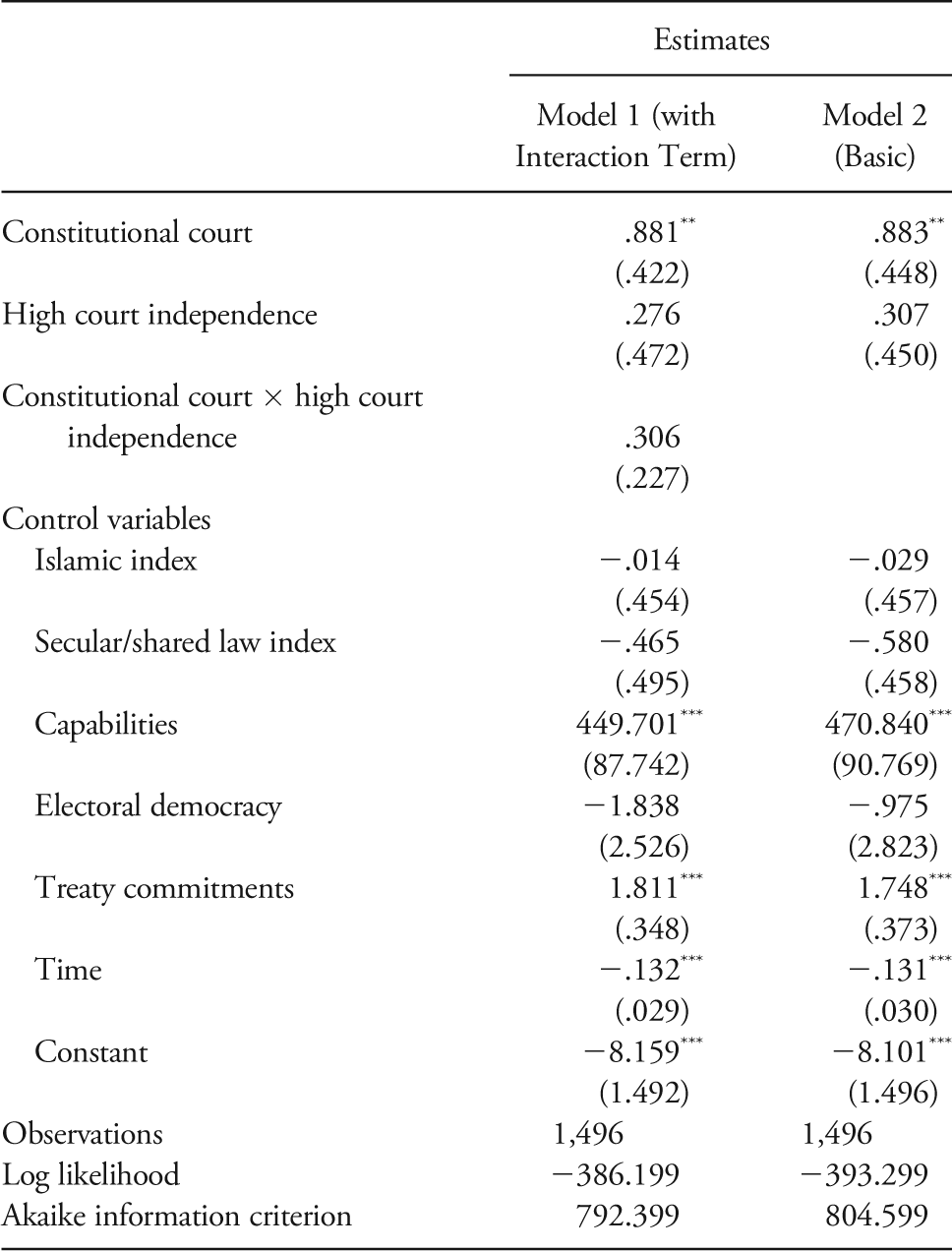
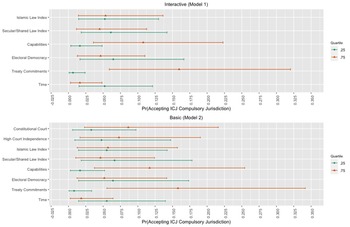
Table 3 presents results from two models: a basic model (model 2), which includes our variables of interest, and model 1 with an interaction term between the Constitutional Court and the High Court Independence variables. Since the hypothesis directly addresses the interconnection between the existence of a constitutional court and its independence, model 1 better reflects our theoretical expectations. Figure 1 presents each variable’s impact by comparing the predicted probabilities of accepting the ICJ’s compulsory jurisdiction for both models at the 25th and 75th percentile of each variable.Footnote 44
Predicted probabilities of variables in interactive model and basic model

When interpreting these results, it is important to bear in mind that the magnitude of the substantive effect tells only a part of the story. States in general and ILS in particular tend to seek out more informal venues to peacefully resolve their disputes. In general, states rarely choose litigation as their first step to resolve a conflict (Scott Reference Scott and Klein2014, 29). In addition, when states decide to litigate, several alternatives are available (Salles Reference Salles2014; Mondré Reference Mondré2015). Moreover, since only five ILS accept the compulsory jurisdiction of the ICJ, ILS have an overall low probability of accepting the Court through this mechanism (Powell Reference Powell2020, 223–24). As such, although the predicted probabilities are small, they are substantively meaningful.
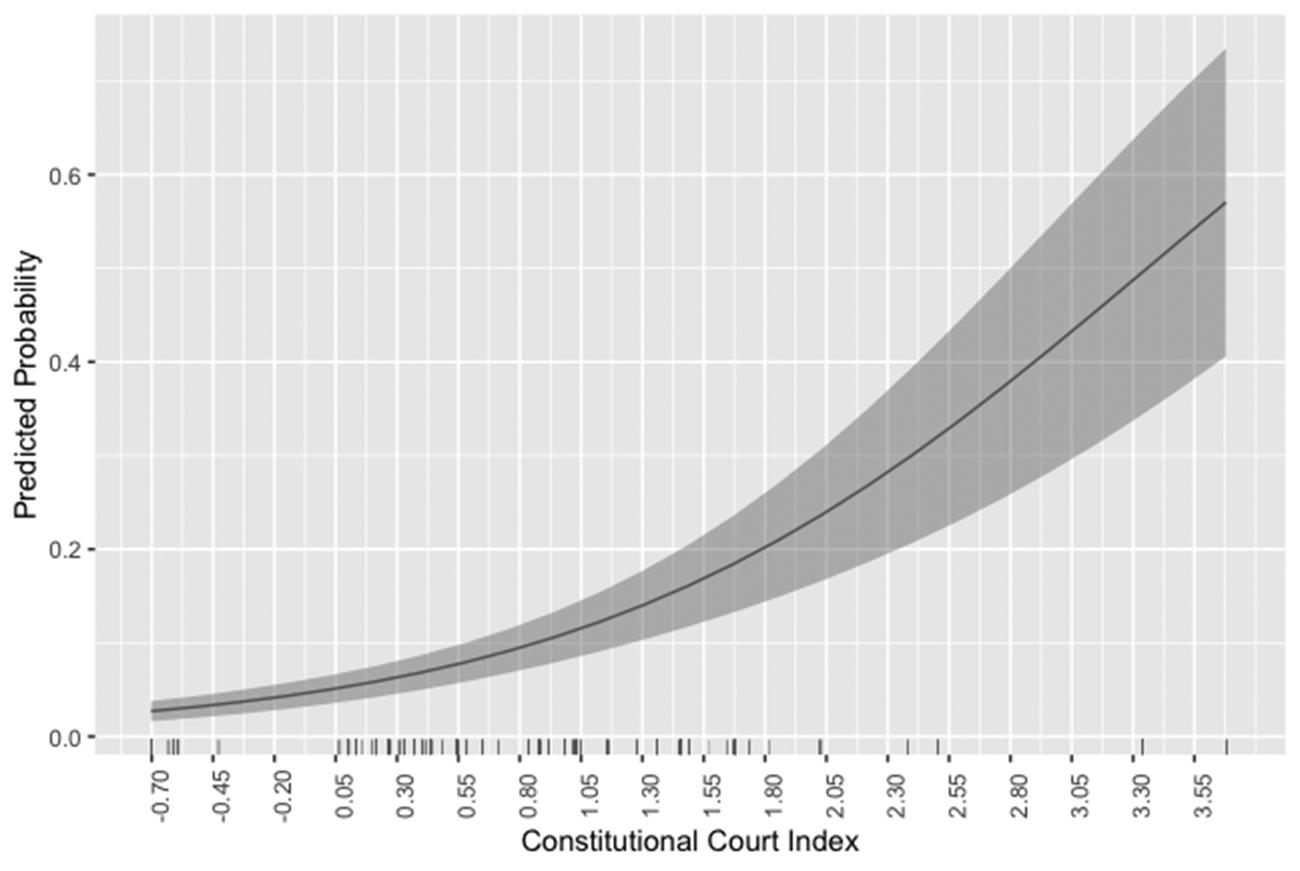
Interestingly, in both the interactive model (model 1) and the basic model (model 2), the Constitutional Court variable is statistically significant, which suggests that by itself, the constitutional presence of a constitutional court has a very small but significant effect on the expected probability of an ILS accepting the jurisdiction of the ICJ. Moreover, this effect increases in the expected (positive) direction as states move from lower to higher levels of Constitutional Court. Figure 2 illustrates the predicted probabilities of accepting the ICJ compulsory jurisdiction at all levels of Constitutional Court, and it shows that as Constitutional Court increases, so does the predicted probability of accepting the ICJ’s compulsory jurisdiction.Footnote 45
Effect of the Constitutional Court variable (basic model)

In contrast, as figure 1 shows, the degree of High Court Independence changes in the expected direction but seems to lack an independent effect on an ILS’s preferences toward the institutionalized global justice. In both models, the effects of control variables are nearly identical. Somewhat surprisingly, ILS with more secular legal institutions are slightly less likely to accept the jurisdiction of the ICJ. Yet, this result can be readily explained by the fact that our Secular/Shared Law Index variable is based on an amalgamation of a variety of secular legal features present within an ILS. Arguably each specific legal institution has a unique effect on the country’s view of international adjudicators. Higher levels of Electoral Democracy are also associated with a slightly lower probability of accepting the compulsory jurisdiction, although neither this difference nor the average effect of Electoral Democracy is statistically significant at conventional levels.
Two control variables, Capabilities and Treaty Commitments, are positive and statistically significant in both models. ILS with more international treaty commitments are more likely to accept the ICJ’s compulsory jurisdiction than those with fewer treaty commitments. As we anticipated, ILS that are part of a higher number of international treaty obligations may, simply put, have more frequent need of international conflict management. Indeed, such states want to peacefully settle their disagreements about compliance with treaty obligations. Or, in the language of credible commitments, ILS with many treaty commitments may want to solidify these commitments—make them more credible—by accepting the compulsory jurisdiction of the ICJ. While an ILS at the 25th percentile of treaty commitments is unlikely to accept the compulsory jurisdiction at all, in both models, ILS at the 75th percentile have approximately a 16% probability of doing so. This finding suggests a potential alternative or complementary explanation to our argument, and indeed it highlights the complexity of explaining acceptance of the compulsory jurisdiction. States with more treaty obligations may accept the compulsory jurisdiction because they anticipate a need for dispute resolution. These states may select into treaty membership for some of the same reasons they accept the compulsory jurisdiction. Hopefully, future research will unpack the explanatory power of treaty commitments for the compulsory jurisdiction to home in on the deep connection between states’ international legal obligations.
The substantive effect of state capabilities is strong for the most powerful states (0.117 for the 75th percentile but only 0.017 at the 25th percentile). In support of earlier scholarship (Powell Reference Powell2020), these results indicate that more powerful ILS are more likely to accept the ICJ’s compulsory jurisdiction.Footnote 46 However, these results are largely driven by Pakistan, a country that scores very high on the CINC measure, 0.0145 in 2012, much higher than almost all ILS. Indonesia has nearly an identical score to Pakistan, and only Iran (0.0158 in 2012) scores higher.
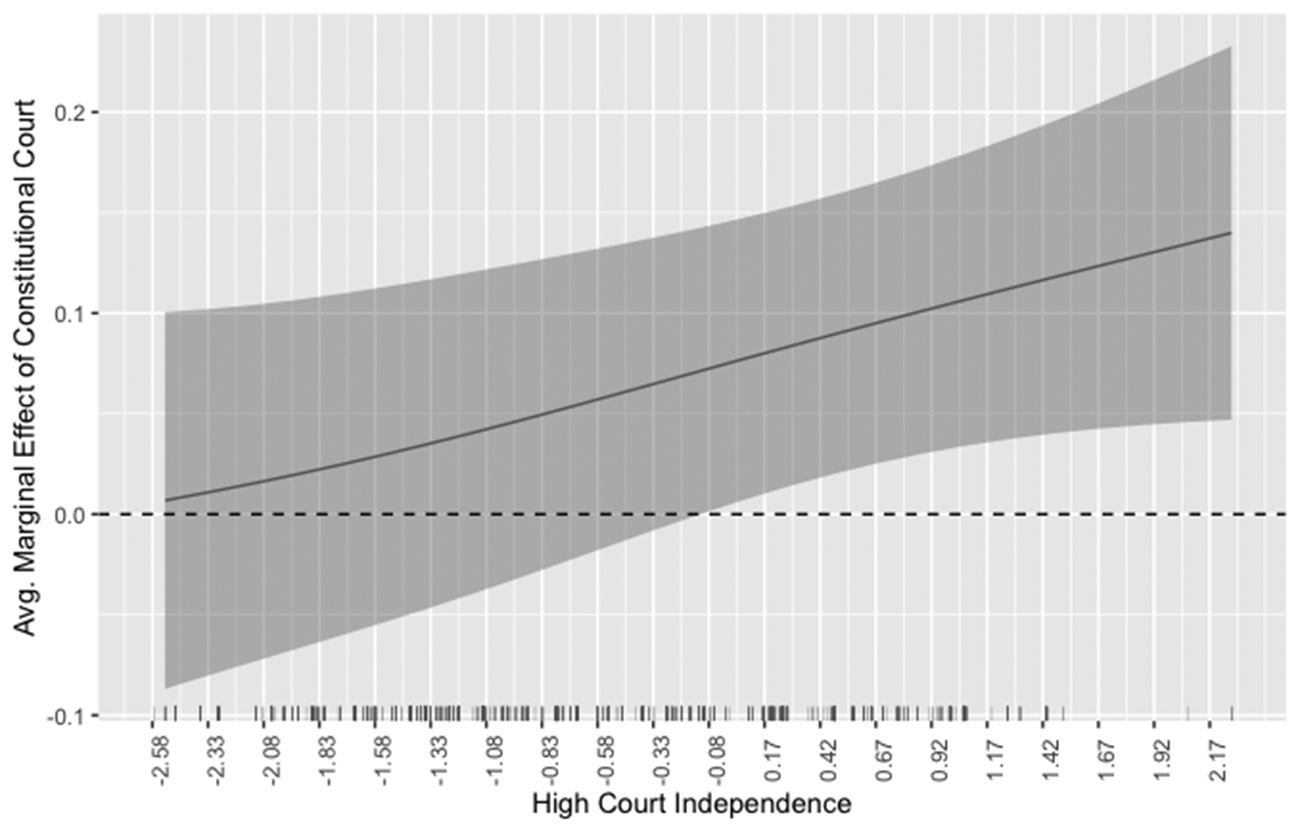
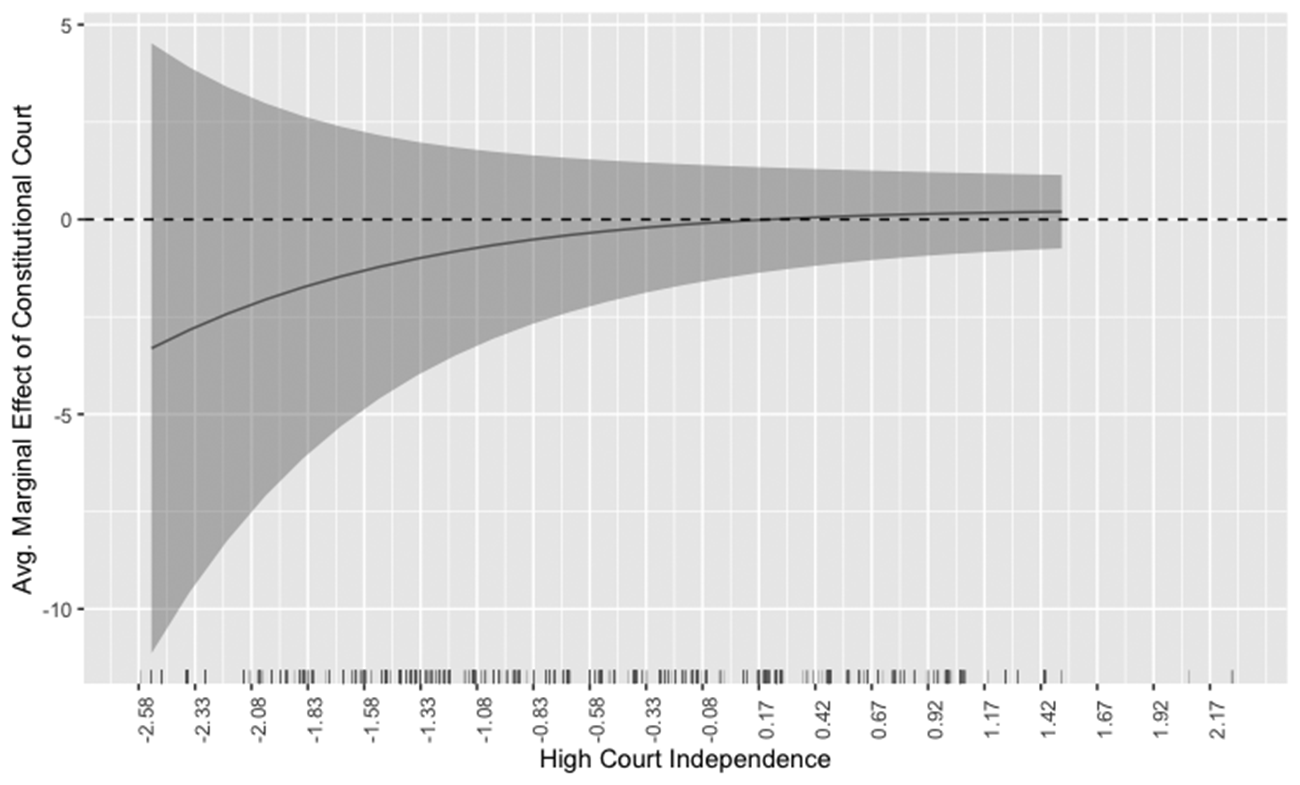
Moreover, the magnitude of individual variables’ effects does not tell the whole story about the influence of these variables. Figure 3 visualizes the interactive effect of the constitutional court as conditional on the levels of High Court Independence within an ILS, from model 1.Footnote 47 When interpreting these results, it is critical to keep in mind that our variable Constitutional Court captures not only whether an ILS has a domestic constitutional court but also the magnitude of constitutional regulation devoted to such a court. As levels of judicial independence increase, the probability of an ILS accepting the ICJ compulsory jurisdiction rises and becomes statistically significant at −0.08 and higher. Using the V-Dem project’s terminology, the effect of Constitutional Court does not have a statistically significant association with accepting the ICJ compulsory jurisdiction for ILS with a constitutional court that “always” or “usually” reflects the government’s position regardless of the court’s view of the issue (Coppedge et al. Reference Coppedge and Gerring2018a, 153). However, when the constitutional court’s decisions simply reflect the government’s preferences “about half the time,” “seldom,” or “never,” the results are positive and statistically significant (Coppedge et al. Reference Coppedge and Gerring2018a, 153). In other words, the effect of Constitutional Court is positive and statistically significant when the court’s decisions are relatively independent and are unlikely to be influenced by an ILS’s government.
Average marginal effect of Constitutional Court, conditional on High Court Independence.

In this model, the presence of a constitutionally anchored constitutional court has an effect on an ILS’s attitudes toward the ICJ only when the constitutional court has a degree of de facto independence. The existence of a constitutional court is not in itself a credible signal of respect for domestic and international rule of law. What matters is the composition and capabilities of the court. According to our Algerian anonymous interlocutor, in Algeria, “all organic laws should come to the Council before the President of the Republic signs them, before they can be enforceable. So, it has a real power to uphold the constitution and the rule of law.”Footnote 48 Importantly, while Algeria scores as “usually” reflecting government opinions on the High Court Independence measure, the country is in the process of implementing its 2016 constitutional reforms, which are intended to bolster the independence of the Constitutional Council.Footnote 49
A constitutional court with a history of high independence can effectively bolster an ILS’s domestic rule of law, regardless of whether that country accepts the jurisdiction of the ICJ. Kuwait, for instance, consistently scores as reflecting government wishes “about half the time” on the High Court Independence measure, much higher than many ILS. This rating indicates that the Kuwaiti Court’s jurisprudence reflects government’s preferences about half the time. According to Aseel al Awadhi, a female member of the Kuwaiti parliament, the hijab law “was formulated in such broad terms that it could be interpreted in various ways and—it goes against the core principles in the constitution, mainly individual freedom” (quoted in Calderwood Reference Calderwood2009). This case highlights the power of a domestic constitutional court to define the balance between Islam-based rules and other institutions.
We also expected that a higher number of treaty memberships should correspond with a greater propensity to accept the ICJ. Our analysis supports this expectation, in line with the literature (Shannon Reference Shannon2009). It seems that ILS perceive accepting the ICJ’s compulsory jurisdiction as a part of their broader relationship with the global order. The coefficient for the Time variable is negative and statistically significant. As time passes, ILS become less willing to support the ICJ via signing the optional clause.
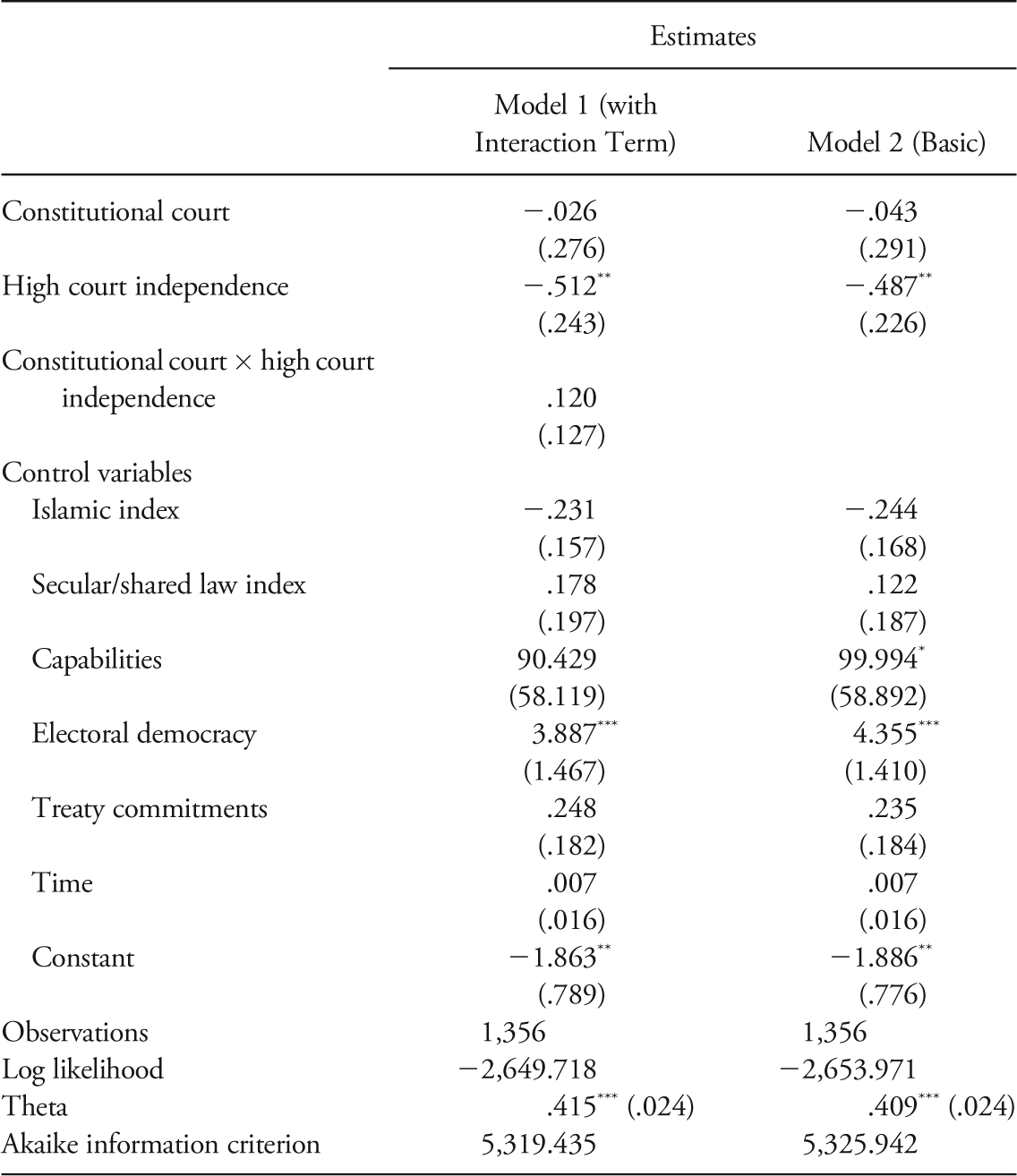
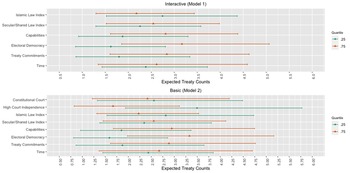
Table 4 presents two negative binomial models for compromissory jurisdiction: model 1 with the Constitutional Court/High Court Independence interaction term and a basic model, model 2. Figure 4 presents expected treaty count—acceptance of the ICJ’s compromissory jurisdiction—for both models at the 25th and 75th percentile of each variable. Interestingly, in the basic model, higher levels of Constitutional Court are associated with slightly lower expected treaty counts. However, neither this effect nor the change from the 25th and 75th percentiles is statistically significant.
Expected counts of variables in interactive model and basic model

In the basic model (model 2), the effect of High Court Independence is also negative and statistically significant, and expected treaty counts are lower at higher levels of High Court Independence. It is possible that this finding can be partially explained by a common alternative explanation to our theory, the domestic culture of legality. This explanation suggests that factors such as judicial independence from the executive, regional politics, and other domestic cultural factors influence how national courts respond to “incursions into their turf” (Huneeus Reference Huneeus, Couso, Huneeus and Sieder2010, Reference Huneeus2016; Huneeus, Couso, and Sieder Reference Huneeus, Couso, Sieder, Couso, Huneeus and Sieder2010). In other words, it is possible that some states with independent constitutional courts are wary of embedding commitments to international courts treaties.
Figure 5 is a graphical representation of the interactive effect between Constitutional Court and High Court Independence. Similar to compulsory jurisdiction, we expected that whether or not domestic constitutional oversight affects an ILS’s propensity to accept compromissory jurisdiction depends on levels of judicial independence. Yet it is only at the highest observed level of court independence that the marginal effect of Constitutional Court on the number of compromissory clauses is positive. Also, this effect does not reach conventional levels of statistical significance for any values of High Court Independence.
Average marginal effect of Constitutional Court, conditional on High Court Independence.

In sum, our results show that the presence of an independent constitutional court does not affect ILS’s willingness to accept the ICJ’s compromissory jurisdiction. The different nature of compulsory and compromissory jurisdiction sheds light on these results. Whereas compulsory jurisdiction provides the strongest and more comprehensive indicator of acceptance of the ICJ, the compromissory jurisdiction usually applies only to specific issue areas.Footnote 50 Indeed, compromissory treaties deal with specific substantive areas of international law, such as commerce and navigation, protection and use of maritime boundaries, consular affairs, and so on. Therefore, it is understandable that the link between an independent constitutional court and ILS’s membership in compromissory treaties is weak.
Results concerning control variables show some interesting patterns. In model 2, only the Electoral Democracy variable is statistically significant at the 0.05 level. This variable’s positive sign indicates that more democratic ILS sign increased numbers of compromissory treaties. In the basic model, the Secular/Shared Law index is positive, which is consistent with previous findings that these shared features between Islamic law and international law provide a powerful connection between ILS and the ICJ (Powell Reference Powell2020). However, this finding is not statistically significant.
Robustness Checks
To ensure that our results are robust to alternative model specifications, we conducted a number of additional tests with different measures of main explanatory variables and additional control variables. We estimated models with individual constitutional court indicators instead of Constitutional Court (Court Presence, Number of Mentions, and Word Count). Results are similar to our base models, and we continue to find that whether domestic constitutional oversight affects ILS’s propensity to accept the ICJ’s compulsory jurisdiction depends on domestic judicial independence. We also estimated our models using individual indicators for the Islamic and Shared/Secular features present in the constitution (Sharia/Islam, Holy Oath, Muslim Head of State, Supremacy of Sharia, Sharia-Based Education, Customary Law, Rule of Law, Secular Courts, Women in Judiciary, Peaceful Resolution of Disputes, Education in Constitution). Again, these findings largely support patterns uncovered in our main models. We considered additional control variables: region, as ICJ acceptance may vary regionally; the status of international law in the constitution, to address the division between monist and dualist legal systems; and the timing of when the constitutional court can challenge laws of lower status (a priori or a posteriori). We also checked whether substituting alternative measures of independent and control variables—Polity IV’s Institutionalized Democracy scale and the Comparative Constitutions Project’s indicators of whether the constitutional court interprets the constitution (Elkins, Ginsburg, and Melton Reference Elkins, Ginsburg and Melton2009) and the Varieties of Democracy’s concept of judicial review—has bearing on our results. These results are also largely supportive of those of our main findings.
Conclusion
We find that embeddedness of a domestic constitutional court in the constitution of an ILS could, under certain conditions, be a signal of commitment to international adjudication. Only when a constitutional court is truly independent and operates as a guardian of the constitution is the association between domestic law and international law clear. This is especially true in the context of accepting the ICJ’s compulsory jurisdiction. An independent domestic constitutional court may be able to accommodate the Islamic legal tradition in ways that promote accepting the compulsory jurisdiction of the main judicial organ of the UN, the ICJ. As existing scholarship shows, the Islamic legal tradition, as a whole, is not irreconcilable with international law (Al-Zuhili Reference Al-Zuhili2005; Al-Khasawneh Reference Al-Khasawneh, Frick and Müller2013; Bassiouni Reference Bassiouni2014; Powell Reference Powell2020, Reference Powell2022). Many ILS have been supportive of international legalized resolution forums—arbitration and adjudication. It also seems that this trend may be growing. Our article demonstrates that domestic constitutional oversight opens these states to the adjudicative powers of the UN’s main judicial organ, the International Court of Justice.