Hospital-acquired vancomycin-resistant Enterococcus (VRE) gastrointestinal colonization is common among patients with hematologic malignancies and increases the risk for VRE bloodstream infection (BSI), especially in those with acute leukemia.Reference Worth, Thursky, Seymour and Slavin1, Reference Ford, Lopansri and Haydoura2 In these patients, VRE BSI has been associated with increased mortality, lengths of stay, and costs.Reference Ford, Lopansri and Haydoura2, Reference Bach, Malak and Jurcic3
Several risk factors for VRE colonization have been identified, especially prolonged broad-spectrum antibiotic exposure. We have previously reported that use of a carbapenem for empiric therapy of febrile neutropenia is a major independent risk factor for VRE colonization among patients with newly diagnosed acute leukemia.Reference Ford, Lopansri and Haydoura2 In September 2015, with the aim of decreasing VRE colonization and slowing the emergence of multidrug-resistant gram-negative infections, we changed our empiric antibiotic of choice for neutropenic fever from a carbapenem to monthly cycling of cefepime and piperacillin/tazobactam. In this study, we report the results of this change on the incidence of hospital-acquired VRE colonization. We also investigated the effects on BSI rates, the gastrointestinal (GI) microbiome, dominant VRE strains on the unit, and patient outcomes.
Methods
Patients and treatments
We studied 342 consecutive patients admitted with newly diagnosed acute myelogenous leukemia (AML), acute lymphoblastic leukemia (ALL), biphenotypic leukemia (BPL), or chronic myelogenous leukemia in blast phase (CML-BP) between September 2011 and August 2017. During this interval, leukemia induction and supportive treatment protocols, indications for nonempiric antibiotics, and environmental sanitation procedures remained uniform. Suitably fit patients who consented received induction chemotherapy. All patients were housed in individual rooms with high-efficiency particulate air (HEPA) filtration and positive-pressure airflow. Patients routinely had central venous catheters placed and received prophylactic proton pump inhibitors. Patients had stool cultures for VRE ordered on admission and performed weekly during hospitalization. VRE surveillance compliance was consistent throughout the study period. In May 2013, our laboratory detection plates for VRE were changed from Campylobacter agar (Becton Dickinson, Franklin Lakes, NJ) to VRE chromogenic agar (ThermoFisher Scientific, Waltham, MA). VRE-colonized or -infected patients were placed into contact isolation (ie, glove and gown protocol). Afebrile neutropenic patients received prophylactic levofloxacin, penicillin VK, and an azole or micafungin. For treatment of febrile neutropenia, patients were changed to an empiric broad-spectrum regimen as follows: between September 2011 and August 2015, an anti-Pseudomonas carbapenem was our standard regimen (carbapenem group). After August 2015, antibiotic treatment for all patients was rotated every month between cefepime and piperacillin/tazobactam (cycling group). The study was approved by the Intermountain Healthcare Institutional Review Board.
Patient data
Clinical data were extracted from the LDS Hospital Acute Leukemia Database, laboratory data were obtained from the Intermountain Healthcare Enterprise Data Warehouse, and cost data were obtained from the hospital case mix database. Total patient costs (direct and indirect), adjusted to 2017 dollars, were estimated by relating total hospital costs to charge codes. Costs were calculated from the day of admission to discharge, the first 3 months, or 1 year following admission. Patients proceeding to hematopoietic stem-cell transplant (HSCT) during the respective interval were not included.
Definitions
Hospital-acquired VRE stool colonization was defined as a negative initial stool for VRE followed by a positive stool. Bloodstream infection (BSI) was defined as a positive blood culture accompanied by symptoms/signs of infection, usually including fever. Severe neutropenia was defined as <100 neutrophils/µL.
Multilocus sequence typing
Previously cryopreserved isolates were inoculated on blood agar. DNA was isolated using the UltraClean Microbial DNA isolation kit (MoBio Laboratories, Carlsbad, CA). Polymerase chain reaction (PCR) was performed using primers for 7 Enterococcus faecium multilocus sequence typing (MLST) housekeeping genes: atpA, ddl, gdh, purK, gyd, pstS, and adk (Invitrogen, Carlsbad, CA).Reference Homan, Tribe and Poznanski4 Reactions were performed in 25-μL volumes using Qiagen Multiplex PCR Master Mix (Qiagen, Hilden, Germany). PCR products were sent for cleanup and sequencing with both PCR forward and reverse primers (TACGen, Richmond, CA). Sequences were queried against the Enterococcus faecium locus and sequence definitions database. Each sequence type was determined via comparison with the MLST database at the University of Oxford (http://pubmlst.org) and with MLST profiles obtained from previously sequenced VRE samples from the same period (see NCBI BioProject database no. PRJNA329509).
Gastrointestinal microbiota assessment
Stool samples for microbiota analysis were selected from a patient stool storage bank without knowledge of patient VRE status. Stools had been frozen at −80°C immediately after collection. DNA was extracted using QIAamp Fast DNA Stool Mini Kit (Qiagen, Hilden, Germany) on the QIAcube (Qiagen), following the manufacturer’s protocol with an added bead-beating step using TissueLyser II (Qiagen). A 16S amplicon sequencing library was prepared according to the 16S Metagenomic Sequencing Library Preparation (Part no. 15044223 Rev. B) protocol for the Illumina MiSeq System (Illumina, San Diego, CA) using the Nextera XT Index Kit v2 Set A (Illumina) for indexing. Sequencing was performed on the Illumina MiSeq platform using Reagent Kit v3 (600-cycle) (Illumina). Sequences were imported into CLC Genomics Workbench 9.0 (Qiagen) as paired-end reads and were processed using the Microbial Genomics Module, Data QC (quality control), and OTU (operational taxonomic unit) Clustering Workflow with default parameters and automatic read-length trimming. Greengenes OTU Reference Database 13_5 was used for taxonomic assignment after OTU clustering at 97% similarity. Alpha diversity was calculated using the Estimate Alpha and Beta Diversities Workflow. After processing, OTUs were filtered to the phylum level and the genus level, and unclassified OTUs were removed. Sequence files are accessible through the National Center for Biotechnology Information (accession no. PRJNA486146).
Statistical methods
The primary endpoint of the study was a reduction in VRE colonization, and a reduction ≥33% was considered clinically significant. Cumulative incidences of VRE colonization during hospitalization and overall survivals, censoring for patients undergoing HSCT, were estimated using the Kaplan-Meier method. Hazard ratios (95% confidence intervals) and P values were calculated using the log-rank test. All hazard ratios reflected the cycling group compared to the carbapenem group. Individual patient factors and outcomes were compared between groups using the 2-tailed Fisher’s exact and Mann-Whitney tests. To evaluate potential competing risk factors for VRE colonization, Cox proportional hazards models were fit with each of the variables of interest as the sole predictor variable (univariate) and a model using all predictors together (multivariate). The predictors were time-varying covariates, and their values were measured each day. The event of interest in the outcome was VRE colonization, with discharge without colonization being a censoring event. Because some stool samples obtained before and after empiric antibiotics were paired, individual phyla and genus reads as a proportion of total reads were compared by fitting a linear mixed-effects model using the antibiotic groups as the fixed effect and the patient ID as the random effect. We chose this method because some of the patients were measured more than once in different groups. P < .05 was considered significant throughout.
Results
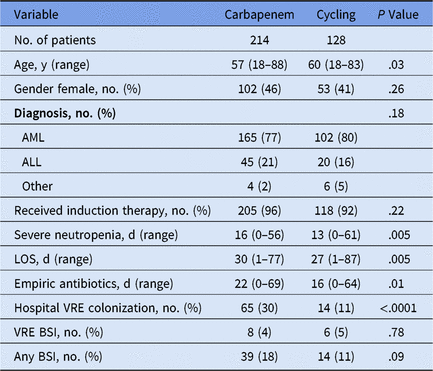
The 214 patients admitted during the carbapenem period were compared to the 128 patients admitted during the cycling period (Table 1). The 2 groups were similar in terms of types of leukemia and the percentage of patients receiving induction therapy; patients admitted during the carbapenem period were slightly younger. The median length of stay (LOS) for all patients was 29 days (range, 1–87). A total of 93 patients (27%) acquired VRE colonization in the hospital, for an incidence of 9.7 patients per 1,000 inpatient days.
Comparisons of Patients during the Carbapenem and Cycling Periods

Note. AML, acute myelogenous leukemia; ALL, acute lymphoblastic leukemia; LOS, length of stay; VRE, vancomycin-resistant Enterococcus; BSI, bloodstream infection.
VRE colonization rates
The incidence of VRE colonization on admission remained similar during the study period (2%–3%). In Figure 1A, we show the rates of hospital acquired VRE colonization for 3 successive 2-year periods: carbapenem 1 (November 2011–August 2013), carbapenem 2 (September 2013–August 2015), and the cycling period (September 2015–August 2017). The VRE colonization rates during the carbapenem periods were identical. In contrast, the change to cycling antibiotics was associated with a significant decrease in the VRE colonization rate (P = .001). Other antibiotics that have been associated with increases in VRE colonization rates (third-generation cephalosporins, metronidazole, and fluoroquinolones) were not administered in higher frequencies during the carbapenem period.
(A) Hospital-acquired VRE colonization rates for 3 successive 2-year periods (September 2011–August 2013; September 2013–August 2015; September 2015–August 2017). During the last period, cycling cefepime and piperacillin/tazobactam (cycling) was the preferred empiric regimen. (B) Cumulative rates of VRE bloodstream infections (BSIs) during the carbapenem (September 2011–August 2015) and cycling periods. (C) Cumulative rates for all gram-positive BSIs. (D) Cumulative rates for all gram-negative BSIs.

VRE dominant strain types
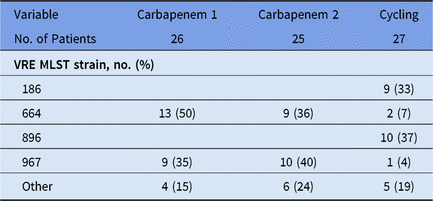
To determine the dominant VRE strain types on the unit, we selected a convenient subset of banked stool samples (1 stool per patient) from each of the 2-year antibiotic periods (Table 2). These data show a persistent domination with ST664 and ST967 prior to the antibiotic change and ST186 and ST896 after.
Comparison of VRE MLST Strain Types

Note. VRE, vancomycin-resistant Enterococcus; MLST, multilocus sequence typing.
VRE colonization risk factors
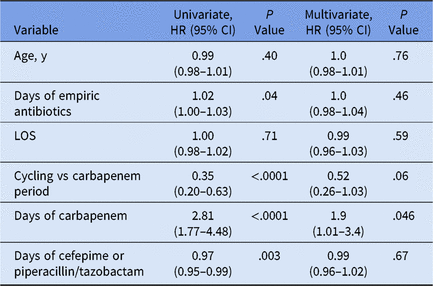
Because the patients admitted during the carbapenem and the cycling periods were not balanced for several potential risk factors for hospital-acquired VRE colonization (LOS, duration of empiric antibiotics, date of admission) (Table 1), we performed a Cox multivariable regression analysis (Table 3). Only days of a carbapenem emerged as a significant independent risk factor.
Hazard Ratios (95% confidence intervals) for Risk Factors for VRE Colonization

Note. HR, hazard ratio; CI, confidence interval; LOS, length of stay.
Effects of carbapenem and cycling cefepime/piperacillin/tazobactam on the gastrointestinal microbiome
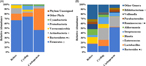
To examine the effects of carbapenems and the cycling antibiotics on the gastrointestinal microbiome, we compared stool metagenomic results from the stools of 8 patients obtained just prior to empiric therapy to those of 6 patients following a median of 3 weeks of cycling antimicrobials (cefepime, 3 patients; piperacillin/tazobactam, 3 patients) to those of 6 patients following a median of 3 weeks of meropenem. Stools from the 12 patients following empiric antibiotics showed a significant decline in their Shannon diversity index compared to stools prior to empiric therapy [median, 3.0 (range, 0.9–5.6) vs median, 4.7 (range, 3.0–6.4); P = .02], with no differences between stools from the 2 antibiotic groups. The phylum- and genus-level results are shown in Figure 3. Patients receiving carbapenems had a reversal of the Firmicutes/Bacteroidetes ratio and more Bacteroides. Blautia spp were also reduced in the carbapenem group. Also, 2 of 6 cycling patients and 3 of 6 receiving carbapenems had VRE colonization, resulting in the expansion of the percentage of VRE OTUs in each group compared to patients prior to empiric therapy.
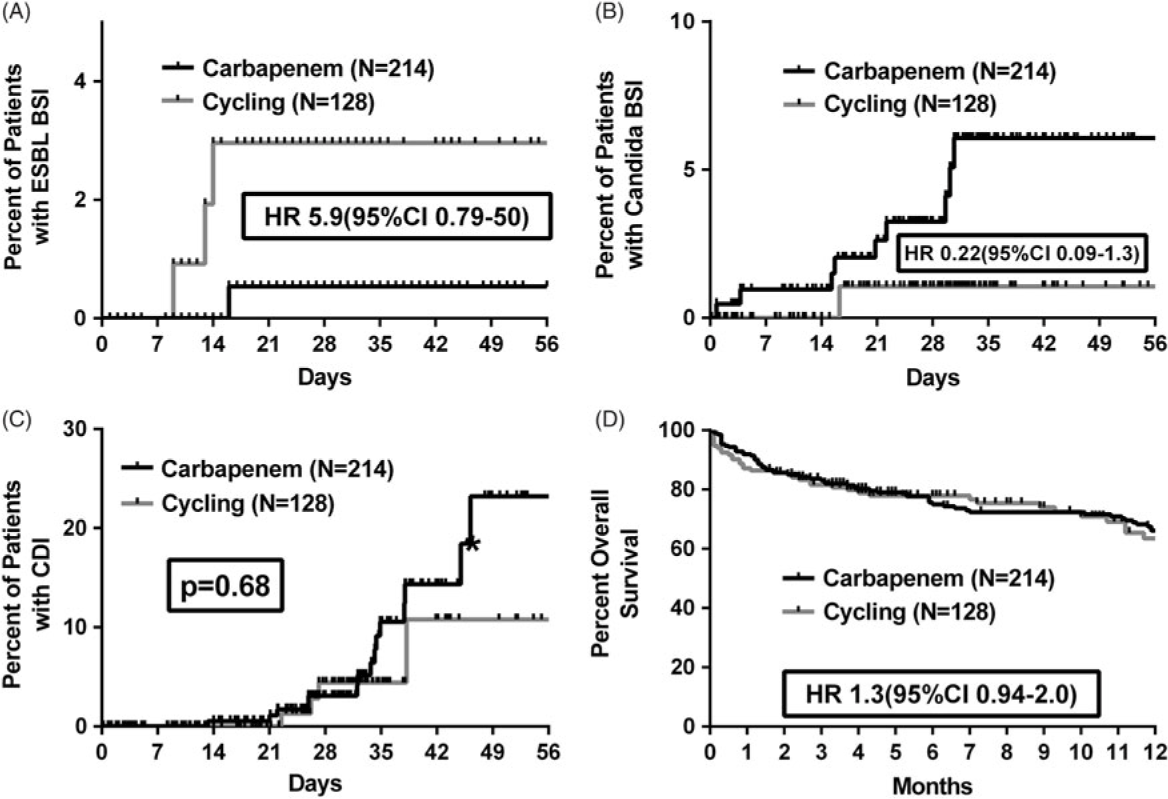
(A) Cumulative rates for ESBL BSI. (B) Cumulative rates of Candida BSI. (C) Cumulative rates for Clostridioides difficile infection. (D) Overall survival for patients admitted during the 2 antibiotic periods.

(A) Phylum-level composition of the gastrointestinal microbial community. Before: 8 stool samples obtained from patients shortly before beginning empiric antibiotic therapy; cycling: stools from 6 patients after receiving a median of 3 weeks of empiric cycling antibiotics; carbapenem: stools from 6 patients after receiving a median of 3 weeks of an empiric carbapenem. (B) Genus-level composition. Open circle: significant difference between the cycling and before groups; closed circle: significant difference between the carbapenem and before groups; Open square: significant difference between the cycling and carbapenem groups.

Bloodstream and C. difficile infections during the carbapenem and cycling periods
During both periods, gram-positive organisms predominated in patient BSIs. There were no differences among the rates of BSI from VRE (Fig. 1B), total gram-positive organisms (Fig. 1C), or total gram-negative isolates (Fig. 1D). We observed numerically more extended-spectrum β-lactamase (ESBL) gram-negative organism BSIs during the cycling period and Candida spp BSIs during the carbapenem period, but these did not reach statistical significance (Fig. 2A–B). The rate of Clostridioides difficile infections did not differ between the 2 groups (HR, 0.63; 95% CI, 0.25–1.8; P = .64).
Patient outcomes
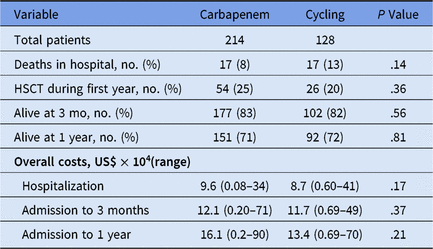
Patients in the carbapenem period had a median of 3 days longer severe neutropenia, more days of empiric antibiotics, and 3 days longer LOS (Table 1). The effects of the antibiotic change on patient overall survival and costs are shown in Table 4. There were no differences in induction hospitalization deaths or the number of patients surviving at 3 months or 1 year. This finding was confirmed by a comparison of actuarial survivals (Fig. 2D). Patients admitted during the carbapenem period had 10% greater hospital costs and higher longer-term costs, although these did not reach statistical significance (Table 4).
Patient Outcomes During the Two Antibiotic Periods

Note. HSCT, hemopoietic stem-cell transfer.
Discussion
Carbapenems, cefepime, and piperacillin/tazobactam are established front-line empiric treatments for febrile neutropenia in patients with hematologic malignancies.Reference Raad, Escalante and Hachem5, Reference Gorschluter, Hahn and Fixson6 We changed our standard empiric regimen from a carbapenem with the aims of decreasing VRE colonization rates,Reference Ford, Lopansri and Haydoura2 preventing the appearance of carbapenem-resistant Enterobacteriaceae, and retarding the emergence of antibiotic-resistant gram-negative infections.Reference Hashino, Morita and Kanamori7–Reference Chong, Shimoda and Yakushiji9 Because of low numbers of the respective infections, the latter 2 goals could not be evaluated in this study.
The mechanism underlying the decrease in VRE colonization remains to be fully elucidated. Conceivably, the broad aerobic/anaerobic spectrum of carbapenems and the relative resistance of VRE to these agents may explain our observations. Differential effects on the microbiome may also have played a role. It may be pertinent that the greatest decrease in Blautia spp occurred in the carbapenem cohort. Commensal populations that include Blautia producta have shown colonization resistance to VRE.Reference Caballero, Kim and Carter10 In addition, many leukemic patients proceed to hematopoietic stem-cell transplantation, and Blautia abundance has been associated with reduced overall and graft-versus-host–related mortality in transplant recipients.Reference Jenq, Taur and Devlin11
Patients during the carbapenem period had an unexpected 3-day longer LOS, a similar delay in neutrophil recovery, and an increase in hospital costs. These were not explained by differences in types of leukemia or the percentage of patients receiving induction therapy. This raises the question of whether carbapenems themselves may have contributed to these outcomes. Unfortunately, no randomized trials have evaluated the use of a carbapenem versus cefepime or piperacillin/tazobactam for empiric therapy in patients with a prolonged period of neutropenia. Several larger trials (>100 patients) have been conducted in patients with various hematologic malignancies and/or other cancers admitted for febrile neutropenia for shorter median times. These studies have shown a statistically insignificant increase in LOSReference Oztoprak, Piskin and Aydemir12, Reference Roohullah, Moniwa and Wood13 or duration of neutropeniaReference Biron, Fuhrmann and Cure14–Reference Nakane, Tamura and Hino16 in the carbapenem arm. Our relatively large patient population, with their more prolonged median durations of neutropenia and antibiotic administrations, may have been more likely to show such an effect. More work on this important question is indicated, especially given the current emphasis on cost containment.
Our results suggest that the spectrum of BSI isolates between patients receiving the 2 empiric antibiotic regimens may differ. We observed a possible increase in candidemia and decrease in ESBL isolates in the carbapenem group. The latter may be explained by the greater sensitivity of ESBL organisms to carbapenems, which may also prevent expansion of these among the gastrointestinal microbiota. Unfortunately, previous studies in hematologic malignancies either have not examined Candida infections or have had too few events for analysis. Surprisingly, despite a dramatic decrease in VRE colonization, the VRE BSI rates were similar. Whether this was due to chance, to some effect in the cycling antibiotics group that increased the rate of translocation in VRE colonized patients, to an increased risk of translocation for the new strains that dominated the unit during the cycling period, or other factors is unclear.
Notably, the antibiotic change was associated with the emergence of 2 new dominant VRE strains. Of the 2 predominant strains during the carbapenem period, ST967 is novel and ST664 has rarely been reported elsewhere.Reference Michael, No and Roberts17 Of the 2 more recent strains, ST186 appears to be novel, and ST896 has been uncommonly detected in the Western Hemisphere.Reference Marchi, Perdigao Neto and Martins18 The factors that allow a strain to dominate are largely unknown. Our results suggest that the choice of antibiotic regimens may be one factor, although other explanations cannot be excluded.
Strengths of this study are its large consecutive patient population and relative homogeneity of patients, therapies, and unit sanitation procedures throughout the period of study. Limitations include a single institutional series with local treatment protocols that may not be generalizable. Our sequential study design is both a weakness and a strength. Although a sequential study potentially increases the chance of introducing hidden confounding factors, a randomized prospective trial tends to equalize the unit VRE colonization pressure, making it more difficult to detect differences in VRE colonization rates. Also, we lacked information on patient VRE statuses prior to our admissions.
In conclusion, less carbapenem use was associated with a reduction in VRE colonization, a decreased duration of neutropenia, and a decrease in hospital length of hospital stay, reduced costs, as well as possibly beneficial effects on potentially important gastrointestinal microbiota such as Blautia spp.
Acknowledgments
We thank the physicians, nurses, and other hospital staff who cared for the patients, Peter Jones for help with data abstraction, Gregory Snow, PhD, for assistance with the statistical analysis, Tasha Fernley for assistance with the laboratory procedures, and Sam Pettingill for assistance with the cost data.
Financial support
This work was supported by grants from the Intermountain Healthcare Medical and Research Foundation (grant nos. AWD00527 and 20600035) and the Hemingway Cancer Research Fund.
Conflicts of interest
B.K.L. has received research support from Cubist/Merck and OpGen in support of projects unrelated to this study. B.K.L. is a member of an advisory board for Merck and Co. B.K.W. has received research support from Astellas Pharma Global for work unrelated to this study. The other authors have no conflicts of interest or financial disclosures to declare.