Introduction
Treatment with corticosteroids, also called glucocorticoids (GC), is critical for effective clinical management of several medical conditions. However, high-dose systemic steroids can affect the central nervous system (CNS) and cause troublesome side effects. These most commonly involve regulatory functions underlying appetite, sleep, and mood (McDonough, Curtis, & Saag, Reference McDonough, Curtis and Saag2008). Psychiatric symptoms often include mood swings, anger outbursts, hyperactivity, depression, mania, and even psychosis (for review, see Brown & Chandler, Reference Brown and Chandler2001; Brown, Suppes, Khan, & Carmody, Reference Brown, Suppes, Khan and Carmody2002; Stuart, Segal, & Keady, Reference Stuart, Segal and Keady2005; Wolkowitz, Burke, Epel, & Reus, Reference Wolkowitz, Burke, Epel and Reus2009). Cognitive side effects can include mental confusion, disorganized thought, inattentiveness, forgetfulness, and more frank memory problems (Brown, Beard, Frol, & Rush, Reference Brown, Beard, Frol and Rush2006; Sacks & Shulman, Reference Sacks and Shulman2005; Wolkowitz, Lupien, Bigler, Levin, & Canick, Reference Wolkowitz, Lupien, Bigler, Levin and Canick2004).
There is substantial literature on the acute and long-term cognitive impacts of steroids in adults with various clinical conditions. Individuals exposed to high endogenous GC levels or therapeutic exogenous steroid doses can display hippocampal or cerebral atrophy (Lupien et al., Reference Lupien, de Leon, de Santi, Convit, Tarshish, Nair and Meaney1998; Starkman, Gebarski, Berent, & Schteingart, Reference Starkman, Gebarski, Berent and Schteingart1992; Zanardi, Magna, & Costallat, Reference Zanardi, Magna and Costallat2001) and impaired memory (Bermond et al., Reference Bermond, Surachno, Lok, ten Berge, Plasmans, Kox and Hamel2005; Keenan et al., Reference Keenan, Jacobson, Soleymani, Mayes, Stress and Yaldoo1996; Keenan, Jacobson, Soleymani, & Newcomer, Reference Keenan, Jacobson, Soleymani and Newcomer1995; Starkman et al., Reference Starkman, Gebarski, Berent and Schteingart1992), although some effects may be reversible (Bourdeau et al., Reference Bourdeau, Bard, Noël, LeClerc, Cordeau, Bélair and LaCroix2002; Brunner et al., Reference Brunner, Schaefer, Hess, Parzer, Resch and Schwab2005; Uttner et al., Reference Uttner, Mueller, Zinser, Maier, Sussmuth, Claus and Tumani2005). Adults treated with high to very high steroid doses demonstrate impairments of episodic memory and executive functions (Sacks & Shulman, Reference Sacks and Shulman2005; Wolkowitz et al., Reference Wolkowitz, Lupien, Bigler, Levin and Canick2004). The executive function deficits associated with exogenous steroids appear to involve alteration in the function of prefrontal cortex (Cerqueira et al., Reference Cerqueira, Pego, Taipa, Bessa, Almeida and Sousa2005; Lupien, Gillin, & Hauger, Reference Lupien, Gillin and Hauger1999). These clinical reports are further corroborated by double-blind placebo-controlled studies of healthy adult volunteers that reveal transient effects on memory, with other cognitive functions relatively spared (DeQuervain, Roozendaal, Nitsch, McGaugh, & Hock, Reference DeQuervain, Roozendaal, Nitsch, McGaugh and Hock2000; Lupien, et al., 1999; Monk & Nelson, Reference Monk and Nelson2002; Newcomer, Craft, Hershey, Askins, & Bardgett, Reference Newcomer, Craft, Hershey, Askins and Bardgett1994; Newcomer et al., Reference Newcomer, Selke, Melson, Hershey, Craft, Richards and Alderson1999).
Pediatric populations have repeatedly shown acute side effects of steroid therapy on mood and behavior. Both prednisone and dexamethasone have been associated with increased irritability, aggression, listlessness, depression, and problems with emotional regulation in children treated for cancer (Drigan, Spirito, & Gelber, Reference Drigan, Spirito and Gelber1992; Harris, Carel, Rosenberg, Joshi, & Leventhal, Reference Harris, Carel, Rosenberg, Joshi and Leventhal1986; Mrakotsky et al., Reference Mrakotsky, Silverman, Dahlberg, Alyman, Sands, Queally and Waber2011) and nephrotic syndrome (Soliday, Grey, & Lande, Reference Soliday, Grey and Lande1999). These acute impacts on behavior and mood may be more prominent in younger (preschool) children than in older children and adolescents (Mrakotsky et al., Reference Mrakotsky, Silverman, Dahlberg, Alyman, Sands, Queally and Waber2011).
Pediatric data regarding cognitive side effects of corticosteroids are more limited, especially those not involving pre- or neonatal exposure, and findings are mixed. Children treated with prednisone for asthma demonstrated poorer memory acutely on higher-dose than lower-dose days (Bender, Lerner, & Kollasch, Reference Bender, Lerner and Kollasch1988). Cushing's syndrome, which involves elevations of endogenous GC, was associated with cognitive decline despite reversal of brain atrophy one year after correction of hypercortisolism in a pediatric sample (Merke et al., Reference Merke, Giedd, Keil, Mehlinger, Wiggs, Holzer and Chrousos2005), suggesting that steroid excess can affect the developing brain differently than the mature adult brain, with potentially more permanent effects. Along these lines, patients treated for acute lymphoblastic leukemia with dexamethasone, a more potent steroid preparation, demonstrated more significant cognitive late effects relative to historic controls treated with prednisone (Waber et al., Reference Waber, Carpentieri, Klar, Silverman, Schwenn, Hurwitz and Sallan2000); however, a recent randomized controlled trial did not confirm such differences (Kadan-Lottick et al., Reference Kadan-Lottick, Brouwers, Breiger, Kaleita, Dziura, Northrup and Neglia2009).
To augment this literature, we investigated the acute cognitive and behavioral side effects of high-dose systemic steroids in another pediatric population without known CNS disease for whom steroid therapy is common, children with inflammatory bowel disease (IBD). IBD, which includes Crohn's disease (CD) and ulcerative colitis (UC), is a chronic inflammatory condition of the gastrointestinal tract that is associated with significant morbidity. In children, it is typically first diagnosed in middle childhood or adolescence. IBD patients often suffer from recurrent abdominal pain, bloody stools, diarrhea, and weight loss, as well as chronic growth and pubertal delay (Murch et al., Reference Murch, Baldassano, Buller, Chin, Griffiths, Hildebrand and Orsi2004). Whereas UC primarily affects the large intestine, CD can affect any gastrointestinal region. Autoimmune processes are thought to be a primary etiologic factor (Podolsky, Reference Podolsky2002), with genetic and environmental components playing an important role. Psychological stress and depression have been associated with difficult or severe IBD (Engstrom, Reference Engstrom1999; King, Reference King2003; Mittermaier et al., Reference Mittermaier, Dejaco, Waldhoer, Oefferlbauer-Ernst, Miehsler, Beier and Moser2004; Szigethy et al., Reference Szigethy, Levy-Warren, Whitton, Bousvaros, Gauvreau, Leichtner and Beardslee2004), suggesting an interaction between the enteric (gut) and central (brain) nervous systems.
IBD has no known cure; however, its impact can be significantly mitigated by therapies that control inflammation, correct nutritional deficiencies, and relieve symptoms. Conventional pharmacologic therapy with corticosteroids is often used to control disease flares; however, for severe disease activity, high-dose systemic steroids are indicated, including intravenous methylprednisolone succinate, oral prednisone, or methylprednisolone, to induce remission (Markowitz et al., Reference Markowitz, Hyams, Mack, Leleiko, Evans and Kugathasan2006; Rufo & Bousvaros, Reference Rufo and Bousvaros2006).
The present study compares patients with IBD who were on high-dose steroid therapy with patients who were off steroid therapy, hypothesizing that steroids would produce acute adverse effects on memory, executive function, and mood. Based on prior literature, we predicted that patients on high-dose steroids would demonstrate poorer performance on measures of memory, especially declarative memory, than would a control group currently not receiving steroid therapy. We also predicted that acute steroid treatment would affect immediate and working memory more than long-term memory, as reported by Lupien et al. (Reference Lupien, Gillin and Hauger1999). Our prediction about performance on executive function measures was more exploratory due to limited prior data in this domain. Consistent with the literature, however, we hypothesized that patients on steroid therapy would exhibit poorer behavioral and emotional regulation than the control group. Medical factors such as disease severity, pain, and sleep that could mediate potential associations or independently affect the outcomes of interest were considered as well.
Method
Design
The study design was cross-sectional, comparing an IBD treatment group currently on high-dose systemic steroids with an IBD control group who had not received steroids for at least 6 months. Primary outcomes included cognitive measures as well as questionnaire summary indices. Questionnaire subscales were considered secondary outcomes and analyzed for descriptive purposes.
Participants
Children and adolescents with IBD (8 to 17 years; N = 73) were recruited from the Center for Inflammatory Bowel Disease at Boston Children's Hospital. Patients were included if they had a diagnosis of CD or UC based on pathology results. The Steroid group had been receiving ≥30 mg/day or 1 mg/kg/day of oral prednisone, prednisolone, or intravenous methylprednisolone succinate for at least 5 days, were medically stable, and were evaluated shortly before or after their steroid taper, while still above the criterial dose (mean prednisone dose 42 mg/day, range 30 to 75 mg/day). The Control group had been in disease remission and off steroids for at least 6 months. Duration of current steroid therapy was M = 56.1 (range 8 to 854) days for the Steroid group. Duration of lifetime steroid therapy was M = 135.0 (range = 8 to 854) days for the Steroid group, and M = 272.0 (range 25 to 1149) days for the Control group (t = 2.418; df = 63; p < .02), an expected difference because the Steroid group included more newly diagnosed patients. Exclusion criteria were pre-existing major psychiatric illness unrelated to steroid therapy and requiring psychopharmacological intervention, pre-existing developmental or learning disorders (including intellectual disability, autism, developmental language disorders, ADHD, and specific learning disabilities) requiring special education intervention (provision of an IEP), significant neurological disorders, low-dose and/or topical steroid treatment, and non-English speaking families. Eligibility was determined based on review of medical records, a screening checklist, and parent interview.
Participation rate was 55.4% of all approached patients for the Steroid group and 39.8% for the Control group; the decline rate was 15.4% and 30.1% in the Steroid and Control groups respectively. The rest were deemed ineligible (Steroid: 9.2%; Control: 18.3%), lost due to time constraints (Steroid: 16.4%; Control: 5.4%), or never replied after initial interest (Steroid: 3.1%; Control: 6.5%). Seven children were excluded after enrollment (2, bolus steroid administration too brief to qualify; 5, on IEP for pre-existing developmental or learning problems, including 2 Steroid, and 3 Control).
Sixty-six patients (33 Steroid, 33 Control) remained and participated. Informed written consent/assent was obtained from all participants and parents. The protocol and all procedures were approved by the Institutional Review Board of Boston Children's Hospital.
Procedures
Participants were recruited during a routine clinic visit or hospital stay and screened for eligibility with a brief checklist. Eligible patients participated in a one-time study visit that occurred during steroid therapy for the Steroid group or at the family's convenience for the Control group. Participants completed a neuropsychological assessment comprised of measures of attention, memory, executive functions, cognitive ability, mood and behavior, as well as a pain and sleep rating. Medical data, including information necessary to generate a rating of disease severity, were obtained from the treating physician and the medical record. Parents completed behavior rating scales and a history/demographic questionnaire at the time of visit.
Demographic Measures
Data pertaining to age, gender, ethnicity and/or race, school placement, family composition, as well as marital status, occupation, and educational level of parents, were obtained from questionnaires, medical records, and direct interview.
Cognitive Ability
General cognitive ability was assessed by the Wechsler Abbreviated Scale of Intelligence (WASI; Wechsler, Reference Wechsler1999) to ensure comparability of the two study groups. We did not hypothesize that steroid therapy would affect general intelligence; IQ was measured for descriptive purposes.
Neuropsychological Measures
The neuropsychological assessment consisted of standardized tests and rating scales selected a priori to assess memory, executive skills, and mood, the domains most commonly affected by corticosteroid therapy based on prior literature in both children and adults. The memory measures focused on declarative memory (i.e., paragraph recall, word list learning and visual equivalent), previously found to be sensitive to steroid effects. The selection of executive function tasks was more exploratory due to the limited prior data in this domain. For adolescents age 16 years and older, the adult test versions (if available) were used.
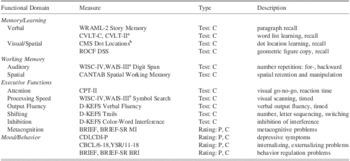
Parent rating scales were administered to assess executive functions, behavior and mood in daily life. Children and adolescents completed the self-report version if they were within the age range for these scales. Patients and parents were instructed to use a 2-week (instead of the 6-month) reporting window on ratings to capture the acute effects of steroids. We previously found these scales sensitive to acute steroid effects with an even shorter window (1-week) and repeat administration (Mrakotsky et al., Reference Mrakotsky, Silverman, Dahlberg, Alyman, Sands, Queally and Waber2011). Table 1 lists the outcome measures by functional domain.
Neuropsychological measures of primary outcomes

Note. C = child; P = parent; WRAML-2 = Wide Range Asssessment of Memory and Learning, Second Edition (Sheslow & Adams, 2003); CVLT-C =California Verbal Learning Test, Children's Version (Delis et al., 1994), CVLT-II = California Verbal Learning Test, Second Edition (Delis et al., 2000); CMS = Children's Memory Scale (Cohen, 1997); ROCF DSS = Rey-Osterrieth Complex Figure Developmental Scoring System (Bernstein & Waber, 1996); WISC-IV = Wechsler Intelligence Scale for Children, Fourth Edition (Wechsler, 2003); WAIS-III = Wechsler Adult Intelligence Scale, Third Edition (Wechsler, 1997); CANTAB = Cambridge Neuropsychological Test Automated Battery- eclipse v2.0TM (Cambridge Cognition Ltd, 2005); CPT-II =Conners’ Continuous Performance Test, Second Edition (Conners, 2000); D-KEFS = Delis-Kaplan Executive Function System (Delis et al., 2001); BRIEF = Behavior Rating Inventory of Executive Function (Gioia et al., 2000); BRIEF-SR = Behavior Rating Inventory of Executive Function, Self Report (Guy et al., 2004); MI = Metacognitive Index; BRI = Behavior Regulation Index; CDI = Children's Depression Inventory (Kovacs, 1992). CDI-P =Children's Depression Inventory, Parent Version (Kovacs, 1992); CBCL/6-18 = Child Behavior Checklist for Ages 6–18 (Achenbach & Rescorla, 2001); YSR/11-18 = Youth Self Report 11–18 (Achenbach & Rescorla, 2001).
aAdult test versions administered to participants age 16 and 17 years.
bAge norms for 16 year-olds used for participants age 17 years.
Medical Symptom Measures
Disease severity was quantified using rating scales designed for both clinical practice and research: the Pediatric Crohn's Disease Activity Index (PCDAI; Hyams et al., Reference Hyams, Ferry, Mandel, Gryboski, Kibort, Kirschner and Lesser1991) for CD and the Clinical Score of Kozarek (Kozarek et al., Reference Kozarek, Patterson, Gelfand, Botoman, Ball and Wilske1989) for UC. These scales include measures in three illness domains collected as part of the patients’ routine medical visits in close proximity to the study visit: (a) self-report, including pain and functional disability, (b) clinician-rated severity, and (c) objective data such as blood tests (i.e., erythrocyte sedimentation rate) and weight and growth charting. The resulting continuous total scores were converted to categorical data (inactive, mild, moderate/severe) based on pre-established criteria.
Pain was assessed at the time of the visit by the Visual Analogue Scale for Pain (VAS-P; Carlsson, Reference Carlsson1983; Stinson, Kavanagh, Yamada, Gill, & Stevens, Reference Stinson, Kavanagh, Yamada, Gill and Stevens2006), a self-report analogue scale consisting of a 10 cm horizontal line labeled from “no pain” to “most intense pain.”
Sleep disruption was assessed by the sleep item from the Children's Depression Rating Scale Revised (CDRS-R; Poznanski & Mokros, Reference Poznanski and Mokros1996). Respondents rated their sleep on a 5-point Likert-scale with “1” indicating no difficulty with sleep and “5” indicating difficulties with sleep nearly every night.
Statistical Methods
Group differences on the demographic and medical variables were evaluated by χ2 or Fisher's exact tests for categorical variables and t- or Wilcoxon tests for continuous variables. Group differences on tests and rating scales were evaluated by analysis of variance (ANOVA). Distributions of scores for all primary outcomes (cognitive, in particular memory and working memory scores; rating scale indices) were inspected for outliers; means, standard deviations, and ranges were within expected limits. To account for potential moderation effects of disease type (CD vs. UC), we tested Steroid group-by-Disease type interactions for all outcomes. A finding of significant interactions would merit comparison of Steroid and Control groups separately within disease type. If Steroid groups differed for demographic or medical characteristics, models for the whole sample as well as disease subsamples were adjusted for these variables, as well as for age (where raw scores were analyzed) and test version (where either child or adult version of a measure was used) by analysis of covariance (ANCOVA). Because of the many scores generated by questionnaires, we submitted only summary indices as primary outcomes to adjusted analyses, and report unadjusted results for subscales for descriptive purposes only.
Parameter estimates of main and covariate effects are presented as standardized betas (β), which serve as indicators of effect sizes. They also provide for comparison across outcome variables as well as across predictors. For example, a standardized β of 1.0 for Group would indicate that the groups differ by one standard deviation. Analyses to determine mediating effects of covariates was conducted according to the method of Preacher and Hayes (Reference Preacher and Hayes2004). Given the limited sample size and exploratory nature of this study, we set alpha at .05 (two-sided), and adjusted primary outcomes for multiple comparisons by False Discovery Rate (Benjamini & Hochberg, Reference Benjamini and Hochberg1995; Kromrey & Hogarty, Reference Kromrey and Hogarty2002) – which controls the expected proportion of Type 1 errors – within families of similar variables (i.e., verbal memory, executive function).
Results
Demographic and Clinical Characteristics
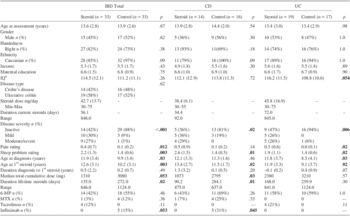
Table 2 shows demographic and medical characteristics for the Steroid and Control groups in the total sample as well as sub-divided by Disease groups. Groups were comparable demographically but differed in some clinical characteristics. As expected, the Steroid group was more acutely ill at the time of assessment and experienced greater disease severity, pain, and sleep problems than Controls. In addition, since the Control group had been in remission (off steroids) for at least 6 months at the time of assessment but were of comparable age, they were younger at diagnosis and first steroid treatment. UC Controls were notably younger at diagnosis than UC Steroid patients, but this difference was not significant for the CD sample. Controls in both disease subgroups were younger at their first steroid treatment.
Demographic and clinical sample characteristics by steroid and disease group [Mean (SD)]

Note. IBD = Inflammatory bowel disease; CD = Crohn's disease; UC = ulcerative colitis; 6-MP = 6-mercaptopurine; MTX = methotrexate. a Full Scale IQ, Wechsler Abbreviated Scale of Intelligence (WASI)
Thus, age at first steroid treatment, sleep problems, and disease severity were entered as covariates in subsequent group comparisons. Age at diagnosis and at first steroid were highly correlated (r = 0.892; p < .001), thus models were adjusted only for age at first steroid. Lifetime steroid duration also differed between groups, with longer overall duration for Controls, particularly CD Controls; however, since it was not correlated with any outcomes, it was not entered in covariate models. We also did not adjust separately for pain since rating of abdominal pain is part of the disease severity scales.
Concurrent medical treatments differed only for infliximab, a TNF-alpha antagonist commonly given as both induction and maintenance therapy in CD. Thus, more CD Controls (in remission) received this agent. Since there is little evidence for associated cognitive risks at the doses given, and differences were only marginally significant, it was omitted as a covariate.
Although there was no overall group difference in IQ, the UC Control group had marginally lower IQ scores than the UC Steroid group (p = .054), potentially influencing neuropsychological outcomes in that subgroup. We thus adjusted for IQ in the UC sub-analysis. Although this difference could reflect an impact of steroid or younger age at disease onset within the UC Control group, it is more likely a function of potentially uneven distributions given the small cell sizes within the disease and steroid subgroups.
Comparison of Steroid and Control Groups
Primary outcomes
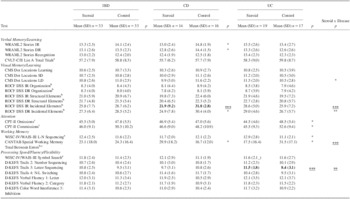
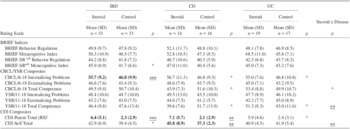
Unadjusted analyses revealed no main effects of Steroid for laboratory cognitive measures (Table 3), but some differences on behavior ratings (Table 4). Steroid-treated patients were rated as experiencing more problems with emotional and executive functions in daily life than Controls, although group mean scores were not within clinical range. Parents and patients in the Steroid group endorsed more internalizing (depressive) symptoms on the CBCL/6-18, CDI-P, and CDI than Controls. The Steroid group also self-reported more problems on the BRIEF-SR Metacognitive Index.
Unadjusted steroid group comparison of neuropsychological test performance for the overall sample and for disease subsamples

Note. All scores listed are standard scores unless otherwise noted. Steroid x Disease: p-values for interaction between steroid group (on vs. off steroids) and disease type (CD vs. UC). CD controls performed generally better than those treated with steroids (CDControls > CDSteroid), whereas performance differences were reversed for UC patients (UCControls < UCSteroid). IBD = inflammatory bowel disease; CD = Crohn's disease; UC = ulcerative colitis; RS = raw scores; SD = standard deviation; IR = immediate recall, DR = delayed recall; SD = short delay, LD = long delay, WRAML2 = Wide Range Assessment of Memory and Learning-Second Edition; CVLT-C/II = California Verbal Learning Test, Children's Edition and Second Edition; CMS = Children's Memory Scale; ROCF DSS = Rey-Osterrieth Complex Figure Developmental Scoring System; CPT-II: Continuous Performance Test- Second Edition; WISC-IV = Wechsler Intelligence Scale for Children- Fourth Edition, WAIS-III = Wechsler Adult Scale of Intelligence – Third Edition, L-N = Letter-Number; CANTAB = Cambridge Neuropsychological Test Automated Battery; D-KEFS = Delis-Kaplan Executive Function System, N-L = Number-Letter;
aStandard Scores; Analyses adjusted for test version.
b Raw scores; Age-adjusted analyses.
cHigher scores represent poorer performance.
*p < .05. **p < .01. ***p ≤ .001.
Bolded means and underlined p-values indicate findings that remain significant after False Discovery Rate correction for multiple comparisons.
Unadjusted steroid group comparison of rating scales for the overall sample and for disease subsamples

Note. IBD = inflammatory bowel disease; CD = Crohn's disease; UC = ulcerative colitis. Steroid x Disease: For interactions, CD controls reported fewer problems than those treated with steroids (CDControls < CDSteroid), whereas rating differences were reversed for UC patients (UCControls > UCSteroid). BRIEF/BRIEF-SR = Behavior Rating Inventory of Executive Function, parent/self-report; CBLC6-18 =Child Behavior Checklist; YSR11-18 = Youth Self Report; CDI = Children's Depression Inventory; RS = raw score.
aN CD-Steroid = 12, N CD-Control = 16.
bN UC-Steroid = 15, N UC-Control = 13.
c Raw scores; Age-adjusted analyses.
*p ≤ .05. **p ≤ .01. ***p ≤ .001.
Bolded means and underlined p-values indicate findings that remain significant after False Discovery Rate correction for multiple comparisons.
After correction for multiple comparisons, group differences remained significant for parent ratings (CBCL/6-18 Internalizing Problems; CDI-P Total), but not self-report (CDI Total; BRIEF-SR Metacognitive Index). Similarly, differences persisted after adjusting for covariates (sleep, disease severity, age at first steroid) for the parent ratings, but not the self-reported metacognitive or depressive symptoms, which appeared to be largely explained by sleep problems. Sleep mediated the effect of steroids on the self-report CDI Total (p = .02; 65.7% mediated), while this mediating role was not significant for parent rating indices. No sizable mediation effect was found for age at first steroid.
Secondary outcomes
For descriptive purposes, we evaluated the subscales comprising the index scores in unadjusted analyses only. Parents of patients on steroids reported more problems related to cognitive functioning on the BRIEF (Working Memory, Plan/Organize scales: p < .05), the CBCL (Attention Problems: p < .05, Thought Problems: p < .01), and the CDI-P (Ineffectiveness: p < .05). Similarly, patients self-reported more cognitive problems on the BRIEF-SR (Task Completion: p < .05) and YSR/11-18 (Thought Problems: p < .05). Parents reported poorer academic functioning on the CBCL School Competence scale, and patients similarly reported poorer functioning on the YSR Academic Performance scale (both p < .05).
For the mood subscales, parents of patients on steroids reported more depressive symptoms on the CBCL (Withdrawn/Depressed: p < .05) and the CDI-P (Negative Mood, Negative Self Esteem scales: p < .05), especially anhedonia (CDI-P Anhedonia: p < .0001). The CDI self-report Anhedonia scale was also elevated (p < .05).
Comparison of Steroid and Control Groups Within Disease Type
Complicating interpretation of these group comparisons were several significant interactions between Steroid group and Disease type, as indicated in Tables 3 and 4. Where interactions were documented, the predicted steroid effect emerged for CD patients, but the group differences were often opposite to the predicted direction for UC patients (UC Controls performing more poorly than the UC Steroid group). This was true for the laboratory tests (see Table 3, last column) and some behavior ratings (see Table 4, last column). Because of these unanticipated interactions, which survived correction for multiple comparisons, we conducted further analyses within Disease type.
Ulcerative colitis (UC)
Although there were no Steroid group differences on the memory measures within the UC sample, differences were documented on measures of attention, working memory, and processing speed (Table 3). These were, however, in the opposite direction from prediction, with the Steroid group outperforming Controls. The same pattern emerged for parent- and self-report ratings of overall and academic competence (Table 4). Adjusting for IQ did not change the results.
Crohn's disease (CD)
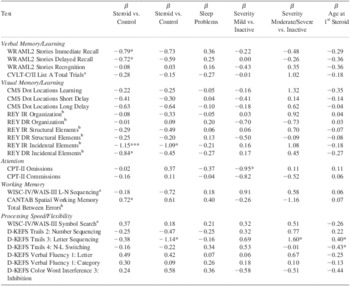
Among CD patients, the Steroid group performed more poorly than the Control group on several measures of memory, including verbal (story) memory (immediate and delayed recall), complex figure recall (immediate and delayed, with stronger effects for immediate), and spatial working memory (Table 3), although again mean scores were within the average range. After correction for multiple comparisons, only the group difference for the ROCF Incidental Elements Immediate Recall remained significant (p = .0005).
Table 5 shows standardized parameter estimates (β) for both unadjusted and adjusted (covariance) models, which consistently favored the Control group, although the magnitude of differences was variable. Note, however, that some large effect sizes failed to achieve statistical significance, presumably because of the very reduced sample size.
Standardized parameter estimates (β) for steroid group differences in neuropsychological performance for unadjusted and covariate analyses (CD only)

Note. Standardized βs for the unadjusted analyses are displayed at left. Standardized βs indicate effect sizes. For example, a standardized β of −0.79 for Steroid vs. Control Group for the WRAML2 Stories Immediate Recall indicates that the Steroid group performed 0.79 standard deviations lower than the Control group. Similarly, a standardized β of −0.48 comparing the most severely ill children with those in remission (reference category) indicates that the mean outcome for the severe group is half a standard deviation lower than the reference group.
CD = Crohn's disease; IR = immediate recall, DR = delayed recall; WRAML2 = Wide Range Assessment of Memory and Learning-Second Edition; CVLT-C/II = California Verbal Learning Test, Children's Edition and Second Edition; CMS = Children's Memory Scale; ROCF DSS = Rey-Osterrieth Complex Figure Developmental Scoring System; CPT-II: Continuous Performance Test- Second Edition; WISC-IV = Wechsler Intelligence Scale for Children- Fourth Edition, WAIS-III = Wechsler Adult Scale of Intelligence – Third Edition, L-N = Letter-Number; CANTAB = Cambridge Neuropsychological Test Automated Battery; D-KEFS = Delis-Kaplan Executive Function System, N-L = Number-Letter;
aStandard Scores; Analyses adjusted for test version.
b Raw scores; Age-adjusted analyses.
* p < .05. ** p < .01. *** p < .001.
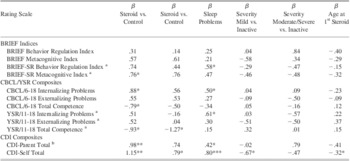
Results were similar for behavior ratings (Table 6). The CD Steroid group endorsed more mood/depressive symptoms (CBCL Internalizing Problems, CDI-P and CDI Total) and lower overall competence, by both parent and child report (CBCL and YSR Total Competence), than CD Controls. Descriptive subscale analysis revealed anhedonia as the most robust “depressive” symptom (CDI and CDI-P Anhedonia: both p < .01). Group differences for parent and self-report index scores persisted after correcting for multiple comparisons. After adjusting for covariates, steroid effects were largely explained by sleep problems for both parent- and self-reported mood symptoms (CBLC Internalizing Problems, CDI and CDI-P Total), although most effects remained at moderate to large magnitude with sleep in the models (Table 6). Sleep significantly mediated the steroid effects on self-reported depressive symptoms (CDI Total: p = .01, 61% mediated), while this mediating role did not reach statistical significance for parent report (CBCL Internalizing Problems: p = .061; CDI-P Total: p = .054).
Standardized parameter estimates (β) for steroid group differences on behavior ratings for unadjusted and covariate analyses (CD only)

Note. Standardized βs for the unadjusted analyses are displayed at left. Standardized βs indicate effect sizes. For example, a standardized β of 0.76 for Steroid vs. Control Group for the BRIEF-SR Metacognitive Index indicates that the groups differed by 0.76 standard deviations, with the Steroid group reporting more problems.
CD = Crohn's disease; BRIEF/BRIEF-SR = Behavior Rating Inventory of Executive Function, parent/self-report; CBCL/6-18 = Child Behavior Checklist; YSR/11-18 = Youth Self Report; CDI = Children's Depression Inventory; RS = raw score.
aN CD-Steroid = 12, N CD-Control = 16.
bRaw Scores; Age-adjusted analyses.
* p < .05. ** p < .01. *** p < .001.
Discussion
This group comparison study investigated whether acute corticosteroid treatment adversely impacts memory, executive functions, and mood in children and adolescents with inflammatory bowel disease. The findings were mixed. Consistent with previous reports for both adults and children (Brown, Suppes, Khan, & Carmody, 2002; Drigan et al., Reference Drigan, Spirito and Gelber1992; Mrakotsky et al., Reference Mrakotsky, Silverman, Dahlberg, Alyman, Sands, Queally and Waber2011; Soliday et al., Reference Soliday, Grey and Lande1999), we did document moderate to large behavioral side-effects of steroids, as endorsed on parent and child ratings of function in everyday life. Fewer differences were detected on laboratory cognitive tests, however. There were also unanticipated differences in outcomes related to disease group; CD patients showed steroid effects consistent with prediction, whereas UC patients showed more mixed outcomes, some opposite to prediction.
Among the behavioral outcomes, mood appeared most consistently and strongly affected. Anhedonia was the most prominent “depressive” symptom, likely reflecting an overlap of vegetative depressive symptoms and illness-related physical symptoms (i.e., fatigue). Symptoms of actual depressed mood were endorsed by parents but not children, who endorsed more cognitive/vegetative symptoms (i.e., Thought Problems, Inefficiency). Patients on steroids also endorsed more problems with executive functioning in everyday life than did steroid-free disease controls, but the size of these effects was more modest. Although some of these effects were not of sufficient magnitude to survive adjustment for multiple comparisons for summary indices, the descriptive analyses of subscales revealed modest but significant differences on several outcomes implicating cognitive functioning (e.g., Task Completion, Ineffectiveness, Academic Performance), suggesting that steroid effects are not limited to mood. These results were not pursued in detail because of the large number of outcomes and limitations due to small sample sizes, but the potential existence of such effects on cognition cannot be dismissed.
While we did find statistically significant differences on behavior ratings, group means fell in the average range, suggesting that most children are not experiencing clinically significant dysfunction. Moreover, because parents and patients could not be blinded to treatment status, the potential for reporter bias must be considered in interpreting these results.
As indicated above, the laboratory measures, especially those purported to measure executive functioning, did not discriminate the steroid groups in the overall IBD sample. For the CD group, however, there was consistent evidence of impact on memory across verbal and nonverbal tasks. As supported by prior literature, we found steroid effects on declarative memory (paragraph recall, design recall) (i.e., Newcomer et al., Reference Newcomer, Selke, Melson, Hershey, Craft, Richards and Alderson1999), with some indication for more acute effects on immediate/working memory (immediate design recall, spatial working memory) (Lupien et al., Reference Lupien, Gillin and Hauger1999).
The discrepancy between behavior rating and laboratory measures seen here is consistent with a report by Klein-Gitelman and Pachman (Reference Klein-Gitelman and Pachman1998), who found adverse psychological effects of intravenous methylprednisolone on parent/child or clinician report, but not on standardized assessment. More generally, there are now multiple reports indicating that observer and self-reports of everyday functioning can be more sensitive to cognitive compromise than laboratory tests (Anderson, Anderson, Northam, Jacobs, & Mikiewicz, Reference Anderson, Anderson, Northam, Jacobs and Mikiewicz2002; Bodnar, Prahme, Cutting, Denckla, & Mahone, Reference Bodnar, Prahme, Cutting, Denckla and Mahone2007; Chan, Shum, Toulopoulou, & Chen, Reference Chan, Shum, Toulopoulou and Chen2008; Payne, Hyman, Shores, & North, Reference Payne, Hyman, Shores and North2011). The reasons for this differential sensitivity are not clear. Laboratory cognitive tests may be less sensitive to deficits in an intellectually high-functioning population or one without frank impairment (Mahone et al., Reference Mahone, Hagelthorn, Cutting, Schuerholz, Pelletier, Rawlins and Denckla2002). In addition, the structure provided by the laboratory test setting may serve to compensate for deficits that can emerge in the less structured milieu of daily life, especially deficits in executive functioning.
The differences in steroid effects by disease type were unanticipated, and the significance of this moderating effect is uncertain. Steroid group comparisons among UC patients yielded few meaningful differences or were difficult to interpret. The few statistically significant differences that did emerge in the UC group were opposite to our prediction, with control patients performing more poorly and endorsing less adaptive skills than steroid patients. For CD patients, in contrast, the pattern of performance was consistent with prediction. Patients on steroids performed more poorly on laboratory measures of memory, both verbal and visual, as well as working memory, and also endorsed more executive and emotional problems on rating scales. Some of these differences were large in magnitude, but did not reach statistical significance, likely because of reduced sample size. Nevertheless, steroid effects on visual recall and parent and self-reported depressive symptoms were robust, even after correction for multiple comparisons.
We have no obvious explanation for the discrepancy between disease groups. One possible account would involve heterogeneity between CD and UC in terms of disease factors, such as natural history of disease etiology, pathology, immune mechanisms, symptom presentation, and treatment protocols, underscoring the potential problem of pooling disease populations when studying developmental outcomes. In addition, UC patients who met screening criteria for the control group were younger at diagnosis and had been ill for a longer time before their first steroid treatment than the UC steroid group, with a potential developmental impact. Younger age at IBD onset has been associated with more extensive and severe disease (Van Limbergen et al., Reference Van Limbergen, Russell, Drummond, Aldhous, Round, Nimmo and Wilson2008), which in turn has the potential to impact physical growth and overall development. Younger age at steroid treatment can also carry greater vulnerability to acute neurobehavioral side effects (Mrakotsky et al., Reference Mrakotsky, Silverman, Dahlberg, Alyman, Sands, Queally and Waber2011). An equally plausible explanation, however, would involve idiosyncrasies of sampling, given the small cell sizes once steroid groups are considered within disease type. In any event, disease type should be an explicit consideration for future studies of steroid and other biological correlates of cognition and behavior in patients with IBD.
Sleep problems emerged as the most consistent mediator of the observed steroid effects, especially mood. This outcome was anticipated since steroids can disrupt sleep (Hinds et al., Reference Hinds, Hockenberry, Gattuso, Srivastava, Tong, Jones and Pui2007), which in turn can affect mood, behavior, and cognition, particularly memory (Stickgold, Fosse, & Walker, Reference Stickgold, Fosse and Walker2002; for review see Killgore, Reference Killgore2010). Patients on steroids also experienced greater disease severity including pain, which could have affected sleep, mood, and cognition. Nevertheless, some steroid effects, particularly as observed in the CD group, remained at moderate to large magnitude with sleep and disease severity in the model, suggesting that these covariates account only partially for the cognitive and behavioral side effects of steroid therapy.
Cumulative lifetime steroid dose and duration may also be relevant. All participants had received steroids at some point in their history. In the CD sample, control patients had actually received larger cumulative steroid doses and longer lifetime duration than those on active steroids. A cumulative effect of lifetime steroid should, however, have served to diminish the differences between steroid and control groups. Since lifetime duration was not associated with any of the outcomes, cumulative dose may either not be relevant or its longer-term adverse impact could be more limited than the acute steroid effects observed.
The results of this initial study of the impact of steroid therapy in patients with IBD should be interpreted in the context of its potential limitations, the primary one being the relatively small sample size and associated reduction in statistical power. Although we successfully recruited 33 eligible patients into each group, the unanticipated disease group interactions led to very small cell sizes and potential instability of findings. The use of rating scales is also a main concern since respondents could not be blinded to treatment status, potentially causing over-reporting of symptoms in the steroid group. It is less plausible, however, that such bias would affect the CD but not the UC group, arguing against a substantial impact of reporter bias.
Other methodological considerations that could complicate evaluation of treatment effects include timing of the assessment (which occurred at various points during a steroid course rather than at a uniform time point or the time of maximum dose), an arbitrary criterion of only 30 mg/day as “high-dose” (potentially underestimating effects), and lack of standard treatment and steroid dosing protocols. Furthermore, because of the complexity of IBD treatment, patients were exposed to other agents, whose potential CNS impacts are unknown. Effective treatment often requires multiple immunomodulatory agents during induction and maintenance therapy that are the same as those used in chemotherapy protocols for cancer patients (i.e., methotrexate, 6-mercaptopurine). Although these are typically prescribed at low to moderate doses, their CNS effects are not established.
Finally, the underlying disease itself has the potential to disrupt brain and cognitive development, primarily through systemic inflammation (for review, see Deretzi et al., Reference Deretzi, Kountouras, Grigoriadis, Zavos, Chatzigeorgiou, Koutlas and Tsiptsios2009; Haroon, Raison, & Miller, Reference Haroon, Raison and Miller2012), nutritional deficiencies (Yehuda, Rabinovitz, & Mostofsky, Reference Yehuda, Rabinovitz and Mostofsky2006), and growth delay. Because patients are treated with steroids for underlying inflammation, distinguishing their independent effects can be difficult. In light of the known associations between inflammation and CNS function (Haroon et al., Reference Haroon, Raison and Miller2012; Maier, Reference Maier2003), the potential impacts of the disease itself on behavioral outcomes merit more in-depth exploration.
In sum, this initial study of CNS impact of steroid therapy in pediatric IBD demonstrates some differences between steroid-treated patients and controls that indicate acute steroid effects on memory, mood, and behavior, especially as reported in everyday life. These findings are consistent with previous reports of cognitive and emotional side effects described in other pediatric populations. Nevertheless, where deleterious effects of steroids were observed, group means remained largely within the average range, suggesting that most patients did not experience marked dysfunction. Longitudinal studies that evaluate the same patients on and off steroids could help to resolve some of the ambiguities in these data and better specify clinical implications. Future studies that can address some of the methodological issues encountered in the course of this study should provide greater insight into the acute and potentially longer-term burdens of therapeutic steroids, as well as into the impact of underlying disease itself on cognition and behavior in this population.
Acknowledgements
This investigation was supported by funding from the National Institutes of Health (F32 HD046245 and K23 HD058466 to Dr. Mrakotsky). A portion of the data from this investigation was presented at the 2006 annual conference of the International Neuropsychological Society. The authors thank Carl deMoor, Ph.D., and Alka Indurkhya, Ph.D. for their contributions to an earlier version of this work as well as Leslie Kalish, Ph.D. for his consultation and advice for the statistical analysis section. The authors also thank Elyse Kenney, BA, Lyvia Chriki, BA, Adam Grabell, MA, and Megan Waters, BA for their contributions to recruitment, data collection and data management. The authors have no financial or other relationships that could be regarded as a conflict of interest affecting this manuscript.