Introduction
Mild cognitive impairment (MCI) (Petersen et al. Reference Petersen, Smith, Waring, Ivnik, Tangalos and Kokmen1999, Reference Petersen, Doody, Kurz, Mohs, Morris, Rabins, Ritchie, Rossor, Thal and Winblad2001; Petersen, Reference Petersen2004; Winblad et al. Reference Winblad, Palmer, Kivipelto, Jelic, Fratiglioni, Wahlund, Nordberg, Bäckman, Albert, Almkvist, Arai, Basun, Blennow, de Leon, DeCarli, Erkinjuntti, Giacobini, Graff, Hardy, Jack, Jorm, Ritchie, van Duijn, Visser and Petersen2004) is associated with a high risk for the development of dementia (e.g. Busse et al. Reference Busse, Bischkopf, Riedel-Heller and Angermeyer2003, Reference Busse, Hensel, Gühne, Angermeyer and Riedel-Heller2006; Amieva et al. Reference Amieva, Letenneur, Dartigues, Rouch-Leroyer, Sourgen, D'Alchée-Birée, Dib, Barberger-Gateau, Orgogozo and Fabrigoule2004; Petersen et al. Reference Petersen, Thomas, Grundman, Bennett, Doody, Ferris, Galasko, Jin, Kaye, Levey, Pfeiffer, Sano, Dyk and van Thal2005). With regard to a significant number of subjects with MCI who do not progress to dementia, an MCI diagnosis alone cannot, however, be equated one-to-one with a pre-dementia stage. Some studies have shown that impairments in cognitively demanding instrumental activities of daily living (IADL), such as the use of the telephone or responsibility for one's own medication, also constitute an early sign for the development of dementia (e.g. Barberger-Gateau et al. Reference Barberger-Gateau, Fabrigoule, Helmer, Rouch and Dartigues1999; Pérès et al. Reference Pérès, Helmer, Amieva, Orgogozo, Rouch, Dartigues and Barberger-Gateau2008). With regard to the current MCI criteria (Winblad et al. Reference Winblad, Palmer, Kivipelto, Jelic, Fratiglioni, Wahlund, Nordberg, Bäckman, Albert, Almkvist, Arai, Basun, Blennow, de Leon, DeCarli, Erkinjuntti, Giacobini, Graff, Hardy, Jack, Jorm, Ritchie, van Duijn, Visser and Petersen2004), minimal IADL impairment is accepted but not required. An obligatory inclusion of IADL impairment in the MCI criteria, however, may improve the predictive power for the development of dementia (Pérès et al. Reference Pérès, Chrysostome, Fabrigoule, Orgogozo, Dartigues and Barberger-Gateau2006). So far, the association between MCI and IADL impairment has been mainly analysed in cross-sectional studies (e.g. Griffith et al. Reference Griffith, Belue, Sicola, Krzywanski, Zamrini, Harrell and Marson2003; Tam et al. Reference Tam, Lam, Chiu and Lui2007; Jefferson et al. Reference Jefferson, Byerly, Vanderhill, Lambe, Wong, Ozonoff and Karlawish2008; Wadley et al. Reference Wadley, Okonkwo, Crowe and Ross-Meadows2008; Burton et al. Reference Burton, Strauss, Bunce, Hunter and Hultsch2009; Kim et al. Reference Kim, Lee, Cheong, Eom, Oh and Hong2009). Longitudinal studies on the impact of MCI in association with IADL impairment on the development of dementia are rather rare (Tabert et al. Reference Tabert, Albert, Borukhova-Milov, Camacho, Pelton, Liu, Stern and Devanand2002; Pérès et al. Reference Pérès, Chrysostome, Fabrigoule, Orgogozo, Dartigues and Barberger-Gateau2006; Artero et al. Reference Artero, Ancelin, Portet, Dupuy, Berr, Dartigues, Tzourio, Rouaud, Poncet, Pasquier, Auriacombe, Touchon and Ritchie2008). Particularly, little is known about the impact of MCI and IADL impairment on the time to incident dementia diagnosis. Knowledge about the time to clinical manifestation of dementia, however, makes it possible to implement prevention or treatment options such as cognitive training or medication more exactly and may be helpful for patients and family members in preparing for the disease (e.g. to discuss advance directives). Thus, the aim of the study was to determine the impact of MCI and IADL impairment – controlled for further risk factors for dementia – on the time to incident dementia diagnosis in a large population-based sample of subjects aged ⩾75 years.
Material and method
Sample
The data were derived from the Leipzig Longitudinal Study of the Aged (LEILA 75+), a population-based study on the epidemiology of dementia and cognitive impairment. At baseline, a total of 1692 subjects aged ⩾75 years were included in the sample. Altogether, 1500 of these subjects were identified by systematic random sampling from an age-ordered list from the local registry office. In addition, institutionalized subjects were included by proportion (n=192) by systematic random sampling from an age-ordered list provided by the four institutions in the study area. The study design of the LEILA 75+ has been described in detail elsewhere (Riedel-Heller et al. Reference Riedel-Heller, Busse, Aurich, Matschinger and Angermeyer2001).
The study covered a period of 8 years, including a baseline (1997/01–1998/06) and five follow-up assessments (1998/07–2005/04), on average every 1.4 years.
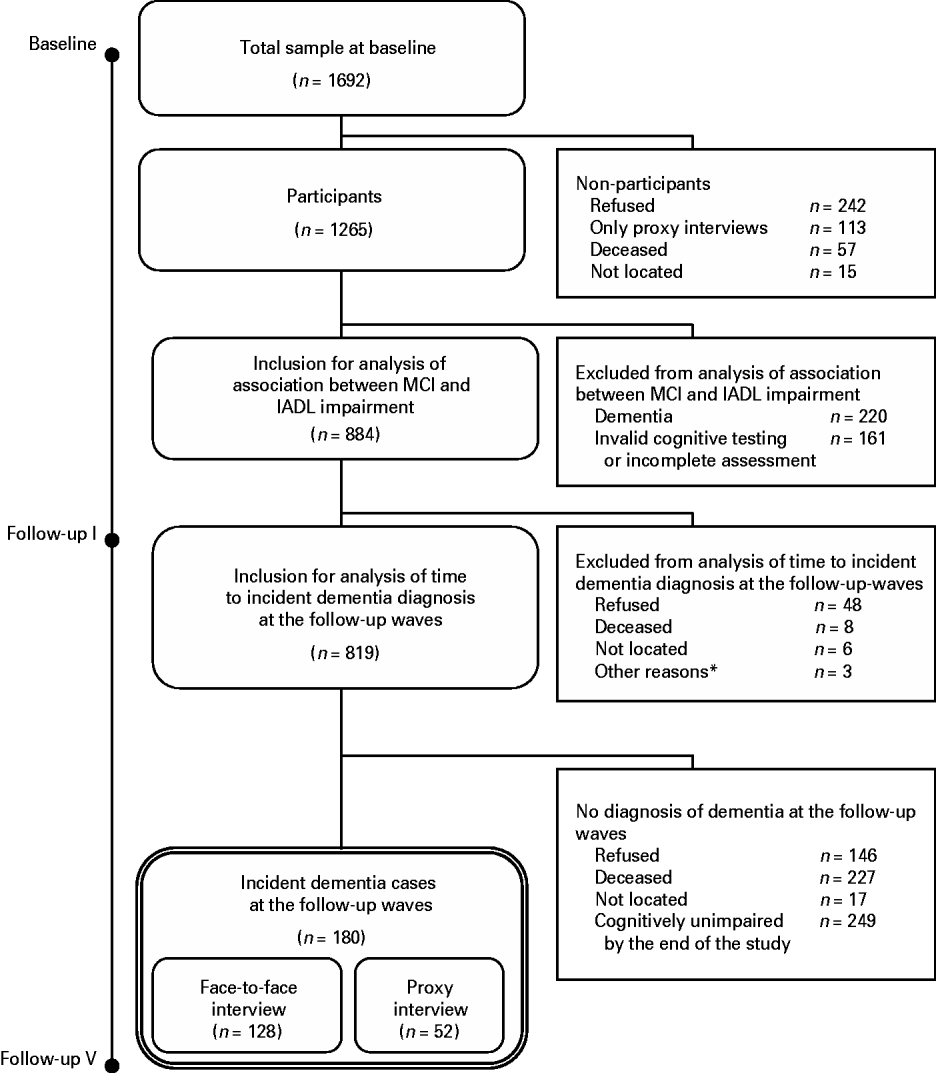
At baseline, 242 (14.2%) subjects from the total sample of 1692 refused participation, 57 (3.4%) had died and 15 (0.9%) could not be located. Information on 113 (6.7%) individuals shielded by their relatives was obtained solely by proxy interviews. Clinical interviews incorporating neuropsychological assessment were conducted with 1265 (74.6%) subjects. These 1265 subjects did not differ from the remainder of the sample in terms of age (U=263553, p=0.455) or gender [χ2=0.391, degrees of freedom (df)=1, p=0.532].
Of the 1265 subjects with neuropsychological assessment at baseline, 220 (17.4%) were classified as having dementia according to DSM-IV (APA, 2000) and 161 (12.7%) subjects had invalid cognitive testing or insufficient data to apply diagnostic criteria of MCI or to assess IADL. Thus, the analysis of association between MCI and IADL impairment is based on the remaining 884 (69.9%) subjects (Fig. 1). These 884 subjects, however, were slightly younger (mean=81.3, s.d.=4.8 v. mean=82.8, s.d.=5.2 years; U=59458.500, p=0.001) and included more men (26.6% v. 17.4%; χ2=6.111, df=1, p=0.013) than the 161 subjects who had to be excluded because of invalid cognitive testing or insufficient data.
Sample attrition and sample. MCI, Mild cognitive impairment; IADL, instrumental activities of daily living. * Mental retardation, paranoia.

Data collection and assessment procedures
Structured clinical interviews were conducted by trained psychologists and physicians during the baseline and follow-up visits at the participants' homes. In addition, structured third party interviews were conducted with proxies.
The main instrument used was the Structured Interview for Diagnosis of Dementia of Alzheimer type, Multi-infarct Dementia and Dementia of other Aetiology according to DSM-III-R, DSM-IV and ICD-10 (SIDAM) (Zaudig et al. Reference Zaudig, Mittelhammer, Hiller, Pauls, Thora, Morinigo and Mombour1991). The SIDAM consists of: (1) a cognitive test battery; (2) a section for clinical judgement and third-party information on psychosocial impairment, including a scale for the assessment of activities of daily living with 14 items (SIDAM-ADL scale). The cognitive test battery consists of 55 items, including the 30 items of the Mini-Mental State Examination (Folstein et al. Reference Folstein, Folstein and McHugh1975). The items cover four domains of cognitive functioning: orientation; memory; intellectual abilities; higher cortical functioning. In order to evaluate cognitive impairment, age- and education-specific norms for the cognitive domains were applied (Luck et al. Reference Luck, Zaudig, Wiese and Riedel-Heller2007).
If it was not possible to administer the SIDAM at a follow-up assessment (e.g. because of death or severe weakness), a comprehensive structured proxy interview was offered. This included the Clinical Dementia Rating (CDR) scale (Hughes et al. Reference Hughes, Berg, Danziger, Coben and Martin1982).
Subjective memory complaints were measured before cognitive testing by asking: ‘Do you have problems with your memory?’
The capacity to perform IADL was assessed with nine IADL items according to Schneekloth & Potthoff (Reference Schneekloth and Potthoff1993). The nine items cover responsibility for one's own medication, ability to buy food, to prepare meals, to keep the home clean, to use the telephone, to handle finances, to use public transport, to orientate oneself outside and to visit people. Participants with difficulties in at least one of the nine IADL were regarded as impaired. We have chosen this cut-off point as it yielded the highest discriminatory power [receiver operating characteristics (ROC): sensitivity=43.9%, specificity=79.2%; area under the ROC curve=0.615, 95% confidence interval (CI)=0.567–0.664, p<0.001; Youden Index (Youden, Reference Youden1950)=0.231] for the prediction of future dementia of all possible cut-off points.
Data on sociodemography, co-morbidity and familial history of dementia were collected based on a standardized questionnaire. Data on co-morbidity were self-reported. Dates of death of participants were obtained from structured proxy interviews or from the official registry office.
Definition of cases
For each subject, consensus conferences of physicians and psychologists were held. Dementia was assessed by the SIDAM (Zaudig et al. Reference Zaudig, Mittelhammer, Hiller, Pauls, Thora, Morinigo and Mombour1991) or – in case of proxy interviews – by the CDR (Hughes et al. Reference Hughes, Berg, Danziger, Coben and Martin1982). MCI was diagnosed according to consensus criteria proposed (Winblad et al. Reference Winblad, Palmer, Kivipelto, Jelic, Fratiglioni, Wahlund, Nordberg, Bäckman, Albert, Almkvist, Arai, Basun, Blennow, de Leon, DeCarli, Erkinjuntti, Giacobini, Graff, Hardy, Jack, Jorm, Ritchie, van Duijn, Visser and Petersen2004). The criteria were:
(1) Absence of dementia according to DSM-IV.
(2) Preserved basic activities of daily living or only minimal impairment in complex instrumental functions, assessed by the SIDAM-ADL scale. Participants with a maximum of one impairment in the 14 items were regarded as functionally unimpaired or minimally impaired.
(3) Evidence of cognitive decline, self- and/or informant report, and impairment on objective cognitive tasks. Criterion of cognitive decline was fulfilled when the question on subjective memory impairment was positively answered (self-report and/or informant). An objective cognitive impairment was derived from the SIDAM cognitive test battery. Impairment in a cognitive domain was defined as test performance of >1 s.d. below the mean value for age- and education-specific norms (Luck et al. Reference Luck, Zaudig, Wiese and Riedel-Heller2007).
According to Winblad et al. (Reference Winblad, Palmer, Kivipelto, Jelic, Fratiglioni, Wahlund, Nordberg, Bäckman, Albert, Almkvist, Arai, Basun, Blennow, de Leon, DeCarli, Erkinjuntti, Giacobini, Graff, Hardy, Jack, Jorm, Ritchie, van Duijn, Visser and Petersen2004), four subtypes of MCI were examined. Participants with an objective deficit in memory but not in any other domain of cognitive functioning received a diagnosis of single-domain amnestic MCI. Single non-memory MCI was diagnosed only if a single domain other than memory was impaired. If at least two cognitive domains other than memory showed an objective impairment, participants received a diagnosis of multi-domain MCI non-amnestic. Finally, multi-domain MCI amnestic was diagnosed if memory and at least one other cognitive domain were impaired.
Statistical analysis
The statistical analyses were performed with PASW for Windows, version 18.0 (SPSS Inc., USA). Group differences were analysed with Mann-Whitney-U test, χ2 test and Fisher's exact test as appropriate. If necessary, the Bonferroni correction procedure for adjustments for multiple testing was applied.
Incidence of dementia was calculated as the number of new cases at the follow-up waves divided by the person-years at risk. Incident dementia could only be diagnosed at the defined times of the follow-up assessments. On average, the exact time of first possible diagnosis could be assumed at the midway point between the follow-up visit, when dementia was diagnosed, and the previous visit. Thus, for participants with incident dementia, the time of diagnosis was set as this midway point. Person-years at risk were calculated accordingly. Subjects who were deceased, refused or could no longer be located at a particular time between the first follow-up and the fifth follow-up as well as subjects still alive at the fifth follow-up without suffering from dementia were treated as censored data. For those subjects, person-years at risk were calculated as the time between the baseline visit and the last follow-up interview information was available. Regarding the subjects who were deceased, refused or could no longer be located, we have made comprehensive informant interviews including the CDR (Hughes et al. Reference Hughes, Berg, Danziger, Coben and Martin1982). Thus, we obtained information on whether these subjects suffered from dementia or not at the time they had left the study.
Kaplan–Meier survival analysis was used to determine the time to incident dementia. Log rank test and Breslow test were used to compare survival distributions of time to incident dementia of subgroups. To determine the impact of MCI and IADL impairment on the time to incident dementia, Cox proportional hazards models (Cox, Reference Cox1972) were applied. Cox proportional hazards models were adjusted for sociodemography, familial history of dementia as well as for co-morbidity, which could also be associated with the development of dementia. Age was included as a continuous variable and all other possible risk factors as categorical variables. For each variable, hazard ratios (HRs) and 95% CI were calculated. Schoenfeld residuals were calculated in order to test the proportional hazards assumption of the Cox proportional hazards models.
The significance level was set at 0.05 for all analyses.
Results
Association between MCI and IADL impairment
Out of the 884 subjects who have been included for the analysis of association between MCI and IADL impairment, 161 (18.3%) were classified as having MCI and 723 as having no cognitive impairment (NCI) at baseline. With regard to the 161 subjects with MCI, 36 were classified as having single-domain amnestic MCI, 42 as having multi-domain MCI amnestic, 60 as having single non-memory MCI and 23 as having multi-domain MCI non-amnestic. The prevalence of the amnestic MCI subtypes considered together was 8.8% and of the non-amnestic MCI subtypes considered together 9.4%.
As shown in Table 1, subjects with MCI at baseline did not differ in age and gender from subjects with NCI. Subjects with MCI, however, more frequently had an IADL impairment than subjects with NCI (63.4% v. 52.3%; χ2=6.505, df=1, p=0.011). This effect – even though existent in amnestic as well as non-amnestic MCI subtypes – was somewhat stronger in the amnestic than the non-amnestic subtypes (66.7% v. 60.2%) and did not reach significance in the non-amnestic ones (Table 1).
Association between MCI and IADL impairment at baseline (n=884)

MCI, mild cognitive impairment; IADL, instrumental activities of daily living; NCI, no cognitive impairment; U=Mann–Whitney-U test; df, degrees of freedom.
a Amnestic MCI subtypes include single-domain amnestic MCI and multi-domain MCI amnestic.
b Non-amnestic MCI subtypes include single non-memory MCI and multi-domain MCI non-amnestic.
* Bonferroni correction procedure for adjustments for multiple testing: significance level p<0.0167.
Impact of MCI and IADL impairment on time to incident dementia
Analysis of impact of MCI and IADL impairment on the time to incident dementia is based on 819 subjects (Fig. 1). During the follow-up period, 180 (22.0%) subjects developed dementia (person-years=3474.38). The conversion rate to dementia was higher in subjects with IADL impairment at baseline than in subjects without (31.2% v. 11.1%; χ2=47.847, df=1, p<0.001) and higher in subjects with MCI than in subjects with NCI at baseline (41.9% v. 17.6%; χ2=41.776, df=1, p<0.001). The highest conversion rate was found in subjects with MCI and impaired IADL (47.4%), followed by subjects with MCI and unimpaired IADL (31.4%), subjects with NCI and impaired IADL (26.7%) and, finally, subjects with NCI and unimpaired IADL (8.0%; χ2=80.947, df=3, p<0.001). Moreover, subjects with MCI and impaired IADL at baseline showed a cognitive improvement significantly less often than subjects with MCI and unimpaired IADL (14.4% v. 29.4%; χ2=4.760, df=1, p=0.029). Comparable findings for subjects with MCI with and without impaired IADL at baseline were found with regard to the proportion of subjects with a stable course of MCI (30.9% v. 27.5% met the MCI criteria during the study; χ2=0.193, df=1, p=0.660) and an unstable course of MCI (7.2% v. 11.8% improved to NCI and later received a MCI diagnosis again; χ2=0.863, df=1, p=0.353).
With regard to MCI subtypes, the conversion rate to dementia was higher in subjects with amnestic subtypes than in subjects with non-amnestic subtypes (53.4% v. 30.7%; χ2=7.871, df=1, p=0.005). The highest conversion rate was found in subjects with amnestic MCI subtypes and impaired IADL (57.1%), followed by subjects with amnestic MCI subtypes and unimpaired IADL (45.8%), subjects with non-amnestic MCI subtypes and impaired IADL (37.5%), subjects with NCI and impaired IADL (26.7%), subjects with non-amnestic MCI subtypes and unimpaired IADL (18.5%) and, finally, subjects with NCI and unimpaired IADL (8.0%; χ2=91.931, df=5, p<0.001).
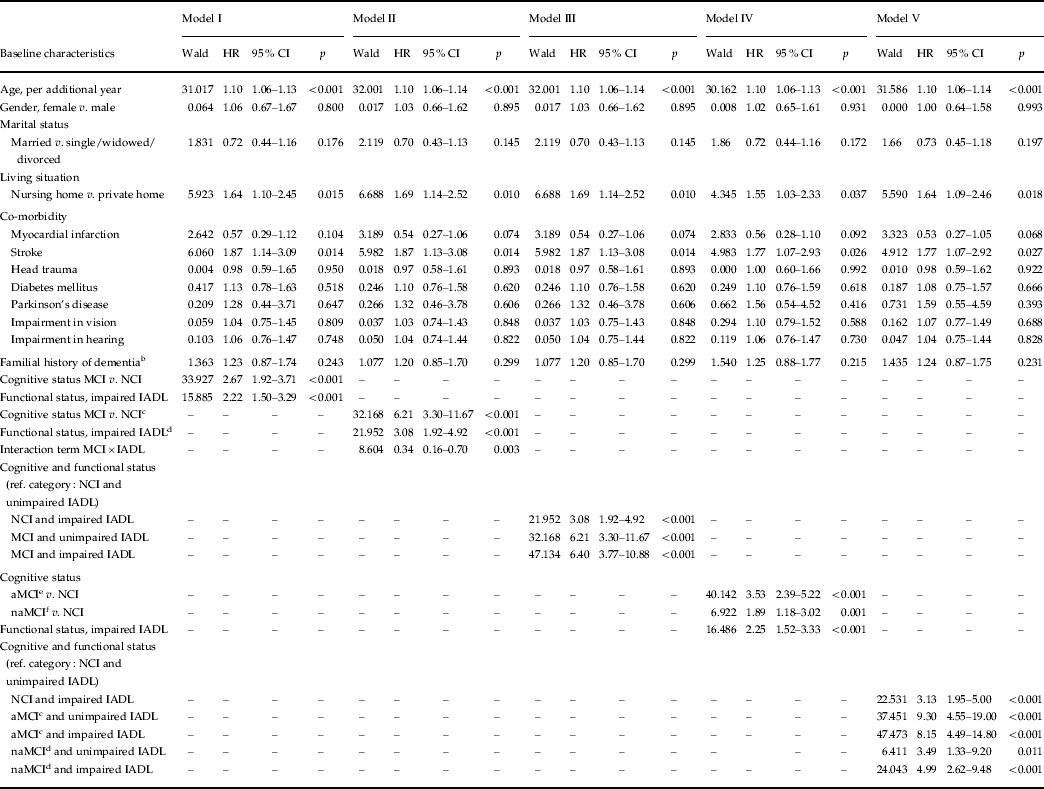
The mean time to incident dementia – estimated by the Kaplan-Meier survival analysis – was 6.7 years (95% CI 6.5–6.9). The impact of MCI and IADL impairment on the time to incident dementia was analysed using five Cox proportional hazards models (Table 2). The proportional hazards assumption was met for all Cox proportional hazards models (p>0.05). In model I, both – the presence of MCI and IADL impairment – were identified as risk factors for a shorter time incident dementia. MCI yielded HR=2.67 (95% CI 1.92–3.71) and IADL impairment HR=2.22 (95% CI 1.50–3.29).
Cox proportional hazards models of time to incident dementia diagnosis (n=807)Footnote a

HR, Hazard ratio; CI, confidence interval; ref., reference.
a Missing data for 12 (1.5%) subjects.
b At least one close family member (mother, father or sibling) suffered from dementia.
c Condition: unimpaired instrumental activities of daily living (IADL).
d Condition: no cognitive impairment (NCI).
e Amnestic mild cognitive impairment (aMCI) subtypes: include single-domain amnestic MCI and multi-domain MCI amnestic.
f Non-amnestic MCI (naMCI) subtypes: include single non-memory MCI and multi-domain MCI non-amnestic.
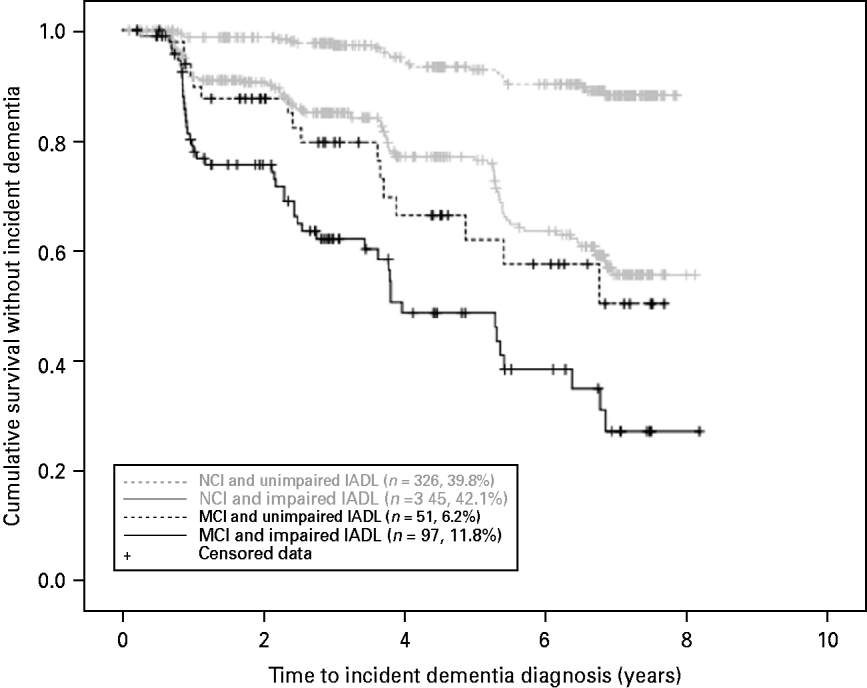
The interaction between MCI and IADL impairment was analysed in models II and III. Regarding model II, the interaction between cognitive and functional status (interaction term: MCI×IADL) was also found to be significantly associated with the time to incident dementia. As shown in model III, all three possible combinations – MCI and impaired IADL, NCI and impaired IADL and MCI and unimpaired IADL – were found to be significant risk factors for a shorter time to incident dementia compared with NCI and unimpaired IADL (Table 2). Using Kaplan–Meier survival analysis, the mean time to incident dementia in subjects with NCI and unimpaired IADL was found to be 7.4 years (95% CI 7.3–7.6), in subjects with NCI and impaired IADL 6.3 years (95% CI 6.0–6.6) and in subjects with MCI and unimpaired IADL 5.6 years (95% CI 6.5–6.9). The shortest time to incident dementia was found in subjects with MCI and impaired IADL: 4.6 years (95% CI 3.9–5.2) (log rank test: χ2=127.430, df=3, p<0.001; Fig. 2).
Kaplan–Meier survival curves I of time to incident dementia diagnosis subject to cognitive and functional status (n=819). IADL, Instrumental activities of daily living; MCI, mild cognitive impairment; NCI, no cognitive impairment.

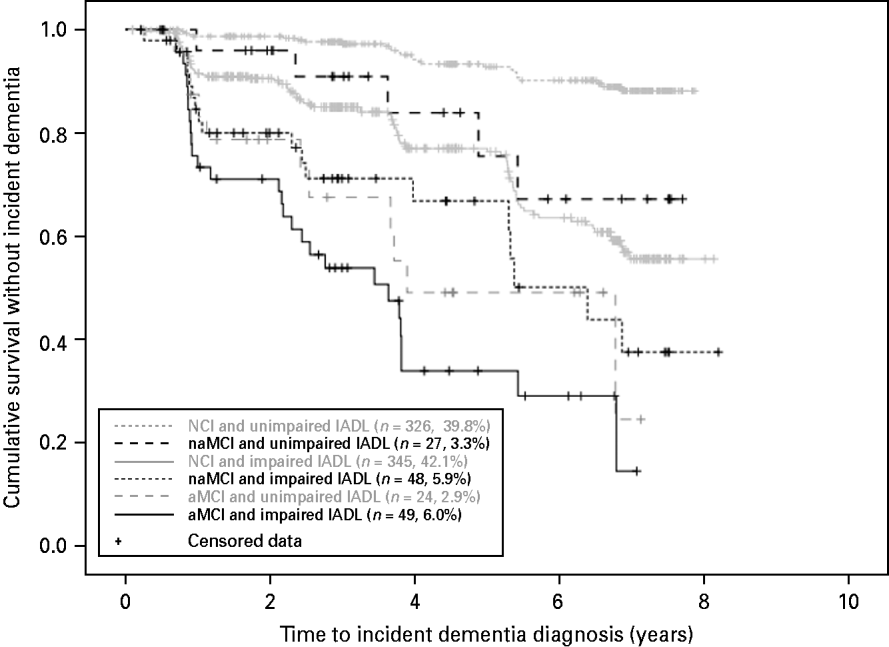
The impact of amnestic and non-amnestic MCI subtypes on the time to incident dementia was analysed in models IV and V. Both subtypes were identified as significant risk factors for a shorter time to incident dementia. Regarding the mean time to incident dementia calculated by Kaplan-Meier survival analysis, the time in subjects with amnestic MCI and impaired IADL was 3.7 years (95% CI 2.9–4.4) and thus half as long as in subjects with NCI and unimpaired IADL (7.4 years; 95% CI 7.3–7.6). The mean time in subjects with amnestic MCI and unimpaired IADL was 4.6 years (95% CI 3.5–5.7), in subjects with non-amnestic MCI and impaired IADL 5.4 years (95% CI 4.4–6.3), in subjects with non-amnestic MCI and unimpaired IADL 6.4 years (95% CI 5.5–7.4), and in subjects with NCI but impaired IADL it was 6.3 years (95% CI 6.0–6.6) (Breslow test: χ2=134.783, df=5, p<0.001; Fig. 3).
Kaplan–Meier survival curves II of time to incident dementia diagnosis subject to cognitive and functional status (n=819). IADL, Instrumental activities of daily living; aMCI, amnestic mild cognitive impairment; NCI, no cognitive impairment; naMCI, non-amnestic mild cognitive impairment.

As shown in Table 2, results of the five Cox proportional hazards models have been controlled for sociodemography, co-morbidity and familial history of dementia. Age, stroke and living in a nursing home (compared with living in a private home) were also found to be significant risk factors for a shorter time to incident dementia. With regard to the living situation, for example, the mean time to incident dementia in subjects living in a nursing home was 4.4 years (95% CI 3.8–5.0) compared with 6.9 years (95% CI 6.7–7.1) in subjects living in a private home (log rank test: χ2=66.202; df=1; p<0.001).
Discussion
The present study showed: (1) a significant association between MCI and IADL impairment; (2) that the presence of MCI combined with impaired IADL is associated with a higher conversion rate to dementia, a shorter time to clinically manifest diagnosis and a lower chance of cognitive reversibility to NCI; (3) the highest conversion rate and the shortest time to incident dementia in subjects with amnestic MCI and impaired IADL.
(1) Regarding cross-sectional findings, a number of previous studies also revealed less IADL functioning in subjects with MCI than in subjects with NCI (e.g. Griffith et al. Reference Griffith, Belue, Sicola, Krzywanski, Zamrini, Harrell and Marson2003; Pérès et al. Reference Pérès, Chrysostome, Fabrigoule, Orgogozo, Dartigues and Barberger-Gateau2006; Tam et al. Reference Tam, Lam, Chiu and Lui2007; Wadley et al. Reference Wadley, Okonkwo, Crowe and Ross-Meadows2008; Burton et al. Reference Burton, Strauss, Bunce, Hunter and Hultsch2009; Kim et al. Reference Kim, Lee, Cheong, Eom, Oh and Hong2009). The association between IADL impairment and MCI, however, is complex. For example, Kim et al. (Reference Kim, Lee, Cheong, Eom, Oh and Hong2009) revealed a significant association between MCI and impaired IADL, particularly for specific IADL domains (e.g. ability to handle finances or ability to use the telephone). With regard to our study, no systematic association was found between MCI and specific IADL domains. Moreover, less IADL functioning was found in subjects with multi-domain MCI than in subjects with single-domain MCI (Pérès et al. Reference Pérès, Chrysostome, Fabrigoule, Orgogozo, Dartigues and Barberger-Gateau2006, Burton et al. Reference Burton, Strauss, Bunce, Hunter and Hultsch2009). Regarding the present study, a significantly higher frequency of IADL impairment was found in subjects with amnestic MCI subtypes compared with subjects with NCI but not in subjects with non-amnestic MCI subtypes compared with subjects with NCI. Whether performance in IADL might be more affected by impairment in memory than impairment in other cognitive domains, however, creates a controversial issue. On the one hand, it can be assumed that memory could be more important for the performance of IADL than other cognitive domains as intact memory might be required in the performance of every IADL and unimpaired functioning in cognitive domains, such as calculation or constructional ability, only in some IADL. On the other hand, there was also a higher frequency of IADL impairment in subjects with non-amnestic MCI subtypes than in subjects with NCI; the difference simply failed to be significant.
(2) Both – MCI and IADL impairment – were found to be independent risk factors for the development of dementia and to be associated with a shorter time to diagnosis. MCI constitutes a proven risk factor for dementia and a pre-dementia stage in many cases (e.g. Busse et al. Reference Busse, Bischkopf, Riedel-Heller and Angermeyer2003, Reference Busse, Hensel, Gühne, Angermeyer and Riedel-Heller2006; Amieva et al. Reference Amieva, Letenneur, Dartigues, Rouch-Leroyer, Sourgen, D'Alchée-Birée, Dib, Barberger-Gateau, Orgogozo and Fabrigoule2004; Petersen et al. Reference Petersen, Thomas, Grundman, Bennett, Doody, Ferris, Galasko, Jin, Kaye, Levey, Pfeiffer, Sano, Dyk and van Thal2005). IADL impairment was also found to be an early sign for the development of dementia in some previous studies (e.g. Barberger-Gateau et al. Reference Barberger-Gateau, Fabrigoule, Helmer, Rouch and Dartigues1999; Pérès et al. Reference Pérès, Helmer, Amieva, Orgogozo, Rouch, Dartigues and Barberger-Gateau2008). As stated by Pérès et al. (Reference Pérès, Helmer, Amieva, Orgogozo, Rouch, Dartigues and Barberger-Gateau2008), IADL impairment expresses the development of dementia in the real situation of daily life (whereas neuropsychological deficits are rather an expression of an experimental situation).
The impact of MCI in association with IADL impairment on the development of dementia, however, has been analysed only to a limited extent (Tabert et al. Reference Tabert, Albert, Borukhova-Milov, Camacho, Pelton, Liu, Stern and Devanand2002; Pérès et al. Reference Pérès, Chrysostome, Fabrigoule, Orgogozo, Dartigues and Barberger-Gateau2006; Artero et al. Reference Artero, Ancelin, Portet, Dupuy, Berr, Dartigues, Tzourio, Rouaud, Poncet, Pasquier, Auriacombe, Touchon and Ritchie2008). Artero et al. (Reference Artero, Ancelin, Portet, Dupuy, Berr, Dartigues, Tzourio, Rouaud, Poncet, Pasquier, Auriacombe, Touchon and Ritchie2008) identified IADL impairment as a significant risk factor for the development of dementia in women and men with MCI. Tabert et al. (Reference Tabert, Albert, Borukhova-Milov, Camacho, Pelton, Liu, Stern and Devanand2002) showed that, particularly, informant-reported functional deficits significantly predict the development of Alzheimer's disease in subjects with MCI. Cognitively unimpaired subjects, however, were not included in the analyses of progression to dementia in the studies of Tabert et al. (Reference Tabert, Albert, Borukhova-Milov, Camacho, Pelton, Liu, Stern and Devanand2002) and Artero et al. (Reference Artero, Ancelin, Portet, Dupuy, Berr, Dartigues, Tzourio, Rouaud, Poncet, Pasquier, Auriacombe, Touchon and Ritchie2008). Thus, no information on the risk of dementia in subjects with MCI with and without impaired IADL compared with cognitively and functionally unimpaired subjects was available. This information was first provided by Pérès et al. (Reference Pérès, Chrysostome, Fabrigoule, Orgogozo, Dartigues and Barberger-Gateau2006). Using a logistic regression model, Pérès et al. (Reference Pérès, Chrysostome, Fabrigoule, Orgogozo, Dartigues and Barberger-Gateau2006) identified a higher risk of developing dementia not only in subjects with MCI and impaired IADL but also in subjects with MCI and unimpaired IADL and with NCI and impaired IADL compared with subjects with NCI and unimpaired IADL. These findings are in line with our findings. According to the results of Pérès et al. (Reference Pérès, Chrysostome, Fabrigoule, Orgogozo, Dartigues and Barberger-Gateau2006), subjects with MCI and IADL impairment were found to have the highest conversion rate to dementia compared with subjects without MCI or IADL impairment or both. Moreover, according to Pérès et al. (Reference Pérès, Chrysostome, Fabrigoule, Orgogozo, Dartigues and Barberger-Gateau2006), supplemental IADL impairment in subjects with MCI lowered the chance of cognitive improvement, i.e. reversibility of MCI to NCI. In addition, we have shown a shorter mean time to incident dementia in subjects with MCI and IADL impairment (4.6 years) compared with subjects with MCI and unimpaired IADL (5.6 years), subjects with NCI and impaired IADL (6.3 years) and subjects with NCI and unimpaired IADL (7.4 years).
(3) With regard to MCI subtypes, a higher conversion to dementia was found in subjects with amnestic subtypes than with non-amnestic ones. This is in line with previous findings (e.g. Rasquin et al. Reference Rasquin, Lodder, Visser, Lousberg and Verhey2005; Busse et al. Reference Busse, Hensel, Gühne, Angermeyer and Riedel-Heller2006; Luck et al. Reference Luck, Busse, Hensel, Angermeyer and Riedel-Heller2008). A higher risk of amnestic MCI subtypes for the development of dementia, however, is not unexpected. As stated by Artero et al. (Reference Artero, Petersen, Touchon and Ritchie2006), amnestic difficulties – as a possible early sign of developing dementia, particularly of the Alzheimer's type – are more frequent than difficulties in other cognitive domains and less likely to be benign. Thus, information on the MCI subtype should be taken into consideration in order to assess the risk of future dementia. However, we have shown that even in subjects with amnestic MCI, and thus in subjects who already constitute a high-risk population of dementia, information on IADL impairment might have an additional value for the prediction of dementia. The mean time to incident dementia in subjects with amnestic MCI subtypes and impaired IADL (3.7 years) was half as long as the time in subjects with NCI and unimpaired IADL (7.4 years) but also shorter than in subjects with amnestic MCI subtypes but unimpaired IADL (4.6 years).
The results of the present study are subject to some limitations. First, as incident dementia could only be diagnosed at the defined times of the follow-up assessments, the time of the onset of the disorder was set at the midway point between the follow-up, when dementia was diagnosed, and the previous follow-up. Second, the diagnosis of dementia was not supported by imaging or autopsy. Third, the assortment of factors that could also be associated with the development of dementia was limited to those focused on when this long-term study was planned. Data on co-morbidity were self-reported. Finally, a further limitation is shown in Fig. 1. A substantial number of subjects of the initial baseline sample of 1692 subjects did not participate in the study (n=427), or had to be excluded from analyses of association between MCI and IADL impairment (n=381) and of time to incident dementia diagnosis at the follow-up waves (n=65). Moreover, 163 of the 819 subjects who were included in the analysis of time to incident dementia were treated as censored data because they refused participation or could not be located from a certain follow-up wave. It is quite possible that these subjects – after being censored – as well as the subjects who previously refused participation could not be located, were shielded by their relatives or had invalid cognitive testing or incomplete assessment particularly might have shown a higher risk for and/or a shorter time to the development of dementia than the subjects who could be included in the analyses or had not been censored due to the reasons mentioned above. Of course, the time to and the risk for future dementia in the large number of subjects who were excluded or censored might also have differed in another way or in no way. In general, a bias of the present results on time to incident dementia, as well as on the association between MCI and IADL impairment and on the impact of MCI and IADL impairment on the time to incident dementia diagnosis due to the sample attrition in the course of the study, however, cannot be excluded and generalization of the results has to be made with caution.
Irrespective of these limitations, we assume that in addition to cognitive impairment (MCI) the consideration of IADL impairment might help to improve the prediction of dementia, particularly with regard to an estimation of the time to clinical manifestation. IADL impairment particularly, however, might help to improve the prediction of dementia as it reflects the development of dementia in real situations of daily life (Pérès et al. Reference Pérès, Helmer, Amieva, Orgogozo, Rouch, Dartigues and Barberger-Gateau2008) and, moreover, can be assessed less extensively than biological markers, such as reduced hippocampal volume, for example. A brief instrument to measure IADL impairment might be used, for instance, by general practitioners, who could play a decisive role in an early detection of changes in function (and cognition) in an incipient dementia process, since they have regular and long-term contact with elderly people. The IADL scale that has been used in the present study, however, showed – particularly with regard to low sensitivity – rather less discriminative power for the prediction of future dementia and thus rather less clinical utility. Further strength is required in order to develop an IADL scale that would be more useful in clinical practice. Moreover, due to a substantial number of subjects with MCI (and IADL impairment) who do not progress to dementia, the current MCI concept – even in combination with IADL impairment – cannot be equated with a pre-dementia stage allowing the implementation of treatments such as medication. In order to allow those treatments, information on further risk factors for dementia is required (Devanand et al. Reference Devanand, Liu, Tabert, Pradhaban, Cuasay, Bell, de Leon, Doty, Stern and Pelton2008, Förstl et al. Reference Förstl, Bickel, Frölich, Gertz, Gutzmann, Hörr, Pantel, Schmidt, Schönknecht, Ulm and Werheid2009).
Acknowledgements
This publication was funded by the junior research grant by the Medical Faculty, University of Leipzig. The fieldwork was supported by the Interdisciplinary Centre for Clinical Research Leipzig (project C07) and published with affiliation to the Leipzig Interdisciplinary Research Cluster of Genetic Factors, Clinical Phenotypes and Environment (LIFE Center, Universität Leipzig). LIFE is financed by means of the European Union, by the European Regional Development Fund (ERDF) and by means of the Free State of Saxony within the framework of the excellence initiative.
Declaration of Interest
None.