Introduction
With the increasing emergence of drug resistance, alternative methods for control of pathogenic helminths have attracted much attention. The use of plant-based anthelmintics was in existence prior to the advent of synthetic drugs. They are still widely used in many traditional societies, particularly in developing countries, for the treatment of a variety of acute and chronic parasitic diseases, both in human and in veterinary medicine (McCorkle et al., Reference McCorkle, Mathias and Schillhorn van Veen1996; Tandon et al., Reference Tandon, Pal, Roy, Rao and Reddy1997; Grade et al., Reference Grade, Tabuti, Van Damme and Arble2007). Although many plant species are listed as anthelmintic, only a few have been subjected to rigorous validation (Hammond et al., Reference Hammond, Fielding and Bishop1997; Pal & Tandon, Reference Pal and Tandon1998a; Das et al., Reference Das, Tandon and Saha2004; Nandi et al., Reference Nandi, Roy, Bhattacharya and Sinha Babu2004; Fischer, Reference Fischer2007; Aksu, Reference Aksu2009; Klimpel et al., Reference Klimpel, Abdel-Ghaffar, Al-Rasheid, Aksu, Fischer, Strassen and Mehlhorn2010). Species of the plant Cassia have different medicinal properties and are widely distributed in the tropical and subtropical regions, including India. Examples are: Cassia angustifolia Vahl, known for its purgative properties and for regularization of bowel movements (Paria, Reference Paria2005); C. alata Linn and C. occidentalis Linn, used as fungicides and as antimicrobial agents (Ibrahim & Osman, Reference Ibrahim and Osman1995; Arya et al., Reference Arya, Yadav, Kumar and Yadav2010). Decoction of the leaves of C. angustifolia and C. alata is widely practised in India (Kirtikar & Basu, Reference Kirtikar and Basu1975) as compared with other parts of the plant. In addition, their leaves have been listed as a treatment for gastrointestinal worms in Medicinal plant resources (Paria, Reference Paria2005). Although their laxative and antibacterial properties have been widely explored (Rahman, 1996; Khan et al., Reference Khan, Kihara and Omoloso2001; Somchit et al., Reference Somchit, Reezal, Elysha Nur and Mutalib2003; Peter & Deogracious, Reference Peter and Deogracious2006; Makinde et al., Reference Makinde, Igoli, TA'Ama, Shaibu and Garba2007; Agarwal & Bajpai, Reference Agarwal and Bajpai2010), their use as anthelmintics is poorly understood (Kirtikar & Basu, Reference Kirtikar and Basu1975). Because of their rich content of bioactive chemicals, namely hydroxyanthraquinones, glycosides, chrysophanic acid, rhein and kaempferol (Kochar, Reference Kochar1981; Palanichamy & Nagarajan, 1990; Abo et al., Reference Abo, Adediwura and Ibikunle1998; Hofilena et al., Reference Hofilena, Ragasa and Rideout2000), detailed investigation is awaited. Thus in the present study the anthelmintic activity alone of the above three Cassia species is explored. In addition, the study aims to validate any synergistic or additive effect on any alterations in the tegumental architecture of a commonly available parasitic model, Raillietina tetragona (fowl tapeworm), and to compare these effects with those of a widely used cestocidal drug, praziquantel.
Materials and methods
Preparation of plant extracts
Fresh young plants of C. angustifolia Vahl, C. alata Linn and C. occidentalis Linn were collected from different locations in Santiniketan, West Bengal, and the voucher specimens (VBSL-1 for C. alata, VBSL-2 for C. occidentalis and VBSL-3 for C. angustifolia) were deposited in the Central National Herbarium, Kolkata, India. Young leaves were weighed and washed with deionized water, and oven-dried at 50°C. The powdered leaves were extracted with ethanol (90%) in a Soxhlet apparatus for 7–8 h. The final crude extract was recovered using a rotary evaporator and stored at 4°C until further use.
Chemicals and drugs
All the chemicals used were of standard analytical grade, obtained from Merck (Whitehouse Station, New Jersey, USA). Ethanol was supplied by Bengal Chemicals (Kolkata, India). The reference drug praziquantel with the trade name Distocide (composed of 600 mg praziquantel) is a product of Chandrabhagat Pharma Pvt. Ltd (Mumbai, India).
Experimental design
The parasites were collected from the intestine of freshly slaughtered domestic fowl. Live worms were treated in vitro with various concentrations (5, 10, 20, 40 and 80 mg/ml, in 0.9% phosphate-buffered saline (PBS)) of three ethanolic leaf extracts and praziquantel (0.0005, 0.001, 0.0025 and 0.005 mg/ml). Control worms were maintained in PBS with 1% dimethylsulphoxide (DMSO) at 37 ± 1°C. Combinations of plant extracts in the ratio 1:1 (C. alata+C. occidentalis, C. alata+C. angustifolia, C. occidentalis+C. angustifolia) with different concentrations (10, 20 and 40 mg/ml) were tested on fresh worms at 37 ± 1°C to observe any synergistic or additive effect of the plant extracts.
Paralysis at 40 mg/ml was observed within a time span that was comparable with that of worms treated with praziquantel, but at different concentrations. Thus, this concentration was selected for scanning electron microscope (SEM) studies, following Roy & Tandon (Reference Roy and Tandon1991). Specimens were viewed in a Jeol JSM 6360 at an electron accelerating voltage of 20 kV.
Statistical analysis
Data are presented as mean values ± standard deviations for each group (n= 6). For determining statistical significance, standard deviation and analysis of variance (ANOVA) at the 5% level of significance were employed; P< 0.001 was considered significant.
Results
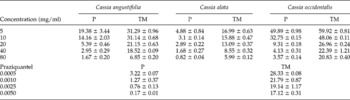
The times recorded for paralysis and mortality revealed that each plant leaf crude extract has dose-dependent efficacy (table 1). Using plant extracts with a concentration of 40 mg/ml, paralysis with C. alata took the least time (1.68 ± 0.27 h), followed by C. angustifolia (2.95 ± 0.29 h) and C. occidentalis (4.13 ± 0.31 h). The post-paralytic time (mortality) followed a similar pattern, with C. alata taking a shorter time (8.55 ± 0.32 h) and C. occidentalis a longer time (22.39 ± 1.21 h). In low concentrations (5, 10 and 20 mg/ml), the time of paralysis and time of mortality exhibited the same pattern, with C. alata first, followed by C. angustifolia and C. occidentalis. The 40 mg/ml concentration of C. alata can be compared with praziquantel at 0.001 mg/ml, since paralysis occurred almost at the same time. The time of mortality by plant extracts is comparatively short as compared with the drug. However, the control parasites survived up to 81.93 ± 5.85 h.
Effect of crude leaf extracts of three species of Cassia and praziquantel on R. tetragona.

Values are represented as mean ± SD (n= 6). Data were found to be significant by testing through two-factor ANOVA with replication at the 5% level of significance (P< 0.001). Control parasite survival time was 81.93 ± 5.85 h. P, time of paralysis (h); TM, time of mortality (h).
For combined plant extracts, paralysis occurred much faster, with C. alata+C. occidentalis (1.47 ± 0.20 h) followed by C. alata+C. angustifolia (1.86 ± 0.12 h), while C. angustifolia+C. occidentalis took more time (2.61 ± 0.17 h) at the concentration of 40 mg/ml (table 2). The post-paralytic time followed the same pattern, where mortality occurred faster in C. alata+C. occidentalis (in just 8.57 ± 0.44 h) and took a longer time (19.67 ± 0.33 h) with C. angustifolia+C. occidentalis.
Effect of the three Cassia leaf extracts in combination on R. tetragona.

Values are expressed as mean ± SD (n= 6). P, time of paralysis (h); TM, time of mortality (h).
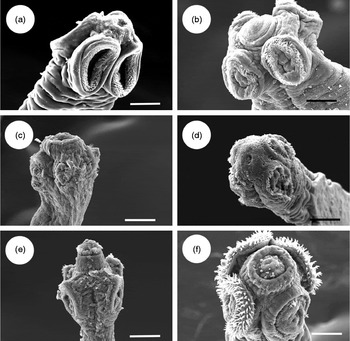
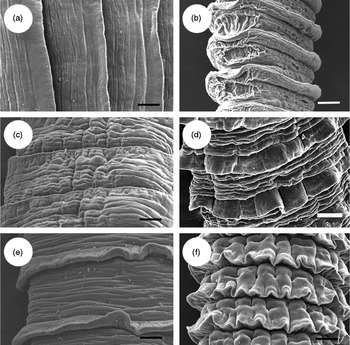
SEM images of the control worms revealed a normal body structure of the cestode. The anterior lobed extremity is the scolex with four suckers located radially around its proximal end (fig. 1a). Each sucker is marked with rows of short hooklets. Above the four suckers is a rostellum with rows of smaller hooks arranged in circle. Worms treated with plant extracts (fig. 1c, d and e) showed shrinkage on the tegument of the scolex, and truncations and translocation of the hooks compared with the control worms (fig. 1a). Parasites treated with a combination of C. alata and C. occidentalis (fig. 1f) showed a closer similarity to those treated with praziquantel (fig. 1b), with more contractions in the proglottids. The entire body of the parasite is densely covered with arrays of microtriches, giving the surface a velvety appearance, and each proglottid is clearly demarcated with transverse striations (fig. 2a). On the contrary, all the worms treated with crude extracts (fig. 2c–e) showed irrevocable destruction. The general topography of the body possesses prominent infoldings at the ends of each proglottid. This observation can be compared with that of worms treated with praziquantel (fig. 2b). Amongst the three individual plant extracts, C. alata showed the maximum damage in both the scolex and mature proglottids, while worms treated with a combination of C. alata and C. occidentalis (fig. 2f) showed more foldings in the integument compared with worms treated with a single plant (fig. 2d and e).
Scanning electron microscope images of scolex of Raillietina tetragona. (a) Control, showing suckers with apical rostellum surrounded by marginal rows of hooks. Worms treated with praziquantel (b) and Cassia angustifolia (c) show clumps of hooks and shrinkage; those treated with C. alata (d) and C. occidentalis (e) show disruption of the rostellum and shrinkage; and those treated with a combination of C. alata and C. occidentalis (f) show similar shrinkage. Scale bars 50 μm.

Scanning electron microscope images of proglottids of Raillietina tetragona. (a) Control, showing smooth unfolded proglottids. Worms treated with praziquantel (b) showing close and immense infoldings; those treated with Cassia angustifolia (c) and C. alata (d) showing wrinkling and clumping; those treated with C. occidentalis (e) showing folding around the rim; and when treated with a combination of C. alata and C. occidentalis (f) they show extensive wrinkling. Scale bars 50 μm.

Discussion
The present study showed a dose-dependent efficacy of the crude plant extract, as an increase in the concentration of the test material caused more pronounced destructive effects on the tegument of the parasites (Blair et al., Reference Blair, Bennett and Pax1993; Lyndem et al., Reference Lyndem, Tandon and Das2008; Dasgupta et al., Reference Dasgupta, Roy and Tandon2010). In primary evaluations, early loss of spontaneous movement and complete immobilization of treated worms compared with controls have been observed when using several ethnomedicinal plants, establishing their anthelmintic potency (Temjenmongla & Yadav, Reference Temjenmongla and Yadav2005; Tangpu et al., Reference Tangpu, Temjenmongla and Yadav2006). Furthermore, many chemically derived marketed drugs have shown dose-dependent efficacy as well as tegument alterations and enzymatic changes in treated worms (Markoski et al., Reference Markoski, Trindade, Cabrera, Laschuk, Galanti, Zaha, Nader and Ferreira2006; Tariq et al., Reference Tariq, Chishti, Ahmad and Shawl2008).
In the present study, exposure of the worm to various concentrations of the three leaf extracts did not cause immobility for some time, but once paralysed it took a very short time for mortality to commence as compared with praziquantel. Thus, it may be suggested that these plants possess vermifugal activity in nature and the inactivity caused would last long enough for the parasites to be swept out of the host's body (Cox, Reference Cox1982). SEM studies revealed permanent damage in the contour of the scolex, dislocation of its hooks and disorganization of the tegument. Such extensive distortion may be attributed to the tegumental enzymes since they are the primary targets of such action (Pal & Tandon, Reference Pal and Tandon1998a; Das et al., Reference Das, Tandon and Saha2004). The plant-treated parasites also showed infoldings in the terminals of the proglottids, which may be due to an increase in chloride ion conductance of worm muscle membrane producing hyperpolarization and reducing excitability, which could lead to muscle relaxation and flaccid paralysis (Martin, Reference Martin1985; Pal & Tandon, Reference Pal and Tandon1998b).
So, although C. occidentalis has the least effect as compared with the other two plants, in combination with either of the other two, it causes paralysis of the worms in less time. SEM studies of the combination of C. alata and C. occidentalis revealed damage in the integument as extensive as that when using the drug praziquantel, compared with individual plants. This indicates that the plant extracts have an additive effect on the parasites (Tandon et al., Reference Tandon, Lyndem, Kar, Pal and Das2004; Lyndem et al., Reference Lyndem, Tandon and Das2008).
It can be concluded that the plant extracts have significant killing effects on the parasites. Similar effects have been described for many plants, e.g. for pumpkin or agrimony extracts against Taenia solium (Xiao & Fu, Reference Xiao and Fu1986), Punica granatum against T. solium (Hukkeri et al., Reference Hukkeri, Kalyani, Hatpaki and Manvi1993) and Thymus serrulatus against T. saginata (Desta, Reference Desta1995). Many reports on effective plants are also listed in the surveys of Von Bingen (Reference Von Bingen1974), Soffar & Mokhtar (Reference Soffar and Mokhtar1991) and Tagboto & Townson (Reference Tagboto and Townson2001). Our results from the present study indicate the potential usefulness of the three species of Cassia plants in the treatment of cestode infection. However, many aspects have still to be investigated, such as biochemical and molecular analysis, to draw concrete inferences into the actual mode of action and to determine the specific active compound(s) responsible for such anthelmintic activity.
Acknowledgements
We gratefully acknowledge the University Grants Commission (UCG), New Delhi for providing financial assistance through the UGC Research Fellowship in Science for Meritorious Students scheme, and infrastructural support from the Centre of Advanced Study (Department of Science and Technology – Fund for Improvement of Science and Technology Infrastructure) programme to the Department of Zoology. We also thank Chris Bedford for reviewing the language.