Introduction
The subject of this study concerns developments regarding Norwegian rule on Svalbard, and possible explanations for these developments. Firstly, it will be argued that Norway's jurisdiction on Svalbard has been in a constant process of change. Since Svalbard became a part of Norway in 1925, Norwegian jurisdiction on the archipelago has developed from non-existent to firm. Especially over the last four decades, Norwegian rule has become increasingly resolute. Secondly, it will be demonstrated that these gradual developments must be accounted for in terms of both international relations and domestic politics. External factors have posed constraints on the development, while it has been propelled by internal factors. From the mid-1970s onward, the interaction of international and domestic explanatory variables has resulted in the incremental strengthening of Norwegian rule on Svalbard. Today, Norway has an unprecedented grip on the Arctic islands in which the other parties to the 1920 Svalbard Treaty seemingly acquiesce.
As the subject of this analysis implies, it has both empirical and theoretical aims. On one hand, it seeks to describe changes in the exercise of Norwegian jurisdiction. On the other, it seeks to explain them. Two alternative theoretical approaches will be presented and explored in the latter analysis, one highlighting external explanatory factors, and the other internal factors. Subsequently, the two approaches will be considered in union.
A case-study methodology has been applied, involving the use of multiple sources of evidence, to chart developments and their explanations. Qualitative data has also been supplemented with quantitative data, as will be evident from the analysis below. By probing multiple sources of evidence, the quality of the study has, one trusts, been enhanced (Yin Reference Yin2003).
Developments in Norwegian rule
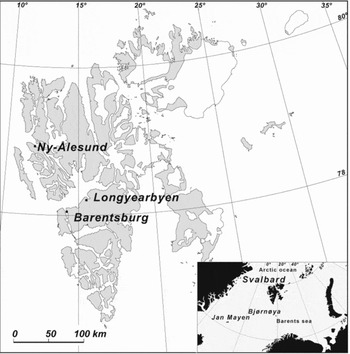
Svalbard, a group of Arctic islands midway between mainland Norway and the North Pole (Fig. 1), was a no man's land until Norway obtained sovereignty over the archipelago after World War I. The Paris peace negotiations produced the Svalbard Treaty of 1920 (Treaty 1920), which recognized the ‘full and absolute sovereignty’ of Norway over the islands (Article 1). However, the treaty also stipulated some conditions that curbed the sovereign rights of Norway (Ulfstein Reference Ulfstein1995; Pedersen 2006). Nationals of all signatory parties were to be ‘admitted under the same conditions of equality’ to undertake mining and other commercial activities on the islands (Article 3). Taxes levied by Norway had to be devoted entirely to Svalbard (Article 8), and the islands could not be used for ‘warlike purposes’ or fortification (Article 9). Due to these limitations, Andenæs initially suggested that the sovereignty did not have the same ‘exclusive character’ as sovereignty does elsewhere (Andenæs 1994: 84). Ulfstein, on the other hand, has denied that Norwegian sovereignty is limited. In his view the Svalbard Treaty only posed restrictions on specific sovereign rights (Ulfstein Reference Ulfstein1995; see also Fleischer Reference Fleischer1983).
Map of Svalbard (courtesy of the Norwegian Polar Institute).

Jurisdiction, the main topic for this study, is a vital and central feature of state sovereignty (Shaw Reference Shaw1991). Jurisdiction entails the capacity to prescribe legislation, as well as the capacity to enforce it. Whether Norway's sovereignty over Svalbard is regarded absolute or limited, Norway's resolve and ability actually to exercise jurisdiction on Svalbard has certainly developed over the years. The first decades after 1925 have been characterised as a laissez-faire period (Østreng Reference Østreng1975). Norway lacked both the resolve and ability to exercise its newly won jurisdiction. By illustration, the first governor of Svalbard did not even have his own means to travel around the islands. The Norwegian government's high representative on the islands had to obtain lifts with private vessels if he wanted to move around, which before long resulted in absurd situations. Having caught a ride to Green Harbour in the autumn of 1925, but being unable to return to his quarters, Governor J. G. Bassøe had to spend the winter in the mining community (Østreng Reference Østreng1975). On a territory twice as large as Belgium, with hardly any resources available, it is obvious that the governor could not exercise Norwegian jurisdiction efficiently.
Another challenge to Norway's control over Svalbard was the presence of a large number of Soviet citizens. The Soviet Union had established permanent settlements on the archipelago, and these were virtually closed to the Norwegian authorities. By the 1950s, approximately 2,500 Soviets were working in the mines of Barentsburg, Grumant and Pyramiden (Arlov Reference Arlov2003). The settlements became widely perceived as Soviet enclaves. As late as 1975, a Danish newspaper asserted that ‘the Soviet's grip on Svalbard is as tight as Norway's’ adding that ‘Norway struggles to maintain sovereignty over Svalbard’ (Fogt Reference Fogt1975).
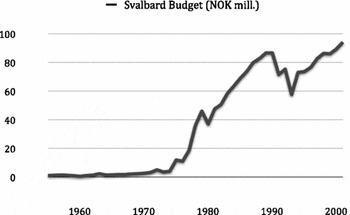
Indeed, not until the 1970s did Norway begin to establish a convincing resolve or ability to exercise national jurisdiction on Svalbard. A number of measures were taken to strengthen Norwegian rule. In 1971 the Norwegian government decided to build the airport at Longyearbyen, an idea that had been shelved a decade earlier amid Soviet protests. Two years later Norway passed new and far-reaching environmental legislation. The governor was equipped with a helicopter that enabled him to enforce jurisdiction effectively over the entire archipelago. In 1975, the first white paper on Svalbard called for further steps to strengthen Norwegian jurisdiction on the islands (Norway 1974–1975). The Svalbard budget swelled; from NKR 0.7 million in 1960, to 2.8 million in 1970, and to 37.2 million in 1980 (Fig. 2).
Funds allocated over the Svalbard Budget from 1955. The numbers are nominal and do not include the significant funds that are transferred from other ministries than the Norwegian Ministry of Justice. (Source: The Norwegian Ministry of Justice)

Since the second white paper on Svalbard was issued in 1986, the explicit overall policy objective of Norway has been to exercise sovereignty consistently and firmly, to comply with all Treaty obligations, to maintain peace and stability in the area, to conserve the wilderness, and to maintain Norwegian settlements on the islands (Norway 1986).
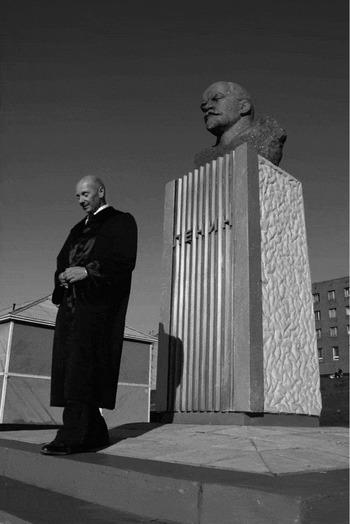
Today the governor maintains a large and active presence on the islands. This includes two helicopters and almost 30 full-time employees. Approximately one third of them are police officers. For every passing year, Longyearbyen becomes more like a regular Norwegian small town, and less like the ‘company town’ it used to be (Arlov and others Reference Arlov, Holm and Moe2001). Even the Russians have increasingly adapted to Norwegian rules. For example, Norwegian traffic signs have appeared in Barentsburg. The Russian mining company Trust Arktikugol produces, at least to some extent, area plans and other paperwork to the Governor in accordance with Norwegian regulations. Accidents and crimes in the Russian settlement are now reported to, and investigated by, Norwegian police. In 2006, a trial was held in Barentsburg before a Norwegian court (Fig. 3). Russian and Ukrainian miners were tried and convicted of reindeer poaching, arguably a show of Norwegian rule within the Russian society that would have been unthinkable only a decade ago. The Norwegian government concludes in its latest (1999) white paper on Svalbard that Norwegian sovereignty has ‘never stood stronger’ (Norway 1999). A new white paper on Svalbard is scheduled for 2009.
Prosecutor Rune Bård Hansen poses by the Lenin bust after a trial in Barentsburg in 2006. (Photo by the author)

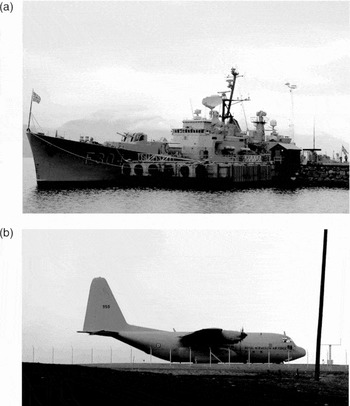
Nevertheless, the exercise of Norwegian jurisdiction on Svalbard remains, in effect, restricted. The archipelago is organised in a distinct manner in comparison with Norwegian mainland counties and municipalities. Taxes are either absent or low. The Norwegian settlements are heavily subsidised, but their citizens are, in general, not entitled to social benefits. Norwegian administrative law does not apply to Svalbard, unless specified by the legislation. Military presence, beyond the coast guard, is limited to one annual call by a naval vessel and a limited number of visits by a C-130 cargo aircraft (Fig. 4). The governor occasionally dispatches uniformed police to Barentsburg, but the degree of Norwegian involvement in internal affairs in the Russian settlement remains limited.
Military presence, limited to one annual call by a naval vessel and sporadic visits by C-130 cargo aircraft. (Photos by the author)

Some of these restrictions are imposed by the Svalbard Treaty, but others are obviously not. Put differently, Norwegian jurisdiction on Svalbard seems more restricted than the Svalbard Treaty would suggest, despite the fact that Norway's sovereignty over the archipelago is widely recognised. The reasons for these constraints will be explored below.
International relations
According to Waltz, the international system represents the ‘constraints that confine all states’ (Waltz Reference Waltz1979: 122). The structure of the system, the way that power capabilities are distributed among its component units, affects each state's ability to pursue its interests. The ancient Greek historian Thucydides put it even more bluntly in his accounts of the Peloponnesian War: ‘the strong do what they have the power to do, and the weak accept what they have to accept’ (Thucydides 1972: 402). In the state of anarchy, the philosopher Thomas Hobbes wrote in 1651 that every man is enemy to every man, and in such conditions there would be ‘continuall feare, and danger of violent death; And the life of man, solitary, poore, nasty, brutish, and short’ (Hobbes Reference Hobbes1996: 89). By the same logic, in an international system without a supra-national authority or world government, states fear each other. The security of one state is primarily provided by its own relative strength. Hence, policies of states will be influences by the international structure (for an overview of literature, see Rose Reference Rose1998).
Scholars disagree on how power should be defined in international relations theory. Gilpin has described ‘power’ as one of the most troublesome concepts within international relations theory (Gilpin Reference Gilpin and Keohane1986). Strength may obviously come from superior military power, but may also be subscribed to a vigorous economy, demographic resources, a favourable geography, and so on. However, the general notion of the international relations approach is that international circumstances affect the way states behave. For most practical reasons, however, the approach comes down to how external factors influence state behaviour.
Østreng put emphasis on international circumstances when he, as early as in 1975, explained developments in the exercise of Norwegian jurisdiction on Svalbard (Østreng Reference Østreng1975). During the laissez-faire period, small state Norway refrained from taking actions, since these might provoke the great powers. The delicacy of Svalbard policies was ascribed to the area's proximity to the preponderance of military-strategic capabilities in the northwestern Soviet Union, also separating the naval bases of the northern fleet from its most important areas of operation, and positioned straight under the shortest route for intercontinental bombers between the Russian and American territories. According to Østreng, the great Norwegian policy shift in the early 1970s was only possible due to the détente between the east and the west at the time (Østreng Reference Østreng1975). The détente, a period of thawing in the cold war, lasted from the late 1960s to the early 1980s. During this period, the Kremlin gave its consent to the building of an airport at Longyearbyen. Prior to this, in 1958 to 1960, the Soviet Union had vigorously condemned similar plans. But changes in international relations altered the circumstances, which in turn allowed for Norway to build an airfield without fearing international repercussions.
Policy makers admit that structural conditions affect their decisions. Indeed, few policy issues stir more alarm among Norwegian diplomats than the Svalbard issue. John Lyng, the foreign minister of Norway from 1965 to 1970, said that if his telephone rang in the middle of the night, his first anxious thought was that it probably concerned Svalbard (quoted in Frydenlund Reference Frydenlund1982: 63). Knut Frydenlund, who served as foreign minister from 1973 to 1981, explained that, in general, fear is a strong determinant in policy making. When a Soviet surveillance aircraft crashed on one of the Svalbard islands in 1978, and Norwegian authorities seized the ‘black box’ from the wreckage to investigate, the Soviets made explicit threats that disturbed the Norwegian minister. ‘In such situations’ Frydenlund recalled, ‘a foreign minister appreciates a membership in a military alliance’ (Frydenlund Reference Frydenlund1982: 100). Indeed, one may understand their anxiousness by looking at some of the protests that have been handed to Norway by foreign powers, most notably the Soviet Union. One issue concerned the inclusion of Svalbard in the NATO command structure in 1951. The Kremlin stated that it regarded the Norwegian policy as ‘hostile’, that it would ‘severely damage the Soviet-Norwegian relationship’, and that Norway should carry the full responsibilities of the consequences that might follow.
The latest white paper on Svalbard, dating from 1999, points to the effects of glasnost and perestroika on Svalbard policies. In the late 1980s, the Russian settlements on Svalbard became more open to the Norwegian authorities. The white paper concluded that the international relaxation at the end of, and after, the cold war allowed for great changes in Norwegian Svalbard policies (Norway 1999).
Even today, international relations continue to affect Norwegian policies. Foreign minister Jonas Gahr Støre often points to the effects of external conditions on Norwegian policies in the high north. When he presented the Government's high north strategy in Tromsø in 2005, he asserted that Norway faced a manoeuvering space, handlingsrom, and a sphere of possibilities, mulighetsrom. In effect, he described the constraints on Norwegian policymaking as determined by external factors. Indeed, studies demonstrate that international relations in the Svalbard area hold back Norway's jurisdiction in the maritime areas surrounding the archipelago (Pedersen Reference Pedersen2008a; Pedersen Reference Pedersen2008b).
Domestic politics
An alternative approach would be to examine the effects of domestic factors on developments in Norwegian jurisdiction. While the international relations approach came down to how external factors affect state behaviour, the domestic politics paradigm is, in short, about how internal factors affect it. Foreign policy analysts often point to explanations within the nation, highlighting the influence of domestic media, lobbyists, bureaucratic competition, budgetary processes, organisational behaviour, and so on (for an overview of literature see Carlsnaes Reference Carlsnaes, Carlsnaes, Risse and Simmons2005). One of the most quoted foreign policy studies is Allison's account on the Cuban missile crisis in 1962 (Allison and Zelikow Reference Allison and Zelikow1999). Not only did Allison explain U.S. foreign policies during the crisis as rational responses to international circumstances, he also pointed to the influence of domestic organisational behaviour and governmental politics.
Little research has been done on how domestic factors have affected Norwegian jurisdiction on Svalbard specifically, but some assertions have been made with reference to Svalbard and domestic politics. One assertion is that Svalbard was only ‘discovered’ by civil society in the late 1960s, or early 1970s. Hitherto, there had been no pressing need for firm Norwegian rule over the archipelago (Arlov Reference Arlov2003). But an increased interest in the potential oil reserves on Svalbard raised domestic concerns for the environment and demands for a proper environmental regime on the islands (Moe Reference Moe1983). Before the surge in interest for oil, Svalbard had been peripheral in Norwegian debate and on the policy agenda. Now it became a subject for public attention and opinion, which in turn called for firmer Norwegian jurisdiction.
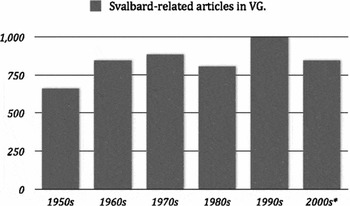
However, the assertion of a ‘forgotten’ and ‘rediscovered’ Svalbard in the domestic debate is not substantially documented. Indeed, a search in the daily newspaper Verdens Gang shows that the number of Svalbard-related articles has been relatively constant from 1950 onward. In the 1950s ‘Svalbard’ was referred to in 662 articles, and in the 1960s it appeared in 849 articles. In the 1970s, the archipelago was mentioned in 885 articles, about the same frequency as in the previous decade, and not dramatically higher than in the 1950s (Fig. 5). In comparison, ‘Israel’ was brought up three times as often as ‘Svalbard’ in the 1970s.
Number of Svalbard articles per decade in Verdens Gang from 1950s onward. Figure for 2000s as of June 2008. (Source: ATEKST, electronic news archive).

Another assertion is that Svalbard affairs are organised in such a way that foreign policy considerations are excluded from most decision making processes. Moe pointed to some domestic organisational effects on Svalbard policies as early as 1983 (Moe Reference Moe1983). Since the mid 1960s, the organising principle has sought to bring the governance of Svalbard more in line with the governance of mainland Norway. Svalbard-related issues have been split up along subject lines and processed by the respective ministry rather than processed collectively by one Svalbard ministry (Moe Reference Moe1983; Arlov Reference Arlov2003). Accordingly, regular civil servants process most Svalbard issues, not trained diplomats or Svalbard specialists. Although a few foreign ministers have been quoted above, any overall Svalbard policy is the responsibility of the ministry of justice, not the ministry of foreign affairs. Notably, foreign powers are not consulted in Svalbard affairs.
Civil servants, in a number of different ministries and agencies, spur developments in Norwegian jurisdiction. Due to the fragmentation of Svalbard authority, Nilsen concludes that Norwegian policies toward Svalbard are driven by sector interests rather than by an overall national objective. Notably, the ministry of the environment has been a proponent for new environmental legislation on Svalbard, while the ministry of trade and industry has defended Norway's coal mining and economic interests on Svalbard (Nilsen Reference Nilsen2001; Arlov Reference Arlov2003). Administrative agencies, such as the Norwegian post and telecommunications authority, the Norwegian labour inspection authority and the accident investigation board, have inevitably expanded their de facto area of jurisdiction to the Russian settlement on Svalbard. The public servants have no competence to assess international relations ramifications of their actions. Accordingly, they exercise jurisdiction under no foreign policy constraints.
If foreign policy considerations have been organised out of the relevant decision making processes, then foreign policy considerations could not influence decisions. Developments in Norwegian jurisdiction on Svalbard could only be explained in terms of domestic politics, and not in terms of international relations. All explanatory variables could be found within Norway.
However, such assertions are not warranted. International relations may certainly constrain the conduct of civil servants. As an example, even public prosecutors, deemed to be unpartisan and objective, are instructed to take into account foreign policy considerations if their actions may have international repercussions. After the Elektron incident in 2005, when a Russian trawler resisted Norwegian arrest off of Svalbard and fled to its home waters with Norwegian inspectors still onboard, the director of public prosecutors emphasised that legal actions should not be ‘taken in a political vacuum’, and that foreign policy considerations ‘may weigh heavily’ along with other considerations (Pedersen Reference Pedersen2008a). In its reading of the 1999 white paper on Svalbard, the standing committee on foreign affairs in the Norwegian parliament, Stortinget, stated that the exercise of sovereignty had to be ‘robust and flexible’ in order to cope with shifting international circumstances. Indeed, the ministry of foreign affairs does interfere in Svalbard affairs when they become delicate. Rolf Einar Fife, the head of the legal department of the ministry, observes that, in general, ‘when the Ministry of Foreign Affairs offers advice, the others usually listen’ (Inderberg Reference Inderberg2007: 47).
Multiple examples show that international relations indeed affect Norwegian decisions. For instance, when President Vladimir Putin visited Norway in 2002, he expressed only one concern, and that was a concern for environmental protection regulations on Svalbard (Pedersen 2003). The governor of Svalbard, on advice from the Norwegian polar institute, proposed to establish a protection area near Barentsburg. In diplomatic notes handed to Norway, Russia had declared that the proposed provisions were ‘unacceptable’ since they de facto excluded areas from the mining regime established by the Svalbard Treaty (Russia 2002a, 2002b). The measures, in Putin's view, could obstruct Russian mining and, accordingly, also impede the Russian presence on the archipelago. The Russian objections soon had policy consequences. Even though the environmental protection areas were to be determined on strictly technical grounds, the process was reversed on political grounds. The protection area outside Barentsburg was removed from the plan.
It was also on advice from the ministry of foreign affairs that the governor of Svalbard released a Russian trawler that was caught red handed inside the territorial waters in 2004. The vessel received a second warning rather than becoming subject to arrest (Pedersen Reference Pedersen2008a). Again, international considerations weighed on the decision of a civil servant.
International relations versus domestic politics
The international relations and the domestic politics approaches are hardly competing approaches to the analysis of developments in Norwegian jurisdiction. They are complementary. External factors account for the constraints posed on national Svalbard policies. Internal factors explain the drive for more normalised conditions on Svalbard. In other words, the permissive causes of change can be found in international relations, whereas the efficient causes can be found in domestic politics (Waltz Reference Waltz1979).
In combination, the two approaches make up an analytical framework that accounts for gradual change to the extent that the external factors permit, domestic actors, driven by sector interests, seem to push for a more assertive Norwegian jurisdiction. The result is an incremental development. Gradually, Norwegian jurisdiction on Svalbard is brought in line with jurisdiction elsewhere, although it will always be subjected to the restrictions of the Svalbard Treaty. To quote Rune Hansen, a long-time deputy governor of Svalbard and an avid enforcer of Norwegian jurisdiction on the islands: ‘[i]t is the art of the possible. . .The best may become the enemy of the good.’ Hansen argues that measures have to be taken one step at a time, and never pushed to the extremes.
Arguably, the international community acquiesces in the development, which is certainly warranted by the Svalbard Treaty. But the acquiescence may not result from a rational assessment of whether a further ‘Norwegianisation’ of Svalbard will challenge their national interest in the region, which it may or may not do. The incremental development simply does not create the necessary ‘choice opportunity’ (Olsen Reference Olsen1972) or foreign policy ‘occasion’ (Holsti Reference Holsti1992), at which their interests and policies might have been be assessed and addressed. While unconstrained leaps in the development might have attracted the attention of foreign powers with interests in Svalbard (Pedersen Reference Pedersen2008c), thus creating a policy occasion in a number of foreign ministries with the potential for challenging Norwegian rule or testing Norway's resolve on the archipelago, small steps go under their radars. It often takes significant events to attract international attention. Indeed, foreign policy agendas are often determined by noticeable events, as argued by Wood and Peake, among others (Wood and Peake Reference Wood and Peake1998; Peake 2002; Andrade and Young Reference Andrade and Young1996). Intentionally or not, the contracting parties to the Svalbard Treaty comply with the increasingly resolute Norwegian regime on Svalbard, without testing Norway's resolve.
In sum, the strengthening of Norway's jurisdiction on Svalbard has been, and still is, a steady process determined by both internal and external factors. As long as domestic actors propel an increasingly determined exercise of jurisdiction, and as long as foreign policy considerations slow up the pace, Norway's grip on Svalbard will only become increasingly tighter.