



1. Introduction
In this paper, “space” refers to a topological space, and by a “map” we always mean a continuous map. Fibrations are taken in the Hurewicz sense, meaning that they satisfy the homotopy lifting property for maps. Additionally, a
 $G$
-fibration is one that satisfies the homotopy lifting property for
 $G$
-maps.
Let
 $G$
be a compact Hausdorff topological group acting continuously on a Hausdorff space
 $X$
on the left. The equivariant category of
 $X$
, denoted by
 $\text{cat}_G(X)$
, was introduced by Fadell in [Reference Fadell10], as a generalization of the classical category, or Lusternik-Schnirelmann category (LS-category), of a space [Reference Lyusternik and Shnirel’man13]. For a general overview of LS-category, we refer the reader to the survey article by James [Reference James12] and the book by Cornea-Lupton-Oprea-Tanré [Reference Cornea, Lupton, Oprea and Tanré6]. In [Reference Cornea, Lupton, Oprea and Tanré6, Proposition 1.27(2), p. 14] the authors show that for path-connected normal spaces
 $X,Y$
with non-degenerate basepoints, the classical category of the wedge
 $X\vee Y$
is,
 \begin{equation} \mathrm{cat}(X\vee Y) = \max \{\mathrm{cat}(X), \mathrm{cat}(Y)\}, \end{equation}
where
 $X\vee Y$
is the wedge of the disjoint sets
 $X$
and
 $Y$
obtained by identifying their basepoints.
Similar to the definition of classical category,
 $\mathrm{cat}_G(X)$
is defined as the least number of open invariant subsets of
 $X$
that form a covering for
 $X$
, with each open subset being equivariantly contractible to an orbit, rather than a point.
We note that a formula for the equivariant case of (1.1) does not appear in the literature. In [Reference Bayeh and Soumen2, Lemma 2.7, p. 135], the authors show that the inequality
 \begin{equation} \mathrm{cat}_G(X\vee Y)\leq \mathrm{cat}_G(X)+\mathrm{cat}_G(Y)-1 \end{equation}
holds for any pointed
 $G$
-spaces
 $(X,x_0)$
and
 $(Y,y_0)$
. A pointed
 $G$
-space means a
 $G$
-space with a distinguished basepoint fixed by
 $G$
.
In this paper, we extend the classical formula (1.1) to the equivariant case, thus improving the inequality (1.2). Specifically, we show that under certain conditions (see Theorem3.4), the wedge
 $X\vee Y$
has equivariant category equal to
 \begin{equation*}\max \{\mathrm{cat}_G(X), \mathrm{cat}_G(Y)\}.\end{equation*}
To this end, we extend the approach to LS-category given by Cornea-Lupton-Oprea-Tanré in [Reference Cornea, Lupton, Oprea and Tanré6, Section 1.4] to the equivariant setting.
Additionally, we discuss the equivariant and invariant topological complexities for wedge spaces.
In simpler terms, the equivariant topological complexity
 $\mathrm{TC}_G$
is the minimal number of
 $G$
-equivariant motion planning rules, whereas the invariant topological complexity
 $\mathrm{TC}^G$
is the minimal number of
 $G \times G$
-equivariant motion planning rules required to navigate the space in a way that respects the group symmetry (see Definition 4.1).
The main results of this work are the following.
-
• We prove the formula
 $\text{cat}_G(X\vee Y)=\max \{\mathrm{cat}_G(X), \mathrm{cat}_G(Y)\}$
(Theorem3.4).
-
• We show that the wedge
$\bigvee _{i=1}^m X_i$
is
$G$
-contractible if and only if each
$X_i$
is
$G$
-contractible, for each
$i=1,\ldots ,m$
(see Corollary 3.6). -
• We compute the equivariant category of the quotient
$X/A$
for a
$G$
-space
$X$
and an invariant subset
$A$
such that the inclusion
$A \hookrightarrow X$
is
$G$
-homotopic to a constant map
$\overline {x_0}\, : \,A\to X$
, for some
$x_0\in X^G$
(Theorem3.7). -
• We compute the equivariant category
$\text{cat}_G(X\wedge S^k)$
(Theorem3.12). -
• We show that the inequalities
always hold (Theorem4.4).
\begin{align*} \max \{\text{TC}_G(X),\text{TC}_G(Y),\text{cat}_G(X\times Y)\} &\leq \text{TC}_G(X\vee Y) \quad \text{ and } \\[4pt] \nonumber \max \{\text{TC}^G(X),\text{TC}^G(Y),_{X\vee Y}\text{cat}_{G\times G}(X\times Y)\}&\leq \text{TC}^G(X\vee Y) \end{align*}
-
• Under certain conditions, we obtain the following equalities:
(Theorem4.5).
\begin{align*} \text{TC}_G(X\vee Y)&=\max \{\text{TC}_G(X),\text{TC}_G(Y),\text{cat}_G(X\times Y)\} \quad \text{ and } \\[4pt] \nonumber \text{TC}^G(X\vee Y)&=\max \{\text{TC}^G(X),\text{TC}^G(Y),_{X\vee Y}\text{cat}_{G\times G}(X\times Y)\} \end{align*}



The paper is organized as follows: In Section 2, we begin with a brief review of
 $G$
-spaces,
 $G$
-maps,
 $G$
-homotopy, and
 $G$
-invariant sets. Basic properties of invariant sets are presented in Lemma 2.1. We recall the definition of equivariant category in Definition 2.2. Some computation of equivariant category are shown in Example 2.3. Lemma 2.4 yields necessary conditions for
 $G$
-contractiblity. The
 $G$
-homotopy invariance of the equivariant category is presented in Proposition 2.5. A key property of the equivariant category is presented in Lemma 2.6. We introduce the notion of
 $y$
-connectivity for a
 $G$
-space in Definition 2.7. As shown in Remark 2.8,
 $G$
-contractibility implies
 $y$
-connectivity and, with an additional condition,
 $G$
-connectivity. In Example 2.9, we use the
 $y$
-connectivity property to compute the equivariant category of the standard Hamiltonian action. Proposition 2.10 shows that, under
 $y$
-connectivity, the inclusion map of any
 $G$
-categorical set is
 $G$
-homotopic to a
 $G$
-map with values in the orbit of
 $y$
. We recall the definition of
 $G$
-cofibration and
 $G$
-retract in Definition 2.11. Proposition 2.12 provides a characterization of
 $G$
-cofibrations in terms of
 $G$
-retracts, and thus we obtain a key property of
 $G$
-cofibrations. We recall the notion of a
 $G$
-well-pointed space in Definition 2.13. Proposition 2.14 shows that any
 $G$
-non-degenerate basepoint admits a “good” open categorical neighborhood. In Definition 2.15, we recall the notion of a
 $G$
-normal space. Proposition 2.16 shows that any normal
 $G$
-space is a
 $G$
-normal space. Proposition 2.17 presents properties of
 $G$
-normal spaces.
In Section 3, we present our first main result (Theorem3.4). For this purpose, in Proposition 3.1, we show that for any
 $G$
-connected,
 $G$
-normal space with a
 $G$
-non-degenerate basepoint, there exists a “good” open
 $G$
-categorical cover. Such a “good” open
 $G$
-categorical cover is called a based
 $G$
-categorical covering (Definition 3.2). The inequality
 $\max \{\text{cat}_G(X),\text{cat}_G(Y)\}\leq \text{cat}_G(X\vee Y)$
always holds, as shown in Proposition 3.3. Our first main theorem (Theorem3.4) shows that this inequality is, in fact, an equality under certain conditions. Example 3.5 shows that the equality
 $\text{cat}_G(X\vee X)=\text{cat}_G(X)$
holds. A characterization of the
 $G$
-contractibility of the wedge
 $\bigvee _{i=1}^m X_i$
is shown in Corollary 3.6. The second main result in this section is Theorem3.7, which computes the equivariant category of the quotient
 $X/A$
for a
 $G$
-space
 $X$
and an invariant subset
 $A$
such that the inclusion
 $A\hookrightarrow X$
is
 $G$
-homotopic to a constant map
 $\overline {x_0}\,:\,A\to X$
, for some
 $x_0\in X^G$
. Remark 3.8 shows that we can consider more general product actions. Hence, we obtain Proposition 3.9 and Remark 3.10. We end this section by discussing the equivariant category of the smash product (Remark 3.11). For instance, we compute the equivariant category
 $\text{cat}_G(X\wedge S^k)$
in Theorem3.12.
In Section 4, we discuss the equivariant and invariant topological complexity of a wedge. We recall the notions of equivariant and invariant topological complexities in Definition 4.1. In Lemma 4.2, we record standard properties of these invariants. In Proposition 4.3, we compute the equivariant category, and the equivariant and invariant topological complexities of
 $X/A$
under the condition that
 $A$
is
 $G$
-contractible to a fixed point
 $x_0\in X^G$
. The first main theorem in this section is Theorem4.4, which shows that the inequalities
 \begin{align*} \max \{\text{TC}_G(X),\text{TC}_G(Y),\text{cat}_G(X\times Y)\}&\leq \text{TC}_G(X\vee Y) \quad \text{ and } \\[4pt] \nonumber \max \{\text{TC}^G(X),\text{TC}^G(Y),_{X\vee Y}\text{cat}_{G\times G}(X\times Y)\}&\leq \text{TC}^G(X\vee Y) \end{align*}
always hold. Under certain conditions, we show that these inequalities are, in fact, equalities, as shown in Theorem4.5. For instance, in Proposition 4.6, we obtain that the equality
 \begin{equation*}\text{TC}_G(\underbrace {X\vee \cdots \vee X}_{k \text{ times }})=\text{TC}_G(X)\end{equation*}
holds, whenever
 $\text{TC}_G(X)=2\text{cat}_G(X)-1$
. In addition, the equality
 \begin{equation*}\text{TC}^G(\underbrace {X\vee \cdots \vee X}_{k \text{ times }})=\text{TC}^G(X)\end{equation*}
holds, whenever
 $\text{TC}^G(X)=2\text{cat}_G(X)-1$
. Several examples are presented to support these results (Example 4.7, Example 4.8, Example 4.9, and Example 4.10). We end this article with Remark 4.11, which conjectures that the equalities
 \begin{align*} \text{TC}_G(X\vee Y)&=\max \{\text{TC}_G(X),\text{TC}_G(Y),\text{cat}_G(X\times Y)\}, \\[4pt] \nonumber \text{TC}^G(X\vee Y)&=\max \{\text{TC}^G(X),\text{TC}^G(Y),_{X\vee Y}\text{cat}_{G\times G}(X\times Y)\}, \end{align*}
always hold.
The authors of this paper deeply thank the referees for very valuable comments and timely corrections on previous versions of the work.
2. Preliminary results
In this section, we recall some definitions and fix our notation. We follow the standard conventions for compact transformation groups as used in [Reference Bredon4] and [Reference tom Dieck17].
Let
 $G$
be a compact Hausdorff topological group acting continuously on a Hausdorff space
 $X$
on the left. In this case, we say that
 $X$
is a
 $G$
-space.
For each
 $x \in X$
, the isotropy group (or stabilizer) of
 $x$
, denoted
 \begin{equation*} G_x \, :\! = \{g \in G\, : \,gx = x\}, \end{equation*}
is a closed subgroup of
 $G$
.
The set
 \begin{equation*} {O}(x) \, :\! = \{gx\, : \,g \in G\}, \end{equation*}
also denoted by
 $Gx$
, is called the orbit of
 $x$
.
There exists a homeomorphism from the quotient space
 $G/G_x$
to
 ${O}(x)$
, which maps
 $gG_x$
to
 $g^{-1}x$
, for each
 $g \in G$
.
The orbit space
 $X/G$
is the set of equivalence classes determined by the action, endowed with the quotient topology. Since
 $G$
is compact and
 $X$
is Hausdorff, the orbit space
 $X/G$
is also Hausdorff [Reference tom Dieck17, Proposition 3.1-(v), p. 5], and the quotient map
 $p\,:\,X\to X/G$
, sending each point to its orbit, is both open and closed [Reference tom Dieck17, Proposition 3.1, p. 22].
If
 $H$
is a closed subgroup of
 $G$
, then the set
 \begin{equation*} X^H \, :\! =\{x\in X\, :\,hx=x, \text{ for all } h\in H\} \end{equation*}
is called the
 $H$
-fixed point set of
 $X$
. In particular, the set
 $X^G$
is called the fixed point set of
 $X$
. Here,
 $X^H$
is endowed with the subspace topology. Note that
 $x\in X^G$
if and only if
 $O(x)=\{x\}$
, which is equivalent to
 $G_x=G$
.
We denote the closed interval
 $[0,1]$
in
 $\mathbb{R}$
by
 $I$
. Let
 $X$
and
 $Y$
be
 $G$
-spaces. A
 $G$
-equivariant map or (a
 $G$
-map)
 $f\,:\,X\to Y$
is a map that satisfies
 $f(gx)=gf(x)$
, for any
 $g\in G$
and
 $x\in X$
.
Let
 $X$
and
 $Y$
be
 $G$
-spaces. Two
 $G$
-equivariant maps
 $\phi ,\psi \,:\,X\to Y$
are
 $G$
-homotopic, written
 $\phi \simeq _G\psi$
, if there exists a
 $G$
-map
 $F\,:\,X\times [0,1]\to Y$
such that
 $F_0=\phi$
and
 $F_1=\psi$
, where
 $G$
acts trivially on
 $I=[0,1]$
(i.e.,
 $gt=t$
, for all
 $g\in G$
and
 $t\in I$
) and diagonally on
 $X\times [0,1]$
(i.e.,
 $g(x,t)=(gx,gt)=(gx,t)$
, for all
 $g\in G$
and
 $(x,t)\in X\times [0,1]$
). A subset
 $U\subset X$
is described as
 $G$
-invariant (or simply invariant) if
 $gU\subset U$
, for all
 $g\in G$
.
The following statement is straightforward to verify.
Lemma 2.1.
Let
 $X$
be a
 $G$
-space. If
 $U\subset X$
is an invariant subset, then the closure
 $\overline {U}$
and the complements
 $ X-\overline {U}, X-U\subset X$
are also invariant. Furthermore, if
 $\{U_\alpha \}$
is a collection of invariant subsets of
 $X$
, then the intersection
 $\bigcap U_\alpha$
and the complement
 $X-\bigcup _{\alpha }U_\alpha$
are also invariant.
We recall the notion of the equivariant category of a
 $G$
-space
 $X$
, as studied, for instance, by Marzantowicz [Reference Marzantowicz15] and Collman-Grant [Reference Colman and Grant5].
An invariant set
 $U$
in a
 $G$
-space
 $X$
is called
 $G$
-categorical if the inclusion map
 $\text{incl}_U\,:\,U\hookrightarrow X$
is
 $G$
-homotopic to a
 $G$
-map
 $c\,:\,U\to X$
such that
 $c(U)\subset O(x)$
, for some
 $x\in X$
. That is, there exists a
 $G$
-homotopy
 $F\, : \,U\times [0,1]\to X$
such that
 $F_0=\text{incl}_U$
and
 $F_1(U)\subset O(x)$
, for some
 $x\in X$
.
Now, we recall the definition of the equivariant category.
Definition 2.2.
The equivariant category of a
 $G$
-space
 $X$
, denoted
 $\text{cat}_G(X)$
, is the least integer
 $k\geq 1$
such that
 $X$
can be covered by
 $k$
open sets
 $\{U_1,\ldots ,U_k\}$
, each of which is
 $G$
-categorical.
Note that
 $\text{cat}_G(X)\geq \text{cat}(X/G)$
(using the fact that the quotient map
 $X\to X/G$
is open). The equality holds whenever
 $X$
is a free metrizable
 $G$
-space (see [Reference Colman and Grant5, Proposition 3.5, p. 2304]).
A
 $G$
-space
 $X$
is called
 $G$
-contractible if
 $\text{cat}_G(X)=1$
, that is, the identity map
 $1_X\,:\,X\to X$
is
 $G$
-homotopic to a
 $G$
-map
 $c\,:\,X\to X$
such that
 $c(X)\subset O(x)$
, for some
 $x\in X$
.
Example 2.3.
-
(1) If
$G$
acts transitively on
$X$
, that is
$O(x)=X$
, for some (and thus for any)
$x\in X$
, then
$\text{cat}_G(X)=1$
. -
(2) Given a
$G$
-space
$X$
, the cone
$C(X)$
of
$X$
, defined as the quotient of
$X \times [0,1]$
obtained by collapsing
$X \times \{1\}$
to a single point, is a
$G$
-space, with the action defined by
$g[x, t] \, :\! = [gx, t]$
. Moreover, the point
$X \times \{1\}$
belongs to the fixed point set
$(C(X))^G$
. Note that
$\operatorname {cat}_G(C(X)) = 1$
for any
$G$
-space
$X$
. The
$G$
-map
$H \,:\, C(X) \times [0,1] \to C(X)$
, given by
satisfies
\begin{equation*} H([x,t],s) = [x, (1 - s)t + s], \end{equation*}
$H_0 = \operatorname {id}_{C(X)}$
and
$H_1$
is the constant map at the point
$X \times \{1\}$
.
-
(3) Given a
$G$
-space
$X$
, the suspension
$SX$
of
$X$
, defined as the quotient of
$X \times [0,1]$
obtained by collapsing
$X \times \{0\}$
to one point and
$X \times \{1\}$
to another, is itself a
$G$
-space, with the action given by
$g[x,t] \, :\! = [gx,t]$
. Moreover, the points
$X \times \{0\}$
and
$X \times \{1\}$
belong to the fixed point set
$(SX)^G$
. Note that
$\operatorname {cat}_G(SX) \leq 2$
for any
$G$
-space
$X$
. Indeed, an open
$G$
-categorical covering is given by
where
\begin{equation*} \left \{ q\left (X \times [0, 3/4)\right ),\; q\left (X \times (1/4, 1]\right ) \right \}, \end{equation*}
$q \,:\, X \times [0,1] \to SX$
is the quotient map.





The
 $G$
-contractibility condition yields the following statement.
Lemma 2.4.
Let
 $X$
be a
 $G$
-contractible space.
-
(1) There exists a point
$a\in X$
such that for each
$x\in X$
, there is a continuous path
$\alpha \,:\,[0,1]\to X^{G_x}$
such that
$\alpha (0)=x$
and
$\alpha (1)\in Ga$
. -
(2) Given
$x, y \in X$
, there exist continuous paths
$\alpha \,:\, [0,1] \to X^{G_x}$
and
$\beta \,:\, [0,1] \to X^{G_y}$
such that
$\alpha (0) = x$
,
$\beta (1) = y$
, and
$G\alpha (1) = G\beta (0)$
. -
(3) Let
$H$
be a closed subgroup of
$G$
. Given
$x,y\in X^H$
, there exist continuous paths
$\alpha ,\beta \,:\,[0,1]\to X^H$
such that
$\alpha (0)=x$
,
$\beta (1)=y$
, and
$G\alpha (1)=G\beta (0)$
. -
(4) The orbit space
$X/G$
is path-connected.




Proof.
Let
 $F\,:\,X\times [0,1]\to X$
be a
 $G$
-homotopy such that
 $F_0=1_X$
and
 $F_1(X)\subset Ga$
, for some
 $a\in X$
. Given
 $x\in X$
, consider the continuous path
 $\alpha \,:\,[0,1]\to X$
defined by
 \begin{equation*}\alpha (t)=F(x,t).\end{equation*}
Note that
 $\alpha (0)=x$
and
 $\alpha (1)\in Ga$
. Additionally, since
 $F$
is a
 $G$
-map, it follows that
 $\alpha (t)\in X^{G_x}$
, for any
 $t\in [0,1]$
. Similarly, given
 $y\in X$
, then is a continuous path
 $\gamma \,:\,[0,1]\to X^{G_y}$
such that
 $\gamma (0)=y$
and
 $\gamma (1)\in Ga$
. Consider the path
 $\beta (t)=\gamma (1-t)$
. Note that
 $\beta (t)\in X^{G_y}$
, for any
 $t\in [0,1]$
,
 $\beta (1)=\gamma (0)=y$
, and
 $G\beta (0)=G\gamma (1)=Ga=G\alpha (1)$
.
Furthermore, if
 $x\in X^H$
, then
 $H\subset G_x$
, and thus
 $X^{G_x}\subset X^H$
, which implies that
 $\alpha (t)\in X^H$
, for all
 $t\in [0,1]$
.
Let
 $X$
and
 $Y$
be
 $G$
-spaces. We say that
 $X$
 $G$
-dominates
 $Y$
if there exist
 $G$
-maps
 $\phi \,:\,X\to Y$
and
 $\psi \,:\,Y\to X$
such that
 $\phi \circ \psi \simeq _G 1_Y$
. If, in addition,
 $\psi \circ \phi \simeq _G 1_X$
, then
 $\phi$
and
 $\psi$
are
 $G$
-homotopy equivalences, and
 $X$
and
 $Y$
are
 $G$
-homotopy equivalent, written
 $X\simeq _G Y$
.
The following result is well-known and was established in [Reference Marzantowicz15].
Proposition 2.5.
If
 $X$
 $G$
-dominates
 $Y$
, then
 $\text{cat}_G(X)\geq \text{cat}_G(Y)$
. In particular, if
 $X\simeq _G Y$
, then
 $\text{cat}_G(X)=\text{cat}_G(Y)$
.
The following statement is key to the equivariant category theory.
Lemma 2.6. (cf. [Reference Colman and Grant5, Lemma 3.14, p. 2305]) Let
 $X$
be a
 $G$
-space, and let
 $x,y\in X$
such that
 $H \, :\! =G_x$
. There exists a continuous path
 $\alpha \,:\,[0,1]\to X^{H}$
such that
 $\alpha (0)=x$
and
 $\alpha (1)\in Gy$
if and only if there exists a
 $G$
-homotopy
 $F\,:\,Gx\times [0,1]\to X$
such that
 $F_0=incl_{Gx}$
and
 $F_1(Gx)\subset Gy$
.
Proof.
To show the converse, we take
 $\alpha (t) \, :\! =F(x,t)$
. Note that since
 $x\in X^H$
and
 $F$
is a
 $G$
-map, it follows that
 $\alpha (t)\in X^H$
, for any
 $t\in [0,1]$
.
To show the other implication, we take
 $F(gx,t) \, :\! =g\alpha (t)$
. Note that since
 $\alpha (t)\in X^H$
, for any
 $t\in [0,1]$
, we have
 $H\subset G_{\alpha (t)}$
, for any
 $t\in [0,1]$
, and hence,
 $F$
is well-defined. Additionally,
 $F$
satisfies the desired properties.
From [Reference Colman and Grant5, Definition 3.13, p. 2305], a
 $G$
-space
 $X$
is said to be
 $G$
-connected if the
 $H$
-fixed point set
 $X^H$
is path-connected, for every closed subgroup
 $H$
of
 $G$
.
Note that if
 $X$
is
 $G$
-connected, and if
 $x,y\in X$
are such that
 $H \, :\! =G_x\subset G_y$
(equivalently,
 $y\in X^H$
), then there exists a continuous path
 $\alpha \,:\,[0,1]\to X^{H}$
such that
 $\alpha (0)=x$
and
 $\alpha (1)=y\in Gy$
. Motivated by Lemma 2.6, we present the following definition.
Definition 2.7 (
 $y$
-connected). Let
 $X$
be a
 $G$
-space, and let
 $y\in X$
. We say that
 $X$
is
 $y$
-connected if for each point
 $x\in X$
, there is a continuous path
 $\alpha \,:\,[0,1]\to X^H$
, where
 $H=G_x$
, such that
 $\alpha (0)=x$
and
 $\alpha (1)\in Gy$
.
Note that if
 $X$
is
 $y$
-connected, then
 $X$
is also
 $y'$
-connected for any
 $y'\in Gy$
. Moreover, if
 $X$
is
 $G$
-connected, then
 $X$
is
 $x_0$
-connected for any
 $x_0\in X^G$
. Furthermore, if
 $X$
is
 $x_0$
-connected for some point
 $x_0\in X^G$
, then
 $X$
is
 $G$
-connected.
It is important to note that there exist
 $G$
-contractible spaces which are not
 $G$
-connected (see Example 2.3(1)). However, we have the following remark.
Remark 2.8.
By Lemma 2.4(1), if
 $X$
is
 $G$
-contractible, then
 $X$
is
 $y$
-connected for some
 $y\in X$
. Moreover, if
 $X$
is
 $G$
-contractible to a fixed point
 $x_0\in X^G$
, then
 $X$
is
 $G$
-connected.
By Remark 2.8, we can conclude that if a
 $G$
-space
 $X$
is not
 $y$
-connected for any
 $y\in X$
, then
 $\text{cat}_G(X)\geq 2$
.
We have the following example.
Example 2.9 (Standard Hamiltonian action). Let
 $G=S^1$
act on
 $X=S^2$
by rotation about the
 $z$
-axis. This is known as the standard Hamiltonian action of
 $S^1$
on
 $S^2$
[Reference Cornea, Lupton, Oprea and Tanré6, Example 8.39, p. 248]. The fixed point set of
 $X$
is
 $X^G=\{p_N,p_S\}\neq \emptyset$
, where
 $p_N$
is the north pole and
 $p_S$
is the south pole. Hence,
 $X$
is not
 $G$
-connected. Furthermore,
 $X$
is not
 $y$
-connected for any
 $y\in X$
(and, of course, it is not
 $G$
-contractible). Hence, we conclude that
 $\text{cat}_{S^1}(S^2)=2$
. Its equivariant categorical covering is given by
 $U_1=S^2-\{p_N\}$
and
 $U_2=S^2-\{p_S\}$
.
Let
 $X$
be a
 $G$
-space and
 $A$
be a
 $G$
-invariant set of
 $X$
. From [Reference Lubawski and Marzantowicz14, Definition 2.2, p. 103], the
 $A$
-Lusternik-Schnirelmann
 $G$
-category of
 $X$
, denoted by
 $_A\text{cat}_G(X)$
, is the least integer
 $k$
such that
 $X$
can be covered by open
 $G$
-invariant sets
 $U_1,\ldots ,U_k$
of
 $X$
such that each inclusion map
 $\text{incl}_{U_i}\,:\,U_i\hookrightarrow X$
is
 $G$
-homotopic to a
 $G$
-map
 $c_i\,:\,U_i\to X$
with
 $c_i(U_i)\subset A$
. If no such integer
 $k$
exists, we set
 $_A\text{cat}_G(X)=\infty$
. Note that
 $_{O(x)}\text{cat}_G(X)\geq \text{cat}_G(X)$
, for any
 $x\in X$
.
Further discussion of
 $_A\text{cat}_G(X)$
can be found in [Reference Lubawski and Marzantowicz14] and [Reference Bayeh and Sarkar3].
We have the following statement, which shows that under
 $y$
-connectivity, the inclusion map of any
 $G$
-categorical set is
 $G$
-homotopic to a
 $G$
-map with values in the orbit of
 $y$
. As a direct consequence, the
 $A$
-Lusternik-Schnirelmann
 $G$
-category satisfies the following property: there exists a subset
 $A\subseteq X$
such that
 $_Acat_G(X)=cat_G(X)$
, whenever
 $X$
is
 $y$
-connected.
Proposition 2.10.
Let
 $X$
be a
 $G$
-space such that
 $X$
is
 $y$
-connected.
-
(1) If
$U\subset X$
is
$G$
-categorical, then the inclusion map
$\text{incl}_{U}\,:\,U\hookrightarrow X$
is
$G$
-homotopic to a
$G$
-map
$s\,:\,U\to X$
such that
$s(U)\subset Gy$
. -
(2) The following equality holds:
\begin{equation*}_{O(y)}\text{cat}_G(X)=\text{cat}_G(X).\end{equation*}


Proof.
-
(1) Denote by
$H\,:\,U\times [0,1]\to X$
the
$G$
-homotopy between the inclusion
$\text{incl}_U\,:\,U\hookrightarrow X$
and a
$G$
-map
$c\,:\,U\to X$
such that
$c(U)\subset Gx$
, for some
$x\in X$
. Since
$X$
is
$y$
-connected, by Lemma 2.6, we have a
$G$
-homotopy
$F\,:\,Gx\times [0,1]\to X$
such that
$F_0=\text{incl}_{Gx}$
and
$F_1(Gx)\subset Gy$
.Define a homotopy
$T\,:\,U\times [0,1]\to X$
given by:We have that
\begin{equation*}T(x,t) \, :\! =\left \{ \begin{array}{ll} H(x,2t), & \hbox{ if $0\leq t\leq 1/2$;} \\[4pt] \nonumber F(c(x),2t-1)), & \hbox{ if $1/2\leq t\leq 1$.} \end{array} \right .\end{equation*}
$T$
is well-defined, it is
$G$
-equivariant, and it is a homotopy of the inclusion
$\text{incl}_{U}\,:\,U\hookrightarrow X$
into a map
$s \, :\! =T_1\,:\,U\to X$
such that
$s(U)\subset Gy$
.
-
(2) By Item (1), we obtain
$_{O(x)}\text{cat}_G(X)\leq \text{cat}_G(X)$
. In addition, recall that the other inequality always holds.


Note that Proposition 2.10 generalizes [Reference Lubawski and Marzantowicz14, Remark 2.3, p. 103], where the authors considered more restrictive hypotheses.
Additionally, if
 $X$
is
 $x_0$
-connected for some point
 $x_0\in X^G$
(equivalently, if
 $X$
is
 $G$
-connected and
 $X^G\neq \varnothing$
), then
 $_{\{x_0\}}\text{cat}_G(X)\geq \text{cat}(X)$
. Hence, Proposition 2.10 implies that the nonequivariant category provides a lower bound for the equivariant category, that is
 $\text{cat}(X)\leq \text{cat}_G(X)$
for any
 $G$
-connected space
 $X$
with
 $X^G\neq \varnothing$
.
The following definition is the equivariant version of cofibration and retract in the category of
 $G$
-spaces.
Definition 2.11 (
 $G$
-cofibration). Let
 $X$
be a
 $G$
-space and
 $A\subset X$
be an invariant subset.
-
(1) The inclusion map
$j\,:\,A\hookrightarrow X$
is a
$G$
-cofibration if for every
$G$
-space
$Y$
, every
$G$
-map
$f\,:\,X\to Y$
, and every
$G$
-homotopy
$H\,:\,A\times [0,1]\to Y$
satisfying
$H(a,0)=f\circ j(a)$
, for all
$a\in A$
, there exists a
$G$
-homotopy
$\widehat {H}\,:\,X\times [0,1]\to Y$
such that
$\widehat {H}(j(a),t)=H(a,t)$
, for all
$a\in A$
and
$t\in [0,1]$
, and
$\widehat {H}(x,0)=f(x)$
, for all
$x\in X$
. We recall that
$G$
acts trivially on
$I=[0,1]$
and diagonally on
$X\times [0,1]$
.where
$\iota _0(x)=(x,0)$
for all
$x$
. -
(2)
$A$
is a
$G$
-retract of
$X$
if there exists a
$G$
-map
$r\,:\,X\to A$
such that
$r(a)=a$
, for all
$a\in A$
. Such a map
$r$
is called a
$G$
-retraction.





We have a characterization of
 $G$
-cofibrations in terms of
 $G$
-retracts, which leads to a key property of
 $G$
-cofibrations. The proof of this claim follows analogously to the nonequivariant case, as presented in [Reference Aguilar, Gitler and Prieto1, Theorem 4.1.16, Theorem 4.1.7].
Proposition 2.12.
Let
 $X$
be a
 $G$
-space and let
 $A\subset X$
be a closed invariant subset. Then:
-
(1) The inclusion map
$j\,:\,A\hookrightarrow X$
is a
$G$
-cofibration if and only if
$X\times \{0\}\cup A\times I$
is a
$G$
-retract of
$X\times I$
. -
(2) If the inclusion map
$j\,:\,A\hookrightarrow X$
is a
$G$
-cofibration, then there exists a
$G$
-homotopy
$D\,:\,X\times [0,1]\to X$
and a
$G$
-map
$\varphi \,:\,X\to [0,1]$
such that
$A\subset \varphi ^{-1}(0)$
and:
-
•
$D(x,0)=x$
, for all
$x\in X$
. -
•
$D(a,t)=a$
, for all
$a\in A$
and for all
$t\in [0,1]$
. -
•
$D(x,t)\in A$
, for all
$x\in X$
and for all
$t\gt \varphi (x)$
.
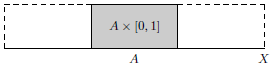
-







Proof.
-
(1) If
$j\,:\,A\hookrightarrow X$
is a
$G$
-cofibration, then the
$G$
-map
$f\,:\,X\to X\times \{0\}\cup A\times I$
given by
$f(x)=(x,0)$
, for all
$x\in X$
, and the
$G$
-homotopy
$H\,:\,A\times I\to X\times \{0\}\cup A\times I$
given by
$H(a,t)=(a,t)$
, for all
$(a,t)\in A\times I$
, together define a
$G$
-map
$\widehat {H}\,:\,X\times I\to X\times \{0\}\cup A\times I$
, which serves as a
$G$
-retraction. This means we can take
$r=\widehat {H}$
.Conversely, if we have a
$G$
-retraction
$r\,:\,X\times I\to X\times \{0\}\cup A\times I$
, then for any
$G$
-space
$Y$
, any
$G$
-map
$f\,:\,X\to Y$
, and any
$G$
-homotopy
$H\,:\,A\times I\to Y$
satisfying
$H(a,0)=f\circ j(a)$
, for all
$a\in A$
, we can define a
$G$
-homotopy
$\widehat {H}\,:\,X\times I\to Y$
by:We note that
\begin{equation*}\widehat {H}(x,t) \, :\! =\left \{ \begin{array}{ll} f\circ proj_X\circ r(x,t), & \hbox{if $(x,t)\in r^{-1}(X\times \{0\})$;} \\ H\circ r(x,t), & \hbox{if $(x,t)\in r^{-1}(A\times I)$.} \end{array} \right .\end{equation*}
$\widehat {H}$
is continuous, since
$X\times \{0\}$
and
$A\times I$
are closed in
$X\times I$
.
-
(2) We shall use the characterization given in Item (1), namely, that there exists a
$G$
-retraction
$r\,:\,X\times I\to X\times \{0\}\cup A\times I$
. We define
$\varphi$
and
$D$
as follows:We have that
\begin{eqnarray*} \varphi (x) & \, :\! =& \sup _{t\in I}\mid t-proj_I r(x,t)\mid ,\, \text{ for } x\in X;\\ D(x,t) & \, :\! =& proj_X r(x,t), \,\text{ for } x\in X, \,t\in I. \end{eqnarray*}
$\varphi$
is well-defined and is a
$G$
-map, since for any
$g\in G$
and any
$x\in X$
, we have:Here, we recall that
\begin{eqnarray*} \varphi (gx) &=& \sup _{t\in I}\mid t-proj_I r(gx,t)\mid \\ &=& \sup _{t\in I}\mid t-proj_I (gr(x,t))\mid \\ &=& \sup _{t\in I}\mid t-proj_I r(x,t)\mid \\ &=& \varphi (x)\\ &=& g\varphi (x). \end{eqnarray*}
$G$
acts trivially on
$I$
and diagonally on
$X\times I$
. Furthermore,
$D$
is well-defined, equivariant, and satisfies the desired properties. Note that for
$t\gt \varphi (x)$
, we have
$r(x,t)\in A\times I$
, since
$t\gt 0$
. Thus,
$D(x,t)\in A$
.


Now, we introduce the notion of a
 $G$
-well-pointed space.
Definition 2.13.
A
 $G$
-space
 $X$
has a
 $G$
-non-degenerate basepoint
 $x_0$
if
 $x_0\in X^G$
and the inclusion
 $\{x_0\}\hookrightarrow X$
is a
 $G$
-cofibration. A
 $G$
-space is
 $G$
-well-pointed if it has a
 $G$
-non-degenerate basepoint.
Examples of equivariant cofibrations are usually a CW pair
 $(X,A)$
, where some group
 $G$
acts on
 $X$
(cellularly) [Reference May16, Theorem 3.1]. Thus, every
 $G$
-CW-complex with a
 $G$
-fixed basepoint is
 $G$
-well-pointed, since the inclusion of the basepoint is a
 $G$
-cofibration.
Proposition 2.12 implies that any
 $G$
-non-degenerate basepoint admits a “good” open
 $G$
-categorical neighborhood.
Proposition 2.14.
If
 $X$
is a
 $G$
-space with a
 $G$
-non-degenerate basepoint
 $x_0$
, then there exists an open invariant neighborhood
 $N$
of
 $x_0$
that
 $G$
-contracts to
 $x_0$
in
 $X$
relative to
 $x_0$
, that is, there exists a
 $G$
-homotopy
 $H\,:\,N\times [0,1]\to X$
such that
 $H_0=\text{incl}_N$
,
 $H_1(N)\subset O(x_0)=\{x_0\}$
, and
 $H(x_0,t)=x_0$
, for all
 $t\in [0,1]$
.
Proof.
We can use Proposition 2.12 for the closed invariant
 $A=\{x_0\}$
. Then, we define
 $N \, :\! =\varphi ^{-1}([0,1))\subset X$
and let
 \begin{equation*}H \, :\! =D\mid _{N\times [0,1]}\,:\,N\times [0,1]\to X\end{equation*}
be the restriction of
 $D$
. Thus,
 $N$
is an open invariant neighborhood
 $N$
of
 $x_0$
that
 $G$
-contracts to
 $x_0$
in
 $X$
relative to
 $x_0$
.
Now, just as in the nonequivariant case, we also need some separation conditions. Recall that a Hausdorff space
 $X$
is called normal if whenever
 $A,B\subset X$
are closed sets such that
 $A\cap B=\emptyset$
, there exist disjoint open sets
 $U,V\subset X$
such that
 $A\subset U$
and
 $B\subset V$
.
The following definition is the equivariant version of normal spaces.
Definition 2.15 (
 $G$
-normal space). A
 $G$
-space
 $X$
is called
 $G$
-normal if whenever
 $A,B\subset X$
are closed invariant sets such that
 $A\cap B=\emptyset$
, there exist disjoint open invariant sets
 $U,V\subset X$
such that
 $A\subset U$
and
 $B\subset V$
.
The following statement is the normal version of [Reference Colman and Grant5, Lemma 3.12, p. 2305].
Proposition 2.16.
If
 $X$
is a normal
 $G$
-space, then
 $X$
is
 $G$
-normal.
Proof.
Recall that the quotient map
 $p\,:\,X\to X/G$
is closed. If
 $X$
is normal, then
 $X/G$
is normal (see [Reference Dugundji7, Theorem 3.3, p. 145]). Thus, it suffices to show that the normality of
 $X/G$
implies the
 $G$
-normality of
 $X$
. Let
 $A,B\subset X$
be disjoint closed invariant sets. Using the quotient map
 $p\,:\,X\to X/G$
, we see that
 $p(A), p(B)\subset X/G$
are disjoint closed sets because
 $A$
and
 $B$
are disjoint invariant sets. Since
 $X/G$
is normal, there exist disjoint open sets
 $U,V\subset X/G$
such that
 $p(A)\subset U$
and
 $p(B)\subset V$
.
Next, we observe that:
 \begin{equation*}A\subset (p^{-1}\circ p)(A)\subset p^{-1}(U), \quad \quad B\subset (p^{-1}\circ p)(B)\subset p^{-1}(V).\end{equation*}
Since
 $p^{-1}(U)$
and
 $p^{-1}(V)$
are invariant, they are open invariant sets in
 $X$
. Therefore, there exist disjoint open invariant sets
 $p^{-1}(U)$
and
 $p^{-1}(V)\subset X$
such that
 $A\subset p^{-1}(U)$
and
 $B\subset p^{-1}(V)$
. This proves that
 $X$
is
 $G$
-normal.
Note that any
 $G$
-normal space satisfies the following properties, which are an extension of the nonequivariant case (cf. [Reference Dugundji7, Theorem 6.1, pg. 152]).
Proposition 2.17.
Let
 $X$
be a
 $G$
-space.
-
(1) If
$X$
is
$G$
-normal, then for each invariant closed subset
$A\subset X$
and nonempty invariant open set
$U\supset A$
, there exists an invariant open set
$V$
such that
$A\subset V\subset \overline {V}\subset U$
. -
(2)
$X$
is
$G$
-normal if and only if for any covering
$\{U_i\}_{i=1}^n$
of
$X$
by open invariant sets, there exists a covering
$\{V_i\}_{i=1}^n$
of
$X$
by open invariant sets such that
$\overline {V_i}\subset U_i$
, for all
$i$
.





Proof.
-
(1) Recall that
$X-U$
is invariant because
$U$
is invariant. Since
$X$
is
$G$
-normal, and
$A$
and
$B \, :\! =X-U$
are disjoint closed invariant subsets of
$X$
(with
$U$
being nonempty), there exist disjoint open invariant sets
$F$
and
$E$
such that
$A\subset F$
and
$B\subset E$
. Define
$V \, :\! =F$
. Then, we have
$\overline {V}\subset U$
, as required. -
(2)
$(\Longrightarrow )$
: For each
$x\in X$
, define
$h(x) \, :\! =\max \{i:\,x\in U_i\}$
. We will define the sets
$\{V_i\}_{i=1}^n$
by induction on
$n$
.Define
$F_1 \, :\! =X-(U_2\cup \cdots \cup U_n)\subset U_1$
. First, note that
$F_1$
is closed and invariant. By item (1), there exists an open invariant set
$V_1$
such that
$F_1\subset V_1\subset \overline {V_1}\subset U_1$
. Note that
$V_1\cup U_2\cup \cdots \cup U_n=X$
. Indeed, given
$x\in X$
, if
$h(x)\gt 1$
, then
$x\in U_2\cup \cdots \cup U_n$
, and if
$h(x)\leq 1$
, then
$x\notin U_2\cup \cdots \cup U_n$
, that is
$x\in F_1\subset V_1$
. Therefore,
$V_1\cup U_2\cup \cdots \cup U_n=X$
.Now, define
$F_2 \, :\! =X-(V_1\cup U_3\cup \cdots \cup U_n)\subset U_2$
. Note that
$F_2$
is closed and invariant. By item (1), there is an open invariant
$V_2$
with
$F_2\subset V_2\subset \overline {V_2}\subset U_2$
. Note that
$V_1\cup V_2\cup U_3\cup \cdots \cup U_n=X$
. Indeed, given
$x\in X$
, if
$h(x)\gt 2$
, then
$x\in U_3\cup \cdots \cup U_n$
, and if
$h(x)\leq 2$
, then
$x\notin U_3\cup \cdots \cup U_n$
. Therefore,
$V_1\cup V_2\cup U_3\cup \cdots \cup U_n=X$
.Assume that
$V_1, V_2,\ldots , V_k$
are open invariant sets such thatDefine
\begin{equation*}V_1\cup \cdots \cup V_k\cup U_{k+1}\cup \cdots \cup U_n=X.\end{equation*}
$F_{k+1} \, :\! =X-(V_1\cup \cdots \cup V_k\cup U_{k+2}\cup \cdots \cup U_n)\subset U_{k+1}$
. Note that
$F_{k+1}$
is closed and invariant. By item (1), there exists an open invariant set
$V_{k+1}$
such that
$F_{k+1}\subset V_{k+1}\subset \overline {V_{k+1}}\subset U_{k+1}$
. Note that
$V_1\cup \cdots \cup V_k\cup V_{k+1}\cup U_{k+2}\cup \cdots \cup U_n=X$
. Indeed, given
$x\in X$
, if
$h(x)\gt k+1$
, then
$x\in U_{k+2}\cup \cdots \cup U_n$
, and if
$h(x)\leq k+1$
, then
$x\notin U_{k+2}\cup \cdots \cup U_n$
. Therefore,
\begin{equation*}V_1\cup \cdots \cup V_k\cup V_{k+1}\cup U_{k+2}\cup \cdots \cup U_n=X.\end{equation*}
Finally, assume that
$V_1, V_2,\ldots , V_{n-1}$
are open invariant sets such thatDefine
\begin{equation*}V_1\cup \cdots \cup V_{n-1}\cup U_n=X.\end{equation*}
$F_{n} \, :\! =X-(V_1\cup \cdots \cup V_{n-1})\subset U_{n}$
. Note that
$F_{n}$
is closed and invariant. By item (1), there exists an open invariant
$V_{n}$
such that
$F_{n}\subset V_{n}\subset \overline {V_{n}}\subset U_{n}$
. Note that
$V_1\cup \cdots \cup V_n=X$
. Indeed, given
$x\in X$
, if
$x\in V_1\cup \cdots \cup V_{n-1}$
the equality holds, and if
$x\notin V_1\cup \cdots \cup V_{n-1}$
, then
$x\in F_{n}\subset V_{n}$
. Therefore,
$V_1\cup \cdots \cup V_n=X$
.
Thus, there exists a covering
$\{V_i\}_{i=1}^n$
of
$X$
by open invariant sets such that
$\overline {V_i}\subset U_i$
, for all
$i$
.
$(\Longleftarrow )$
: Let
$A,B\subset X$
be disjoint closed invariant sets in
$X$
. Thenis a covering of
\begin{equation*}\{X-A, X-B\}\end{equation*}
$X$
by open invariant sets. Hence, there exist open invariant sets
$V_1$
and
$V_2$
in
$X$
such that
$\overline {V_1}\subset X-A$
,
$\overline {V_2}\subset X-B$
, and
$V_1\cup V_2=X$
. Note that
$U \, :\! =X-\overline {V_1}$
and
$V \, :\! =X-\overline {V_2}$
are open invariant neighborhoods of
$A$
and
$B$
, respectively, and
$U\cap V=X-(\overline {V_1}\cup \overline {V_2})=\emptyset$
. Thus,
$X$
is
$G$
-normal.











3. Equivariant category of wedges
In this section, we use the previous results to derive important claims that will imply our first main theorem (Theorem3.4).
First, we show that for any
 $G$
-connected,
 $G$
-normal space with a
 $G$
-non-degenerate basepoint, there exists a “good” open
 $G$
-categorical cover. This claim is the equivariant version of [Reference Cornea, Lupton, Oprea and Tanré6, Lemma 1.25, pg. 13].
Proposition 3.1.
Suppose
 $X$
is a
 $G$
-connected,
 $G$
-normal space with a
 $G$
-non-degenerate basepoint
 $x_0$
. If
 $\text{cat}_G(X)\leq n$
, then there is an open
 $G$
-categorical cover
 $V_1,\ldots ,V_n$
such that
 $x_0\in V_j$
, for all
 $j=1,\ldots ,n$
, and each
 $V_j$
is
 $G$
-contractible to
 $O(x_0)=\{x_0\}$
relative to
 $x_0$
, that is, there is a
 $G$
-homotopy
 $T_j\,:\,V_j\times [0,1]\to X$
such that
 $T_j(x,0)=x$
, for all
 $x\in V_j$
,
 $T_j(x,1)=x_0$
, for all
 $x\in V_j$
, and
 $T_j(x_0,t)=x_0$
, for all
 $t\in [0,1]$
.
Proof.
Let
 $\{U_1,\ldots ,U_n\}$
be an open
 $G$
-categorical cover of
 $X$
. By Proposition 2.10(1), we may assume that the inclusions
 $\text{incl}_{U_j}\,:\,U_j\hookrightarrow X$
are all
 $G$
-homotopic into
 $O(x_0)=\{x_0\}$
, with respective
 $G$
-contracting
 $H_j\,:\,U_j\times [0,1]\to X$
. Note that by the
 $G$
-normality of
 $X$
, there exists a refined cover
 $\{W_j\}_{j=1}^{n}$
of
 $\{U_j\}_{j=1}^{n}$
by open invariant sets with
 $W_j\subset \overline {W_j}\subset U_j$
, for each
 $j=1,\ldots ,n$
(see Proposition 2.17(2)).
By the
 $G$
-non-degenerate basepoint hypothesis (see Proposition 2.14), there exists an open invariant neighborhood of
 $x_0$
, denoted
 $N$
, and a
 $G$
-contracting homotopy
 $H\,:\,N\times [0,1]\to X$
with
 $H_0=\text{incl}_N$
,
 $H_1(N)\subset O(x_0)=\{x_0\}$
, and
 $H(x_0,t)=x_0$
, for all
 $t\in [0,1]$
.
Without loss of generality, we can assume that
 $x_0\in U_j$
, for
 $j=1,\ldots ,k$
, for some
 $1\leq k\leq n-1$
, and
 $x_0\notin U_j$
, for
 $j=k+1,\ldots ,n$
. Define a new
 $G$
-contracting open invariant neighborhood of
 $x_0$
by
 \begin{equation*} \mathcal{N} = N\cap U_1\cap \cdots \cap U_k\cap (X-\overline {W}_{k+1})\cap \cdots \cap (X-\overline {W}_{n})\subset N. \end{equation*}
Note that
 $x_0\in \mathcal{N}$
(since
 $x_0\in X-U_j\subset X-\overline {W}_{j}$
for
 $j=k+1,\ldots ,n$
) and
 $\mathcal{N}\cap W_j=\emptyset$
for all
 $j=k+1,\ldots ,n$
.
Now, again by the
 $G$
-normality of
 $X$
(see Proposition 2.17(1)), for the closed invariant set
 $\{x_0\}\subset \mathcal{N}$
and the open invariant set
 $\mathcal{N}$
, there exists an open invariant set
 $M$
of
 $X$
with
 $x_0\in M\subset \overline {M}\subset \mathcal{N}$
. Note that
 $\mathcal{N}\subset U_j$
, for each
 $j=1,\ldots ,k$
.
Now, we can define an open
 $G$
-categorical cover of
 $X$
that satisfies the conclusions of the proposition. Let
 \begin{equation*} V_j \, :\! =\begin{cases} (U_j\cap (X-\overline {M}))\cup M, & \hbox{for $j=1,\ldots ,k$;} \\ W_j\cup \mathcal{N}, & \hbox{for $j=k+1,\ldots ,n$.} \end{cases} \end{equation*}
Note that
 $\{V_j\}_{j=1}^{n}$
covers
 $X$
. This follows because
 \begin{equation*}[(U_j\cap (X-\overline {M}))\cup M]\cup (\overline {M}-M)=U_j\end{equation*}
and
 $\overline {M}\subset \mathcal{N}$
implies that
 \begin{equation*}[(U_j\cap (X-\overline {M}))\cup M]\cup \mathcal{N}\supset U_j.\end{equation*}
Moreover, since
 $W_j\subset U_j$
, we have that
 \begin{equation*}[(U_j\cap (X-\overline {M}))\cup M]\cup \mathcal{N}\supset W_j,\end{equation*}
for each
 $j=1,\ldots ,k$
. Thus,
 $\bigcup _{j=1}^nV_j\supset \bigcup _{j=1}^n W_j$
, and since
 $\{W_j\}_{j=1}^{n}$
covers
 $X$
, we conclude that
 $\{V_j\}_{j=1}^{n}$
covers
 $X$
. Furthermore,
 $\{V_j\}_{j=1}^{n}$
is a covering by open invariant sets. Note that
 $x_0\in V_j$
, for all
 $j=1,\ldots ,n$
, since
 $x_0\in M$
and
 $x_0\in \mathcal{N}$
.
Moreover, each
 $V_j$
, for
 $j=1,\ldots ,n$
consists of two disjoint open invariant subsets: one subset of
 $U_j$
not containing the basepoint
 $x_0$
, and one subset of
 $\mathcal{N}$
containing the basepoint. This allows us to define a
 $G$
-contracting homotopy: for
 $j=1,\ldots ,k$
, define
 $T_j\,:\,V_j\times [0,1]\to X$
by
 \begin{equation*} T_j(x,t) \, :\! =\left \{ \begin{array}{ll} H_j(x,t), & \hbox{ if $x\in U_j\cap (X-\overline {M})$;} \\ H(x,t), & \hbox{ if $x\in M$.} \end{array} \right .\end{equation*}
We observe that
 $T_j$
is well-defined, invariant, and it is a homotopy between the inclusion
 $\text{incl}_{V_j}$
and the constant map
 $\overline {x_0}\,:\,[0,1]\to X$
with
 $\overline {x_0}(t)=x_0,\forall t\in [0,1]$
. Furthermore, for any
 $t\in [0,1]$
, we have
 $T_i(x_0,t)=H(x_0,t)$
, since
 $x_0\in M$
.
For
 $j=k+1,\ldots ,n$
, we define
 $T_j\,:\,V_j\times [0,1]\to X$
by
 \begin{equation*} T_j(x,t) \, :\! =\left \{ \begin{array}{ll} H_j(x,t), & \hbox{ if $x\in W_j$;} \\ H(x,t), & \hbox{ if $x\in \mathcal{N}$.} \end{array} \right .\end{equation*}
Note that
 $T_j$
is well-defined, invariant, and it is a homotopy between the inclusion
 $\text{incl}_{V_j}$
and the constant map
 $\overline {x_0}\,:\,[0,1]\to X,\,\overline {x_0}(t)=x_0,\forall t\in [0,1]$
. Furthermore, for any
 $t\in [0,1]$
, we have
 $T_j(x_0,t)=H(x_0,t)$
, since
 $x_0\in \mathcal{N}$
.
Thus, we introduce the following definition.
Definition 3.2 (Based
 $G$
-categorical covering). An open
 $G$
-categorical covering
 $V_1,\ldots ,V_n$
of
 $X$
such that
 $x_0\in V_i$
, for all
 $i=1,\ldots ,n$
, and each
 $V_i$
is
 $G$
-contractible to
 $O(x_0)=\{x_0\}$
relative to
 $x_0$
, is called a based
 $G$
-categorical covering.
For
 $G$
-spaces
 $X$
and
 $Y$
, we will assume that
 $G$
acts diagonally on
 $X\times Y$
, meaning that for all
 $(x,y)\in X\times Y$
and for all
 $g\in G$
, we have
 $g(x,y) \, :\! =(gx,gy)$
. If
 $x_0\in X^G$
and
 $y_0\in Y^G$
, the wedge sum
 $X\vee Y=X\times \{y_0\}\cup \{x_0\}\times Y\subset X\times X$
is an invariant subset of the
 $G$
-space
 $X\times Y$
. Furthermore, note that for any
 $x\in X$
and
 $y\in Y$
, the orbits in
 $X\vee Y$
are
 $O(x,y_0)=O(x)\times \{y_0\}$
and
 $O(x_0,y)=\{x_0\}\times O(y)$
. In addition, observe that the wedge
 $X\vee Y$
coincides with the space obtained from the disjoint union
 $X\sqcup Y$
by identifying the basepoints
 $x_0$
and
 $y_0$
.
Proposition 3.3.
Let
 $X$
and
 $Y$
be
 $G$
-spaces with
 $x_0\in X^G$
and
 $y_0\in Y^G$
. Then, the wedge
 $X\vee Y$
satisfies the following inequality:
 \begin{equation*}\max \{\text{cat}_G(X),\text{cat}_G(Y)\}\leq \text{cat}_G(X\vee Y).\end{equation*}
Proof.
Note that there are
 $G$
-retractions
 $r_X\,:\,X\vee Y\to X$
and
 $r_Y\,:\,X\vee Y\to Y$
. Indeed, the map
 $r_X\,:\,X\vee Y\to X$
is given by
 \begin{equation*} r_X(x)=\left \{ \begin{array}{ll} x, & \hbox{if $x\in X$;} \\ x_0, & \hbox{if $x\in Y$.} \end{array} \right . \end{equation*}
Note that
 $r_X$
is well-defined, is equivariant, and
 $r_X(z)=z$
, for all
 $z\in X$
. Hence,
 $r_X$
is a
 $G$
-retraction. Similarly, the map
 $r_Y\,:\,X\vee Y\to Y$
, given by
 \begin{equation*} r_Y(y)=\left \{ \begin{array}{ll} y_0, & \hbox{if $y\in X$;} \\ y, & \hbox{if $y\in Y$.} \end{array} \right . \end{equation*}
is a
 $G$
-retraction. By Proposition 2.5, we then have
 $\text{cat}_G(X)\leq \text{cat}_G(X\vee Y)$
and
 $\text{cat}_G(Y)\leq \text{cat}_G(X\vee Y)$
. Thus,
 \begin{equation*}\max \{\text{cat}_G(X),\text{cat}_G(Y)\}\leq \text{cat}_G(X\vee Y).\end{equation*}
Then, we state one of the main purposes of this paper. This claim is the equivariant version of [Reference Cornea, Lupton, Oprea and Tanré6, Proposition 1.27, pg. 14]. In the next section, we will use this theorem to compute the equivariant and invariant topological complexities for
 $G$
-connected
 $G$
-CW-complexes with
 $X^G\neq \varnothing$
.
Theorem 3.4.
If
 $X,Y$
are
 $G$
-connected,
 $G$
-normal spaces with
 $G$
-non-degenerate basepoints, then
 \begin{equation*} \text{cat}_G(X\vee Y)=\max \{\text{cat}_G(X),\text{cat}_G(Y)\}, \end{equation*}
where
 $X\vee Y$
is the wedge of the disjoint sets
 $X$
and
 $Y$
, obtained by identifying their basepoints.
Proof.
Let
 $\text{cat}_G(X)=n$
and
 $\text{cat}_G(Y)=m$
, with based
 $G$
-categorical covers
 $\{U_i\}_{i=1}^n$
and
 $\{V_j\}_{j=1}^m$
, respectively (see Proposition 3.1). Without loss of generality, assume
 $n\leq m$
. Define
 \begin{equation*}W_i \, :\! =\left \{ \begin{array}{ll} U_i\cup V_i, & \hbox{ for $i=1,\ldots ,n$;} \\ U_n\cup V_i, & \hbox{ for $i=n+1,\ldots ,m$.} \end{array} \right .\end{equation*}
Note that each
 $W_i$
is open in
 $X\vee Y$
, since
 $U_i$
is open in
 $X$
and
 $V_j$
is open in
 $Y$
, and
 $U_i\cap V_j=\{x_0=y_0\}$
. Each
 $W_i$
is invariant, as both
 $U_i$
and
 $V_j$
are invariant.
Let
 $H_i$
and
 $F_j$
be
 $G$
-contractible homotopies for
 $U_i$
and
 $V_j$
, respectively. For each
 $i=1,\ldots ,n$
, define
 $T_i\,:\,W_i\times [0,1]\to X\vee Y$
by
 \begin{equation*}T_i(x,t) \, :\! =\left \{ \begin{array}{ll} H_i(x,t), & \hbox{ if $x\in U_i$;} \\ F_i(x,t), & \hbox{ if $x\in V_i$.} \end{array} \right .\end{equation*}
For each
 $i=n+1,\ldots ,m$
, define
 $T_i\,:\,W_i\times [0,1]\to X\vee Y$
by
 \begin{equation*}T_i(x,t) \, :\! =\left \{ \begin{array}{ll} H_n(x,t), & \hbox{ if $x\in U_n$;} \\ F_i(x,t), & \hbox{ if $x\in V_i$.} \end{array} \right .\end{equation*}
Then, each
 $T_i$
is well-defined, invariant, and it is a homotopy such that
 $(T_i)_0=\text{incl}_{W_i}$
and
 $(T_i)_1(W_i)\subset O(x_0=y_0)=\{x_0=y_0\}$
. Hence,
 $\{W_i\}_{i=1}^m$
is an open
 $G$
-categorical cover of
 $X\vee Y$
. Therefore,
 $\text{cat}_G(X\vee Y)\leq m=\max \{n,m\}=\max \{\text{cat}_G(X),\text{cat}_G(Y)\}$
.
For the reverse inequality, see Proposition 3.3. Consequently,
 \begin{equation*}\text{cat}_G(X\vee Y)=\max \{\text{cat}_G(X),\text{cat}_G(Y)\}.\end{equation*}
A direct consequence of Theorem3.4 is the following example.
Example 3.5.
For any
 $G$
-connected,
 $G$
-normal space
 $X$
with a
 $G$
-non-degenerate basepoint, by Theorem
3.4
, we have
 \begin{equation*}\text{cat}_G(X\vee X)=\text{cat}_G(X).\end{equation*}
As a first application of Theorem3.4, we characterize the
 $G$
-contractibility of the wedge
 $\bigvee _{i=1}^m X_i$
.
Corollary 3.6.
Let
 $\{X_i\}_{i=1}^m$
be a collection of
 $G$
-connected,
 $G$
-normal spaces with
 $G$
-non-degenerate basepoints. The wedge
 $\bigvee _{i=1}^m X_i$
is
 $G$
-contractible if and only if each
 $X_i$
is
 $G$
-contractible, for
 $i=1,\ldots , m$
.
Proof.
By Theorem3.4, we have
 $\text{cat}_G(\bigvee _{i=1}^m X_i)=\max \{\text{cat}_G(X_i):\,i=1,\ldots ,m\}$
. Therefore,
 $\text{cat}_G(\bigvee _{i=1}^m X_i)=1$
if and only if
 $\text{cat}_G(X_i)=1$
, for each
 $i=1,\ldots , m$
.
A second application of Theorem3.4 is to compute the equivariant category of the quotient
 $X/A$
for a
 $G$
-space
 $X$
and an invariant subset
 $A$
such that the inclusion
 $A\hookrightarrow X$
is
 $G$
-homotopic to a constant map
 $\overline {x_0}\,:\,A\to X$
for some
 $x_0\in X^G$
.
Theorem 3.7.
Let
 $X$
be a
 $G$
-space and
 $A\subset X$
an invariant subset such that the inclusion map
 $i\,:\,A\hookrightarrow X$
is a
 $G$
-cofibration. If the inclusion map
 $i\,:\,A\hookrightarrow X$
is
 $G$
-homotopic to a constant map
 $\overline {x_0}\,:\,A\to X$
, for some
 $x_0\in X^G$
, then
 $X/A$
is
 $G$
-homotopic to the wedge
 $X\vee S A$
, where
 $A\times \{0\}$
is the basepoint of
 $S A$
and
 $x_0$
is the base point of
 $X$
.
In addition, if
 $X$
is a non
 $G$
-contractible,
 $G$
-connected,
 $G$
-normal space with a
 $G$
-non-degenerate basepoint, and if
 $S A$
is a
 $G$
-connected,
 $G$
-normal space with a
 $G$
-non-degenerate basepoint, then we have
 \begin{equation*}\text{cat}_G(X/A)=\text{cat}_G(X).\end{equation*}
Proof.
The statement that
 $X/A$
is
 $G$
-homotopy equivalent to
 $X\vee S A$
follows by analogy to [Reference Hatcher11, Example 0.14, p.14]. Hence, by Proposition 2.5, we obtain that
 $\text{cat}_G(X/A)=\text{cat}_G(X\vee S A)$
. From Theorem3.4, we conclude that
 $\text{cat}_G(X/A)=\text{cat}_G(X)$
, since
 $\text{cat}_G(X)\geq 2$
(using the fact that
 $X$
is not
 $G$
-contractible) and
 $\text{cat}_G(S A)\leq 2$
(see Example 2.3(3)).
We can consider more general product actions.
Remark 3.8.
Let
 $K$
be another compact Hausdorff group. Then, the product of a
 $G$
-space
 $X$
and a
 $K$
-space
 $Y$
becomes a
 $G\times K$
-space in an obvious way, namely,
 $(g,k)(x,y) \, :\! =(gx,ky)$
, for all
 $x\in X$
,
 $y\in Y$
,
 $g\in G$
, and
 $k\in K$
. If
 $x_0\in X^G$
and
 $y_0\in Y^K$
, the wedge
 $X\vee Y=X\times \{y_0\}\cup \{x_0\}\times Y\subset X\times X$
is an invariant subset of the
 $G\times K$
-space
 $X\times Y$
. Indeed, for any
 $x\in X$
,
 $y\in Y$
, and any
 $g\in G$
,
 $k\in K$
, we have
 $(g,k)(x,y_0)=(gx,ky_0)=(gx,y_0)\in X\vee Y$
and
 $(g,k)(x_0,y)=(gx_0,ky)=(x_0,ky)\in X\vee Y$
. Hence,
 $X\vee Y$
is a
 $G\times K$
-space. Furthermore, note that, for any
 $x\in X$
and
 $y\in Y$
, the orbits in
 $X\vee Y$
are
 $O(x,y_0)=O(x)\times \{y_0\}$
and
 $O(x_0,y)=\{x_0\}\times O(y)$
. Here,
 $O(x)$
denotes the orbit of
 $x$
in the
 $G$
-space
 $X$
, and
 $O(y)$
denotes the orbit of
 $y$
in the
 $K$
-space
 $Y$
.
Hence, in a similar way to Theorem3.4, one can obtain the following result.
Proposition 3.9.
If
 $X$
is a
 $G$
-connected,
 $G$
-normal space with a
 $G$
-non-degenerate basepoint, and if
 $Y$
is a
 $K$
-connected,
 $K$
-normal space with a
 $K$
-non-degenerate basepoint, then
 \begin{equation*} \text{cat}_{G\times K}(X\vee Y)=\max \{\text{cat}_G(X),\text{cat}_K(Y)\}, \end{equation*}
where
 $X\vee Y$
is the wedge of the disjoint sets
 $X$
and
 $Y$
, obtained by identifying their basepoints.
Recall that a pointed
 $G$
-space means a
 $G$
-space with the distinguished basepoint fixed by
 $G$
.
Remark 3.10. Note that the inequality
 \begin{equation*}\max \{\text{cat}_G(X),\text{cat}_K(Y)\}\leq \text{cat}_{G\times K}(X\vee Y)\end{equation*}
holds for any pointed
 $G$
-space
 $X$
and pointed
 $K$
-space
 $Y$
.
On the other hand, it is natural to inquire about the equivariant category of the smash product. For this, we have the following remark.
Remark 3.11 (Smash product). For the
 $G$
-spaces
 $X$
and
 $Y$
, we recall that
 $G$
acts diagonally on
 $X\times Y$
. If
 $x_0\in X^G$
and
 $y_0\in Y^G$
, the wedge
 $X\vee Y=X\times \{y_0\}\cup \{x_0\}\times Y\subset X\times X$
is an invariant subset of the
 $ G$
-space
 $X\times Y$
, and the smash product
 \begin{equation*}X\wedge Y=\dfrac {X\times Y}{X\vee Y}\end{equation*}
is a
 $G$
-space. The value of the equivariant category
 $\operatorname {cat}_G(X \wedge Y)$
is not known for arbitrary pointed
 $G$
-spaces
 $X$
and
 $Y$
. However, when
 $Y = S^k$
(for
 $k \geq 0$
) equipped with the trivial
 $G$
-action, we have the following result.
Theorem 3.12.
Let
 $H_q(-; \mathbb{Z})$
denote the
 $q$
th singular homology group. Let
 $X$
be a pointed
 $G$
-space such that
 $H_q(X;\mathbb{Z})\neq 0$
, for some
 $q\geq 1$
, and let
 $S^k$
be the
 $k$
-dimensional sphere (
 $k\geq 0$
) equipped with the trivial
 $G$
-action. Assume that
 $X \wedge S^k$
is
 $G$
-connected for
 $k \geq 1$
. Then:
 \begin{equation*} \text{cat}_G(X\wedge S^k)=\begin{cases} \text{cat}_G(X),& \hbox{ for $k=0$,}\\ 2,& \hbox{ for $k\geq 1$.} \end{cases} \end{equation*}
Proof.
Recall that
 $G$
acts trivially on
 $S^k$
. It is a technical procedure to check that there exists a
 $G$
-equivariant homeomorphism between
 $X\wedge S^0$
and
 $X$
. Hence, by Proposition 2.5, we have
 $\text{cat}_G(X\wedge S^0)=\text{cat}_G(X)$
.
For the case
 $k\geq 1$
, it is also a technical procedure to check that there exists a
 $G$
-equivariant homeomorphism between
 $X\wedge S^k$
and the iterated reduced suspension
 $\Sigma ^k X$
. Hence, by Proposition 2.5, we have
 $\text{cat}_G(X\wedge S^k)=\text{cat}_G(\Sigma ^k X)$
. Note that
 $\text{cat}_G(\Sigma ^k X)\leq 2$
. Then, we have
 \begin{eqnarray*} 2 &\leq & \text{cat}(\Sigma ^k X)\\ &\leq & \text{cat}_G(\Sigma ^k X)\\ &\leq & 2. \end{eqnarray*}
The first inequality follows from the fact that
 $H_q(X;\mathbb{Z})\neq 0$
, for some
 $q\geq 1$
(using the Mayer–Vietoris sequence, cf. [Reference Zapata18, Lemma 4.10, p 36]).
4. Equivariant and invariant topological complexities
In this section, we discuss the equivariant and invariant topological complexities of a wedge (Theorem4.5) and the quotient
 $X/A$
(Example 4.9). For this purpose, we use Theorem3.4. Additionally, we also consider the smash product
 $X\wedge S^k$
(Example 4.10).
Let
 $X$
be a
 $G$
-space. Let
 $X^{[0,1]}$
denote the space of all continuous paths in
 $X$
, equipped with the compact-open topology, and let
 $e_2^X\,:\,X^{[0,1]}\to X\times X$
be the fibration given by
 $e_2^X(\gamma )=\left (\gamma (0),\gamma (1)\right )$
. Note that
 $X^{[0,1]}$
is a
 $G$
-space via the pointwise action
 $(g\gamma )(t) \, :\! =g\gamma (t)$
, for any
 $g\in G$
,
 $\gamma \in X^{[0,1]}$
, and
 $t\in [0,1]$
. The Cartesian product
 $X\times X$
is also a
 $G$
-space via the diagonal action
 $g(x,y)=(gx,gy)$
. Hence,
 $e_2^X\,:\,X^{[0,1]}\to X\times X$
is a
 $G$
-map (in fact, it is a
 $G$
-fibration, see [Reference Colman and Grant5, p. 2308]).
On the other hand, consider the space
 \begin{equation*}X^{[0,1]}\times _{X/G} X^{[0,1]} \, :\! =\{(\alpha ,\gamma )\in X^{[0,1]}\times X^{[0,1]}:\,G\alpha (1)=G\gamma (0)\}.\end{equation*}
Note that
 $G\times G$
acts on
 $X^{[0,1]}\times _{X/G} X^{[0,1]}$
via
 $(g,h)(\alpha ,\gamma ) \, :\! =(g\alpha ,h\gamma )$
, and on
 $X\times X$
via
 $(g,h)(x,y)=(gx,hy)$
. Hence, the map
 $p_X\,:\,X^{[0,1]}\times _{X/G} X^{[0,1]}\to X\times X$
, given by
 $p_X(\alpha ,\gamma ) \, :\! =(\alpha (0),\gamma (1))$
, is a
 $G\times G$
-map (indeed, it is a
 $G\times G$
-fibration, see [Reference Lubawski and Marzantowicz14, Proposition 3.7, p. 110]).
Definition 4.1 (Equivariant and invariant topological complexities). Let
 $X$
be a
 $G$
-space.
-
(1) [Reference Colman and Grant5, Definition 5.1, p. 2309] The equivariant topological complexity of
$X$
, denoted by
$\text{TC}_G(X)$
, is the smallest integer
$k$
such that
$X\times X$
can be covered by
$G$
-invariant open sets
$U_1,\ldots ,U_k\subset X\times X$
, each which admitting a
$G$
-map
$s_i\,:\,U_i\to X^{[0,1]}$
such that
$e_2^X\circ s_i=\text{incl}_{U_i}$
. If no such integer
$k$
exists, then we set
$\text{TC}_G(X)=\infty$
. -
(2) [14, p. 110] The invariant topological complexity of
$X$
, denoted by
$\text{TC}^G(X)$
, is the smallest integer
$k$
such that
$X\times X$
may be covered by
$G\times G$
-invariant open sets
$U_1,\ldots ,U_k\subset X\times X$
, each which admitting a
$G\times G$
-map
$s_i\,:\,U_i\to X^{[0,1]}\times _{X/G} X^{[0,1]}$
such that
$p_X\circ s_i=\text{incl}_{U_i}$
. If no such integer
$k$
exists, then we set
$\text{TC}^G(X)=\infty$
.


For convenience, we record the following standard properties.
Lemma 4.2.
-
(1) [Reference Colman and Grant5, Theorem 5.2, p. 2309], [Reference Lubawski and Marzantowicz14, Proposition 3.25, p. 115] If
$X$
$G$
-dominates
$Y$
, then
$\text{TC}_G(X)\geq \text{TC}_G(Y)$
and
$\text{TC}^G(X)\geq \text{TC}^G(Y)$
. In particular, if
$X\simeq _G Y$
, then
$\text{TC}_G(X)=\text{TC}_G(Y)$
and
$\text{TC}^G(X)=\text{TC}^G(Y)$
. -
(2) [Reference Colman and Grant5, Corollary 5.8, p. 2310], [Reference Lubawski and Marzantowicz14, Remark 3.24, p. 114] If
$X$
is a
$G$
-connected
$G$
-CW-complex with
$X^G\neq \varnothing$
, then
\begin{equation*}\max \{\text{TC}_G(X),\text{TC}^G(X)\}\leq 2\text{cat}_G(X)-1.\end{equation*}
-
(3) [Reference Colman and Grant5, Corollary 5.4(1), p. 2310], [Reference Lubawski and Marzantowicz14, Corollary 3.26, p. 115] If
$X$
is a
$G$
-space, then
\begin{equation*}\text{TC}(X^G)\leq \min \{\text{TC}_G(X),\text{TC}^G(X)\}.\end{equation*}


Theorem3.7 shows that the equality
 $\text{cat}_G(X/A)=\text{cat}_G(X)$
holds under the condition that the inclusion map
 $A\hookrightarrow X$
is
 $G$
-homotopic to a constant map
 $\overline {x_0}\,:\,A\to X$
for some
 $x_0\in X^G$
. We can obtain similar formulas for the equivariant and invariant topological complexities under the condition that
 $A$
is
 $G$
-contractible to a fixed point
 $x_0\in X^G$
. For this purpose, we show the equivariant version of [Reference Hatcher11, Proposition 0.17, p. 15]. As a direct consequence, we compute the equivariant category, and the equivariant and invariant topological complexities of
 $X/A$
.
Proposition 4.3.
Let
 $X$
be a
 $G$
-space and
 $A\subset X$
be an invariant subset such that the inclusion map
 $i\,:\,A\hookrightarrow X$
is a
 $G$
-cofibration. If
 $A$
is
 $G$
-contractible to a fixed point
 $x_0\in X^G$
, then the quotient map
 $q\,:\,X\to X/A$
is a
 $G$
-homotopy equivalence. In particular, we have
 $\text{cat}_G(X/A)=\text{cat}_G(X)$
,
 $\text{TC}_G(X/A)=\text{TC}_G(X)$
, and
 $\text{TC}^G(X/A)=\text{TC}^G(X)$
.
Proof.
Let
 $H\,:\,A\times I\to A$
be a
 $G$
-homotopy such that
 $H_0=1_A$
and
 $H_1=\overline {x_0}$
. Since
 $i\,:\,A\hookrightarrow X$
is a
 $G$
-cofibration, there exists a
 $G$
-homotopy
 $\widehat {F}\,:\,X\times I\to X$
such that the following diagram
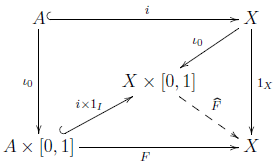
is commutative, where
 $F=i\circ H$
and
 $\iota _0(x)=(x,0)$
, for all
 $x$
. Note that the map
 $\widehat {F}_1\,:\,X\to X$
satisfies
 $\widehat {F}_1(a)=x_0$
, for any
 $a\in A$
. Then, we obtain a
 $G$
-map
 $h\,:\,X/A\to X$
given by
 $h(q(x)) \, :\! =\widehat {F}_1(x)$
, for any
 $x\in X$
. Hence,
 $h\circ q\simeq _G 1_X$
.
Furthermore, note that the
 $G$
-homotopy
 $\widehat {F}\,:\,X\times [0,1]\to X$
satisfies
 $\widehat {F}(a,t)\in A$
, for any
 $a\in A$
and any
 $t\in [0,1]$
. Then, we obtain a
 $G$
-homotopy
 $\varphi \,:\,X/A\times [0,1]\to X/A$
given by
 $\varphi (q(x),t) \, :\! =q(\widehat {F}(x,t))$
, for any
 $x\in X$
and
 $t\in [0,1]$
. Note that
 $\varphi _0=1_{X/A}$
and
 $\varphi _1=q\circ h$
, so
 $q\circ h\simeq _G 1_{X/A}$
.
Therefore,
 $q\,:\,X\to X/A$
is a
 $G$
-homotopy equivalence. By Proposition 2.5, we conclude that the equality
 $\text{cat}_G(X)=\text{cat}_G(X/A)$
holds. Furthermore, by Lemma 4.2(1), we have
 $\text{TC}_G(X/A)=\text{TC}_G(X)$
and
 $\text{TC}^G(X/A)=\text{TC}^G(X)$
.
Given
 $G$
-spaces
 $X$
and
 $Y$
with basepoints
 $x_0\in X^G$
and
 $y_0\in Y^G$
, recall that the wedge
 $X\vee Y$
is a
 $G$
-invariant and a
 $G\times G$
-invariant subset of
 $X\times X$
. Additionally, observe that
 $_{X\vee Y}\text{cat}_{G}(X\times Y)\leq _{X\vee Y}\text{cat}_{G\times G}(X\times Y)$
.
Now, we present the equivariant and invariant version of [Reference Dranishnikov8, Theorem 3.6, p. 4371].
Theorem 4.4.
Let
 $X$
and
 $Y$
be
 $G$
-spaces and
 $x_0\in X^G$
,
 $y_0\in Y^G$
be basepoints. Then, the wedge
 $X\vee Y$
satisfies the following inequalities:
 \begin{equation*}\max \{\text{TC}_G(X),\text{TC}_G(Y),\text{cat}_G(X\times Y)\}\leq \text{TC}_G(X\vee Y),\end{equation*}
and
 \begin{equation*}\max \{\text{TC}^G(X),\text{TC}^G(Y),_{X\vee Y}\text{cat}_{G\times G}(X\times Y)\}\leq \text{TC}^G(X\vee Y).\end{equation*}
Proof.
Recall that there are
 $G$
-retractions (
 $G\times G$
-retractions, respectively)
 $r_X\,:\,X\vee Y\to X$
and
 $r_Y\,:\,X\vee Y\to Y$
(see the proof of Proposition 3.3). Then, by Lemma 4.2(1), we have
 \begin{equation*}\max \{\text{TC}_G(X),\text{TC}_G(Y)\}\leq \text{TC}_G(X\vee Y)\end{equation*}
(and similarly,
 $\max \{\text{TC}^G(X),\text{TC}^G(Y)\}\leq \text{TC}^G(X\vee Y)$
, respectively).
On the other hand, observe that
 \begin{equation*} X\times Y\subset \left (X\vee Y\right )\times \left (X\vee Y\right ). \end{equation*}
-
(1) Given a
$G$
-invariant open set
$U\subset \left (X\vee Y\right )\times \left (X\vee Y\right )$
together with a
$G$
-map
$s\,:\,U\to \left (X\vee Y\right )^{[0,1]}$
such that
$e_2^{X\vee Y}\circ s(u)=u$
, for all
$u\in U$
. Consider the
$G$
-map
$H\,:\,U\times [0,1]\to X\vee Y$
, defined by
$H\left ((a,b),t\right ) \, :\! =s(a,b)(t)$
. Note that
$H\left ((a,b),0\right )=a$
and
$H\left ((a,b),1\right )=b$
.Now, let
$V \, :\! =U\cap \left (X\times Y\right )$
be a
$G$
-invariant open subset of
$X\times Y$
. Define the
$G$
-map
$F\,:\,V\times [0,1]\to X\times Y$
byfor all
\begin{equation*} F\left ((a,b),t\right ) \, :\! =\left (r_X\circ H\left ((a,b),t\right ),r_Y\circ H\left ((a,b),1-t\right )\right ), \end{equation*}
$(a,b)\in V$
and
$t\in [0,1]$
. Note that, for any
$(a,b)\in V$
, we haveThis shows that
\begin{equation*}F\left ((a,b),0\right )=(a,b) \quad \text{ and } \quad F\left ((a,b),1\right )=x_0(=y_0).\end{equation*}
$V$
is an open
$G$
-categorical set of
$X\times Y$
; so, we conclude that
\begin{equation*}\text{TC}_G(X\vee Y)\geq \text{cat}_G(X\times Y).\end{equation*}
Therefore, we obtain
\begin{equation*}\max \{\text{TC}_G(X),\text{TC}_G(Y),\text{cat}_G(X\times Y)\}\leq \text{TC}_G(X\vee Y).\end{equation*}
-
(2) Given a
$G\times G$
-invariant open set
$U\subset \left (X\vee Y\right )\times \left (X\vee Y\right )$
together with a
$G\times G$
-map
$s\,:\,U\to \left (X\vee Y\right )^{[0,1]}\times _{(X\vee Y)/G} \left (X\vee Y\right )^{[0,1]}$
such that
$p_{X\vee Y}\circ s(u)=u$
, for all
$u\in U$
, consider the coordinate maps
$\sigma ,\rho \,:\,U\to \left (X\vee Y\right )^{[0,1]}$
, such that
$s(u)=(\sigma (u),\rho (u))$
, for any
$u\in U$
. The fact that
$s$
is a
$G\times G$
-map implies thatfor any
\begin{equation*}\sigma (ga,hb)=g\sigma (a,b) \quad \text{ and } \quad \rho (ga,hb)=h\rho (a,b),\end{equation*}
$(g,h)\in G\times G$
and
$(a,b)\in U$
. Define the maps
$H, F\, : \,U\times [0,1]\to X\vee Y$
byNote the following:
\begin{equation*}H\left ((a,b),t\right ) \, :\! =\sigma (a,b)(t) \quad \text{ and } \quad F\left ((a,b),t\right ) \, :\! =\rho (a,b)(t).\end{equation*}
Observe that
\begin{align*} H\left ((a,b),0\right )&=a,\\ F\left ((a,b),1\right )&=b,\\ G\left ( H\left ((a,b),1\right )\right )&=G\left ( F\left ((a,b),0\right )\right ). \end{align*}
$V \, :\! =U\cap \left (X\times Y\right )$
is a
$G\times G$
-invariant open subset of
$X\times Y$
. Define the
$G\times G$
-map
$L\,:\,V\times [0,1]\to X\times Y$
byfor all
\begin{equation*} L\left ((a,b),t\right ) \, :\! =\left (r_X\circ H\left ((a,b),t\right ),r_Y\circ F\left ((a,b),1-t\right )\right ),\end{equation*}
$(a,b)\in V$
and
$t\in [0,1]$
. Note that for any
$(a,b)\in V$
, we haveThis shows that
\begin{equation*}L\left ((a,b),0\right )=(a,b) \quad \text{ and } \quad L_1\left (V\right )\subset X\vee Y.\end{equation*}
$\text{TC}^G(X\vee Y)\geq _{X\vee Y}\text{cat}_{G\times G}(X\times Y)$
. Therefore, we conclude
\begin{equation*}\max \{\text{TC}^G(X),\text{TC}^G(Y),_{X\vee Y}\text{cat}_{G\times G}(X\times Y)\}\leq \text{TC}^G(X\vee Y).\end{equation*}


As another application of Theorem3.4 together with Theorem4.4, we obtain the following statement, which is the equivariant and invariant case of [Reference Zapata19, Proposição 4.7.53, p. 177].
Theorem 4.5.
Let
 $X$
and
 $Y$
be
 $G$
-connected
 $G$
-CW-complexes such that
 $X^G\neq \varnothing$
and
 $Y^G\neq \varnothing$
. Suppose that
 $\text{cat}_G(X)\geq \text{cat}_G(Y)$
.
-
(1) If
$\text{TC}_G(X)=2\text{cat}_G(X)-1$
, then
Furthermore,
\begin{equation*}\text{TC}_G(X\vee Y)=\max \{\text{TC}_G(X),\text{TC}_G(Y),\text{cat}_G(X\times Y)\}=\text{TC}_G(X).\end{equation*}
$\text{TC}_G(X\vee Y)=2\text{cat}_G(X\vee Y)-1$
.
-
(2) If
$\text{TC}^G(X)=2\text{cat}_G(X)-1$
, then
Furthermore,
\begin{equation*}\text{TC}^G(X\vee Y)=\max \{\text{TC}^G(X),\text{TC}^G(Y),_{X\vee Y}\text{cat}_{G\times G}(X\times Y)\}=\text{TC}^G(X).\end{equation*}
$\text{TC}^G(X\vee Y)=2\text{cat}_G(X\vee Y)-1$
.


Proof.
By Lemma 4.2(2), we know that
 $\text{TC}_G(X\vee Y)\leq 2\text{cat}_G(X\vee Y)-1$
. Then, by Theorem3.4, we conclude that
 \begin{equation*}\text{TC}_G(X\vee Y)\leq 2\text{cat}_G(X)-1\end{equation*}
(using the hypotheses
 $\text{cat}_G(X)\geq \text{cat}_G(Y)$
).
-
(1) Since
$\text{TC}_G(X)=2\text{cat}_G(X)-1$
, by Theorem4.4, we obtainFurthermore, the equality
\begin{equation*}\text{TC}_G(X\vee Y)=\max \{\text{TC}_G(X),\text{TC}_G(Y),\text{cat}_G(X\times Y)\}=\text{TC}_G(X).\end{equation*}
$\text{TC}_G(X\vee Y)=2\text{cat}_G(X\vee Y)-1$
holds.
-
(2) Since
$\text{TC}^G(X)=2\text{cat}_G(X)-1$
, by Theorem4.4, we obtainFurthermore, the equality
\begin{equation*}\text{TC}^G(X\vee Y)=\max \{\text{TC}^G(X),\text{TC}^G(Y),_{X\vee Y}\text{cat}_{G\times G}(X\times Y)\}=\text{TC}^G(X).\end{equation*}
$\text{TC}^G(X\vee Y)=2\text{cat}_G(X\vee Y)-1$
holds.


Theorem4.5 implies the following proposition.
Proposition 4.6.
Let
 $X$
be a
 $G$
-connected
 $G$
-CW-complex such that
 $X^G\neq \varnothing$
, and
 $k\geq 1$
be an integer.
-
(1) If
$\text{TC}_G(X)=2\text{cat}_G(X)-1$
, then
\begin{equation*}\text{TC}_G(\underbrace {X\vee \cdots \vee X}_{k \text{ times }})=\text{TC}_G(X).\end{equation*}
-
(2) If
$\text{TC}^G(X)=2\text{cat}_G(X)-1$
, then
\begin{equation*}\text{TC}^G(\underbrace {X\vee \cdots \vee X}_{k \text{ times }})=\text{TC}^G(X).\end{equation*}


We present the following example. For completeness, let us first recall that for
 $n\geq 2$
,
 $S^n$
is the
 $n$
-sphere with the group
 $\mathbb{Z}_2$
acting by reflection, given by multiplication by
 $-1$
in the last coordinate. We have
 $\left (S^{n}\right )^{\mathbb{Z}_2}=S^{n-1}$
, and
 $\text{TC}_{\mathbb{Z}_2}(S^n)=2\text{cat}_{\mathbb{Z}_2}(S^n)-1=3$
, as shown in [Reference Colman and Grant5, Example 5.9, p. 2311]. On the other hand,
 \begin{equation*}\text{TC}^{\mathbb{Z}_2}(S^n)=\begin{cases} 2,& \hbox{ if $n$ is even,}\\ 3,& \hbox{ if $n$ is odd,}\\ \end{cases} \end{equation*}
as shown in [Reference Lubawski and Marzantowicz14, Example 4.2, p. 115]. Also, given integers
 $n_1,\ldots ,n_k\geq 1$
with
 $k\geq 2$
, we have
 $\text{TC}\left (S^{n_1}\vee \cdots \vee S^{n_k}\right )=3$
, as shown in [Reference Zapata19, Proposição 4.7.50, p. 176].
Example 4.7.
Let
 $n_1,\ldots ,n_k\geq 2$
be integers.
-
(1) By Theorem 4.5 (1), we obtain
\begin{equation*}\text{TC}_{\mathbb{Z}_2}\left (S^{n_1}\vee \cdots \vee S^{n_k}\right )=3.\end{equation*}
-
(2) Suppose that
$k\geq 2$
. By Lemma 4.2(3),
(using the fact that
\begin{equation*}\text{TC}^{\mathbb{Z}_2}\left (S^{n_1}\vee \cdots \vee S^{n_k}\right )\geq \text{TC}\left (S^{n_1-1}\vee \cdots \vee S^{n_k-1}\right )=3\end{equation*}
$(X\vee Y)^G=X^G\vee Y^G$
). On the other hand, by Lemma 4.2(2) together with Theorem
3.4
, we obtain
Therefore,
\begin{equation*}\text{TC}^{\mathbb{Z}_2}\left (S^{n_1}\vee \cdots \vee S^{n_k}\right )\leq 2\text{cat}_{\mathbb{Z}_2}\left (S^{n_1}\vee \cdots \vee S^{n_k}\right )-1=3.\end{equation*}
$\text{TC}^{\mathbb{Z}_2}\left (S^{n_1}\vee \cdots \vee S^{n_k}\right )=3$
.


Example 4.8.
Let
 $X$
be a
 $\mathbb{Z}_2$
-connected
 $\mathbb{Z}_2$
-CW-complex such that
 $X^{\mathbb{Z}_2}\neq \varnothing$
and
 $\text{cat}_{\mathbb{Z}_2}(X)\geq 2$
. Recall that
 $2=\text{cat}_{\mathbb{Z}_2}(S^n)$
.
-
(1) Suppose that
$\text{TC}_{\mathbb{Z}_2}(X)=2\text{cat}_{\mathbb{Z}_2}(X)-1$
. Then, by Theorem
4.5
(1), we obtain
\begin{equation*}\text{TC}_{\mathbb{Z}_2}(X\vee S^n)=\max \{\text{TC}_{\mathbb{Z}_2}(X),\text{TC}_{\mathbb{Z}_2}(S^n),\text{cat}_{\mathbb{Z}_2}(X\times S^n)\}=\text{TC}_{\mathbb{Z}_2}(X).\end{equation*}
-
(2) Suppose that
$\text{TC}^{\mathbb{Z}_2}(X)=2\text{cat}_{\mathbb{Z}_2}(X)-1$
. Then, by Theorem
4.5
(2), we obtain
\begin{equation*}\text{TC}^{\mathbb{Z}_2}(X\vee S^n)=\max \{\text{TC}^{\mathbb{Z}_2}(X),\text{TC}^{\mathbb{Z}_2}(S^n),_{X\vee S^n}\text{cat}_{\mathbb{Z}_2\times \mathbb{Z}_2}(X\times S^n)\}=\text{TC}^{\mathbb{Z}_2}(X).\end{equation*}


From the first part of Theorem3.7 together with Theorem4.5, we have the following example. Note that, given a pair
 $(X,A)$
of
 $G$
-CW-complexes, the inclusion map
 $A\hookrightarrow X$
is a
 $G$
-cofibration.
Example 4.9.
Let
 $(X,A)$
be a pair of
 $G$
-CW-complexes. If the inclusion map
 $i\,:\,A\hookrightarrow X$
is
 $G$
-homotopic to a constant map
 $\overline {x_0}\,:\,A\to X$
, for some
 $x_0\in X^G$
, then, by Theorem
3.7
, we have that
 $X/A$
is
 $G$
-homotopic to the wedge
 $X\vee S A$
, where
 $A\times \{0\}$
is the basepoint of
 $S A$
and
 $x_0$
is the base point of
 $X$
. Hence, by Lemma 4.2(1), we have
 $\text{TC}_G(X/A)=\text{TC}_G(X\vee S A)$
, and
 $\text{TC}^G(X/A)=\text{TC}^G(X\vee S A)$
. In addition, suppose that
 $X$
and
 $S A$
are
 $G$
-connected such that
 $\text{cat}_G(X)\geq 2$
. Recall that
 $\text{cat}_G(S A)\leq 2$
(see Example 2.3). By Theorem
4.5
, we obtain the following equalities:
-
(1) If
$\text{TC}_G(X)=2\text{cat}_G(X)-1$
, then
\begin{equation*}\text{TC}_G(X/A)=\text{TC}_G(X).\end{equation*}
-
(2) If
$\text{TC}^G(X)=2\text{cat}_G(X)-1$
, then
\begin{equation*}\text{TC}^G(X/A)=\text{TC}^G(X).\end{equation*}


From the proof of Theorem3.12, we obtain the following example.
Example 4.10.
Let
 $X$
be a pointed
 $G$
-space, and let
 $S^k$
be the
 $k$
-dimensional sphere (
 $k\geq 0$
) with the trivial action of
 $G$
. By the first part of the proof of Theorem
3.12
, there exists a
 $G$
-equivariant homeomorphism between
 $X\wedge S^k$
and the iterated reduced suspension
 $\Sigma ^k X$
for each
 $k\geq 0$
. Here,
 $\Sigma ^0 X=X$
. Hence, by Lemma 4.2(1), we have
 \begin{equation*}\text{TC}_G(X\wedge S^k)=\text{TC}_G(\Sigma ^k X) \quad \text{ and } \quad \text{TC}^G(X\wedge S^k)=\text{TC}^G(\Sigma ^k X).\end{equation*}
Recall that
 $\text{cat}_G(\Sigma ^k X)\leq 2$
for any
 $k\geq 1$
. Additionally, suppose that
 $X$
is a
 $G$
-CW-complex. By Lemma 4.2(2), we have
 \begin{equation*}\max \{\text{TC}_G(X\wedge S^k),\text{TC}^G(X\wedge S^k)\}\leq 3,\end{equation*}
for any
 $k\geq 1$
.
We end this article with the following remark.
Remark 4.11.
Motivated by Theorem
4.4
and Theorem
4.5
, we conjecture that the following statement holds: Given
 $G$
-connected
 $G$
-CW-complexes
 $X$
and
 $Y$
with
 $X^G\neq \varnothing$
and
 $Y^G\neq \varnothing$
, then:
 \begin{align*} \text{TC}_G(X\vee Y)&=\max \{\text{TC}_G(X),\text{TC}_G(Y),\text{cat}_G(X\times Y)\}, \\ \text{TC}^G(X\vee Y)&=\max \{\text{TC}^G(X),\text{TC}^G(Y),_{X\vee Y}\text{cat}_{G\times G}(X\times Y)\}. \end{align*}
This conjecture, in the nonequivariant case, was proved in [Reference Dranishnikov and Sadykov9, Theorem 6, p. 409] under more restrictive hypotheses.
Acknowledgements
The first author would like to thank grant #2023/16525-7, #2022/16695-7, #2018/23678-6, and #2016/18714-8, São Paulo Research Foundation (FAPESP). The second author would like to thank grant #2022/16455-6, São Paulo Research Foundation (FAPESP).


