Introduction
Packing is not swallowing (i.e., mouth clean) food or liquid that is in the mouth past a specified duration, typically 30 s. Packing can result from both skill and motivational problems (for discussion, see Gulotta, Piazza, Patel, & Layer, Reference Gulotta, Piazza, Patel and Layer2005). Skill refers to experience or practice, coordination, strength, and physical and structural oral components all involved with swallowing varied consistencies and textures of foods and liquids. Motivational aspects are mealtime environmental and behavioural factors such as avoidance and escape from eating and drinking. Packing hinders food and liquid consumption and is significant mealtime behaviour to treat.
Interventions for packing have been developed and evaluated in a few specialised behaviour–analytic paediatric feeding hospital-based programmes in the United States (for reviews of this literature, see Kozlowski, Taylor, González, & Girolami, Reference Kozlowski, Taylor, González, Girolami, Matson and Matson2015; Volkert, Patel, & Peterson, Reference Volkert, Patel, Peterson and Luiselli2016). One such intervention for packing is called redistribution. This procedure involves recollecting the food in the mouth and placing it onto the tongue. It was originally created using a NUK® infant gum brush. The experimenters used the brush to collect lower texture blended food from the mouth and roll the food bolus onto the mid-tongue in place for swallowing (Gulotta et al., Reference Gulotta, Piazza, Patel and Layer2005; Sevin, Gulotta, Sierp, Rosica, & Miller, Reference Sevin, Gulotta, Sierp, Rosica and Miller2002). This brush redistribution procedure stemmed from swallow induction (or facilitation) and was initially done on the posterior tongue (Hoch, Babbitt, Coe, Ducan, & Trusty, Reference Hoch, Babbitt, Coe, Ducan and Trusty1995). Redistribution was later performed using a flipped spoon procedure rather than the brush, by flipping the spoon upside down (180°) onto the tongue to deposit the food bolus (Volkert, Vaz, Piazza, Frese, & Barnett, Reference Volkert, Vaz, Piazza, Frese and Barnett2011).
A variety of less intrusive interventions are available for packing, such as fading, differential reinforcement, lowering food texture, and chasers (solid or liquid that the child readily accepts and swallows). Lowering food texture can decrease packing. This can be an alternative avenue for children who have faltering growth/failure to thrive and are at risk for tube placement, particularly in different programme service structures where consumption may be unable to be increased rapidly. Another option is increasing cup drinking of formula, particularly if the child is unable to consume large volumes of regular texture efficiently to meet their nutritional needs or has food variety limitations such as food allergies.
To our knowledge, one potential intervention component for packing used in clinical practice has not been evaluated in the literature thus far. This component has been referred to as ‘move-on’ and involves moving on to the next bite presentation for a specified number of bites, typically 3–5, rather than waiting for the child to swallow one bite at a time and checking the mouth periodically, typically every 30 s, until swallowing (i.e., clean mouth) occurs. This procedure has been mentioned in the literature and used in clinical practice in terms of a ‘pack rule’ or maximum number of bites to deposit. To our knowledge, two studies have referred to the use of a move-on component or procedure for packing. Stubbs, Volkert, Rubio, and Ottinger (Reference Stubbs, Volkert, Rubio and Ottinger2018) described using a move-on component to attempt to address packing. However, they reported that it did not improve mouth clean or decrease packing, and evaluated further treatment components (flipped spoon presentation and redistribution). For a child with packing, Kadey, Piazza, Rivas, and Zeleny (Reference Kadey, Piazza, Rivas and Zeleny2013) also described using move-on as a general procedure during texture and single-food assessments, so that packing did not result in bite avoidance.
Move-on is already commonly used clinically in assessment and treatment (Kadey et al., Reference Kadey, Piazza, Rivas and Zeleny2013; Stubbs et al., Reference Stubbs, Volkert, Rubio and Ottinger2018) and may be a general procedure used as part of a treatment evaluation prior to packing emerging. Move-on may be considered as a less invasive option than, for example, redistribution. For children without skill or swallowing deficits or medical complications, move-on may also have advantages compared with reducing food texture in being more age-appropriate and normative, and less labour and time intensive (Vaz et al., Reference Vaz, Piazza, Stewart, Volkert, Groff and Patel2012), and allowing the child to use chewing skills.
For participants without the chewing skill deficits, oral motor issues, or dysphasia/swallowing issues described in the packing treatment literature (see Volkert et al., Reference Volkert, Patel, Peterson and Luiselli2016), the hypothesised maintaining function of inappropriate mealtime behaviour and mechanism of behaviour change for a move-on component is motivational in nature, that is, negative reinforcement or escape/avoidance (see Gulotta et al., Reference Gulotta, Piazza, Patel and Layer2005). The move-on component may serve as escape extinction by interrupting packing such that it no longer results in delaying or escaping subsequent bite presentations. A child may be motivated to swallow to avoid the feeder placing more food in the mouth. Use of a move-on procedure may result in varied volumes and varieties of food in the mouth in each bite presentation, impacting response effort for swallowing bite to bite. The move-on component may share mechanisms as discussed with the use of chasers for packing (for a detailed discussion, see Levin, Volkert, & Piazza, Reference Levin, Volkert and Piazza2014; Vaz et al., Reference Vaz, Piazza, Stewart, Volkert, Groff and Patel2012) or interspersal (for both food texture and food preference level). For example, if a lower texture or more preferred bite is deposited due to move-on, swallowing and thus consumption may increase.
The purpose of the current case history report was to evaluate the effectiveness of a move-on component added as part of a treatment package to increase consumption and decrease latency to swallowing (clean mouth). This report also extends the packing literature because it was done in a home setting in Australia with regular texture for a participant without skill deficits or swallowing issues.
Methods
Participant, Setting, and Materials
Aurélia was a 5-year-old Asian Australian female with autism spectrum disorder (level 3), avoidant/restrictive food intake disorder (ARFID), food selectivity, low height/weight (growth impairment), constipation, toothbrushing refusal, medication refusal, baby bottle dependence (mixture of regular, soy, and almond milk with fibre and fish oil before bedtime), history of formula dependence (6 months prior to the feeding programme), and mild eczema. She did not eat any vegetables. Her diet primarily consisted of plain starches such as plain soup/noodles, rice, bread, and McDonald's fries. She might inconsistently and infrequently eat small amounts of a few certain proteins and fruits as a nonself-feeder with large edible rewards and significant effort from the feeder. Banana was the only fruit she would self-feed. Aurélia did not drink enough water (preferred juice instead). She would go all day at school without drinking any water. Aurélia did not eat enough volume of food other than highly preferred plain starches and snack/dessert/‘junk’ foods. She would only self-feed highly preferred items like ice cream, so was primarily fed as a nonself-feeder. She packed food and would put too much food in her mouth and expel (spit out) or have emesis (vomit). She could chew apple, but would expel the pulp. Aurélia did not early swallow (swallow food whole without adequate chewing). She took a daily multivitamin. Aurélia used an electronic communication device and said a few single words, was toilet trained, and walked. She had sleep issues. Family socioeconomic status was high (informally based on income, education, and employment status).
Aurélia received nearly 2 years of ineffective feeding treatment attempts including behavioural strategies such as positive reinforcement with edibles and tangibles, demand fading, and choice. She received early intensive behavioural intervention, speech therapy, occupational therapy, and physiotherapy. Aurélia's therapy providers did not report oral motor or chewing deficits. Her schedule was cleared/paused during this feeding programme, so that no other therapies were occurring. Her physician filled out a form to clear and approve participation. This form included information concerning growth, food allergy (diagnosed, suspected, intolerances, immediate family history, exposure and reaction details for specific common allergen-risk foods, and testing), gastrointestinal symptoms, comprehensive review of all systems, relevant testing results and referrals needed such as endoscopy, swallow study, acid probe, and bloodwork, and referrals needed to specialists including gastroenterologist, immunologist, dietitian, and speech pathologist. A comprehensive intake was conducted including record review, comprehensive caregiver forms and interview, diet record, and meal observation. Aurélia did not have mealtime skill deficits, and ate regular texture food and could chew, use utensils, and drink from a cup. No drooling, lip control, tongue control, biting, sucking, swallowing, chewing, or aspiration concerns were noted.
A doctoral-level behaviour analyst conducted sessions in a bedroom in-home equipped with seating (Rifton® Activity Chair), dining room table and chairs, laptop computers for data collection, webcam, digital scale, timers, preferred tangible items including toys, colouring, and electronics, and meal-related materials including adaptive shallow bowl maroon spoons, rubber-coated tip metal infant spoons, small child's plates and bowls, Sammons Preston rubber massage infant gum brush similar to a NUK® brush as described and pictured in Rubio, Borrero, and Taylor (Reference Rubio, Borrero and Taylor2015), gloves, smocks, infant finger gum brush/guard, absorbent pads for emesis, and cleaning supplies. Later full plate meals were conducted in the dining room at the table in-home and at a café for a family meal and generalisation. The first author trained a data assistant/observer in operational definitions, data collection and entry, Excel, BDataPro, weighing grams, and food preparation, and the assistant/observer was present.
Response Measurement, Interobserver Agreement, and Procedural Integrity
An observer recorded participant and feeder behaviours live while seated in the room. Observers used Excel for the preference assessments and laptop computers using a specialised real-time data collection programme called BDataPro (Bullock, Fisher, & Hagopian, Reference Bullock, Fisher and Hagopian2017). We measured variables only while the demand to eat was in place during bite presentation and before swallowing. Frequency keys included: clean mouth (product measure of swallowing at anytime; after the entire bite entered the mouth no food larger than the size of a pea was in the mouth at checks unless the absence of food was due to expulsion); inappropriate mealtime behaviour (45° or further head turn, touch of feeder's arm below elbow, push bite/plate away, or mouth cover during spoon presentation); and expulsion (food larger than the size of pea passed plane of lips after deposit). We scored duration keys by activating/deactivating a timer to count seconds for latency to clean mouth and negative vocalisations (crying, screaming, whining, negative statements about the food/liquid/meal with a 3 s offset (deactivated when ceased for 3 s)). Latency to clean mouth was the amount of time elapsed between the entire bite entering the mouth (acceptance) and when the mouth was clear of all food (clean mouth). Packing has been previously defined as not swallowing (i.e., mouth clean; converse of packing) within a certain timeframe (i.e., typically 30 s, although this varies depending on the texture and bolus size and individual chewing skills).
We calculated percentage clean mouth by dividing the frequency of clean mouth by 4 (number of programmed bite presentations for the session) and multiplying by 100 to convert to a percentage to provide an overall measure of consumption of food (i.e., percentage of bites consumed out of total number of bites set for the session). We divided latency duration by the frequency of occurrence to get latency per bite. We divided negative vocalisation duration by session duration within demand and converted to a percentage. We converted other frequencies to responses per minute (RPM) by dividing by session duration within demand (during bite presentation and before swallowing; not including contingent access breaks). We took pictures of meal plates consumed and weighed grams consumed on a kitchen scale. Goals of the programme (n = 10) were to accept within 5 s, chew and swallow within 45 s, decrease inappropriate mealtime behaviour to less than 1 RPM, decrease negative vocalisations to less than 20% of the meal, train caregivers to less than 1 incorrect RPM, generalise, increase variety to eight new separate foods across food groups, increase self-feeding to 75%, increase self-drinking of water in an open cup to 75% of drinks, and increase liquid volume.
We assessed interobserver agreement (reliability) for 33% of sessions across phases and conditions by having an independent observer who collect data using videoed sessions. We calculated proportional agreement using BDataPro (Bullock et al., Reference Bullock, Fisher and Hagopian2017). We separated sessions into 10-s intervals and calculated agreement between the two observers for each interval. If both observers scored the same frequency or duration of a response within the interval, we scored this as 100% agreement. If one observer scored a response and the other observer did not, we scored this as 0% agreement. If both observers scored a response within the same 10-s interval, but at different frequencies or durations, we divided the smaller number by the larger number and multiplied by 100 to determine the percentage agreement. We then averaged the percentages across intervals to determine interobserver agreement for each session. The mean agreement was 98% for clean mouth (range 78−100%), 99% for expulsion (range 94−100%), 96% for inappropriate mealtime behaviour (range 83−100%), 96% for latency to clean mouth (range 75−100%), and 95% (range 67−100%) for negative vocalisations.
We assessed procedural integrity during 100% of sessions. Using BDataPro as a frequency key, observers scored incorrect procedural integrity if the feeder refrained from implementing each procedure (praise, prompting, physical guidance, and tangible delivery) within plus or minus 3 s of when it was programmed to be implemented, and implemented procedures when they were not programmed to be implemented (incorrect attention, bite removal, and tangible delivery). Mean incorrect procedural integrity was low at 0.02 RPM (range 0–0.67 RPM) and mean interobserver agreement for procedural integrity was 100%.
Experimental Design
We used a withdrawal/reversal single-case experimental design to demonstrate experimental control. We used an ABCDEAE design where A was baseline escape and noncontingent access (music), B added differential attention and contingent access, C was differential attention and contingent access plus nonremoval of the spoon and re-presentation of expulsions, D added the finger prompt and side deposit, and E added move-on. We calculated the mean baseline percentage of change (i.e., percent reduction) as a measure of effect size using the average of the final three sessions of treatment using this formula: ((baseline − treatment)/baseline) × 100 as described by Taylor, Blampied, and Roglić (Reference Taylor, Blampied and Roglić2020).
Procedure
Procedures were similar to those described by Taylor (Reference Taylor2018). A doctoral-level behaviour analyst conducted sessions for approximately 7 h a day. We finished the treatment evaluation presented in this case history in 3 days. We then moved to full plate meals and gradually faded hours as caregiver training progressed. The full feeding programme was 13 days in total with 1 Sunday off and 2 half-days. The number of sessions conducted per day varied. We ran as many sessions per day as possible with breaks in between to analyse and enter data, collect weights in grams, take plate pictures, conduct food preparation and clean-up, setup, talk with and train caregivers, take toilet trips, take notes, and write protocols. Aurélia did not consume foods during the programme day in between sessions. From Day 1 to Day 3, we conducted 22, 26, and 23 sessions, respectively. The average session duration was 4.8 min (range 1–10.3 min) and totalled 341.3 min for the entire treatment evaluation.
We initially targeted eight regular texture foods from nonstarch food groups. Aurélia did not consume nominated by parents: chicken, yogurt, cheese, cauliflower, cucumber, kiwi fruit, blueberry, and apple. We included some previously and inconsistently consumed foods and variations of consumed foods. We increased the number of sessions and variety gradually after high and stable consumption. Food presentation was randomly varied within and between sessions. Supplementary Material provides the full food list. Bolus size was a level small maroon spoon (approximately 1 g) and 1 cm2 bites. Sessions were four programmed bites (one from each food group), and no new bite presentations were presented after 10 min. Bolus size and programmed bites per session remained unchanged throughout this treatment evaluation.
We preloaded the spoon and placed it on a small child's plate presenting bites in a self-feeder format for the initial presentation. We presented bites approximately every 30 s by placing the preloaded spoon and plate on the tray in front of Aurélia and verbally prompting her to ‘Take a bite’. We conducted clean mouth checks every 30 s by verbally prompting Aurélia to ‘show me ah’. If Aurélia did not open her mouth, we modelled an open mouth with the verbal prompt and gently touched her chin with the tip of our index finger. If Aurélia still did not open, we gently touched a flipped (180°) rubber-coated tip metal infant spoon to her lips along with the verbal and model prompts. If Aurélia was packing when the timecap (maximum session duration) elapsed, the feeder removed the bite from her mouth (using a rubber-coated tip metal infant spoon) prior to starting another session.
We conducted paired-stimulus tangible and edible preference assessment sessions before treatment using procedures similar to those described by Fisher et al. (Reference Fisher, Piazza, Bowman, Hagopian, Owens and Slevin1992) and Kunkel, Kozlowski, Taylor, and González (Reference Kunkel, Kozlowski, Taylor and González2018). Tangibles were a variety of reserved items informed by parents. We discontinued the edible assessment due to high avoidance and zero approach or consumption responses.
Treatment conditions
In baseline escape, we played preferred music (continuous noncontingent access). If Aurélia did not accept the bite within 5 s, we picked up the spoon and held it stationary approximately 2 cm from her lips until Aurélia opened her mouth and allowed us to deposit the bite, 30 s elapsed, or she engaged in inappropriate mealtime behaviour or expulsion, whereby we removed the bite from the tray and provided escape from bite presentations for 30 s. If a bite was accepted, we conducted a mouth clean check every 30 s until clean mouth or the timecap elapsed.
In contingent access and differential attention, sessions were identical to the previous phase with the following changes. If Aurélia accepted the bite or had a clean mouth at anytime, we provided descriptive praise (‘Great job taking your bite!’ and ‘Great job swallowing your bite!’) and interaction. Upon clean mouth, we provided 30-s access to highly preferred items.
For nonremoval and re-presentation, sessions were identical to the previous phase with the following changes. We no longer provided escape contingent on inappropriate mealtime behaviour and expulsion (e.g., Hoch, Babbitt, Coe, Krell, & Hackbert, Reference Hoch, Babbitt, Coe, Krell and Hackbert1994; Kerwin, Ahearn, Eicher, & Burd, Reference Kerwin, Ahearn, Eicher and Burd1995). If she did not accept the bite within 5 s, we did hand-over-hand (placed our hand over Aurélia's hand with the spoon or bite) and guided the spoon to her upper lip. We followed her mouth with the spoon if she turned her head, and we blocked disruptions and mouth covering. We kept the bite at her upper lip until acceptance or the timecap elapsed. If she opened her mouth at anytime, we inserted the spoon with the exception of gags, coughs, yawns, or emesis (vomiting), following which the bite was placed only after those responses ceased. We scooped up expulsions and re-presented the bite immediately, but if the bite could not be re-presented due to simultaneous expulsion and emesis, we re-presented a new fresh bite of the same food.
Due to nonacceptance (not opening the mouth; teeth/lip clenching), for finger prompt and side deposit, sessions were identical to the previous phase with the following changes. If Aurélia did not accept the bite, after 10 s of presentation (5 s after hand-over-hand), we implemented a finger prompt by inserting our index finger between the cheek and the upper gumline until reaching the back of the mouth and held it stationary until she opened to accept the bite or 5 s elapsed (Borrero, Schlereth, Rubio, & Taylor, Reference Borrero, Schlereth, Rubio and Taylor2013). We did not place any additional pressure and it was still possible for Aurélia to keep her mouth closed (i.e., clench teeth) and refuse to accept the bite. We used the finger from our free hand that was not holding the spoon. Our outer finger and fingernail faced her inner cheek, and the inside of our finger faced her upper teeth and gums. We wore purple nitrile powder-free latex-free gloves and trimmed fingernails shorter than the fingertip. After 15 s of bite presentation (5 s after finger prompt), we implemented a side deposit (Rubio et al., Reference Rubio, Borrero and Taylor2015). For regular texture bites, we used our fingers to manually deposit the bite into the cheek in the space created with the finger prompt (Taylor, Reference Taylor2020b). For lower textures (Rubio et al., Reference Rubio, Borrero and Taylor2015), we transferred the bolus to an infant gum brush keeping the utensils as close to the mouth as possible. Simultaneous with the finger prompt, we then used the infant gum brush to roll the bolus of food onto Aurélia's tongue (if she opened her mouth) or onto the inside of her cheek (if her mouth was not open) by gently shifting the straightened finger (i.e., finger prompt) away from the gumline horizontally to create space for the infant gum brush to be inserted and rolling the infant gum brush towards the cheek and away from the gumline. We re-presented expulsions immediately using the side deposit procedure. In the last session of this phase, we removed continuous noncontingent access to preferred music.
For move-on, sessions were identical to the previous phase with the following changes. Rather than waiting for a clean mouth to present the next bite, we moved on to presenting the next bite at 30 s (maximum of four bites). However, if Aurélia was chewing at 30 s, we waited an additional 30 s before moving on. Outside of the move-on phase, the feeder did not move on to the next bite when food was in Aurélia's mouth in any of the other phases. In the last phase of the treatment evaluation (move-on replication), we presented all four bites on the plate at once (rather than in single-bite presentations) and provided tangible contingent access at the end of session when all four bites on the plate were consumed (fixed ratio 4).
Social validity, training, generalisation, and maintenance
At programme end, we gave parents a written discharge questionnaire (Likert-type scale from 1 to 5) to assess satisfaction (23 items similar to Hoch et al., Reference Hoch, Babbitt, Coe, Krell and Hackbert1994; Table 1) and social acceptability of treatment (16 items similar to the Intervention Rating Profile by Martens, Witt, Elliott, & Darveaux, Reference Martens, Witt, Elliott and Darveaux1985). We computed averages (total summed score divided by the number of items) for each parent (mother and father). We conducted intensive caregiver behavioural skills training and generalisation (cutlery/crockery, seating, and settings) as described by Taylor (Reference Taylor2018) with Aurélia's mother and father, and conducted a family meal at a café with both parents and her sister. We trained school staff on a free access meal protocol. For follow-up for 1-month postdischarge, we asked Aurélia's parents to rotate through her food list and record mealtime data on a shared electronic spreadsheet, take pictures of mealtime plates, and video meals.
Results
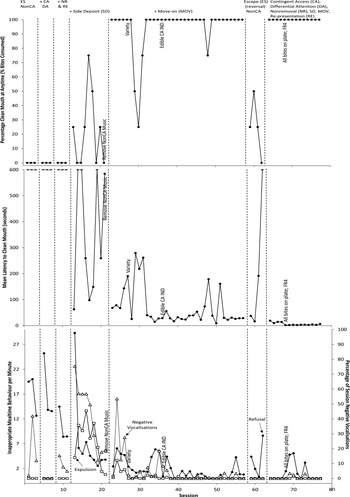
Results of the treatment evaluation are displayed in Figure 1 including latency to clean mouth, percentage of consumption, and inappropriate mealtime behaviour.
Latency to clean mouth in seconds (top panel) and percentage of consumption (clean mouth at anytime/swallowing; middle panel); inappropriate mealtime behaviour (refusal, expulsion, negative vocalisations; bottom panel). For latency to clean mouth/swallowing, horizontal line data markers indicate reaching the session timecap with no bites consumed.

Consumption was stable at 0% (with high refusal M = 15.1 RPM) in the first three phases with baseline escape, contingent access and differential attention, and nonremoval and re-presentation. Due to zero acceptance or consumption and not opening her mouth (sealed lips and clinched teeth), we added the finger prompt and side deposit. Aurélia consumed a bite in the first session (less than 10 min) with the side deposit. However, consumption remained low and variable (M = 22%), she was only consuming lower texture bites (yogurt) and certain foods (e.g., cheese), expulsions were high (M = 7.3 RPM), but decreased towards the end of this phase, and Aurélia started packing (not chewing or swallowing; bite in cheek; latency to clean mouth M = 325 s; reached all timecaps without consuming all the bites). There was also a burst of negative vocalisations and refusal that decreased towards the end of this phase. When the move-on to the next bite component was added, consumption increased to 100% and latency to clean mouth decreased to M = 70 s (less than 30 s for the six sessions before the reversal). Aurélia finished all four bites with move-on within the first sessions in 6.5 min and was at stable 100% consumption within 2 h of treatment. Aurélia started taking some bites independently (acceptance following the verbal prompt without any physical assistance such as hand-over-hand) and chewing appropriately.
We started increasing variety once consumption was high and stable at 100% on Day 2 starting session 23. Aurélia started self-feeding more foods independently and inappropriate mealtime behaviour decreased. At session 32, we changed the criteria to earn the small piece of preferred edible piece of contingent access to independent acceptance, and inappropriate mealtime behaviour remained low for the rest of the phase. During the reversal to baseline, Aurélia kept consuming some foods, but latency to clean mouth increased to 192 s, then consumption decreased to 0% and refusal increased to 8.6 RPM. In session 54, she swallowed one bite in 37 s and refused the other bite presentations. In session 55, she swallowed two bites in 32 s and refused the other bite presentations. When treatment was re-implemented, consumption increased to 100%, latency to clean mouth was low at M = 14 s with no packing, and all inappropriate mealtime behaviour was stable at zero and independence was high (reaching for bites to take them before they were presented). When we changed to all bites on the plate and contingent access after all bites were consumed, latency to clean mouth was low at M = 9 s, consumption was 100%, and inappropriate mealtime behaviour had decreased to 0 for the last four sessions. Independence was high, duration was low, and she was chewing appropriately even with raw vegetables such as celery and capsicum.
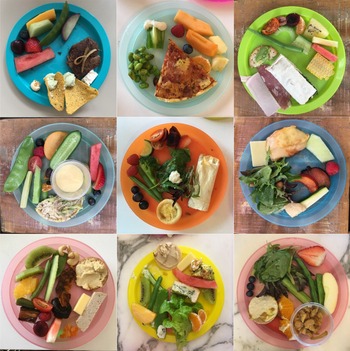
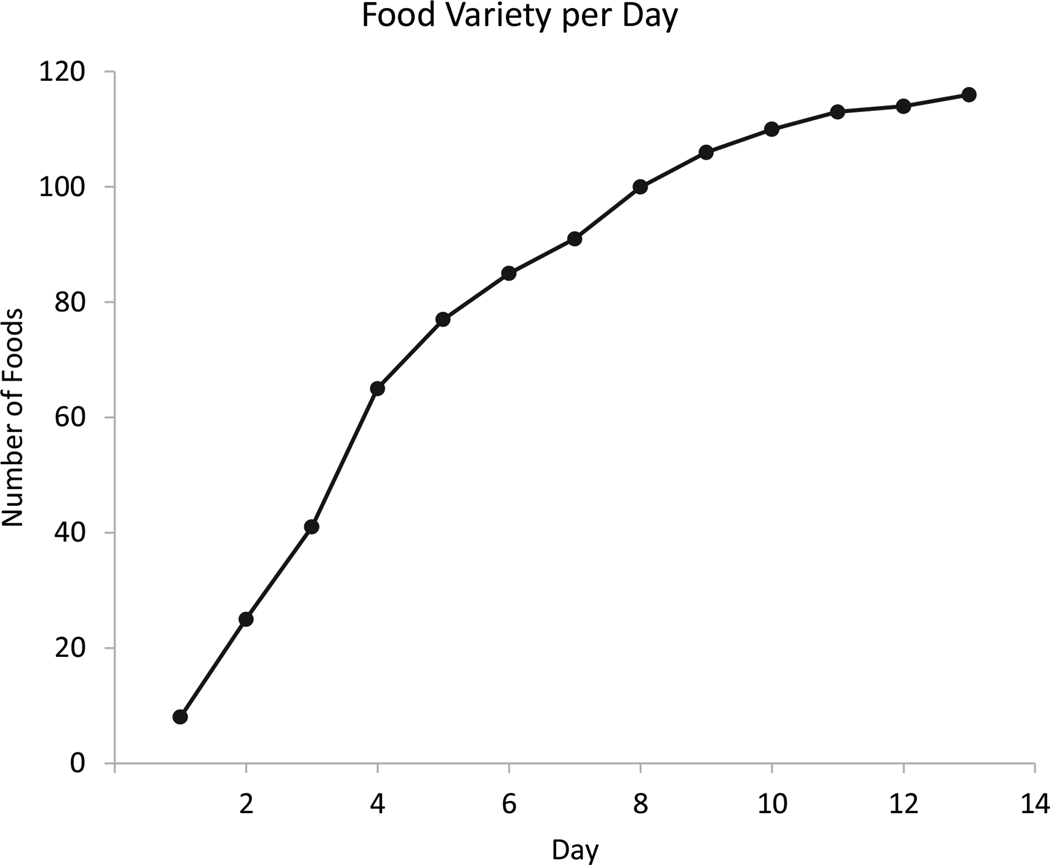
Aurélia met 100% of admission goals. Upon discharge, Aurélia was consuming volumes in meals up to 182 g of solids and 186 g of liquids. Figure 2 provides example plate pictures of full plate meals consumed. She was consuming 100% of the eight novel foods introduced across food groups on the first day of treatment (within 2 h). By the end of this treatment evaluation (Day 3), her variety was at 41 foods. Figure 3 depicts Aurélia's food variety per day of the programme. Upon discharge, Aurélia's food variety increased to 116 foods (29 proteins, 9 starches, 26 vegetables, 24 fruits, 25 combination foods, and 3 other foods) at regular texture (full list available in Supplementary Material). Aurélia also increased independence in self-feeding and consumption of water from an open cup. Aurélia's growth was impaired prior to the programme, but during the programme per observation and parental report, she gained weight. As a measure of effect size of the treatment, there was a 100% increase in consumption, a 96% decrease in latency to clean mouth, and a 100% decrease in inappropriate mealtime behaviour. Her mother and father (respectively) reported high acceptability of the treatment (4.81, 5 out of 5) and satisfaction (4.68, 5 out of 5). Aurélia's mother wrote in the comments that they were extremely satisfied with the outcome and could not be happier. One month postdischarge, Aurélia's consumption was high and stable at 100% for all meals (n = 113) and average meal duration was 22 min. Overall meals were rated high at an average of 5.2 out of 6.
Example pictures of mealtime plates that were consumed in entirety (100% consumption; clean plate).

Food variety per day.

During full plate meals with regular portions (rather than precut-up bites), we had to make additional modifications due to increased latency to mouth clean and decreased consumption. This included interspersing drink presentations, infant rubber-coated spoon and infant gum brush redistribution (Gulotta et al., Reference Gulotta, Piazza, Patel and Layer2005; Sevin et al., Reference Sevin, Gulotta, Sierp, Rosica and Miller2002), and interspersal/rotation of foods based on preference and texture (requiring rotating through different foods rather than allowing her to independently choose what bites to take or eat all of a portion/texture; i.e., vegetables first, then fruits, then proteins, then starches last; reserving soft mashable fruits, and foods throughout). Redistribution was not used for the last 34 sessions (last 7 days of the programme) and consumption was high and stable at 100%. Postdischarge with caregivers, brush redistribution was used only one time in one meal early on (the 6th meal out of 113 meals).
Discussion
In a 2-week in-home programme, Aurélia met all of her goals, reaching over 100 foods across food groups at regular texture, self-feeding, and drinking water from a cup. Both parents were trained and reported high social validity. We generalised to family meal in a café and gains maintained to 1 month. We demonstrated experimental control, and presented permanent product (plate pictures), reliability, and procedural integrity data.
This treatment evaluation was brief (3 days and less than 6 h of session duration) and used a single-case experimental design to evaluate multiple components within a complex feeding intervention. This report evaluated a move-on procedure commonly used in clinical practice, but not yet evaluated in the literature. This is important and needed because there may be cases where move-on may be: effective but not published; ineffective thus requiring additional more complex procedures; included unnecessarily as a general procedure; or included as a general procedure and preventative of packing, but not evaluated separately. In this case report, when the move-on to the next bite component was added to the treatment package, latency to clean mouth (packing) decreased and consumption increased from 0 to 100%. Before move-on was added, in the side deposit phase, response covariation was observed (Sevin et al., Reference Sevin, Gulotta, Sierp, Rosica and Miller2002). In the side deposit phase, latency to acceptance decreased, then refusal, negative vocalisations, and expulsion decreased, while latency to clean mouth increased and consumption remained low (0–25%). However, further procedures were required in full plate meals.
Careful consultation, assessment, planning, and expertise are needed for food texture (see discussion in Taylor, Reference Taylor2020a) and bite size prior to implementing a move-on component. This move-on component may be contraindicated for children with oral motor skills or swallowing deficits or aspiration concerns. Compared with some other participants described in the packing treatment literature (see Volkert et al., Reference Volkert, Patel, Peterson and Luiselli2016), Aurélia did not have significant chewing skill deficits, oral motor issues, or dysphasia/swallowing issues. Thus, the hypothesised maintaining function and mechanism of behaviour change was negative reinforcement or escape/avoidance rather than skill-based in nature (see Gulotta et al., Reference Gulotta, Piazza, Patel and Layer2005). We did not initially include foods that require more response effort to chew such as raw carrot or celery and less tender meats. It is notable that Aurélia was not observed to swallow food whole without chewing (i.e., early swallows, Volkert, Piazza, Vaz, & Frese, Reference Volkert, Piazza, Vaz and Frese2013; Volkert, Peterson, Zeleny, & Piazza, Reference Volkert, Peterson, Zeleny and Piazza2014). Programmed sessions were four bites, so a four-bite maximum rule (‘pack rule’) was in place. Other authors (e.g., Stubbs et al., Reference Stubbs, Volkert, Rubio and Ottinger2018) have also described this and is used in clinical practice particularly in full plate meals (rather than single-bite presentation sessions with precut bite sizes). For Aurélia in full plate meals, due to packing (high latency to mouth clean impacting consumption), she required additional treatment components including redistribution and interspersal. We have also observed this in clinical practice as meal demands increase including variety, texture, and portions, and during caregiver training. For Aurélia, redistribution frequency decreased significantly in the programme (zero in the last 7 days), and it was not used for the last 107 meals parents fed in the month postdischarge.
We added move-on to a treatment package that included a side deposit procedure with one lower texture food, yogurt. The side deposit procedure with lower texture deposited on the tongue is a modified bolus placement method that can decrease packing (Milnes, Piazza, Ibañez, & Kozisek, Reference Milnes, Piazza, Ibañez and Kozisek2019; Volkert et al., Reference Volkert, Sharp, Clark, Ormand, Rubio, McCracken and Bryan2019). However, we evaluated side deposit alone first and move-on was still needed due to high latency to clean mouth. Also, Aurélia was consuming a regular texture food (cheese) during this side deposit phase prior to move-on, and all but one of the eight foods initially used were bite-sized rather than naturally lower texture. Another limitation is the use of the side deposit procedure with regular texture for children who tend to pack food in the cheek position. We used an intrusive procedure for nonacceptance (not opening the mouth so that no bites were deposited) prior to the less intrusive move-on procedure which was used for packing. Future research could evaluate the move-on component without the side deposit procedure included, as well as separately for lower versus regular textured foods.
We did not assess treatment acceptability separately for each component of this treatment package or alternative options such as reducing variety, bite size, or volume or other packing treatments such as a chaser (Taylor, Reference Taylor2021). Future research could look at social validity for packing treatment options such as move-on compared with reducing food texture, as well as other additional treatment avenues, before and after treatment outcome is evaluated.
It is important to specify that a least restrictive approach must be taken, exhausting less intrusive procedures first if possible, and in careful consideration of severity and impact of the feeding problem, child complexity, time to effectiveness, appropriate intensity of treatment services, and the necessity of high competency and expertise of the provider (González, Mulderink, & Girolami, Reference González, Mulderink, Girolami, Maragakis and O'Donohue2018; Piazza, Milnes, & Shalev, Reference Piazza, Milnes, Shalev, Roane, Ringdahl and Falcomata2015; Rubio, McMahon, & Volkert, Reference Rubio, McMahon and Volkert2020; Taylor, Reference Taylor2020c; Taylor & Taylor, Reference Taylor and Taylor2021). The author of this report, a doctoral-level behaviour analyst with over 5 years of feeding training at the hospital where these procedures originated, with over 10 years of sole feeding experience, personally implemented this intervention (Rubio et al., Reference Rubio, McMahon and Volkert2020). No injury occurred, safety procedures were in place, and we assessed social validity and procedural integrity and decreased use and necessity over time (Rubio et al., Reference Rubio, McMahon and Volkert2020). Aurélia had multiple lengthy failed treatment attempts including behavioural strategies such as positive reinforcement, and we systematically evaluated less intrusive interventions such as differential attention, differential reinforcement, and noncontingent reinforcement in the treatment evaluation prior to extinction-based procedures. This programme does involve a resource-intensive approach, requiring consecutive days for a couple of weeks dedicated to feeding as well as high clinician expertise; thus, it may not be applicable or generalisable in general clinical practice.
Several limitations were present. We did not conduct a component analysis to demonstrate the effectiveness of the move-on component alone as it was evaluated as part of a treatment package. We only presented one data point for removal of the continuous noncontingent access to music; however, this did not seem to be significant or have an impact on mealtime behaviour. Prior treatment phases were brief (less than 1 day). Food variety used in sessions varied; however, bolus size and number of bites per session remained consistent, this tested the treatment for a wide variety of foods, increased variety occurred prior to the reversal, and the original eight foods remained in the variety throughout the treatment evaluation (i.e., these foods were not discontinued and continued to be presented). A dietitian did not prescribe the foods used; however, we introduced a wide variety of foods across food groups in a brief time frame, and Aurélia did not have any dietary restrictions. It is recommended to consult with a dietitian, especially if there are food allergies or intolerances, blood sugar issues, nutritional deficiencies, absorption issues, formula dependence, faltering growth/failure to thrive, or cultural, religious, or family dietary restrictions or considerations. Due to the multifactorial and complex nature of feeding disorders, an interdisciplinary evaluation with the necessary feeding expertise is recommended prior to treatment (gastroenterologist for endoscopies, immunologist for food allergy testing, speech pathologist for swallow studies, Friman & Piazza, Reference Friman, Piazza, Fisher, Piazza and Roane2011; Taylor & Taylor, Reference Taylor and Taylor2021; Yeung et al., Reference Yeung, Taylor, Scheimann, Carvalho, Reinhardt, Girolami and Wood2015). Aurélia's physician approved and cleared her participation, she did not have medical or motor concerns, and she had a range of therapy providers including speech and occupational therapists involved in her care.
Additional limitations included not conducting a functional analysis. Consistent with prior functional analysis and treatment literature in paediatric feeding, escape was hypothesised to maintain refusal, and attention and tangible interventions attempted prior to escape extinction were ineffective. We did not analyse factors impacting packing such as variety, texture, or bite size (Rivero & Borrero, Reference Rivero and Borrero2019), but this was a brief clinical case in-home and move-on was effective. We did not formally obtain child assent, but bite size and number and session duration caps were small so changes could be made rapidly; noncontingent access, positive reinforcement, demand fading, frequent breaks, safety procedures, physician clearance, and parental consent were in place; and feeding disorders are detrimental to health and multiple areas of functioning such that progress must be made rapidly due to significant risk (for Aurélia, growth impairment, constipation, toothbrushing and medication refusal, dehydration, baby bottle dependence, and nutritional deficiencies). Expulsion may impact latency to clean mouth, and we did present these data. We did not present data on packing (absence of mouth clean at 30 s). Latency to clean mouth may be impacted by feeder behaviour such as efficiency with mouth clean checks, and it may be difficult to determine the exact moment the mouth is clear of food. Aurélia began opening her mouth independently to show a clean mouth before checks on the second day of treatment. The follow-up duration was short-term (1 month). Future research should examine long-term follow-up. We did not present observational follow-up data; however, we did collect caregiver data, permanent product data (plate pictures), and mealtime videos of caregiver-fed meals although we did not formally score them. Replication is needed for more cases as this is only one, and more research with additional participants is needed to determine parameters impacting the effectiveness of this component.
Supplementary material
The supplementary material for this article can be found at https://doi.org/10.1017/bec.2021.17.
Conflicts of interest
The author reports no conflicts of interest.
Ethical standards
Caregivers provided written informed consent. This case history was conducted in the context of a treatment evaluation for a clinical case where progress monitoring and data indicated that additional procedures were needed and is a retrospective report of existing non-identifiable data. Participant name was changed to protect confidentiality. This study was performed in accordance with ethical standards laid out in the 1964 Declaration of Helsinki and its later amendments and the American Psychological Association (APA) ethical standards in the treatment of humans.