Health rationing due to budgetary constraints has raised seemingly unsolved issues internationally (Reference Abel-Smith and Mossialos1). To promote cost containment, healthcare managements use various measures directed toward increasing resources or reducing demand for service (Reference Abel-Smith and Mossialos1;Reference Harrison, Moran, Albrecht, Fitzpatrick and Scrimshaw11). Implementation of these measures almost invariably involves physicians, who are accountable for a large proportion of the total healthcare expenditures. Attempts to modify physicians' conduct come in various forms, all well documented in the literature (3,14). Intervention goals include changing physicians' attitudes and knowledge by educational means, changing physicians' behavior by limiting utilization or enforcing second-opinion procedures, and providing incentives to save through physician-targeted rewards or sanctions. While some strategies have proven to be more efficient than others, interdisciplinary approaches incorporating multiple strategies appear to be most effective in creating prolonged behavioral change (Reference Fishman, Mandell, Bennet and Dolin7;Reference Lowet and Eisenberg16).
These transformations and the ensuing reactions have imposed unfamiliar strains on physicians. Demands to economize are countered by consumer pressures for greater accountability and better value for money. Cost consciousness likewise appears to contradict traditional ethical standards that obligate physicians to consider only their patients' best interests; economic considerations thus appear to counter their primary mission and to induce some physicians to violate what they consider to be management-imposed unethical guidelines (Reference Lowet and Eisenberg16;Reference Wynia, Cummins, VanGeest and Wilson22). In addition, the introduction of changes in medical practice by nonphysician managers sometimes triggers antagonism among physicians sensitive to issues of professional autonomy (Reference Corbun and Willis4;Reference Hillman12).
Given these escalating pressures and their effect on physicians' job satisfaction (Reference Edwards, Kornacki and Silverstein5), it is somewhat surprising to note the paucity of studies directed at profiling physicians' attitudes regarding cost containment. One of the few large-scale surveys conducted demonstrated substantial objection to cost-cutting methods among U.S. physicians; respondents reported that changes in the system had diminished their undivided loyalty to their patients while reducing patients' trust in physicians (Reference Sulmasy, Bloche, Mitchell and Hadley20). Israeli physicians and Israel's healthcare system—respected throughout industrial countries (21)—confront similar strains due to medicine's new face. The study reported here attempted to explore the physicians' perceptions with respect to these dilemmas and to identify the factors that affect physicians' cost consciousness. For this purpose, a wide range of attitudes and behaviors were surveyed and their relationships explored.
METHODS
Participants and Procedure
A sample of 1,545 physicians was randomly selected from the Ministry of Health's register of all physicians under 65 (a total of 23,380 physicians). Before mailing the questionnaire, a “refuse to participate” postcard was sent (143 physicians refused to participate). The remainder received the questionnaire together with a prepaid, self-addressed return envelope. Ten days later, a written reminder was mailed; 3 weeks later, the questionnaire was resent to physicians who had failed to return their questionnaire by that date. Four weeks later, the physicians received telephone reminders and were offered the option of participating in a telephone interview or receiving another copy of the written questionnaire. The whole process took place between November 2001 and March 2002.
At the procedure's conclusion, 456 physicians were eliminated (406 due to erroneous addresses and phone numbers, 21 no longer practiced medicine, 22 were abroad, and 7 had passed away) from the initial sample of 1,545 physicians, which was reduced to 1,089. (The seemingly high proportion of erroneous addresses and phone numbers is not implausible in light of our reliance on the Ministry of Health's register. The register relies on details supplied by physicians close to receipt of their license to practice medicine. That the list is infrequently updated is a barrier to research.) From this sample, 552 physicians (50.7 percent) ultimately participated in the survey. Among the respondents in the final sample, 67 percent (370/552) were men; average age was 46 (SD = 8.48), 85 percent (469/552) were 31–54 years of age; the main countries of origin were Israel (39 percent [215/552] and the former Soviet Union (31 percent [171/552]; Israel absorbed more than one million immigrants from the former Soviet Union between the years 1989 and 1999. This group of immigrants, which represents approximately a sixth of Israel's current population, included approximately 7,300 physicians below 65 years of age [see reference 13]); 30 percent (166/552) were employed solely by community-based health maintenance organization (HMOs), 30 percent (166/552) solely by hospitals, 26 percent (144/552) by both, and 14 percent (77/552) by neither (the major place of employment being private clinics); 69 percent (381/552) were specialists (including Family Medicine), 14 percent (77/552) nonspecialist general practitioners, and 17 percent (94/552) residents; 31 percent (171/552) of all respondents held a managerial position (i.e., they exercised some degree of managerial responsibility usually combined with clinical responsibilities).
To assess the sample's representativeness, we compared the sample's demographic characteristics with data on the entire population of Israel's physicians as published by Israel's Ministry of Health (17). This comparison yielded close similarity for most variables (e.g., gender, age, and medical specialty), excluding two variables that are apparently related. The first referred to country of origin: 39 percent (215/552) of the respondents were born in Israel as compared to 26 percent (6,188/23,800) in the general population of physicians. The second difference was specialization: 69 percent (381/552) of the survey's respondents were specialists, compared to 41 percent (9,758/23,800) in the general population of physicians. This gap is largely attributed to the relatively high proportion 84 percent (14,794/17,612) of nonspecialist general practitioners among immigrant physicians, whose relatively low response rates may be explained by language difficulties. Apart from these differences, all other comparisons yielded acceptable results. Another test performed compared the early (i.e., physicians who responded on the first mailing; n = 349) and late (n = 203) respondents' demographic characteristics and responses to major substantive items. The only significant difference was related to country of origin. Immigrants were found again to be somewhat underrepresented (56 percent of the early respondents were immigrants compared with 66 percent of the late respondents). However, no significant differences were found between the early and late respondents with respect to the substantive questions. These results indicate that the bias did not compromise the external validity of the attitudes, knowledge, and conduct reported for the sample as a whole.
Questionnaire
The questionnaire consisted of 55 items, constructed on the basis of the literature in addition to exploratory open-ended interviews conducted with physicians and managers in Israel's healthcare system. Several pretests were conducted before completion of the final version, which contained four sections: (i) extent of cost consciousness in daily practice and perception of locus of responsibility for economic decision making; (ii) general attitudes toward cost containment (the respondents were asked to indicate how much they agreed with statements such as, “economic considerations compromise patients' health” or “economic considerations facilitate better utilization of resources”); (iii) familiarity with the costs of medical resources (e.g., in-patient bed days, computed tomography [CT] scans and prevalent antibiotic drugs); and (iv) selected demographic variables. Likert-type scale responses were requested for the items in sections (1–3).
RESULTS
Cost Consciousness in Daily Practice
The physicians were asked to what extent they take economic criteria into consideration in their daily practice. Forty-two percent (230/548) reported a large to a great extent and another 45 percent (247/548) reported a moderate level of economic decision making; only 1 percent (5/548) stated that they completely ignore economic considerations.
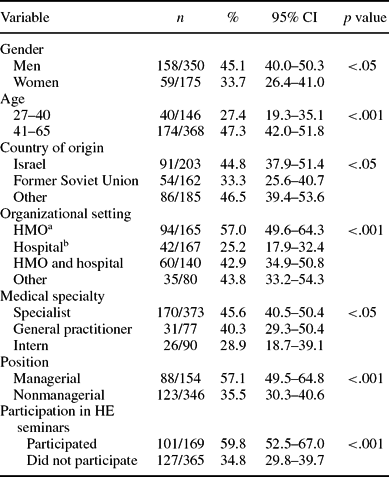
Univariate analyses of the responses revealed several significant differences between the sample's subgroups (Table 1). The most noticeable differences appeared between age groups, HMO physicians and hospital physicians, physicians holding a managerial position and those who do not, and physicians who participated in health economics (HE) seminars as opposed to those who did not.
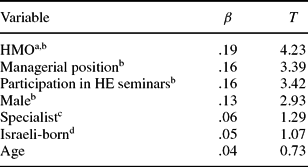
A simultaneous multiple regression analysis was performed to ascertain the relative contribution of the demographic variables to physicians' cost consciousness. As seen in Table 2, four variables were found to contribute significantly to cost consciousness, which we list in descending order of their contribution: employment by an HMO, holding a managerial position, participation in HE seminars, and gender, with male physicians reporting greater cost consciousness than female physicians.
Demographic Variables Associated with Physicians' Cost Consciousness

Note. Values are numbers, percentages, and 95% confidence intervals (CI) of physicians reporting large to great extent of cost consciousness. Some respondents did not answer all questions. The subscripts a and b indicate a difference significant at p < .01.
HMO = health maintenance organization; HE = health economics.
Simultaneous Multiple Regression Analysis of Factors Affecting Physicians' Cost Consciousness
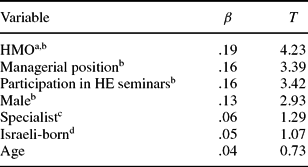
Note. R 2=.15, p < .01.
a Versus physicians working in hospitals, hospitals and HMOs, and other.
b p < .01.
c Versus general practitioners and residents.
d Versus immigrant physicians.
HMO, health maintenance organization; HE, health economics.
The participants in the survey were also asked to compare the level of their current cost consciousness relative to 5 years ago. Seventy percent (374/520) reported an increase in cost consciousness compared to the past, whereas only 1 percent (5/520) reported a decrease in that level.
Perception of the Locus of Responsibility for Economic Decision Making
The physicians were asked about the degree to which they perceive economic decision-making as an element of their roles. Among the respondents, 39 percent (203/521) agreed that economic decision making was within the framework of the physician's role to a large or great extent; an additional 44 percent (229/521) agreed to a moderate extent. A minority (5 percent [26/521]) indicated that such issues were completely foreign to a physician's duties and rejected the idea. When asked about the degree to which economic decision making was inherent in management's role, 83 percent (432/523) expressed a large or great extent of agreement.
Attitudes Toward Cost Containment
The physicians were presented with a series of statements regarding various aspects and implications of cost containment. (The reported percentages in this and in the next section refer to physicians who indicated a large or great extent of agreement with the associated statement.) Eighty-one percent (445/547) of the respondents indicated that integration of cost containment measures into the healthcare system would facilitate better utilization of resources. Seventy-six percent (418/551) acknowledged the legitimacy of institutional demands that physicians contain costs. Furthermore, 60 percent (330/547) agreed that oversight of physicians' work would promote saving. On the other hand, only one-third (33 percent [183/552]) of the respondents indicated that it was legitimate to offer financial incentives to physicians to encourage saving. A large majority (85 percent (467/548) agreed with the statement that the best way to increase saving was to practice “right” medicine. (“Right” medicine is a recently formulated concept, used in the Israeli healthcare system to define the role of the individual physician regarding cost-containment practices. It is based on the paradigm modeling right medicine, ie, the wisdom to render a compassionate, patient-oriented medical care, based on scientific evidence and in accord with desired clinical routines, as being inevitably economical by markedly reducing inappropriate utilization of resources.) Only 11 percent (59/547) indicated that expensive medicine necessarily meant better medicine.
Obstacles to Achievement of Cost Containment
To achieve cost containment, impediments must be confronted. Based on the literature and the interviews conducted, we formulated a series of statements regarding possible obstacles to application of cost containment measures. The physicians were asked to respond accordingly.
Approximately two-thirds (65 percent (361/552) of the physicians reported that apprehension regarding malpractice lawsuits was restraining their cost containment efforts. Approximately half (51 percent [283/551]) indicated that economic considerations would reduce patient satisfaction with care received whereas 45 percent (246/551) indicated that they might harm patient health, albeit only 18 percent (99/547) indicated that physicians should approve every patient request regardless of the economic implications.
Apart from apprehensions related to the physician–patient relationship, other barriers were mentioned as well. Approximately two-thirds (64 percent [351/546]) of the respondents indicated that physicians lack sufficient awareness of economic issues. Half (51 percent [280/547]) perceived a contradiction between their professional autonomy and their organization policies guided by economic considerations. Finally, 38 percent (203/540) indicated that cost containment would compromise their earnings.
Attitudinal Correlates
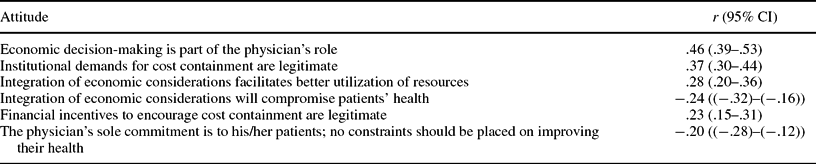
In an attempt to identify the attitudes that endorse cost-containment behavior, we calculated the correlation between the attitudes expressed by the respondents and the level of cost consciousness reported. As seen in Table 3, economic considerations were strongly correlated with the attitude that economic decision making was part of the physician's role, and that cost containment measures facilitate better utilization of existing resources. As far as implementation is concerned, economic decision making was correlated with the perceived legitimacy of institutional demands for cost containment and weaker objections to financial incentives as motivations for saving. Perceived potential hazards to patient health appear to be inversely correlated with endorsement of cost consciousness.
Correlations between Physicians' Attitudes and Self-Reported Level of Cost Consciousness
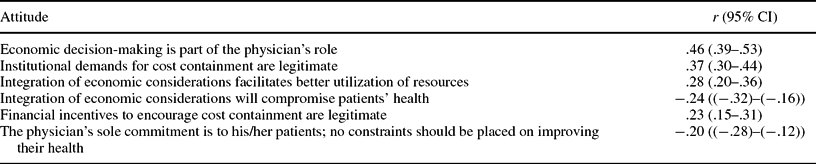
Note. The table presents only absolute correlations equal to or above .20 (all significant at p < .001).
CI, confidence interval.
Knowledge of Costs
One manifestation of economic decision making is knowledge of resource costs. To explore this issue, the survey's participants were asked whether they were familiar with the cost to their organization of nine frequently used medical resources (responses were given on a three-point scale: full knowledge of exact cost, approximate knowledge of cost, and no knowledge of cost. The list items: cardiac isotopic scans, laboratory exams, X-rays, CT scans, and magnetic resonance imaging scans, frequently prescribed drugs, frequently prescribed antibiotics, expert referrals, emergency room [ER] visits, and in-patient bed days.). The physicians were quite familiar with the costs of in-patient bed days and ER visits (56 percent [291/519] reported full knowledge for both items). In contrast, relatively little awareness of the cost of expert referrals, laboratory tests, and cardiac scans was reported (full knowledge of the costs of these items ranged between 17 percent and 28 percent (88–145/519). The respondents reported knowing the exact cost of 2.72 resources on average, yet 58 percent (301/519) knew the cost of no more than two resources. Knowledge of costs was positively correlated with the level of cost consciousness exercised in daily practice (r s(518) = .30; p < .001).
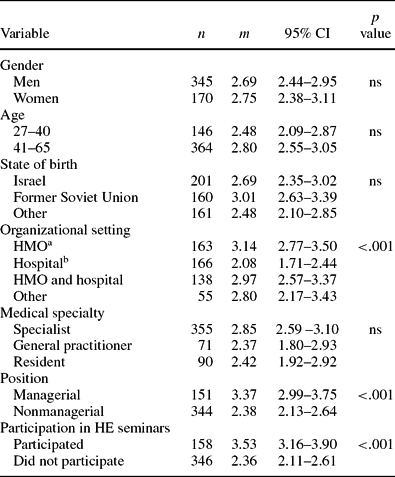
Univariate analyses were performed to identify the demographic characteristics associated with knowledge of exact costs. The results (Table 4) indicated a significant effect for physicians' organizational affiliation: HMO physicians (m = 3.14) reported knowing the costs of more resources than did hospital physicians (m = 2.08). Physicians holding a managerial position (m = 3.37) reported greater knowledge when compared with physicians in nonmanagerial positions (m = 2.38), and physicians who participated in health economics seminars (m = 3.53) reported greater knowledge when compared with physicians who had not participated in such seminars (m = 2.36).
Variables Associated with Physicians' Knowledge of Resource Costs
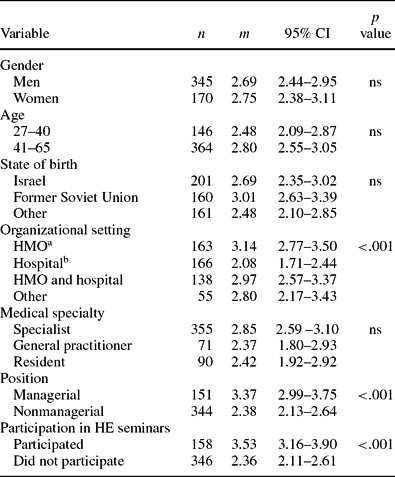
Note. Values are mean number of resources, and 95% confidence interval. The superscripts a and b indicate a difference significant at p < .01. Some respondents did not answer all questions.
HMO, health maintenance organization; HE, health economics; CI, confidence interval; ns, not significant.
DISCUSSION
This study revealed a rather pragmatic approach toward cost containment among Israeli physicians. Most reported increasing levels of cost consciousness in their practice over recent years, legitimized management demands for cost containment, and believed it could improve resource utilization. It appears that the traditional association of economic measures with suboptimal medicine is no longer considered straightforward and that an alternative “right” or evidence-based medicine can combine cost-effectiveness with excellence.
Yet, the emerging picture is still characterized by considerable physician reluctance to perceive economic decision making as vital to fulfilling their responsibilities. This attitude's high correlation with application of economic decision making in practice calls for special attention. Only a minority perceived economic decision making as an aspect of the physician's role, compared with more than 80 percent who attributed such thinking to management. This position might result from the physicians' sense of helplessness regarding their ability to affect healthcare costs, as was expressed by primary care trainees in the United States (Reference Skootsky, Slavin and Wilkes19). Still, a more plausible explanation appears rooted in the physicians' perception of the boundaries of their profession, which they view as confined to purely clinical activities. The increasing salience of economic considerations in shaping contemporary medicine may nevertheless prove this “encapsulation strategy” to be a double-edged sword. Recent studies have shown that the general population perceives physicians to be the most suitable advocates for their patients in the conflict between clinical practice and economic constraints (Reference Mossialos and King18). Therefore, because refusal to incorporate economic decision-making within the physician's role not only “invites” greater nonmedical intervention on the micro as well as macro level, and hence decline the physician's advocacy capacities, patient trust in their own physicians and the public healthcare system as a whole may ultimately be undermined.
Some of the other apprehensions mentioned add to our understanding of the physicians' attitudes. Approximately half saw a contradiction between their professional autonomy and cost-cutting healthcare policies, and approximately two-thirds expressed concern about malpractice suits. These attitudes appear to reflect physicians' anxieties that proponents of economic medicine are compelling them to implement a policy that undermines their professional status while depriving them of the formal backing needed to contend with some of the potential consequences.
In light of these considerations, we conclude that an additional aspect of the identified predictors of cost consciousness (e.g., employment in an HMO or participation in HE seminars) points to the weight of organizational culture in shaping physicians' on-the-job behavior. Previous studies have demonstrated the relative success of interdisciplinary approaches in creating effective intervention strategies (Reference Lowet and Eisenberg16;Reference Wynia, Cummins, VanGeest and Wilson22). The current study's added value thus lies in stressing the need for congruence among the messages conveyed to physicians by their myriad work circles (managers and colleagues in the work setting, instructors in professional seminars, government, media, patient organizations, and so on). Such agreement may positively impact on the ability to devise a compact between physicians and their environments that is more appropriate to the current exigencies. In the process, it may help physicians regain satisfaction with the practice of their calling (Reference Edwards, Kornacki and Silverstein5).
In contrast to this elaborate approach, some organizations rely on financial incentives as the sole (and often blatant) measure to promote saving, resulting in strong physician antagonism (2;10;13;15;20). Our findings corroborate the prevalence of this response. We conclude that extreme caution is required when introducing any intervention containing such incentives.
Despite that knowledge of costs was self-reported in the present study, the findings agree with those of previous studies (which relied on objective measures) in demonstrating relatively low levels of cost-related knowledge among physicians (Reference Ernst, Kelly and Hoenhs6;Reference Fowkes8). Two-thirds of the respondents in our study agreed with the statement that physicians lack sufficient awareness of economic issues. It thus appears that physicians are not overly confident about their knowledge of healthcare costs and wish to be better informed on the issue. In light of the relationship between attitudes, knowledge, and behavior, educational interventions meant to elaborate physicians' understanding of health economy issues are required and wanted (Reference Greene, Goldberg and Beattie9).
The current study has several shortcomings that should be acknowledged. First, our sample was characterized by under-representation of newly immigrant physicians, a group constituting a substantial minority of Israel's practitioners. Although the literature indicates that immigrants eventually assimilate pervasive attitudes, our current results are somewhat less applicable to this population and invite further study. Another shortcoming rests on the limitations of self-reported data, which affect the validity of the results regarding cost containment behavior and knowledge of costs. Notwithstanding this caveat, the findings do provide information about the physician's idiosyncratic approach to cost containment, input that is crucial for preintervention purposes when strategies of intervention need to be formulated.
CONCLUSION
Inducing change in healthcare systems is not a trivial task. This study focused on one aspect of this complex endeavor and demonstrated—above all—the wide range of factors shaping physicians' behavior. The participants in the study expressed pragmatic faith in the feasibility of combining cost consciousness with quality through “right” medicine alongside fears and reluctance to adopt economic decision making in daily practice. In addition to the attitudes expressed, we were able to confirm the salience of several other variables that we had hypothesized as contributing to cost consciousness, such as knowledge of costs, managerial status, and organizational setting, with the last two especially viewed as representing the influence of organizational culture. The myriad of variables suggests that, to achieve on-going change, a comprehensive approach is mandatory.
CONTACT INFORMATION
Rachel Wilf-Miron, MD, MPH (Rachel_m@mac.org.il), Director, Quality Management, Maccabi Healthcare Services, 27 Hamered Street, Tel-Aviv 68125, Israel; School of Public Health, Sackler School of Medicine, Tel-Aviv University, Ramat-Aviv 69978, Israel
Liad Uziel, PhD (liaduziel@gmail.com), Graduate Student, School of Business Administration, The Hebrew University of Jerusalem, Mt. Scopus, Jerusalem 91905, Israel
Alexander Aviram, MD (Aviram@israelhpr.health.gov.il), Clinical Associate Professor (Ret.), Faculty of Medicine, Tel-Aviv University, Tel-Aviv 69978, Israel; Scientific Director, Israel National Institute for Health Policy Research, Sheba Medical Center, Tel- Hashomer 62521, Israel
Abraham Carmeli, PhD (avraham@pilat.co.il), Chief, Department of Research & Evaluation, Pilat Management Consulting, 9 Habarzel Street, Tel-Aviv 69710, Israel
Mordechai Shani, MD (mshani@post.tau.ac.ili), Full Professor & Director, School of Public Health, Tel-Aviv University, Ramat-Aviv P.O.B 39040, Tel-Aviv 69978, Israel; Director, Israeli Center for Health Technology, Sackler School of Medicine, Assessment in Health Care (ICTAHC), The Gertner Institute for Epidemiology and Health Policy Research, Sheba Medical Center, Tel-Hashomer 52621, Israel
Joshua Shemer, MD (shukis@gertner.health.gov.il), Full Professor, Department of Internal Medicine, Tel-Aviv University, Ramat Aviv 69978, Israel; Director, Sackler Faculty of Medicine, Israeli Center for Health Technology, Assessment in Health Care (ICTAHC), The Gertner Institute for Epidemiology and Health Policy Research, Sheba Medical Center, Tel-Hashomer 52621, Israel
The authors thank Mrs. Nina Hakak, Information Specialist, for her tremendous assistance in the search for research tools and other relevant information. This study was supported by a grant from the Israel National Institute for Health Policy and Health Services Research. Grant number 1998/001/A. The funding source had no role in the writing of the manuscript or the decision to submit it for publication. None of the authors has been or will be paid to write this article by any company or agency.