Introduction
There is no universal definition of loneliness, although it is generally described as a perceived deprivation of social contact, the lack of people available or willing to share social and emotional experiences, a state where an individual has the potential to interact with others but is not doing so, or as a discrepancy between the actual and desired interaction and intimacy with others.Reference Victor, Scambler, Bond and Bowling1, Reference Gierveld2 While loneliness describes the subjective feeling of living in the absence of social contacts or support (e.g. living with companionship, feeling a valued and supported member of a friendship group or community), it can be contrasted with objective social isolation, which describes the actual number of people in a person's social structure.Reference Weiss3 This differentiation is widely recognized both in sociological and psychological literature, although the relation between the two concepts and the probable effects of each in health and well-being is not clear.
Loneliness is seen to involve the manner in which the person perceives, experiences, and evaluates his or her isolation and lack of communication with other people. According to GierveldReference Gierveld4 there would be several cognitive processes that mediate between characteristics of the social network and the experience of loneliness. Several recent investigations show that it is the respondent's evaluation of their relationship rather than the number of social contacts in a person's social network that is important.Reference Victor, Scambler, Bond and Bowling1, Reference Routasalo, Savikko, Tilvis, Standberg and Pitkala5 This assumption may explain several research findings such as that reported by Walker and MaltbyReference Walker and Maltby6 on the percentage of older people who often feel lonely in European countries, which ranged from 5% in Denmark to 32% in Portugal or 36% in Greece. According to these authors, Northern countries, including the UK, showed a lower rate of loneliness than Mediterranean countries, despite lower levels of social contact and a higher percentage of old people living alone.
In a meta-analysis of research findings on the influences of loneliness in older adults, Pinquart and SorensenReference Pinquart and Sorensen7 concluded that 5–15% of older adults report frequent loneliness. They found a U-shaped association between age and loneliness where quality rather than quantity of social network is correlated more strongly with loneliness. Friends and neighbours seem more effective in dealing with loneliness than family members. Gender (being a woman), having low socioeconomic status and low competence, and living in nursing homes were also associated with higher loneliness.
The prevalence of loneliness varied widely between studies due to different conceptions of loneliness and methods of assessment, but overall findings suggest the importance of studying the determinants of both social isolation and perceived social isolation throughout the ageing process in culturally distinct community samples.Reference Rokach, Orzeck and Neto8
Emotional and social isolation in later life
According to Weiss,Reference Weiss3 loneliness is conceptually comprised of two primary dimensions, emotional and social isolation, and they are both recognized as negative experiences. The first one refers to a lack of others to whom the individual can be emotionally attached and of the experience of social bonding that is intuitively desired, whereas social isolation refers to the lack of an acceptable social network.
In an extensive study of Finns aged 74+ years (n = 6786), Routasalo et al.Reference Routasalo, Savikko, Tilvis, Standberg and Pitkala5 found that 39.4% of the sample suffered from loneliness but this was not associated with the frequency of contacts with children and friends, but rather with the satisfaction with these contacts. In this study, the relevant predictors of loneliness were living alone, being depressed, reporting a feeling of being misunderstood, and the presence of unfulfilled expectations towards contacts with others. Considering these findings, the authors concluded that emotional loneliness is a different concept from social isolation as proposed by Wenger et al.Reference Wenger, Davies, Shahtahmasebi and Scott9 This perspective was further corroborated by Hughes et al.Reference Hughes, Waite, Hawkley and Cacciopo10 who found that objective and subjective isolation are modestly related, indicating that the quantitative and qualitative aspects of social relationships are quite distinct.
Within social contacts in later life, relationships with the spouse are thought to be of crucial importance. It seems that there is a strong relationship between marital status and loneliness since it moderates the influence of social contacts with other family members, friends and neighbours, favouring married adults.Reference Pinquart11 Considering the differentiation between social and emotional loneliness, Drennan et al.Reference Drennan, Treacy, Butler, Byrne, Fealy, Frazer and Irving12 found that social and family loneliness were low among older people in Ireland but that a specific form of loneliness concerning close relationships with partner or friends was relatively high. These authors used Ditommaso, Brannen and Best'sReference Ditommaso, Brannen and Best13 SELSA-S Scale to measure loneliness, and that instrument introduced a second dimension in the emotional loneliness related to attachment and intimate relationships called ‘romantic loneliness’. The predictors of social loneliness were greater age, poorer health, living in rural areas and lack of contact with friends. Family loneliness was predicted by rural setting, being male, having a lower income, being widowed, having no access to transportation, infrequent contact with children and relatives, and being a caregiver at home. In turn, marital status, particularly being widowed, never married or divorced, predicted romantic loneliness. The authors concluded that the quality of social and family relations may not buffer the older person from the experience of romantic loneliness, which means that loneliness is clearly a multifaceted and complex experience that can affect old people both socially and emotionally.
Ageing, loneliness and health
Loneliness is associated with both subjective and objective health outcomes.Reference Andersson14, Reference Tomaka, Thompson and Palacios15 In a revision of a large number of cross-sectional studies conducted to determine the correlates of loneliness, Routasalo and PitkalaReference Routasalo and Pitkala16 presented the strength of association between loneliness and health factors in old people. According to these authors, the most closely associated factors, as shown in several population-based studies, were impairment of physical functioning, poor health, anxiety, sensory impairment, depression and mortality. Demographic factors (age, widowhood, institutional care and living alone) appeared also in a large number of cross-sectional studies, whereas social factors (low number of social contacts or lack of friends) appeared in only few population-based studies or studies with small samples. More recently, in another revision of relevant studies on loneliness with the purpose of showing the medical impact and biological effects of loneliness, Luanaigh and LawlorReference Luanaigh and Lawlor17 concluded that loneliness has been associated detrimentally with physical health (e.g. poor sleep, systolic hypertension, heart disease), depression and worse cognition. Additionally, social isolation predicts morbidity and mortality from cancer, cardiovascular disease, and a host of other causes.Reference Hawkley and Cacioppo18
Specifically in regard to mental health, loneliness has been identified as a primary issue affecting seniors, and numerous studies have confirmed the close relationship between loneliness and depression in old age,Reference Alpass and Neville19–Reference Cheng, Fung and Chan21 particularly among very old women.Reference Paúl, Ribeiro, Hansson and Olsson22 Throughout several study findings, the main consequences of loneliness are decreased well-being and depression. In a study focused on the association between loneliness, psychological distress and disability in old age, Paúl et al.Reference Paúl, Ayis and Ebrahim23 found that those feeling loneliness had the highest percentage of psychological disturbance (55%) and that the predictors of loneliness were being divorced/separated or widowed and not having good quality of life. Greater loneliness was related to increased psychiatric morbidity, increased physical impairment, low life satisfaction, small social networks and the lack of a confidant. According to the findings of Bowling et al.,Reference Bowling, Edelmann, Leaver and Oekel24 the two variables most likely to distinguish between lonely and non-lonely older people were increased psychiatric morbidity and decreased life satisfaction.
Considering the well-established association between loneliness and mortality on one hand, and social support and loneliness on the other, UchinoReference Uchino25 introduced loneliness in a model relating social integration and social support with physical health, and stated that the influence of loneliness as a direct pathway by which social integration may influence mortality has not been studied so far. This is a challenge that persists nowadays and we still need to establish clearly the difference between the concepts of loneliness and social isolation to reach a clear hypothesis of association of loneliness with physical health.
As a major issue in ageing studies, loneliness and its relation with both mental and physical health conditions remains an imperative research topic. Due to the cross-sectional nature of most studies, it is impossible to observe the direction of the association between loneliness, social isolation and health, therefore more research is needed to understand the paths between them. It may be that people feeling lonely are more vulnerable to disease, due to poor self care, or people with decreased health status become lonelier because they cannot communicate properly, want to hide their condition, or simply because social contacts become more difficult. Cacioppo et al. state that loneliness is a potent but little understood risk factor for broad-based morbidity and mortality.Reference Cacioppo, Hawkley and Berntson26
Objectives
Our objective in this paper was to study loneliness on a Portuguese sample of people aged 50 and over living in the community, and identify the factors that can contribute to its experience. Our specific purpose was to discover the quantity of people feeling loneliness in a community sample of old autonomous people, and analyse the aspects of their lives (particularly structural circumstances such as demographic social network and general health condition) that could better predict loneliness.
Methods
Sample and data collection
This research was part of an extensive Portuguese project on active ageing (DIA Project) that included a cross-sectional survey of adults aged 50+ years living in the community. For this study subjects were recruited randomly through announcements in local newspapers, local agencies (e.g. seniors clubs) and NGOs, and using the snowball method by which participants indicate other people with similar conditions. The study ran in different Portuguese regions, including the Madeira and Azores islands. The survey was conducted by trained interviewers, using a structured questionnaire format that entailed demographic, social, psychological and cognitive questions. A full description of the assessment protocol (P3A) can be found in Paúl, Fonseca and Ribeiro.Reference Paúl, Fonseca and Ribeiro27 The interviews took place in local community facilities (e.g. parish hall) or in the participants’ homes. Informed consents were obtained from the participants.
The sample comprised 1266 people aged 50–101 years old. The average age was 70.32 years (SD 8.66 years) and females comprised 70.5% of the sample. The majority of participants were married/partnered (56.1%), 30.2% were widowed, 8.8% were single and 5% were divorced. As for the social network, 23.7% of the participants lived alone. Primary school education was reported by 55.7% of the respondents, 18.7% had never attended school, 17.7% had completed high-school and 7.8% had higher education (trade qualification or university degree). The majority (49.5%) had a monthly income equal or less than 386 € (by reference to the Portuguese Minimum National Wage in 2006).
Measures and data analysis
Loneliness was measured using a direct self-rating question that required study participants to rate their current levels of loneliness on a four-point scale: ‘Would you say that you (1) always feel lonely, (2) often feel lonely, (3) sometimes feel lonely, or (4) never feel lonely?’ This method of measuring has been broadly used in several studies.Reference Victor, Grenade and Boldy28 Additionally, we considered two questions on when they felt lonely (morning/afternoon/night/weekends/holidays/other occasions) and if they felt more or less lonely than a year before. For the present study ‘feeling loneliness’ corresponded to those who answered (1) always feel lonely, or (2) often feel lonely, to better discriminate between those with stronger feelings of loneliness from those that never feel lonely or had this feeling occasionally. Social network was assessed with the Lubben Social Network Scale (LSNS)Reference Lubben29 which comprises four subscales (family, friends, confidants and helping others) and we used a cut-off score of 20 to qualify elderly people at greater risk of extremely limited social network. In addition to these two measures on loneliness and social network, data were collected on socio-demographic variables (gender, age, marital status, living arrangements, educational level). Subjective indicators of health condition were determined by a standard health-rating item: ‘In general, how would you rate your health?’ (response options were very good, good, regular, poor, and very poor) and by considering the sum of self-reported health problems. Psychological distress was assessed by the 12-item General Health Questionnaire (GHQ-12, dichotomic scoring)Reference Goldberg and Hillier30 using a cut-off score of 4+ to select cases with psychological distress. Cognitive functioning was measured with the Portuguese version of the Mini-Mental State Examination (MMSE) adapted to illiterate people and people with very few years of education.Reference Folstein, Folstein and McHugh31, Reference Guerreiro, Silva, Botelho, Leitão, Castro-Caldas and Garcia32
Descriptive statistics were firstly used to report data distributions and their association with loneliness, followed by a logistic regression model to determine which variables better explain loneliness. Along with the loneliness and social network measure, perceived health, number of health problems, psychological distress and cognitive status, other variables used in the analysis were gender, age groups (50–64, 65–69, 70–79, 80+ years), marital status and educational level.
Results
The prevalence of loneliness was 16.3% (n = 206) and a small number of people presented low social networks (7%). These findings reveal that while most participants were socially connected, 4.6% reported always feeling loneliness and 11.7% reported feeling loneliness on a regular basis. Loneliness was found to be more frequent at night (19%), and 12% of the sample referred to feeling more lonely at present than a year before.
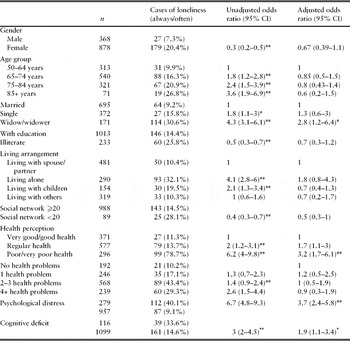
The distribution of percentages of loneliness by potential explanatory variables can be seen in Table 1. Loneliness varied by gender with more women feeling lonely (20.4%) than men (7.3%), and by educational level with more illiterate people (25.8%) reporting loneliness. The proportion of people feeling lonely increased with age: 9.9% in the 50–64 year age group, 16.3% in the group aged 65–74 years, 20.9% in the group aged 75–84 years and 26.8% in people aged 85 and over.
Associations of explanatory variables with loneliness (always/often)

Model adjusted for variables in all other domains reported in the table. *p < 0.05; **p < 0.01.
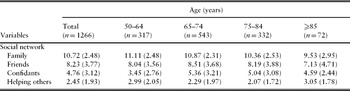
Social network decreases with age and familial network was found to be less extended at more advanced ages (see Table 2). The pattern of change of friends and confidants network had no such clear trend along age groups but tended also to diminish at older ages.
‘Social network’ variables by age groups

Loneliness is more frequent in widowed (30.6%) and single (15.8%) than in married people 9.2%. Loneliness is higher in people living alone (32.1%) and living with children (19.5%) than those living with spouse or partner (10.4%) or living with others (10.3%). Old people that perceived their health as poor or very poor had the highest percentage of loneliness (78.7%) followed by those that perceived their health as regular (13.7%) or very good or good (11.3%). People having two or three health problems had the highest percentage of loneliness (43.4%), followed by people with four or more health problems (29.3%), one health problem (17.1%), and finally by those with no health problems. People having psychological distress had a higher percentage of loneliness (40.1%) than those without psychological distress (9.1%). Similarly, those with cognitive deficit presented a higher percentage of loneliness (33.6%) than people without cognitive deficit (14.6%).
The unadjusted odds ratios for loneliness showed that gender, age, marital status, education, living arrangements (living alone, living with children), social network (smaller), self-perception of health (regular or poor and very poor), health problems (2–3 health problems), psychological distress and cognitive decline are positively associated with loneliness. When adjusting for all the variables present in the model the only variables that remained associated with loneliness were being widowed (OR 2.8, 95% CI 1.2–6.4), perceiving own health as poor or very poor (OR 3.2, 95% CI 1.7–6.1), having psychological distress (OR 3.7, 95% CI 2.4–5.8) and cognitive decline (OR 1.9, 95% CI 1.1–3.4), as shown in Table 1. The amount of variance in loneliness explained by the model, estimated by the Nagelkerke R2 statistic, was 29%.
Discussion
This study supports previous research showing that old people, in general, do not experience high levels of social isolation and loneliness. A small number of subjects presented a poor social network (7%) and an overall prevalence of loneliness of 16.3%. Our data confirmed the expected associations between loneliness, widowhood, self-perceived poor health, psychological distress and cognitive deficit but failed to show, when controlling for all the other variables in the model, the association with gender, age, living arrangements, social network or the number of health problems, as described in previous research.Reference Routasalo and Pitkala16, Reference Prince, Harwood, Blizard, Thomas and Mann33
Any relevant association between loneliness and usual predictors of social isolation (living arrangement, namely living alone and social network) became non-significant in the adjustment model of loneliness with the exception of being a widow/widower that goes on being a predictor of loneliness, relevant from a theoretical as well as a practical point of view. This finding suggests, on one hand, the independence of both concepts of emotional and social isolation, and on the other hand, the subjective and affective nature of loneliness in old age.
Within this context, the proposal of romantic lonelinessReference Ditommaso, Brannen and Best13 seems of particular relevance since it provides a valuable framework from which to interpret our findings, and as a potential model to explain loneliness in future researches. We found that when the loss of an intimate relationship occurs – widowhood – old people became more vulnerable to loneliness, despite all the other conditions. The simplest form of a network is a social dyad (e.g. spouse relationship), and the impact of losing a loved one, particularly in the case of a long-lasting marital relationship, as could be the case here, can be regarded as a major threat to feeling socially connected. Not only may there be the loss of a partner to share intimate thoughts and feelings with, but the loss of a partner who presumably gave crucial support and encouragement. Facing the challenges of the ageing process as a couple is different from facing them as a widow(er).
Self-perceived poor health and psychological distress emerged as predictors of loneliness. These findings are in line with previous research that has revealed poorer self-rated health as being related to greater loneliness among older people and the close relation between depression and loneliness,Reference Mullins, Smith, Colquitt and Mushel34 but we cannot assert that they are a cause or a consequence of loneliness due to the cross-sectional research design. People with poor physical and mental health may restrict their social contacts and activities outside their homes, or people feeling lonely may become more careless about their lifestyle and self care, leading to poor physical and mental health. In either case, this finding may have important indicators for health and social professionals who assist older people in the community in adjusting to health-related changes, depression resulting from loneliness or both. As for cognitive deficit, it appears to be associated with loneliness but again we cannot assume it as a cause or consequence of feeling loneliness.
A final word should be given to the non-significant finding for age, gender, number of health problems, living arrangements and social network. Advanced age has been found to predispose individuals to the experience of loneliness and most studies show a strong association with age. In a recent UK study, feelings of loneliness were reported by 7% of old people, ranging from 3% in the group aged 65–69 years to 13% in the group aged 80+ years, with more females (8%) than males (5%) reporting feeling loneliness.Reference Paúl, Ayis and Ebrahim23 Some previous researchers suggested that the feeling of loneliness is more common among people aged 75+ than younger adults, but that the prevalence of loneliness levels off after the age of 90 years.Reference Andersson14 Furthermore, the association of gender with loneliness is not totally clear: according to Routasalo and Pitkala's review,Reference Routasalo and Pitkala16 some studies present males as being more often lonely than females, while other studies reported results to the contrary.
As for the number of health problems, Mullins et al.Reference Mullins, Smith, Colquitt and Mushel34 though considering in their study a more objective measure of disability, showed no relationship between this and feelings of loneliness. These authors suggested that functionally disabled people generally receive more care and attention than those whose poor health status is self-perceived, but not necessarily manifest; it may also indicate that formal services are more accessible to disabled people, permitting greater social contact. A face value interpretation of our findings is that attitudes about health may be a more important variable in loneliness than actual health condition.
Finally, considering the specific measure of loneliness used in this study, more than being an objective condition, it appears as a subjective feeling accompanying the ageing process for a significant percentage of old people, independent of their social network and living arrangement.
Conclusions
Considering the results of this study and given the fact that there are poor long-term health outcomes associated with loneliness (as early death and suicide), public health intervention in those in structural circumstances of emotional isolation (particularly widows), should be increased. Besides community interventions promoting friendliness between old people, promoting intergeneration solidarity and avoiding social isolation that may ultimately contribute to enhance the quality of life of old people, old people feeling alone would benefit from psychological interventions helping them to cope with widowhood, psychological distress (mainly depression) and the challenges of declines associated with ageing. Furthermore, from a psychosocial point of view, further research should focus on the coping mechanisms used by those community-dwelling individuals who feel significant levels of loneliness. Loneliness in old age is an area that has been relatively neglected in the medical literature, but considering its association with adverse health outcomes, both from a mental and physical point of view, increased attention should be paid to this topic.
Acknowledgments
This paper draws from research supported by the Foundation for Science and Technology (FCT), Portugal (Grant POCTI/PSI/56505/2004).