Introduction
Alcohol use and abuse in the United States constitute a pervasive problem associated with innumerable costs to individuals, families, and society at large. Many studies have linked alcohol use to increased incidence of accidentalReference Hingson, Heeren, Jamanka and Howland1-Reference Soderstrom, Cole and Porter6 and intentional trauma,Reference Hingson, Heeren, Zakocs, Kopstein and Wechsler5-Reference Hingson, Heeren and Zakocs9 suicide,Reference Soderstrom, Cole and Porter6, Reference Birckmayer and Hemenway10 sexual assault,Reference Hingson, Heeren, Zakocs, Kopstein and Wechsler5, 11 unwanted pregnancies,Reference Allard-Hendren12 and motor-vehicle collisions.Reference Hingson, Heeren, Zakocs, Kopstein and Wechsler5, Reference Maskalyk13-Reference Byrd15 Alcohol-related disease and injury constitute the third leading cause of death in the United States, and are linked to 3% to 10% of all deaths, inclusive.Reference Soderstrom, Cole and Porter6 Alcohol's accessibility to minors makes it a drug of choice for many as they enter adolescence and early adulthood. Early alcohol use is associated with increased dependence and abuse later in life.Reference Martin, Kelly, Rayens, Brogli, Brenzel, Smith and Omar16 This finding stresses the importance of early intervention to reduce underage alcohol consumption and diminish the sequelae that occur later in life.
American consumers’ expenditures for alcohol in 1999 were estimated at $116.2 billion and, of that total, $22.5 billion was attributed to underage drinking.Reference Foster, Vaughan, Foster and Califano17 More than 50% of adolescents admit to consuming alcohol,Reference Soderstrom, Cole and Porter6, Reference Foster, Vaughan, Foster and Califano17 with about 20% reporting regular use.Reference Spirito, Barnett and Lewander18 It is not just that more adolescents are consuming alcohol; those who are consuming alcohol are drinking more of it.
Drinking establishments are required to abide by several state statutes and other ordinances regarding the sale of alcoholic beverages.Reference Bastin, Worms and Acar19-Reference Carnicelli, Grieco, Menchini, Saba and Luisi22 They must obtain and maintain alcohol-sale permits, which detail the scope of their alcohol-selling privileges. Licensees in the State of Maryland must provide ongoing alcohol awareness training programs for employees. The intent of this training is to educate employees about alcohol use problems and their role in enforcement.Reference Bastin, Worms and Acar19 These enforcement duties include validation of patron identification, refusal to sell alcohol to obviously intoxicated persons, and prevention of loitering about a place of business. Each underage drinker constitutes a violation, which can result in the suspension or revocation of the establishment's liquor license (personal communication, Jane Schroeder, Deputy Executive Secretary of the Baltimore City Liquor License Board).
In most areas, authorities use anecdotal information for choosing locations for spot enforcement. The purpose of this study is to use available EMS dispatch data validated by matched hospital records to identify drinking establishments associated with high numbers of intoxicated minors. Providing this objective information to police and liquor board officials should aid in the planning of enforcement activities.
Methods
The Baltimore City Fire Department (BCFD) maintains a computer-aided dispatch database, which contains EMS call times, addresses, response types, and destination data. Data are available for all consecutive EMS calls received during the study period, calendar year 2003.
Hospital medical record data were extracted from a Meditech (Medical Information Technology, Inc., Version 4; Westwood, Massachusetts USA) master database. Hospital information systems specialists provided a spreadsheet file containing requested data for the study period: patient identifiers, age <21 years old, gender, race, chief complaints, total hospital charges per bar, medical procedure billing codes, and admission and discharge information. The legal drinking age in Maryland is 21.
Data from the fire department and hospital were extracted from text files into a MySQL (MySQL AB Version 4.0.22; Uppsala, Sweden) database for analysis. Navicat (PremiumSoft, Version 6.1.4; Hong Kong SAR) database interface software was used for query development and reporting. Initial data analysis and reporting were performed using a combination of Excel 2003 (Microsoft, Redmond, Washington USA) and Minitab 14 (Minitab Inc, State College, Pennsylvania USA) statistical software.
Bars and clubs in Baltimore City were identified by using several online and printed telephone books. Each location was verified to be unique, and the address formatting was standardized.
Emergency Medical Services call records were matched to the addresses of local bars. Searches were expanded in a half-block radius around each bar to increase capture rates. Each bar was located on Street Atlas 2004 USA (Delorme, Yarmouth, Maine USA). The street search was expanded to include nearby cross streets. Address information was expanded to reach a half-block radius on all included streets. The justification for this expansion is that bar employees often expel highly intoxicated patrons. The patron then stumbles out of the bar, and collapses or sits down a short distance away. Emergency Medical Services is then called by passersby who notice these individuals.
Some of the bars and clubs also function as restaurants. Emergency Medical Services calls to these establishments during the day are often for employee and non-alcohol-related injuries; therefore, data were filtered to include only calls placed between 6 PM and 6 AM. Computer-aided dispatch runs by administrative (EMS Officer) or supporting apparatus (fire engine) were also filtered out to ensure only a single call was counted for a given response. The result of this query was a list of bars with EMS call counts attributable to each location.
The hospital Emergency Department (ED) admission records were queried for the corresponding time period and records were matched by arrival time and chief complaint. To validate the matching, each medical record was reviewed for narrative commentary attributing the call to a specific bar or club. This information would be present in the record if it was provided to the clinician by the patient, EMS providers, or persons accompanying the patient. Depending on the extent of validating information available, matches were listed as “specific” (S) or “loose” (L). A specific match was made when the EMS address information matched exactly to a bar, or the bar was mentioned in the medical record by name. A loose match was made when the EMS address data were within one-half block of the site address in the medical record or if the medical record mentioned a non-specific bar or club as the source of the patient's intoxication.
After the data collection phase, the authors approached multiple agencies (Baltimore Board of Liquor License Commissioners, Baltimore City Police, Maryland Department of Health and Mental Hygiene, and The Baltimore City Health Department) to discuss potential intervention and enforcement efforts. Study findings were presented, and a question-and-answer session followed. All agency officials attending the presentation were asked to complete a questionnaire. The questionnaire asked about attendees’ perception of the relevance of the information presented to them, and their expectation of action resulting from it. This study was submitted to the University of Maryland Baltimore County Institutional Review Board (IRB) and the Mercy Medical Center hospital IRB. Both IRBs approved the study with exempted status.
Results
The BCFD dispatch database contained a total of 147,767 calls from the study period. These calls were filtered to remove administrative and duplicate entries, leaving 138,929 calls to 52,518 discrete addresses during the 2003 calendar year.
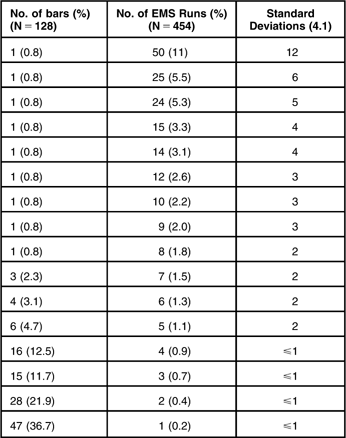
Two hundred eighty-one bars were identified within city limits. Ambulances were called to 149 (53%) of those establishments during the study period. EMS responses between 6 PM and 6 AM were documented for 128 (45.5%) of the total bars and for 390 (86%) of the 454 ambulance runs to specific bar addresses (Table 1). If subject to random distribution, the mean number of ambulance runs expected per bar is 454/281, or 1.6 calls per bar per year (95% CI 1.1-2.1; SD = 4.1).
Number of EMS runs to bars and clubs between 6 PM and 6 AM

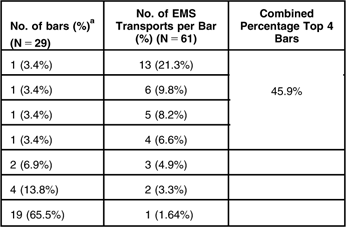
Bars with the highest number of ambulance calls are in close proximity to each other in a downtown nightclub district. The study hospital is located near this area and received most of the patients. Patrons from 29 of the 128 bars were transported to the study facility; more than one transport came from 10 of those 29 bars. The data distribution for the 29 bars with transports to the study facility is shown in Table 2.
Number of EMS transports from bars and clubs between 6 PM and 6 AM (specific address matching)

aPercentage does not total 100% due to rounding error
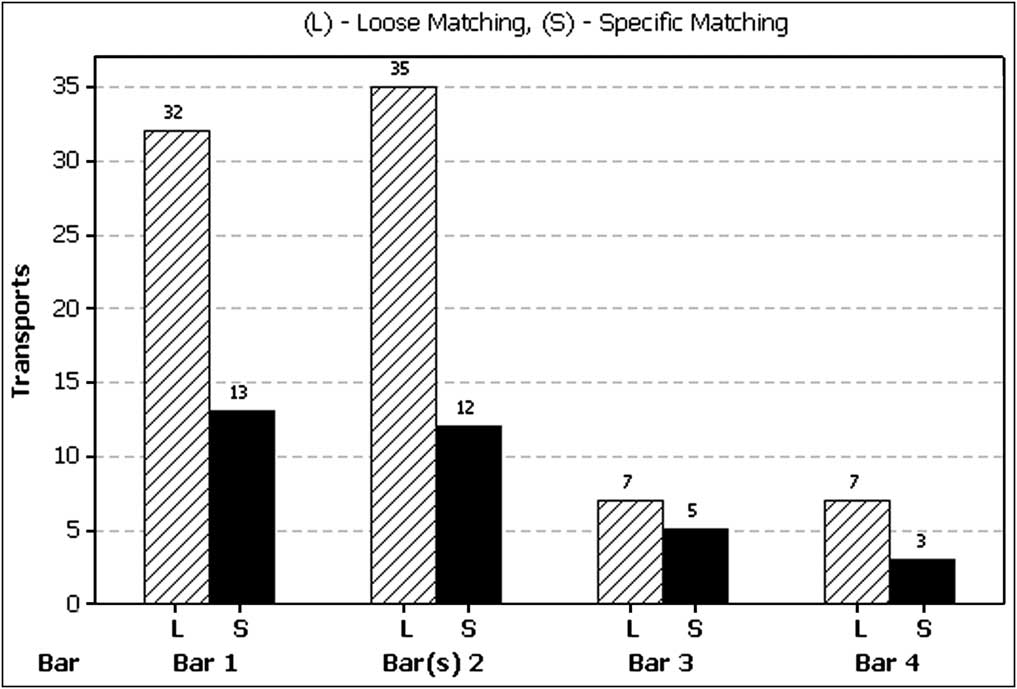
Several intoxicated individuals were identified by expanding the search parameters slightly beyond the study bars. The increases in transport numbers resulting from the search expansion for bars with the highest number of transports are portrayed in Figure 1. Expansion of the search criteria increased the number of transports from Bar 1 from 13 to 32. The second column on Figure 1 represents a collection of three bars located so close together that differentiation by address was not feasible. Collectively, these bars represent the second largest cluster of alcohol-related transports. The number of transports from Bars 3 and 4 increased comparatively less after expanding the search criteria to “loose” matching. These two bars turned out to be the initiation site of very few alcohol-related transports. One is located in a hotel, and most transports involved hotel visitors with medical or trauma emergencies. The other site had a few medical emergencies and only one alcohol-related transport.
Number of transports by Loose (L) and specific (S) address matching.

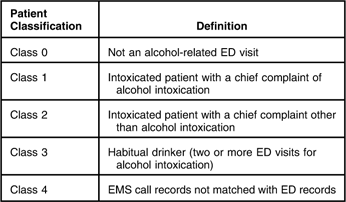
All of the specific and loose matches for the six bars with the most transports were compared with ED records, resulting in a total of 84 transports that were examined. Based on the matching methodology, 78 of 84 (93%) of the EMS call records were matched to ED records. Patients were subcategorized by chief complaint, to clarify the population of interest (Table 3). Analysis of the 78 matched records identified 51 (65%) patients with complaints related to alcohol. Forty-one patients presented with a chief complaint of alcohol intoxication. Ten presented with a chief complaint reasonably attributable to alcohol intake, such as assault or fall. These 51 medical records were further analyzed. Eight patients were transported to the ED for alcohol intoxication more than twice during the study period; they were considered habitual drinkers and were excluded from further analyses of this study. Nineteen ED visits were not alcohol-related. These included transport for work-related injuries and non-alcohol-related seizures.
Patient classification type based on ED records.

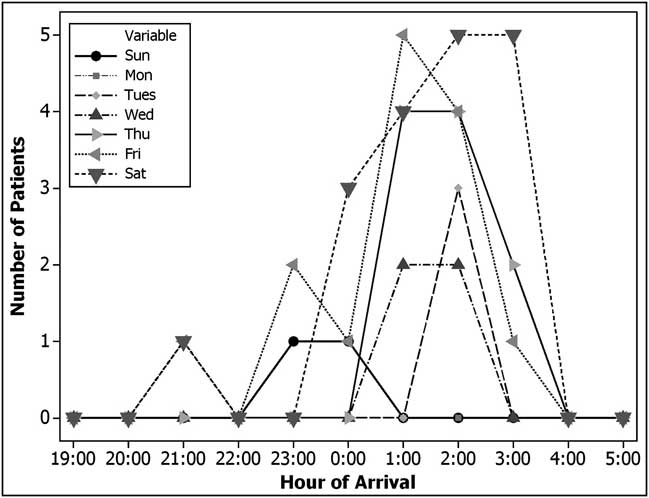
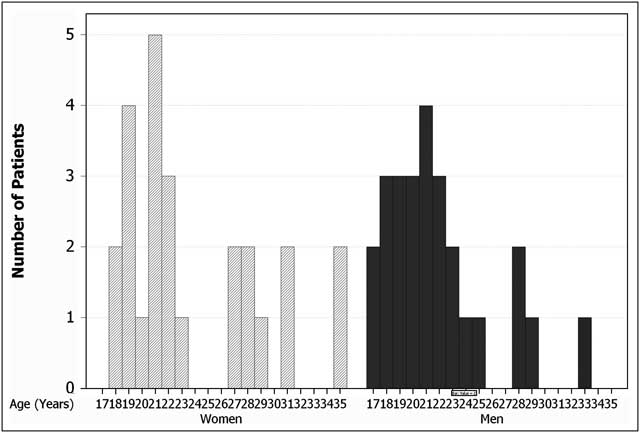
The analysis was duplicated by an independent researcher, who confirmed the reliability of the matching methodology. There were two discrepancies among the 84 records that were analyzed. One was determined to be caused by an investigator's failure to see the physician narrative in a patient's chart. The other was a difference of opinion regarding the classification of one patient. Neither discrepancy changed the conclusions drawn from the data or compromised the reliability of the study methodology. Forty-six percent of transports for alcohol-induced conditions originated at four bars (Table 2). Patient admissions to the ED peaked in the early morning hours and were concentrated on Thursdays, Fridays, and Saturdays (Figure 2). Eighteen of the 51 (35%) patients with alcohol-related visits were minors (Figure 3). There was a small spike in the number of transports at 21 years of age that was more pronounced for females.
Patient temporal arrival patterns by day of week

Patient ages grouped by gender

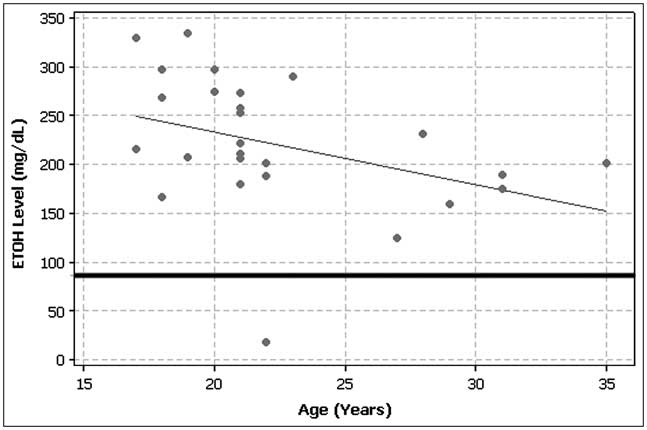
The blood alcohol concentration was measured in 26 (50.9%) of the 51 patients. The scatterplot in Figure 4 demonstrates a regression line with a negative correlation between alcohol level and age: the older the patient, the less likely their alcohol level would be severely elevated.
Alcohol concentration distributed by age

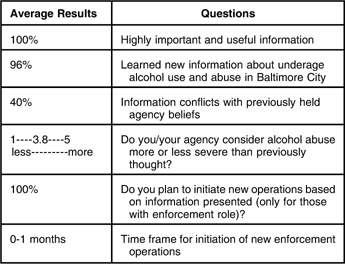
After analyzing the data, the authors contacted the Maryland Department of Health and Mental Hygiene, the Baltimore City Health Department, and the Baltimore City Department of Liquor License Commissioners to arrange meetings with their representatives who work in the areas of alcohol- and drug-related illnesses or enforcement of alcohol-distribution statutes. Following presentations, participants were asked to complete a questionnaire. In summary, 100% of the agencies found the information useful and planned to initiate a new operation to address underage drinking, and 96% learned new information about underage drinking. The cumulative results are summarized in Table 4.
Responses to questionnaires by enforcement officials

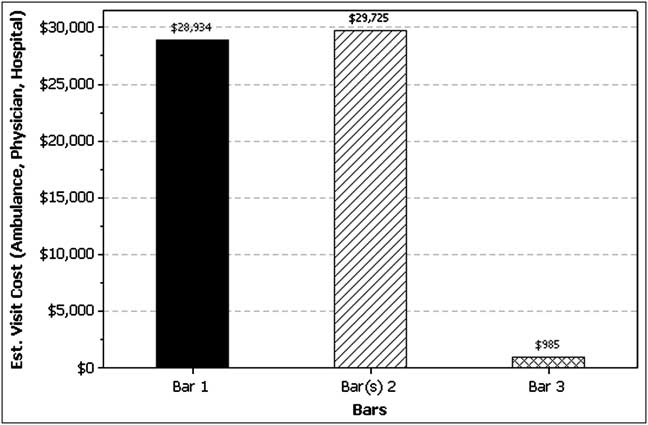
Figure 5 denotes the estimated medical costs for all patients evaluated in the ED for the top three bars. For all patients matched to a bar loosely or specifically, Bar 1 had an average cost per patient of $904, Bar(s) 2, $849, and Bar 3, $140, which includes the estimated cost of ambulance transport, hospital facility charges, and physician professional fees.
Patient care costs attributed to bars

Discussion
The initial costs of underage drinking include those associated with local EMS agencies, hospitals, and physician charges. The long-range impact of underage drinking is its potential to lead to the overuse and abuse of alcohol into adulthood, increasing the likelihood of risks to public safety and individual well-being. The financial and emotional costs associated with injuries and deaths caused by drunk drivers should also be considered. Alcoholism has a major role in work-related injuries, absenteeism, and long-term health problems.Reference McCammon14, Reference Foster, Vaughan, Foster and Califano17 Given that the population at risk is dramatically larger than the numbers of patients admitted to EDs, the scope of this problem is much larger than raw admission numbers imply.
This study has many strengths. Emergency Medical Services and ED records provided useful information about measurable health effects related to the selling practices of specific bars in the study region. Detailed demographic information was provided to identify the population at risk, providing data for public health education and intervention. The information enabled public health and enforcement agencies to initiate immediate interventions. The methodology used to cull EMS dispatch data was validated and could be applied in other jurisdictions.
Limitations
The primary weakness of the study is the lack of a quantifiable measure of efficacy, indicating the need for further data collection and repeat analysis to determine if there has been a significant decrease in ED admissions from the bars identified as problematic. The second weakness in the study is that the number of minors identified was low (51 charts analyzed); however, this number was large enough to identify bars that were significant outliers.
Conclusions
The linkage of EMS call records and ED medical records provided tangible and relevant information about the alcohol-selling practices of local bars and nightclubs. Action taken in response to the presentation of the results of this study to local law enforcement officials could decrease the prevalence of severely intoxicated minors and corresponding ED admissions.
Abbreviations
- BCFD:
Baltimore City Fire Department
- CAD:
computer-aided dispatch
- ED:
Emergency Department
- EMS:
Emergency Medical Services
Acknowledgments
The manuscript was copyedited by Linda J. Kesselring, MS, ELS, the Technical Editor/Writer in the Department of Emergency Medicine at the University of Maryland School of Medicine.