Historians continue to be captivated by the English civil wars. The period has stimulated enduring fascination because, whatever scholars may think about the causes, conduct, and consequences of the wars, any sober assessment of the seventeenth century cannot fail to reckon with the sheer disruptiveness of the conflict and the ways in which it devoured lives and shattered the seemingly solid bedrock of English social and political existence. And while this upheaval was traumatic for large numbers of people, it also undeniably forced upon many of its victims a necessary recalibration of ideas, values, and religious assumptions, resulting in considerable ideological ferment and change on all sides of the political divide. Although many royalists (and the nonaligned) partook of this vertiginous process of ideological change, the effects of the disruption are most obvious among committed parliamentarians, for whom the relatively conservative rhetoric of loyalty to the king, measured godly reformation, and enmity to evil council, so apparent in 1640 and 1641, quickly gave way to all manner of religious and political fragmentation. This fragmentation was accompanied in some circles by parallel processes of radicalization, ultimately allowing for a bloody regicidal denouement and a constitutional upheaval that would have been unthinkable for most English subjects in 1640. Knowing that such radicalization took place, however, is quite different from charting it, still less explaining it. In part because of the sheer weight of material generated during the civil wars and interregnum, and the dizzying and accelerating pace of changing circumstance that confronts any would-be historian of the period, it has proved surprisingly difficult to provide a satisfying account of how the muted and indeed conservative rhetoric of 1640 evolved into the regicidal violence of 1649.
The following article makes no comprehensive attempt to carry out such an operation. That project, vast in its scope, would need to chart various different fields of ideological change from the prewar period into the 1640s, mapping those fields onto the fiendishly complex narrative of the politics of the civil wars and interregnum. It would demand several strands of parallel analysis, integrated side-by-side, and is therefore far beyond the compass of a single essay. More modestly, this article aims to unravel what might be seen as one of these narrative strands and to explore the dynamics of gradual ideological escalation by examining, in close detail, the issue of censorship during the early phases of the first civil war.Footnote 1 By reconstructing the process through which Parliament reinstituted press controls in 1643, and then by exploring the ways in which the new policy was implemented over the year that followed, useful insight is provided into the story of how the parliamentarian front began to come apart under the pressures of political infighting. Particular attention will be accorded to the ways in which those at the fringes of the parliamentarian coalition began during these months to articulate increasingly radical and novel political and religious opinions. Press control will thus be used as a point of access, or a window allowing us to observe a trajectory of ideological fragmentation and escalation. It will also be demonstrated, however, that the increasingly contested issue of censorship acted as a kind of accelerant and was itself implicated in the process of change in that it helped to push some parliamentary partisans in more extreme directions.
Press control might seem, on the face of it, to be an unlikely point of embarkation for an investigation of this nature. After all, it has for generations been something of an article of faith that the opening of the Long Parliament in 1640 witnessed a “breakdown” or “collapse” of the thoroughgoing system of constraints that had been constructed in previous decades to oversee the print trade. On this view, the novel or radical opinions that emerged during the 1640s are seen as a consequence of the abandonment of press control.Footnote 2 This picture contains undeniable elements of truth, but it also involves oversimplification. Recent scholarship on censorship has called into question the extent to which the prewar regime of press oversight amounted to a rigorous system of control, thereby downplaying the dramatic divide represented by 1640.Footnote 3 Conversely, students of the Civil War and interregnum have challenged the notion that there was a complete disintegration of censorship during the 1640s and 1650s.Footnote 4 The following article continues this process of reevaluation, in an effort further to clarify the precise nature of press control—or its absence—during the Civil War era.Footnote 5
Readers will not be surprised to discover that lurking at the edges of any story about press restraint during the 1640s, we find the looming figure of the poet and propagandist John Milton. November 1644 witnessed the appearance of Areopagitica; A Speech of John Milton For the Liberty of Unlicenc’d Printing, To the Parliament of England, the author’s eloquent plea against the invidious effects of prepublication censorship. This book has not infrequently been celebrated as the first expression of the idea of press freedom written in the English language. Although modern scholarship has tended to qualify, or even discount, any vision of Milton as an apostle of free speech, his book continues to exert a magnetic pull, partly because of its long-standing popular reputation and partly because of its author’s unassailably canonical stature. Yet despite all that has been written about Areopagitica, there remain puzzles and uncertainties about the conditions under which it was composed. While it might come as a surprise to learn that there could be anything left to unearth about Milton’s own life and intellectual evolution, this article will, it is hoped, present important new evidence for understanding the ideological, personal, and political circumstances that contributed to the publication of Areopagitica.Footnote 6 In turn, Milton’s entanglement in that tumultuous context will permit a deeper exploration of the process of ideological change and escalation that lies at the core of this study.
During the opening months of the Long Parliament, when so many assumptions of political life were being rewritten, the traditional system of press licensing, overseen by the episcopal authorities and the privy council and managed through the Stationers’ Company, effectively crumbled, opening space for a freewheeling, and to a certain extent, unregulated market of print.Footnote 7 The reasons for this are not far to seek; with the convention of Parliament, the courts of Star Chamber and High Commission—the bodies most directly responsible for enforcing the licensing regime—quickly retreated into cowed inactivity before being permanently abolished in July 1641.Footnote 8 The king and his council were placed in a profoundly defensive position and had little choice but to watch as obnoxious, unlicensed publications attacking courtiers and the established church spilled from London’s presses. Meanwhile, prevailing sentiment in Parliament, particularly at the outset, was largely sympathetic to much of the complaint literature, satire, and news that now crammed city bookstalls, which meant that there seems to have been a general, if tacit, presumption that such previously forbidden material could now expect winking approval at the highest levels of the parliamentary establishment. This, in turn, fostered or reinforced an assumption among some pro-parliamentary enthusiasts that the press during the “time of parliament” ought in some sense to be unfettered and hence able to provide a kind of public counsel and debate, much as members of the two houses could claim a protected privilege of free speech while Parliament was in session.Footnote 9
Yet as the political situation became ever more contentious—and as the crown and its friends began to claw back initiative—both Parliament and the king made repeated attempts, working in tandem with the stationers, to stem the tide of unlicensed pamphlets now cascading from London’s presses. During the first twenty months of the Long Parliament, several unsuccessful ordinances were promulgated, clandestine printing operations (including one managed in part by the future Leveller propagandist Richard Overton) were suppressed, Parliament experimented with a new system of licensing through its Committee for Printing, and upwards of fifty publicists and booksellers were summoned, questioned, or imprisoned for their activities.Footnote 10 This haphazard, yet occasionally repressive, regime of postpublication oversight continued after the outbreak of open civil war in late 1642. Nevertheless, the piecemeal and occasional punishment of publishers and authors hardly amounted to a stable or predictable system of control, and the exigencies of war now created greater incentive for Parliament to set up a thoroughgoing system of press regulation.
It was presumably to formalize the process of oversight and to render it more effective that the two houses—pushed by a Stationers’ Company keen to reassert its own privileges—finally took more substantive action. On 14 June 1643, Parliament passed its “Ordinance for the Regulation of Printing,” which reinstituted a system of censorship and renewed the stationers’ monopoly over printing and retailing books. Only works approved by named parliamentary licensers and duly entered into the Stationers’ Company registers could now legally be printed or sold; any printers or retailers violating the new rules were subject to search, seizure, and confiscation at the hands of parliamentary or company authorities (who were empowered to call to their assistance JPs, constables, and militia officers), with offenders liable to further punishment by Parliament.Footnote 11
This measure threatened to undo the relative neglect that had permitted the transformation of the book trade in recent years. Unfortunately, little is known about the origins, sponsorship, or timing of the ordinance. Two months earlier, in April 1643, in an effort to pressure Parliament to act, the stationers had published a remonstrance, requesting that the houses pass a measure to redress the collapse of the old system of licensing and copy registration. The language of this remonstrance was at several points mirrored in the June ordinance, suggesting that there was a direct connection between the two. But how the new ordinance was finalized or by whom remains a mystery.Footnote 12 It seems to have slid through both houses with little attention and no debate: the Commons’ Journals laconically noted that the house had, without division, passed an “Ordinance to prevent and suppress the License of printing.”Footnote 13 Indeed, Lawrence Whitacre, chairman of the Committee for Examinations, which under the new ordinance was invested with primary responsibility for enforcement, did not even bother to note its passage in his diary, choosing instead to memorialize other parliamentary minutiae, including “an Order … for Chelsey College,” and another for “Nicholas Crispes house at Hanworth.”Footnote 14 Sir Simonds D’ewes, also a member of the Committee for Examinations, likewise breezed past the measure in his diary without a single word.Footnote 15 Evidently, there was little here to debate: the suppression of “license in printing” was by and large an uncontentious issue among MPs.Footnote 16 Further easing the passage of the ordinance may have been the fact, hinted at in its text, and noted with bitterness by later critics, that the measure was marketed chiefly as a tool to staunch the flow of pro-Royalist publications (a particularly sensitive issue in the wake of the so-called Waller’s Plot against Parliament, which had been made public just a few days earlier). In any case, it is striking that a measure with such serious repercussions for the print trade came into effect almost, it seems, as an afterthought.
It is difficult to know how intensively the new ordinance was enforced, since routine searches and seizures, conducted by the Stationers’ Company, generated no direct surviving records. Only when such searches left some other trace—either occasioning comment in print or eliciting passing notice in independent manuscript sources—do we learn of their existence. The first case in which the ordinance was invoked was evidently that of Peter Cole, a stationer and separatist sympathizer, who in March 1643 had acted as a trustee for Richard Overton in taking over Overton’s confiscated press. In June 1643, just days after the new ordinance passed, Cole’s house was apparently raided. In order to recover the keys to his shop, he was forced by the Committee for Examinations to enter into a large bond to ensure that he would not print anything unlicensed and that he would not move his presses from their current location.Footnote 17 A month later, another raid took place at the house of the crypto-Royalist printer, Richard Herne.Footnote 18 At some point in the following weeks, a third victim, the widow Franklin, likewise saw her premises searched and some of her printers’ things seized.Footnote 19 We know of these searches only through the survival of incidental records, so it is possible that other cases of enforcement have escaped attention. The impact of the new press licensers is likewise resistant to analysis, since works rejected or revised by the censors rarely left any trace in the historical record, but it is probable that at least some books were denied permission.Footnote 20 The immediate effects of the ordinance are therefore difficult to gauge. The rapid increase in the number of new works entered in the Stationers’ Register does suggest some concern to comply with the ordinance, as well as an awareness among publishers that the measure had invested the Stationers’ Company with enough power to protect rights to copy in a meaningful way. Yet even so, a considerable majority of works continued to be published without license or entry. The initial impact of the ordinance was mixed, and the precise character of the new licensing regime would have appeared uncertain at first.
Toward the end of 1643, however, there were signs that the ordinance began to be enforced in a novel fashion, and as its effects started to be felt, so too a conversation began as to the merits of the new order. It has long been understood, in a general way, that the issue of press freedom first came to be contested as part of a broader debate between religious factions within the parliamentarian coalition.Footnote 21 Long simmering animosities between presbyterians and independents (taking this word to encompass all those who supported some form of gathered church, whether congregationalist, separatist, baptist, or otherwise) burst into open view over the course of late 1643 and early 1644, creating the initial fissures that would eventually split the parliamentarian coalition into competing and hostile politico-religious factions. These disputes began in earnest as a result of the Scottish alliance of August 1643, which brought the Scots into the war. The effort to cement the alliance prompted the convocation of the Westminster Assembly of divines and led to the promulgation of the crypto-presbyterian Solemn League and Covenant, exacerbating preexisting religious tensions within the English parliamentarian front. The uncomfortable sparring that took place in late 1643 gave way to open recrimination after the publication, on 3 January 1644, of the famous Apologeticall Narration, a manifesto signed by the five leading congregationalist ministers of the Westminster Assembly.Footnote 22 The release of this document rendered public a series of discussions that had hitherto been carried out largely outside the realm of print, and the result was a rancorous debate, conducted in pamphlet, pulpit, and private conversation.
As political and polemical conflict heated up in late 1643, the troubles that began to wrack the London parliamentarian community inevitably crept into the management of the press, and the uncertainties that had characterized the initial enforcement of the ordinance gave way to a more stringent regime. On the whole, this tended to work against the independents, particularly those of an aggressively sectarian temper: Brownists, anabaptists, or those challenging Calvinist orthodoxy. With a couple of notable exceptions, the clerical licensers who had been named in 1643 were long-standing Church of England ministers—respectable, orthodox, and learned, if resolutely puritan in outlook. Similarly, the Stationers’ Company appears during this phase to have been dominated by a mixture of conservative, indeed, crypto-Royalist members, together with a handful of presbyterians.Footnote 23 This ensured that the machinery of the new system of regulation was weighted in favor of emerging presbyterian interests.
This was a fact much commented upon by observers at the time. In later years, some would complain that while the ordinance had originally been touted as a means of shutting down royalist publication, the new system was quickly hijacked by duplicitous presbyterian insiders. In 1649, a Leveller petition repeated this assertion and claimed that “the first that suffered” under the new ordinance was one “Lawrence Sanders, for Printing without license, a book intituled, Gods Love to Mankind.”Footnote 24 This charge was not without substance. In December 1643, Lawrence Sanders, a Blackwell Hall cloth factor, was indeed imprisoned by Parliament’s Committee for Examinations. On 24 December, after petitioning the committee, he was “discharged of his imprisonment upon sufficient bayle in twoe hundred pounds … with condicion not to print, publish or cause to bee printed, or published the booke entituled, The fulnes of Gods love etc. unlesse hee bee licensed by authoritie of Parliament.” Standing as sureties on his behalf were two supporters, William Walwyn and Samuel Eames. Although the wording of the bond is somewhat ambiguous, Sanders’s unlicensed theological tract, The Fulnesse of Gods Love Manifested, had apparently already been printed, as at least three copies are extant today.Footnote 25 While there might have been some overstatement involved in the claim that Sanders was the very “first that suffered” under Parliament’s licensing ordinance, it is possible that he was indeed the first individual imprisoned for violating its conditions.
Contributing to the sense of grievance here was the fact that Sanders had been an avid supporter of Parliament. At the outbreak of the Civil War, he was in business with another Blackwell Hall factor, Clement Writer. Both men were living in Red Lion Court, Watling Street, in July 1642, when they decided to pool their resources to contribute to the parliamentary war effort two horses, with arms, equipment, and riders.Footnote 26 Sanders’s partner, Clement Writer, was himself a notorious religious radical. By 1643, he had emerged as the spiritual leader, along with the Londoners Samuel Eames and Richard Blunt, of what one detractor called “one of the first and prime Churches of Anabaptists now in these latter times.”Footnote 27 Evidence suggests that by this point, the church was already well on its way to rejecting a number of crucial pillars of Calvinist orthodoxy, a departure from mainstream religiosity that would soon lead to the breakup of the congregation.Footnote 28 Lawrence Sanders was, in all likelihood, a member of this Writer-Eames-Blunt connection, and his tract The Fulnesse of Gods Love probably gives a good indication as to the kind of divinity on offer in this circle during the first year of the Civil War. This surely accounts for Samuel Eames’s willingness to stand as a surety for Sanders. It also helps to explain the involvement of William Walwyn, eventually to emerge as a chief spokesman for the Levellers. Sanders’s business partner, Clement Writer, and Walwyn were close associates throughout the 1640s, entering into a friendship that would persist down to Writer’s death in 1662.Footnote 29
What aspect of Sanders’s treatise had proven so offensive that it landed him in prison? While Sanders’s work prudently avoided the explosive question of infant baptism, it probably drew the hostile attention of the authorities due to its systematic and forthright attack on Calvinist orthodoxy. The main goal of the tract was to prove that Christ had died for all and that God’s grace was available to every person in the world. Those who refused this grace were justly condemned for their own obstinacy. To argue otherwise was to deny the righteousness and goodness of God.Footnote 30 In this, Sanders was presumably giving voice to the increasing tendency among some anabaptists to reject predestinarianism, a tendency that would culminate in the emergence of the denomination later known as the “General Baptists.”Footnote 31
But Sanders’s treatise offended on other levels as well. It revealed strong hints of mortalism (thus preempting by some three weeks that more famous expression of this argument, Richard Overton’s Mans Mortallitie).Footnote 32 The book also contained passages that suggested that Sanders had embraced aspects of the antinomian critique of mainstream puritan “legalism.”Footnote 33 Finally, it included a stinging attack on puritan ministers, whose piety had, Sanders suggested, devolved into “a rigid, blind and preposterous zeal in seeking dominion over the faith of our brethren and fellow-servants, and by humane and positive lawes inhumanely … to compell their judgements and consciences to conformity to our dictates and determinations in matters of the worship of God.”Footnote 34
Given all of this, it is hardly surprising that Sanders found himself in trouble with the Committee for Examinations. Nor should we be surprised that Walwyn championed Sanders. Although Sanders presumably emerged out of the anabaptist tradition, and Walwyn from an antinomian perspective, the two men appear to have arrived at an ideological meeting point: by the close of 1643, both were flirting with, in varying degrees, an antipredestinarian, antilegalist, and quasi-mortalist theological position.Footnote 35 Both men’s views can be taken as indicative of the increasingly extreme and heterodox opinions that were beginning to circulate in London among longtime veterans of the radical puritan fringe.
Moreover, the involvement of Eames, and especially Walwyn, is suggestive of a more general pattern, one crucial for understanding the development of radical religious (and political) opinions during the English Civil War. The remarkable flux and chaos of the crisis of the early 1640s, and the attendant freedom of press, speech, and association that had been accorded to diehard parliamentarians during the first years of the Long Parliament, particularly in London, had allowed for the rapid proliferation of new and often unorthodox ideas. And while it is tempting (and to some extent, necessary) to place these ideas into abstract and discrete categories—anabaptist, separatist, antinomian, independent, and so forth—the fact is that at the fringe of the puritan community, these boundaries were not always apparent. New ideas bled into one another, and parliamentary enthusiasts of different ideological shadings rubbed shoulders and debated in an increasingly volatile environment, which, while it had precedent in the prewar puritan community, was novel in its scale, shape, and fecundity. There was, then, what might be seen as an emerging fringe culture of religious heterodoxy, which to some extent transcended denominational boundaries and categories. This fluid environment was not wholly removed from the broader godly community; indeed, it shaded off imperceptibly into the somewhat more respectable milieu of New England–style congregationalists, with whom sectaries shared much, and with whom they now found themselves in a strong, if sometimes uneasy, tactical alliance. But within this independent alliance, we can discern the emergence of a discrete, and to some extent self-conscious community of debate and discourse, in which the boundaries of acceptable religious opinion were being stretched to their very limit. And it was along this fringe that, during the months that followed, enthusiasts would elaborate fully developed and sophisticated theories of general religious toleration.
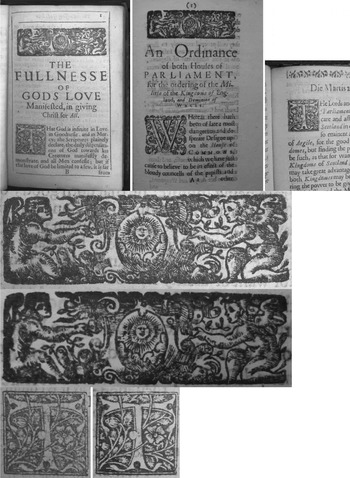
The existence and nature of this variegated, cross-fertilizing radical puritan subculture is helpfully illustrated by examining the domain of print. The world of publishing and bookselling allows us to observe this amorphous, nondenominational tendency toward consociation in its complexity. Certain London printers and publicists—Cole, Overton, Thomas Paine, and a small handful of others—consistently proved willing to handle diverse and even conflicting heterodox texts, some of which had now begun to express ideas that would have been unspeakable five years earlier. Perhaps the most crucial figure of all was Gregory Dexter, a young printer who, in partnership with the more established stationer, Richard Oulton, had entered the book trade in 1641. Dexter served briefly as a dragoon in the parliamentary armies in late 1642. Throughout the early 1640s, he and his partner showed an undeniable pro-parliamentarian, and indeed overtly puritan, bias in their choice of titles, which had occasionally gotten Dexter and his wife in hot water with the authorities.Footnote 36 At some point around June 1643, he and Oulton apparently parted company, with Dexter taking over the business on his own, and Oulton retiring from the trade.Footnote 37 Dexter continued along in his partisan, indeed increasingly radical, ways, and by the end of 1643 he had apparently emerged as the printer of choice for sectarian or heterodox authors. Unsurprisingly, he was responsible for Sanders’s The Fulnesse of Gods Love. Although the book bore no imprint, typographical evidence demonstrates that it was printed in the house of Gregory Dexter. The various printers’ ornaments used in the book can be seen to have come from Dexter’s repertoire (see app. A, fig. A1).
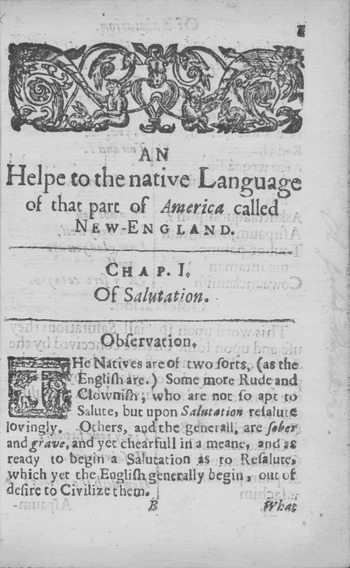
Whether Dexter was implicated in the investigation of Sanders our records do not say. But he was surely involved in the production of texts by other radical puritan authors during these weeks and months. In September 1643, for instance, he had put his imprint to Roger Williams’s first known publication. Williams was, of course, the rogue minister whose separatist extremism had so offended the puritans of New England that in 1636 they had banished him from Massachusetts Bay. Relying at first on the generosity of the native population for his survival, Williams went on to found the colony of Providence, which, as a haven of religious toleration, quickly became a destination of choice for puritan religious dissenters. In early 1643, Williams returned to England to try to secure a patent for Providence, and it was at this time that he published his first book, A Key into the Language of America, with Dexter as his chosen printer (app. A, fig. A2). Interesting as this guide to the Narragansett language was, it was uncontroversial, and Dexter readily put his name to the title page of the work.
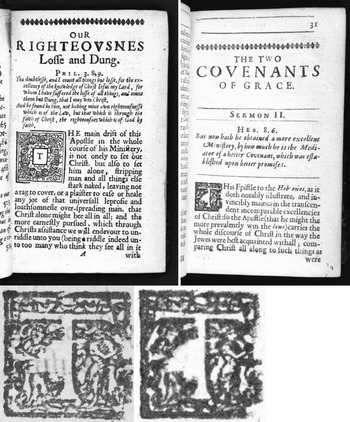
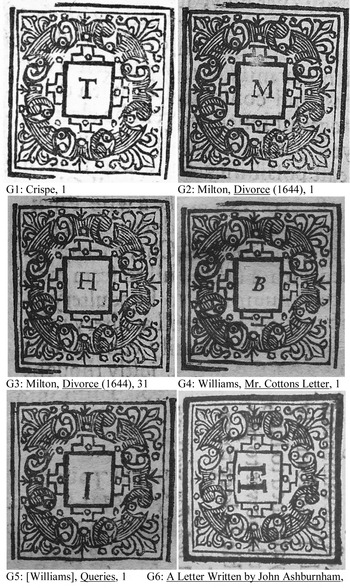
Some of Dexter’s other undertakings from the period were less innocuous. In late 1643, admirers of the recently deceased antinomian minister Tobias Crispe chose to present to the world a second collection of sermons by the infamous preacher.Footnote 38 Here, again, we can observe a subtly instructive shift in the political conditions of press production. The first volume of Crispe’s sermons had been released in July 1643. Although the licensing ordinance had passed several weeks earlier, there is no sign that its printer or publishers sought to obtain permission for the collection; nevertheless, the work’s chief promoter, Robert Lancaster, its printer, and its funder all identified themselves by name or initials in the book.Footnote 39 This would prove costly. Lancaster would, in the weeks that followed, find himself repeatedly interrogated by a committee of MPs and divines for engineering the publication of Crispe’s book.Footnote 40 Not surprisingly, the next volume of the great man’s sermons contained no signed prefatory material, and the printers wisely chose not to identify themselves. Nevertheless, typographical examination—and particularly, the use of a small, cracked, initial “T” (see app. A, fig. A3)—reveals that Gregory Dexter’s print house was responsible for the title page, opening matter, and at least the first three sheets of this book.Footnote 41 This “T” had also been used on Williams’s Key into the Language of the Narragansett, imprinted by Dexter around the same time.Footnote 42 Also, crucially, one of the initial sheets of the sermon cycle used a crude, broken factotum (app. A, figs. A3 and A7, part G1), which we will encounter again. Dexter was quickly confirming his status as the printer of choice for London sectaries, particularly those who wanted to elude censorship.
In the early weeks of 1644, following the imprisonment of Sanders, the stakes in the combat over licensing were raised by the publication of a series of particularly incendiary works. In mid-January, Richard Overton printed his notorious treatise, Mans Mortallitie, most likely on a press operated by Peter Cole. This was followed, shortly thereafter, by another equally offensive work, the second, enlarged edition of John Milton’s The Doctrine and Discipline of Divorce. The first edition of this famously controversial book had appeared in August 1643, without Milton’s name, and without license, but bearing the initials of its printers, Thomas Paine and Matthew Simmons. Now, however, the increasingly fraught political atmosphere meant that the printer needed to be more circumspect when Milton sought to publish his expanded edition in early 1644. Milton’s authorship of the book was already an open secret, and he thus threw caution to the wind and attached his name to the fresh version of his tract, which bore a new dedication to Parliament, as well as substantial additions to the body of the text.Footnote 43 The need to append all of this new material no doubt meant that Milton engaged in sustained contact with his printer or publishers. Indeed, it has been suggested that a series of fastidious stop-press corrections made during the printing of the book may furnish indirect evidence that Milton himself closely supervised its production.Footnote 44 Whereas Paine and Simmons had openly avowed their publication of the first edition, on this occasion, Milton’s printer was careful to hide his identity. When the book appeared—Thomason acquired his copy on 2 February 1644—it was shorn of any reference to printer or publisher.
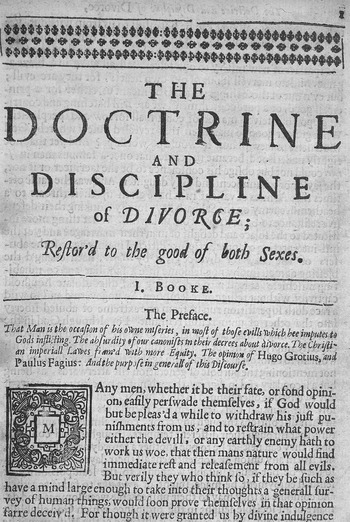
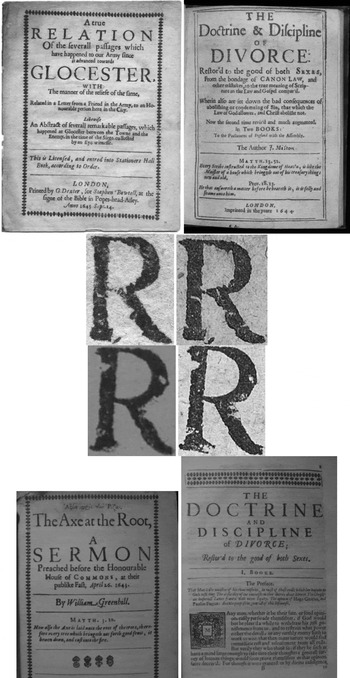
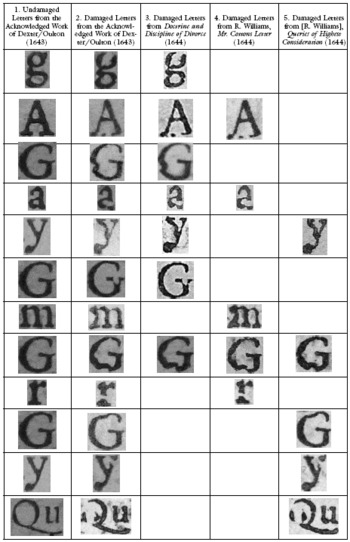
Fortunately, the book’s typography allows us to identify the perpetrator. For a start, the pamphlet twice used a distinctive ornamental block, the badly worn factotum that had recently appeared in Tobias Crisp’s sermons (see app. A, figs. A4 and A7, parts G2 and G3). But even more convincingly, Milton’s divorce tract was also rendered using type that can be traced directly to the printing house of Gregory Dexter. Two large capital “R” letters, both bearing distinctive cracks and wear, and identical to ones found on items printed by Dexter during the previous year, were used respectively on the title page and the first page of Milton’s book (see app. B, fig. B1). In addition, the body of the text was printed using a distinctive pica Roman typeface that matched one Dexter had been using occasionally in 1643. A number of individual letters found in the second edition of The Doctrine and Discipline of Divorce—identifiable on the basis of small cracks or deformations, which render them unique and traceable—had appeared in these earlier works by Dexter (see app. B, table B1). Together, this evidence demonstrates beyond reasonable doubt that Milton’s tract had been executed using ornaments and type that belonged to Gregory Dexter. Again, this is not surprising. It has long been known that Dexter and Oulton published some of Milton’s first pamphlets in the early 1640s, so there already existed an established commercial and cooperative relationship.Footnote 45 When combined with Dexter’s known willingness to handle illicit material, this would have made Dexter a natural choice when Milton went to publish the second, expanded edition of his divorce tract.
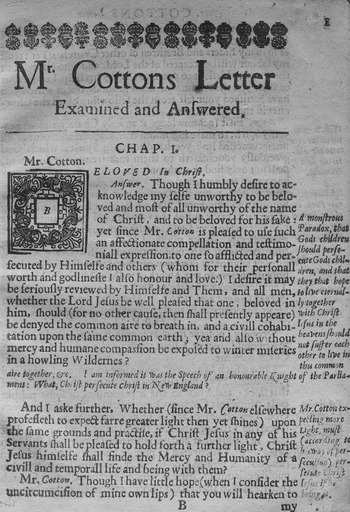
On 5 February 1644, just three days after the first appearance of Milton’s tract, Thomason acquired another book, printed in an identical typeface, and using the same incriminating factotum (figs. A5 and A7, part G4). This was Mr. Cottons Letter Lately Printed, Examined and Answered, by Roger Williams. Although the book again bore no imprint, the use of the factotum, together with the recurrence of several deformed or broken letters (some of which had been used on Milton’s book) leaves no doubt that Dexter was responsible—predictable enough, given that only a few months earlier, he had published Williams’s first foray into print (app. B). This new tract was, however, more controversial, and Dexter proved less than eager to advertise his identity. The book represented the first shot in what was to be a long, bitter pamphlet war between Roger Williams and John Cotton, in which the two men rehashed the details of Williams’s banishment from Massachusetts, in the process bequeathing to posterity one of the Civil War’s most memorable arguments over religious coercion and toleration. In this first installment, Williams refuted a private letter, written by Cotton, in which Cotton had attempted to justify Williams’s banishment.
The tract betokened an important new development that followed in the wake of the publication of The Apologeticall Narration in early January 1644. While the primary conflict that ensued was waged between independents and their presbyterian critics, it must be understood that the independent coalition was itself not without its tensions and fault lines, particularly between those at the sectarian fringe and more respectable supporters of congregational church government. The Apologeticall Narration in many ways pushed these tensions to the foreground: one of the apologists’ polemical strategies had been to distance their own position—as self-identifying congregationalist supporters of the so-called New England Way—from the alleged excesses and errors of separatism. Understandably, this irritated some on the puritan extremist margin. Separatists, baptists, and other religious radicals resented the implied aspersion cast on them by the “Dissenting Brethren,” presumably having expected better from those who, at an informal level, were cooperating closely with them. The publication of the Narration thus led some to look more closely at the New England polity and the position now being elaborated by its cheerleaders, with the result that sectarian publicists in short time formulated more extreme, and in some cases, novel cases for liberty of conscience. Ironically, it was partly through this process of arguing with other independents (as well, of course, through engagement with overt presbyterians) that puritan radicals during 1644 first articulated some of the more celebrated Civil War arguments for religious toleration. Williams, who had firsthand experience of the repressive impulses on display in New England, would be central to this process, and his answer to Cotton’s letter can be seen as an initial expression of this process of introspection and ideological development.
The same inclination was apparent in Williams’s next effort, Queries of Highest Consideration, Proposed to the five Holland Ministers and Scotch Commissioners (So Called.) Upon occasion of their late Printed Apologies for themselves and their Churches, which appeared just a few days later. Here, the five dissenting independents, conveniently stigmatized as Dutch, and therefore un-English, were simply lumped together with that other foreign presence, the Scots. Both groups were then informed that “the Common-weale cannot without a spirituall rape force the consciences of all to one worship” and, ultimately, that the whole idea of an overarching “Nationall Church” was an erroneous one, built upon Mosaic rather than Christian principles. Expanding on classic separatist arguments, Williams maintained that Christ’s church was wholly spiritual, bearing no relationship to the temporal state or mechanisms of state coercion. Indeed, pushing toward the extreme formulation that Williams would develop in his later pamphlets, he hinted that even persecution of papists was illegitimate.Footnote 46 These were all themes that would be developed at great length in Williams’s more famous tract, The Bloudy Tenent, of Persecution, a few months later.
Although there is little doubt that Williams was the author of Queries of Highest Consideration, the book was published anonymously and without license or imprint.Footnote 47 Registering a first, harsh note of criticism against the licensing regime, its author complained in his prefatory epistle to Parliament, “we have been humbly bold to presume as Ester into Ahasuerus his presence, against your Order: For who can passe the many Locks and Bars of any the severall Licencers, appointed by you with such a Message.”Footnote 48 Yet despite the attempt to disguise the origins of the pamphlet, we can once again say with certainty that the printer responsible for this work was Gregory Dexter. The pamphlet used the familiar cracked factotum that had appeared on both Milton’s tract and Williams’s attack on Cotton. Moreover, it was unquestionably printed using the same type, including a number of the broken or bent letters that can be found in Dexter’s repertoire (see app. A, figs. A6 and A7, parts G1–G6, and app. B, table B1). In this case, however, the identity of the printer can be rendered still more certain through the use of two other ornaments (app. A, fig. A8). Both of these ornaments, showing clear and distinctive wear, can be found in the acknowledged print work of Gregory Dexter over the previous two years.Footnote 49
Dexter had thus been responsible for a string of unlicensed, clandestine publications, including Crispe’s sermons and Sanders’s treatise of December 1643. A month later, he followed this by printing, in rapid succession, Milton’s divorce tract and two incendiary pamphlets by Roger Williams. The fact that these last works were executed using the same type and distinctive ornament perhaps suggests that Dexter had somehow separated out a portion of his printing accoutrements specifically to maintain this line of illicit pamphlets. Dexter’s deliberately provocative activities did not go unnoticed. The increasingly unpleasant political atmosphere, combined with the appearance of Mans Mortallitie and Dexter’s tracts evidently pushed the Stationers’ Company to begin a hunt for the offending parties. Indeed, by the time George Thomason had acquired Queries of Highest Consideration on 9 February, Dexter’s increasingly risky printing operation had already been detected and squashed. On the night of 5 February 1644, the Stationers’ Company raided his printing house.
We know of this raid only because, a week after the fact, the Committee for Examinations ordered that Peter Cole—Richard Overton’s collaborator, and the first man who had been disciplined under the new ordinance—should make a submission to the Stationers’ Company governors. Cole appeared personally before the company court, where he was forced to read a prepared confession:
I Peter Cole … on Monday night the 5th of February instant, did disobediently Carry my selfe in resistance of the Warden of my Company (and those that assisted him), in a search and taking downe a presse in the house of Gregory Dexter, wherewith was unlawfully printed divers bookes Contrary to a late ordinance of Parliament Concerning Printing. I the said Peter Cole according to the Comand of the honorable Comittee of Examinacions, doe hereby acknowledge my disobedience. … And do promise (for the time to Come) to behave my selfe orderly to the Mr wardens and Assistants of my said Company in the Lawfull Government thereof.Footnote 50
Cole, true to form, recited his prescribed confession, but with obvious contempt for the proceedings. The court complained that he read the submission “in a very carelesse and slight manner” and that he refused to subscribe his name to it. Cole’s presence at the search is something of a puzzle. It is possible that he attended because of his duties as a stationer, assisting the master and wardens. More likely, he was somehow meddling on behalf of Dexter. Both men had histories as radical puritan sympathizers, and both were evidently engaged in the seamy business of underground printing. Moreover, it is almost certain that they had done business with one another as late as October 1643, when Dexter had collaborated with Cole to issue a pamphlet under Cole’s name.Footnote 51
Dexter’s business never recovered from the raid. No pamphlet bearing his name or initials is known to have appeared after that point. Four months later, the Stationers’ Company decreed that “Gregory Dexter had leave … to sell his presses and other things (seized by the Wardens) to Moses Bell, the charges of seizure laid out by the warden beinge first paid.”Footnote 52 This suggests that the raid of February 1644 resulted not merely in the disassembly of one press, but in the seizure of all Dexter’s presses and printers’ materials.Footnote 53 The raid presumably brought him into financial hardship, perhaps even leaving him insolvent. Having sold off the tools of his trade, Dexter now sought a new life in a more congenial environment, Providence plantation—a destination that should not surprise us given his connection to Roger Williams.Footnote 54
The seizure of Dexter’s press represents an important turning point in the history of the print trade as it evolved over the course of the English civil wars. The relative freedom and lenience that had characterized parliamentarian publishing in London, under a regime that had allowed even radical puritans to vent novel religious and political opinions with relative impunity, had now disappeared. Dexter was a battle-hardened veteran of the struggle against the king, a man who had staked his life on the field in 1642. But the emergence of significant religious conflict within the parliamentarian coalition meant that he was now fair game. His case served as a grave warning to others.
At a practical level, the passing of this order led to greater vigilance among those who dared to publish sectarian or radical material. Over the course of the months that followed, such materials came to be printed in heavily anonymized formats, with no distinctive ornamentation, a tactic that presumably rendered more difficult the sort of detailed typographical analysis that has been attempted in the present study.
At an ideological level, the result was anger over what was now increasingly deemed to be a persecuting regime. The fates of Dexter, Sanders, and Cole may have led to more caution and to a temporary abatement in the flow of heterodox works. But as often happens in such cases, there was in the longer term a corresponding escalation in both the hostility and defiance of those who came to feel themselves targeted by these tactics. Opponents began in the ensuing months to produce ever more extreme defenses of toleration. The most famous of these were Henry Robinson’s Liberty of Conscience (March 1644), William Walwyn’s The Compassionate Samaritane (July 1644), and Roger Williams’s The Bloudy Tenent, of Persecution (July 1644), all of which were printed surreptitiously, in highly anonymized editions that were clearly designed to throw off the authorities. These books have long been seen as critical to the emergence of the idea of religious toleration in the Anglo-American world, and they have received extensive attention from scholars, particularly those working within the Whig tradition.Footnote 55
But as Whiggish scholars such as Haller and Sirluck emphasized, these manifestos of tolerationist sentiment also touched passingly on the issue of press freedom. Having experienced a period of relative openness during which radical parliamentarians had been able to print with little fear of retribution, these theorists soon began to translate their rising sense of loss and betrayal into something more like a theoretical critique of the new licensing regime. Robinson argued that religious dispute “must be fought out on eaven ground, on equall termes, neither side must expect to have greater liberty of speech, writing, Printing, or whatsoever else, then the other”;Footnote 56 Walwyn more explicitly tackled the problem, arguing for the first time that the aims of the licensing ordinance had been perverted by self-interested divines for their own sinister ends. Although the ordinance “was purposed by [Parliament] to restraine the venting and dispersings of the Kings writings and his Agents, yet it hath by reason of the qualifications of the Licensers wrought the wrong way, and stopt the mouthes of good men.” He hinted that this was part of a secret, underhanded design: it would have been far “better dealing if the Divines had in expresse tearmes obtained of [Parliament] an Ordinance for the suppression of all Anabaptisticall, Brownisticall or Independent writings; then to have their mouthes stopt so subtlely and insensibly, and their liberty taken from them unawares.” Through such cunning artifices, corrupt ministers had ensured “that nothing may come to the Worlds view but what they please, unlesse men will runne the hazard of imprisonment (as I now doe).” This was not a call for the total abolition of censorship—Walwyn made it clear that he thought it legitimate to suppress books that were “scandalous or dangerous to the State.”Footnote 57 But it was by far the closest thing to a defense of press freedom that Civil War England had yet seen. Walwyn was, no doubt, thinking directly about the experience of his associate Lawrence Sanders; it is likely, too, that he was pondering the tribulations of Sanders’s printer, Gregory Dexter, whose fate was probably well known to Walwyn.
As should be clear, however, Walwyn’s statements on press censorship were tightly linked to a blistering and more general attack on the clergy as a whole. Indeed, although The Compassionate Samaritane was obviously aimed primarily at an emerging presbyterian nexus, like Williams’s tracts, it grew also from dissatisfaction with the position adopted by prominent independent ministers. Walwyn began his book by recounting the “gladnesse of heart” with which he had begun to read The Apologeticall Narration. His expectations had been dashed, however, when he had seen the way the Dissenting Brethren treated the separatists. Walwyn suggested that it was to defend the much-maligned separatists and anabaptists that he had taken up his pen. The pamphlet thus went on to construct a sustained defense of so-called sectaries, moving back and forth between an attempt to portray them as vigorous Commonwealthmen, committed to the state and “the publike weale,” and a more theoretical and abstract plane of argument, which maintained, using the authority of the Gospels, that religious coercion was not warranted under any circumstances.Footnote 58 Bubbling up throughout the treatise, however, was a vicious polemic against those Walwyn dismissed as “the divines.” Anticipating a favored theme of later years, Walwyn blasted the “craft” and guile through which the established clergy had engrossed wealth to themselves, established their authority by claiming a monopoly of specious and sophistical learning, and stifled all criticism, culminating in their most recent attempts to control the press through the licensing ordinance.Footnote 59 The self-serving, private interest of the clergy was then contrasted against the supposedly rational and entirely public-minded selflessness of separatists and anabaptists, whose main crime, in Walwyn’s view, was that they challenged the pretensions and power of the clerical caste.
The publication of The Compassionate Samaritane should be seen as an important example of the ways in which arguments over religious toleration—sparked by the heightening tensions of late 1643 and early 1644, and combined with the increasing harassment of sectarian publicists—were beginning to bleed together and to miscegenate with other, more secular arguments for civil liberties of various kinds. The Compassionate Samaritane not only championed liberty of conscience and defended relatively broad press freedom but also offered a kind of political catechism, summarizing what Walwyn took to be the core principles of government and the true nature of the struggle against the king. In portraying anabaptists as sturdy patriots, he insisted that they had been the “most zealous and rationall defenders of our government” and the most dedicated opponents of “those that would disolve our free government, and bring in tyranny.” But the government Walwyn had in mind was not one that Charles I would have recognized. England’s political system was, Walwyn argued, “the most excellent” in the world. But it was so because “the people by their chosen men, being the makers and reformers thereof” possessed control over the operations of government. Because of this principle of representation, “the Parliament is the supreme power, and … the King is accountable to them for the not performance of his office, as all other officers of the Commonwealth are.” Having reduced the monarch to the status of a mere “officer,” Walwyn went on to explain that “the Parliament only are the makers and alterers of Lawes for the regulation and ordering of the people,” which meant that “it is not at the Kings will or pleasure to sign or refuse those Bills the Parliament shall passe, but that he is of duty to signe them,” thereby denying the king’s veto power and effectively cutting him out of the legislative process. Moreover, “to Parliaments alone” belonged the right to appoint military commanders, as well the power of “The making of Peace and Warre, the pressing of Souldiers, the raising of monies for the preserving or regaining the safety or freedome of the People, which for any other person to doe, is treasonable.”Footnote 60
This last statement quietly implied that Charles I was a traitor. And taken as a whole, the passage laid out what was arguably a crypto-republican constitution for the state of England. It also reprised exactly the demands of a ten-point political Remonstrance that Walwyn and several collaborators had unsuccessfully sought to ram through the London Common Council in March 1643.Footnote 61 In almost identical language and sequence, the passage cited above duplicated the ten propositions of the Remonstrance. Although Walwyn couched this passage in terms that put distance between himself and these most incendiary statements—the opinions were, after all, ascribed not to the author but to honest and public-hearted anabaptists—it is patently obvious, given his involvement in trying to have them adopted as official city policy a year earlier, that Walwyn himself not only approved of them but believed that they embodied the true English constitution, as it was (or rather, as it should be).
By mid-1644, theorists such as Walwyn were beginning to formulate and to piece together unprecedented programs for reform, which quite overturned existing English political and religious arrangements. Moreover, it is crucial to observe that arguments for political and religious freedom were here becoming hopelessly intertwined and were increasingly presented as two parts of the same grand struggle. Contemporaries, including Walwyn himself, were entirely able to distinguish at a conceptual level between the spheres of religion and politics (and they even, from time to time, anticipated modern historians by arguing over the relative weight to be assigned to religious and political factors in triggering the Civil War). But at the practical level, the two realms were more difficult to separate. Different thinkers, operating from different political or religious perspectives, often spliced the religious and the political together in different ways. For Walwyn, and for those who were coming in these months to think like him, freedom of conscience and its corollary, a more open press, had by this point become tightly interlinked with the establishment of a “free government,” exercised through Parliament, the legitimacy of which rested on its election by the people.Footnote 62
The ways in which these different elements fit together and played off one another are difficult to pin down, and any attempt to do so in a systematic way lies beyond the scope of this article. But to illustrate the problem (and the point), we may continue to consider the example of William Walwyn: a few months later, now responding to increasingly ferocious pressure from anti-independent propagandists, Walwyn brought out still another anonymous tract, A Helpe to the right understanding of a Discourse Concerning Independency (1645). Here, Walwyn made a crucial move, sharpening his previous arguments about freedom of conscience, and reducing them to a kind of general political principle (which he obligingly italicized so that readers would take note). Walwyn insisted:
That the people of a Nation in chusing of a Parliament cannot confer more then that power which was justly in themselves: the plain rule being this: That which a man may not voluntarily binde himselfe to do, or to forbear to doe, without sinne: That he cannot entrust or refer unto the ordering of any other: Whatsoever (be it Parliament, Generall Councells, or Nationall Assemblies:) … no man can refer matters of Religion to any others regulation. And what cannot be given, cannot be received: and then as a particular man cannot be robbed of that which he never had; so neither can a Parliament, or any other just Authority be violated in, or deprived of a power which cannot be entrusted to them.Footnote 63
The argument here was that one’s freedom of conscience was a thing that simply could not be surrendered to any government; to do so was to commit sin and injustice.
Accordingly, any government claiming that right was equally unjust and sinful. We would call this an inalienable right (although it is surely significant that Walwyn cast the entire discussion not in terms of rights but of sin). While arguably Walwyn’s new position merely theorized and concretized further a principle that was lurking beneath the tolerationist pamphlets of the previous year, it was nevertheless a step with significant ideological ramifications. In October 1645, the anonymous author of Englands Lamentable Slaverie (presumed by generations of scholars to be Walwyn) would transpose this precise argument out of the realm of religion, applying it now to the purely political domain in order to assert that there were certain political freedoms—most notably, freedom from arbitrary arrest and self-incrimination—that no man could surrender without sin, and that no government could justly revoke.Footnote 64 This logic, repeated frequently in later radical pamphlets, and increasingly presented in a more comfortably modern language of “rights,” would underpin a central strand in what would later emerge as the Leveller program: the insistence upon certain, reserved rights that no government could abridge.
Importantly, however, this process of ideological escalation was driven in no small part by continuing conflicts over press licensing and illicit printing. The ideas and problems canvassed by Walwyn and his ideological bedfellows were articulated in large measure as a result of conflicts provoked by illegal pamphleteering. The separatist hero and eventual Leveller icon John Lilburne first began to vent his increasingly threatening political ideas in reaction to a string of arrests, examinations, and imprisonments inflicted on him for writing unlicensed pamphlets, several of which were produced on clandestine presses operated by Richard Overton.Footnote 65 Overton and Walwyn, in turn, honed their own ideas in a series of exchanges designed to defend, and ultimately vindicate, Lilburne, a process that eventually led to Overton’s imprisonment and the seizure of his underground press.Footnote 66 In this manner, the elaborate amalgam of ideas that would eventually come to fruition in the Leveller agitation of the late 1640s, although the result of a complex and multifaceted process, was driven partly by repeated confrontations over unlicensed printing and its suppression. It is no surprise, then, that one feature of this emerging ideological amalgam included more insistent demands for opening up the press, claims that are encapsulated well by Walwyn’s avowal that “printing (if any thing in this age) would preserve us from slavery.” As one of Overton’s defenders put it with even more soaring grandiloquence, “this persecuted means of unlicenced Printing hath done more good to the people, then all the bloodie wars” of the 1640s.Footnote 67 In 1649, when allied Leveller elements in London presented their petition against ongoing press controls, looking back to the sad precedent of Lawrence Sanders, the caveats and qualifications that had characterized Walwyn’s earlier arguments on the issue had now evaporated; members of the sovereign House of Commons, it was claimed, needed “to hear all voices and judgements, which they can never do, but by giving freedom to the Press; and in case any abuse their authority by scandalous Pamphlets, they will never want Advocates to vindicate their innocency.”Footnote 68 Argument, and not censorship, was the proper antidote against threatening or challenging ideas broadcast from the press.
Walwyn was not the only figure to experience a process of intellectual maturation—indeed, radicalization—during these months. The story of Dexter’s printing house also serves to shed light on the ideological peregrinations of John Milton and on the publication of Areopagitica. The arguments of Areopagitica do not need to be rehearsed here, although it is perhaps worth emphasizing the fact that in its call for a complete abandonment of all forms of prepublication censorship, the book did go a step further than The Compassionate Samaritane, or any other work up to that point.Footnote 69 Commentators have long recognized that Milton’s pamphlet needs to be set against the backdrop of increasing conflict between independents and their presbyterian detractors. But the evidence presented above serves to sharpen and clarify our understanding of the immediate context that led to the production of Areopagitica. Surely, Milton cannot have been unaware of the attack on his printer, Gregory Dexter, for having produced “divers bookes Contrary to the late ordinance,” nor could he have been ignorant of the ensuing collapse of Dexter’s business. The blow must have seemed all the more sharp if, as seems plausible, Dexter had been targeted partly out of suspicion that one of those unlicensed books was Milton’s divorce tract, which had appeared just days before the search, adorned with a new dedication signed by Milton.Footnote 70
This is not to say that Milton suddenly began to compose Areopagitica in his mind’s eye as soon as Dexter’s print shop was raided. For a start, it apparently took many weeks for Dexter’s fate to become clear, during which time the consequences of flouting the ordinance would have had time to settle and grate. Nine months would pass before Areopagitica appeared. In the interim, Dexter sold off his presses and folded his business. During the same months, contraband copies of Milton’s book continued to circulate, until by the beginning of August, the entire second edition had sold out.Footnote 71 This proved to be a mixed blessing for the ambitious poet. His divorce tract, which had received no public attention in the first months of its life, came over the course of 1644 to be the subject of open vituperation, as presbyterian publicists began to cite it as an example of the kinds of intellectual and moral degeneracy that could be expected in the absence of a robust form of church discipline.Footnote 72
It was in this atmosphere that a second, and presumably decisive, series of events transpired. In August 1644, the Stationers’ Company presented a petition to Parliament. Unfortunately, the text of that petition has not survived. But the parliamentary diarist Lawrence Whitacre observed that it called upon Parliament to “redresse the false Printing of Bibles beyond sea, and other disorders in Printing.”Footnote 73 Among the lamented “disorders,” it seems, was the ongoing printing and selling of unlicensed, illegal books. Hence, when the Commons enjoined its Committee for Printing to frame an ordinance against the importation of foreign bibles, the committee was also ordered “diligently to inquire out the Authors, Printers, and Publishers, of the Pamphlet against the Immortality of the Soul, and concerning Divorce.”Footnote 74
There is no record that any such direct action was taken. Manuscript evidence shows, for instance, that in the following weeks, Parliament and the stationers hammered out a draft ordinance “for the printing of the Bibles.” But nothing survives to suggest that this ordinance dealt in any way with unlicensed domestic pamphlets, still less with Overton or Milton.Footnote 75 Nevertheless, it seems reasonable to assume, as David Masson did a century and a half ago, that the presentation of the stationers’ petition, and the spectacle of having his book dragged through the mud on the floor of the House of Commons, helped to provoke Milton to publish his Areopagitica.Footnote 76 But as the evidence here suggests, this was probably just the culmination of a process that had begun months before, when Milton watched the printer of The Doctrine and Discipline of Divorce harried into ruin and eventual exile through the mobilization of the new licensing ordinance.
To elaborate the immediate context of the work is not, of course, to explore the rich palette of arguments, images, rhetorical strategies, and sources from which Milton crafted his landmark book. Extensive and searching literary scholarship has been devoted to Areopagitica, and although the present article adds little to these sophisticated accounts, the analysis here is not entirely without value in terms of understanding the pamphlet. Recent scholarship on Areopagitica has come to reject an older, liberal tradition, which saw the book as a relatively straightforward precursor to modern notions of freedom of speech. A powerful strand of scholarship, for instance, has sought to demonstrate the various ways in which Milton’s arguments in Areopagitica are at odds with liberal notions of freedom, are ultimately unconcerned with the issue of press freedom, or tend somehow to prove contradictory or self-undermining.Footnote 77 Partly in response, a number of studies have tried to recuperate Milton’s pamphlet by placing it in theoretical contexts or intellectual traditions that escape the liberal straightjacket.Footnote 78 Inspired by Habermas, a series of scholars have, for instance, sought instead to understand the pamphlet within the context of an emergent public sphere of print and ideas.Footnote 79 Other studies have attempted to assimilate Milton and his tract to a tradition not of liberalism, but classical republicanism.Footnote 80 Although the evidence presented here cannot resolve these debates, it might be thought to render certain readings more plausible than others. Forceful claims, for example, that Milton was at a deep level unconcerned with the issue of freedom from press licensing would seem on the face of it to be less defensible in light of the case of Gregory Dexter.Footnote 81 While it is true that Milton had little to say about printers, publishers, or booksellers in his pamphlet—focusing instead on the stultifying effects of censorship on authors and readers—the licensing regime operated not through direct pressure applied to authors or consumers, but rather through careful monitoring of producers and retailers, who represented the soft underbelly of the book trade and formed the crucial pivot-point around which all of the various censorship regimes of early modern England were organized.Footnote 82 Even to discuss licensing, then, immediately implicated printers and booksellers, a fact that would have been plain to both Milton and his readers.
If the story of the second edition of The Doctrine and Discipline of Divorce offers some clues as to the context of Areopagitica, it also potentially reveals another layer of important biographical information about Milton. It gives a clearer sense of the circles in which Milton was traveling in 1643 and 1644. Although the poet had an existing business relationship with Dexter and Oulton, Milton’s decision to use Dexter as his printer of choice in early 1644 could not have been blindly taken. As we have seen here, in the wake of the passage of the licensing ordinance, Dexter established himself as perhaps London’s most adventurous printer of radical puritan books. That Milton was willing to resort to Dexter is a sign that he knew where he needed to go to get his controversial work republished, that he perhaps had made a judgment about the audience to which the new edition was most likely to appeal, and that he was willing to associate himself with a questionable printer who in recent months had drifted to the very margins of the parliamentarian coalition. Indeed, the choice of Dexter’s print house put Milton into the orbit of the likes not just of Dexter, but of Cole, Sanders, Walwyn, and Williams—precisely that loose network or consociation of heterodox puritans, with their alarming penchant for debate and innovation, described earlier in this article.
It would be a mistake to push this argument too far. We do not know how much contact, beyond Dexter himself, Milton may have had with Dexter’s clients and friends, or with their writings. To work with a stationer is not to embrace either his principles or his social network, a point that would be amply evident the next year when Milton sought out the Royalist sympathizer, Humphrey Moseley, to publish his poems (although this too perhaps revealed calculation and forethought as to audience and distribution). Nevertheless, the association with Dexter may be relevant to understanding Milton’s own intellectual trajectory. This trajectory might at first seem quite remote from that of someone like Walwyn. The two men drew upon very different traditions, and possessed sensibilities that were in certain respects quite alien from one another. Yet it is also true that if we are to accept the traditional attribution of De Doctrina Christiana to Milton, then the poet seems during the 1640s and 1650s to have undergone a process of intense theological radicalization, in which he repudiated a relatively conventional puritanism for a mode of religious heterodoxy that was extreme even for the day—one that blended antitrinitarianism, mortalism, Arminianism, antinomianism, and anabaptism. In fact, it was a combination of elements not too dissimilar from that embraced by Walwyn himself. This willingness to entertain novel, indeed, heretical, theological ideas may have been encouraged by the ethos on display in the circles in which Milton found himself by early 1644.Footnote 83
But even if readers reject this argument as overly speculative, it should be clear that in examining the stresses and pressures under which The Compassionate Samaritane and Areopagitica were composed, we see a close correspondence. Each author had observed firsthand the spectacle of humiliation and punishment doled out to committed and militant parliamentarians for daring to publish unlicensed books, and each had watched as the increasingly bitter internecine warfare within the parliamentary coalition slowly poisoned the political atmosphere in London.
But of course, each was, too, a participant in the gathering crisis that would soon permanently shatter the parliamentarian front. For in the process of articulating their increasingly radical opinions, Walwyn and Milton revealed that there were new, and in fact profoundly transformative, visions of the English polity emerging out of the crucible of military and polemical conflict.Footnote 84 These transformative visions embraced the realms of both religion and politics, and proposed deep alterations in the nature of state and church. In both cases, these blueprints fed off of an inchoate, but real, sense that the Civil War represented an event of radical disjuncture and fundamental change in the arrangement of power: for Milton, it was a generalized “time of Reformation,” in which the veils of ignorance and blindness were to be lifted, and family, state, and church reformed; Walwyn in the next year expressed almost identical sentiments, likewise invoking the notion of a “time of reformation,” to call for legal reform, while upbraiding Parliament for its failure to rectify all “wicked decrees, Popish Cannons, Arbitrary, corrupt, or defective Lawes, their predicessors in the dayes of grosse ignorance and palpable darknesse, did establish.”Footnote 85 There was a sense here, anxious and raw, yet palpable, that England was moving into a phase of revelation, in which new truths of church and state would be unveiled. Again, we see here a marked leakage between the religious and political realms, for this sense surely drew heavily, if in an informal and half-conscious way, upon theological ideas about progressive revelation, “new light,” and indeed the eschatological unfolding of God’s divine plan. Just as God’s church was now to be purified, so too the state was to be cleansed and rebuilt. As the Kentish parliamentarian gentleman Cheney Culpepper put it in December 1643, “the question will be between Protestancy and liberty on the one side & Popery & tiranny on the other; for certainly Babylon or confusion muste fall as well in Civill as Ecclesiasticall govermente when in both (by a dayly greater shining forthe of truthe into the harte of all nations) Revel: 19: c: 17: & 18: v: shall be fulfilld.”Footnote 86 For Culpepper, as for Walwyn, the fall of Babylon would come to be equated with religious toleration, the supremacy of the House of Commons, and the destruction of the Norman Yoke. It was through such logic, and according to such modes of thought that a Civil War—undertaken initially to remove the king’s popish councillors and to restore the kingdom to a happily mixed constitutional arrangement—metastasized into a revolution.
Appendix A
—L[awrence] S[anders], The Fulnesse of Gods Love to Mankind (n.p., 1643), 1 (Princeton Theological Seminary Library: SCB #12,240); An Ordinance from His Maiesty, and both houses of Parliament. For the ordering of the Militia (R. O[ulton] and G. D[exter] for Francis Coles, 1642), 1 (photograph by the author, from the collection of the Folger Shakespeare Library: 149–964q); Certaine reasons presented to the Kings most Excellent Maiestie, Feb. 24. 1641 (printed by R. Oulton and G. Dexter for John Wright, 1642), sig. A3r (used with permission of Guildhall Library, City of London: A.6.6.no. 8); details from The Fulnesse, 1, and An Ordinance, 1; and details from The Fulnesse, 1, and Certaine reasons, sig. A3r. A third ornament was used on The Fulnesse, 152; this too belonged to Oulton and Dexter.

Roger Williams, A Key into the Language of America (printed by G. Dexter, 1643), 1. This item is reproduced by permission of The Huntington Library, San Marino, California: 9312.

Tobias Crisp, Christ Alone Exalted; In seventeene Sermons: Preached In or neare London (n.p., 1643), sig. Ar and 31 (with permission of University of Glasgow Library, Department of Special Collections: Sp Coll BI5-I.23); comparison of details from Williams, Key into the Language, 1; and Crisp, Christ Alone Exalted, 31.

John Milton, The Doctrine and Discipline of Divorce, 2nd ed. (n.p., 1644), 1 (Courtesy, Lilly Library, Indiana University, Bloomington, Indiana: PR3570.D639). The broken factotum shown here was also used on a later sheet of the tract, at p. 31.

Roger Williams, Mr. Cottons Letter Lately Printed, Examined and Answered (n.p., 1643), 1. This item is reproduced by permission of The Huntington Library, San Marino, California: 9178.

[Roger Williams], Queries of Highest Consideration (n.p., 1643), sig. A2r, 1. This item is reproduced by permission of The Huntington Library, San Marino, California: 17414.

G1, detail from Tobias Crisp, Christ Alone Exalted, 1; G2, detail from Milton, Doctrine and Discipline of Divorce (1644), 1; G3, detail from Milton, Doctrine and Discipline of Divorce (1644), 31 (Courtesy, Lilly Library, Indiana University, Bloomington, Indiana: PR3570.D63). Note that the factotum now shows a break in the bordering just below the central box. This break does not appear in any examined copies of p. 1, and it seems to have formed during the production of this book. G4, detail from Roger Williams, Mr. Cottons Letter Lately Printed, Examined and Answered, 1. Note the persistence of the crack that had formed in the printing of Milton’s Doctrine and Discipline. G5, detail from [Roger Williams], Queries of Highest Consideration, 1. Note that the fractured outer border of the ornament has broken away or been removed by the printer. G6, compare the very similar factotum used on A Letter written by John Ashburnham Esquire, from Carisbrook Castle (1647), 1 (reproduced with permission of the Provost and Fellows of Worcester College, Oxford: AA.1.19 [131]). Although this factotum was clearly cast or carved from an identical mold or template, it shows minute but obvious differences which distinguish it from the broken piece used by Dexter.

Mr. Wallers Speech in the House of Commons (printed by Gregory Dexter, 1643), 1 (used with permission from the Sutro Library, the San Francisco branch of the State Library of California: PE 135:27); Richard Mather, Church-Government and Church-Covenant Discussed (printed by R. O[ulton] and G. D[exter] for Benjamin Allen, 1643), sig. ***r (By courtesy of the Department of Special Collections, Memorial Library, University of Wisconsin-Madison: BX 7230 M3); detail from [R. Williams], Queries of Highest Consideration, sig. A2r (rotated for comparison); detail from Mather, Church-Government, sig.***r; detail from Queries of Highest Consideration, sig. A2r; detail from Mr. Wallers Speech, 1.

Appendix B
First row: A true Relation Of the severall passages which have happened to our Army since it advanced towards Glocester (printed by G. Dexter, 1643), title page (Courtesy, Lilly Library, Indiana University, Bloomington, Indiana: DA412 .T3047); John Milton, The Doctrine and Discipline of Divorce (n.p., 1644), title page, (Courtesy, Lilly Library, Indiana University, Bloomington, Indiana: PR3570.D63); second row: detail of “R” from A true Relation, title page, and Milton, Doctrine, title page, original height = 11 mm; third row: detail of “R” from Greenhill, The Axe, title page, and Milton, Doctrine, p. 1, original height = 11 mm; fourth row: W. Greenhill, The Axe at the Root, A Sermon Preached before the Honourable House of Commons (R.O[oulton] and G.D[exter] for Benjamin Allen, 1643) (William Andrews Clark Library, Pam. Coll.); John Milton, The Doctrine and Discipline of Divorce (n.p., 1644), p. 1 (Courtesy, Lilly Library, Indiana University, Bloomington, Indiana: PR3570.D639).

Comparison of Dexter’s Type against That Used in Unacknowledged Pamphlets

Note All letters above are pica roman, approximate body size (mm): 82; Face: 4 × 20 = 80; x = 1.7; Cap. = 3.
Copies used in table B1, above:
Richard Mather, Church-Government and Church-Covenant Discussed, In an Answer of the Elders of the severall Churches in New-England (London: Printed by R[ichard] O[ulton] and G[regory] D[exter] for Benjamin Allen, 1643). By courtesy of the Department of Special Collections, Memorial Library, University of Wisconsin-Madison: BX 7230 M3 [hereafter CC1].
Richard Mather, Church-Government and Church-Covenant Discussed, In an Answer of the Elders of the severall Churches in New-England (London: Printed by R[ichard] O[ulton] and G[regory] D[exter] for Benjamin Allen, 1643). The William Andrews Clark Memorial Library, University of California, Los Angeles: BX 7136. M32* [hereafter CC2].
Richard Mather, Church-Government and Church-Covenant Discussed, In an Answer of the Elders of the severall Churches in New-England (London: Printed by R[ichard] O[ulton] and G[regory] D[exter] for Benjamin Allen, 1643). Reproduced by permission of The Huntington Library, San Marino, California: 23989 [hereafter CC3].
The Answer of the Generall Assembly in Scotland to The Letter of some of their Reverend Brethren of the Ministry in England (London: Printed by G. Dexter, 1643). The William Andrews Clark Memorial Library, University of California, Los Angeles: Pam. Coll. [hereafter AGA].
John Milton, The Doctrine and Discipline of Divorce (1644). The William Andrews Clark Memorial Library, University of California, Los Angeles. PR3570.D61 1644a* [hereafter DDD1].
John Milton, The Doctrine and Discipline of Divorce (1644). Courtesy, Lilly Library, Indiana University, Bloomington, Indiana: PR3570.D639 [hereafter DDD2].
John Milton, The Doctrine and Discipline of Divorce (1644). Courtesy, Lilly Library, Indiana University, Bloomington, Indiana: PR3570.D63 [hereafter DDD3].
John Milton, The Doctrine and Discipline of Divorce (1644). Photograph by the author, from the collection of the Folger Shakespeare Library: 149–328q [Hereafter DDD4].
Roger Williams, Mr. Cottons Letter Lately Printed, Examined and Answered (London, 1644). Reproduced by permission of The Huntington Library, San Marino, California: 9178 [hereafter MCL].
[Roger Williams], Queries of Highest Consideration (London, 1644). Reproduced by permission of The Huntington Library, San Marino, California: 17414 [hereafter QHC].
Column 1: “g” from “discerning,”CC1, p. 64, line 18; “A” from “And,” CC1, p. 64, line 19; “G” from “God,” CC1, p. 22, line 16; “a” from “laid,” CC1, p. 64, line 30; “y” from “way,” CC1, p. 60, line 3; “G” from “God,” CC1, p. 22, line 16; “m” from “determine,” CC1, p. 22, line 15; “G” from “God,” CC1, p. 22, line 16; “r” from “determine,” CC1, p. 22, line 15; “G” from “God,” CC1, p. 22 line 16; “y” from “way,” CC1, p. 60, line 3; “Q” from “Question” CC1, p. 19, line 14.
Column 2: “g” from “enquiring,” CC1, p. 66, line 10; “A” from “And,” CC1, p. 45, line 1; “G” from “God,” AGA, p. 5, line 12; “a” from “case,” CC1, p. 19, line 26; “y” from “beyond,” CC2, p. 64, line 18; “G” from “God,” CC1, p. 81, line 25; “m” from “make,” CC2, p. 24, line 13; “G” from “God,” CC1, p. 81, line 16; “r” from “experience,” CC2, p. 22, line 16; “G” from “God,” CC2, p. 62, line 17; “y” from “may,” CC1, p. 69, line 10; “Q” from “Question,” CC3, p. 18, line 2.
Column 3: “g” from “giving,” DDD2, p. 4, line 27; “A” from “And,” DDD3, p. 47, line 27; “G” from “God,” DDD1, p. 41, line 40; “a” from “bestial,” DDD2, p. 23, line 40; “y” from “marying,” DDD2, p. 43 (mispaginated as 45), line 19; “G” from “Gospel,” DDD3, p. 79, line 37; “G” from “God,” DDD4, p. 21, line 36.
Column 4: “A” from “Arke,” MCL, p. 3, line 25; “a” from “locall,” MCL, p. 26, l. 22; “m” from “must,” MCL, p. 37, line 4; “G” from “Gentlemen,” MCL, p. 9, line 33; “r” from “your,” MCL, p. 13, line 10.
Column 5: “y” from “say,” QHC, p. 1, line 18 (including headings); “G” from “Gentry,” QHC, p. 4, line 16; “G” from “Government,” QHC, p. 11, line 11; “y” from “dayes,” QHC, p. 9, line 33; “Q” from “Queen,” QHC, p. 3, line 25.