Children of anxious mothers are at heightened risk for anxiety (Beidel & Turner, Reference Beidel and Turner1997; Hettema, Neale, & Kendler, Reference Hettema, Neale and Kendler2001). Social phobia, which is one of the most common anxiety disorders, with an estimated lifetime prevalence of 13.3% (Kessler et al., Reference Kessler, McGonagle, Shanyang, Nelson, Hughes and Eshleman1994), has been shown to aggregate in families, with offspring of affected parents being at risk of becoming socially anxious themselves (Lieb et al., Reference Lieb, Wittchen, Hofler, Fuetsch, Stein and Merikangas2000; Mancini, Van Amerigen, Szatmari, Fugerer, & Boyle, Reference Mancini, Van Amerigen, Szatmari, Fugerer and Boyle1996; Micco et al., Reference Micco, Henin, Mick, Kim, Hopkins and Biederman2009). It has been estimated that the odds of children of affected parents developing social phobia are 4.7 times greater than the odds for children of nonaffected parents (Lieb et al., Reference Lieb, Wittchen, Hofler, Fuetsch, Stein and Merikangas2000). Studies examining parents' mental health have also found that parents of inhibited, socially fearful children have a high probability of manifesting social phobia (Rausenbaum et al., Reference Rausenbaum, Biederman, Hirshfeld, Bolduc, Faraone and Kagan1991). Several explanations for this familial aggregation have been postulated (for reviews, see Ollendick & Hirshfeld-Becker, Reference Ollendick and Hirshfeld-Becker2002; Rapee & Spence, Reference Rapee and Spence2004). First, genes are clearly an important mechanism of intergenerational transmission (Hettema et al., Reference Hettema, Neale and Kendler2001; Kendler, Neale, Kessler, Heath, & Eaves, Reference Kendler, Neale, Kessler, Heath and Eaves1992). In addition, parenting practices that are characterized as disengaged, less warm, withdrawn (McLeod, Wood, & Weisz, Reference McLeod, Wood and Weisz2007; Woodruff-Borden, Morrow, Bourland, & Cambron, Reference Woodruff-Borden, Morrow, Bourland and Cambron2002), and excessively controlling (van der Bruggen, Stams, & Bogels, Reference van der Bruggen, Stams and Bogels2008) have been linked to anxiety in children.
However, genes and parenting cannot individually explain the frequently observed phenomenon: not all offspring of socially anxious mothers develop inhibited, anxious behaviors or anxiety disorders. Very little systematic evidence exists to explain why there is such marked variability in the association of social anxiety in children and parents. In an attempt to advance our understanding of this complex issue, we used a genotype–environment interaction framework as one approach for specifying the mechanisms of this heterogeneity in the offspring of socially anxious mothers. Social phobia may be transmitted, in part, for genetic reasons from a parent to a child, but the expression of these inherited characteristics also likely depends on the environment in which the child is raised. In particular, this study was designed to examine whether an enriched, supportive environment characterized by high parental responsiveness moderates genetic influences on social anxiety (Shannahan & Hofer, Reference Shannahan and Hofer2005). The major aim of the present study, therefore, was to investigate the interplay of genetic and environmental contributions in the transmission of social anxiety from mothers to children in toddlerhood.
In pursuit of this aim, we used data from an ongoing prospective adoption study, the Early Growth and Development Study (EGDS; Leve et al., Reference Leve, Neiderhiser, Ge, Scaramella, Conger and Reid2007; Leve, Neiderhiser, Scaramella, & Reiss, Reference Leve, Neiderhiser, Scaramella and Reiss2008). The study has recruited adoption-linked families that include adopted children and adoptive and birth parents. An adoption study, particularly a longitudinal one, is one of the most powerful research tools for detecting the interaction between genetic liability and environment; where there is no selective placement of the child, genetic and environmental risk can be examined independently (Rutter, Reference Rutter2006; Rutter, Pickles, Murray, & Eaves, Reference Rutter, Pickles, Murray and Eaves2001). The current study estimated genetic risk for social anxiety from the birth mothers' lifetime diagnosis of social phobia and examined rearing environment influences from the adoptive parents' responsiveness to the child.
Parental Responsiveness and Social Anxiety
One plausible environmental explanation for the familial clustering of social anxiety involves compromised parenting in anxious parents (Woodruff-Borden et al., Reference Woodruff-Borden, Morrow, Bourland and Cambron2002). Anxious parents are known to be less responsive to cues from their children (Woodruff-Borden et al., Reference Woodruff-Borden, Morrow, Bourland and Cambron2002), and as a result, children who are raised by unresponsive parents are at heightened risk for becoming fearful, vigilant, worrisome, and insecurely attached, which increases the risk of later anxiety (Warren, Huston, Egeland, & Sroufe, Reference Warren, Huston, Egeland and Sroufe1997). In the area of social phobia in particular, compromised affective responsiveness in parents is associated with increased rates of social phobia in offspring (Lieb et al., Reference Lieb, Wittchen, Hofler, Fuetsch, Stein and Merikangas2000).
If unresponsive parenting may explain the familial aggregation of social anxiety, responsive parenting could interrupt the transmission of social anxiety from parent to offspring. Parental responsiveness is characterized by the presence of highly affective, positive engagement to the child and sensitive and contingent responses to the child's needs (Landry, Smith, Swank, Assel, & Vellet, Reference Landry, Smith, Swank, Assel and Vellet2001). Parental, particularly maternal, responsiveness has been identified as an optimizer of child development and a protective factor for an array of maladaptive outcomes in social, emotional, cognitive, and communicative domains (e.g., Bornstein & Tamis-LeMonda, Reference Bornstein, Tamis-LeMonda and Bornstein1989; Bradley, Caldwell, & Rock, Reference Bradley, Caldwell and Rock1988; Landry, Smith, & Swank, Reference Landry, Smith and Swank2006; Wakshlag & Hans, Reference Wakshlag and Hans1999). In the context of the development of childhood anxiety, parental responsiveness in particular has been associated with several beneficial outcomes because responsive caregivers may help children to disengage their attention from the source of distress, which in turn prevents their fear and anxiety from becoming overwhelming (Degnan, Almas, & Fox, Reference Degnan, Almas and Fox2010).
Despite its benefits, the main effect of caregiver responsiveness on childhood social anxiety appears to be modest (McLeod et al., Reference McLeod, Wood and Weisz2007). One of the potential explanations for the limited effect is that the amount of parental responsiveness that optimizes child development is not uniform across children; it depends, in part, on the specific needs and characteristics of the individual child. A number of studies have shown the importance of the interaction between a child's characteristics and the rearing environment in shaping his or her development (e.g., Crockenberg & Leerkes, Reference Crockenberg and Leerkes2006; Feldman, Greenbaum, & Yirmiya, Reference Feldman, Greenbaum and Yirmiya1999; Kochanska, Reference Kochanska1995; Kochanska, Aksan, & Joy, Reference Kochanska, Aksan and Joy2007; Landry, Smith, Miller-Loncar, & Swank, Reference Landry, Smith, Miller-Loncar and Swank1997; Landry et al., Reference Landry, Smith, Swank, Assel and Vellet2001; Pluess & Belsky, Reference Pluess and Belsky2010). For instance, Kochanska and colleagues have demonstrated that mothers' use of gentle, non-power-asserting discipline is effective in promoting the development of the internalization of control in highly fearful children because gentle parental discipline can prevent anxious arousal from becoming overwhelming to children who are prone to distress, fear, and withdrawal (Kochanska, Reference Kochanska1995; Kochanska et al., Reference Kochanska, Aksan and Joy2007). Variation in maternal discipline was not significantly associated with child outcomes among relatively less anxious children in Kochanska's study. Therefore, the efficacy of parental responsiveness in preventing social anxiety needs to be examined in the context of children's characteristics.
One missing piece in extant literature on parental responsiveness, or parenting in general, is the role of fathers. Our knowledge on parental influences is mainly based on data from mothers (Phares & Compas, Reference Phares and Compas1992); available evidence has shown that fathers' responsiveness to the child is equally predictive of children's negative affective regulation to mothers' responsiveness (Davidov & Grusec, Reference Davidov and Grusec2006). The present study aimed to fill this void by examining both maternal and paternal responsiveness.
Genes, Environment, and Their Joint Operation
Genetic influences are one important component of individual differences in child's needs and capacities. Anxiety disorders, including social phobia, are partially genetically influenced (Eley et al., Reference Eley, Bolton, O'Connor, Perrin, Smith and Plomin2003; Rapee & Spence, Reference Rapee and Spence2004), and the expression of the genes involved in anxiety is likely to depend on the environment (Gross & Hen, Reference Gross and Hen2004). For instance, using a longitudinal twin design, Lau and colleagues found that genetic variance on separation anxiety symptoms in middle childhood increased as the number of negative life events increased (Lau, Gregory, Goldwin, Pine, & Eley, Reference Lau, Gregory, Goldwin, Pine and Eley2007). Using a twin design, Silberg and colleagues reported that parental emotional disorder was predictive of girls' emotional disorder in the presence of stressful life events but not in its absence (Silberg, Rutter, Neale, & Eaves, Reference Silberg, Rutter, Neale and Eaves2001). More relevant to the present investigation, a series of recent empirical studies has begun to reveal the protective role of the supportive rearing environment in modifying offspring's genetic predisposition for the development of anxious, fearful behaviors during childhood (Barry, Kochanska, & Philibert, Reference Barry, Kochanska and Philibert2008; Fox et al., Reference Fox, Nichols, Hendersen, Rubin, Schmidt and Hamer2005; Kochanska, Philibert, & Barry, Reference Kochanska, Philibert and Barry2009; Natsuaki et al., Reference Natsuaki, Ge, Leve, Neiderhiser, Shaw and Conger2010; Pauli-Pott, Friedl, Hinney, & Hebeberand, Reference Pauli-Pott, Friedl, Hinney and Hebeberand2009). For instance, Fox and colleagues reported that during middle childhood, children with genetic risk for anxiety (i.e., a short serotonin transporter allele) did not develop heightened shyness if they had been raised in a highly supportive family environment (Fox et al., Reference Fox, Nichols, Hendersen, Rubin, Schmidt and Hamer2005).
How are the genes inherited from mothers with social phobia expressed in offspring's phenotype? This is the challenge that researchers who are interested in the emergence of social phobia in early childhood inevitably face. Because the current diagnostic system for social phobia is developmentally inapplicable to very young children, researchers cannot draw a one-to-one link between maternal social phobia and young offspring's social phobia. The manifestation of social phobia, and many other disorders, in young children is still under investigation (Egger & Angold, Reference Egger and Angold2006).
A first step toward informing this challenging issue is identifying the childhood-relevant precursors of disorders, such as temperamental characteristics and early signs of maladjustment (Egger & Angold, Reference Egger and Angold2006; Zeanah, Boris, & Scheeringa, Reference Zeanah, Boris and Scheeringa1997). In the present investigation, we focused on behavioral inhibition and childhood social anxiety symptoms as known early correlates of social phobia. Behavioral inhibition has been most extensively studied as one form of phenotypic precursor of anxiety (Biederman et al., Reference Biederman, Rosenbaum, Hirshfeld, Faraone, Bolduc and Gersten1990; Feng, Shaw, & Silk, Reference Feng, Shaw and Silk2008; Prior, Smart, Sanson, & Oberklaid, Reference Prior, Smart, Sanson and Oberklaid2000), particularly social anxiety (Biederman et al., Reference Biederman, Hirshfeld-Becker, Rosenbaum, Friedman, Snidman and Kagan2001). Inhibited young children tend to react to unfamiliar social encounters with fear, anxiety, crying, withdrawal, reticence, and clinging (Degnan et al., Reference Degnan, Almas and Fox2010; Kagan, Reznick, & Snidman, Reference Kagan, Reznick and Snidman1988; Ollendick & Hirshfeld-Becker, Reference Ollendick and Hirshfeld-Becker2002). Anxiety disorders and the normal range of temperamental fearfulness, behavioral inhibition, and childhood anxiety symptoms, which appear to be all genetically influenced, are difficult to distinguish (Goldsmith & Lemery, Reference Goldsmith and Lemery2000). Thus, we focused on behavioral inhibition in social settings and socially anxious symptoms as possible outlets through which the genetic influences on social phobia are potentially expressed in early childhood.
The Present Study
The present study examined the effects of genetic risk for social anxiety (inferred from birth mothers' social phobia) and environment (adoptive parents' anxiety and responsiveness) on the development of socially anxious, inhibited behavior between 18 and 27 months of age. This study expands previous research in several ways. First, utilizing an adoption design that links adoptees who were placed at birth with adoptive parents and their birth mother is a conservative and effective approach to examining the interplay of nature and nurture (Rutter, Reference Rutter2006; Rutter et al., Reference Rutter, Pickles, Murray and Eaves2001). Second, we applied a longitudinal approach to investigate the development of socially anxious, inhibited behaviors. Although longitudinal designs do not afford the testing of causal mechanisms, they can at least suggest the sequence of events in a given timeframe. Third, we examined two correlates of social anxiety in young children (i.e., observed behavioral inhibition and adoptive parent report of social anxiety symptoms) to investigate whether the findings using one measure and one method would be replicated with data from another source. If a similar pattern of results was found for both measures of social anxiety, we would have increased confidence in our findings. Fourth, the current study examined both maternal and paternal responsiveness as potential moderating factors for genetic influences on social anxiety. This is in contrast to the majority of empirical work in this area, which has focused solely on maternal responsiveness.
Our primary hypothesis was that compared to children whose birth mothers did not have a history of social phobia, children of birth mothers with a history of social phobia would be at risk for developing socially anxious behavior between the ages of 18 and 27 months, particularly in the context of less responsive parenting. However, children of birth mothers with a history of social phobia would not show such an increase in social anxiety if the adoptive parents provided a highly responsive environment. Given the dearth of research on father influences in this area, we did not formulate any specific hypothesis regarding differential influences of maternal and paternal responsiveness.
Method
Participants
The sample in the current investigation was based on the data from the EGDS, a prospective adoption study of adopted children and adoptive and birth parents. The overarching goal of the EGDS is to examine the effects of genotype–environment interaction and correlation on socioemotional development. The original cohort of the EGDS consisted of 361 families. Each participating family unit consisted of family members who were linked through adoption, including the child who was adopted at birth, the adoptive parents, and the birth mother. Although they were not a focus of the current study, birth fathers also participated in approximately one-third of the families.
The EGDS drew its sample from 33 adoption agencies in 10 states in three regions in the United States: the Northwest, Southwest, and Mid-Atlantic. These agencies reflect the full range of US adoption agencies: public, private, religious, secular, those favoring open adoptions, and those favoring closed adoptions. An examination of regional differences in participants' demographic characteristics (i.e., age, income, and education of birth and adoptive parents) revealed that they were only two significant regional differences: adoptive fathers' education was slightly higher in the Northwest site than in the Southwest site and birth mothers' household income was slightly higher in the Mid-Atlantic site than the Southwest site. The mean age of the child at the adoption placement was 7 days (SD = 13 days).
The current investigation was based on two waves of data. Adoptive families were assessed when the children were 18 and 27 months of age, and birth parents were assessed when the child was 18 and 48 months of age. A narrower time window between assessments for adoptive families was designed to capture rapidly changing development in early childhood. Because we were interested in overall risk conferred by birth parent diagnosis of social phobia, the timing of birth parent assessment does not need to match the child assessments. Therefore, lifetime diagnoses for social phobia collected at both waves were used in the present study. It is noteworthy that the EGDS also interviewed families when children were 9 months old. However, because of the young age of the children, the 9-month assessment did not include a standard measure of anxiety for the infant. In this study, participating families were included in the analytical sample if they had provided the complete information on predictors that were crucial for the present study. A total of 275 linked families met the criteria and thus were included in this study. There were no significant differences between the participants in the analytical sample and those who were not included in this report in terms of demographic characteristics or any other study variables. Sixteen pairs of adoptive parents were same-sex couples (10 male–male couples, 6 female–female couples), resulting in the unequal numbers of mothers and fathers. Therefore, the analysis examining maternal responsive parenting was based on data from 265 families while the investigation of paternal responsive parenting was based on a sample of 269 families.
Forty-three percent of the children were female. Fifty-nine percent of the children were Caucasian, 21% were mixed race, 10% were African American, and 10% were Asian or unknown. The mean ages of the adoptive mothers, adoptive fathers, and birth mothers at the birth of the child were 37.7 (SD = 5.4), 38.5 (SD = 5.7), and 24.1 (SD = 5.7), respectively. Over 90% of the adoptive mothers and fathers in this sample were Caucasian. These estimates for Caucasian ethnicity are higher than the Census 2000 national estimates of adoptive parents' race/ethnicity composition (which includes infant and noninfant adoptions, and where 71% of adoptive parents were non-Hispanic White; for details, see Kreider, Reference Kreider2003). The birth mother sample was slightly more ethnically diverse: 72% were Caucasian, 10% were African American, 7% were Hispanic American, 5% were of more than one racial/ethnic background, 4 % were Asian, and 2% had unknown/other racial–ethnic background. Approximately half of the adoptive families had an average household income of $100,000 or more (the mode [27%] was $70,001–$100,000). Over 70% of the adoptive parents had completed college or had an advanced degree. Sixty-two percent of the birth mothers had a household income of less than $15,000, and 34% had an income between $15,001 and $40,000. The majority of birth mothers (88%) did not have a 4-year college degree.
Procedure
The birth parent assessment consisted of a 2.5-hr interview in the participants' home or in another location they identified as convenient for them. The adoptive family assessments were 2.5 hr long and conducted in their home. For both the birth- and adoptive-parent assessments, interviewers asked participants computer-assisted interview questions, and each participant independently completed a set of questionnaires. Adoptive families also participated in tasks in which their behavioral responses were observed and video recorded. Participants also answered questions via paper and pencil prior to the interview. Participants were paid for volunteering their time to the study.
Assessments of birth parents and adoptive families were conducted by separate teams of interviewers; within a family unit, each interviewer team was completely blind to data collected by the other team. Interviewers completed a minimum of 40 hr of training prior to administering interviews with study participants, including a 2-day group session, pilot interviews, and videotaped feedback. All interviews were audio- or videotaped, and a random selection of 15% of the interviews received feedback by a trained evaluator to ensure adherence to the study's standardized interview protocols. Additional details on the EGDS study recruitment procedures, sample, and assessment methods can be found in Leve et al. (Reference Leve, Neiderhiser, Ge, Scaramella, Conger and Reid2007).
Measures
Children's observed behavioral inhibition in a social context at 18 and 27 months of age
Each child's inhibited, socially anxious behavior was observed during the standardized Stranger Task derived from the Laboratory Temperament Assessment Battery temperament procedures (Goldsmith & Rothbart, Reference Goldsmith and Rothbart1999a, Reference Goldsmith and Rothbart1999b). The Stranger Task was designed to measure children's responses to unfamiliar social encounters and was conducted when the interviewer first arrived at each family's home, so that the interviewer would be a stranger to the child. The task was segmented into four 30-s intervals. In the first interval, the interviewer sat across from the child and stared into space. In the second interval, the interviewer slowly stacked a set of stacking cups but did not speak to the child. In the third interval, the interviewer minimally interacted with the child by saying, “Do you want to knock down my tower?” and then knocked down and rebuilt the tower. In the fourth interval, the interviewer fully interacted with the child in building and knocking down the tower. One parent (mothers for male–female and female–female couples, and fathers for male–male couples) was present in the room during the assessment but did not engage with the child during the task.
The coding system was adapted from a system developed by Kochanska (Reference Kochanska1991). Child behaviors were coded in each of the 30-s intervals on a 4-point scale from 1 (not inhibited/fearless/explorative) to 4 (much inhibited/fearful/not explorative). Seven categories were used to describe the behaviors: (a) the child's proximity to caregivers, (b) the child's proximity to the stranger (i.e., the interviewer), (c) the child's inhibition to the stranger (the degree to which the child acted uncomfortably with the stranger and retreated from the stranger), (d) the child's inhibition to exploration, (e) the child's active exploration, (f) the global impression of the child's fearlessness with objects (i.e., the coder's overall impression of the child's fearlessness/fearfulness toward the toys), and (g) the coder's global impression of the child's inhibition/approach toward the toys. Fifteen percent of videos were double coded in order to check the interrater reliability. The average reliability was 0.90, with a range of 0.79 to 0.94 across the categories. All seven categories were aggregated to construct the child's behavioral inhibition in unfamiliar social encounters (α = 0.95 and 0.94 for the 18- and 27-month assessment, respectively), with higher scores indicating the child's high inhibition, withdrawal, rejection, hesitance, and discomfort in unfamiliar social situations.
Toddler socially anxious symptoms at 18 and 27 months of age (reported by adoptive parents)
In addition to the observed behavioral inhibition, we obtained parental reports of socially anxious behaviors in the child. At the 18- (baseline) and 27-month assessments, adoptive mothers and fathers individually completed the Child Behavior Checklist (CBCL; Achenbach, Reference Achenbach1992) to rate the child's internalizing and externalizing problems on a 3-point scale ranging from 0 (not true) to 2 (very true). We selected 14 items that were relevant to socially fearful, anxious behavior, most of which are derived from the anxious/depressed and withdrawn subscales. Examples of these items include avoids looking others in the eyes; doesn't answer when people talk to him/her; easily embarrassed; shows little affection toward people; and withdrawn, doesn't get involved with others. The responses for the 14 items were averaged for the reports by adoptive mothers and fathers separately (at the 18-month assessment, α = 0.59 and 0.70; at the 27-month assessment, α = 0.68 and 0.74, for adoptive mothers and fathers, respectively). The correlations between the social anxiety symptoms scales and the original broadband internalizing symptoms scales were above .80 for both adoptive mothers and fathers across two waves.
Birth mothers' lifetime diagnosis of social phobia
Birth mothers' mental health was assessed via the Composite International Diagnostic Interview (CIDI; Andrews & Peters, Reference Andrews and Peters1998; Kessler & Ustun, Reference Kessler and Ustun2004) at two times. The CIDI is a highly structured, standardized interview that assesses 17 major diagnostic mental disorders according to the definitions and criteria of the fourth edition of the American Psychiatric Association's Diagnostic and Statistical Manual of Mental Disorders (DSM-IV; American Psychiatric Association, 1994). Validity and reliability of CIDI has been tested and found adequate (Andrews & Peters, Reference Andrews and Peters1998). The computer-assisted version of the program was used in the present study. Data were processed by a SAS program distributed by the CIDI training group. The present study used DSM-IV criteria to assess the diagnosis of birth mothers' lifetime social phobia. By the second administration of the CIDI, 23% (n = 64) of birth mothers met the diagnosis criteria for lifetime social phobia and 77% (n = 211) reported having no history of social phobia in their lifetime. Birth mothers who met the DSM-IV criteria for lifetime social phobia at either wave were coded as 1 and those without any history of social phobia were coded as 0.
We also examined birth fathers' diagnosis for social phobia. In the present study, there were only 15 cases of social phobia (20% of the analytical sample of birth fathers). Although the contribution of birth fathers is not trivial, the smaller sample size posed analytical challenges and prevented the full evaluation of the study hypotheses. Therefore, the present study did not focus on the analysis of birth fathers' data.
Adoptive parents' responsiveness at 18 months of child age
Upon the completion of the in-home interview, the interviewer rated adoptive parents' responsiveness to the child based on their observation of parent–child interactions during the visit. Interviewers responded to the responsiveness subscale of the infant and toddler version of the Home Observation for Measurement of the Environment (HOME) Inventory (Caldwell & Bradley, Reference Caldwell and Bradley1984). The HOME Inventory was designed to measure the quantity and quality of social, emotional, and cognitive support available to young children of up to 3 years of age in their homes (Caldwell & Bradley, Reference Caldwell and Bradley1984). Although the original responsiveness scale in the HOME consists of 11 items, only 10 items were used in the EGDS. One item (i.e., mother/father allows the child to engage in “messy” types of play, including playing with sand, mud, water, finger-paints, or, for young babies, food) was omitted because of the infrequency of opportunities for the interviewers to observe such behaviors during the 2.5-hr visit. Examples of items included in the study are: mother/father responds to the child's vocalizations with verbal or vocal response; when speaking of or to the child, mother's/father's voice conveys positive feeling; and mother/father shows some positive emotional response to praise of the child offered by interviewer. Using a yes–no response format, the interviewers rated adoptive mother's and father's emotional and verbal responsiveness during the visit (α = 0.54 and 0.63 for adoptive mothers and fathers, respectively).
Adoptive parents' anxiety symptoms
Although not a focus of this study, we also included adoptive parents' anxiety in the model. Children who are exposed to parental anxiety may learn behavioral and emotional repertoires from socially anxious parents by observing and modeling their parents' everyday functioning (Askey & Field, Reference Askey and Field2008; Bandura, Reference Bandura1969). At the 18-month assessment, adoptive mothers and fathers individually responded to the Beck Anxiety Inventory (Beck & Steer, Reference Beck and Steer1993a). Respondents indicated the degree to which they experienced specific symptoms of anxiety (e.g., numbness or sweating) in the past week using a 4-point scale ranging from 0 (not at all) to 3 (severely). The alphas of the scale were 0.78 and 0.80 for adoptive mothers and fathers, respectively.
Covariates
Four covariates were included in the analyses: the adoptive family's household income, the birth mothers' depressive symptoms, openness in adoption, and prenatal complications.
Adoptive family's household income
Adoptive family's income was classified into 11 categories (1 = below $15,000; 11 = more than $300,000).
Birth mothers' depressive symptoms
It is well documented that anxiety-related disorders and depression co-occur. In the investigation of the genetic etiology of anxiety-related disorders, researchers must alert themselves to this correlation because different internalizing symptoms may share the same genes (Kendler, Prescott, Myers, & Neale, Reference Kendler, Prescott, Myers and Neale2003). We included the birth mother's depressive symptoms at the child's age of 18 months as a covariate. The Beck Depression Inventory (Beck & Steer, Reference Beck and Steer1993b) was administered to birth mothers to assess their levels of sad, depressed feelings in the past week. Birth mothers indicated their mood and feelings using a 4-point scale, with higher scores representing higher levels of depressive symptoms. The original Beck Depression Inventory scale contained 21 items; however, an item on suicidal ideation was not included in the current study. The alpha coefficient was 0.90.
Openness in adoption
Postadoption exchanges between birth parents and adoptive families, if there are any, may inflate the estimate of genetic influences. Thus, openness in adoption was statistically accounted for in the analyses. Birth mothers, adoptive mothers, and adoptive fathers individually reported their perception of openness in their adoption experience using a 7-point scale ranging from 1 (very closed) to 7 (very open). Because the interrater convergence was high (r range = .66–.88; Ge et al., Reference Ge, Natsuaki, Martin, Leve, Neiderhiser and Shaw2008), we constructed a composite index of perceived openness.
Prenatal complications
Birth mothers' obstetric complications during pregnancy are a potential intrauterine environmental factor that can confound estimates of genetic influences. We included prenatal complications in the analyses in an effort to disentangle genetic influences from those of the prenatal environment. Using a pregnancy screener and pregnancy calendar method to enhance recall (Caspi et al., Reference Caspi, Moffitt, Thornston, Freedman, Amell and Harrington1996), birth mothers retrospectively described the complications that took place during pregnancy (e.g., maternal illness, exposure to drug/alcohol, prolonged labor, or cord complications). Using the scoring system that was derived from the McNeil–Sjostrom Scale for Obstetric Complications (McNeil & Sjostrom, Reference McNeil and Sjostrom1995), each event that birth mothers recalled was rated from 1 (not harmful or relevant) to 6 (very harmful to offspring). A total score of the obstetric complication, which was used in the present study, reflects the number of events that were potentially harmful to child development (events that were scored greater than 3), with a higher score indicating more prenatal complications. Previous studies have shown the predictive validity of the McNeil–Sjostrom Scale (Nicodemus et al., Reference Nicodemus, Marenco, Batten, Vakkalanka, Egan and Straub2008).
Results
Analytical strategy
Analyses were conducted in the following steps. First, the means, standard deviations, and intercorrelations among the study variables were examined. Second, a series of regression analyses was performed to test whether birth mothers' social phobia and adoptive parents' responsiveness when adopted children were 18 months of age were prospectively associated with observed child behavioral inhibition in social situations at 27 months of age after controlling for baseline inhibition. Third, to lend further credence to the results, the same model was estimated, this time predicting parent reports of child social anxiety (CBCL), rather than observer ratings.
Shared method variance can inflate estimates when a predictor and a criterion share the same data source (Bank, Dishion, Skinner, & Patterson, Reference Bank, Dishion, Skinner, Patterson and Patterson1990). In the case of studies focusing on psychopathology, such as the current investigation, it is particularly important to minimize this problem because individuals with a mental disorder may have a biased view about their surroundings. For instance, emotionally distressed individuals are known to have a tendency to be attentive to negativity in the environment (Moggs, Bradley, & Williams, Reference Moggs, Bradley and Williams1995). Furthermore, studies that examine genetic and environmental factors need to be particularly sensitive to issues of shared method variance because they can result in an overestimation of genetic and/or environmental effects.
Recruiting multiple informants from a family provides a potential solution to the problems of shared method variance (e.g., Bank et al., Reference Bank, Dishion, Skinner, Patterson and Patterson1990; Kraemer et al., Reference Kraemer, Measelle, Ablow, Essex, Boyce and Kupfer2003). We designed the present study so that no overlap in informants on the major predictors (birth mothers' social phobia and adoptive parents' anxiety and responsiveness) and the criterion variable (child's behavioral inhibition and anxious, fearful behavior in social settings) occurred. When we tested the effect of the adoptive mother's responsiveness (reported by interviewer) and her anxiety symptoms (self-reported by adoptive mothers), the criterion variable was either the child's observed behavioral inhibition or the adoptive father's report of the child's social anxiety symptoms. Conversely, we used the observation of the child's behavioral inhibition and the adoptive mother's report of child's social anxiety symptoms as outcome variables when we tested the effects of the adoptive father's responsiveness (reported by interviewers) and his anxiety symptoms (self-reported by adoptive fathers).
Descriptive analyses
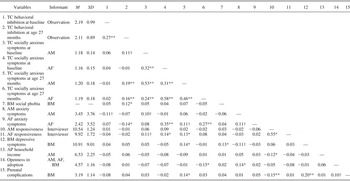
Table 1 presents the means, standard deviations, and bivariate correlations among the study variables. The stability across two assessments was moderate, with stability coefficients of 0.27 for observed behavioral inhibition, 0.53 for adoptive mothers' report of child social anxiety, and 0.58 for adoptive father's report of child social anxiety (p < .01). Overall, the levels of children's observed behavioral inhibition did not change significantly between the ages of 18 (baseline) and 27 months, t (245) = 0.84, ns. However, a statistically significant increase was observed in adoptive mothers' report of their children's social anxiety, t (237) = 2.42, p < .05. No similar trend was obtained for the adoptive fathers' report of their children's social anxiety, t (230) = 1.49, ns. At the baseline, observed social inhibition was not associated with adoptive mothers' or fathers' reports of child social anxiety. However, modest but significant correlations emerged at age 27 months; observed behavioral inhibition was associated with adoptive mothers' and fathers' reports of child social anxiety at .19 and .16 (ps < .01), respectively.
Means, standard deviations, and bivariate correlations of the study variables

Note: TC, target child; AM, adoptive mother; AF, adoptive father; BM, birth mother; AP, adoptive parents. Baseline age = 18 months.
†p < .10. *p < .05. **p < .01.
There was a positive correlation between observed behavioral inhibition at age 27 months and birth mothers' social phobia (r = .12, p < .05). If birth mothers' social phobia had been significantly associated with the measures of adoptive family environment, gene–environment correlation would be suggested. Such a finding would have complicated the estimate of gene–environment interaction. However, we did not find any significant association between birth mothers' social phobia and the indices of adoptive parents' home environment, including those of adoptive parents' anxiety symptoms, responsiveness, or family income.
Primary analyses
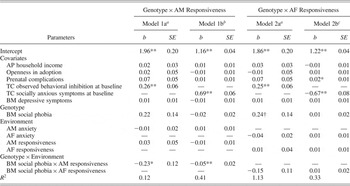
The major aim of this study was to investigate the main and joint effects of genetic risk for social anxiety (inferred from birth mothers' social phobia) and adoptive parents' responsiveness on the development of social anxiety in children. To accomplish this task, we tested four hierarchical linear regression models (see Table 2). Based on the suggestion by Aiken and West (Reference Aiken and West1996), all continuous scales were centered at their own means. The betas reported in Table 2 are unstandardized coefficients, indicating changes in the dependent variables, with one unit change in respective predictors. Models 1a and 1b examined the prospective effects of birth mothers' social phobia and adoptive mothers' responsiveness and anxiety on children's socially inhibited, anxious behaviors at 27 months of age. The dependent variables were the child's observed behavioral inhibition (Model 1a) and the adoptive father's report of the child's socially anxious symptoms (Model 1b). Models 2a and 2b tested the effects of birth mothers' social phobia and adoptive fathers' responsiveness and anxiety. In Model 2a the dependent variable was the child's observed behavioral inhibition, and in Model 2b the dependent variable was adoptive mothers' report of their child's socially anxious symptoms. In all models, we controlled for the covariates of adoptive parents' household income, birth mothers' depressive symptoms, openness in adoption, prenatal complications, and children's baseline social anxiety.
The prospective effects of parental responsiveness on child's inhibition and anxious symptoms at age 27 months

Note: AP, adoptive parents; AM, adoptive mother; AF, adoptive father; TC, target child; BM, birth mother. Baseline age = 18 months.
aObserved behavioral inhibition.
bAF report of socially anxious symptoms.
cAM report of socially anxious symptoms.
†p < .10. *p < .05. **p < .01.
Birth mothers' social anxiety and adoptive mother's responsiveness
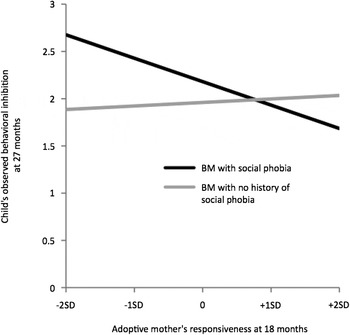
The results of Model 1a demonstrated no main effect of birth mothers' social phobia on children's observed behavioral inhibition at 27 months of age, after controlling for baseline behavioral inhibition (b = 0.26, p < .01) and other covariates. We also found no statistically significant main effect of adoptive mothers' anxiety or responsiveness on children's behavioral inhibition. As expected, the interaction between birth mothers' social phobia and adoptive mothers' responsiveness was significant b = –0.23, p < .05). Following the guidelines by Aiken and West (Reference Aiken and West1996), we illustrated the nature of this interaction in Figure 1. To probe the nature of the interaction, we calculated the simple slope (Preacher, Curran, & Bauer, Reference Preacher, Curran and Bauer2006). For children whose birth mothers had no history of social phobia, adoptive mothers' responsiveness did not have much of an impact on children's inhibited behaviors at 27 months (b = 0.03, ns). However, adoptive mothers' responsiveness was prospectively effective in reducing the levels of social inhibition in children whose birth mothers had experienced social phobia b = –0.20, p < .01).
The interaction between birth mothers' social phobia and adoptive mothers' responsiveness in predicting children's behavioral inhibition in a social setting at 27 months of age.

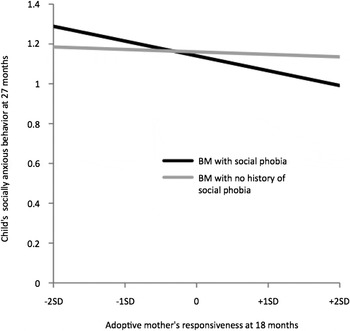
We attempted to replicate the Model 1a findings in Model 1b in which the dependent variable was the adoptive father's report of his child's socially anxious symptoms. The results indicated a similar pattern: The interaction between birth mothers' social phobia and adoptive mothers' responsiveness was statistically significant (b = –0.05, p < .01). This interaction is graphically illustrated in Figure 2. Consistent with the Model 1a results, for children of birth mothers with a history of social phobia, adoptive mothers' responsiveness was negatively associated with the number of socially anxious symptoms at 27 months of age (b = –0.05, p < .01). However, such a negative association between maternal responsiveness and children's social anxiety was not observed in children whose birth mothers had no history of social phobia (b = –0.01, ns).
The interaction between birth mothers' social phobia and adoptive mothers' responsiveness in predicting children's socially anxious behavior (father report) at 27 months of age.

Birth mother's social phobia and adoptive father's responsiveness
Models 2a and 2b explored the moderating effect of the adoptive fathers' responsiveness in the association between genetic vulnerability for social anxiety and their children's fearful, anxious behaviors. As shown in Model 2a, adoptive fathers' anxiety showed a modestly significant main effect but in the unexpected direction (b = –0.04, p < .05). Unlike the adoptive mother's model, the interaction with birth mothers' social phobia and adoptive fathers' responsiveness was not statistically significant.
Model 2b, with the dependent variable being adoptive mother's report of socially anxious symptoms in the adopted child, yielded few significant results with regard to our substantive interest; children who had experienced prenatal complications (b = 0.02, p < .05) and who had higher baseline anxious symptoms (b = 0.67, p < .01) were likely to manifest elevated levels of anxious symptoms at age 27 months. The main effects of birth mothers' social phobia, adoptive fathers' responsiveness, adoptive fathers' anxiety symptoms, and the interaction all failed to reach statistical significance.
Discussion
One of the most important findings of the current investigation is that children with genetic influences on social anxiety (inferred from birth mothers' social phobia) did not show an elevation in social anxiety if their adoptive mothers provided an emotionally and verbally responsive environment. In contrast, the genetic influences on social phobia appear to be accentuated when the child is raised in a less responsive home environment. To lend further credence to the results, the interaction between genetic propensity and maternal responsiveness was replicated in both models in which observed behavioral inhibition and the parent-report CBCL social anxiety subscale were used as the dependent variables. The current report joins the work on older children (Fox et al., Reference Fox, Nichols, Hendersen, Rubin, Schmidt and Hamer2005) by highlighting the importance of gene–environmental interactions in understanding why some children develop socially anxious, fearful behavior while others do not.
The present findings concerning maternal responsiveness as an effective modifier of the genetic vulnerability for social anxiety in toddlerhood point out the necessity of considering the concept of parental responsiveness within a developmental framework. While parental awareness of children's needs and prompt delivery of support may be protective factors, parental overprotective behaviors that threaten children's age-normative autonomy and independence are known as risk factors for offspring's anxiety (Lieb et al., Reference Lieb, Wittchen, Hofler, Fuetsch, Stein and Merikangas2000; McLeod et al., Reference McLeod, Wood and Weisz2007). For instance, parental behavior that was once considered as responsive (e.g., spoon-feeding the child when he wants to eat) may become overtly solicitous and controlling when the child reaches an age at which he or she prefers to develop autonomy (e.g., eating by himself with his own spoon). Previous work indicates that children whose parents are overly warm and/or protective tend to maintain their inhibited behaviors over time (Rubin, Burgess, & Hastings, Reference Rubin, Burgess and Hastings2002). At what point responsive parenting becomes excessively controlling and oversolicitous is likely to depend on the age of the child and his or her cognitive, emotional, and physical capability. Future studies should examine the ways in which parents adjust their definition of responsiveness to the developing child's needs and the ways in which changing parenting affects the development of social anxiety in children.
A next step for furthering parenting–child characteristic interactions is to scrutinize whether the ranges of children's reactions to parenting are driven by the children's individual “liability/risk factors,” “resilience,” or “susceptibility to environment.” Belsky and others have argued that children may have differential susceptibility to environments, and that differential susceptibility is likely to have biological roots (Belsky, Bakermans-Kranenburg, & van IJzendoorn, Reference Belsky, Bakermans-Kranenburg and van IJzendoorn2007; Boyce & Ellis, Reference Boyce and Ellis2005). According to their theoretical framework, children who are highly sensitive to environmental influences are expected to fare better when they are placed in a supportive environment but to function worse in an adverse environment. The present findings are somewhat consistent with the predictions of the differential susceptibility hypothesis, but unfortunately they are not sufficient to confirm it. A rigorous test of the differential susceptibility hypothesis requires a design whereby researchers can examine the range of reactions in children who are exposed to a wide variety of environments, ideally in a longitudinal fashion. The current investigation focused on a relatively narrow range of environments (i.e., adoptive parents' responsiveness), which was generally supportive. We encourage future research to focus efforts on examining why children of mothers with social phobia are more susceptible to the protective effect of responsive parenting and whether these children are also sensitive to the influences of adverse, difficult environment.
An important contribution of the present study to the existing literature is the inclusion of paternal responsiveness. The majority of studies examining parental responsiveness in young children have limited their scope to mothers, leaving fathers out of the picture. The results of the present investigation, however, did not yield conclusive findings for paternal responsiveness. The question of why the effect of paternal responsiveness is not as evident as that of maternal responsiveness in modulating genetic influences warrants further attention. One potential explanation may be that children tend to spend less time with their fathers than with their mothers in early childhood (Yeung, Sandberg, Davis-Kean, & Hofferth, Reference Yeung, Sandberg, Davis-Kean and Hofferth2001), which limits the impact paternal parenting exerts on children. Continued research is encouraged to examine how paternal responsiveness influences early child development.
Several methodological strengths of the current investigation bolster the credence of the findings in this report. An application of an adoption design allowed us to maximally tease apart the nature and nurture aspects of the familial aggregation of psychopathology. This is a well-known advantage of the adoption design over traditional family designs in which a child is raised by parents who are biologically related (Rutter et al., Reference Rutter, Pickles, Murray and Eaves2001). We further applied three methodological approaches to clarify the distinction between nature and nurture: (a) recruiting the sample of adoptees who were placed at birth; (b) including assessments of openness in the adoption as a covariate to statistically adjust for any postadoption contact between adoptive and birth parents that may, if not considered, overestimate genetic effects; and (c) being attentive to prenatal environmental risks by assessing birth mothers' obstetric complications. In addition, we included other environmental variables (i.e., adoptive parents' anxiety) into our account to investigate the unique effects of the caregiving environment. We further included birth mothers' depressive symptoms to at least statistically account for the comorbidity between depression and social phobia. We also applied the mismatched informant design to reduce the shared method variance by using five reporters (birth mother, adoptive mother, adoptive father, interviewer, and observed/coded) so that no informant reported both the criterion and the predictor variables of substantive interest. Furthermore, we conducted internal replications by using different, but theoretically closely related dependent variables (behavioral inhibition in a social setting vs. CBCL social anxiety) whose data were collected via distinctive means (i.e., observation vs. adoptive parents' reports). Finally, although the longitudinal design does not offer any evidence for causality, it yields a more definitive logical basis for inferring the sequence of events. In particular, by including the preexisting social anxiety as a covariate in the analytical models, we were better able to discern what would likely happen later in development when children with differing levels of genetic propensity are provided with varying levels of caregiving environments. These methodological approaches provided an opportunity to conservatively test how genotype and environment jointly constitute the underpinnings of the intergenerational transmission of social phobia. Nevertheless, because evidence of moderation of genetic liability by environment in a longitudinal adoption design is rare, replication is needed.
Limitations and future directions
Several caveats of the present study should be discussed. First, the use of birth mothers' phenotype (i.e., social phobia) to infer their genotype produces several limitations. It is of the most importance that this estimation approach does not include genetic influences from birth fathers. In the present study, only 31% of families in the anlaytical sample had data from birth fathers, and only 15 of them had social phobia. The small sample size posed analytical challenges and prevented the full evaluation of the study hypotheses. The importance of including birth father data should be emphasized in future research. Furthermore, the present study used a lifetime diagnosis of social phobia, which inevitably weighted the likelihood of being diagnosed with lifetime social phobia higher for older birth mothers than for younger mothers. The examination of candidate genes in future studies may solve these issues. However, the hunt for specific genes for psychopathology appears to be less promising than previously hoped for because most phenotypes appear to involve complex interactions and sequences of multiple genes, neural actions, and environnements (e.g., Gottlieb, Reference Gottlieb1998, Reference Gottlieb2007). Genes that are linked to specific phenotypes in humans appears to only account for a small amount of variance in outcomes (Plomin & McGuffin, Reference Plomin and McGuffin2003). Even though we believe that the findings based on inferred genetic effects are not trivial, readers are reminded that the understanding of a complex interplay between genetic risk for social phobia and environment in children's emotional development requires extra caution.
Second, parental responsiveness was assessed via interviewer ratings on a standardized measure after a 2.5-hr home visit, which may have reduced sensitivity in capturing the complexities that parental responsiveness entails. Parental responsiveness is a multidimensional construct that connotes dimensions such as response contingency, emotional–affective support, scaffolding of infant attention, and language input, and each aspect is known to have related yet distinct functioning in supporting child development (Landry et al., Reference Landry, Smith and Swank2006). Readers are also reminded that the alphas for the responsiveness scale were lower than optimal and that the scale was negatively skewed.
Additional limitations are that although we conceptualized behavioral inhibition as a precursor of social phobia, behavioral inhibition is a general risk factor for a variety of emotional and behavioral syndromes that extend beyond social anxiety (Degnan et al., Reference Degnan, Almas and Fox2010). The developmental psychopathology perspective has long identified this phenomenon, as expressed in the developmental principle of multifinality, in which one common starting point (e.g., a highly inhibited, fearful child) may result in varied outcomes and in which one risk factor probabilistically forebodes later psychopathology (Cicchetti & Cohen, Reference Cicchetti, Cohen, Cicchetti and Cohen1995; Sroufe, Reference Sroufe1997). Thus, readers should be reminded that high behavioral inhibition may increase the probability of future social phobia as well as other psychopathology. In addition, there may have been factors unique to individuals who opted for adoption, which may limit generalizability of the present findings. For instance, we reported elsewhere that the rates of substance use cessation during pregnancy in our sample of birth mothers were lower than those in the general population of pregnant women but were more similar to the rates reported in low-income pregnant women who chose to parent children (for details, see Massey et al., Reference Massey, Lieberman, Reiss, Leve, Shaw and Neiderhiser2010). In addition, it is important to note that the observed effects were small (R 2 for four models ranging from .12 to .41) and main effects of genetic influences and two kinds of environments (i.e., responsive parenting and adoptive parents' anxiety) did not reach statistical significance. However, dismissing small effects as trivial would be erroneous given the complexity of human behavior (Ahadi & Diener, Reference Ahadi and Diener1989). Finally, although we did not find any significant finding for gene–environment correlation in this study, gene–environment correlation in social anxiety is a topic that warrants future attention, becuase gene–environment correlation has been identified as one of the key players in the mechanisms through which parents and children influence each other (Neiderhiser, Reference Neiderhiser, Booth, McHale and Landale2011).
These limitations notwithstanding, the present investigation identified an important pathway through which social anxiety is transmitted from a parent to a child: genetic influences on social anxiety, if inherited, may be manifested in an unresponsive rearing environment, but they can be offset by a responsive caregiving environment. Such interactions between genotype and environment likely explain, at least partially, why social anxiety tends to cluster in some families but not in others.