Childhood adversity is among the strongest predictors of psychopathology and is associated with a range of mood and psychotic symptoms that cut across diagnostic boundaries (Collinshaw et al., Reference Collishaw, Pickles, Messer, Rutter, Shearer and Maughan2007; Danese et al., Reference Danese, Moffitt, Harrington, Milne, Polanczyk, Pariante and Caspi2009; Evans, Li, & Whipple, Reference Evans, Li and Whipple2013; Kessler et al., Reference Kessler, Green, Gruber, Sampson, Bromet, Cuitan and Lara2010; Price, Kao, Burgers, Carpenter, & Tyrka, Reference Price, Kao, Burgers, Carpenter and Tyrka2013). In addition to conferring increased risk for serious mental illnesses such as schizophrenia and bipolar disorder (Mandelli, Perelli, & Seretti, Reference Mandelli, Petrelli and Serretti2015; Palmier-Claus et al., Reference Palmier-Claus, Berry, Darrell-Berry, Emsley, Parker, Drake and Bucci2016), exposure to childhood trauma is associated with subthreshold psychotic experiences (e.g., low-grade delusions, isolated auditory hallucinations, and perceptual aberrations), even among individuals who do not have a psychotic disorder (Kelleher et al., Reference Kelleher, Harley, Lynch, Arseneault, Fitzpatrick and Cannon2008). While there is general agreement around the broad principle that childhood adversity confers risk for psychopathology by altering developing stress systems, the cortisol findings have been inconsistent (Gunnar & Quevedo, Reference Gunnar and Quevedo2007b; Hunter, Minnis, & Wilson, Reference Hunter, Minnis and Wilson2011; Lupien, McEwen, Gunnar, & Heim, Reference Lupien, McEwen, Gunnar and Heim2009; Repetti, Robles, & Reynolds, Reference Repetti, Robles and Reynolds2011; Tyrka et al., Reference Tyrka, Wier, Price, Ross, Anderson, Wilkinson and Carpenter2008). These mixed findings raise the possibility that psychological aspects of stress processing, such as stress perception, may underlie variations in these associations, and that differences in adversity type, sex, and age may be relevant in understanding the diverse effects of childhood adversity on stress processes.
Previous research on childhood adversity has typically focused on the biological stress response and paid less attention to the subjective stress appraisals. However, transactional models of stress posit a dynamic interplay between stressful experiences, subjective stress perception, and neuroendocrine responses (Gunnar & Quevedo, Reference Gunnar and Quevedo2007a). These intermediary appraisal processes have been hypothesized to play a critical role in stress vulnerability (Olff, Langeland, & Gersons, Reference Olff, Langeland and Gersons2005). There is growing support and theorizing that early experiences shape an individual's perception of, and tolerance to, subsequent stressors later in life (Chen & Baram, Reference Chen and Baram2016; Hammen, Henry, & Daley, Reference Hamman, Henry and Daley2000; Harkness, Hayden, & Lopez-Duran, Reference Harkness, Hayden and Lopez-Duran2015; Maniam, Antoniadis, & Morris, Reference Maniam, Antoniadis and Morris2014; Pechtel, & Pizzagalli, Reference Pechtel and Pizzagalli2011). Active calibration and biological sensitivity to context models posit that information from early environments is used to calibrate activation thresholds and responses within stress systems to best match those environments (Boyce & Ellis, Reference Boyce and Ellis2005; Del Giudice, Ellis, & Shirtcliff, Reference Del Giudice, Ellis and Shirtcliff2011). Extending these theories to include stress perception raises the possibility that the psychological perception of stress may also be shaped to match the demands of childhood adversity. Early experiences and environments characterized by high levels of stress, unpredictability, low controllability, and unresponsive caregiving have been shown to have enduring effects on indices known to impact stress perception, including perceptions of control, cognitive biases, coping strategies, self-efficacy, and attributional styles (Chorpita & Barlow, Reference Chorpita and Barlow1998; Jerusalem & Schwarzer, Reference Jerusalem, Schwarzer and Schwarzer1992; Mittal & Griskevicius, Reference Mittal and Griskevicius2014; Repetti, Taylor, & Seeman, Reference Repetti, Taylor and Seeman2002, Suzuki, Poon, Papadopoulos, Kumari, & Cleare, Reference Suzuki, Poon, Papadopoulos, Kumari and Cleare2014). Thus, childhood adversity may have specific effects on the development of an individual's subjective perceptions of stress.
Stress perception depends upon an individual's detection and appraisal of a threat within the context of the available coping resources (Folkman, Lazarus, Dunkel-Schetter, DeLongis, & Gruen, Reference Folkman, Lazarus, Dunkel-Schetter, DeLongis and Gruen1986; Gunnar & Vazquez, Reference Gunnar, Vazquez, Cicchetti and Cohen2006; Lazarus & Folkman, Reference Lazarus, Folkman and Gentry1984). Both animal and human studies have found that experiences with controllable stressors in childhood facilitate the development of adaptive stress responding and detection thresholds via calibration of corticolimbic circuits (Maier, Amat, Baratta, Paul, & Watkins, Reference Maier, Amat, Baratta, Paul and Watkins2006; Mittal & Griskevicius, Reference Mittal and Griskevicius2014; Wadsworth, Reference Wadsworth2015). In childhood environments characterized by uncontrollable stressors, this calibration process is altered, such that the individual becomes more attuned and responsive to detecting potential stressors and threats (Chen & Baram, Reference Chen and Baram2016). While heightened detection promotes safety in adverse environments, it also has the potential to contribute to a dysfunctional state of hypervigilance in normal contexts. Another critical component of stress perception involves the individual's evaluation of his or her coping capacities (Lazarus & Folkman, Reference Lazarus, Folkman and Gentry1984; Lengua & Long, Reference Lengua and Long2002). Decreases in perceived coping resources have been found to increase subjective experiences of stress (Folkman et al. Reference Folkman, Lazarus, Dunkel-Schetter, DeLongis and Gruen1986). Childhood environments play a critical role in shaping the development of coping repertoires, which sets the stage for how stressors are evaluated later in life. While coping strategies are more flexible and context specific in childhood, they become increasingly traitlike in adulthood (Compas, Connor, Saltzman, Thomsen, & Wadsworth, Reference Compas, Connor, Saltzman, Thomsen, Wadsworth, Lewis and Ramsay1999).
Uncontrollable or unpredictable environments impede the development of active coping strategies, such as problem solving, which are less likely to be effective in these environmental contexts (Wadsworth, Reference Wadsworth2015). Instead, children who experience trauma often develop problematic coping strategies in an effort to protect themselves from harm and overwhelming stress (Ullman & Peter-Hagene, Reference Ullman and Peter-Hagene2014). While these strategies may be adaptive in their immediate environments, they impair an individual's ability to navigate future stressors (van Harmelen et al., Reference van Harmelen, van Tol, van der Wee, Veltman, Aleman, Spinhoven and Elzinga2010; Wadsworth, Reference Wadsworth2015). The combination of heightened threat detection and limited coping repertories, which may be viewed as functional adaptations to childhood adversity, are likely to have longstanding effects on an individual's propensity to appraise and react to the daily stressors later in life (Suzuki et al., Reference Suzuki, Poon, Papadopoulos, Kumari and Cleare2014). Consistent with this proposed developmental sequelae, a large longitudinal study (n = 34,653) found that exposure to childhood adversity was related to a higher perceived intensity of daily stress in adults (McLaughlin, Conron, Koenen, & Gilman, Reference McLaughlin, Conron, Koenen and Gilman2010). Similarly, a recent epidemiological community study found that childhood trauma was associated with higher subjective stress appraisals (Rössler, Ajdacic-Gross, Rodgers, Haker, & Muller, Reference Rössler, Ajdacic-Gross, Rodgers, Haker and Müller2016). Studies with depressed (Wichers et al., Reference Wichers, Barge-Schaapveld, Nicolson, Peeters, De Vries, Mengelers and van Os2009) and psychosis risk (Lardinois, Lataster, Mengelers, van Os, & Myin-Germeys, Reference Lardinois, Lataster, Mengelers, van Os and Myin-Germeys2011) samples have also found that individuals exposed to childhood physical and sexual abuse show heightened stress perception toward minor daily hassles. These findings suggest that childhood adversities may have an enduring effect on the stress system via heightened perception of day-to-day stressors across the life span (Glaser, van Os, Portegijs, & Myin-Germeys Reference Glaser, van Os, Portegijs and Myin-Germeys2006).
Consistent with transactional models of stress, there is also evidence that stress perception modulates endocrine responses. Several studies have found associations between subjective perceptions of stress (e.g., magnitude, controllability, and coping ability) and biological stress response indices (Dickerson & Kemeny, Reference Dickerson and Kemeny2004; Juster, Perna, Marin, Sindi, & Lupien, Reference Juster, Perna, Marin, Sindi and Lupien2012; Sladek, Doane, Luecken, & Eisenberg, Reference Sladek, Doane, Luecken and Eisenberg2016; Slattery, Grieve, Ames, Armstrong, & Essex, Reference Slattery, Grieve, Ames, Armstrong and Essex2013; Wirtz et al., Reference Wirtz, von Känel, Emini, Suter, Fontana and Ehlert2007), although others have not (Schlotz et al., Reference Schlotz, Kumsta, Layes, Entringer, Jones and Wüst2008). Specifically, some studies have found that cognitive appraisal of stressors accounts for approximately 20%–30% of the variance in cortisol response (Gaab et al., Reference Gaab, Blättler, Menzi, Pabst, Stoyer and Ehlert2003; Gaab, Rohleder, Nater, & Ehlert, Reference Gaab, Rohleder, Nater and Ehlert2005; Hammerfald et al., Reference Hammerfald, Eberle, Grau, Kinsperger, Zimmermann, Ehlert and Gaab2006). A recent study with healthy youth (ages 6–17) found that perceived stress had greater associations with basal cortisol and peak cortisol following a stressor task than objective experiences of stress (i.e., significant life events scale), even after controlling for anxiety (Allwood, Gaffey, Vergara-Lopez, & Stroud, Reference Allwood, Gaffey, Vergara-Lopez and Stroud2017). Meanwhile, a study with adolescents found that perceptions of coping abilities predicted acute cortisol reactivity to a stressor task (Slattery et al., Reference Slattery, Grieve, Ames, Armstrong and Essex2013). Other physiological responses to stress (e.g., cardiovascular reactivity) have also been shown to differ based on whether the stress is perceived as a challenge versus a threat (Seery, Reference Seery2011; Seery, Weisbuch, & Blascovich, Reference Seery, Weisbuch and Blascovich2009; Turner, Jones, Sheffield, Barker, & Coffee, Reference Turner, Jones, Sheffield, Barker and Coffee2014), suggesting that subjective appraisals may modulate both endocrine and sympathetic arousal. Taken together, these findings further reinforce the importance of considering stress perception in models of stress functioning.
An important step in this line of investigation is to establish whether childhood adversity is associated with heightened perception of daily stressors, and whether this relationship mediates the association between adversity and cortisol levels. Higher perceptions of daily stress may lead to amplified hypothalamic–pituitary–adrenal (HPA) axis activity, and elevations in cortisol, as a result of being in a constant state of stress. Previous research suggests that cortisol levels fluctuate across days due to situational factors including subjective stress load from the prior, as well as the upcoming day (Hellhammer et al., Reference Hellhammer, Fries, Schweisthal, Schlotz, Stone and Hagemann2007). Consistent with this, a study with adults found that appraisals of daily hassles impacted next day cortisol awakening responses, such that lower cortisol awakening response levels were only seen after days when hassles were appraised as stressful (Gartland, O'Connor, Lawtwon, & Bristow, Reference Gartland, O'Connor, Lawton and Bristow2014). These findings suggest stress perception may be salient to HPA axis activity and reflected in next day cortisol patterns.
Assuming perceptions of and reactions to stress are shaped by the characteristics of early environments, it stands to reason that adversity type may be relevant to delineating the associations between childhood adversity and stress indices. Most studies employ generalized risk approaches that include subjects with varied histories of sexual abuse, physical abuse, neglect, and poverty in one sample. A critical assumption here is that different types of adversity uniformly impact outcomes, and thus are exchangeable. However, there is preliminary evidence that different types of childhood adversity, and stressors more broadly, may have distinct consequences on the stress response system (Busso, McLaughlin, & Sheridan, Reference Busso, McLaughlin and Sheridan2017; Kuhlman, Geiss, Vargas, & Lopez-Duran, Reference Kuhlman, Geiss, Vargas and Lopez-Duran2015; Miller, Chen, & Zhou, Reference Miller, Chen and Zhou2007). For example, a large meta-analysis by Miller et al. (Reference Miller, Chen and Zhou2007) found that stressors characterized by threat of harm and/or traumas were uniquely associated with a high, flat diurnal profile of cortisol secretion. A recent study in adolescents with a history of childhood adversity also found differential associations among subtypes of childhood adversity and indices of HPA axis functioning (e.g., diurnal rhythm, reactivity, and recovery; Kulhman et al., Reference Kuhlman, Geiss, Vargas and Lopez-Duran2015). Different types of adversity may also have unique effects on the development of locus of control, self-efficacy, coping strategies, and schemas that influence stress appraisals (Chorpita & Barlow, Reference Chorpita and Barlow1998; Jerusalem & Schwarzer, Reference Jerusalem, Schwarzer and Schwarzer1992). These findings suggest that the nature of adversity experiences pose different demands on stress processes that result in unique neuroendocrine and subjective perceptions and highlight the utility of distinguishing between different types of adversity when examining their associations with stress indices.
While several different approaches to categorizing adversity types have been utilized in the literature (e.g., dependent vs. independent, social vs. nonsocial, and physical abuse vs. emotional abuse), these categories often lack a theoretical rationale for why these experiences should predict different outcomes. However, a recent conceptual model outlined by McLaughlin, Sheridan, and Lambert (Reference McLaughlin, Sheridan and Lambert2014) that distinguishes and categorizes adversity experiences along dimensions of threat and deprivation may provide a more useful strategy. In this model, threat refers to interpersonal exposures that involve harm or threat of harm, such as physical and sexual abuse. In contrast, deprivation refers to exposures that reflect an absence of expected environmental inputs such as poverty, neglect, and limited psychosocial support. In contrast with generalized-risk models this differentiated “dimensions of adversity” approach posits that threat and deprivation may increase risk for poor outcomes through distinct biological and developmental processes. A recent study utilizing the dimensions of adversity framework found that threat, but not deprivation, was associated with attenuated cortisol reactivity following a stress induction task (Busso, McLaughlin, & Sheridan, Reference Busso, McLaughlin and Sheridan2017), providing some of the first empirical evidence for the differentiation of these dimensions in stress processes. While threat and deprivation dimensions have face validity, and there is some evidence that the distinction may be a valid one, further empirical exploration is needed. Comparing generalized adversity and differentiated adversity models that distinguish between threat and deprivation will help us determine whether the nature of specific exposures uniquely impacts stress indices.
Finally, sex and age differences are documented throughout the stress literature and may moderate the impact of childhood adversity on stress processes. Females report higher levels of perceived stress when compared to males in response to both life events (Davis, Matthews, & Twamley, Reference Davis, Matthews and Twamley1999) and daily hassles (Almedia & Kessler, Reference Almeida and Kessler1998; Myin-Germeys, Krabbendam, Delespaul, & van Os, Reference Myin-Germeys, Krabbendam, Delespaul and van Os2004). Sex differences in biological indices of HPA axis activity and stress reactivity have been less consistent and may depend on the nature of stressor presented (Kudielka & Kirschbaum, Reference Kudielka and Kirschbaum2005, Paris et al., Reference Paris, Franco, Sodano, Freidenberg, Gordis, Anderson and Frye2010; Pruessner et al., Reference Pruessner, Wolf, Hellhammer, Buske-Kirschbaum, Von Auer, Jobst and Kirschbaum1997; Wüst, Federenko, Hellhammer, & Kirschbaum, Reference Wüst, Federenko, Hellhammer and Kirschbaum2000). For example, there is some evidence that females show stronger biological responses to stressors that are interpersonal in nature (Stroud, Salovey, & Epel, Reference Stroud, Salovey and Epel2002).
Developmental differences related to age and pubertal status are also observed in the stress literature. There are normative age-related increases in stress reactivity and sensitivity to emotional stimuli during the transition from middle childhood to adolescence related to pubertal development and the activation of gonadal hormones (Andersen & Teicher, Reference Andersen and Teicher2008; Romeo & McEwen, Reference Romeo and McEwen2006; Spear, Reference Spear2009; Walker, Sabuwalla, & Huot, Reference Walker, Sabuwalla and Huot2004). Increases in both basal cortisol levels and cortisol response to stress inductions are observed across this developmental period (Gunnar, Wewerka, Frenn, Long, & Griggs, Reference Gunnar, Wewerka, Frenn, Long and Griggs2009). Similarly, perceived daily stress increases through adolescence, then appears to decline and stabilize in healthy youth at the age of 18 (Trotman et al., Reference Trotman, Holtzman, Walker, Addington, Bearden, Cadenhead and Tsuang2014). Another study found that stress perception increases in early to middle adolescence (12–15 years), and then decreases during the transition to adulthood (Seiffge-Krenke, Aunola, & Nurmi, Reference Seiffge-Krenke, Aunola and Nurmi2009). This pattern aligns with research on age differences in coping capacities, which has found that middle adolescence (15 to 17 years old) represents a turning point during which youth utilize more adaptive coping strategies as a function of cognitive maturation (Zimmer-Gembeck & Skinner, Reference Zimmer-Gembeck and Skinner2011). These findings point to early to middle adolescence as a developmental period during which the effects of childhood adversity on stress functioning may be amplified.
Current Study
The current study investigated the links between childhood adversity, stress perception, and a biological index of HPA axis function (i.e., salivary morning cortisol), and examined whether stress perception mediates the association between childhood adversity and morning cortisol. Heightened stress perception may be a key consequence of childhood adversity that perpetuates stress vulnerability and continues to impact day-to-day HPA axis functioning. Accordingly, we hypothesized that childhood adversity would have an indirect effect on morning cortisol through stress perception. Given evidence that different types of adversity may have unique effects on stress processes, we compared a generalized and differentiated adversity model (threat vs. deprivation). Based on the principles of functional adaptation models (e.g., the active calibration model), we predicted that associations between childhood adversity and stress measures would be stronger for threat exposures. Early experiences of danger and threat of harm are likely to pose more significant functional demands on developing threat detection and coping processes related to stress perception, as well as greater HPA axis dysregulation (Busso, Mclaughlin, Brueck, et al., Reference Busso, McLaughlin, Brueck, Peverill, Gold and Sheridan2017). We also examined whether adversity–stress associations were moderated by sex and age. Given the evidence of increased stress vulnerability in females, we predicted that sex would moderate the associations between childhood adversity and stress measures, with stronger effects observed in females. Finally, we predicted that age would also moderate these associations. Given the normative developmental changes in stress responsivity and coping capacities during adolescence, we expected the associations between childhood adversity and stress measures to be stronger in our younger participants.
We utilized a large sample that included individuals at clinical-high risk (CHR) for serious mental illness, who are identified on the basis of subthreshold psychotic symptoms. The CHR population is ideally suited to test the effects of childhood adversity as these samples are enriched for adversity experiences and allow for a wider variation of adversity than what is typically afforded by community samples (Bendall, Jackson, Hulbert, & McGorry, Reference Bendall, Jackson, Hulbert and McGorry2007; Larsson et al., Reference Larsson, Andreassen, Aas, Røssberg, Mork, Steen and Melle2013; Matheson, Shepherd, Pinchbeck, Laurens, & Carr, Reference Matheson, Shepherd, Pinchbeck, Laurens and Carr2013; Read, van Os, Morrison, & Ross, Reference Read, van Os, Morrison and Ross2005, Ruby et al., Reference Ruby, Polito, McMahon, Gorovitz, Corcoran and Malaspina2014). In addition to subthreshold positive symptoms, 80% of CHR individuals have comorbid diagnoses of mood, personality, and externalizing disorders that are independent of psychosis outcome (Addington et al., Reference Addington, Piskulic, Liu, Lockwood, Cadenhead, Cannon and Tsuang2017). While about 20%–30% go on to manifest a psychotic disorder, even more develop major depression and bipolar disorder (Fusar-Poli, Nelson, Valmaggia, Yung, & McGuire, Reference Fusar-Poli, Nelson, Valmaggia, Yung and McGuire2014).
Method
Sample
The sample included 605 individuals between 12 and 30 years of age (mean = 19.2, SD = 4.5). All participants were recruited as part of the North American Prodrome Longitudinal Study, which identifies individuals at CHR for developing psychosis. Specific details about ascertainment and inclusion and exclusion criteria have been described in detail elsewhere (Addington et al., Reference Addington, Cadenhead, Cornblatt, Mathalon, McGlashan, Perkins and Addington2012). Of the 605 participants, 423 (70%) met CHR criteria for serious mental illness; 182 (30%) did not meet the criteria for CHR status. Participants were included in the current study if measures of childhood adversity exposure, salivary cortisol, and stress perception were collected at the baseline visit.
Measures
Threat exposure
Threat was operationalized to denote adverse experiences involving harm or threat of harm to an individual. Specific types of threat exposures were assessed using the Documentation of Trauma Form, a semistructured interview that retrospectively assesses six types of negative childhood experiences before the age of 16. Participants where asked whether they had experienced the following: emotional abuse (e.g., “unjustified punishment” or “being sworn at”), physical abuse (e.g., “being kicked or punched”), psychological bullying (e.g., “taunted or sworn at by peers”), physical bullying (e.g., “physically assaulted at school”), and sexual abuse (e.g., “touched sexually against will” or “sexual contact against will”). Responses were rated on a categorical “present” or “absent” scale. A threat composite score was created by summing responses to the physical abuse, sexual abuse, emotional abuse, physical bullying, and psychological bullying items. The threat composite score ranged from 0 (no endorsement of threat exposures) to 5 (endorsement of all threat exposures), and was used in all statistical analyses to capture variation in threat exposures.
Deprivation exposure
Deprivation was operationalized to denote experiences involving the absence of expected cognitive and social inputs. In the current study, deprivation items included indices of childhood poverty, emotional neglect, parental absence, and restricted peer relationships during childhood. Poverty was determined by the ratio of income to needs, which was computed by dividing reported family of origins income by US Census 2014 poverty line for a family of that size, with a value of <1 indicating that a family was living below the poverty line. A dichotomous measure of poverty was used rather than the linear income-to-needs ratio because it is unlikely that deprivation of inputs exist at the higher end of income distribution. Neglect was assessed via the neglect item (e.g., “not able to find any attention or support from people at home”) on the Documentation of Trauma Form described above. Restricted peer interactions (a proxy of psychosocial deprivation) was determined using the social subscales of the Premorbid Adjustment Scale (Cannon-Spoor, Potkin, & Wyatt, Reference Cannon-Spoor, Potkin and Wyatt1982), a widely used semistructured interview designed to retrospectively assess social and academic functioning across development. Interviewers rated participants on a 7-point scale for peer relationships during childhood (age 5–11 years). Scores falling between 4 and 6, which indicate social isolation and lack of same-aged peer relationships, were used to indicate restricted peer relationships. Finally, absence of a biological parental figure (e.g., no/minimal contact) was determined from a demographic information interview. A deprivation composite score was created by summing items of childhood poverty, childhood peer relations, parental absence, and neglect. This deprivation composite ranged from 0 (no endorsement of deprivation exposures) to 4 (endorsement of all deprivation exposures), and was used in all statistical analyses to capture variation in deprivation exposures.
Salivary cortisol
Basal cortisol levels were measured rather than acute cortisol reactivity given concerns about adverse effects of stress-induction paradigms on participants at risk for psychopathology. In addition, numerous animal and human studies have demonstrated that basal cortisol levels are associated with cortical volume, cognitive performance, and behavior, and it is assumed that these relations reflect the adverse effects of cortisol exposure that contribute to risk for psychopathology (for reviews see Lupien et al., Reference Lupien, McEwen, Gunnar and Heim2009; Lupien, Ouellet-Morin, Herba, Juster, & McEwen, Reference Lupien, Ouellet-Morin, Herba, Juster and McEwen2016). Cortisol (μg/dL) concentrations were assessed via salivary samples during a baseline assessment in the research clinic. Salivary samples were collected using the drool method, whereby participants expectorate approximately 1.5 mL of saliva into a tube. Multiple saliva samples (n = 3) were obtained to derive an average and increase the reliability of the cortisol estimate. Cortisol levels were measured in the morning in order to minimize the cumulative effects of extraneous factors, such as food and activity level, that accrue through the day and have been shown to influence cortisol measurement (Kudielka, Hellhammer, & Wust, Reference Kudielka, Hellhammer and Wüst2009; Kudielka, Schommer, Hellhammer, & Kirschbaum, 200;). Samples were collected approximately on the hour, beginning on average about 10:00 a.m., with a range from 9:00 a.m. to 11:30 a.m. at onset of sampling (SD = 26 min). Saliva samples were immediately stored in a −20 °C freezer until they were shipped on dry ice to a laboratory in Atlanta, Georgia. In preparation for assay, samples were rapidly thawed and centrifuged. All samples were assayed for salivary cortisol (μg/dL) using a highly sensitive enzyme immunoassay (Salimetrics, State College, Pennsylvania). The test uses about 25 μL of saliva (for singlet determinations), has a range of sensitivity from .007 to 1.8 mg/dL, and has average intra-assay and interassay coefficients of variation of less than 10% and 15%. All samples were assayed in duplicate.
Stress perception
Stress perception was operationalized as perceived stressfulness of daily hassles. The Daily Stress Inventory is a 58-item measure of minor, common daily hassles occurring within the past 24 hr. Examples of such items include “was interrupted during task/activity,” “was criticized,” and “had your sleep disturbed.” Participants indicated if the event occurred and rated each endorsed event on a 7-point Likert scale ranging from occurred, but was not very stressful to caused me to panic. An index of stress perception was computed by regressing the total sum of stress ratings on the number of daily stress items endorsed. This method distinguishes among individuals who report the same number of exposures, but who differ in their subjective stress appraisals.
Data analyses
Consistent with findings of elevated rates of childhood adversity among youth at risk for psychosis, CHR youth endorsed higher levels of threat, (F (1, 603) = 95.40 p < . 01, deprivation, F (1, 603) = 77.20, p < . 01, and generalized adversity, F (1, 603) = 119.84, p < . 01, exposures. CHR youth also had higher levels of stress perception compared to healthy controls, F (1, 603) = 24.97, p <. 01; however, these group differences were no longer significant when adversity exposure was controlled for. There were no group differences in morning cortisol, F (1, 603) = 0.16, p =. 69. Analyses were conducted on the entire sample in order to include variation in childhood adversity exposure, stress measures, and psychopathology. However, group status (CHR vs. healthy control) was included in all analyses to control for diagnostic group effects on the proposed associations.
Path models were constructed to examine the associations between childhood adversity, stress perception, and morning cortisol using software package Mplus version 5.21 (Muthen & Muthen, Reference Muthen and Muthén2010). Childhood adversity, stress perception, and age variables were standardized prior to analyses. We estimated a generalized adversity model, which aggregates all adversity exposures into a single score, and compared it to a differentiated adversity model, which categorizes adversity exposures along dimensions of threat and deprivation. In the differentiated adversity model, both threat and deprivation were entered into the model, which allowed us to examine the effect of each adversity dimension (e.g., threat), while controlling for the effect of the other (e.g., deprivation). To test for mediation across all models, both direct and indirect effects were examined. The significance of indirect effects was tested using a bootstrapping approach (Hayes, Reference Hayes2013). To test for moderation, interaction terms were created by multiplying two standardized variables (e.g., Age × Threat). Main effect and interaction terms (sex and age) were included on all pathways. In the generalized risk model, a total of 6 interaction terms were modeled simultaneously; 10 interaction terms were modeled in the differentiated adversity model. The significance of the interaction term was used to determine whether moderation occurred. To ensure that co-occurring psychopathology did not confound associations, all models controlled for CHR group status.
For both the generalized and the differentiated-adversity approaches, we estimated two models. The first path model included interaction terms for sex and age on all pathways to examine whether stress perception mediated the association between adversity and morning cortisol, and whether these pathways were moderated by sex or age. The second path model was modified to only include the significant interaction terms observed in first model.
Prior to analyses, we tested whether cortisol sample timing was related to variables of interest (i.e., adversity exposure, stress perception, and CHR status) and found no significant associations. Due to diurnal changes and the relation between sampling time and cortisol levels, cortisol samples were adjusted for time of day collection by using a residualized score. A log transformation was applied to normalize the distribution of cortisol, a standard procedure with cortisol data (Miller & Plessow, Reference Miller and Plessow2013). Statistical significance was based on p < .05, and all tests were two-tailed. Standardized betas are presented in results; unstandardized betas are reported for tests of simple slopes.
Results
Sample characteristics
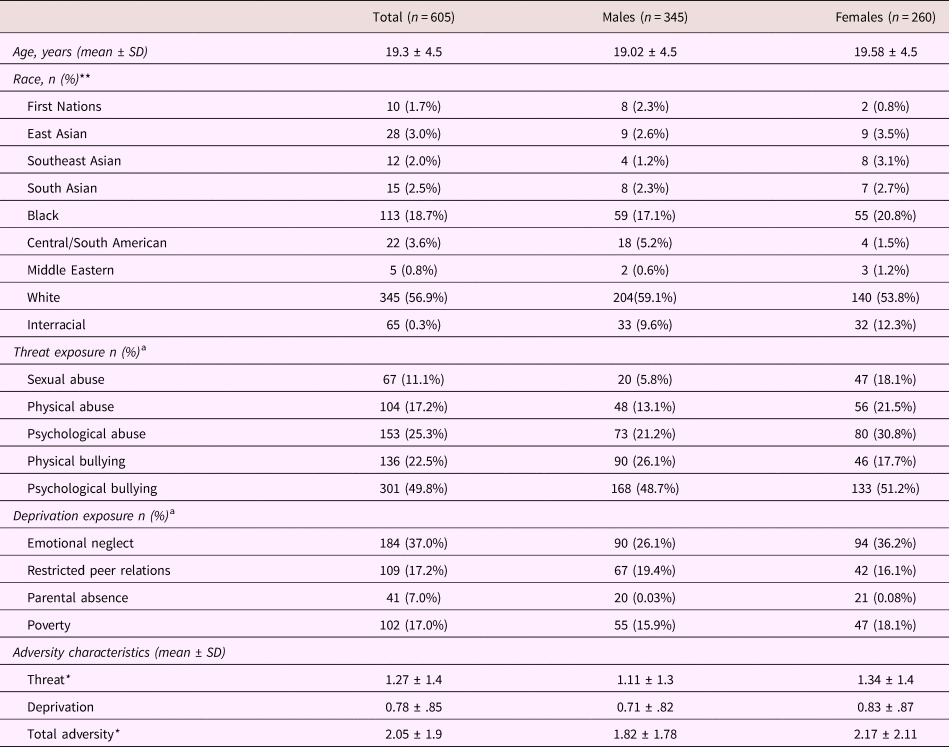
Demographic and adversity characteristics are shown in Table 1. The majority of individuals in the current study reported at least one adversity exposure (74%; n = 448). Across the entire sample, 59% (n = 357) endorsed at least one threat exposure and 54% (n = 328) endorsed at least one deprivation exposure during childhood. Co-occurring adversities were common, with 49% (n = 300) of individuals reporting two or more adversity exposures. Females endorsed higher levels of total adversity exposure, F (1, 603) = 5.4, p =. 02, and threat exposure, F (1, 603) = 4.23, p = .04, compared to males. There were no sex differences in deprivation exposures, F (1, 603) = 4.01, p =. 06, stress perception, F (1, 603) = 0.68, p = .41, or morning cortisol, F (1, 603) = 0.09, p = .75. There was a significant age difference in morning cortisol, F (1, 603) = 1.74, p < .01, whereby cortisol increased with age, consistent with previous reports (Walker et al., Reference Walker, Trotman, Pearce, Addington, Cadenhead, Cornblatt and Tsuang2013). A moderate correlation was observed between threat and deprivation (r = .46, p < .01) in the total sample, which is consistent with the literature on the co-occurrence rates among different types of adversity (Green et al., Reference Green, McLaughlin, Berglund, Gruber, Sampson, Zaslavsky and Kessler2010). However, this modest correlation also suggests a degree of independence of the two adversity dimensions.
Sample characteristics (n = 605)

aPercentages add up to >100% because one subject can score multiple items. *p < .05. **p < .01.
Bivariate and partial correlations between adversity dimensions and stress measures stratified by sex are presented in Table 2. In females, generalized adversity (r = .35, p < .01) and threat (r = .22, p < .01) were associated with stress perception; in males, deprivation (r = .12 p < .02) was associated with stress perception. Stress perception was associated with cortisol in females (r = .16, p < .01) but not in males. Cortisol was not associated with any indices of adversity for either sex. Age was associated with deprivation (r = .13, p < .01), generalized adversity (r = .10, p < .01), and morning cortisol (r = .15, p < .01).
Partial correlations for adversity exposure and stress measures

Note: Correlations for threat control for deprivation; correlations for deprivation control for threat. There was a significant two-tailed correlation between threat and deprivation (males: r = .40, females: r = .51, total sample: r = .46). aGeneralized adversity equals sum of threat and deprivation. bCorrelations with cortisol control for saliva sampling time. *p < .05. **p < .01.
Generalized adversity path models
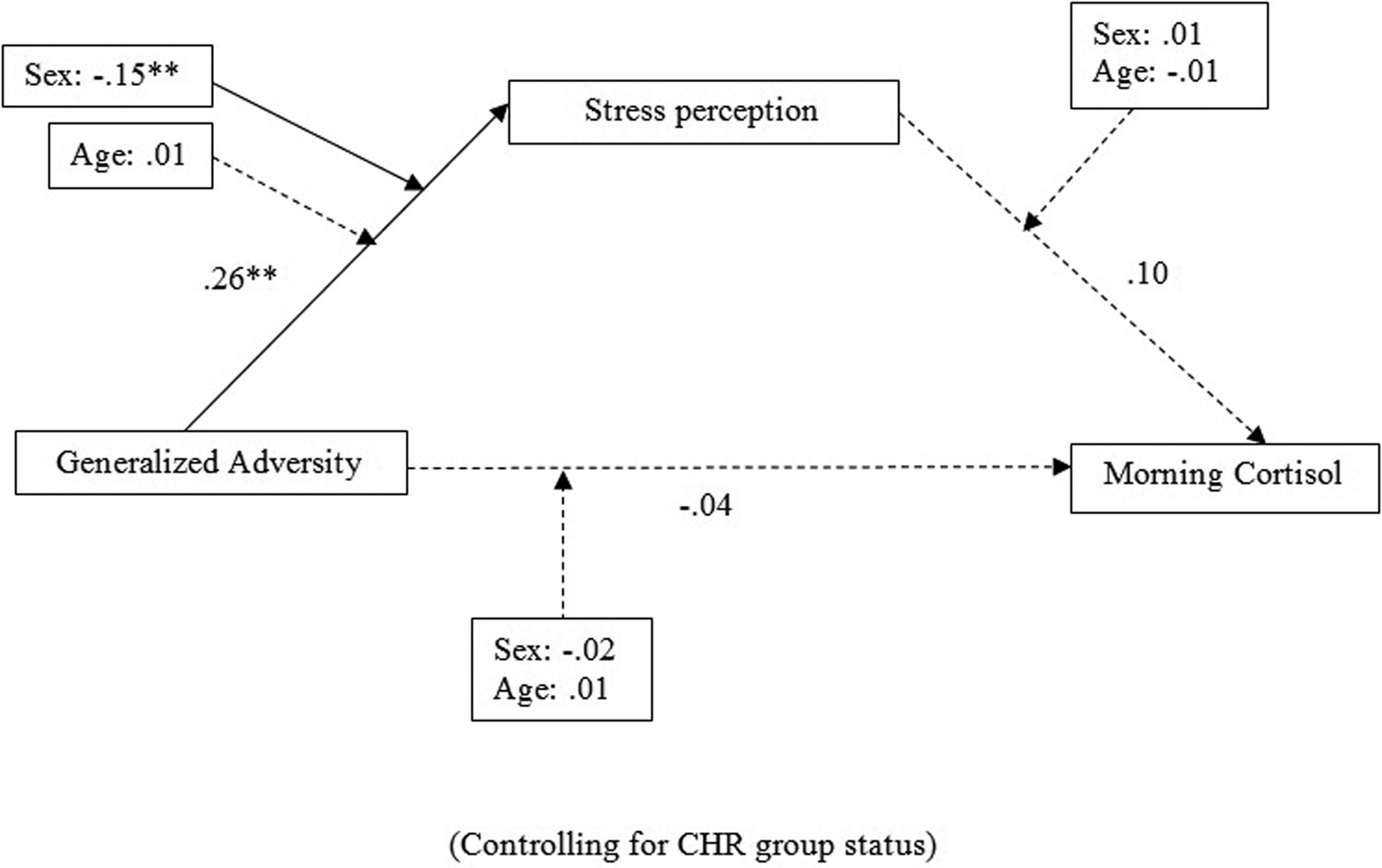
We first constructed a path model including sex and age interaction terms on all pathways to determine if stress perception mediated the association between generalized adversity and morning cortisol, and whether sex and age moderated these associations. This model (Figure 1) accounted for 6% of the variance in stress perception and 13% of the variance in morning cortisol. Sex moderated the association between generalized adversity and stress perception (β = –.15, p = .01), but not the associations between generalized adversity and cortisol (β = –.02, p = .74) or stress perception and cortisol (β = .01, p =.87). For females only, higher levels of generalized adversity were associated higher levels of stress perception (simple slopes: b = .15, p < .01). Age did not moderate any of the associations; however, there was a direct effect of age on morning cortisol (β = .19, p < .01), such that older individuals had higher cortisol levels. There were no direct effects of generalized adversity on morning cortisol stress (β = –.04, p = .47) or stress perception on morning cortisol (β = .10, p = .16), so indirect effects were not estimated.
Generalized adversity interaction path model examining the mediating effect of stress perception on the association between generalized adversity and morning cortisol. Paths are marked with standardized coefficients. **p < .01.

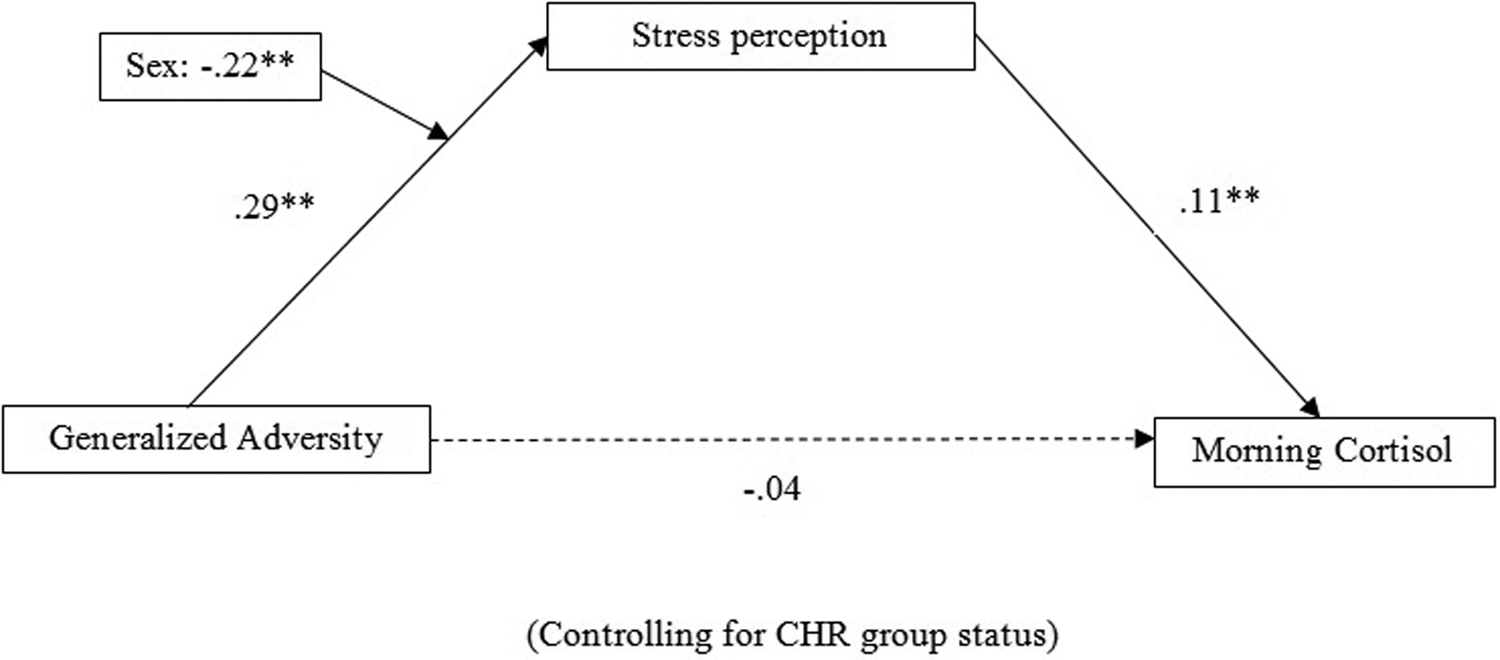
Next, we estimated a modified generalized adversity model that only included the significant interaction terms. This model (Figure 2) accounted for 8% of the variance in stress perception and 15% of the variance in morning cortisol. Sex moderated the association between generalized adversity and stress perception (β = –.22, p < .01). For females only, higher levels of generalized adversity were associated with higher levels of stress perception (simple slopes: b = .17 p < .01). Consistent with the previous model, there was no direct effect of generalized adversity on morning cortisol (β = –.04, p = .41); however, there was a direct effect of stress perception on morning cortisol (β = .11, p = .04). There was also an indirect effect in females of generalized adversity on morning cortisol through stress perception, b = .01, SE = .005, 95% confidence interval [.002, .023].
Generalized adversity modified path model examining the mediating effect of stress perception on the association between generalized adversity and morning cortisol. Paths are marked with standardized coefficients. Indirect effect of generalized adversity on morning cortisol through stress perception in females (Indirect Estimate: b = .01, SE = .005, 95% CI [.002–.023]). **p < .01.

Differentiated adversity path models
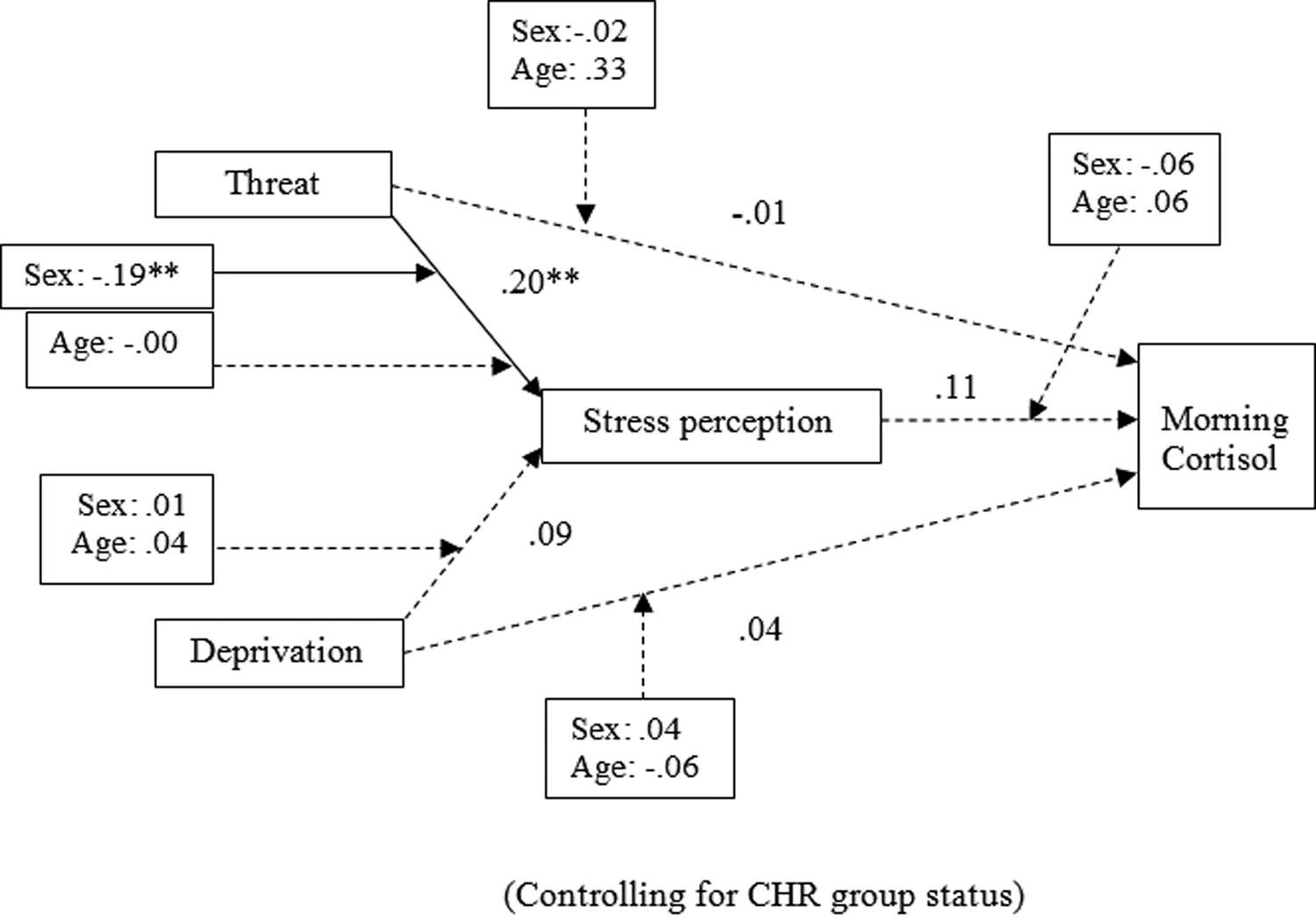
We then examined the associations among childhood adversity, stress perception, and morning cortisol in a differentiated model that estimated threat and deprivation separately. In the first model, sex and age interaction terms were included on all pathways. This model (Figure 3) accounted for 9% of the variance in stress perception and 14% of the variance in morning cortisol. Sex moderated the association between threat and stress perception (β = –.10, p < .01), but not the association between deprivation and stress perception (β = .01, p = .85). For females only, higher levels of threat were associated with higher levels of stress perception (simple slopes: b = .20, p < .01). Sex did not moderate the associations between threat and morning cortisol (β = –.01, p = .34), deprivation and morning cortisol (β = .04, p = .51), or stress perception and morning cortisol (β = .00, p = .98). Age did not moderate any of the associations; however, there was a direct effect of age on morning cortisol (β = .19, p < .01), such that older individuals had higher cortisol levels. There were no direct effects of threat (β = .01, p =.84), deprivation (β = –.04, p = .53), or stress perception (β = .11, p = .09) on morning cortisol, so indirect effects were not estimated.
Differentiated adversity interaction path model examining the mediating effect of stress perception on the association between threat, deprivation, and morning cortisol. Paths are marked with standardized coefficients. **p < .01.

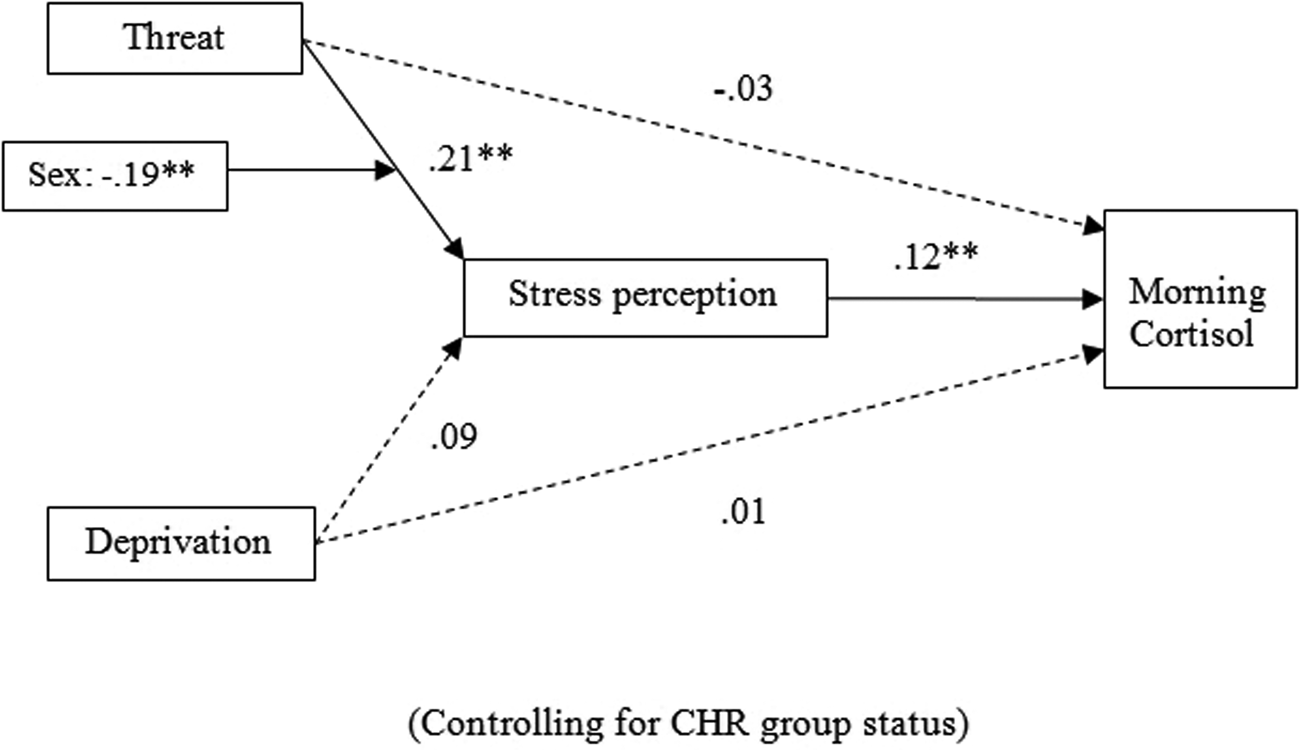
Finally, we estimated a modified differentiated adversity model that only included the significant interaction term. This model (Figure 4) accounted for 10% of the variance in stress perception and 14% of the variance in morning cortisol. Sex moderated the association between threat and stress perception (β = –.19, p < .01). For females only, higher levels of threat predicated increased levels of stress perception (simple slopes: b = .21, p < .01). Consistent with the previous model, there was no direct effect of threat (β = .02, p = .79) nor deprivation (β = –.05, p = .51) on morning cortisol; however, there was a direct effect of stress perception on morning cortisol (β = .12, p = .01). There was also an indirect effect in females only of threat on morning cortisol through stress perception, b = .02, SE = .00, 95% confidence interval [.004, .032].
Differentiated adversity modified path model examining the mediating effect of stress perception on the association between threat, deprivation, and morning cortisol. Paths are marked with standardized coefficients. Indirect effect of threat on cortisol through stress perception in females (Indirect Estimate: b = .02, SE = .00, 95% CI [.004–.032]). **p < .01.

Discussion
We investigated the relationship between childhood adversity, stress perception, and morning cortisol and examined whether these associations varied by adversity type, sex, and age. Childhood adversity was associated with increased stress perception, which subsequently predicted higher morning cortisol levels. However, this association was specific to threat exposures in females. The differentiated adversity model distinguishing between threat and deprivation highlighted the specificity of threat exposures, which was obscured in the generalized adversity model. Age did not moderate any of the adversity and stress associations. All models controlled for psychopathology (CHR status), suggesting that these finding are not simply a consequence of risk status and may constitute a more general risk process in females. Taken together, our finding suggest females with childhood histories of threat exposure may experience heighted stress perception later in life, which may confer an enduring vulnerability to stress-related disorders.
Childhood adversity, specifically threat exposure, was associated with increased stress perception in females. Our findings are consistent with previous work documenting a relationship between childhood adversity and subjective perceptions of stress in adulthood (Gibson et al., Reference Gibson, Anglin, Klugman, Reeves, Fineberg, Maxwell and Ellman2014; McLaughlin et al., Reference McLaughlin, Conron, Koenen and Gilman2010; Rössler et al., Reference Rössler, Ajdacic-Gross, Rodgers, Haker and Müller2016), but extend the literature by highlighting relevant adversity type and sex differences. While the exact mechanisms underlying these associations are unknown, there is basis for speculation. Given that the findings were specific to threat, it is important to consider why these types of exposures, as opposed to deprivation, are associated with stress perception.
From a functional adaptation perspective, heightened stress perception may develop as a response to threatening environments, via heightened threat detection and limited coping resources (Wadsworth, Reference Wadsworth2015). In the face of acute harm or danger, heighted threat detection and avoidant-coping strategies are likely to be adaptive. Approach-oriented coping (i.e., attempt to act or modify stressors through cognitive or overt behavior) may actually increase risk of danger or harm in threatening environments. Thus, heightened threat detection and coping strategies that protect a child from danger may become favored and established, at the expense of flexible coping strategies (i.e., problem solving) that are more adaptive when facing mild and normative stressors (Blair & Raver, Reference Blair and Raver2012; Masten & Cicchetti, Reference Masten and Cicchetti2010). As a result, individuals with threat histories may develop a heightened perception of threat, and limited coping repertoires, which are a mismatch with the normative daily stressors they face later in life. Heighted attention to potential threats and the use of avoidant coping strategies have both been associated with both increased neuroendocrine activity and higher levels of perceived stress (Aldwin & Yancura, Reference Aldwin, Yancura, Schurr and Green2004; Cramer, Reference Cramer2003; Jerusalem & Schwarzer, Reference Jerusalem, Schwarzer and Schwarzer1992). While deprivation exposures may impact coping capacities, the presence of danger and harm in threat experiences may pose stronger demands for adaptation on coping resources. In addition, the nature of deprivation exposures is less likely to impact the calibration of threat detection systems (Busso, McLaughlin, Brueck, et al. Reference Busso, McLaughlin, Brueck, Peverill, Gold and Sheridan2017).
Threat experiences may also be more strongly linked to beliefs about helplessness, self-efficacy, safety, and control, which will influence an individual's assessment of their ability to handle situational demands. Of note, psychological abuse was the most common threat exposure in our sample. In this type of abuse, explicit negative messages that undermine the child's abilities, efficacy, and self-worth are directly supplied to the abuser. Future work is needed to elucidate the cognitive and biological processes through which threat exposures influence stress perception.
Our findings add to a growing body of literature for distinct effects of threat and deprivation (Busso, McLaughlin, & Sheridan, Reference Busso, McLaughlin and Sheridan2017; Dennison et al., Reference Dennison, Rosen, Sambrook, Jenness, Sheridan and McLaughlin2017; Lambert, King, Monahan, & McLaughlin, Reference Lambert, King, Monahan and McLaughlin2017; Sheridan et al., Reference Sheridan, McLaughlin, Winter, Fox, Zeanah and Nelson2018). While the generalized adversity approach is commonly utilized in the literature (Evan et al., Reference Evans, Li and Whipple2013), our threat-specific findings highlight the limitations of this approach. By comparing the generalized and differentiated-adversity models, we were able to detect unique effects of threat. Previous studies that have grouped all adversity exposures into a single sum score have likely masked unique associations between different categories of adversity and outcomes. As the field looks to elucidate specific mechanisms linking adversity to psychopathology, it will be important to consider the specific nature of adversity experiences and the different functional demands they pose on developing systems.
The association between threat and stress perception was specific to females, which is consistent with the higher rates of stress-related forms of psychopathology (e.g., depression and posttraumatic stress disorder) observed in females compared to males (Bangassar & Valentino, Reference Bangasser and Valentino2014). Although the effects are small, these findings raise important questions regarding what factors underlie these observed sex differences. There are a number of possible explanations ranging from sex differences in fear circuitry, to the nature of threat experiences, to reporting biases. For example, sex differences are observed across development in the neurobiology of corticolimbic fear circuitry, such that females show poorer discrimination between danger and safety signals (Gamwell et al. Reference Gamwell, Nylocks, Cross, Bradley, Norrholm and Jovanovic2015), heightened physiological and neural perception to threat cues (Domes et al., Reference Domes, Schulze, Böttger, Grossmann, Hauenstein, Wirtz and Herpertz2010; Lebron-Milad et al., Reference Lebron-Milad, Abbs, Milad, Linnman, Rougemount-Bücking, Zeidan and Goldstein2012; Stevens & Hamann, Reference Stevens and Hamann2012; Tolin & Foa, Reference Tolin and Foa2006), and lower thresholds for threat detection (Glover et al., Reference Glover, Jovanovic, Mercer, Kerley, Bradley, Ressler and Norrholm2012). Consistent with evidence that females are more sensitive than males to stressors that are interpersonal in nature (Stroud et al., Reference Stroud, Salovey and Epel2002), the strong interpersonal quality of threat experiences, as opposed to deprivation, may increase the potency of threat exposures in females.
Alternatively, these sex differences may be accounted for by differences in the nature of threat experienced by females relative to males. In the current sample, females endorsed higher rates of sexual abuse, physical abuse, and psychological abuse (but not physical bullying). While including sex in our models helps account for differences in severity (i.e., total threat severity), it does not control for differences in the specific types of threat exposures, which may ultimately prove important. Relatedly, sex differences in reporting of both childhood adversity and perceived stress may also underlie these associations. Females tend to endorse higher levels of childhood trauma even though, with the exception of sexual abuse, there are few sex differences in rates of physical abuse, psychological abuse, and neglect (Koenen & Widom, Reference Koenen and Widom2009; Tolin & Foa, Reference Tolin and Foa2006). Thus, the current study may underestimate threat exposure in males. In regards to subjective perceived stress reporting, a large meta-analysis concluded that there are robust sex differences in the appraisal of stressful events relative to actual stress exposures, with females endorsing higher levels of perceived stress (Davis et al., Reference Davis, Matthews and Twamley1999). In our sample there were no sex differences in stress perception. More work is needed to tease apart whether these associations are driven by true sex differences in the way threat experiences shape subjective stress perception, or whether they are artifacts of severity differences and reporting tendencies.
Contrary to our hypothesis, age did not moderate any of the associations between adversity and stress processes. This is somewhat surprising given the normative increases in stress responsivity typically observed during adolescence (Gunnar et al., Reference Gunnar, Wewerka, Frenn, Long and Griggs2009; Trotman et al., Reference Trotman, Holtzman, Walker, Addington, Bearden, Cadenhead and Tsuang2014). However, our sample was composed primarily of postpubertal individuals, which may have limited our ability to detect developmental effects. Given the effect of gonadal hormones on developing stress systems, it would be helpful to examine differences in these associations in younger individuals (e.g., ages 9–11) who are earlier in the pubertal transition (Bale & Epperson, Reference Bale and Epperson2015). In addition, the younger individuals in our sample had lower levels of adversity exposure, which may have also limited our ability to detect age effects. This is likely due to the fact that parental involvement and consent is required for participation of minors (<18 years), but not for those aged 18 and above. Consistent with research on sensitive periods for stress exposure, it is also possible that developmental effects are more salient to the timing of adversity exposure than to the age at which these associations are assessed (Bosch et al., Reference Bosch, Riese, Reijneveld, Bakker, Verhulst, Ormel and Oldehinkel2012; Lupien et al., Reference Lupien, McEwen, Gunnar and Heim2009; Pesonen et al., Reference Pesonen, Räikkönen, Feldt, Heinonen, Osmond, Phillips and Kajantie2010).
There were no direct effects of adversity exposure on morning cortisol levels in any of our models. This is not surprising given the complexities of estimating the association between history of childhood adversity and cortisol, particularly given the variability in the time lag between exposure and cortisol measurement (Gunnar & Quivedo, Reference Gunnar and Quevedo2007b; Miller et al., Reference Miller, Chen and Zhou2007; Tarullo & Gunnar, Reference Tarullo and Gunnar2006). In addition, differences in the chronicity of adversity exposures may be an important moderator in these associations. While some adversity exposures are more pervasive and chronic in nature, others are periodic and acute. These differences in chronicity may result in distinct patterns of hypercortisolim and hypocortisolism that are washed out in samples in which chronicity is not assessed. It is also possible that childhood adversity exerts direct long-term effects on other indices of HPA axis functioning not measured in this study, such as cortisol reactivity, early awakening response, and diurnal rhythm. The lack of direct effects of adversity on morning cortisol may also stem from differential susceptibility to the environment. Accumulating research suggests that genetic factors and early adversity operate in concert to instantiate vulnerability and predict negative outcomes later in life (Ellis et al., Reference Ellis, Boyce, Belsky, Bakermans-Kranenburg and van IJzendoorn2011; Pluess, Reference Pluess2015; Pluess & Belsky, Reference Pluess and Belsky2011; Pluess, Stevens, & Belsky, Reference Pluess, Stevens, Belsky, Legestee, Haley and Bornstein2013). Consistent with this, a number of genotypes implicated in Gene × Environment studies have been found to moderate the effects of early adversity on HPA axis reactivity (Cicchetti, Rogosch, & Oshri, Reference Cicchetti, Rogosch and Oshri2011; Heim et al., Reference Heim, Bradley, Mletzko, Deveau, Musselmann, Nemeroff and Binder2009; Tyrka et al., Reference Tyrka, Price, Gelernter, Schepker, Anderson and Carpenter2009). Thus, samples of adversity-exposed youth likely include individuals with different polygenic risk profiles, leading to inconsistencies in findings as a function of the sample's genetic makeup. In addition, protective factors such as social support and strong cognitive and social skills have also been shown to buffer the detrimental effects of childhood adversity (Collinshaw et al., Reference Collishaw, Pickles, Messer, Rutter, Shearer and Maughan2007; Jaffee, Caspi, Moffit, Polo-Thomas, & Taylor, 2007; Rutten et al., Reference Rutten, Hammels, Geschwind, Menne-Lothmann, Pishva, Schruers and Wichers2013). Future studies that include better characterization of genetic profiles and protective factors are needed to delineate the complex associations between childhood adversity and HPA axis function.
While there were no direct effects on morning cortisol, there was an indirect effect of threat on morning cortisol through stress perception in females. The effects are small and should be interpreted with caution. However, these findings provide preliminary evidence that childhood experiences of threat may have an indirect, but enduring, effect on stress systems via heightened sensitivity to day-to-day stressors among females. This interpretation is consistent with theories and evidence concerning greater female sensitivity to stress, particularly after puberty, due to the effects of gonadal hormones on the HPA axis (Bale & Epperson, Reference Bale and Epperson2015). More work is needed to elucidate sex differences in the role of stress appraisals in modulating biological stress responses, and the relative concordance between those two measures.
Finally, we controlled for CHR status in all models, suggesting that our findings are not confounded by risk status. Although we did not look at psychiatric outcomes, heightened stress perception may be a plausible risk mechanism underlying the link between childhood threat experiences and mixed presentations of psychopathology. A recent study found that heightened stress perception was associated with later comorbid psychopathology in individuals with a trauma history (van Nierop et al., Reference van Nierop, Lecei, Myin-Germeys, Collip, Viechtbauer, Jacobs and van Winkel2018). While prevention of childhood adversity is the ultimate goal, stress perception may be a critical and modifiable preventative intervention target to reduce negative outcomes following adversity experiences, especially for females.
The findings from this study should be considered in light of several limitations. All adversity indices were self-reported, retrospective, and categorical variables. The reliance of retrospective reporting of childhood adversity introduces the possibility of both under- and overreporting, which may have affected our results. While the categorical variables provide a rough estimate of exposure history, they do not include measures of frequency, intensity, or timing of specific exposure types (e.g., times of sexual abuse or intensity of physical abuse), which are likely to be important. In addition, the adversity experiences included in this study do not encompass all forms of threat (e.g., community violence and witnessing domestic abuse) or deprivation, nor do they include parental psychopathology or non-interpersonal forms of trauma (e.g., car accidents, injuries, and natural disasters). While childhood poverty in the deprivation domain was assessed using the federal poverty line, this is likely an underestimate of poverty at some sites, given the diversity in cost of living among the urban areas from which participants were drawn (i.e., Los Angeles, Atlanta, San Diego, Boston, and Chapel Hill). Future studies utilizing more extensive measures of threat and deprivation will be needed to replicate these findings. Although morning cortisol is one index of HPA axis activity, there are challenges to its measurement due to diurnal and circadian rhythms (Young & Breslau, Reference Young and Breslau2004). Finally, although our theoretical model implies a developmental sequence, our measures of self-reported childhood adversity, stress perception, and morning cortisol were assessed concurrently, and thus are not temporally ordered.
In sum, the current findings point to a complex relationship between childhood adversity and stress processes that varies by adversity dimension and sex. While subjective stress perception has received relatively little attention in the childhood adversity literature, it may be important to understanding the long-term impact of adversity exposure on subsequent stress processes and psychiatric vulnerability. The findings also highlight the importance of assessing specific types of adversity, as well as sex differences. Future work should continue to delineate both the biological and the cognitive pathways through which childhood experiences of threat and deprivation shape future perceptions of stress, and whether these differ by sex and age. This work will be critical to the development of preventative interventions following adversity exposure in childhood.
Acknowledgments
This work was supported by a collaborative U01 award from the National Institute of Mental Health at the National Institutes of Health (MH081902 to T.D.C.; MH081857 to B.A.C.; MH081988 to E.W.; MH081928 to L.J.S.; MH082004 to D.P. MH082022 to K.C.; MH081984 to J.A.; and MH082022 to S.W.W.) and NIMH P50 MH066286 and the Staglin Music Festival for Mental Health (to C.E.B.).