Implications
Smallholders’ sheep production in the Ethiopian highlands is commonly unplanned and lambing is thus thinly spread throughout the year. This hampers rate of genetic improvement in village-based breeding programmes due to low selection intensity as only few selection candidates would be available at any one time. On the other hand, generating improved rams in central nucleus flocks and disseminating them to villages could be hampered by the prohibitively large nucleus requirements to provide sufficient rams to villages. Introducing oestrus synchronization in village programmes and artificial insemination in nucleus programmes is expected to, respectively, increase selection candidates and reduce nucleus size.
Introduction
Dissemination of genetic gains generated in nucleus flocks to smallholder village flocks has been a challenge in developing livestock production systems. The overall efficiency of a breeding programme is determined by the rate of genetic improvement in the breeding tier, which is mainly influenced by the selection intensity (Danchin-Burgea et al., Reference Danchin-Burgea, Allain, Clément, Piacère, Martin and Palhière2012), and the capacity of the breeding tier to supply enough improved breeding material to the production tier. Empirical evidences suggest that responses in monetary value in the commercial tier is well below what was attained in the resource flocks and in the best participating flocks. For instance, only Rand 0.098 to Rand 0.818 per small stock unit per annum was achieved in South Africa between 2000 and 2006 (Schoeman et al., Reference Schoeman, Cloete and Olivier2010). Reproductive technologies such as oestrous synchronization and artificial insemination (AI) could greatly enhance the overall efficiency of breeding programmes by accelerating the production and dissemination of improved rams to the production tier.
Comparative evaluation of dispersed village-based nucleus and central nucleus-based schemes for genetic improvement of small ruminants in Ethiopia has identified the challenges in setting up efficient breeding programmes under smallholder systems (Gizaw et al., Reference Gizaw, Rischkowsky, Valle-Zárate, Haile, van Arendonk, Mwai and Dessie2014). One of the challenges was achieving high selection intensities in village-based nuclei due to a year-round distribution of lambings in village flocks with only about 34% of the lambings occurring at one peak lambing season limiting the number of available selection candidates (Gizaw et al., Reference Gizaw, Komen and van Arendonk2013). On the other hand, while the central nucleus scheme could generate high genetic gains as a result of selection on BLUP breeding values which is not feasible in village nuclei, the size of the central nucleus was found to be too small to supply enough breeding rams to the production tier. The challenges in the village and central nucleus schemes could be tackled, respectively, with the introduction of synchronized breeding by hormonal oestrous synchronization and AI. It is hypothesized that oestrus synchronization in the nucleus flock in village breeding programmes could increase the number of selection candidates thereby increasing selection intensity and genetic progress. The use of AI in the production tier in central nucleus-based programmes would enable to disseminate genetic gains from the nucleus flock to the production tier through small number of rams which helps to overcome the need to maintain large/unaffordable nucleus. However, the bio-economic advantages as well as the operational feasibilities of these reproductive technologies over the conventional breeding practices need to be assessed.
Research on hormonal oestrous synchronization and AI in small ruminants has been underway in Ethiopia for long (Tegegne et al., Reference Tegegne, Estifanos, Tera and Hoekstra1986 and Reference Tegegne, Warnick, Mukasa Mugerwa and Ketema2012; Zeleke, Reference Zeleke2009; Tadesse et al., Reference Tadesse, Ashebir and Yayneshet2016). However, there are challenges which could hamper the application of the technologies under smallholder conditions. Previous results show that oestrous response to synchronization in village flocks varies and is not consistent (Omontese et al., Reference Omontese, Rekwot, Ate, Ayo, Kawu, Rwuaan, Nwannenna, Mustapha and Bello2016). Oestrous responses to hormonal synchronization ranging from 65% to 100% have been reported for Ethiopian sheep breeds (Zeleke, Reference Zeleke2009; Zeleke et al., Reference Zeleke, Habtemariam, Tegegne and Muluneh2016). Conception rates and operational feasibility of AI in sheep also vary with the AI technique (Smith et al., Reference Smith, Parr, Beaumont, Oliver and Upreti1995). The use of frozen semen is challenging in several ways. It requires processing and cryopreservation of semen, intrauterine laparoscopic AI method, and the conception rate is as low as 10% to 40% (Evans, Reference Evans1988). The above challenges together with the extra cost associated with the reproductive technologies would have implications on the genetic, economic and operational feasibility of introducing the technologies under smallholder systems.
In this study we designed alternative breeding schemes with and without hormonal oestrus synchronization intervention for village-based breeding programmes to accelerate genetic progress by increasing selection intensity. We also designed alternative schemes with and without AI for central nucleus-based breeding programmes to tackle the need for extra-large central nucleus flock. The schemes were designed considering the infrastructure and managerial resources under typical smallholder system. The schemes were modelled using deterministic simulation and evaluated for their genetic, economic and operational efficiency using Bonga sheep in Ethiopia as a case study.
Material and methods
Bonga sheep production system
The total Bonga sheep population is estimated at about 509 714 heads based on Central Statistical Agency (CSA, Reference Cloete, Mitzal and Olivier2015) sample surveys and the breed’s geographic distribution (Gizaw et al., Reference Gizaw and Joshi2008). The breed is found in Keffa, Sheka and part of Bench-Maji zones of the Southern Nations, Nationalities and Peoples Regional state in Ethiopia. Bonga sheep is one of the best meat type breeds in the country and is being used as a sire breed to improve productivity of other local breeds in the country. The sheep are reared under smallholder traditional production system. The average flock size is 9.7 sheep per household. Flocks are managed under extensive system with grazing in communal lands, around home steads or tethered. Breeding is commonly uncontrolled and lambing is distributed throughout the year with some peak lambing seasons (Metsafe, Reference Metsafe2016).
Breeding objective for Bonga sheep
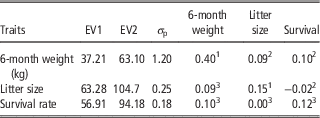
The breeding objective of Bonga sheep farmers is lamb production for generating household income (Metsafe, Reference Metsafe2016). The breeding-objective traits identified to reflect farmers’ breeding objectives were BW at 6 months of age, ewe litter size and lamb survival. The same traits were used as selection criteria. The parameters describing the traits including standard deviations and genetic parameters are provided in Table 1.
Phenotypic standard deviations (σ p, heritabilities and genetic and phenotypic correlations for 6-month weight, litter size and survival and relative economic values (in Birr)) for Bonga sheep breeding-objective traits

EV1=economic values (Birr) for slaughter lamb production system; EV2=economic values for breeding ram production system; σ p=phenotypic standard deviation.
1 Ethiopian Birr=USD 0.043.
Source: Metsafe (Reference Metsafe2016); Abegaz et al. (Reference Abegaz, Sölkner, Gizaw, Dessie, Haile, Mirkena, Getachew and Wurzinger2002); Gizaw and Joshi (Reference Gizaw, Getachew, Goshme, Valle-Zárate, van Arendonk, Kemp, Mwai and Dessie2004); Safari and Fogarty (Reference Safari and Fogarty2003); Safari et al. (Reference Safari, Fogarty and Gilmour2005).
1 Heritability.
2 Genetic correlations.
3 Phenotypic correlations.
Economic values for 6-month weight, litter size and lamb survival were estimated (Table 1) by constructing a bio-economic model on Microsoft Excel sheet that described the production system of Bonga sheep. The inputs for the model were adopted form Metsafe (Reference Metsafe2016) and Zewdu (Reference Zewdu2014). Two sets of economic values were estimated in Ethiopian Birr (1 Birr=USD 0.043): for the slaughter lamb production system and the breeding ram production system which is applicable to the breeding tier only, respectively. The economic values were used to calculate returns by ZPLAN (William et al., Reference William, Nitter, Bartenchlager, Karras, Niebel and Graser2008). ZPLAN was run twice using each set of the economic values.
Breeding programme and schemes
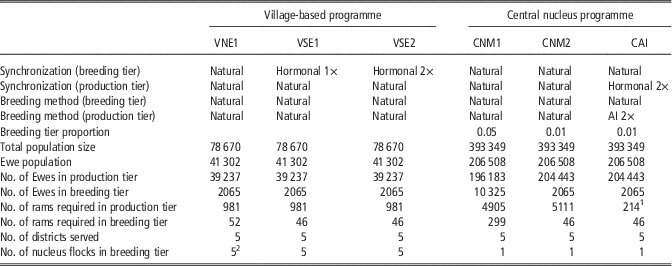
The current Bonga sheep improvement programme is a one-tier village-based cooperative breeding programme, where farmers in a village are organized to implement selective breeding for the purpose of producing improved rams for their own flocks. However, some improved rams are sold out to farmers outside the cooperative breeding villages. Design of village-based cooperative breeding programme is described elsewhere (Gizaw et al., Reference Gizaw, Komen, Hanotte and van Arendonk2009 and Reference Gizaw, Komen and van Arendonk2013). There is also a Bonga sheep breeding flock maintained by Bonga Agricultural Research Center. The flock is currently not involved in any genetic improvement programme. The flock could be considered as a resource for setting up a central nucleus-based breeding programme as an alternative to the ongoing village-based breeding programme which is currently limited to few villages. Two alternative breeding programmes were designed for Bonga sheep using a deterministic simulation, namely village-based cooperative breeding programme and central nucleus-based breeding programme (Table 2). These are the two alternative designs of breeding programmes being discussed in the literature as alternative breeding programmes for smallholder systems (Gizaw et al., Reference Gizaw, Rischkowsky, Valle-Zárate, Haile, van Arendonk, Mwai and Dessie2014).
Basic features of schemes designed for village-based and central nucleus-based alternative breeding programmes utilizing oestrus synchronization and artificial insemination (AI) for Bonga sheep in Ethiopia

VNE=no hormonal oestrus synchronization; VSE1=single hormonal oestrus synchronization in breeding tier; VSE2=double hormonal oestrus synchronization in breeding tier; CNM1=natural breeding in breeding and production tier, nucleus size=5% of ewe population; CNM2=natural breeding in breeding and production tier, nucleus size=1% of ewe population; CAI=natural mating in breeding and AI in production tier, nucleus size=1%, synchronization in production tier.
1 Number of rams required for semen collection.
2 One in each district.
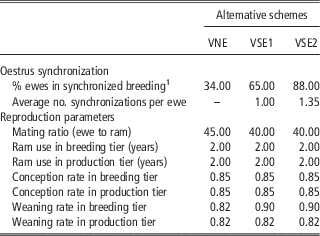
The effectiveness of village-based programmes is hampered by low selection intensity achieved due to year round distribution of lambing (Gizaw et al., Reference Gizaw, Komen and van Arendonk2013). We thus designed three alternative breeding schemes for Bonga sheep village-based programme, a base scheme with natural oestrus (VNE), a scheme with one dose of hormonal oestrus synchronization in the breeding tier (VSE1) and a third scheme with two doses of hormonal oestrus synchronization in the breeding tier (VSE2). The proportion of ewes lambing under natural oestrus (VNE) was estimated at 34% based on Bonga sheep village flock reproduction data (Metsafe, Reference Metsafe2016). A single dose of Lutylase hormone (VSE1) would result in 65% of the ewes showing oestrus at the same time (Zeleke et al., Reference Zeleke, Habtemariam, Tegegne and Muluneh2016) and a repeat administration of the hormone (VSE2) to ewes that did not show oestrus to first administration would result in overall oestrus expression in 88% of the ewes. The number of synchronizations required for VSE1 and VSE2 were calculated to be 1.0 and 1.35, respectively. The biological and technical parameters for the three schemes are presented in Table 3.
Biological and technical parameters used to design three alternative breeding schemes utilizing natural and hormonal oestrus synchronization for Bonga sheep village-based cooperative breeding programme

VNE=no hormonal oestrus synchronization; VSE1=single hormonal oestrus synchronization in breeding tier; VSE2=double hormonal oestrus synchronization in breeding tier.
1 Percentage of ewes lambing within a short period of time within a lambing season. For VNE scheme 34% of the ewes were assumed to lamb within a short period of time under natural oestrus (Metsafe, Reference Metsafe2016).
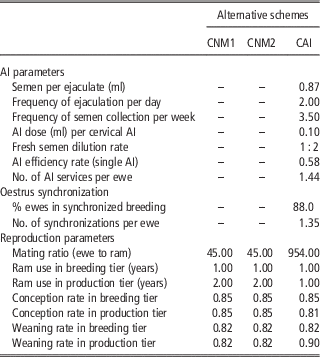
As an alternative to village-based programme, a central nucleus-based breeding programme may be opted for Bonga sheep by utilizing the existing idle breeding flock at Bonga Research Center. However, central nucleus programmes are difficult to set up as it requires a large nucleus flock to serve the ewe population in the production tier (Gizaw et al., Reference Gizaw, Rischkowsky, Valle-Zárate, Haile, van Arendonk, Mwai and Dessie2014). Thus AI was considered and two alternative schemes were designed: a base scheme with natural mating having two sub-schemes (a nucleus flock with 5% (CNM1) and 1% (CNM2) of the population in the production tier) and a scheme with AI in the production tier (CAI). Since insemination of individual ewes may not be feasible under village conditions, we included hormonal oestrus synchronization as a component of the AI package. However, synchronization was not the technology to be evaluated in this study for the central nucleus programme. Yet, we evaluated the AI scheme by including and excluding the cost of synchronization leaving the decision for the user as to whether to include or exclude the cost of synchronization when designing/setting up breeding programmes. The biological and technical parameters for the three schemes are presented in Table 4.
Biological and technical parameters used to design three alternative breeding schemes utilizing natural mating and artificial insemination (AI) for Bonga sheep central nucleus-based breeding programme

CNM1=natural breeding in breeding and production tier, nucleus size=5% of ewe population; CNM2=natural breeding in breeding and production tier, nucleus size=1% of ewe population; CAI=natural mating in breeding and AI in production tier, nucleus size=1%, synchronization in production tier.
The two alternative breeding programmes were simulated for Bonga sheep population found in the major breeding tract of the breed as determined by the population concentration. The major breeding tract is located in five districts of Keffa zone (Decha, Ginbo, Adiya, Tello and Gesha districts) with a population of 393 349 sheep. The breeding ewe population in these districts was estimated to be 206 508 based on flock structure in the area (CSA, Reference Cloete, Mitzal and Olivier2015). The nuclei in the breeding tier are supposed to supply improved genetics in the form of breeding rams and semen. The village-based programme was designed with independent cooperative breeding groups in each district forming breeding nuclei serving the population in their respective district, whereas the central nucleus flock run by the regional government is designed to serve the whole population of 206 508 ewes.
In total, five selection pathways (selection groups) were identified for each scheme. Genetic gain was generated in the breeding tiers in both central nucleus and village-based programmes (Table 2) and disseminated to the production tier. The selection groups are as follows: selection of males in the breeding tier to produce males and females for the breeding tier, selection of females in the breeding tier to produce males and females for the breeding tier (for central nucleus programme only) and selection of males in the breeding tier to supply rams or semen to the production tier. The source of information for selection of rams in the village programme was the candidates’ own (for 6-month weight) or their dams’ (for litter size and lamb survival) phenotype. For the central nucleus programme, the sources of information were the candidate and all his/her relatives (sire, dam, sibs) in a BLUP estimation of breeding value. The impact of hormonal oestrus synchronization and AI is reflected in the proportion of animals selected (calculated by diving the number of ram/ewe lambs selected by the number of proven animals) and hence on the selection intensity achieved. The proportion of animals selected is expected to be higher when the proportion of ewes lambing is concentrated within a short period of time as a result of hormonal synchronization resulting in more number of candidate ram lambs. Similarly the number of rams required to donate semen was lower than the number of rams required for natural mating (Table 2), which enabled to achieve higher selection intensity.
Costs of breeding programme
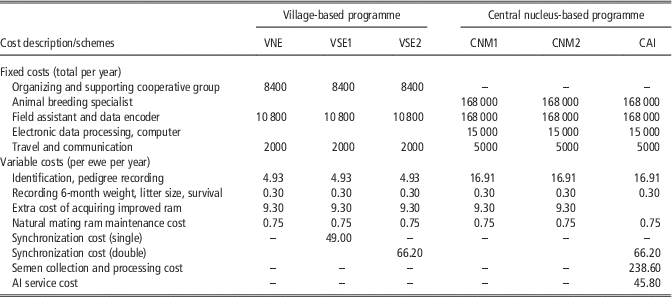
Costs associated directly with selection (recording, data processing, oestrus synchronization for the VES1 and VES2 schemes, and semen collection and processing in CAI scheme), acquiring improved genetics (improved rams and AI service) and facilitating delivery of improved genetics (cost of synchronization for CAI scheme) were estimated. The costs were estimated using current market prices of products and services. The direct costs of selection were incurred by the breeding tier, and the costs of acquiring improved genetics were incurred by the production tier. Synchronization costs included costs of hormone and expert services. Artificial insemination costs were semen collection and processing costs (expert time, AI ram maintenance and transportation costs, artificial vagina, extenders and fresh semen chiller). Artificial insemination service costs were AI technicians’ time, pipettes for cervical AI, speculum, syringe and pregnancy diagnosis device. The costs are given in Table 5.
Costs of selection, acquiring improved genetic material, oestrus synchronization and artificial insemination (AI) per ewe per year (in Ethiopian Birr) for breeding schemes utilizing natural and hormonal oestrus synchronization in village breeding programme and natural mating and AI in central nucleus breeding programmes simulated for Bonga sheep

VNE=no hormonal oestrus synchronization; VSE1=single hormonal oestrus synchronization in breeding tier; VSE2=double hormonal oestrus synchronization in breeding tier; CNM1=natural breeding in breeding and production tier, nucleus size=5% of ewe population; CNM2=natural breeding in breeding and production tier, nucleus size=1% of ewe population; CAI=natural mating in breeding and AI in production tier, nucleus size=1%, synchronization in production tier.
1 Ethiopian Birr=USD 0.043.
Oestrus synchronization and artificial insemination service provision scheme
Oestrus synchronization and AI service was organized with a decentralized district and kebele (the smallest administrative unit) centres. The district livestock development office coordinated the service. Existing veterinary health posts (one for three kebeles) and a livestock development agent in each kebele served as technical experts with assistance from the district livestock and AI experts. Each health post had facilities for oestrus synchronization and fresh semen AI. Fresh semen collection was on site with rams purchased from the central nucleus and kept with a volunteer farmer at cost.
Oestrus synchronization was staggered with groups of 100 ewes being synchronized at once. This was to limit the number of rams required for mating. Mating ratio in the village breeding tier was calculated assuming one ram could breed four synchronized ewes in a day and defining a mating period of 10 days. With the assumption that one AI technician could perform 100 AI services for a synchronized group of ewes within a village, an AI period of 28 days was defined for each village. Synchronization and AI was performed twice, the second round being for ewes that did not respond to the first hormone administration and AI service. The biological and technical parameters are summarized in Tables 3 and 4. The parameters were determined based on relevant local literature (Zeleke, Reference Zeleke2009; Zewdu, Reference Zewdu2014; Metsafe, Reference Metsafe2016; Zeleke et al., Reference Zeleke, Habtemariam, Tegegne and Muluneh2016) and other literature (Abegaz et al., Reference Abegaz, Sölkner, Gizaw, Dessie, Haile, Mirkena, Getachew and Wurzinger2002; Safari and Fogarty, Reference Safari and Fogarty2003; Gizaw and Joshi, Reference Gizaw, Getachew, Goshme, Valle-Zárate, van Arendonk, Kemp, Mwai and Dessie2004; Safari et al., Reference Safari, Fogarty and Gilmour2005) when directly relevant local literature was not available.
Data analysis
This study used ZPLAN (William et al., Reference William, Nitter, Bartenchlager, Karras, Niebel and Graser2008) for simulating the breeding programmes. Genetic gains from the various breeding schemes were estimated for each trait and the breeding objective. Returns to investment and profits (net present value) were also calculated by the programme. The alternative schemes designed for the village-based breeding programme were compared to determine the impact of oestrus synchronization on genetic progress and profitability of the breeding programme. Similarly, the central nucleus programme schemes were evaluated for the biological and economic feasibility of introducing AI in Bonga sheep breeding programme.
Results
Impact of oestrus synchronization
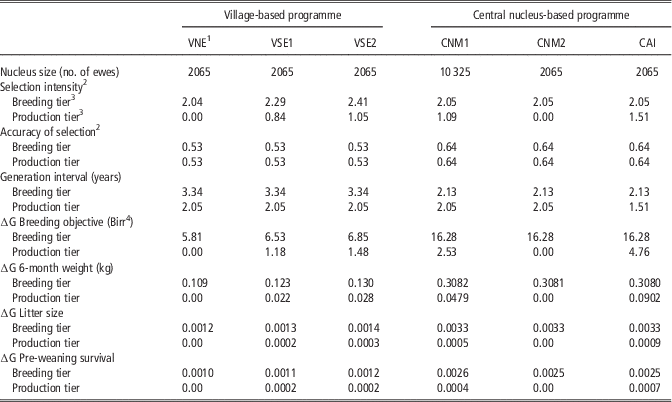
The impact of introducing oestrus synchronization in village-based breeding programme was evaluated based on the selection intensity, genetic gains and profits achieved (Tables 6 and 7). A higher selection intensity was achieved from schemes with oestrus synchronization (VSE1 and VSE2) than the natural oestrus scheme (VNE). The selection intensities for selection pathways ‘selection of nucleus rams to breed nucleus rams’, ‘nucleus rams to breed nucleus ewes’ and ‘nucleus rams to supply rams for production tier’ were, respectively, 2.04, 2.04 and 0.0 for VNE; 2.29, 2.09 and 0.84 for VSE1, and 2.41, 2.41 and 1.05 for VSE2 (Table 6). The selection intensities in the breeding tier varied across the three schemes and selection pathways although the flock sizes in the breeding tiers were equal. This was because the number of the available selection candidate rams was smaller in scheme VNE since the proportion of the ewes modelled to lamb was smaller than in schemes VSE1 and VSE2 where oestrus was hormonally synchronized to get more number of ewes to lamb in the same season. The accuracy of selection was the same for all the breeding schemes in the village-based breeding programme as the source of information for estimating the breeding values of selection candidates was the same across schemes (see ‘Material and methods’ section).
Genetic gains (∆G per year) generated in the breeding tier and disseminated to production tier in three alternative breeding schemes designed to introduce oestrus synchronization and artificial insemination in village-based and central nucleus-based Bonga sheep breeding programmes

VNE=no hormonal oestrus synchronization; VSE1=single hormonal oestrus synchronization in breeding tier; VSE2=double hormonal oestrus synchronization in breeding tier; CNM1=natural breeding in breeding and production tier, nucleus size=5% of ewe population; CNM2=natural breeding in breeding and production tier, nucleus size=1% of ewe population; CAI=natural mating in breeding and AI in production tier, nucleus size=1%, synchronization in production tier.
1 Schemes are described in Table 1.
2 The selection intensities and accuracies of selection presented under the ‘production tier’ are for ram selection in the breeding tier to supply for the production tier. There was no selection in the production tier. The selection intensities presented are for the male selection pathways. Selection intensities for the female pathways are presented in the text.
3 Selection groups in breeding tier: selection of males in breeding tier to produce males and females in breeding tier and selection of females in breeding tier to produce males and females in breeding tier (for the central nucleus programme only). Selection groups in production tier: selection of males in breeding tier to supply rams to production tier.
4 One Ethiopian Birr=0.043 USD.
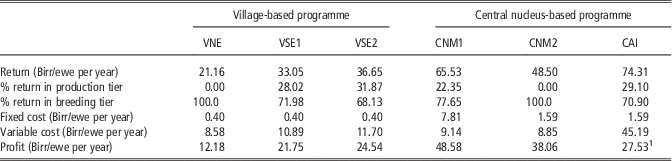
Returns, costs and profits from introduction of oestrus synchronization and artificial insemination in simulated Bonga sheep breeding programmes

VNE=no hormonal oestrus synchronization; VSE1=single hormonal oestrus synchronization in breeding tier; VSE2=double hormonal oestrus synchronization in breeding tier; CNM1=natural breeding in breeding and production tier, nucleus size=5% of ewe population; CNM2=natural breeding in breeding and production tier, nucleus size=1% of ewe population; CAI=natural mating in breeding and AI in production tier, nucleus size=1%, synchronization in production tier.
1 Profit=Birr 37.6 if synchronization cost is considered. 1 Ethiopian Birr=USD 0.043.
The higher selection intensity achieved in the schemes with hormonal synchronization (scheme VSE1 and VSE2) resulted in more genetic gains in the breeding objective and breeding-objective traits compared with the scheme with natural oestrus (scheme VNE). The percentage superiority of a scheme was calculated as the deviation in total genetic gain/profit (in breeding and production tiers) of the superior scheme from the inferior scheme and dividing the deviation by the total genetic gain/profit from the inferior scheme. Schemes VSE1 and VSE2 increased genetic gains per year by 32.7% and 43.4% (Table 6) and profits per dam per year by 78.6% and 101.5% over VNE (Table 7). Double oestrus synchronization (VSE2) gave higher genetic gains than single synchronization (VES1). The genetic gains disseminated to the production tier in village flocks was 15.3% (scheme VSE1) to 17.8% (VSE2) of the gains generated in the village nuclei. In the scheme with natural oestrus (VNE), the genetic gain transmitted from the nuclei to the village production tier and the profits were close to zero (Tables 5 and 6).
Introducing hormonal oestrus synchronization gave 188.8% to 223.7% more profit in village-based breeding programmes (schemes VSE1 and VSE2, Table 7). Double oestrus synchronization (scheme VSE2) increased the advantage of the technology marginally by 12.8% more profit.
Impact of artificial insemination
Introduction of AI was evaluated among central nucleus breeding schemes (Table 6). The selection intensities and hence the genetic gains in the breeding tier were the same for all the three schemes, although the flock sizes in the breeding tier differed. The number of proven and selected rams for the CNM1 were, respectively, 6601 and 342 (the proportion selected being 0.052) and the corresponding numbers for CNM2 were 1320 and 68 (the proportion selected being 0.052). However, the selection intensities applied to select rams for the production tier varied across schemes (Table 6). Overall, CAI increased the selection intensity by 13.4% and 73.7% over CNM1 and CNM2, respectively. The selection intensities presented for the breeding tier in Table 6 were for the male selection line (‘nucleus males to breed nucleus males’ and ‘nucleus males to breed nucleus females’). The selection intensity for the female line (nucleus females to breed nucleus females and males) was lower (0.98) than the male selection intensity. Intensities presented in Table 6 for ‘selection of nucleus males to supply rams to the production tier’ were all for the male selection pathway as only male germplasm was disseminated to the production tier. The accuracy of selection was the same for all the breeding schemes and selection pathways in the central nucleus breeding programme since the source of information for estimating the breeding values of selection candidates was the same across schemes.
Using AI in the production tier (scheme CAI) resulted in 11.9% and 29.2% more genetic gain (Table 6) in the breeding objective and 13.4% and 53.2% more returns to investment (Table 7) than the natural mating schemes CNM1 and CNM2, respectively. When the nucleus size was reduced to a manageable/affordable size of 1.0% of the total ewe population (scheme CNM2), the genetic gain disseminated from the breeding tier to the production tier was close to zero due to very low selection intensity achieved in the breeding tier when selecting rams for the production tier.
Artificial insemination technology was found to be less profitable than natural mating (scheme CAI v. CNM1 and CNM2; Table 7). The profit for the AI scheme was calculated excluding the cost of oestrus synchronization in the production tier. When the cost of synchronization was considered, the profit was Birr 37.6/ewe per year. Most of the return to investment and hence the profit was realized in the breeding tier in all the schemes.
The returns and profits in Table 7 were calculated based on economic values of traits calculated for slaughter lamb production system. When the economic values were calculated for breeding ram production system, the profit in schemes VNE, VSE1, VSE2, CNM1, CNM2 and CAI were Birr 20.8, 35.2, 39.4, 75.2, 57.8 and 57.7, respectively.
Discussion
Oestrus synchronization in village breeding programmes
This study identified one of the challenges of village-based small ruminant breeding programmes, namely the challenge of achieving optimal selection intensity in village nuclei to generate sufficient genetic gains to improve the genetic merits of village flocks. This is due to the lambing pattern in village flocks which is distributed throughout the year (Gizaw et al., Reference Gizaw, Komen and van Arendonk2013) resulting in few selection candidates. Selection pressure contributes nearly 50% to genetic trends (Danchin-Burgea et al., Reference Danchin-Burgea, Allain, Clément, Piacère, Martin and Palhière2012). The current results from the scheme without hormonal synchronization (scheme VNE) showed that all of the available candidate rams, saving some rams for the nucleus flock, had to be transferred to villages. The scheme thus not only gave less genetic gain and return on investment, but also the genetic gain achieved in the village nuclei was not disseminated to the production tier and almost all of the return occurred in the nucleus flocks. Hormonally synchronized breeding was found to be highly beneficial to effect genetic improvement in village flocks. Although the various hormonal oestrus synchronization protocols may not have impact on pregnancy and lambing rates (Jackson et al., Reference Jackson, Neville, Mercadante, Waters, Lamb, Dahlen and Redden2014), the challenge with the technology is the variable oestrous response ranging from 4.3% to 100% (Omontese et al., Reference Omontese, Rekwot, Ate, Ayo, Kawu, Rwuaan, Nwannenna, Mustapha and Bello2016) depending on the synchronization protocol which impacts on the rate of genetic response. Oestrous response as low as 65% has been reported in Ethiopia (Zeleke et al., Reference Zeleke, Habtemariam, Tegegne and Muluneh2016). However, double rounds of synchronization with Lutylase hormone as modelled in the current study (scheme VSE2) could increase oestrous response rates, genetic gains and returns, but the increase in profit over the single dose protocol (scheme VSE1) was marginal. There are alternative synchronization protocols such as PMSG administration in relation to medroxyprogesterone acetate (MAP) sponge which could increase oestrous response to hormonal synchronization to 100% (Zeleke, Reference Zeleke2009; Najafi et al., Reference Najafi, Fatin, Hamid and Abbas2014), but the economic and operational feasibility of such protocols need to be evaluated.
One of the factors that determine rate of genetic improvement is lamb weaning rate, which depends on season of lambing, through its effect on the number of selection candidates available. The scheme without hormonal synchronization in the current study (scheme VNE) was modelled with a weaning rate of 0.82 based on a study on village Bonga sheep population in a cooperative breeding village (Metsafe, Reference Metsafe2016). However, village lamb mortality rate could be as high as 25% (i.e. weaning rate of as low as 0.75) and hence the genetic and economic benefit could be less than what was found in this study. Hormonal synchronization is thus also beneficial to increase rate of response to selection by synchronizing breeding towards seasons favourable for maximum lamb survival. However, genetic response and returns to investment due to selection on pre-weaning lamb survival and litter size was low. This was due to the low heritability of the traits, although their economic values are higher than the weight traits evaluated in the current study. As a result, about 98.4% of the returns was obtained from selection for weight traits. The slow genetic progress achieved in the current study in litter size (0.0012 to 0.0033) and lamb survival (0.1% to 0.26%) is in agreement with the low genetic response reported in the literature for litter size (0.0006% to −0.0001%) and lamb survival (0.0068% to 0.0195%) in a simulation study (Abegaz et al., Reference Abegaz, Negussie, Duguma and Rege2014) and observed annual genetic gain of 0.52% lamb survival (Cloete et al., 2014). The breeding strategy for reproductive traits needs further considerations since results (Bradford et al., Reference Bradford, Quirke and Famula1986) show that selection for increased growth rate could have an adverse effect on several components of reproduction, leading to a net decline in fitness.
The oestrus synchronization protocol modelled in this study should be operationally feasible since the protocol chosen balanced efficiency and simplicity. There is also field experience with the technology under smallholder condition in dairy cattle breeding in Ethiopia (Tegegne et al., Reference Tegegne, Warnick, Mukasa Mugerwa and Ketema2012; Gizaw et al., Reference Gizaw, Tesfaye, Mekuriaw, Tadesse, Hoekstra, Gebremedhin and Tegegne2016). Protocols that would give higher oestrous response such as PMSG administration 14 days after the application of MAP sponge may not be practical for a large scale application.
Artificial insemination in central nucleus breeding programmes
The long lag phase in the dissemination of new genetic material through the conventional two-tier breeding structures with a central nucleus is a major impediment to rapid uptake of the improvements. Effective reproductive technologies are considered necessary for achieving the desired rates of dissemination (Smith et al., Reference Smith, Vetharaniam, Mccall and Tervit2000). In agreement to the foregoing argument, the AI scheme in the current study (scheme CAI) resulted in the highest genetic change and percentage return in the production tier among the three central nucleus schemes evaluated. This was due to the high selection intensity achieved when selecting AI rams for the production tier. The AI scheme with nucleus size of 1% of the total ewe population (CAI) was superior to the natural mating scheme with similar nucleus size (CNM2) as the later scheme does not contribute to the genetic change in the production tier although it had a higher economic efficiency. The natural mating scheme with 5% nucleus size (CNM1) was superior to the AI scheme, but its operational feasibility needs to be considered.
The current results show that the central issue in designing central nucleus-based breeding programmes is the nucleus flock size. The central nucleus scheme with natural mating both in the nucleus and production tier (scheme CNM1) is the most profitable scheme. However, organizing and running such a breeding programme with a nucleus size of 10 325 ewes is rather not operationally feasible. Although central nucleus schemes are always genetically more efficient than village-based schemes because of the possibility of selection on breeding values rather than on phenotypic values, nucleus size has always been a hindrance to opting for such a scheme (Gizaw et al., Reference Gizaw, Rischkowsky, Valle-Zárate, Haile, van Arendonk, Mwai and Dessie2014). The AI scheme modelled in the current study was found to be a solution to the challenge of unaffordable large nucleus size. On the other hand, a scheme with small affordable and manageable nucleus size such as CNM2 in the current study would not yield benefits to the production tier as shown by the near zero genetic gain and returns to investment in the production tier. This is because of the low selection intensity achieved when selecting rams for the production tier after retaining the required number of rams for the nucleus flock. An alternative natural-mating scheme to overcome the need for extra-large nucleus flock would be to introduce multiplier farms in a three-tier scheme. However, such a scheme would not generate sufficient genetic improvement in the production tier because of genetic lag and was found to be less profitable than a two-tier scheme (Gizaw et al., Reference Gizaw, Rischkowsky, Valle-Zárate, Haile, van Arendonk, Mwai and Dessie2014). Operational feasibility and the extra costs of establishing multiplier farms may escalate the cost of breeding rams further and thus the affordability by the farmers in the production tier.
Kahi et al. (Reference Kahi, Nitter and Gall2004) stresses the importance of the cost of genetic material leaving the breeding tier for the sustainability of breeding programmes under smallholder systems. However, AI simulation studies have rarely accounted for the cost of breeding materials to the producer, but semen price has been found to be the second most significant factor affecting profitability (Valergakis et al., Reference Valergakis, Gelasakis, Oikonomou, Arsenos, Fortomaris and Banos2010). Two scenarios could be defined to set up practical breeding programmes with reproductive technologies regarding the cost of selection and the cost of genetic material (improved rams and semen): public-funded programmes with government nucleus centres and private commercial breeding studies (either breeding ranches or cooperative village breeding groups). In the current study, we assumed a public-funded programme for the central nucleus scheme with a full recovery of the cost of selection and reproductive technologies. For the village-based breeding programme, the cost of breeding rams was based on the actual market price for improved Bonga rams. We have accounted for the costs of hormonal synchronization, improved rams and AI service as appropriate when they are directly related to genetic improvement. For instance, the cost of synchronization in the AI scheme was not accounted for as it is not directly related to acquiring improved genetic material since AI could theoretically be carried out with natural oestrus. The profit for the breeding programme would be Birr 37.6/ewe per year if the cost of synchronization is included in the cost of the AI service. Artificial insemination-based breeding programmes may not be profitable at the initial stages and financial loss should not be felt by farmers during this period. Valergakis et al. (Reference Valergakis, Gelasakis, Oikonomou, Arsenos, Fortomaris and Banos2010) argues for limited public funding at the initial stages and costs necessary for the profitability of the programme to be introduced at later stages when sufficient genetic improvement is effected so that costs may not be a burden for farmers. Although AI could theoretically be used without oestrus synchronization, AI in village flocks without hormonal synchronization may not be feasible since inseminating single ewes with daily heat detection is rather impractical. Besides, percentage pregnancy is higher for AI with hormonal oestrus synchronization (58.3%) than for AI with natural oestrus (33.3% to 45.2%) (Yotov et al., Reference Yotov, Velislavova and Dimova2016). Thus the cost of synchronization for the AI scheme in the current study is inevitable. However, the inclusion of the cost of synchronization to evaluate the AI scheme may need further consideration.
Introduction of AI allows for more intensive selection and shorter generation interval resulting in increased rate of genetic gain. However, extensive use of AI would also increase the rate of inbreeding. It has been found that a profitable AI-based breeding programme with AI ram to ewe ratios of 700 to 900 could be designed with acceptable levels of inbreeding rate (Eikje et al., Reference Eikje, Schaeffer, Adnøy and Klemetsdal2010). In our study about 954 ewes were inseminated by semen from one ram. As a safeguard against build-up of inbreeding, a mating ratio of 500 ewes was evaluated (results not shown) and the profit was less by 19.4% than the 1 : 954 ratio.
General discussion
The district-decentralized AI scheme with fresh chilled semen seems to be operationally more feasible under the Ethiopian condition than the conventional frozen semen AI scheme which involves semen processing at central AI institutions with cold storage facilities and distribution of semen to districts. The frozen semen method also requires laparoscopic intrauterine deposition of semen which is impractical for large scale application even under the conditions of developed livestock industries. Further, pregnancy rate with vaginal/cervical insemination using frozen semen is far lower (36% to 46%) than cervical insemination using fresh semen (76%; Najafi et al., Reference Najafi, Fatin, Hamid and Abbas2014), and 17% to 45% v. 60% (O’Meara et al., Reference O’Meara, Hanrahan, Donovan, Fair, Rizos, Wade, Boland, Evans and Lonergan2005).
Private investment in genetic improvement in developing livestock industries is currently absent. The current results are encouraging for private investors. The proportion of returns and profits is higher for the breeders than for producers. The selection strategy adopted in this study was pre-selection of rams for the production tier where the best rams were provided to the production tier. This means the breeders profit would be even higher if pre-selection for the breeding tier is modelled. Another factor is the economic values used. The breeding tier outputs are breeding rams that would have higher market price than slaughter lambs produced in the production tier. When economic values for the breeding ram production was used, the profit increased by 60.6% to 109.6% across schemes. However the increase will only benefit the breeders.
Conclusions
Hormonal oestrus synchronization was found to be a beneficial and economically and operationally feasible technological aide to accelerate genetic improvement under village conditions since it helped to increase the number of selection candidates and thus the selection intensity. Central nucleus breeding programme with natural mating may not be recommended since CNM2 yields no benefit for the production tier and CNM1 is operationally infeasible and unaffordable since it required too large a nucleus flock. Introducing AI in small ruminant breeding programmes could overcome the challenge of central nucleus breeding schemes, namely an unaffordable/unmanageable large nucleus flock, since AI helps to reduce the size of the nucleus needed for a certain producer tier, and therefore makes a nucleus breeding programme more affordable. With due commitment to small ruminant development as a major source of livelihood for poor farmers in marginal areas, the CAI scheme could be adopted as a feasible genetic improvement tool with the suggested simple AI scheme organization and operation. However, the CAI scheme would only be economically feasible for farmers if the programme is subsidized by the public sector at the initial stages of the programme to cover the cost of synchronization.
Acknowledgements
This work was done as part of the small ruminant value chain development intervention of the Livestock and Irrigation Value Chains for Ethiopian Smallholders (LIVES) project of the International Livestock Research Institute (ILRI). LIVES project is financed by Global Affairs Canada (GAC).