BACKGROUND
The May 2004 decision of the London High Court in the matter of
Thomson v. Christie's captured the interest of the salacious
British press for its glamorous players: the Canadian heiress, the English
aristocrat, and the international auction house. Taylor Thomson, the
daughter of billionaire newspaper baron, Lord Thomson of Fleet, sued both
the Marquess of Cholmondeley, a bachelor filmmaker with a fortune valued
at over £100 million,1
Syal, Rajeev,
and Catherine Milner, “Peer sued by buyer of £1.9m
‘antique’ urns.” The Daily Telegraph, 17
February 2002.
http://www.telegraph.co.uk/news/main.jhtml?xml≠news/2002/02/17.nurn17.xml%20
(accessed 6 June 2005). This analysis will not address the claims against
Lord Cholmondeley as he reached a settlement with Ms. Thomson during the
course of the trial. Taylor Lynn Thomson v. Christie Manson &
Woods Ltd., Christie's Fine Art Security Services Ltd., David George
Philip Cholmondeley, (2004) E.W.H.C. 1101 (Q.B.) ¶ 2.
and Christie's Auction House, for misrepresenting a pair of gilt and
porphyry urns she purchased from Cholmondeley at a Christie's sale in
London in 1994 for just under £2 million.
2 Thomson v. Christie's Appeal, 
1.
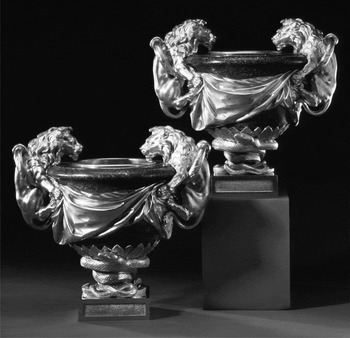
Pair of porphyry and gilt-bronze two-handed vases. Photo:
Christie's Auction House.
Following the auction, Ms. Thomson placed the urns in storage with
Christie's. It was not until the fall of 1998 when Ms. Thomson became
concerned about the authenticity of the vases, having heard a rumor
through an art dealer that the urns were “not
‘right’.”3
Thomsonv.
Christie's Appeal, ¶ 56.
Shortly thereafter, Ms.
Thomson conveyed her concerns to Christie's, precipitating an
investigation and, ultimately, legal proceedings.
The case has generated wide coverage in the art world because of the
possible implications of liability for auction houses and its potential
effect on the art market. Christie's and Sotheby's, which
together control approximately 95% of the world's auction market,4
Frantz, “Auction House Chairmen
Scrutinized.” New York Times, 7 April 2000,
http://www.nytimes.com/library/arts/040700auction-lawsuit.html
(accessed 29 May 2005).
have both faced an uphill struggle in the
last fifteen or so years. First the duopoly struggled to regain public
confidence, and then to recover from dismal financial returns.
In the early 1990's, Christie's and Sotheby's conspired
to combat an art market slump through collusion, agreeing to charge
identical commissions on sales.5
In the settlement of the antitrust
lawsuits that followed in the United States, each auction house was fined
$256 million in compensation to clients.
6 While Christie's escaped further
fines as the whistle-blower on the price-fixing scheme, Sotheby's was
fined an additional $45 million by the U.S. Department of Justice and $20
million by the European Commission.
7 By 2003, consumer confidence had fallen, and fine art sales had
plummeted 40% since 1998.8
During the art market boom of the
1980's, many old master and impressionist works were placed in
museums' permanent collections, ensuring they would not resurface on
the market. At the same time, owners of private collections were simply
reluctant to sell, resulting in a lack of blue-chip work available to the
resale market.
9 Both auction houses were forced to
undergo major restructuring to reduce operating costs. Between 2001 and
2003, Christie's and Sotheby's both laid off 15% of their
employees,
10 including
experts specializing in “arcane areas,” such as rare coins and
porcelain.
11 Despite these obstacles, the market appeared to be making a recovery
in 2003, with sales at record-setting prices: for modern and contemporary
works at Christie's, and impressionist pieces at Sotheby's.12
The trend continued in
2004, with twentieth-century works in particular achieving prices well
above pre-auction estimates and even resulting in a renewed interest in
investment portfolios consisting of fine art.
13 Porter, “Economists Have Advice for Potential Buyers as
the Art Market Heats Up,” New York Times, December 1, 2004,
http://query.nytimes.com/search/restricted/article?res=F30611FA3A5A0C728CDDAB0994DC404482
(accessed June 6, 2005).
And so it was in this cautiously optimistic climate that the art world
waited in great anticipation for the Thomson v. Christie's
judgment and the subsequent Court of Appeal decision published one year
later, in May 2005. Would the court's ruling constitute yet another
setback for the art-at-auction market?
THE HIGH COURT JUDGMENT
In the following review of the High Court's decision, which has
been variously described as “curious,”
“bizarre,”14
“complex but decisive,”
15 “Auctioneers Beware,” Internet Newspaper for the
British Antiques Trade, Headlines,
http://www.antiquesnews.com/head.php (accessed 11 December
2004).
and “a bit of a mess,”
16 “Thomson v. Christie's,” Cronaca,
20 May 2004, http://www.cronaca.com/archives/002387.html
(accessed 6 June 2005).
I will examine Ms. Thomson's
assertions, Christie's rejoinder, the evidence presented and the
findings of Mr. Justice Ian Jack.
The Catalogue Entry
In the Christie's catalogue for the Houghton sale, the first part
of the entry for the urns describes them as follows:
A PAIR OF LOUIS XV PORPHYRY AND GILT-BRONZE TWO-HANDLED VASES
designed by Ennemond-Alexandre Petitot, each with moulded everted rim with
gilt bronze lining, flanked by climbing lions within acanthus cast rings,
their paws supporting garlanded drapery, the tapering body above a
stiff-leave base and entwined serpent socle, on pounced panelled square
plinth 16-1/4 in. (41.5cm.) wide; 15-1/4 in. (39cm.) high; 11 in.
(28cm.) deep.
PROVENANCE: Acquired by Sybil Sassoon, Countess of Rocksavage
before 1921.
LITERATURE: [Nothing of relevance]
The catalogue description continues with a brief biography of Petitot,
illustrating his relationship to the Duke of Parma:
ENNEMOND-ALEXANDRE PETITOT AND PHILIP, DUKE OF PARMA
These vases were designed by the architect and ornamentalist
Ennemond-Alexandre Petitot (1727–1801) circa 1760, either for his
patron Philip, Duke of Parma (d. 1756) or one of his leading courtiers. A
pupil of Jacques-Germain Soufflot in Lyons, Petitot studied at the Academy
in Paris, where he won the Grand Prix d'Architecture in 1745. From
May 1746 until April 1750 he resided in Rome as a stipendiary at the
French Academy, where he designed extensive architectural settings in the
manner of Louis-Joseph Le Lorrain, architect of Lalive de Jully. Indeed,
it was through the recommendations of Le Lorrain and Lalive de
Jully's mutual friend, the Comte de Caylus, for whose book Recueil
d'Antiquités Petitot had already engraved several plates, that
Petitot was appointed architetto delle fabbriche ducali to the
Duke of Parma in 1753.
Petitot was responsible for introducing neo-classicism to
Parma, where he remained for the rest of his life, designing the facade of
S. Pietro (1761), the interior of the Biblioteca Palatina (1763) and the
extensions of the Palazzo Ducale. (1767)
The last paragraphs of the catalogue essay offer a symbolic
interpretation of the lions; a comparison to the Getty vases; and possible
sources of inspiration for the urns.
In his Suite de Vases of 1764, Petitot published a related
vase pattern surmounted by cockerels, emblematic of France and
iconographically applicable to his patron, who was Louis XV's
son-in-law. The bacchic lions may, therefore, be a reference to the
Netherlands an emblematic motif employed on the Boulle cabinet-on-stand in
the J. Paul Getty Museum, California (illustrated in C. Bremer-David et
al., Decorative Arts An Illustrated Summary Catalogue of the Collections
of J. Paul Getty Museum, Malibu, 1993, no. 7, pp. 14–15) The design
of these vases is one of thirty plates engraved by Benigo Bossi
(1727–1792) in Parma in 1764 and dedicated to Guillaume-Léon
du Tillet, marquis de Felino (1711–1774), the Prime Minister of
Parma. Another pair of vases of this model is in the J. Paul Getty Museum,
California (ibid., no. 270, p. 159).
As G. Wilson notes (op. cit., pp. 199–201), the actual
bases of the Getty vases, like the Houghton pair, are not of porphyry but
of a different material, that of the Getty pair being of red marble and
the Houghton ones of scagliola, which is not visible when the mounts are
in place. This suggests that the porphyry on both pairs is antique. A
third pair is now in a private collection in Greece.
The boldly modelled lions recall the lion grasping a horse in
the celebrated Roman marble in the palazzo dei Conservatori (C. Avery.
Giambologna, Oxford, 1987, p. 60), while their positioning on the
vase-rims recalls Louis XIV's silver vases designed by Claude Ballin
(d. 1678). However, the lion handles may have been inspired by an antique
vase in the Vatican Museum, engraved in E. Q. Visconti's Museo Pio
Clementino, 1782, Vol. 7, pl. XLIV.
Such vases were appropriate embellishments for the
fashionable French buffet, with its marble bronze ornament, such as
Jacques-Francois Blondel (1705–1774) illustrated in his De la
distribution des maisons de plaisances, 1737.17
The Claims
Ms. Thompson's contention is that the vases, or the Houghton urns
as they became known (coming from the Marquess' seat, Houghton
Hall),18
were a product of the nineteenth-century Second Empire
revival of the Louis XV style.
19 Second
Empire refers to the reign of Napoleon III as emperor, from 1852 to 1870,
not 1840 to 1870 as cited in Thomson at ¶ 12. Encyclopedia Britannica Online, s.v. “Second Empire,”
http://www.britannica.com/eb/article?tocId=40440&query=second%20empire&ct=
(accessed 6 June 2005).
Christie's dated the urns, designed
circa 1760, in the last years of the Louis XV's reign, between 1764
and 1774.
20 If, however, the Houghton urns were reproductions dating from
after 1840, as Ms. Thomson claimed, their value would be substantially
diminished. Expert evidence estimates that at auction, such pieces would
fetch £20,000 to £30,000,
21 whereas the presale
estimate at Christie's Houghton sale, where the urns were classified
as eighteenth century, was £400,000 to £600,000.
22Misrepresentation
Ms. Thomson's first claim against Christie's asserts that
the representations in the auction catalogue she was sent, as well as
those imparted by her Christie's special client advisor, Mr. Patrick
Cooney, were false. Not only were the urns nineteenth century rather than
eighteenth century, but they were also not of the quality stated.23
The
Misrepresentation Act allows claims for damages when one party
suffers a loss because of the misrepresentation of another party. The
party accused of misrepresentation is liable unless he is able to prove
“that he had reasonable grounds to believe and did believe up to the
time the contract was made that the facts represented were
true.”
24 Misrepresentation Act
1967, Ch. 7, s.2(1) (Eng.)
Duty of Care
The second claim against Christie's alleges a breach of duty of
care to Ms. Thomson. A duty of care consists simply of a legal obligation
to exercise caution, the scope of which is ultimately decided by
public-policy considerations. Ms. Thomson asserted that Christie's
duty here was twofold: a duty of care “in describing and dating the
urns” and a duty to inform Ms. Thomson “of any doubts or
queries of which Christie's were aware” regarding these
representations. This duty was said to arise because Ms. Thomson had
received the auction catalogue, because of her status as special client,
and because of her conversations with her Christie's advisor Mr.
Cooney prior to the sale.25
Thomson, ¶ 7. The statute of limitations on
this second claim is six years, but here s. 14A of the Limitation Act
1980 saves the claim from being barred.
The auction house maintained that its evaluation of the Houghton urns
as dating from the eighteenth century was accurate and denied owing Ms.
Thomson a duty either on the basis that she received a catalogue or
because of her special client status.26
However,
Christie's conceded that, in its oral and written statements
describing and dating the urns, it owed Ms. Thomson a duty “to use
reasonable skill and care” consistent with the standards of an
international auction house of its standing, specializing in fine arts and
antiques.
27The Investigation
As the dating of the urns made up a significant component of Ms.
Thomson's claim against Christie's, the urns were studied
extensively in an effort to make a positive determination. The courts look
to three criteria to establish authenticity of fine art and, by extension,
furniture and decorative arts. These are provenance, expert evaluation,
and scientific testing.28
Provenance
The Houghton urns have little in the way of provenance. Lord
Cholmondeley's grandmother, the Countess of Rocksavage, purchased the
urns in France sometime before 1921, when they appeared in a photograph
taken at Houghton Hall.29
No records of the urns exist prior to that time.
30 An
argument was made on behalf of Ms. Thomson that the absence of provenance
favored a nineteenth-century date, because their grandeur as
eighteenth-century decorative objects makes it likely that they would have
been recorded, and that this recording would have survived. However, a
Christie's expert demonstrated that many choice eighteenth-century
furnishings have no provenance either. Provenance alone is insufficient to
authenticate a piece, and, conversely, a lack of records is also
inconclusive, despite being qualified by the trial court judge, Mr.
Justice Jack, as “a reason for care.”
31Expert Evaluation
Christie's and Ms. Thomson called eight expert witnesses between
them, and the court embarked upon a detailed examination of the evidence
presented.32
Expert witnesses and their
qualifications enumerated. See Thomson, 
94–101.
Experts spoke to the design of the urns, based on a
drawing by Ennemond-Alexandre Petitot (1727–1801) engraved by
Benigno Bossi (1727–1792).
33 Though the evidence was
inconclusive, Mr. Justice Jack suggested as “general
experience” that the design was more likely to have been followed
soon after it became available, as opposed to “many decades
later.”
34 This conclusion appears to neglect the very nature of a
style revival such as the Second Empire, when pleasing eighteenth-century
designs would be implemented, regardless of whether or not they had been
executed before.
Experts produced contrary evidence regarding the style of gilt and the
modeling of lions, leaving Mr. Justice Jack unpersuaded by either
argument.35
The lack of a maker's mark was noted and found
to be inconclusive.
36 The porphyry was said to indicate eighteenth-century
craftsmanship by Christie's experts, and nineteenth-century work by
Ms. Thomson's experts, while the court held that the finish was more
consistent with the eighteenth century.
37 The judgment continues
to detail reports on all aspects of the urns, including their mounts,
joints, gilding, and liners.
In spite of Mr. Justice Jack's cursory study of eighteenth- and
nineteenth-century French furniture, he gained sufficient confidence on
the subject to make pronouncements at odds with the experts. The judge
differed with Mr. Paterson, a longtime consultant and appraiser in the
fine art and antiques business, on the expressions of the faces of the
gilt lions.38
The trial judge also found, independent of expert opinion,
an “appropriateness” to the “low finish” on the
porphyry, because “the eye needs a rest from glitter.”
39 These
comments suggest a departure from the justice's usual domain of fact
and law.
While the ultimate finding in a case is naturally the conclusion of
the presiding judge, it is nonetheless surprising that a judge may not
only be unpersuaded by authoritative expert opinion but may draw his own
conclusions independent of the expert. This runs contrary to the
fundamental nature and purpose of expert opinion evidence. Admissibility
of expert opinion evidence is dependent on the necessity of the insight of
an expert who, through formal study or practical experience, has special
knowledge, without which an ordinary person would be unlikely to form a
correct judgment.40
It is this specialized
knowledge that Mr. Justice Jack is clearly lacking, yet he demonstrated
little hesitation in assuming the role of the expert witness.
Scientific Testing
Scientific testing of the urns was carried out in the guise of
metallurgical analysis. Scientific testing can only disprove the
authenticity of a work; it cannot affirm its identity.41
The most famous example of this is the result of carbon
dating which revealed the Shroud of Turin to be a hoax.
Factoring
in the great expense of scientific analysis and its portent of oft
unwelcome news for collectors, museums, dealers, and auction houses alike,
the technology is not employed as regularly as one might expect. Neither
Christie's nor Sotheby's has a laboratory for scientific
testing.
42 The potential pitfalls of relying on new science were evident in the
independent specialists' first report commissioned by
Christie's: the data analysis was flawed, and the results were
subsequently discredited.43
Further tests were
carried out and analyzed; the judgment includes pages describing
methodology and minutiae on metals, but in the end, no conclusions could
be reliably drawn from the testing.
44 When neither provenance, expert evaluation, nor scientific testing
prove conclusive, the law does not hold the means to resolve the
authenticity question with any greater success than the art world. When
dealing with a piece without provenance in a market that includes copies
and fakes, “[i]t means that almost any attribution to a
recognized artist, especially … [when] provenance is
unknown, may be arguable.”45
Nourse L.
J. in Harlingdon ua Leinster Enterprises Ltd v. Christopher Hull Fine
Art Ltd (1991) 1 Q.B. 629, (1990) 1 All E.R. 737 (Eng.).
It
is always possible to find a second expert prepared to refute the
first.
Authentication
On the difficulties of attributing authenticity, Thomas Jayne, a
decorator and specialist in American architecture and decorative arts who
has worked at the J. Paul Getty Museum and provides appraisals for
Christie's, suggested that “[t]he decorative arts
world is not finite, like the world of an important picture.”46
W. L. Hamilton,. “Hot Bids and Cold
Sweat,” New York Times, 3 June 2004, D1.
However,
the authentication of an eighteenth-century urn in a marketplace filled
with nineteenth-century revivalist copies could be considered analogous to
the problem of a painting attributed to a well-known artist who is known
to have spawned many forgeries.
47 Fakes
abound of Van Gogh, Modigliani, Picasso, Warhol, da Vinci, and Dali, to
name but a few.
A similar problem arises when attempting to
attribute authorship to a painting from a master painter's studio
such as Rembrandt's: is the work by the master himself, or has the
style been carefully copied by one of his many students, after Rembrandt
or by the School of Rembrandt, or is it a combined effort of the
workshop?
Inherent Uncertainty
In his closing speech, Christie's counsel Mr. Onslow concedes
that “[t]here can never be certainty in this field and at
one level the art market is inherently uncertain.”48
When
Mr. Justice Jack concludes that, because of the fashion for Second Empire
revivals, Christie's should have informed Ms. Thomson of the risk
that the urns were not Louis XV, the judge appears to be relying on the
notion that identification of the Houghton urns was particularly and
“unusually” difficult.
49 However, the challenge
of dating the urns is no more difficult than the problem of dating many
works of fine art.
Having considered provenance, expert evaluation, and scientific
testing, and after reviewing the mostly conflicting expert evidence, Mr.
Justice Jack finally rejected both parties conclusions on the dating of
the urns and found a 70% likelihood that the urns were Louis XV.50
As
such, Ms. Thomson did not succeed in her primary claim.
The Advisory Relationship
Ms. Thomson's remaining claims against Christie's centre
around the alleged duties owed to her by Christie's in light of their
relationship. The case turned not on whether the works sold were as
described and warranted by the auction house, but rather on the auction
house's duty to this particular client to disclose the risk involved
when relying on their expert opinion.
By dispatching Mr. Cooney to serve as Ms. Thomson's special
client advisor, Christie's entered into an advisory role with their
client. The role of the special client advisor is to provide the client
with detailed information to assist with bidding decisions.51
Mr.
Cooney was aware that Ms. Thomson was not familiar with Louis XV
furniture, nor was she seeking advice outside of Christie's on this
purchase.
52 He had also been informed that Ms. Thomson insisted upon
purchasing only work of museum quality.
53 In conversation with
Ms. Thomson, Mr. Cooney never suggested that the Houghton urns were
anything other than authentic pieces from the eighteenth century, as was
the firm and reasonable belief of Christie's in-house experts. Nor
did Mr. Cooney ever suggest that the description of the urns in the
catalogue was less than certain.
Ms. Thomson was not a newcomer to bidding at auction at the time of
the Houghton sale. Her most significant purchase prior to the urns was a
tapestry costing $217,500.54
Ms. Thomson's
status as special client would have been a consequence of her previous
purchases, combined with her purchasing power. A self-described keen
private collector, Ms. Thomson was almost certainly aware of the
disclaimers associated with catalogue entries, although this issue was not
addressed by the court. If Ms. Thomson paused to ask how, for example, it
was determined that the urns were designed for the Duke of Parma or one of
his courtiers, there was no evidence presented of her inquiry. The concept
of due diligence was, in fact, never raised by the court, thereby
alleviating Ms. Thomson of any responsibility to be vigilant or even
cautious under the doctrine of caveat emptor.
All the responsibility of adequately informing Ms. Thomson of the
possible risks and pitfalls of bidding on the urns fell to Mr. Cooney. Yet
it is undeniable that part of Mr. Cooney's function as special client
advisor entailed a certain degree of salesmanship. While the establishment
of a comfortable business relationship with the special client is
undoubtedly imperative, Christie's ultimate goal, surely, is to sell
works to the client and ensure her satisfaction with those works. Can a
customer-relations expert such as Mr. Cooney reasonably be expected to
inform the worldly Ms. Thomson of a risk that he himself does not believe
exists?
The Catalogue Description
Christie's dating of the urns in the catalogue heading as Louis
XV was found to be reasonable, and therefore not in breach of duty to Ms.
Thompson.55
The description that followed, however, was labeled
“misleading,” instilling in the reader “a feeling of
confidence and certainty about the urns, which was unjustified.”
56 Working drafts of the catalogue description revealed that, prior to
final revisions, the urns had been described as “possibly
Italian.” The court could not find any justification for removing
these words, besides the fact that the Christie's cataloguer had
decided that the urns were French. The trial judge did not find this
reasoning sufficiently convincing and characterized the removal of the
phrase as the first element of “an unjustified firming-up of the
catalogue description.”57
Mr. Justice Jack also took issue with Christie's claim in the
catalogue description that the urns were designed by Petitot,
“either for his patron Philip, Duke of Parma (d. 1756), or one of
his leading courtiers.” This assertion was apparently made without
any evidence beyond the possibility of Petitot receiving such a
commission.58
However, these florid passages that follow the catalogue
heading carry an explicit disclaimer. Section 6 of Christie's
Terms and Conditions of Sale, entitled
Limited Warranty,
confines its warranty of authenticity to the capitalized heading of the
catalogue entry, in this instance, “A PAIR OF LOUIS XV PORPHYRY AND
GILT-BRONZE TWO-HANDLED VASES,” and absolves the auction house of
any responsibility for errors and omissions in the description that
follows the heading.
59
The description in the catalogue is, as a matter of common practice for
Christie's and Sotheby's, merely “opinion and not to be
relied on as statements of fact.”
60 Christie's
Terms and
Conditions meet the requirements set out by English legislation on
disclaimers as “properly drafted” according to “the
standards of reasonableness, fairness, balance, even-handedness and
coherence.”
61 The last element of “firming-up” found by the court was
not in the catalogue description but in the condition report, which was,
in fact, never seen by Ms. Thomson. This document stated that the
“antique” urns had been “reworked” by Petitot,
suggesting that the urns dated from classical Roman times.62
The
trial judge suggested that, as this document was read by Mr. Cooney, it
would have unjustifiably increased his confidence in the authenticity of
the urns.
Christie's responded to these contentions in their appeal,
successfully convincing the court that these three elements of so-called
firming-up found by Mr. Justice Jack in the catalogue description were all
minor details, none of which bolstered Christie's confidence in
dating the urns as Louis XV.63
Thomson
v. Christie Manson & Woods Ltd. and others, [2005]
E.W.C.A. CIV. 555, [2005] All E.R. (D) 176 (May) 
99(3).
Findings of the High Court
Notwithstanding the Limited Warranty, and the fact that
Christie's were found to have reasonable grounds for their opinion on
the authenticity of the urns, the trial court held that Christie's
did not have reasonable grounds “for expressing the unqualified
opinion” on the authenticity of the urns as eighteenth-century
pieces through special client advisor Mr. Cooney.64
Because of the
“advisory relationship”
65 between
Christie's and Ms. Thomson as a special client, the auction house
owed “particular duty”
66 to Ms. Thomson
according to Mr. Justice Jack.
The court's ruling stated that Christie's special client
advisor would not be held to the same standard as an independent art
expert regarding the detail in which he was expected to inform his
client.67
Nonetheless, Mr. Justice Jack determined that
“circumstances” required that Ms. Thomson be informed about
the difficulty of dating Louis XV items: the preponderance of
“copies and imitations” from the nineteenth century, the fact
that Christie's were relying “upon their exercise of their
judgment following visual inspection,” the misleading nature of the
catalogue description, and the resulting risk “in paying a large sum
for the urns.”
68 Christie's failure to qualify their opinion thus
was held to be an indefensible omission and a breach of the advisory
relationship duty.
Christie's contended that as they were found to have reasonable
grounds for dating the urns to Louis XV in the warranted catalogue heading
without any qualification,69
there could be no
breach in duty by describing them as such to Ms. Thomson.
70 It is not surprising to learn in the following paragraph of the
judgment that had she been furnished with that information, Ms. Thomson
would not have bought the urns.71
While the case involved a lengthy investigation effort to date the
urns, ultimately the judge's decision turned on Christie's duty
to Ms. Thomson. Mr. Justice Raymond Jack ruled in Ms. Thomson's favor
when he concluded that although the auction house was entitled to describe
the urns as Louis XV in the catalogue heading without any qualifications,
Christie's breached their duty to Ms. Thomson as a special client
when they failed to inform her of the existence of the Second Empire
revival and the resulting difficulties in authenticating the urns.72
Christie's was also found liable for damages under the
Misrepresentation Act because of their failure to qualify the
catalogue description as misleading in its tone of confidence and
certainty.
73Damages
The judgment called for Christie's to refund to Ms. Thomson the
difference between the price she paid for the urns and their “actual
worth” plus interest to compensate for “any breach of duty
which caused Ms. Thomson to purchase the urns.”74
Damages awarded
for her successful claim for misrepresentation were to be calculated based
on the buyer's premium she paid Christie's on the purchase.
75 In sum,
the damages were estimated to total £2 million, on top of which Ms.
Thomson would be awarded legal costs.
76 BBC
News article “Collector Wins £1.9m Urns Case,” BBC
News UK Edition, 19 May 2004,
http://news.bbc.co.uk/1/hi/england/norfolk/3727623.stm
(accessed 6 June 2005).
The urns were to remain in Ms.
Thomson's possession.
THE APPEAL
Naturally, Christie's entered an appeal. For her part, Ms.
Thomson entered a cross-appeal, alleging that the trial judge did not give
sufficient consideration to the evidence in favor of a nineteenth-century
date and claiming that her purchase was based on a misrepresentation.
The main grounds of Christie's appeal are related to issues of
duty of care. The trial judge considered the breach of duty problem as two
questions. First, was Christie's negligent in their catalogue
description of the urns? Second, did Christie's owe a particular duty
to Ms. Thomson, obliging them to inform her that the catalogue description
might be incorrect, or, in other words, was Christie's justified in
“expressing the unqualified opinion” that the urns were Louis
XV.77
Lord Justice May, the Court of Appeal judge, interprets the main
thrust of the appeal as whether it was reasonable to expect
Christie's to inform Ms. Thomson of doubts surrounding the dating of
the urns; this, of course, requires a determination as to whether it was
reasonable to expect Christie's to have had such doubts at all.78
The Extent of Christie's Duty of Care
Regarding any doubts Christie's may have had about the urns'
dates and any resulting obligation to Ms. Thomson at the High Court trial,
Christie's readily accepted the responsibility to exercise reasonable
skill and care in dating the urns and describing their quality to Ms.
Thomson, thereby acknowledging duty towards their special client.79
However, Mr. Justice Jack found that the auction house was
negligent for failing to expressly stipulate that its assessment of the
urns was only a matter of opinion and did not preclude the possibility
that an outside evaluation could date and describe the urns
differently.
80 Christie's
Appeal, ¶ 90(2).
This led Christie's to assert on
appeal that the trial judge's decision “turned a professional
obligation to exercise skill and care in stating an opinion into an
insurance obligation against the possible existence of contrary
opinions.”
81 Christie's
Appeal, ¶ 90(3).
Even if a contrary opinion as to the origins of the urns were to be
offered, and even if it were backed by persuasive evidence,
Christie's could not be held negligent for their characterization of
the urns, because their conduct conformed to the professional standards of
their trade. As a matter of practice, it is accepted in the art market
that an evaluation inevitably entails the formation of an opinion. A
professional opinion, like any opinion, is fallible. In the event that the
opinion is proven wrong, there will be no finding of professional
negligence unless reasonable skill and care have not been exercised.82
Christie's Appeal, 
116.
Moreover, a professional conforming to the duty of care is
neither required nor expected to state the obvious nor “draw
attention to risks which [in the professional's opinion]
are fanciful.”
83 Accordingly, in answer to the first part of Lord Justice May's
inquiry, Christie's could not have been reasonably expected to alert
Ms. Thomson to any doubts regarding the dating of the urns, in the form of
others' contrary opinions. Christie's did not
themselves have any doubts regarding the dating of the urns, and,
therefore, it is tautological to suggest that they should have cautioned
Ms. Thomson in this way. The Court of Appeal thereby overturned Mr.
Justice Jack's finding that Christie's breached their advisory
relationship duty to Ms. Thomson when they expressed their unqualified
opinion on the urns.
Certainty of Dating
Addressing the question of whether Christie's should reasonably
have doubted the dating of the urns, the lower court determined on the
balance of probabilities that the urns were Louis XV pieces, and that it
was reasonable to describe them as such.84
Christie's Appeal, ¶ 90(1).
Christie's contends that this case should have never progressed any
further after this determination, because Ms. Thomson's claim was
dependent on the assertion that the urns were misrepresented
nineteenth-century revival copies.
85 Christie's Appeal, ¶ 90(1).
Ms.
Thomson's case, as portrayed by Christie's, did not advance any
allegations of breach of duty, but rested rather on the assertion that, as
nineteenth-century pieces, the urns' value was merely £25,000
or thereabouts.
86 Christie's underlines the fact that instead of dismissing her
claim, the trial judge, while rejecting Ms. Thomson's pleadings,
“found in her favour only by reformulating her case in a way that
was not even argued at trial.”87
Christie's Appeal, ¶ 90(1).
This
perhaps accounts for the lack of linear narrative in the lower
court's judgment. Lord Justice May is not persuaded by this tact,
however, and refuses to allow Ms. Thomson's case to “founder on
a formalistic pleading point.”
88 Returning to the question of whether or not it was reasonable to
expect Christie's to have had doubts surrounding the dating of the
urns, Lord Justice May finds Christie's under no obligation “to
express anything other than confidence to Ms. Thomson.”89
Christie's Appeal, 
157.
The Court of Appeal judge finds that Mr. Justice Jack's
conclusion that Christie's was entitled to call the urns Louis XV in
the catalogue “sits most uncomfortably” with the holding that
Christie's was nonetheless in breach of duty to their special
client.
90 Christie's Appeal,
¶ 153.
Lord Justice May succinctly reviews and discards the trial
judge's threefold finding that the auction house breached its duty of
care in spite of its confidence in the dating of the urns. First, the
trial judge claimed that the existence of nineteenth-century copies meant
that dating the urns was an “unusually difficult” task; this
notion is at odds with the trial judge's own earlier finding that
Christie's was justifiably confident in their opinion of the urns as
eighteenth century. The Court of Appeal concludes the earlier finding was
correct and the auction house had clearly ruled out the possibility that
the urns were nineteenth-century copies.91
Christie's Appeal, ¶ 160.
Second, the trial judge contends that Ms. Thomson should have been
informed that Christie's evaluation was based mainly on their visual
inspection. This point is obvious, raising once again the fact that a
professional conforming to the duty of care does not need to state the
self-evident. In fact, Mr. Justice Jack refers to the practice of dating
items through visual examination as “well-established” in
“auction houses and the art world generally” earlier in his
own judgment!92
Lord Justice May makes the additional points that Ms.
Thomson was not so naïve as to require this explanation, and that as
Christie's were found to be justifiably confident in the dating of
the urns, it is unreasonable to cast doubt on their methodology.
93 Christie's Appeal, 
161.
Third, the High Court concluded that the catalogue entry was
misleading in its tone of confidence. The aforementioned firming-up of the
catalogue description had no relevance to the authenticity or the value of
the urns; these possible exaggerations were harmless because they did not
influence Christie's confidence in its evaluation.
Having methodically dissected and disposed of the High Court's
various findings of negligence, misrepresentation, and duty of care and
having implied that, were the evidence to be reevaluated as a whole, the
urns would be found to be eighteenth century with not 70% but 100%
certainty, the Court of Appeal allowed Christie's appeal and
dismissed Ms. Thomson's cross-appeal. The Court of Appeal's
discussion of the measure of damages employed by the High Court thereby
became purely academic.
CONCLUSION
Christie's victory may have, at least temporarily, alleviated the
concerns of auction houses and art dealers; had Ms. Thomson succeeded in
her claims, the implications for potential liability of the seller may
well have paralyzed the art market. Despite the fact that the final result
was not in Ms. Thomson's favor, the issues raised by her case should
give pause to art dealers and auction houses alike. Should the resale
market be prepared to invest in costly and lengthy authentication
exercises before offering a work for sale? In wake of Ms. Thomson's
claims, will a seller describe its wares with the same certainty and
assurances as before?
Many collectors would not or could not expend the necessary resources
to sue on a question of authenticity,94
The
expense of suing an auction house with resources such as Christie's
could be crippling. Engaging experts to testify is very costly and
consumed eleven days in this case. Ms. Thomson's legal fees were
estimated at £800,000. See Timmons, Heather. “Judge Faults
Christie's in Auction of Urns,” New York Times, 20 May
2004, B1. Ms. Thomson retained Lord Grabiner Q.C. as counsel for the
appeal. According to Lawyer Magazine, Grabiner charges up to
£3,000 per hour. See “Thomson Urn Saga
… Will it Ever End.”
and others would choose
not to publicize their misfortune because of the shame of being duped.
Moreover, once the authenticity of a piece has been questioned, it may
lose its worth entirely on the art market, even if the question appears to
have been resolved in favor of the artwork. The Houghton urns may now be
“virtually unsaleable.”
95 Valentin, “Taylor
Thomson.” An extensive body of case law exists on libel suits
against experts by collectors suing for disparagement, claiming that the
expert appraisal of their artwork has devalued it, the classic case being
Hahn v. Duveen 133 Misc. 871 234 N.Y.S. 185 (Sup. Ct.
1929).
Forty years ago, auctions were almost exclusively the domain of the
experienced and educated dealer, resulting in a wholesale, rather than
retail marketplace. Rarely did the auction house face the added possible
complication of duties towards an uninformed buyer. The lure of lower
prices, however, soon drew the collectors. It has been suggested that the
collector cannot enjoy the same certainty on issues such as authenticity
at auction as he may in a private sale.96
Mr. Justice Jack's ruling that
Christie's could not be to expected “to give the full and
detailed advice” that would be anticipated from an independent
expert supports this proposition.
97 Furthermore,
Christie's catalogue description was considered misleading yet
“good enough for the ordinary buyer,” but not for a special
client.
98 Art and antique
dealers would certainly like the collector to believe that they offer a
more secure environment for the buyer, and, following this cautionary
tale, are primed to promote the benefits of doing business outside the
auction house.
99 Should auction houses be expected to remind the buyers that their
in-house expert evaluation is merely their opinion, and there is always a
risk that they are mistaken? If auction houses were to employ additional
disclaimers and exclusion clauses will they undermine consumer confidence
altogether? Where can auction houses be expected to draw the line between
salesmanship and puffery and self-defeating declarations of uncertainty
and risk?
When Ms. Thomson purchased the urns in 1994, by her own admission she
thought she had paid “too much,” having spent three times the
pre-auction estimate.100
Claiming she had “nowhere suitable to house the
urns”
101 (despite residences in Southern California, Toronto, London,
and the English countryside),
102 Adams,
James, “Ruling on Christie's sale of urns to heiress
overturned,” Globe and Mail, 13 May 2005, A12.
the
heiress left her purchase in storage at Christie's. Were Ms.
Thomson's claims merely the result of buyer's remorse on a grand
scale? The answer is unknowable. Regardless, the art world will be
watching with anticipation for further interpretations of this legal
precedent. Ms. Thomson is said to be considering an appeal to the House of
Lords;
103 certainly she has the funds with which to
do so. For their part, the Houghton urns stand to become the most costly
(and notorious) eighteenth-century vases ever to grace the market.