The Diagnostic and Statistical Manual of Mental Disorders-5 [DSM-5; American Psychiatric Association (APA), 2013] personality disorder (PD) classification system delineates 10 PD diagnoses; however, high diagnostic co-occurrence (e.g. Zimmerman et al. Reference Zimmerman, Rothschild and Chelminski2005) and other limitations have led researchers to question its validity (e.g. Clark, Reference Clark2007). An alternative model of PD (AMPD) was proposed for DSM-5; however, it ultimately was placed within Section III of DSM-5 for continued research (APA, 2013). The AMPD has a personality functioning dimension (Criterion A) that describes general impairments shared across PDs and a trait model to describe specific presentations (Criterion B). Despite being independent diagnostic criteria, few studies have examined the separation of general PD impairment and descriptive specific dimensions within one model (e.g. Krueger et al. Reference Krueger, Hopwood, Wright and Markon2014). Furthermore, existing research has not considered the complexity of interpreting general and specific dimensions within combined models. The present study (a) compares the fit of several viable structural PD models that attempt to delineate general (e.g. functioning) and specific (e.g. trait) dimensions, and then (b) examines the construct validity of the best-fitting models.
Combining general and specific personality disorder features
Despite the general-specific distinction in the AMPD, studies of this model have only recently emerged. Existing research suggests that: (a) general and specific features overlap (Clark & Ro, Reference Clark and Ro2014), (b) specific features (e.g. traits) increment general features in predicting external variables (e.g. Few et al. Reference Few, Miller, Rothbaum, Meller, Maples, Terry, Collins and MacKillop2013), and (c) general features sometimes weakly increment specific features in such analyses (e.g. Bastiaansen et al. Reference Bastiaansen, De Fruyt, Rossi, Schotte and Hofmans2013, Reference Bastiaansen, Hopwood, Van den Broeck, Rossi, Schotte and De Fruyt2016). Presently, disagreement persists regarding the degree of general-specific feature overlap and the value of the distinction (e.g. Berghuis et al. Reference Berghuis, Kamphuis and Verheul2012; Clark & Ro, Reference Clark and Ro2014). One limitation to this research and the AMPD's construction is that general and specific PD feature models were developed independently (Morey et al. Reference Morey, Berghuis, Bender, Verheul, Krueger and Skodol2011; Krueger et al. Reference Krueger, Derringer, Markon, Watson and Skodol2012). Thus, assumptions regarding which features are shared among all individuals with PDs and which vary across individuals are built into such models. One approach to addressing this dilemma is building an integrated model using established PD indicators (e.g. DSM PDs), in which general and specific features are empirically determined based on observed covariation.
Hopwood et al. (Reference Hopwood, Malone, Ansell, Sanislow and Grilo2011) attempted this through: (a) summing PD criteria to estimate impairment, (b) regressing PD criterion counts onto impairment to estimate PD residuals, and (c) conducting a principal component analysis of these residuals. The impairment dimension correlated with preoccupation with rejection, self-doubt, anger, identity disturbance, and paranoid ideation. Additionally, peculiarity, withdrawal, fearfulness, instability, and deliberateness emerged as unique dimensions. Semerari et al. (Reference Semerari, Colle, Pellecchia, Buccione, Carcione, Dimaggio, Nicolò, Procacci and Pedone2014) used the same method and found the following style dimensions: withdrawal, peculiarity, instability, and oppositionality v. inflexible adherence to rules. Semerari et al. also found that PD impairment predicted global meta-cognitive impairment. Despite these findings, bifactor modeling can provide more sophisticated tests of models related to the AMPD.
Bifactor models of personality pathology
Bifactor models include a ‘general’ factor that accounts for variance shared among all indicators, as well as ‘specific’ factors that explain variance that is: (a) common to subsets of indicators and (b) orthogonal to the general factor (Reise et al. Reference Reise, Moore and Haviland2010). For PDs, the general factor accounts for features cutting across varied presentations, whereas the specific factors capture the uniqueness of individual PD presentations. Bifactor models may: (a) be confirmatory (CBFA) or exploratory (EBFA; Jennrich & Bentler, Reference Jennrich and Bentler2011) and (b) have orthogonal or correlated specific factors.
Four studies have examined PD bifactor models. Jahng et al. (Reference Jahng, Trull, Wood, Tragesser, Tomko, Grant, Bucholz and Sher2011) used CBFA with PD diagnoses, finding a general factor and specific ‘cluster B’ factor (narcissistic, borderline, antisocial, and histrionic) that independently predicted substance use. Conway et al. (Reference Conway, Hammen and Brennan2015) conducted an EBFA of PD criterion count, which yielded a general factor with strong borderline (BPD) and paranoid (PPD) PD loadings, along with three specific factors: submissiveness, instability v. rigidity, and attention seeking. The Conway et al. (Reference Conway, Hammen and Brennan2015) general factor uniquely predicted functioning, beyond internalizing and externalizing symptoms, whereas the specific factors showed weaker criterion validity. Wright et al. (Reference Wright, Hopwood, Skodol and Morey2016) tested a bifactor model using five waves of PD criterion count data. This model and its relation to external variables (e.g. traits), provide evidence for a general factor defined by BPD, neuroticism, mistrust, aggression, self-harm, and eccentric perceptions, along with clear specific factors for detachment, dependency, and dominance. Weaker compulsivity and disinhibition-specific factors also emerged. Sharp et al. (Reference Sharp, Wright, Fowler, Frueh, Allen, Oldham and Clark2015) applied EBFA to the individual criteria of six PDs, resulting in a model where BPD criteria strongly loaded on the general factor and clear antisocial, narcissistic, and schizotypal PD (STPD)-specific factors emerged. Notably, within individual PDs some criteria (e.g. Schizotypal ‘ideas of reference’) were stronger markers of the general factor than others (e.g. Schizotypal ‘constricted affect’), suggesting DSM PD diagnoses and criterion counts are problematic factor indicators.
Despite the value of criterion-level bifactor analysis, no study has used this method with the criteria of all 10 PDs; including all criteria may alter the resulting factors. Additionally, previous work has not examined a single-factor model, which would be useful for estimating the added value of specific factors. Finally, further construct validation of a PD bifactor model is necessary, as both general and specific factors explain variance in observed variables, complicating factor interpretation (e.g. Simms et al. Reference Simms, Prisciandaro, Krueger and Goldberg2012). In particular, examining such a model in relation to pathological personality traits (e.g. Krueger et al. Reference Krueger, Derringer, Markon, Watson and Skodol2012) and contemporary psychopathology models (Kotov et al. Reference Kotov, Ruggero, Krueger, Watson, Yuan and Zimmeran2011) would (a) richly characterize the resulting factors, (b) clarify relations to other symptoms, and (c) indicate impairments unique to PDs.
Present study
We examined the nature and necessity of both general and specific dimensions through structural analyses of prominent PD criteria models and criterion validity. Three confirmatory models were compared. First, a single-factor model (e.g. general impairment) with loadings from all PD criteria was examined. Second, a 10-factor model (i.e. DSM-5 Section II PDs; APA, 2013) was estimated, with traditional PD factors marked by each PD's respective criteria. Finally, a CBFA model was tested, through adding a general factor (i.e. with loadings from all criteria) to the 10-factor model. Confirmatory models were based on traditional DSM PDs, because Sharp and colleagues’ final model included dimensions resembling PD diagnoses. We hypothesized that the bifactor model would fit best and that the general factor would most heavily be saturated with BPD criteria. In addition, we predicted that (a) the BPD-specific factor would have weak loadings; (b) clear antisocial (ASPD), narcissistic (NPD), and STPD-specific factors would emerge; and (c) PD criteria not examined in Sharp et al. (Reference Sharp, Wright, Fowler, Frueh, Allen, Oldham and Clark2015; i.e. histrionic, dependent, schizoid, and paranoid) would form meaningful specific factors, particularly those that have shown weaker relations to the general factor in the past, such as schizoid PD (SZPD) and histrionic PD (HPD; Hopwood et al. Reference Hopwood, Malone, Ansell, Sanislow and Grilo2011; Conway et al. Reference Conway, Hammen and Brennan2015).
In addition, we examined the criterion validity of the best-fitting models. As we predicted the bifactor model would fit best, we framed hypotheses in terms of this model. First, we predicted the general factor would relate most strongly to trait negative affectivity, but also would relate to antagonism and disinhibition. Second, based on Sharp et al. (Reference Sharp, Wright, Fowler, Frueh, Allen, Oldham and Clark2015), we predicted that (a) the ASPD and NPD-specific factors would relate most strongly to antagonism and (b) the STPD factor would relate most strongly to psychoticism. Additionally, we predicted that SZPD would relate to detachment and HPD would relate to attention seeking (i.e. antagonism facet). Finally, the general factor's criterion validity was compared with internalizing symptoms, substance use, and psychosis; we hypothesized that the general factor would uniquely predict general impairment and specific interpersonal impairment.
Method
Participants and procedures
Current and recent psychiatric patients (N = 628), recruited from Western New York mental health clinics, completed structured interviews and computer-administered self-report measures. Participants were compensated with $50 and transportation reimbursement. Most participants were currently in treatment (80%) or had been within the last 1 (10%) to 2 (5%) years. Reported treatment foci included: mood disorders (57%), anxiety (15%), alcohol use (7%), relationship/family problems (5%), schizophrenia (5%), other drug use (4%), and eating disorders (<1%). Participants averaged 43.2 years of age (s.d. = 12.5), were 65% female, and identified as Caucasian (63%) or African American (34%). Due to the large number of measures, not all participants finished, and thus some have missing data. Procedures for handling missing data are described below.
Interview measures
Structured clinical interview for DSM-IV (SCID-II)
The SCID-II is a structured diagnostic interview of DSM-IV PDs (First et al. Reference First, Spitzer, Gibbon and Williams1995). Participants completed the SCID-II Personality Questionnaire (SCID-II PQ) as a screening measure and then were interviewed, focusing only on the criteria of PDs for which they screened positive. Criteria not reviewed during interviews were recorded as indicated by the SCID-II PQ. This procedure led to some missing responses, as individuals who skipped a SCID-II PQ item did not receive a value for the item if they were not interviewed for that PD. Overall, there was negligible missing data for most variables (i.e. 89% of criteria had no missing data); however, all ASPD criteria and two observed HPD criteria had considerable missingness (e.g. >60% missing)Footnote † Footnote 1 . Interviewers were mostly clinical psychology doctoral students and were supervised weekly by a Ph.D.-level clinical psychologist (e.g. video review of interviewing practices). Randomly selected videotaped interviews (n = 120) were rated by a second interviewer, revealing strong inter-rater reliability (Mdn κ = 0.96, range = 0.66–1.00). In this sample, 67% of participants met criteria for at least one PD (4% Histrionic to 37% Obsessive-Compulsive).
Mini international neuropsychiatric interview (MINI)
The MINI 5.0.0 is a brief structured diagnostic interview for commonly diagnosed disorders (Sheehan et al. Reference Sheehan, Lecrubier, Sheehan, Amorim, Janavs, Weiller, Hergueta, Baker and Dunbar1998). In the present study, the MINI 5.0.0 was adapted, with permission, to assess DSM-5 disorders. Dimensional symptom counts were scored for major depressive disorder, dysthymia, generalized anxiety disorder, post-traumatic stress disorder, social anxiety disorder, panic disorder, agoraphobia, alcohol use disorder, (other) substance use disorder, hallucinations, and delusions. The median internal consistency of these symptom counts, when calculable, was 0.87 (range = 0.44–0.91).
World Health Organization Disability Assessment Schedule 2.0 (WHODAS 2.0) 12-item version, interview-administered
The WHODAS 2.0 is a 12-item interview measuring six functioning and disability domains: cognition, mobility, self-care, getting along (i.e. with others), life activities (e.g. work responsibilities), and participation in society (e.g. community engagement; Üstün et al. Reference Üstün, Chatterji, Kostanjsek, Rehm, Kennedy, Epping-Jordan, Saxena, von Korff and Pull2010). Interviewers described the interview and instructed participants to report the average difficulty experienced over the past 30 days using a scale of 1 (none) to 5 (extreme or cannot do). All items were summed to create a ‘general impairment’ score (α = 0.86.), as recommended by previous research (Üstün et al. Reference Üstün, Chatterji, Kostanjsek, Rehm, Kennedy, Epping-Jordan, Saxena, von Korff and Pull2010). Ninety-six percent of participants provided complete data on this measure.
Self-report measures
Personality inventory for DSM-5 (PID-5)
The PID-5 (Krueger et al. Reference Krueger, Derringer, Markon, Watson and Skodol2012) is a 220-item questionnaire with 25 lower-order scales, one for each AMPD pathological personality trait. Lower-order facet scales form five domains (Negative Affectivity, Antagonism, Detachment, Disinhibition, and Psychoticism). Each facet scale has 4–14 items measured on a four-point scale of 0 (very false or often false) to 3 (very true or often true). In the present sample, 74% of participants completed the PID-5. The median α coefficient was 0.93 (range = 0.93–0.95) and 0.87 (range = 75–0.96) for domains and facets, respectively.
Satisfaction with life scale (SWLS)
The SWLS (Diener et al. Reference Diener, Emmons, Larsen and Griffin1985) is five-item scale that assesses participants’ global self-evaluation of their life (e.g. ‘In most ways my life is close to my ideal’). Items are rated on scale of 1 (strongly disagree) to 7 (strongly agree) and summed such that high scores indicate satisfaction. In the present study, 69% of participants completed the SWLS, and the α coefficient for the total score was 0.90.
Inventory of interpersonal problems-short circumplex (IIP-SC)
The IIP-SC (Soldz et al. Reference Soldz, Budman, Demby and Merry1995) is a 32-item measure of interpersonal behaviors that individuals perform excessively (e.g. ‘I argue with other people too much’) or deficiently (e.g. ‘It is hard for me to feel close to other people’). Items form eight four-item scales (Domineering, Vindictive, Cold, Socially Avoidant, Nonassertive, Exploitable, Overly Nurturant, and Intrusive), which in the present study were summed to create a total score (α = 0.93). Seventy percent of the sample provided complete data.
Multidimensional dysfunction aggregate (MDA)
Participants were presented with five questions related to psychosocial functioning in the past 6 months and responded using a visual analog scale ranging from ‘not at all’ to ‘very much.’ Four questions assessed Ro & Clark's (Reference Ro and Clark2009) psychosocial impairment domains: well-being, basic functioning (e.g. self-care), self-mastery (e.g. internal self-control), and interpersonal and social relationships. An additional question assessing difficulties at work and school was included. These items were summed to create a dysfunction composite, which was adequately reliable (α = 0.72). Complete data were available for 95% of the sample.
Analyses
Analyses were conducted in Mplus 7.3 (Muthén & Muthén, Reference Muthén and Muthén2012). Since SCID-II criteria are dichotomous, structural models were estimated using a robust weighted least-squares estimator (WLSMV) that produces mean- and variance adjusted chi-square (χ2) values. WLSMV also takes into account patterns of missing data, using a pairwise present analysis that operates consistently when data at least approximate missing completely at randomFootnote 2 (Asparouhov & Muthén, Reference Asparouhov and Muthén2010). Structural models were compared directly using chi-square difference tests (Δχ2), when possibleFootnote 3 , and relative comparative fit index (CFI) differences (i.e. ⩾0.01) indicated model fit differences (Cheung & Rensvold, Reference Cheung and Rensvold2002). Final models were evaluated using: model χ2 significance, root-mean-square error of approximation (RMSEA; <0.06 is good, >0.10 is poor), and CFI and Tucker–Lewis indices (CFI/TLI; ⩾0.95 is good, ⩾0.90 is acceptable; Hu & Bentler, Reference Hu and Bentler1999).
To examine hypotheses about the relationship of the general PD factor to impairment, controlling for other psychopathology, structural regressions were estimated. In these models, the general PD factor score, internalizing (major depression, dysthymia, post-traumatic stress disorder, generalized anxiety disorder, social anxiety disorder, panic disorder, agoraphobia), substance use (alcohol use and other substance use), and psychotic symptom (hallucinations and delusions) latent variables were predictors of impairment, a latent-dependent variable based on IIP-SC, WHODAS 2.0, SWLS, and MDA scales. These analyses used a robust maximum-likelihood estimator that accounts for missing data patterns using full-information.
Results
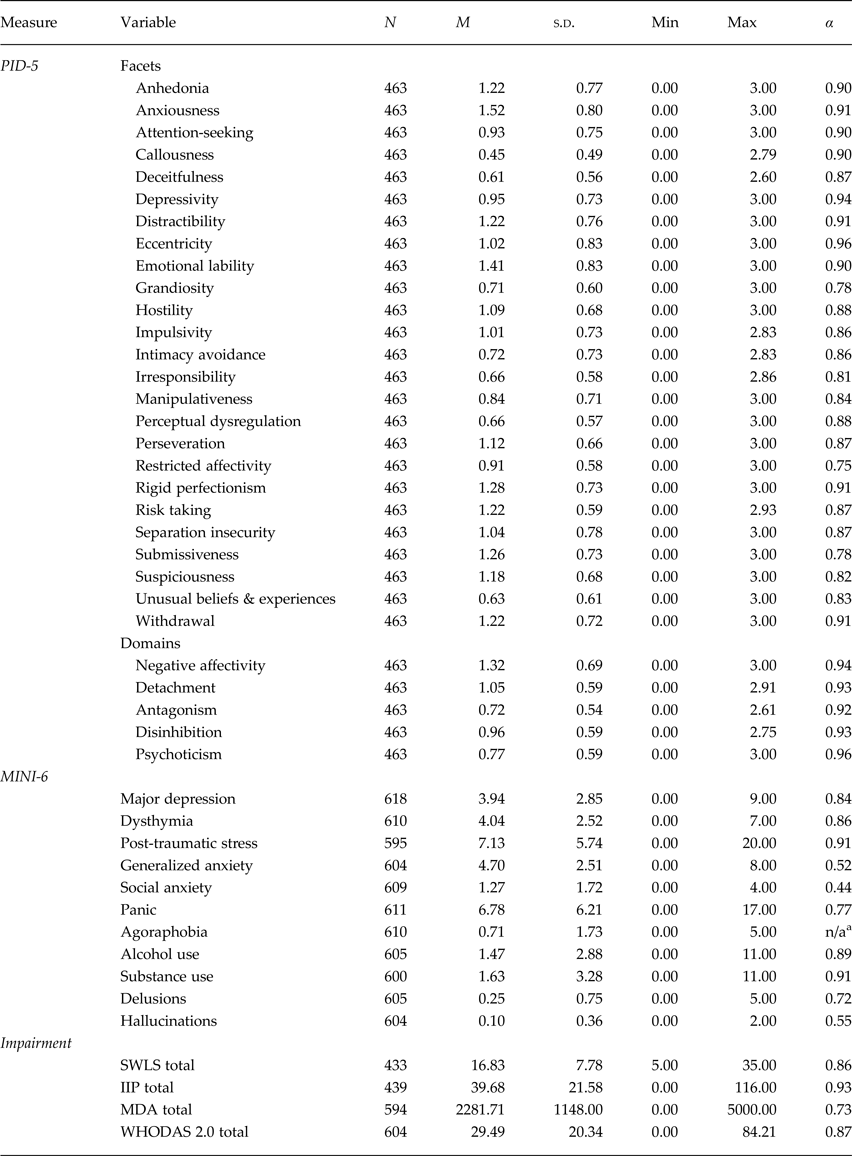
Descriptive statistics for all scored variables are provided in Table 1. To test study hypotheses, the 79 criteria from the 10 DSM-IV/5 PDs were factor analyzed. Five criteriaFootnote 4 were omitted due to high levels of missing data, which lead to low covariance coverage or near perfect correlations with other criteria. These criteria were removed prior to all reported analyses, leaving a total of 74 PD criteria. For the remaining criteria, the average endorsement rate was 40% (s.d. = 17%; range = 0.05–0.74%).
Descriptive statistics

a Due to a skip pattern in the criteria, the α coefficient could not be calculated. Time constraints and refusals to answer certain questions led to some missing data across measures.
Confirmatory factor analyses
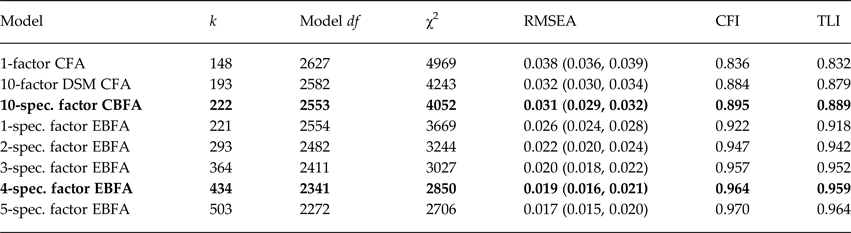
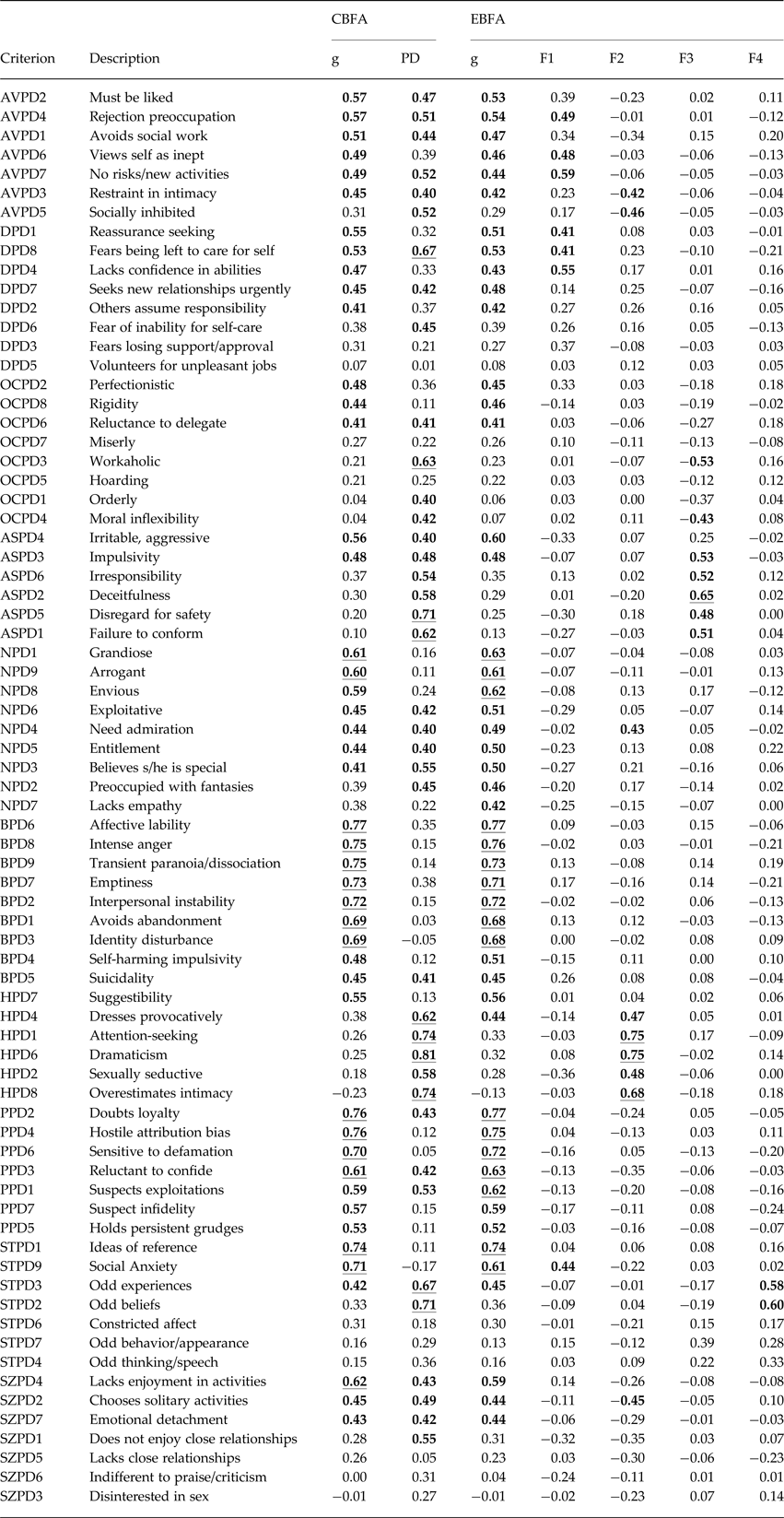
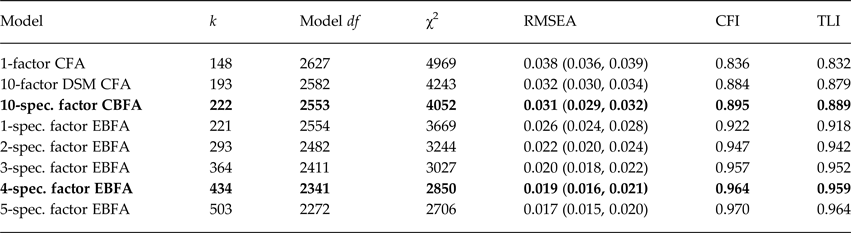
Single-factor, 10-factor (i.e. specified based on DSM PDs), and bifactor PD (i.e. DSM PD specific factors and general factor) criteria models were estimated and compared (see Table 2). The single-factor confirmatory factor analysis (CFA) model fit poorly, suggesting general PD features cannot alone account for PD expression. The 10-factor model fit significantly better than the one-factor model [Δχ2(45) = 676, p<0.001]; however, its overall fit was below conventionally acceptable standards (e.g. CFI = 0.88), and factor intercorrelations were large (Mdn r = 0.61, range = 0.07–0.91)Footnote 5 . Next a CBFA was conducted, in which all factors were orthogonal. The improved CFI suggested that including a general factor improved model fit relative to the 10-factor CFA. The CBFA solution is displayed in Table 3. Most criteria had moderate (i.e. >0.30; 77%) to large (i.e. >0.50; 37%) general factor loadings (M = 0.44, s.d. = 0.20). As predicted, BPD criteria had the highest general factor loadings (M = 0.67, s.d. = 0.11), but PPD criteria loaded similarly (M = 0.66, s.d. = 0.09). Strong HPD, ASPD, and AVPD-specific factors emerged. Weaker SZPD, OCPD, DPD, NPD, and STPD-specific factors emerged. Clear BPD and PPD-specific factors did not emerge.
Model fit information
EBFA, Exploratory Bifactor Factor Analysis and CBFA, Confirmatory Bifactor Analysis.
N = 628, observations = 2775. k = number of free parameters.
Final models are in bold. All model χ2 values are significantly different from 0 (i.e. p < 0.001).
Factor loadings for the final EBFA and CBFA

AVPD, avoidant PD; DPD, dependent PD; OCPD, obsessive-compulsive PD; ASPD, antisocial PD; NPD, narcissistic PD; BPD, borderline PD; HPD, histrionic PD; PPD, paranoid PD; STPD, schizotypal PD; SZPD, schizoid PD.
Note. The first two columns represent the 10-factor CBFA solution, where numbers in the ‘g’ column are loadings on the general factor and the PD column shows loadings for each DSM PD's specific factor (all cross-loadings are set to 0). Columns to the right represent the results of an EBFA with four specific factors. Items are sorted in descending order within PD by the g-loading in the CBFA. Loadings >0.40 are in boldface and loadings >0.60 are additionally underlined.
Exploratory bifactor analyses
The CBFA model's overall fit was barely acceptable, suggesting that more appropriate models exist. Thus, we conducted post hoc EBFAs, with correlated specific factors (i.e. Jennrich & Bentler, Reference Jennrich and Bentler2012) to empirically determine the number and nature of specific factors. Models with three to five specific factors yielded similar model fit; however, the model with four specific factors was most interpretable (see Table 3). EBFA and CBFA general factors were essentially identical (Tucker's Congruence Coefficient = 0.99). The specific factors are provisionally labeled here. The first specific factor, ‘inhibited neuroticism’ (DeYoung et al. Reference DeYoung, Quilty and Peterson2007), was defined by AVPD and DPD criteria loadings. The second specific factor, labeled ‘extraversion,’ had positive HPD loadings and negative loadings reflecting social avoidance [e.g. AVPD 5 (socially inhibited)]. The third specific factor, ‘disinhibition v. constraint,’ had positive ASPD criteria loadings and negative OCPD criteria loadings. The final specific factor, ‘psychoticism,’ was defined by three STPD criteria. There were small correlations between specific factors 1 and 2 (r = −0.19, p < 0.001), and 1 and 3 (r = 0.06, p < 0.001).
External correlates of factor scores
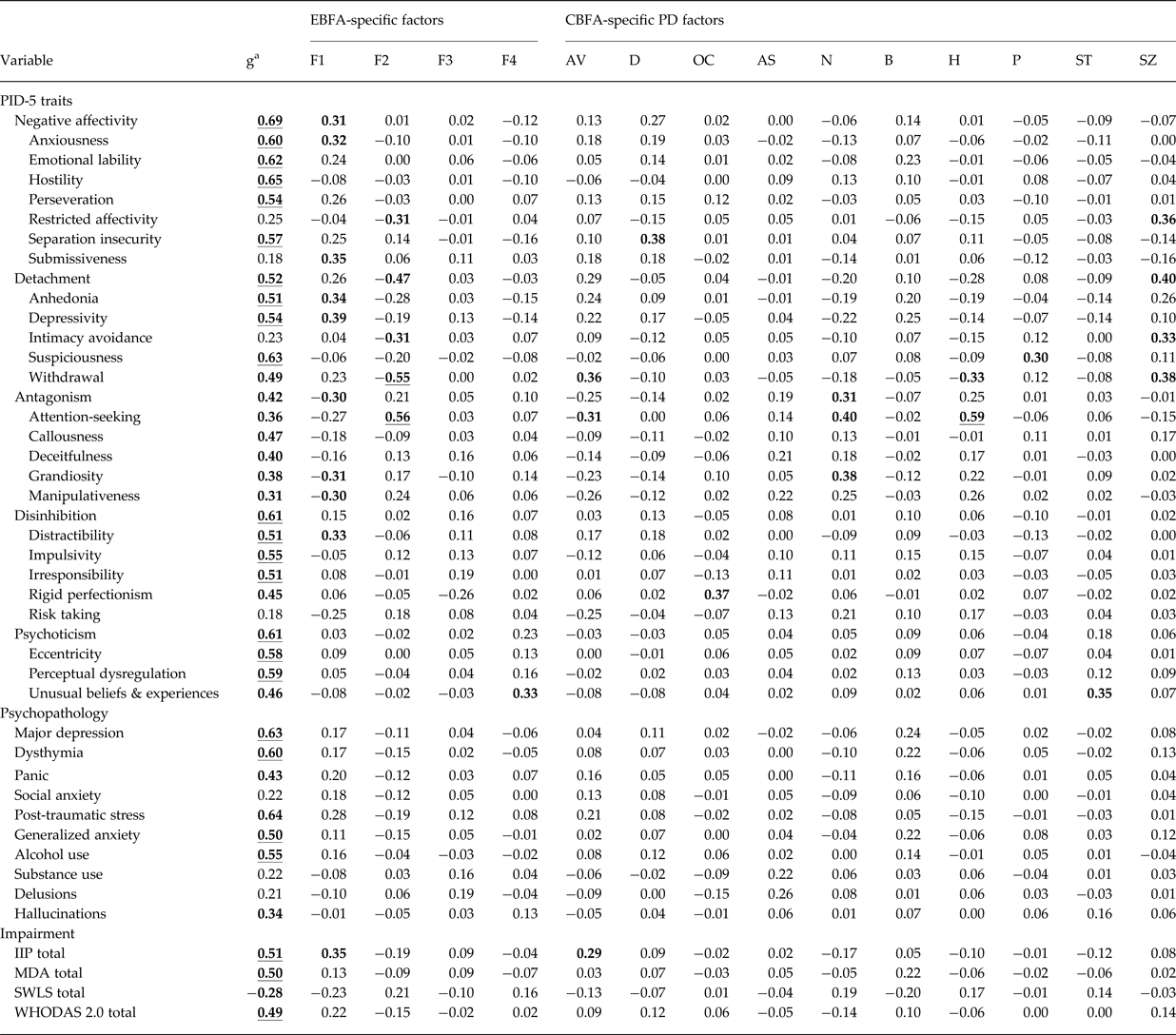
Final EBFA and CBFA factor scores were correlated with PID-5 traits, MINI symptoms, and impairment markers (see Table 4). The general factor correlated moderately to strongly with all PID-5 domains [range = 0.42 (antagonism) to r = 0.69 (negative affectivity)]. Defining facet-level correlations (general factor r > 0.50, all specific factor r < 0.30) included: emotional lability, hostility, separation insecurity, suspiciousness, impulsivity, irresponsibility, eccentricity, and perceptual dysregulation. In addition, the general factor not only correlated strongly with internalizing psychopathology, but also moderately with substance use and psychosis. Finally, the general factor related strongly to all impairment indicators except the SWLS (i.e. r = −0.28)Footnote 6 .
Criterion validity of the final EBFA and CBFA
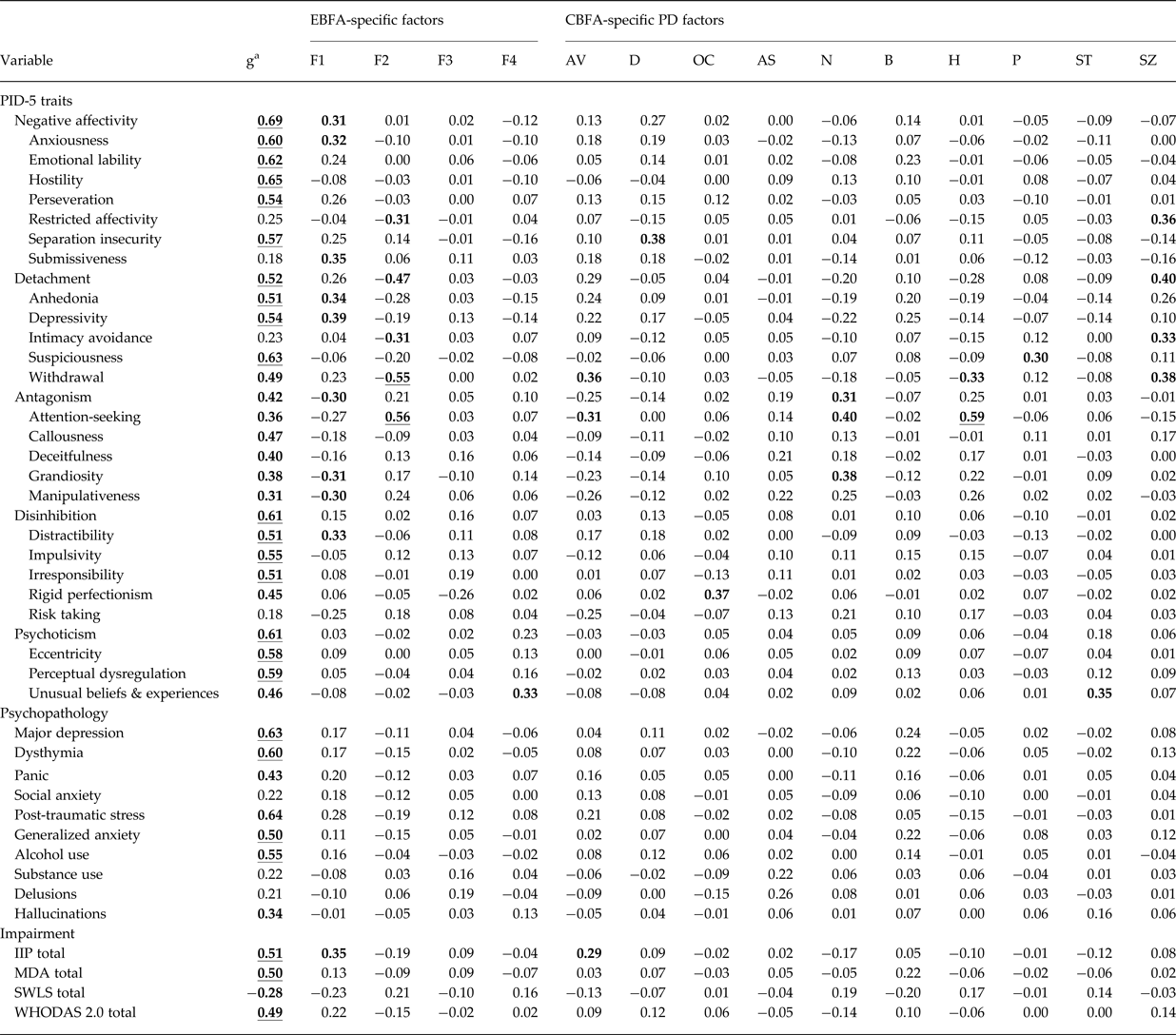
Column abbreviations: g, general factor of personality pathology; F1–F4, EBFA specific factors; AV, avoidant PD; D, dependent PD; OC, obsessive-compulsive PD; AS, antisocial PD; N, narcissistic; B, borderline; H, histrionic; P, paranoid; ST, schizotypal; and SZ, schizoid.
a The general factor from the EBFA, which was essentially identical to the CBFA general factor [Tucker's Congruence Coefficient (TCC)=0.99] and 1-factor CFA (TCC=0.99). Correlations >|0.30| are in boldface and those >|0.50| are additionally underlined; correlations >|0.08| are significant at p < 0.05, r > |0.11| are p < 0.01, and r > |0.14| are p < 0.001.
Hypothesized correlations between specific CBFA PD factors and personality traits emerged, although some effects were smaller than expected. At the domain-level, ASPD and NPD correlated most strongly with antagonism, although ASPD's correlation was weaker. STPD weakly correlated with psychoticism; however, it correlated moderately with the unusual beliefs and experiences facet. Finally, SZPD correlated moderately with detachment and HPD correlated strongly with attention seeking.
For EBFA-specific factors, inhibited neuroticism correlated moderately with traits indicating low positive affect (e.g. depressivity), high anxiousness, and low antagonism. The second specific factor, extraversion, correlated strongly with attention seeking and withdrawal, but in opposing directions. This factor also had negative correlations with restricted affectivity and anhedonia. The third specific factor, disinhibition v. constraint, correlated weakly with irresponsibility and deceitfulness (positive), as well as rigid perfectionism (negative). The fourth factor, psychoticism, correlated with unusual beliefs and experiences. Notable correlations with psychopathology and impairment included: inhibited neuroticism's small positive correlations with internalizing disorders and moderate correlation with interpersonal distress, extraversion's small positive correlation with the SWLS, disinhibition v. constraint's small correlations with alcohol and substance use, and psychoticism's small positive correlation with the SWLS.
Predicting psychosocial impairment
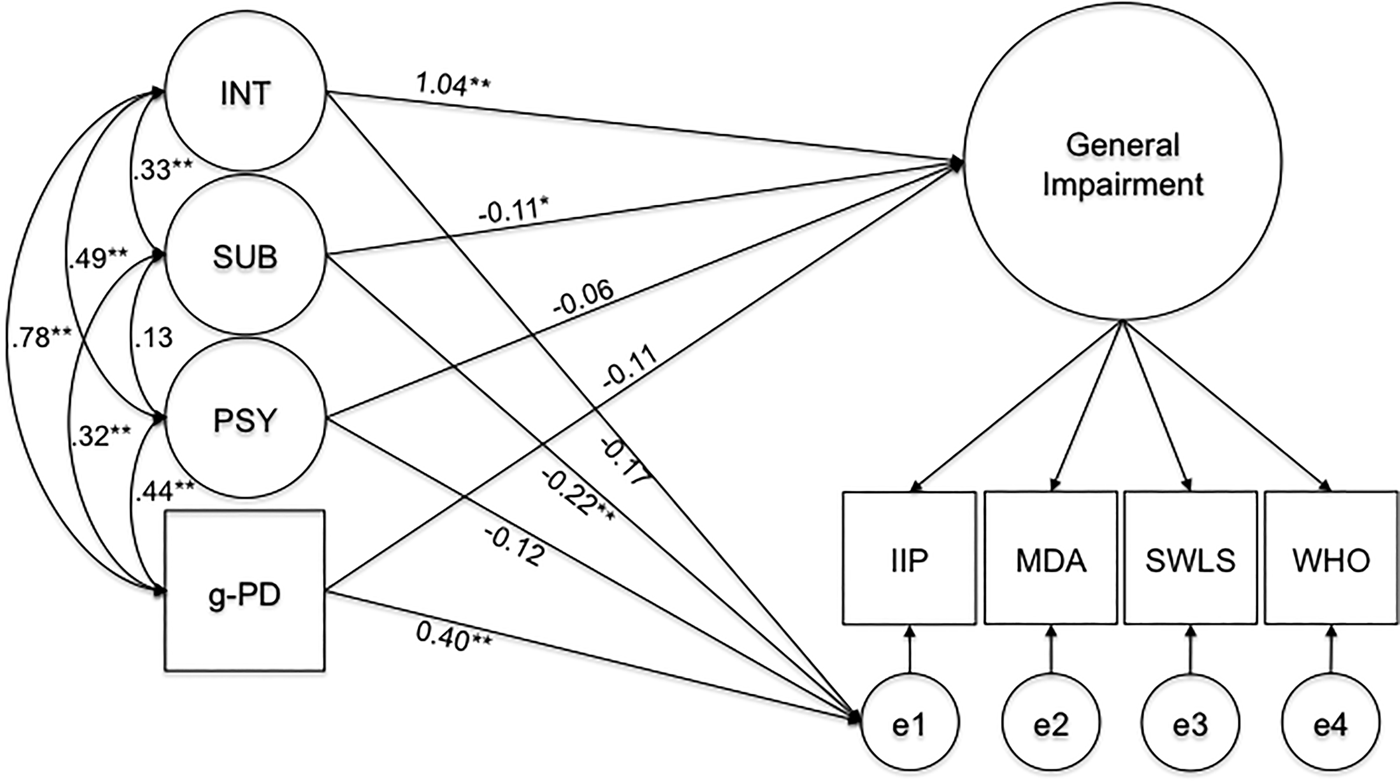
A series of structural regressions (see Fig. 1 for final model) were conducted to test hypotheses that the general PD factor uniquely relates to: (a) general psychosocial impairment and (b) interpersonal problems. The first model, in which psychopathology dimensions (e.g. internalizing) predicted general psychosocial impairment, fit well [χ2(83) = 223.01, p < 0.001; CFI = 0.95; TLI = 0.93; RMSEA = 0.05; SRMR = 0.04] and accounted for 81% of general impairment variance. The second model [χ2(94) = 280.10, p < 0.001; CFI = 0.94; TLI = 0.92; RMSEA = 0.06; SRMR = 0.04], added the general PD dimension as a predictor of impairment. Contrary to our hypothesis, the general PD factor did not uniquely predict (β = −0.02, p = 0.75) general impairment.
INT, latent internalizing symptoms dimension; SUB, latent substance use dimension; PSY, latent psychotic symptoms dimension; g-PD, the general PD factor score; IIP, Inventory of Interpersonal Problems total score; MDA, Multidimensional Dysfunction Aggregate; SWLS, Satisfaction With Life Scale total score; WHO, WHODAS 2.0 total score. All parameter estimates are standardized. *p < 0.05. **p < 0.01.

The third model added paths from the psychopathology factors dimensions to the IIP total score residual [χ2(91) = 280.94, p < 0.001; CFI = 0.94; TLI = 0.92; RMSEA = 0.06; SRMR = 0.04] and the fourth model added a similar path from the general PD dimension [χ2(91) = 249.51, p < 0.001; CFI = 0.95; TLI = 0.92; RMSEA = 0.05; SRMR = 0.04]. The IIP residual represents variability not accounted for by general psychosocial impairment, making the remaining reliable variance specifically interpersonal. General impairment accounted for 36.8% of observed IIP variance. The psychopathology factors predicted 1.2% additional variance, with substance use having a small effect (β = −0.23, p = 0.03). The general PD factor score was a significant positive predictor (β = 0.40, p < 0.001) of interpersonal problems, accounting for an additional 4.7% of the IIP total score variance beyond the latent psychopathology factors.
Discussion
In the present study, we tested structural and criterion validity hypotheses regarding DSM-IV/5 PD criteria, in a large psychiatric sample. Confirmatory and exploratory bifactor models fit best, with PD criteria loading on both a general factor and specific factors. The general factor was robust across analyses, had substantial loadings from all PDs, and was related to emotional dysregulation, internalizing symptoms, disinhibition, ambiguous personal and social boundaries, distorted social cognition, and problematic interpersonal behavior. Specific factors improved structural validity and accounted for differential expressions of personality pathology, with the best-fitting model having inhibited neuroticism, extraversion, disinhibition v. constraint, and psychoticism-specific factors. These findings extend our understanding of PD structure and have important implications.
The nature and necessity of ‘g-PD’
The present study provided structural validity evidence for a general PD factor, or ‘g-PD.’ As hypothesized, combining g-PD and specific PD dimensions via CBFA produced a model superior to either in isolation. Notably, g-PD permitted constraining PD factors to be orthogonal, accounting for overlap in DSM-IV/5 PDs (e.g. comorbidity; Clark, Reference Clark2007). Furthermore, three different analyses (i.e. single-factor CFA, CBFA, and EBFA) produced essentially identical loading patterns, suggesting that g-PD is robust and not an artifact of a particular analysis.
Interpreting latent factors within bifactor models is complicated (Bonifay et al. Reference Bonifay, Lane and Reise2017), thus we also examined g-PD's construct validity, a step not taken in most previous papers. Criteria from each PD loaded above 0.45 on g-PD, suggesting it covers diverse presentations; however, loading strength varied within and between PDs. As hypothesized, BPD criteria loaded most strongly on g-PD; however, PPD criteria loaded with similar strength. As in Sharp et al. (Reference Sharp, Wright, Fowler, Frueh, Allen, Oldham and Clark2015), loadings that best defined g-PD reflected emotional dysregulation [e.g. affective lability (BPD 6)], distorted thoughts about oneself [e.g. grandiose (NPD 1)] and others [e.g. doubts loyalty (PPD 2)], and problematic interpersonal behavior [e.g. avoids abandonment (BPD 1)]. Criterion validity analyses clarified these loadings, showing that, as predicted, negative affectivity and disinhibition strongly relate to g-PD. Contrary to hypotheses, antagonism more weakly related to g-PD. Facet-level findings also indicated strong connections to emotional dysregulation, (e.g. hostility), distorted social cognition (e.g. suspiciousness), poor self-regulation (e.g. impulsivity), and an altered understanding of personal boundaries and social norms (e.g. eccentricity). Additionally, g-PD was strongly related to internalizing psychopathology; however, further work examining g-PD at multiple levels of psychopathology hierarchies is needed to clarify the nosological implications of this finding. In particular, whether g-PD reflects general psychopathology (e.g. p-factor; Caspi et al. Reference Caspi, Houts, Belsky, Goldman-Mellor, Harrington, Israel, Meier, Ramrakha, Shalev, Poulton and Moffit2014), an internalizing symptoms subdomain, or an altogether separate domain, should be further explored. Despite strong relations to other psychopathology dimensions, g-PD showed a substantial and unique connection to interpersonal dysfunction, suggesting that g-PD captures an important clinical presentation. Furthermore, this finding aligns with theoretical (e.g. Bender et al. Reference Bender, Morey and Skodol2011; Hopwood et al. Reference Hopwood, Wright, Ansell and Pincus2013) and empirical work (Stepp et al. Reference Stepp, Hallquist, Morse and Pilkonis2011; Williams & Simms, Reference Williams and Simms2016) suggesting personality pathology is largely defined by interpersonal dysfunction.
In view of the previous work, g-PD may reflect difficulty regulating volatile emotions (e.g. Crowell et al. Reference Crowell, Beauchaine and Linehan2009) surrounding distorted perceptions, thoughts, and beliefs regarding interpersonal situations (e.g. Bach et al. Reference Bach, Lee, Mortensen and Simonsen2016), leading to problematic interpersonal behavior (e.g. Williams & Simms, Reference Williams and Simms2016). This definition of g-PD interfaces with cognitive-behavioral (e.g. Crowell et al. Reference Crowell, Beauchaine and Linehan2009), interpersonal (e.g. Hopwood et al. Reference Hopwood, Wright, Ansell and Pincus2013), and psychodynamic (e.g. Bender et al. Reference Bender, Morey and Skodol2011) theories of PD etiology and phenomenology. Despite this, PD theories often disagree on the development and dynamic organization of symptoms (e.g. Crowell et al. Reference Crowell, Beauchaine and Linehan2009), which has implications for treatment. The present study does not address these disagreements; however, it does provide a clearer description of the system they compete to explain and illustrates its relevance to varied forms of psychopathology.
Evidence for stylistic variation in PD
Despite providing evidence for g-PD, our data also show that g-PD alone cannot fully describe PD presentations; additional ‘specific’ factors are needed. The first bifactor model had a specific factor for each of the DSM-IV/5 PDs and assumed that this organization was a priori valid. Hypotheses about this model generally were supported; however, the overall model did not fit particularly well (e.g. several factors seemed unnecessary). Instead, as the EBFA suggested, a more appropriate model may have four specific factors resembling dimensions from previous studies (e.g. Semerari et al. Reference Semerari, Colle, Pellecchia, Buccione, Carcione, Dimaggio, Nicolò, Procacci and Pedone2014; Wright et al. Reference Wright, Hopwood, Skodol and Morey2016). The first EBFA-specific factor, inhibited neuroticism, had loadings (e.g. no risks/new activities) and correlates (e.g. depressivity) similar to the ‘withdrawn’ aspects of neuroticism (DeYoung et al. Reference DeYoung, Quilty and Peterson2007), which contrast with g-PD's relation to more volatile neuroticism facets (e.g. hostility). The second factor contrasted assertive attempts to affiliate with others (attention-seeking) with social withdrawal (detachment) and low positive emotionality, suggesting this factor reflects extraversion. The third factor included loadings (e.g. workaholism) and correlates (e.g. disinhibition) that led us to tentatively conclude, it reflects disinhibition v. constraint; however, weaker criterion validity and associations with antagonism traits, make this interpretation tenuous. Previous research (Semerari et al. Reference Semerari, Colle, Pellecchia, Buccione, Carcione, Dimaggio, Nicolò, Procacci and Pedone2014; Conway et al. Reference Conway, Hammen and Brennan2015; Wright et al. Reference Wright, Hopwood, Skodol and Morey2016) has provided mixed support for the inclusion of a disinhibition v. constraint dimension, thus work focused specifically on the validity of this dimension is needed. The fourth factor was characterized by STPD criteria and unusual beliefs and experiences; it seemed best described as ‘psychoticism’ (e.g. Krueger et al. Reference Krueger, Derringer, Markon, Watson and Skodol2012).
Although these factors parallel contemporary pathological trait models (e.g. Krueger et al. Reference Krueger, Derringer, Markon, Watson and Skodol2012), some differences exist. Most notably, inhibited neuroticism is narrower than the broad neuroticism domain and no specific factor for antagonism emerged. These divergences may partly be a result of simultaneously modeling a broad personality construct with narrower ones, as opposed to the tendency in trait research to model them in separate analyses (e.g. Wright et al. Reference Wright, Thomas, Hopwood, Markon, Pincus and Krueger2012). Thus, as typically modeled, personality traits may combine unique features of a trait (e.g. negative affectivity) with aspects that are accounted for by broader constructs (e.g. internalizing). Given that g-PD was strongly related to interpersonal dysfunction, which figures prominently in theoretical models of PDs (e.g. Hopwood et al. Reference Hopwood, Wright, Ansell and Pincus2013), it is perhaps not surprising that g-PD accounted for volatile neuroticism facets (e.g. hostility) and antagonism.
Implications for nosology
The present results can inform the validity of the AMPD, which separates impaired self and interpersonal functioning (i.e. criterion A) from traits (i.e. criterion B; APA, 2013). Evidence was found for a general PD dimension similar to criterion A. Specifically, g-PD's relations to emotional dysregulation, poor self-regulation, and compromised personal boundaries are suggestive of impaired self-functioning, whereas relations to distorted social cognition and problematic interpersonal behaviors align with interpersonal-functioning. Despite these results and being orthogonal to trait-like specific factors, g-PD still correlated strongly with many criterion B traits. This suggests that self-reported pathological personality traits measure both general and specific features of PD. The present study adds to a growing literature (e.g. Zimmerman et al. Reference Zimmerman, Böhnke, Eschstruth, Mathews, Wenzel and Leising2015; Bastiaansen et al. Reference Bastiaansen, Hopwood, Van den Broeck, Rossi, Schotte and De Fruyt2016) that suggests the theoretical separation of criteria A and B does not fully match empirical observations. Revisions to the AMPD model should address this issue through theoretical reformulation or re-structuring the model.
Regarding the latter possibility, the present results and a recent study (Zimmerman et al. Reference Zimmerman, Böhnke, Eschstruth, Mathews, Wenzel and Leising2015) suggest that some traits (e.g. separation insecurity) indicate general impairments experienced by clients with varied PD presentations, whereas others (e.g. intimacy avoidance) describe differences between PD clients. Thus one possibility may be to base the AMPD solely on pathological traits, but separate traits by their function: (a) indicating PD presence or (b) describing individual differences in presentation. This approach could be more directly explored in future studies through bifactor analyses of pathological traits.
Limitations
Strengths of the present study include a large clinical sample and multiple assessment methods; however, our results must be considered in the context of several limitations. First, five PD criteria were eliminated from analyses for statistical reasons. Although this limits the breadth of PD criteria examined, this study still represents the broadest criterion-level PD bifactor analysis to date. On a related note, the interviewing method led to considerable missing data for ASPD criteria. This may have led to a weaker specific ASPD factor in the CBFA and contributed to the lack of an antagonism factor in the EBFA. Nonetheless, ASPD criteria did show notable g-PD and specific factor loadings, suggesting that these criteria meaningfully contributed to the analysis. Whether antagonism should be included as a factor within PD models should be addressed in further research. In addition, the χ2 difference test and information criterion statistics could not be used to compare the 10-factor CFA to the associated CBFA model. Notably, correlated factor models are not nested within bifactor models when the number of specific factors exceeds three (L. Muthén, personal communication, 4 December 2015; S. Reise, personal communication, 9 December 2015). Despite this, the CBFA model is restrictive in the sense that it proposes one factor can account for PD comorbidity; in the present study this model fit the data better than other confirmatory models.
Conclusions
Previous research (e.g. Sharp et al. Reference Sharp, Wright, Fowler, Frueh, Allen, Oldham and Clark2015) showing that a bifactor model best represents personality pathology was replicated, as was the finding that BPD is a strong indicator of g-PD. The present study also found that: (a) PPD is an equally important indicator of g-PD, (b) g-PD shows criterion validity and uniquely predicts interpersonal impairment, and (c) inhibited neuroticism, extraversion, psychoticism, and possibly disinhibition v. constraint dimensions account for meaningful variance separate from g-PD. Findings also suggested that g-PD overlaps substantially with the DSM-5 AMPD trait model. These findings have implications for psychiatric nosology, as they highlight the importance of general PD features, as well as the overlap between these and many pathological traits. Future work should compare alternative operationalizations of g-PD and attempt to better integrate these with a PD trait model.
Acknowledgements
The authors would like to thank Kristin Naragon-Gainey for feedback on an earlier draft of this paper, as well as Lew Goldberg, David Watson, John Roberts, John Welte, William Calabrese, Jane Rotterman, Monica Rudick, Aidan Wright, Wern How Yam, and Kerry Zelazny for their support of the broader project from which these data were drawn. This study was supported by a research grant to L. J. Simms from the National Institute of Mental Health (No. R01MH 080 086).
Declaration of Interest
None.
Ethical standards
The authors assert that all procedures contributing to this work comply with the ethical standards of the relevant national and institutional committees on human experimentation and with the Helsinki Declaration of 1975, as revised in 2008. The authors assert that all procedures contributing to this work comply with the ethical standards of the relevant national and institutional guides on the care and use of laboratory animals.