INTRODUCTION
In India, the increase in population and consequent increase in requirement for various kinds of paper, and the emphasis on paper as an environmentally friendly packaging material has led to increased demand for wood. Of the 660 paper mills in India, 26 are wood-based and face challenges with the supply of forest-based raw material. Many pulp mills are finding it difficult to gain access to land where they can establish plantations and source wood from natural forests (Puri and Nair, Reference Puri and Nair2004). The annual pulp production of 1.9 million t uses 6.8 million t of wood, of which about 20% is procured from natural forests through government sources, and the remaining 80% is procured from trees grown in agro-forestry systems by private landholders (Kulkarni, Reference Kulkarni2008). A majority of mills enter into contracts with local communities in the name of joint venture schemes for producing wood (Saxena, Reference Saxena, Saxena and Ballabh1995). The presence of an assured market, high returns from trees and supportive policies of the government have contributed to a rapid increase in acreage under tree-based systems during the past decade. Tree growing became a profitable land use with the establishment of industry–farmer relationships, trading of wood in the open market and competition among paper mills to meet their wood requirements.
Eucalyptus, leucaena and casuarina are the important tree species used as raw material for the manufacture of paper and packaging material in southern India. Leucaena leucocephala has a porous wood structure, longer fibres than that of other hardwoods, high holocellulose and α-cellulose, and low lignin content with xylan-type hemicellulose, making it a suitable raw material in the pulp and paper industry (Malik et al., Reference Malik, Dutt, Tyagi, Jindal and Lakharia2004). Apart from paper industries, leucaena wood is increasingly being used as a substitute for coal in biomass-based power generation units, due to the emphasis on reducing CO2 emissions from the power plants and also the emerging opportunities under the Clean Development Mechanism of the Kyoto protocol. Leucaena wood is also used for generation of heat required for curing tobacco. Leucaena is one of the few trees from which wood is used for both industrial and non-industrial purposes. Wood of leucaena is generally described as being strong, lightweight, easy to work and capable of producing an attractive finish (Rao, Reference Rao1984). These qualities make leucaena wood suitable for a wide variety of uses, ranging from the traditional small-scale use by farmers and smallholders to the more recent utilization by large-scale industries for pulp and energy generation (Pottinger and Hughes, Reference Pottinger and Hughes1995).
Leucaena is grown in many parts of the state of Andhra Pradesh in India and is generally planted at a close spacing of 1.3 × 1.3 m, which does not permit intercropping. Trees are first harvested four years after planting and subsequently two ratoons are harvested at three-year intervals. Thus three harvests are taken in a 10-year rotation. Returns from the plantation can be obtained only after four years from planting, during which period considerable investment has to be made for raising the trees. Since trees are closely spaced, there is no scope for raising intercrops. For this reason much of the acreage under plantations is confined to large landholders. Smallholders are not able to take advantage of these systems due to the absence of annual returns, which are essential to their livelihood. Annual crops not only provide annual returns, but also dry fodder for animals whose contribution to the smallholders’ household income is substantial. Facilitating intercropping in leucaena-based systems not only provides regular income for the sustenance of farmers before the tree is harvested but also fodder for the livestock that form an integral part of smallholder farming systems. Pruning the tree canopy and moving the first intercrop row further from the tree-row have been suggested for reducing the negative effects of timber tree–crop interactions (Nissen et al., Reference Nissen, Midmore and Cabrera1999). Canopy pruning in tall growing trees is difficult and moving the crop row away from the tree is not feasible in the narrow rows spaced at 1.3 m.
Plantation spacing affects management options and the final output throughout the rotation. Production of saw logs, pulp or material for bio-energy, for example, may be optimized with initial spacing. Although wood quality is of fundamental importance to the utilization of leucaena, there is little published information on this aspect. Many reports are related to the alley cropping systems where the emphasis is on the use of the foliage either as fodder or as source of nutrients. Information on silvicultural manipulation of tropical trees, such as tree density and planting geometry, is scarce.
We had a discussion with farmers and paper company representatives on the possibility of intercropping in the leucaena system, which would enable smallholders to take up tree cultivation. Altering the tree geometry to facilitate intercultural operations is essential for taking up intercropping. Reduction in the population of the trees in comparison to the farmers’ practice and altering the tree geometry are some of the options that can provide more space for intercrops and reduce the interface between trees and crops.
Tree–crop competition is intense for limited resources, particularly in rainfed situations. Crops require sufficient space to harness adequate natural resources for their normal growth and economically viable yield. Techniques such as canopy pruning, pollarding, thinning and root pruning by trenching have been suggested to reduce tree–crop competition and to improve the productivity of intercrops in agro-forestry systems (Nair, Reference Nair1993). These techniques suffer from one or more limitations and are applicable only in certain specific situations. The question, therefore, worth exploring is to what extent the tree density can be reduced without substantial reduction in biomass production and what spatial arrangements can give more space for intercrops without sacrificing tree population and production. We hypothesized that wider spacing between tree rows would increase the intercrop yields, the total system productivity and gross/ net returns compared to the existing farmers’ practice. To test this hypothesis, we took up a study with the following specific objectives: 1) to study the effect of reducing tree density on the growth and productivity of trees and intercrops, 2) to evaluate the effects of different spatial arrangements of a constant tree density of 2500 trees ha−1 on growth and biomass production of leucaena and 3) to identify appropriate alternative arrangement(s) to the current farmers’ practice of 1.3 × 1.3 m that would enable intercropping, reduce tree–crop competition and enhance the yields of intercrops without affecting tree growth. Hence experiments were conducted to study the effect of modifying leucaena geometry and density on the productivity of intercrops.
MATERIALS AND METHODS
Site description
On-farm experiments were conducted on three farmers’ fields in three villages within a 50 km radius near Bhadrachalam town (82°52′05″E; 17°41′19″ N) in Khammam district of Andhra Pradesh, South India, where the paper company Indian Tobacco Company, Paper Boards and Specialty Papers Division (ITC-PSPD) is located. Although the area has substantial acreage under eucalyptus, leucaena has been introduced recently by ITC-PSPD in association with the Central Research Institute for Dryland Agriculture. The locations selected for this study are close to the paper manufacturing factory, which procures the raw material grown in farmers’ fields. The field trials were conducted as Type II trials (Franzel and Sherr, Reference Franzel and Sherr2002) with the purpose of involving farmers in the technology development process and for quick adoption of promising treatments by the surrounding farming community. While researchers were responsible for site selection, design of the experiment and data collection, farmers under the advice of researchers were responsible for all field operations such as land preparation, tree planting, intercrop sowing, fertilizer application, weeding and harvesting. The selected locations for the study are within the alluvial belt of Godavari river with a relatively flat landscape (about 3% slope).The soils are neutral to slightly alkaline (pH 7.0–8.3) and non-saline (EC 0.14–0.19 dS m−1), low in organic carbon (0.31–0.58%) and available forms of all the three major nutrients (nitrogen 63–100 kg ha−1, phosphorus 9.6–12.5 kg ha−1 and potassium 75–110 kg ha−1) in the top 15 cm soil layer. The area receives an average annual precipitation of 1120 mm, distributed in about 60 rainy days. About 85–90% of the total rainfall is received in five months, from June to October. The annual rainfall during the study period was 1091, 784, 1486, 1058 and 1526 mm in 2001, 2002, 2003, 2004 and 2005, respectively. The mean maximum temperature is 36.2 °C and the mean minimum temperature is 17.1 °C.
Tree establishment
The selected fields were ploughed twice using a disc harrow and levelled. Farmers’ fields which were not under arable crop cultivation for the previous few seasons were selected for the study. Pits of the size 0.3 × 0.3 × 0.3 m were dug manually and 100 g of single super phosphate was added to each pit and the soil was thoroughly mixed. L. leucocephala variety K-636 was selected for the study because of its desirable characteristics such as low seed production and straight growth with fewer branches.
The seeds were treated with hot water and sown in polythene bags filled with soil and manure mixture. Three-month-old 30-cm tall seedlings were transplanted in pits in August 2001. A small quantity of water was added to each pit immediately after transplanting to prevent seedling mortality.
Experimental design
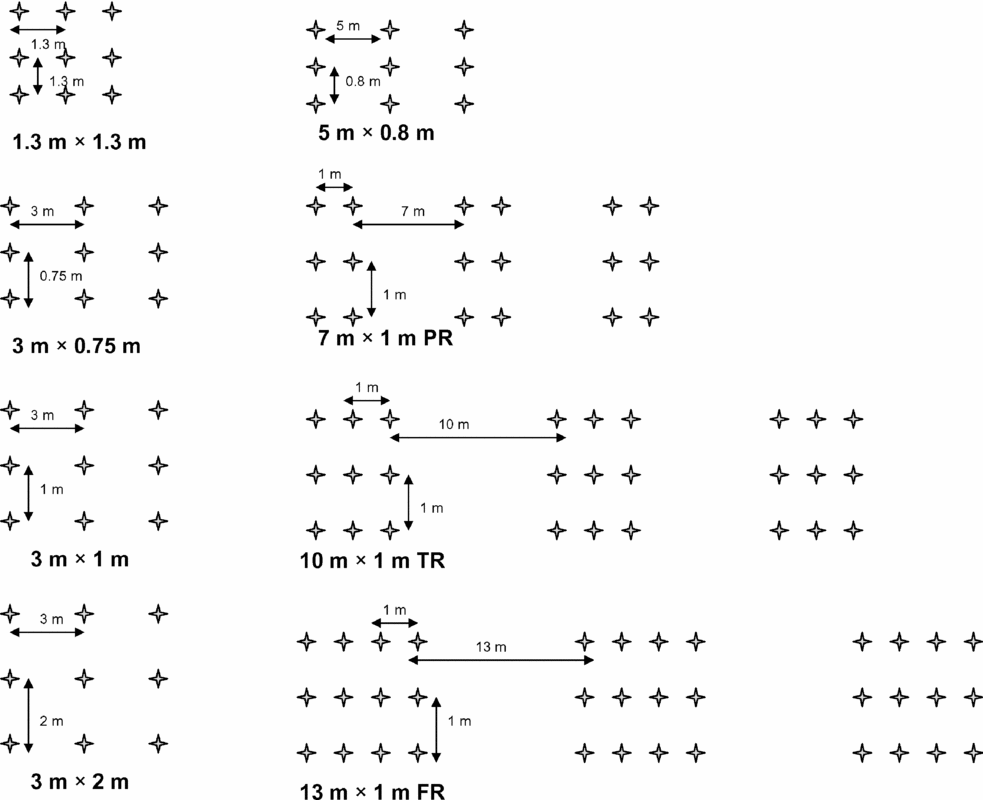
Tree density treatments were 1.3 × 1.3 m, 3 × 0.75 m, 3 × 1 m, 3 × 2 m and 5 × 0.8 m, which give tree densities of 5917, 4444, 3333, 1666 and 2500 trees ha−1, respectively. Tree geometry treatments tried were 7 × 1.0 m in paired rows (7 × 1 PR), 10 × 1 m triple rows (10 × 1 TR) and 13 × 1 m four rows (13 × 1 FR) with a constant tree population of 2500 hectare−1. In the 7 × 1 PR treatment, distance between any two sets of paired rows was 7 m, in 10 × 1 TR, the set of three tree rows were spaced at 10 m and in 13 × 1 FR distance between any two sets of four rows was 13 m; in all treatments rows were 1 m apart, and trees within a row were 1 m apart (Figure 1). At each location all five tree density treatments were evaluated, forming one complete replication. Tree geometry treatments were evaluated in two locations. The experimental design was a split plot with tree spacings in the main plots and intercrops in the subplots. Each experimental plot had at least three sets of paired rows or triple rows, and the central set was considered as a net plot leaving sufficient border at each end. The width of the plot for each tree geometry treatment was fixed, but the length of plot was variable depending on the space available in each farmer's field. The number of trees in the net plot was 102, 99, 78, 138, 37, 91, 119 and 225 for 13 × 1 FR, 10 × 1 TR, 7 × 1 PR, 5 × 0.8 m, 3 × 2 m, 3 × 1 m, 3 × 0.75 m and 1.3 × 1.3 m, respectively. Nitrogen was supplied as urea, phosphorus as single super phosphate and potash as muriate of potash. Nitrogen was supplied during the first year only, when 23 kg N ha−1 was applied. Trees were fertilized annually from the second year onwards with 23 kg P and 44 kg K ha−1. The two fertilizers supplying the two nutrients were mixed and the mixture was applied in 30-cm deep holes at 0.5 m away from the stem on either side of the row. The fertilizer was divided equally among all the trees in a plot. Rhizobium was applied because leucaena was being grown for the first time in these farmers’ fields. The rhizobium bacterium was isolated from the root nodules of seedlings in the nursery, cultured in the laboratory, mixed in water and applied to young seedlings, a few days after transplanting.
Tree density and geometry arrangements of leucaena at Andhra Pradesh, India (Each star represents the tree position and the diagrams are not to the scale).
Tree growth and biomass production
Tree height and diameter at breast height (DBH) were measured on five selected trees in each treatment at monthly intervals at all the locations. Trees were harvested after 51 months in December 2005. At harvest, tree height, collar diameter and DBH were recorded for all the trees in the net plot. Diameter at breast height of the trees was recorded at 1.37 m above ground level. The trees were categorized into 5 cm diameter classes, which ranged from 2.5–5 cm to 15–17.5 cm across all the treatments. Trees having diameter equivalent to the midpoint of any particular class were harvested to study the effect of spacing on biomass partitioning and to calculate the total biomass productivity. All the trees in the net plot were measured. Based on the data, distribution of trees in the net plot was compiled and percentage of trees matching the DBH class was calculated. Based on the recorded biomass data of trees for each girth class in each treatment at each location, the tree biomass production per hectare was calculated.
Intercrops and their management
Farmers were consulted while selecting the intercrops and their management. Cowpea (Vigna unguiculata) was grown as intercrop during the three cropping seasons, i.e. 2001, 2002 and 2003 post-rainy seasons (October–February). Sole tree stands without intercrop were maintained throughout the study. For ease of operations sole trees were grown at one end of the plot and the remaining area was equally divided for intercrops. The minimum gross area of the sole tree plot was 192 m2. Sole stands of the intercrop were grown each season in the same field away from trees.
The experiment was conducted under rainfed conditions. Cowpea was sown using bullock-drawn implements. The crop was sown in rows spaced at 30 cm. The seedlings were thinned to maintain an intra-row spacing of 10 cm between plants after germination in both the intercrop and sole stands. The crop was fertilized at the time of sowing at the recommended rates of application. Cowpea was supplied with 20 kg N ha−1 and 18 kg P ha−1 in the form of di-ammonium phosphate basally before sowing. Weeds in intercrops were controlled by inter-row cultivation using bullock-drawn implements. Crop yields were recorded by harvesting the first, second and third rows on either side of the central tree row(s) in each treatment up to the centre of the treatment. The mean of both sides of the tree row represents the yield of that row and the mean of all the rows was presented. Samples of green biomass were oven dried at 70 °C to a constant weight, and the ratio of fresh to dry biomass was used to convert the fresh weights to dry weights on a per hectare basis.
Light measurements
Photosynthetically active radiation (PAR) was measured during the 2001/02 and 2002/03 cropping seasons three times at monthly intervals from the date of sowing of intercrops using a 1.2 m long line quantum sensor (ACCUPAR, Decagon). During 2002/03, PAR was measured at 1 m away from the tree row and at every 1 m up to the centre of the alley in both the northern and southern directions. The measurements were also made in open conditions far from the interference of trees. Measurements were made above the crop canopy in four directions and the average values of the three observations were taken. The under-storey PAR flux was converted into PAR transmittance, the ratio of PAR below the canopy to PAR incident in the open.
Soil water
During the 2001 and 2002 post-rainy seasons, soil water was monitored thermo-gravimetrically in samples taken using an auger at four locations in each treatment: in the tree row, 1 m away from tree row in northern and southern directions and in the centre of two tree rows. Samples were also collected in open crop conditions far from the interference of trees. The samples were collected at monthly intervals after sowing of the intercrops from 0−30 cm depth. The collected samples were weighed immediately, dried in an oven at 105 °C to constant weight and reweighed to determine soil water content.
Economics
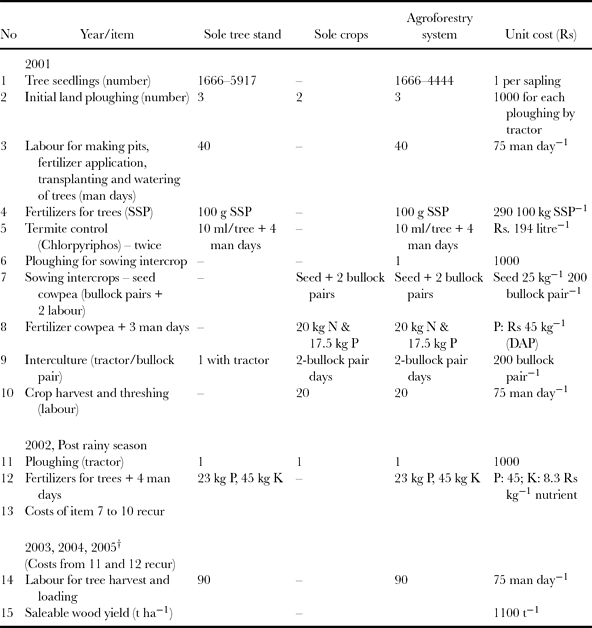
Financial analysis was performed on different agro-forestry systems compared with sole leucaena and sole annual crops covering one harvest cycle of leucaena. The parameters used for comparison of systems were net present value (NPV), benefit:cost (B:C) ratio, and gross and net returns. Net present value was computed using three different discount rates. The discount rates selected were based on the rates of interest farmers are charged for loans from financial institutions, which depend on the kind and duration of loan and on the financial institutions. The stream of costs incurred and the direct benefits derived from each system were worked out. In the case of agro-forestry treatments the costs included initial expenditure for planting trees plus the cultivation costs such as land preparation, fertilizers, sowing, weeding, harvesting and threshing of field crops (Table 1). In case of sole crops, the expenditure incurred for raising crops each season was considered. Farmers were consulted in arriving at the quantity of different inputs and labour for different field operations. Certain products, which do not have any economic value in the region, such as cowpea haulms, leucaena branch and leaves, were not considered in the analysis. Biomass of fresh leucaena wood was used for calculation of returns. Market costs of inputs and values of outputs prevailing at the end of the harvest cycle (December 2005) were used for the financial analysis.
Inputs and their costs, and values of outputs (for 1 ha) for sole leucaena, arable crops and leucaena-based agroforestry systems during the four-year period of the study in Andhra Pradesh, India.
SSP: Single super phosphate; DAP: di-ammonium phosphate.
Average cost of transportation of leucaena saplings: Rs 450 ha−1. Price of cowpea Rs 18 000 t−1; leucaena wood: Rs 1100 t−1, on fresh weight basis.
† During 2005, interculture (item no. 10) was not done.
Statistical analyses
The data were analysed following the one-way analysis as per randomized block design. Where the F-test was significant, treatment differences were tested using least significant difference (LSD) at 5% significance level. Differences between trees in intercropped and sole situations and various tree density treatments were evaluated using the paired t-test at 0.05 probability.
RESULTS AND DISCUSSION
Effect of tree geometry on tree growth and biomass production
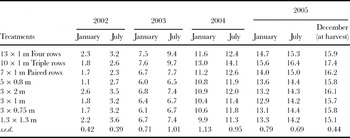
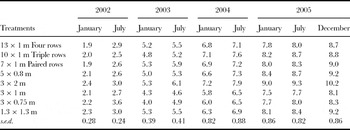
Increasing the spacing and reducing the tree density contributed to an increase in DBH but not tree height. Diameter at breast height in the 3 × 2 m treatment was higher than in the other treatments. At the time of harvest, the 3 × 2 m treatment recorded 11, 26, 23 and 11% higher DBH over 5 × 0.8 m, 3 × 1 m, 3 × 0.75 m and 1.3 × 1.3 m, respectively. Reducing tree density had little influence on tree height, and it ranged from 15.1 to 16.1 m at the time of harvest. Modification of tree geometry into wider rows (13 × 1 FR, 10 × 1 TR, 7 × 1 PR) contributed to marginal increases in tree height whereas DBH increment was not observed in comparison to the 5 × 0.8 m treatment. Differences in tree height growth between the paired row treatments were greater during the first two years of growth, and differences diminished during the third and fourth years (Table 2). During any given year, tree growth and DBH increment were highest during July–December, coinciding with the rainy season (Table 3). Tree growth rate in terms of height and DBH was highest during the second year after planting (Tables 2 and 3). The mean annual height increment of leucaena in the present study ranged from 3.55 to 4.1 m yr−1.
Height growth (m) of leucaena in different planting arrangements in agroforestry over a four-year period in Andhra Pradesh, India.

Diameter at breast height (cm) of leucaena trees in different planting arrangements in agro-forestry during four years (2001–2005) at Bhadrachalam, Andhra Pradesh, India.

Increasing tree spacing and reducing the tree density from 1.3 × 1.3 m to 3 × 1 m and 3 × 2 m did not increase tree height in leucaena. In some temperate tree species, height growth is relatively unaffected by tree density (Daniel et al., Reference Daniel, Helms and Baker1979). Spacing did have a noticeable effect on diameter growth. Individual trees responded to wider spacing and lower competition with greater individual diameter growth. For example, the lowest stand densities (3 × 2 m, 5 × 0.8 m) recorded relatively higher DBH over higher stand density treatments throughout the study period. Decrease in diameter growth of trees with increase in density was reported in Cordia spp. (Hummel, Reference Hummel2000), Eucalyptus (Bernando et al. Reference Bernando, Reis, Reis, Harrison and Firme1998, Pinkard and Nelson Reference Pinkard and Neilsen2003) and six sub tropical rainforest tree species (Grant et al., Reference Grant, Nichols, Pelletier, Glencross and Bell2006). Alteration of tree geometry also did not influence the diameter growth. Ares et al. (Reference Ares, St Louis and Brauer2003) working on southern pines in USA observed similar stem diameter distributions in unthinned stands with different single and double row configurations at constant tree density at the age of 18 years and concluded that tree arrangement had little impact on diameter frequency distribution.
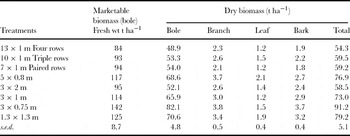
The biomass productivity of leucaena observed in our study was higher than that of trees raised from seedlings at Dehradun, which has higher rainfall than the present study location and where leucaena was grown for wood (Narain et al., Reference Narain, Singh, Sindhwal and Joshie1998). As leucaena in this region is primarily used as raw material for the manufacture of paper and packaging material and also in energy production, as a substitute for coal, the bole with the bark is the marketable product. In the absence of any specifications from industry on minimum diameter of stem for pricing, the total wood production is the primary criterion for evaluating the treatments. The marketable biomass was highest with 3 × 0.75 m (142 t ha−1). The narrow row spacing of 1.3 ×1.3 m produced wood yield of 125 t ha−1, which was comparable to 5 × 0.8 m. Modification of tree geometry resulted in significantly lower wood biomass than that of 5 × 0.8 m (Table 4). Among all treatments, total and bole dry biomass was highest with 3 × 0.75 m spacing. Biomass contributed by different tree parts to the total was as follows: bole > bark > branch > leaf.
Fresh and dry biomass and dry biomass of different parts of leucaena planted in different planting arrangements in agroforestry system at harvest (51 months) at Bhadrachalam, Andhra Pradesh, India.

Tree survival (at harvest) ranged from 83 to 93% and was not significantly affected by tree geometry. Replanting was done twice during the first year to ensure 100% survival of trees in all the treatments.
The differences in wood production among treatments can be partly explained by relative size distribution of trees, canopy characteristics and the tree population at the time of harvest. Trees planted at 3 × 0.75 m and 3 × 1 m produced a relatively higher percentage of trees with greater DBH in comparison to trees in paired rows and close spacing of 1.3 × 1.3 m. For example, in the 5 × 0.8 treatment, at the time of harvest 73% of trees attained a DBH of more than 7.5 cm, whereas in 13 × 1 FR and 7 × 1 m PR treatments it was only 54 and 58% of trees, respectively. At harvest, about 28, 20 and 32% of trees attained more than 10 cm DBH in 3 × 1 m, 3 × 2 m and 5 × 0.8 m treatments, respectively, where as it was only 12% in case of 1.3 × 1.3 m. Trees with greater DBH have greater weight per plant and contributed to the increase in tonnage. Secondly, trees in paired, triple and four rows expanded their canopies. The canopy width of paired row treatments at harvest ranged from 2.4 to 2.6 m, and the spread of canopy in these paired rows was more towards the open side. The average number of marketable branches in paired row treatments ranged from 3.0 to 3.6 at the time of harvest. Apart from the marketable branches, numerous side branches were observed in paired rows; these contributed to the expansion of the canopy and diversion of biomass in to smaller branches that do not produce marketable wood.
Although a higher percentage of trees in 3 × 1 m, 5 × 0.8 m and 3 × 2 m treatments attained a DBH more than 10 cm at harvest, the total wood productivity was higher with 1.3 × 1.3 m spacing. The sizes of stems were relatively bigger at the widest spacing levels, presumably due to higher availability of soil moisture and light resources. Since the tree density ranged from 1666 stems ha−1 to 5917 stems ha−1, the overall productivity of a unit area of land can be quite different than the average stem size considered alone. Average trees at 3 × 2 m spacing would need to grow 3.5 times the weight of average trees at 1.3 × 1.3 m spacing for the total weights per hectare to be equal. This did not occur. Hence reduction in tree densities resulted in the decrease in biomass production. However, 3 × 0.75 m produced relatively higher biomass over the close spacing of 1.3 × 1.3 m. which could be due to production of large trees with greater diameter. The 3 m distance between tree rows allowed farmers to undertake operations such as ploughing with a mould board plough or with a tractor-drawn cultivator, which contribute towards reduction of runoff and conserving soil moisture under rainfed conditions.
The study showed that leucaena variety K-636 in a four-year rotation under on-farm situations has the potential to produce up to 140 t ha−1 of fresh biomass in a four-year period. The results of this study are of importance for future fibre and wood supply and carbon sequestration. It is clear that the productivity of short rotation plantations with suitable management practices can greatly exceed that of native forests.
Crop yields
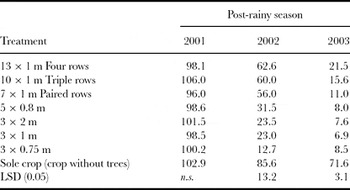
During the first cropping season after tree planting (i.e. 2001 post-rainy season), intercrop yields were not influenced by tree density and tree geometry. The adverse affect of trees on intercrops was observed from the second year (i.e. 2002 post-rainy season) onwards. During the 2002 post-rainy season, all the paired row (FR, TR and PR) treatments recorded significantly higher intercrop yield over 3 × 1 m and 3 × 2 m treatments (Table 5). Intercrop yields improved with increase in tree row spacing. Improvement in yield in FR, TR and PR treatments was 172, 160 and 143%, respectively, over 3 × 1 m. However, FR, TR and PR recorded 73, 70 and 65%, respectively, of sole cowpea yields. Cowpea intercropped in 3 × 0.75 m yielded only 15% of the sole crop during 2002 post-rainy season. Cowpea yields in TR and FR treatments were close to the sole crop. The extent of yield reduction was greater nearer to the tree rows and decreased with distance from the tree rows. During the post-rainy season of 2003, the cowpea yields of FR, TR and PR were about 30, 22 and 15% of the sole crop. In case of narrow rows of 3 × 2 m, 3 × 1 m and 3 × 0.75 m the extent of yield reduction was close to 90% in comparison to the sole crop.
Cowpea yields (g m−2) in sole and leucaena agro-forestry systems at Bhadrachalam, Andhra Pradesh, India (2001–2005).

The magnitude of crop yield losses in agro-forestry systems increased with age of the trees. The extent of yield reduction was 56% in cowpea during 2002. The increased competition with age was due to the increased size of the trees and their ability to draw resources at the expense of crops (Dhyani and Tripathi, Reference Dhyani and Tripathi1999; Khybri et al., Reference Khybri, Gupta, Ram and Tomar1992; Narain et al., Reference Narain, Singh, Sindhwal and Joshie1998). Competition of trees with intercrops is expected to be particularly high in the post-rainy season when crops were grown under limited stored soil water on which both the trees and crops have to thrive.
Light interception
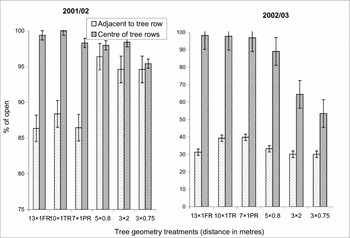
During the first year of cropping (2001), the first crop row close to the trees received on an average 91% of the open radiation as the trees grew only 1.8 m tall. The centre of wider tree rows received about 100% of the radiation. However, during the second year (2002), light interception was reduced significantly in the crop rows nearer to the tree. The extent of reduction in light interception was about 60–70% in various tree treatments (Figure 2). The centre of the leucaena alley in four, three and two rows received normal radiation, which is about 95% of PAR. However, in closer spacings like 3 × 2 and 3 × 1 m spacing, on average the centre received about 59% of the open solar radiation during the crop growth period. Leucaena puts forth dense foliage during the months of June–January, coinciding with the rainy season and availability of moisture in the soil, resulting in considerable reduction in light transmitted to the crop underneath. This was particularly evident in the 5 × 0.8 m, 3 × 2 m and 3 × 1 m spacings, which produced numerous small branches resulting in a spreading canopy that reduced the light reaching the understorey crop from the second year onwards. In wider spacings like four rows, three rows and two rows, spread of the tree canopy was observed to the open side which caused obstruction of light particularly for the first few crop rows adjacent to the tree row. In the later stages there was bending of the tree canopy to the open sides in wider rows which extended up to 3 m from the tree rows on both sides of paired rows resulting in obstruction of light reaching the understorey crops during the third year (2003).
Photosynthetically active radiation transmitted to the crop in leucaena with different spatial arrangements during 2001/02 and 2002/03 cropping seasons in Andhra Pradesh, India. Vertical lines at top of the bars show s.e.

Shade affects the growth and development of crop plants severely (Wong, Reference Wong, Shelton and Stur1991). In the present study, shade extended up to the centre of wide tree rows. Insufficient radiation under eucalyptus was found to delay wheat tillering on either (northern or southern) side or both sides of tree rows at a distance of <3.7 m in northern latitudes during the rabi (post-rainy) season (Kohli and Saini, Reference Kohli and Saini2003). Burner and Brauer (Reference Burner and Brauer2003) reported a 45% reduction of solar radiation by one-year-old pines in 2.4 m wide rows compared to no shading when the tree rows are spaced at 9.7 m. In tropical forage crops, shade reduces production of tillers, leaf and roots, and results in thinner leaves with higher water content and a higher specific leaf area (Wong, Reference Wong, Shelton and Stur1991).
Soil water availability
There was a progressive decline in soil water content at 0–30 cm depth as the season progressed during the second year of cropping. In the wider tree geometry treatments, soil water close to the tree row was higher on both sides, and it decreased with distance from the tree row. Moisture content at the centre of alleys was relatively lower when compared to the crop rows nearer to the tree, at 30 days after sowing. However, at 90 days after sowing of the intercrop, these differences narrowed but the centre of wider tree geometry treatments recorded lower moisture content. Differences in water content in the centre of the alleys and at the adjacent position of trees were not significant. This shows that trees might have contributed towards the water uptake and competed with crops for moisture. Crop rows that were nearer to trees on both sides were worst affected and did not put up normal vegetative growth. Crop rows up to 1 m from the tree row suffered from reduced light as well as from the water stress, due to competition from trees. Szott et al. (Reference Szott, Palm and Sanchez1991) and Salazar et al. (Reference Salazar, Szott and Palm1993) also reported that root competition for water and nutrients is primarily responsible for yield depression at the tree–crop interface in agro-forestry. In the present study, seedlings of cowpea adjacent to leucaena rows grew poorly and remained stunted throughout the season. The effect was severe during the 2003 post-rainy season, which received only 784 mm of rainfall with 42 rainy days as against the average of 1119 mm with 68 rainy days. Negative effects of tree rows on seasonal crops due to competition for water were widely reported in semi-arid and arid climates (Lal, Reference Lal1989; Rao et al., Reference Rao, Ong, Pathak and Sharma1991). In addition to the above, allelopathic affects of leucaena might have contributed to the poor crop growth particularly during initial germination and growth. Several studies reported allelopathic effects of leucaena on crop growth (Suresh and Rai, Reference Suresh and Rai1988).
Financial evaluation
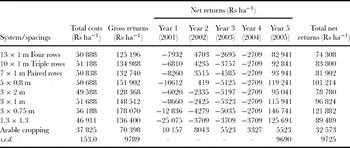
Intercropping leucaena in different spatial arrangements gave net returns varying between Rs 74 308 and Rs 101 214 over a four-year period, which were comparable to the farmers’ practice of sole leucaena without intercropping (Rs 89 498) but considerably higher than the returns from sole arable cropping (Rs 32 573). Net returns were negative from year 1 (2001) to year 4 (2004) for intercropping in closely planted leucaena at 3 × 2 m, 3 × 1 m and 3 × 0.75 m because of reduced crop yields (Table 6). All the leucaena treatments contributed to the higher net returns in comparison to the arable cropping, which explains the large-scale adoption of the leucaena system. Leucaena cultivation requires additional expenditure mainly due to the cost of the planting material, its transportation to the field, pitting and planting. For this reason net returns from all the leucaena systems were negative during 2001. Reducing tree density and modification of tree geometry into paired, triple and four row tree geometries provided some income from annual crops for the initial two years. Intercropping in wider tree geometry treatments though provided additional returns through crops, but did not completely eliminate negative returns from the third year onwards due to the severe tree–crop competition and poor performance of intercrops. The farmers’ practice of dense plantings (1.3 × 1.3 m) required heavy investment, and there was no income from this system until the trees were harvested 51 months after planting. Although tree-based systems require additional expenditure during the first year, the returns more than compensate the expenditure. For example, leucaena at a spacing of 3 × 1 m incurred a total expenditure of Rs 51 688, 37% higher than the expenditure for arable crops, but the returns were 197% higher than that of arable cropping. Intercropping in leucaena with a spacing of 3 × 0.75 m required only an extra expenditure of Rs 4777 over sole leucaena at closer spacing of 1.3 × 1.3 m, but the additional returns more than compensated the expenditure.
Financial analyses of sole leucaena, sole crop and leucaena-based agroforestry systems in Andhra Pradesh, India.

US $ 1 = Rs 45 (2005); NPV: Net present value; B:C = benefit:cost ratio.
Net present value and B:C ratio of all the leucaena systems were higher than arable cropping at different discount rates (Table 7). Intercropping in leucaena at 3 × 0.75 m spacing gave greater NPV than close row spacings of 1.3 × 1.3 m and all the wider paired row tree geometry treatments. Modifying the tree geometry into paired rows did not contribute towards enhancing the NPV and B:C ratio in comparison to 5 × 0.8 m. Reducing the tree density from 5917 (1.3 × 1.3 m) to 4444 (3 × 0.75 m) trees ha−1 resulted in higher NPV and B:C ratio. Further reduction in tree density contributed towards lower returns and B:C ratio. The return per investment from sole woodlot and agro-forestry was higher than the return per investment in sole annual crops at all the discount rates.
Net present value (NPV) and benefit:cost ratios (B:C) at different discount rates for leucaena based systems in Andhra Pradesh, India.

Leucaena plantations can be retained for a total of 10 years or three cycles. As the cost of planting material is incurred only in the first year (of the first cycle), NPV of leucaena-based systems in subsequent cycles would be much greater compared with arable crops. Some additional labour may be required to manage the coppice shoots during the second to fourth cycles, but its costs may not be higher than the labour required during the first establishment cycle when pitting, transplanting and weed control demands more labour. The tree–intercrop systems required about 55 man-days labour ha−1 year−1 compared to 37 man-days ha−1 year−1 for sole leucaena and 29 man-days ha−1 year−1 for sole arable cropping. Some of the operations like pitting for tree planting, wood harvesting and loading into tractors demand heavy labour input. Tree harvesting provides employment for labour during October–January, when other avenues for employment are unavailable in rural areas. All the financial indicators show that agro-forestry is more profitable than arable cropping and the farmers’ practice of 1.3 × 1.3 m sole tree cropping. Similar conclusions were also made for eucalyptus (Dube et al., 2002) and poplar (Singh et al., Reference Singh, Singh, Dagar, Singh and Sharma1997) grown for wood production. Intercropping in the initial years allows better cash flow during the initial years of plantation cycle when the returns from tree are not forthcoming.
CONCLUSIONS
Reducing the tree density affects the wood production in leucaena. Reduction in tree density beyond 4444 trees ha−1 resulted in reduction in wood production. Modification of tree geometry with a base population of 2500 into wider rows enhanced the intercrop yields during the initial two years but reduced tree biomass productivity. Yields of intercrops in paired row treatments were affected due to the spread of the leucaena canopy with smaller branches. An alternative could be to prune these branches, which can also be used as fodder. However, pruning branches is a labour-intensive operation, involving considerable cost and needs to be done at regular intervals, and its effect on wood biomass, which is the marketable produce, is not known.
Some of the options tried in the present study (3 × 0.75 m, 3 × 1 m, 3 × 2 m), with reduced tree population to permit intercropping during the first two years, were found to give higher returns than the farmers’ practice. A spacing of 3 m between tree rows provides scope for mechanical weed control in the initial stages, intercropping and to implement soil and water conservation practices that may not be feasible in the farmers’ practice of narrow rows and high tree density. However, further experimentation is required to enhance the biomass productivity and profitability of these systems through means such as the selection of shade-tolerant crops, reducing the intra-row distance further and reducing the duration of the plantation to three years. Use of leucaena-based agro-forestry systems in marginal lands is an important strategy for improving the income for the smallholders. Integrating wood and arable crop production for smallholders helps to overcome the concerns of declining food production due to shift in acreage from crops to woodlots.
Acknowledgements
We would like to thank Indian Council of Agricultural Research for funding this project through the Agricultural Product Cess Fund and National Agricultural Technology Project.