INTRODUCTION
Taste, social status, ideology and political agendas have all had a profound impact on the way different historical periods have looked at the Classical world;Footnote 1 eighteenth-century Britain is no exception. After the official establishment of the Society of Antiquaries of London in 1718, a time when the study of the British past was perceived as ‘a means of consolidating political stability’ after the turbulence of the Hanoverian succession,Footnote 2 the study of Roman antiquities in Britain underwent several shifts in aims and focus. Some of these trends have been reviewed in detail, such as the adoption of Roman ideals in eighteenth-century English culture.Footnote 3 Rosemary Sweet's excellent overview of the achievements of eighteenth-century antiquarians has a substantial section dedicated to the study of Roman Britain,Footnote 4 while Richard Hingley has investigated the legacy of these early Romanists in terms of research priorities and theoretical frameworks, with a focus on the problematic Romanisation paradigm.Footnote 5 At the same time, figures of particular relevance for the history of Romano-British archaeology such as William StukeleyFootnote 6 and Samuel LysonsFootnote 7 have also attracted scholarly interest.
However, while attention has been paid to the influence of Classical art and architectureFootnote 8 and to the changing perceptions of Romano-British antiquities during this period,Footnote 9 very little has been written so far about the attitude that Georgian antiquarians had towards one of the most distinct and widespread types of Roman building, i.e. public, military and private baths. Similarly, the possible connections between ancient facilities and eighteenth-century baths and bathing have so far been neglected. The aim of this paper is therefore to address some of these under-studied aspects of the complex interactions between eighteenth-century antiquarians and the Roman past. The city of Bath, where the rediscovery of Roman antiquities coincided with the acme of Georgian urban redevelopment, is the ideal starting point for this investigation. Drawing on contemporary reports of excavations, I shall examine how antiquarians engaged with the remains of bath buildings in Britain more broadly, highlighting their sometimes uncritical use of Classical sources and tracking the origins of their misconceptions regarding the components and functioning of these facilities. Finally, this overview will allow me to trace the elusive legacy of Roman baths in eighteenth-century Britain, stressing influences and differences in practice and architecture.
AN AMBIGUOUS HERITAGE
During the eighteenth century, when Roman civic ideals were widely adopted by the British aristocracy, the ‘rediscovery’ of Roman Britain was seen as a crucial step in the process of restoring Roman virtues.Footnote 10 Towns with Roman origins were celebrated for their glorious past, and antiquarians across the country were keen to increase the prestige of their rural communities through the discovery of Roman antiquities.Footnote 11 Major foci of antiquarian investigation during this period were the road system created by Rome in Britain and the remains of her military presence.Footnote 12 On the other hand, particularly during the first half of the century, evidence of civilian activities was rarely considered and usually misinterpreted, as in the case of domestic mosaic floors erroneously associated with military camps at Stonesfield (Oxon.)Footnote 13 and Wellow (Somerset).Footnote 14 Furthermore, the relationship between eighteenth-century scholars and Romano-British antiquities was an ambiguous one. While the latter were seen as tangible evidence of the illustrious past of the country within the Roman Empire, their ‘lower’ quality in comparison with continental remainsFootnote 15 made them less appealing and less worthy of investigation.Footnote 16 Roman Bath is emblematic in this sense, since the baths and hypocausts unearthed there in 1755 during the demolition of a house (the Abbey House) were barely commented upon by the antiquarian worldFootnote 17 and a contemporary German visitor described them as ‘built of bricks, without any great art or science’.Footnote 18
At a local level, however, the impact of these discoveries was far more significant. The New Bath Guide Footnote 19 gives an enthusiastic description of these structures: it reports that ‘a very valuable Piece of Antiquity’ had been discovered, including the ‘Remains of very noble Roman Baths and Sudatories, constructed upon their elegant Plans, with Floors suspended upon square Brick Pillars, and surrounded with tabulated Bricks, for the equal Conveyance of Heat and Vigour (…)’. In line with the prevalent military-style interpretation of Romano-British archaeology at the time, the author identifies the site as a station and praises the ‘Roman Soldiery’ that ‘entertained higher Ideas of the Conveniency, Elegance, and Use of Baths than the settled and opulent Inhabitants of Great-Britain ever proposed to themselves’.Footnote 20 After the discovery, the Duke of Kingston, the owner of the land, had the springs that supplied these ancient facilities ‘cleared from the Rubbish’ and ‘the several ancient Sewers for carrying the Water from the Baths repaired’.Footnote 21 He then ‘built on the same Spot several Baths and Sudatories upon an entire new Plan, which will be a great Advantage for the Public’.Footnote 22 Seven structures, the Kingston Baths, were designed by Thomas Jelly, a local builder, and erected in this area during 1763–66. They were demolished a decade or so later, when the great Roman Bath was exposed.Footnote 23 Since no contemporary representation of them seems to have survived, very little can be said about their appearance. However, at least in the eyes of the author of the Guide, Kingston's investment was intended to create some form of continuity with the Roman past.
At the time of these discoveries, Bath was changing quickly, forced to renovate itself to keep pace with the new spa establishments appearing all over the country and with the expectations of the growing clientele.Footnote 24 The impact that these interventions had on the archaeology of the city and on the study of its Roman past will be briefly discussed in the next section, with an emphasis on the role played by John Wood the Elder (1704–54), and his son John Wood the Younger (1728–82), two of the most influential figures in the construction of the Georgian city.
ARCHITECTS AND ANTIQUARIANS
Wood the Elder started working in Bath in 1727 when he was only 23, completing the rebuilding of St John's Hospital initiated by William Killigrew in 1716.Footnote 25 In his later work An Essay Towards a Description of Bath,Footnote 26 he claims that already in 1725 he had begun to turn his ‘Thoughts towards an Improvement of the City by Building’.Footnote 27 His design was majestic in intent: he wanted to create a replica of a Roman city, with ‘a grand Place of Assembly, to be called the Royal Forum of Bath’, a Grand Circus and a Gymnasium, ‘from a Work of that Kind, taking its Rise at first in Bath, during the Time of the Roman Emperors’.Footnote 28 While Wood appeared keen to revive classical architecture, his relationship with the Roman past of the city was ambiguous. According to his fanciful historical reconstruction, inspired by Geoffrey of Monmouth's Historia Regum Britanniae,Footnote 29 the British king Bladud had founded Bath and discovered its hot springs centuries before the arrival of the legions.Footnote 30 Consequently, the Romans are unflatteringly portrayed as the destroyers of the splendid ‘Metropolitan Seat of the British Druids’ built by Bladud and his descendants, and adorned with ‘Sacred Edifices (…) composed of Marble, even when the Romans themselves had aspired no higher, in their Works of Architecture, than to build their Temples with common Clay’.Footnote 31 Wood might have had a negative opinion of the Romans and their deeds but the influence of their architecture on his work, filtered by Palladian classicism, is undeniable and his keen interest in the Classical antiquities of Bath emerges in another passage of his Essay. In 1738, while supervising the construction of the Mineral Water Hospital, Wood watched and recorded the unearthing of what he believed to be the ‘Vestigia of Part of the Praetorium’Footnote 32 of a Roman military camp, subsequently identified as the remains of a house of late Roman date.Footnote 33 His account includes a plan and a detailed description of the Roman features, consisting of a hypocaust, walls and mosaics.Footnote 34
During the same year, the Bath Corporation entrusted him with the renovation of the King's and Queen's Baths. Although his design was ‘perused and highly approved by several eminent Physicians’, a ‘Dissention soon arose in the Corporation, which put a Final end to this Scheme’.Footnote 35 That Wood's project might have been in some way inspired by Roman thermal architecture remains a matter of conjecture. It certainly included some elements reminiscent of Classical buildings such as ‘a Porticoe (…) for Shelter to the Bathers’ and four slips (small and more private baths) ‘with dressing Rooms and Anti-Chambers’Footnote 36 to be added to the King's Bath.
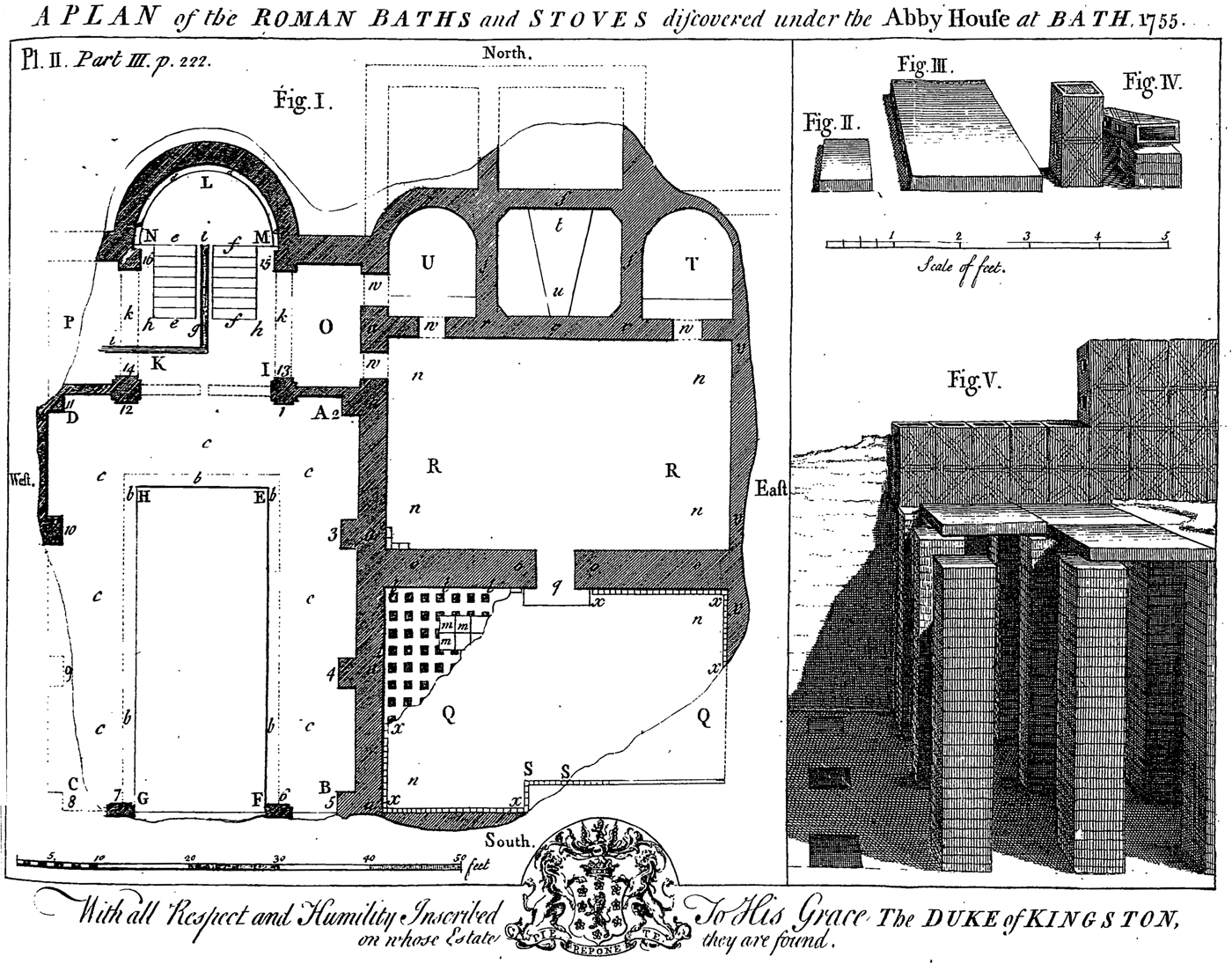
Wood the Elder died on 23 May 1754 and did not have the chance to admire the Roman baths discovered under Abbey House in the summer of 1755.Footnote 37 His son John Wood the Younger helped Charles Lucas (1713–71) to record the remains and drew the first plan of the site, published in Lucas’ An Essay on Waters Footnote 38 (fig. 1). Lucas is better known as a politician than an antiquarian, and the political subtext of this book has been recently addressed.Footnote 39 Despite this, his account of the Roman buildings is exceptionally detailed and provides meticulous measurements of the rooms uncovered.Footnote 40 These included: a large room (ABCD in Wood's plan) with a rectangular pool in its centre (EFGH), now known as the Lucas Bath;Footnote 41 a square room (IKNM) with an apsidal plunge-bath on its northern side (LMN), which, according to Lucas, ‘has suffered some alteration since it's [sic] building’; a ‘vestibule’ (O), the southern wall of which does not appear in any of Cunliffe's plans;Footnote 42 two large hypocausted rooms (QQ and RR) and their furnace (u, t); and two ‘semicircular chambers’ with mosaic floors (U and T).Footnote 43 Two other rooms (unnumbered) were only partially revealed north of the furnace and identified as ‘part of the habitations or lodges of the keepers or attendants of the baths’.Footnote 44 Lucas, perhaps influenced by contemporary expectations, interpreted the rectangular pool in room ABCD as ‘the plebeans, or soldier's bath’ and the apsidal bath (LMN) as ‘originally (…) designed for the patricians or nobles’.Footnote 45 He then discusses at length the functioning of the ‘Hypocausta, Laconica or stoves’ in rooms QQ and RR, detailing their different components and providing an accurate description of the ‘strong square brick tubes’, the box flue-tiles, that ‘communicate with the hollow between the double floors’.Footnote 46 A beautiful ‘perspective view’ of the hypocaust is given in plate II, figure V, probably also drawn by Wood. The latter did not just help in measuring the remains but actively participated in their interpretation, ‘point[ing] out doors or opens, where probably they should have been, but actually were not to be seen’.Footnote 47
Plan of the Roman baths discovered at Bath in 1755 (Lucas Reference Lucas1756, vol. 3, pl. II). (Digital image courtesy of the British Library, with permission)

‘THE HYPOCAUSTA OF THE ANCIENTS’
A paper presented to the Society of Antiquarians by William Stukeley (1687–1765) in 1761Footnote 48 is certainly one of the earliest contributions specifically dedicated to the study of baths in Roman Britain, with a focus on the remains recently recovered at Bath. The fact that it was never published, however, is suggestive of the tepid response of his colleagues to this matter.Footnote 49 Stukeley was a prominent figure in the antiquarian world of the first half of the century, among the founders of the Society of Antiquaries in 1718 and promoter of the Roman Knights (1722–26), a short-lived association of gentlemen and, extraordinarily for the period, ladies devoted to the study of Roman Britain.Footnote 50 When offering his paper in 1761, Stukeley was in his seventies and had already published a series of contributions on the most diverse subjects,Footnote 51 including his well-known account of StonehengeFootnote 52 and the Itinerarium curiosum,Footnote 53 a guide for ‘a classic journey on this side the streights of Dover’.Footnote 54 His first-hand examination of the archaeological evidence from Bath, Lincoln and Caerleon, together with a meticulous knowledge of the ancient sources,Footnote 55 informed Stukeley's discussion of baths. In particular, he was keen to stress the healing effects of bathing and to celebrate the ‘incomparable invention’ of the hypocaust.Footnote 56
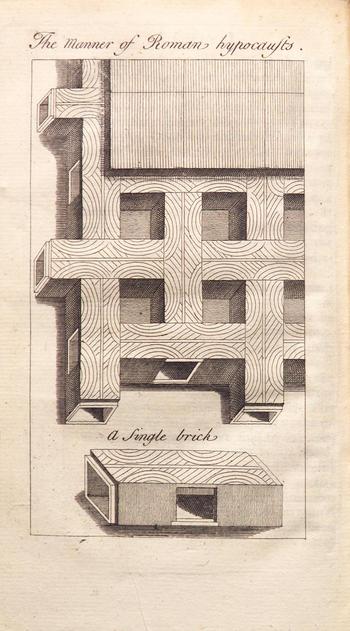
Stukeley had already praised the hypocaust in his Itinerarium (‘an excellent invention for heating a room’ that ‘might well be introduced among us in winter time’)Footnote 57 and the ancient habit of ‘dayly bathing and oyling’ in his treaty Of the Gout.Footnote 58 He presented it as a healthy routine popular also in Roman Britain, as testified by ‘the innumerable remains of hypocausts in our island’, but regrettably not reintroduced ‘among all the refin'd politeness of our age’.Footnote 59 In the latter work, he then gave an extremely detailed account of the method used by the Romans to build a hypocaust — although according to his reconstruction the floor heating system was formed by tubuli (or box flue-tiles) jointed togetherFootnote 60 (fig. 2). One wonders about the impact that this misleading, if ingenious, reconstruction had on subsequent scholarship and the 1761 paper suggests that it was still widely accepted at the time. This is surprising, since, in 1717, the physician John Tabor of Lewis rightly identified the function of some box flue-tiles from a Roman bath-house discovered in 1712 at Eastbourne in East Sussex. In his report, published in the Philosophical Transaction of the Royal Society, he states that ‘(…) they were placed in the Walls to distribute Heat throughout the Building, as was usual in the ancient Structures at Rome’.Footnote 61 To understand the reasons behind this seeming incongruity, we will now look in more detail at the archaeological discoveries that underpinned Stukeley's interpretation.
William Stukeley's reconstruction of the hypocaust heating system (Stukeley Reference Stukeley1734, 114, pl. 116). (Digital image from Wikimedia Commons)

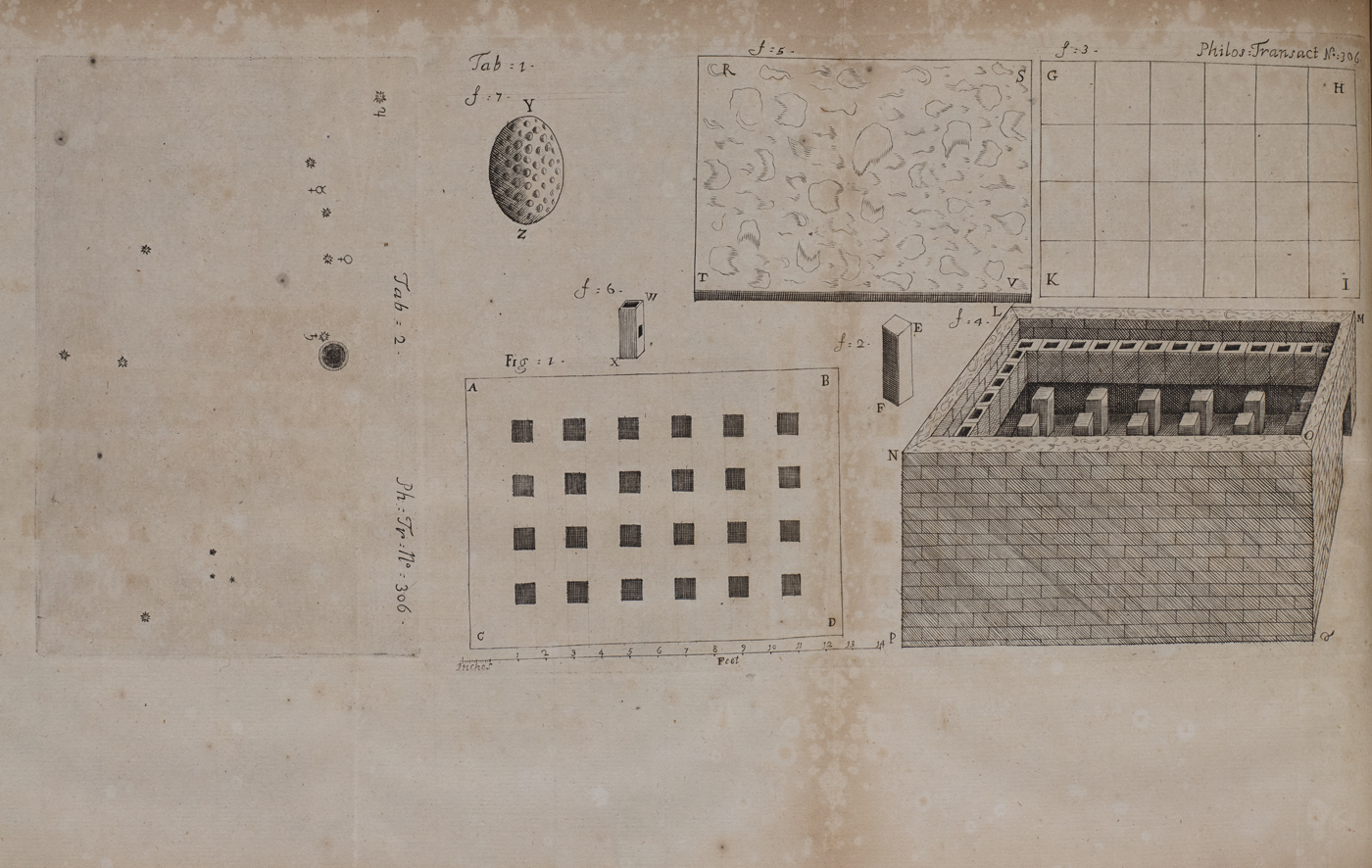
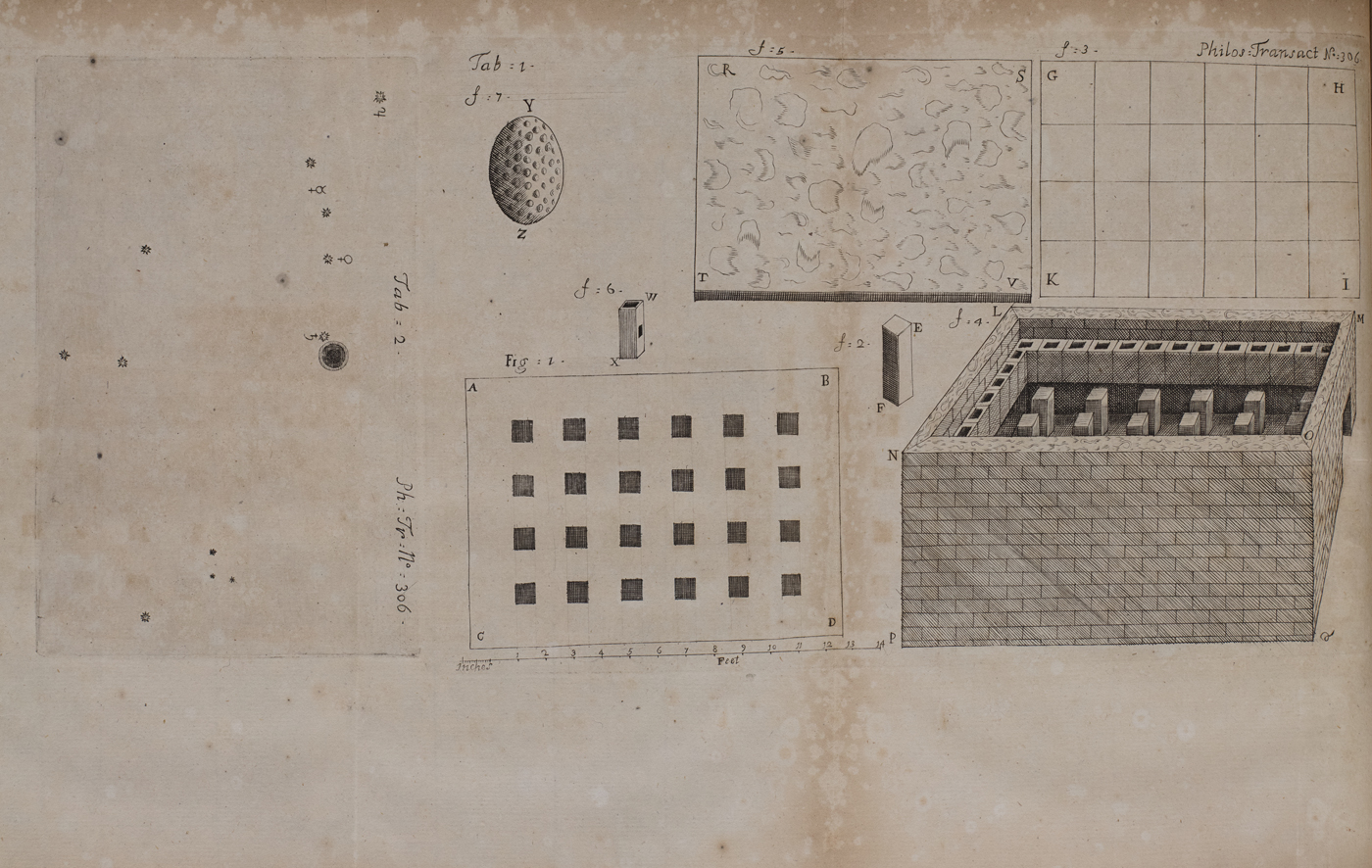
Wood's plan of the baths unearthed in 1755, partially adapted by Lucas (fig. 1), is among the earliest measured drawings of a bath-house in Britain. Looking at six previous and contemporary examples, considerable variability in the detail of archaeological drawing and recording at this time is evident. The earliest of these illustrations accompanied the brief ‘Description of a Roman Sudatory, or Hypocaustum, found at Wroxeter in Shropshire’ by John LysterFootnote 62 (fig. 3), located c. 200 m north of the Old Work.Footnote 63 Following the contemporary military-oriented trend in the study of the Roman past of Britain, Lyster saw this structure as ‘a Sudatory or Sweating house for Roman Soldiers’.Footnote 64 His paper is extremely concise and he claims that ‘[t]he Form of the whole will be better understood by inspecting the Figures’. The latter are indeed quite detailed and include a scale in feet. We see ‘the Sweating-House, in Perspective’ together with the ground plans of the three ‘layers’ of the hypocaust: ‘the Ground Plat, on which the Pillars of Brick stand’ (fig. 1), ‘the Ceiling of Square Tiles’ (fig. 3) and the ‘double Floor’ (fig. 5). Figure 6 is an accurate depiction of one of the box flue-tiles that were ‘fixt with Iron cramps up to the Wall’ of the hypocaust. These are called ‘Flews’ or ‘Tunnel-Bricks’ in the text and the author seems to be confident about their function: ‘every Tunnel had alike 2 opposite Mortice-holes, one on either side, cut through for a cross passage to disperse the Heat amongst them all’.Footnote 65 Apparently, a model of this building was kept in the Museum of the Royal Society, at least until 1738.Footnote 66
The ‘Roman Sudatory, or Hypocaustum, found at Wroxeter in Shropshire’ (Lyster Reference Lyster1706–7, figs 1–6). (Digital image courtesy of the Royal Society, with permission)
Lyster's paper was followed by a letter from John Harwood to Hans Sloane, Secretary of the Royal Society, ‘concerning the Forementioned Hypocaustum’, and by passages from two letters from William Baxter to Harwood himself, ‘Relating to Wroxeter, and the Hypocausta of the Ancients’.Footnote 67 In his letter, Harwood usefully lists four hypocausts comparable to the one just unearthed. He was informed about the first one by the famous architect Christopher Wren, ‘the justly-admir'd Vitruvius of our Age and Nation’, who discovered it when ‘laying the Foundation of the Kings House at Winchester’.Footnote 68 The second one, found near ‘a Field called the Bower, (…) half way between the Roman Wall and South Tine’ (Tyne and Wear), was briefly described by Christopher Hunter in a letter published in the Philosophical Transactions a few years earlier.Footnote 69 The third and fourth sites are both in Wales (Kaer hên, now Caerhûn, Caerns., and Hope, Flints.) and were mentioned in the English edition of Camden's Britannia Footnote 70 by Edward LhuydFootnote 71 and Camden himself.Footnote 72 William Baxter was a Welsh antiquarian, author of a Glossarium Antiquitatum Britannicarum (Reference Baxter1719), and his letter ‘concerning the Hypocausta of the Ancients’ sheds some light on contemporary understanding of these features:
The Ancients had two sorts of Hypocausta; the one called by Cicero [Q. Fr. 3.1.2], Vaporarium, and by others, Laconicum, or Sudatio, which was a large Sweating Bath. In which were Tria vasaria ahena, called Caldarium, Tepidarium, and Frigidarium, from the Water contained in them [Vitr. 5.10.1]. The other sort of Hypocaustum is not so distinctly handled by Antiquaries, and it was a sort of a Fornax, or Kill [sic] to heat their Winter Parlours, or Cænatiunculæ Hybernæ. (…) The Terrace Floor is called by Vitruvius [5.10.1], Testudo. Testudines Alveorum in Hypocausi calefacientur, saith the same Author [ibid.]. This Hypocausis was called Alveus, and Fornax: And the Man that tended the Fire Fornacator. The Tubuli seems to have been contrived to convey away the smother, that otherwise would choke the Fornacator. This kind of Stove seems to be graphically described by P. Statius [Silv. 1.5] in Balneo Hetrusci.Footnote 73
The already mentioned account by John Tabor reporting the discoveries at Eastbourne in East Sussex, identified by the author as the ‘Apartment of a magnificent Palace’,Footnote 74 was also accompanied by a plate (fig. 4). The sketch, possibly made by Tabor himself, shows a mosaic floor and a plunge-bath entered via three steps. Neither a scale nor north arrow are provided but the author gives detailed measurements of the structures in the main text.Footnote 75 The two features marked as ‘Fig. 2’ and ‘Fig. 3’ in the plate are particularly significant since they are among the earliest depictions of relief-patterned box tiles.Footnote 76 Tabor identifies two types of box flue-tiles: ‘the one like a Trough (…)’, while the other ‘had a Cylindrical Channel; so that when two were clapt together, they form'd a hollow Cylinder of three Inches [c. 7.6 cm] Diameter’.Footnote 77
A mosaic floor and a plunge-bath discovered at Eastbourne (East Sussex) in 1712 (Tabor Reference Tabor1717, plate facing p. 563). (Digital image courtesy of the Royal Society, with permission)

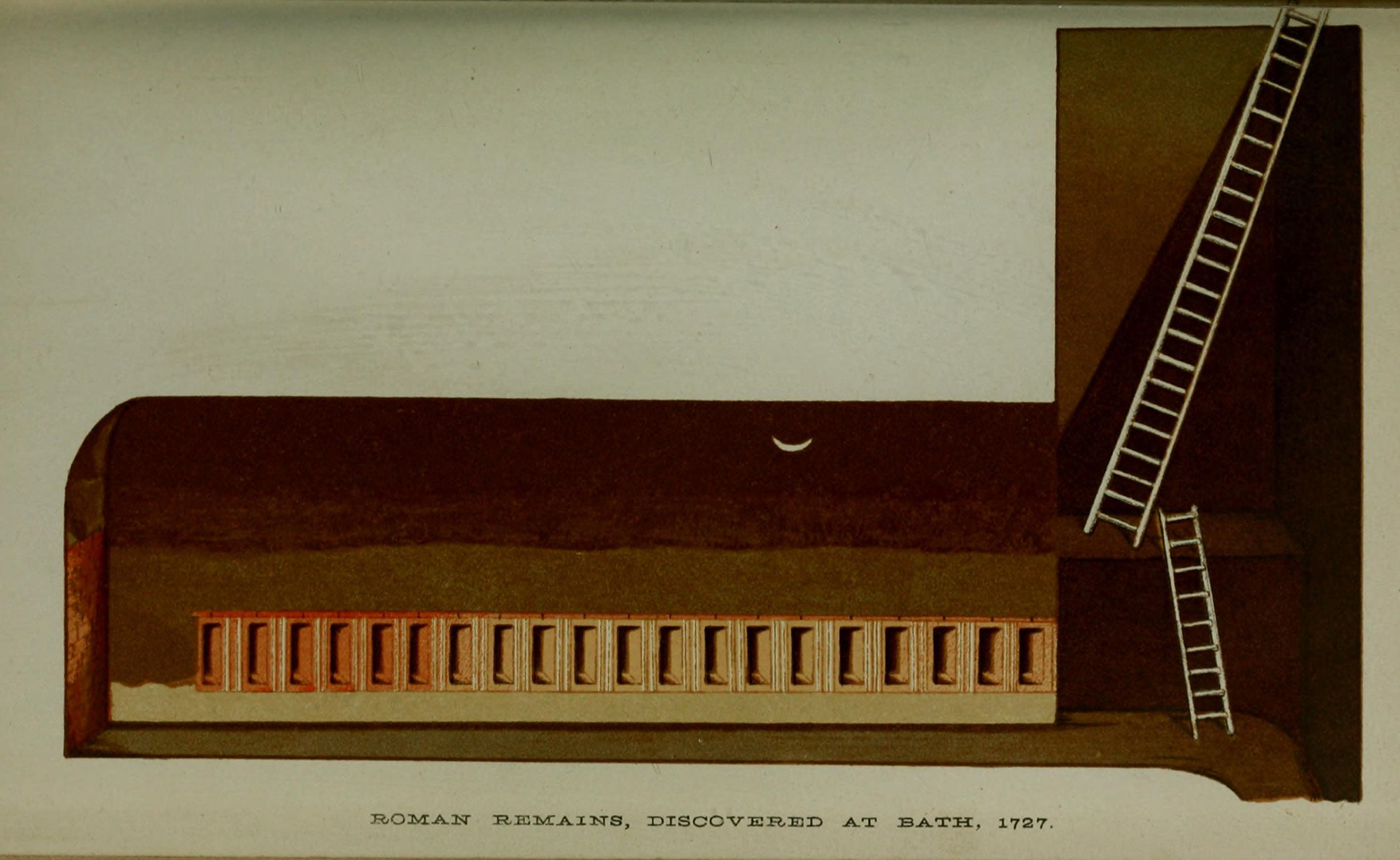
An annotated drawing made by Bernard Lens III (1682–1740) on 20 August 1727Footnote 78 (fig. 5), depicts ‘the subterranean antient Stoves’ discovered in July 1727 during the laying of a sewer near the junction between Bath Street and Stall Street in Bath, the first discovery of similar features in the city. In the sketch we see a floor of box tiles covered by a course of horizontal tiles. This arrangement is comparable to the suspended floor over pillared hypocaust of the tepidarium west of the Circular Bath in the West Baths.Footnote 79 As we will see, a similar solution was also adopted in at least one of the two apsidal rooms of what Cunliffe has identified as the Period 4 and 5 caldarium of the eastern range of heated baths of the complex.Footnote 80
Depiction of the ‘subterranean antient Stoves’ discovered in July 1727 during the laying of a sewer near the junction between Bath Street and Stall Street in Bath by Bernard Lens III (Green Reference Green1890, plate facing p. 118). (Digital image courtesy of the Natural History Museum Library, with permission)

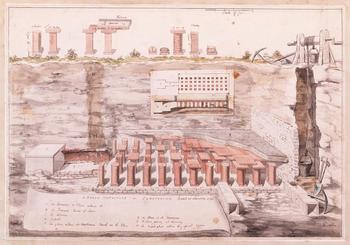
The fourth example, dating to 1740, is a beautiful watercolour by George Vertue (1684–1756), at the time official engraver of the Society of Antiquaries,Footnote 81 entitled Excavations of a Hypocaust at Lincoln Footnote 82 (fig. 6). The building was found the year before during the digging of a cellar at the Precentory (west of Lincoln Cathedral) and accurately recorded by Thomas Sympson, Clerk of the Fabric. The latter sent an account of the discovery to Browne Willis, a member of the Society of Antiquaries, and his letter was subsequently published in the Philosophical Transactions.Footnote 83 The figures that accompanied this publicationFootnote 84 were based on Sympson's sketches. Vertue later redrew the hypocaust in perspective and engraved it for members.Footnote 85 The engraving, with a legend in Latin, was published in the Vetusta Monumenta.Footnote 86 These detailed drawings are exceptional in showing the remains in their original context. Furthermore, they give us hints about the ‘techniques of excavation’ and tools used at the time, including shovels, picks and a hoist to lift buckets of soil. From the legend at the bottom of the plate, we are informed that after the ancient structure was located, a second hole was opened ‘ad accuratiorem hypocausti explorationem’,Footnote 87 ‘to explore in greater detail the hypocaust’. This seems to imply some sort of planning to determine the size of the building.
Excavations of a Hypocaust at Lincoln by George Vertue (Society of Antiquaries of London). (Digital image by kind permission of the Society of Antiquaries of London)

While presented as ‘the remains of a Roman Hypocaustum or Sweating-Room’ in the title of Sympson's paper,Footnote 88 it is not certain that this room was part of a bath-suite. However, the fact that two flues (D and E in Vertue's drawing) ‘for carrying off the Smoke’ were found passing ‘under another Room by the Side of the Hypocaustum’ where ‘it is presumed they turn upwards’Footnote 89 suggests a set of heated rooms,Footnote 90 possibly the private baths of a town-house. These flues, made of tiles or, more likely, slabs of stone,Footnote 91 are called ‘Tubuli’ in the text;Footnote 92 clearly, at this time the term was not exclusively used to identify box flue-tiles and the antiquarians’ Latin terminology was still shifting and inconsistent. Other examples are the words ‘Alveus’ to indicate ‘the Body of the Kiln’Footnote 93 and ‘Testudo or Floor of the Sudatorium or Sweating-Room’.Footnote 94 Thanks to the already mentioned letter by Baxter published a few years before,Footnote 95 we know that the use of these terms originated from the misunderstanding of a particularly problematic passage of Vitruvius:
Aenea supra hypocausim tria sunt componenda, unum caldarium, alterum tepidarium, tertium frigidarium, et ita conlocanda, uti, ex tepidario in caldarium quantum aquae caldae exierit, influat de frigidario in tepidarium ad eundem modum, testudinesque alveolorum ex communi hypocausi calfaciantur.Footnote 96
The author is discussing how to build the hot-water system of a set of baths. What is not immediately clear is that Vitruvius was here describing two separate structures operating from the same furnace: (i) a set of three tanks associated with boilers; and (ii) the testudines alveolorum, a device that helped to heat the water and to keep it warm.Footnote 97 The fact that in his work Vitruvius employed the word testudo to indicate both a ‘vault’ or an ‘aisle’Footnote 98 and two distinct military devicesFootnote 99 seems to have generated some confusion among British antiquarians. The more common attestation of testudo as ‘vault’ in other ancient sourcesFootnote 100 led them to interpret the testudines alveolorum as the ‘vaults of the cavities’, i.e. the hanging floor over the hypocaust itself.
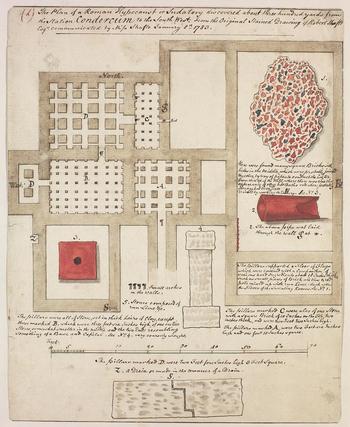
Another ‘Hypocaust or Sudatory’ was discovered c. 274 m south-west of the Roman fort at Benwell (Condercum) in c. 1751. These military baths were drawn ‘by its late very respectable owner, Robert Shafto, Esq. about the time when the military road leading to Carlisle was made’Footnote 101 (fig. 7). The drawing's annotations are quite detailed and give an accurate description of the different types of stone pilae used in each room as well as of the opus signinum floor that covered the hypocausts. This was ‘a Composition of various hard ingredients about 18 inches thick’, including ‘small pieces of brick and blue & red Pots mixed up with run Lime’. According to Shafto, ‘many square Bricks with holes in the Middle’ (no. 3 on fig. 7) were found in one of the rooms. He claims that these curious features ‘were probably joined together by way of pipes to conduct the Water from the Top of the Hill’.Footnote 102 While Shafto's interpretation seems unlikely, the author showed here an unusual interest in the water supply of the site, a factor ignored in most excavations of bath complexes during the eighteenth and nineteenth centuries.
The ‘Hypocaust or Sudatory’ discovered near the Roman fort at Benwell (Condercum) (Society of Antiquaries of London, Britannia Romana 89.4). (Digital image by kind permission of the Society of Antiquaries of London)

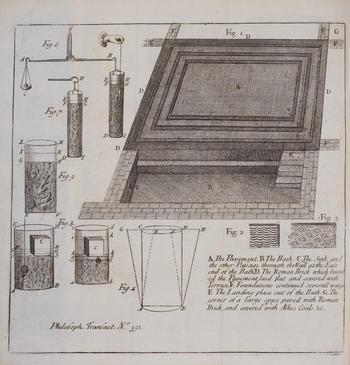
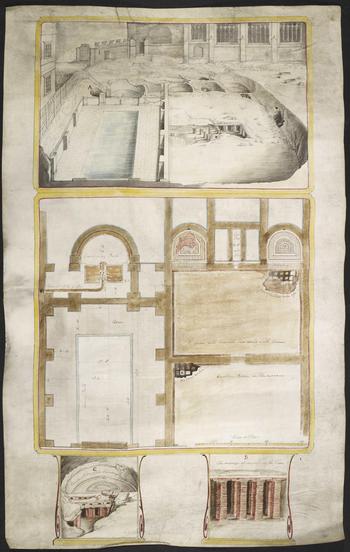
Returning to Bath, Wood's plan and ‘perspective view’ of the baths unearthed there in 1755 (fig. 1) is not the only contemporary illustration of the site. Soon after the discovery, the famous Bath artist William Hoare (c. 1707–92) realised a watercolour detailing the remains, now in the Manuscript Collections of the British LibraryFootnote 103 (fig. 8). The plate is subdivided into four sections. The upper section frames a meticulous bird's-eye view of the site, seemingly in the immediate aftermath of the excavation. The plan in the central section is clearly based on Wood's work, but it is more accurate and shows areas that Wood indicated as unexcavated. In the lower section, we see two vignettes (C and B) labelled ‘Construction of the Sudatory’ and ‘The manner of suspending the Floor’. The former is particularly significant. It depicts the heating system of the western apsidal room to the north of what Cunliffe describes as the Period 4 and 5 caldarium of this set of baths.Footnote 104 We see brick pilae covered by courses of horizontal tiles, on top of which there is a course of box flue-tiles (placed horizontally, at some distance from one another), covered by other tiles and a second course of box flue-tiles (this time placed one next to the other). Cunliffe, while certainly aware of Hoare's sketch, does not discuss this arrangement in any detail, which is similar to the one identified by him in the tepidarium west of the Circular Bath in the West BathsFootnote 105 and to the one discovered in 1727 near the junction between Bath Street and Stall Street (fig. 5). Its importance should not be underestimated: these are among the very few Romano-British buildings in which this solution has been recorded.Footnote 106 Even more relevant for this paper, the arrangement depicted by Lens apparently led Stukeley to believe that this was how box flue-tiles were normally used: in his reconstruction (fig. 2) we see a course of horizontal tiles covering an intricate pattern of tubuli jointed together. The same combination of tiles over tubuli appears in Lens’ drawing. The fact that an analogous arrangement was found in the hypocaust under Abbey House in 1755 must have convinced Stukeley of the accuracy of his reconstruction.
The Roman baths at Bath by William Hoare (British Library, Add MS 21577 B (p. 132)). (Digital image courtesy of the British Library, with permission)

As I shall demonstrate in the next section, some of the other misconceptions that have emerged from these accounts of British antiquarians were based on a far more deeply-rooted and prestigious tradition.
A MISLEADING SOURCE
In 1772, the Scottish architect Charles Cameron (c. 1745–1812) published The Baths of the Romans Explained and Illustrated,Footnote 107 one of the first compendia of this kind available in English. As the author states in the introduction,Footnote 108 this was based on Palladio's unfinished work on the baths of Rome, published in 1730 by Lord Burlington (1694–1753).Footnote 109 Considering the incomplete and ‘imperfect form’ of Palladio's material, Cameron claimed that ‘the buildings [Palladio] has described have been again measured; and the errors which have escaped him, corrected’.Footnote 110 For the purpose of this paper, the most interesting section of this volume is the one dedicated to the ‘Apartments Belonging to the Baths’Footnote 111 and, in particular, the discussion about the hot-water system and the hypocaust. Cameron, paraphrasing Vitruvius,Footnote 112 says that:
The manner in which they heated the water for the Baths (…) was by three copper vessels, so placed that the water ran out of one into the other, and out of the lowest into the Labrum of the Baths, which had also flews from the Hypocaustum to preserve the water in a bathing heat. The particular positions of the vessels alluded to by Vitruvius, had been nearly ascertained by an antique painting found in the Baths of Titus.Footnote 113
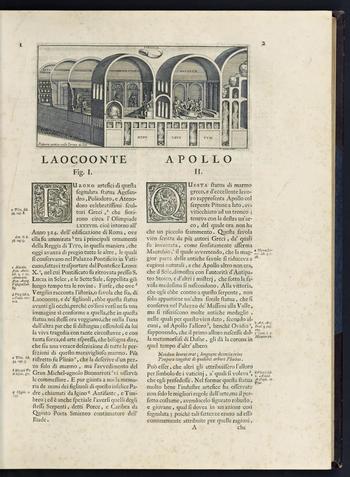
A reproduction of this painting is then given at the beginning of the following chapter.Footnote 114 This is an extremely fascinating image, representing a cutaway view of a set of baths. It appeared in many eighteenth- and nineteenth-century books, from de Montfaucon's influential L’ Antiquité Expliquée et Représentée en Figures Footnote 115 to the Penny Cyclopædia.Footnote 116 The image is firstly presented as based on an ancient wall-painting in Domenico de’ Rossi's and Paolo Alessandro Maffei's Raccolta di Statue Antiche e Moderne, published in 1704 (fig. 9). After the meticulous description of several classical statues, the two authors inserted the section ‘Sposizioni del frontespizio e degli altri ornamenti della presente opera’ (‘Discourses over the frontispiece and the other ornaments of this volume’). Among these, they included ‘(…) a wall-painting of the well-known Baths of Titus, from the books of drawings of the famous Museo Cartaceo of the Commendatore Cassiano dal Pozzo’.Footnote 117
‘An antique painting found in the Baths of Titus’, as reproduced in de’ Rossi and Maffei Reference de’ Rossi and Maffei1704, 2, unnumbered plate. (Digital image courtesy of Getty Research Institute, Los Angeles (93–B5694), with permission)

The Museo Cartaceo, a collection of more than 7,000 watercolours, drawings and prints, most of which are now in the British Library and the Royal Library at Windsor Castle, is currently being catalogued and published thanks to a project of the Warburg Institute, London. Our painting is not included in the first volume of Series A of the catalogue raisonné (Antiquities and Architecture) dedicated to ancient mosaics and wall-paintings,Footnote 118 nor in the three volumes dedicated to ancient Roman topography and architecture.Footnote 119 Amanda Claridge,Footnote 120 general editor of the project, has confirmed that it is not part of the known dal Pozzo corpus. A possibility is that the original drawing or print was lost after the dispersion of the collection in the mid-eighteenth century.Footnote 121 The drawing was realised in the mid-sixteenth century by the architect Giovanni Antonio Rusconi (c. 1500–78) to illustrate the contribution of the physician Giovanni Antonio Sicco to Tommaso Giunti's De balneis,Footnote 122 an anthology of essays on balneology.Footnote 123 However, no mention of it being an ancient wall-painting is made in the text, implying that this misleading label was fabricated at some point between 1553 and the publishing of the Raccolta di Statue Antiche e Moderne in 1704.
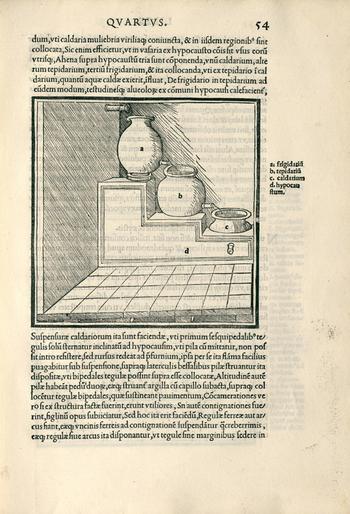
The major issue with this image emerges looking once again at Vitruvius’ recommendations for the construction of a hot-water system.Footnote 124 As seen in the previous section,Footnote 125 modern translations of this passage use the words ‘bronze tanks’ to render the Latin aenea. The main meaning of aeneum, however, is ‘bronze or copper vase’ or ‘cauldron’, and it was interpreted as such in the Renaissance. When Fra GiocondoFootnote 126 (fig. 10) depicted these aenea in the first richly illustrated edition of Vitruvius’ work,Footnote 127 he followed the text literally and drew three vases of bronze, with the water flowing from one into the other.Footnote 128 This erroneous reconstruction clearly influenced Giovanni Antonio Rusconi's illustration. When in the eighteenth century the latter started to be seen as an ‘antique painting’, its authority was used to confirm the validity of Fra Giocondo's interpretation,Footnote 129 fuelling a vicious circle that has affected the understanding of this arrangement for centuries.Footnote 130
Vitruvius’ aenea according to Fra Giocondo (Reference Fra Giocondo1511, 54, unnumbered plate). (Image downloaded from the Architectura platform at http://architectura.cesr.univ-tours.fr/Traite/Notice/CESR_2994.asp?param=en ; Digital image courtesy of CESR Centre d’ Études Supérieures de la Renaissance, Tours, with permission)

NEW DISCOVERIES, OLD DISPUTES
This controversial depiction was certainly known to British antiquarians and John Lyon,Footnote 131 in his account of the discovery of a set of baths at Dover, reports de Montfaucon's opinion that ‘[n]othing (…) better expresses the form of the great baths of the Romans, than a piece of painting in the Thermae of Titus’. His definition of a hypocaust was also affected by this misleading source, since it seems to imply that the fire was burning under the floor itself, as represented in the painting:
This was a subterranean furnace, where the fire was made to warm the room above, and likewise to heat the water for the hot baths to any degree of heat they pleased. This place was curiously and advantageously contrived to diffuse a general and equal heat in every part of the Sudatorium.Footnote 132
Moreover, terminological disputes seem to have been all but settled at this time. A few pages later, the same author discusses the meaning of the word ‘laconicum’ in Vitruvius:
Some say the Lyconycum [sic] is a separate apartment, others that it was the same with the Tepidarium. Was I to offer a conjecture it should be that the Lyconicum [sic] was a furnace under the Tepidarium, as the Hypocaustum was under the Sudatorium, for the funnel bricks fixed in the angle [of the tepidarium of the bath-building at Dover] (…) show there was heat conveyed either in the walls, or under the floor of the Tepidarium.Footnote 133
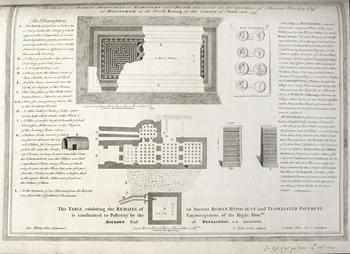
Despite these erroneous preconceptions and controversies, in the second half of the eighteenth century descriptions of hypocausts and baths had generally become more accurate and the antiquarian terminology more consistent. Furthermore, during this period scholars started to question the military interpretation traditionally associated with the Roman heritage in Britain. New typologies of civilian sites were now acknowledged, including villas, even if some of these had been correctly identified already in the late seventeenth century.Footnote 134 Stukeley and Roger Gale (1672–1744) were involved in the study of at least three villas during the 1730s, including Great Weldon (Northants.), which was extensively excavated.Footnote 135 Yet, no bath-suites were found there and, if we exclude the plunge-bath uncovered at Eastbourne in East Sussex in 1712, the first villa baths recognised as such were probably those recorded in 1747 at Hovingham in North Yorkshire.Footnote 136 The site is briefly discussed in a letter from Francis Drake (1696–1771), author of the influential Eboracum,Footnote 137 to William Stukeley.Footnote 138 An etching by George Vertue (fig. 11) depicting the plan of the bath-house and a mosaic floor found nearby provides more detail. This was based on the drawing of a certain Charles Mitley and ‘transmitted to Posterity by the Encouragement of the Right Hon.ble Richard Earl of Burlington’.Footnote 139 In the notes accompanying the etching, Drake states:
The Great Remains of Buildings which have been dug up for several Years (…) by the present Proprietor [Thomas Worsley] and his Father, are plain Evidences of a Roman VILLA or country Seat here placed, belonging (perhaps) to some chief Officer of their sixth Legion, for some centuries stationed at York and in these Northern Parts.
Plan of a mosaic floor and bath-house found at Hovingham in North Yorkshire in 1747 (Society of Antiquaries, Prints and Drawings 1750, p. 51). (Digital image by kind permission of the Society of Antiquaries of London)

This interpretation nicely explains the discovery of a civilian residence in the ‘Northern Parts’, almost exclusively associated with the army in the minds of contemporary scholars. Based on the few coins recovered at the site, ranging from Antoninus Pius to Constantine, Drake also argues that ‘this Place was early and long inhabited by these People’ and that the structures unearthed ‘exhibite a Taste much superior to any thing of those kinds in the lower Empire’. The object marked with the letter K in the plate is described as a ‘Hollow Brick (…) for conveyance of hot Air into the Sweating Rooms, as may be seen round the Circular VAPORARIUM’. This item has a very peculiar shape and has been identified as a D-shaped half box tile,Footnote 140 apparently a unicum in Roman Britain.Footnote 141
One of the earliest full-scale excavations and recordings of a villa complex and its baths took place in 1786 at Mansfield Woodhouse (Notts.), under the direction of Hayman Rooke.Footnote 142 Two residential buildings were located (fig. 12), and the excavator, following ColumellaFootnote 143 and other ancient authors, interpreted the eastern structure as a villa urbana and the western one as a villa rustica.Footnote 144 Both these houses were equipped with hypocausts and RookeFootnote 145 demonstrated an exceptional insight in his analysis, correctly claiming that only the one in the south-east corner of the western building was part of a set of baths, while the others were used to heat residential rooms.
The Roman villa at Mansfield Woodhouse (Notts.) (Rooke Reference Rooke1787, plate facing p. 364). (Reproduced by permission of the Librarian, University of Leicester)

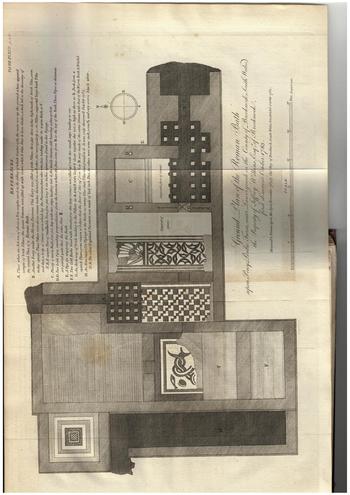
The standards for plans and drawings also improved during the last decades of the century. The members of the Society of Antiquaries had always recognised the importance of visual records of antiquities and the significant number of illustrations that were published in the Society's journal Archaeologia since its first volume in 1770 is suggestive in this sense. Their quality increased even further during the 1780s, when professional draughtsmen started to be employed by the Society.Footnote 146 The bath-house excavated in 1783 at Maesderwen (Brecknock)Footnote 147 was part of a villa complex, although this was not recognised at the time. It was carefully surveyed and the plan, ‘Measured and Drawn upon the Spot’ by Charles Hay,Footnote 148 is remarkably detailed (fig. 13). The same can be said of the plan of the two residences forming the already mentioned villa at Mansfield Woodhouse (Notts.), that ‘was found to be extremely accurate’ when the site was re-examined in 1936–9.Footnote 149
The bath-house excavated in 1783 at Maesderwen (Brecknock) (Charles Hay Reference Hay1785, plate facing p. 206). (Reproduced by permission of the Librarian, University of Leicester)

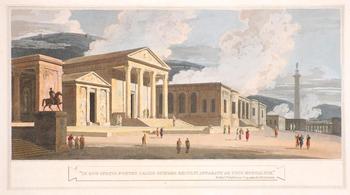
In 1790–1 Bath was back in the spotlight. A pavement of large square stones and sculptural fragments, later identified as the Temple of Minerva, was revealed during the extension of the Pump Room.Footnote 150 The discovery of the remains of a Classical temple in England and its famous gorgon's head drew the attention of several scholars, including Sir Henry Englefield,Footnote 151 at the time vice-president of the Society of Antiquaries, and Samuel Lysons.Footnote 152 Lysons (1763–1819), director of the Society of Antiquaries from 1798 to 1809 and Fellow of the Royal Society, played a key role in the development of Roman archaeology at the turn of the nineteenth century. In particular, the splendid engravings of buildings and mosaics published in his Reliquiae Britannico-Romanae between 1813 and 1817 still constitute an invaluable source of information.Footnote 153 The frontispiece of the section dedicated to the ‘Remains of Two Temples and other Antiquities Discovered at Bath’Footnote 154 (fig. 14) is particularly relevant here. The illustration, based on the drawings of the architect Robert Smirke Junior, is among the earliest ‘archaeological’ reconstructions of life in Britain during the Roman period. Scott has rightly noted how the dignified appearance of the figures in the foreground creates continuity between refined eighteenth-century Bath and its Roman counterpart.Footnote 155 To accentuate this link even further, the author depicted what appears to be a bath-house to the right of the temple, with its thick coils of rising steam, a familiar sight for visitors of Georgian Bath.Footnote 156
Reconstruction of the temple at Bath by Lysons (1813–17, vol. 1, part II, frontispiece). (Photo: Colin Brooks; image courtesy of the Special Collections of the University of Leicester)

Among the authors that engaged with the Roman past of Bath during the late eighteenth to early nineteenth centuries, we should finally mention Richard Warner (1763–1857), who published two books on the subject. The first, An Illustration of the Roman Antiquities Discovered at Bath,Footnote 157 was an erudite description of Roman inscriptions and sculptures from the city. In its introduction, Warner ridiculed the ‘fanciful descriptions of Jeffery of Monmouth’Footnote 158 that presented Bath as a majestic city well before the arrival of the Romans, a picture dear to John Wood the Elder. He also describes how, after the conquest, the Romans speedily arranged to ‘collect together the mineral water that had hitherto wasted their healing powers on the wild solitudes through which they flowed’,Footnote 159 transforming the city into a ‘place of resort’.Footnote 160 Again, a connection between ancient Bath and its Georgian counterpart is evident. In his History of Bath, Warner expands on this subject and claims that the establishment at Bath was deliberately built by the Romans to corrupt the natives, ‘enervating their bodies, emasculating their mind, and fitting them for irreversible bondage’.Footnote 161 A few pages later, Warner tries to explain the Romans’ obsession for bathing and his words nicely lead us to the next section:
As linen was not generally used till the times of the lower empire, cleanliness imposed upon them the necessity of repeated ablutions; and hence, the decent Roman, after every sort of exercise or exertion, plunged into the bath, to free himself from the disagreeable consequences of extreme heat and to refresh and invigorate his exhausted frame.Footnote 162
AN ELUSIVE LEGACY
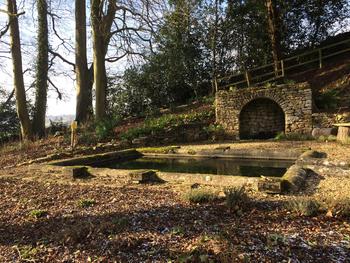
While Classical architecture and its modern reassessments by Palladio and Inigo Jones were the core source of inspiration for Georgian architects,Footnote 163 the impact that Roman bath-houses had on their designs was apparently negligible.Footnote 164 Warner's remarks seem to suggest that the reason behind this had to do with contemporary ideas about cleanliness and personal hygiene. As summarised by Sweet, ‘the quality of Roman virtue and patriotism may have shaped the code of eighteenth-century gentlemanly behaviour, but the Romans’ cult of cleanliness had not won the same widespread admiration’.Footnote 165 However, while a serious debate about the benefits of reintroducing public baths did not take off until the 1790s,Footnote 166 from the late seventeenth century onwards a number of houses and gardens started to be equipped with private baths, testifying to their growing popularity among the elite.Footnote 167 The works of physicians such as Edward Tyson, Charles Leigh, John Floyer (see below) and his collaborator Edward Baynard emphasised the benefits of cold bathingFootnote 168 and their ideas were popularised by John Locke's Some Thoughts concerning Education, published in 1693.Footnote 169 Purpose-built structures appeared in both urban (e.g. John Pinney's Georgian House in Bristol) and country houses (e.g. Streethay, Staffs.; Corsham Court and Stourhead, Wilts.; Painswick, Glos.; Walton Hall, Warkwicks.), where these facilities were set in the landscape, often in association with other garden features such as grottos and cascades.Footnote 170 Their architecture differs greatly, from the double-storey, octagonal bath-house designed by Sir Charles Mordaunt in 1748 at Walton HallFootnote 171 to the Gothic bath-house at Corsham Court built by the famous landscape architect Lancelot Brown (c. 1716–83). Overall, despite the occasional presence of statues of classical gods and nymphs (e.g. Painswick and Stourhead), the influence of Roman and, in particular, Romano-British bath-houses on these buildings appears more superficial than substantial. For instance, the rectangular plunge pool at Painswick (fig. 15) is reminiscent of the piscinae or natationes associated with several Romano-British civilian and military baths,Footnote 172 but none of them had been excavated at the time of its construction in the mid-eighteenth century and a direct inspiration from renaissance and baroque Italian models seems more plausible.Footnote 173
The rectangular plunge pool in the eighteenth-century gardens at Painswick (Glos.). (Photo: Non Morris, with permission)

A similar architectonic variability can be seen in contemporary spas. While hot mineral-water baths were appreciated by the English elite since the sixteenth century, during the first half of the eighteenth century the introduction of turnpike roads, which substantially improved mobility across the country, made major spas, such as Baths and Tunbridge Wells, popular also among the middle ranks of society.Footnote 174 New establishments appeared in this period, the vast majority of which provided facilities only for cold bathing, in line with contemporary fashion.Footnote 175 St Chad's Bath at Unite's Well, near Lichfield (Staffs.), was constructed between 1697 and 1702 by the physician John Floyer (1649–1734), one of the most fervent supporters of the healing virtues of cold bathing.Footnote 176 Whilst claiming that he was ‘publish[ing] no new doctrine, but only design[ing] to revive the Ancient practice of Physick in using cold baths’,Footnote 177 Floyer was very aware that the ancient physicians such as Hippocrates contemplated both hot and cold baths among their remedies.Footnote 178 Nevertheless, as a new Cato who ‘opposed the introducing the use of hot Baths in Rome, by which the Roman Manners might be corrupted, and their Bodies made more Effeminate’, Floyer encouraged ‘this present Age to leave off the imprudent Use of Hot Baths, and to regain their ancient natural viguor, strength and hardiness by a frequent Use of Cold Bathing’.Footnote 179 The complex at Unite's Well is so described by its creator:
The Figure of these baths is oblong, sixteen Foot long [c. 4.57 m], and about Ten broad [c. 3.04 m]. The Baths lie close together, but are divided by a Wall, and the lower receives the Water from the other. The upper I call for Distinction, The Ladies Bath; and the lower, The Mens Bath. The Water is sufficiently deep to reach up to the Neck, and can be conveniently emptied as oft as we please, and will fill both Baths in a Nights time: The Descent into the Bath is by Stone-steps, and there is a convenient Room built to each Bath, for Undressing, and Sweating, upon great occasions.Footnote 180
The baths later became part of a botanic garden designed by the new owner of the land, Erasmus Darwin.Footnote 181 The relevant entry in the Historic England database of Listed Buildings lists the structure as ‘Darwin's Bath’ and describes it as formed by a ‘sandstone base with brick walls and segmental corrugated iron roof’.Footnote 182 The site is on private land and its poor state of preservation prevents a precise assessment of the Roman influences on the architecture of these facilities. The only eighteenth-century representation of the building, a sketch by Richard Greene dating to 1770,Footnote 183 exclusively shows part of its exterior. However, considering Floyer's familiarity with Greek and Roman authors and his interest in ancient balneology, it is plausible that the design of these baths was somehow classical in inspiration, as the presence of rooms ‘for Undressing, and Sweating’ seems to suggest.
The influence of Roman bath buildings on larger Georgian facilities in spa towns like Bath was minimal. We have already seen how John Wood the Elder's planned renovation of the King's and Queen's Baths in 1738 was never accomplished. Between 1773 and 1777, his son John Wood the Younger carried out a full rebuilding of the Hot Baths. The new structure was a central-plan building with a central pool surrounded by four symmetrical parts, each including entrance lobbies, dressing rooms and, alternatively, a sudatory or a dry pump room.Footnote 184 The impact that the Roman remains recorded by Lucas and Wood two decades before had on this sophisticated structure appears to have been very modest indeed. Regardless of their classical decorations and colonnades, the same can be said of the new Pump Room and King's Bath complex, completely reconstructed in the 1790s.Footnote 185
Despite being frequently mentioned in contemporary treaties on balneology, the architectonic links between Roman baths and eighteenth-century private and urban bath buildings were feeble. The eclectic appearance of the latter seems to reflect mainly the personal taste of their architects and patrons. The only exception was the hypocaust, which inspired the underfloor-heating system of the hall of the country house at Holkham Hall (Norfolk), dating from 1734, and the central heating of the residence at West Wycombe Park (Bucks.), started in the 1740s.Footnote 186 The latter is a particularly fascinating case because its structure was directly modelled on the hypocaust discovered at Lincoln in 1739Footnote 187 and illustrated by Vertue (fig. 6).
CONCLUSIONS
Roman baths and their immediately recognisable hypocausts were considered by some Georgian antiquarians among the most conspicuous signs of the Roman presence in Britain,Footnote 188 the latter being described as an ‘incomparable invention’.Footnote 189 The ancient heating system was so iconic that it was reproduced in eighteenth-century country houses, many being actual imitations of Roman villas. The complexity of hypocausts, described by Vitruvius and Pliny the Younger, drew the attention of several scholars, even though the precise functioning and nomenclature of their components was still a matter of debate. As we have seen, the subtleties of Vitruvius’ language were in part responsible for these discordances and misconceptions. Some of these were reinforced by earlier antiquarian interpretations, spoiled by their reliance on an alleged Roman painting from the Thermae of Titus in Rome. The two peculiar hypocausts discovered at Bath in 1727 and 1755 were also paradoxically responsible for adding to this confusion, confirming with their unusual arrangements of box flue-tiles Stukeley's misleading reconstruction of a Roman heated floor (fig. 2).
Despites these issues, most of the antiquarian accounts examined for this study stand out for their accuracy. Both renowned authors like Charles Lucas and neophytes like John Tabor were concerned with painstakingly recording the remains and measuring them as correctly as possible. The standards for plans and drawings were also generally very high, with the members of the Society of Antiquaries well aware of the importance of visual records in the study of antiquities.Footnote 190 The quality of some of these plates is exceptional, both in terms of draughtsmanship and detail. In particular, the watercolour by George Vertue of the hypocaust found at Lincoln in 1740 (fig. 6) is remarkable in showing what looks like a snap-shot of the site soon after its unearthing, revealing the ‘techniques of excavation’ and tools used at the time. A more attentive analysis of these early archaeological illustrations has revealed several peculiar features, including one of the first depictions of relief-patterned box tiles (fig. 4); the apparently unique solution of rows of box flue-tiles over pillared hypocausts at Bath (figs 5, 8); the curious square bricks with holes in the centre from the military baths at Benwell (fig. 7); and the possible D-shaped half box tile from Hovingham (fig. 11).
These meticulous illustrations were constantly referred to in the reports examined, challenging the idea that eighteenth-century antiquarians always gave priority to ancient literary sources over the archaeological evidence and that the latter was used only to confirm the information provided by Classical texts.Footnote 191 Barbara Maria Stafford has noted a correlation between eighteenth-century anatomical and archaeological illustrations, in particular between the engravings of Giovanni Battista Piranesi (1720–78) and contemporary republishing and reinterpretation of Andreas Vesalius’ De humani corporis fabrica Footnote 192 by French, English and Dutch anatomists. She argues that Piranesi was influenced by different ‘“surgical” strategies’ in his depictions of ancient monuments in Rome and that in using ‘the etching needle as a creative surgical tool to uncover information about an otherwise irretrievable past’, he ‘transformed the menial expository tasks formerly assigned to engravings’.Footnote 193 A similar case can be made for the works of Georgian antiquarians. While ancient sources were certainly heavily relied on to engage with Roman antiquities, the physical remains had significance on their own and their accurate depiction became indispensable. Without a visual representation, words alone were perceived as insufficient and sometimes relegated to mere captions (e.g. figs 7, 11). A similar attitude permeated contemporary scientific books, where the text was often complementaryFootnote 194 or even subordinateFootnote 195 to the illustrations, the latter being increasingly improved with the move from woodcuts to metal plate engraving.Footnote 196
Another intriguing trait emphasised by this overview of eighteenth-century writings is the steady, if slowly developing, reconnection between the city of Bath and its Classical past. If at the beginning of the century very little was known about the Roman city, the discoveries in 1727, 1738 and especially 1755 caused a sensation, at least at a local level, and the Duke of Kingston's decision to build his new baths over the ancient remains implied a sense of continuity with the Roman past.Footnote 197 This link was reinforced after the partial unearthing of the Temple of Minerva in 1790–1, and emerged in contemporary authors like Samuel Lysons and Richard Warner. Nevertheless, architectonic influences of Roman baths on eighteenth-century facilities in the city remained minimal, even in the works of John Wood the Younger who had actively collaborated with Charles Lucas during the 1755 excavations.
Finally, it is important to underline how the evidence collected for this study has revealed the origins of some methodological issues that still affect scholarship today. In particular, the terminological disputes that excited early excavators of Roman bathsFootnote 198 have not been completely settled yet and terminology remains a central concern for baths scholars.Footnote 199 The Latin terms adopted by antiquarians to identify different rooms of the baths are still widely used in modern literature despite the shortcomings of this practice having been repeatedly addressed.Footnote 200 While with smaller structures the use of traditional nomenclature is reasonably effective, this classification becomes clumsy and contrived when the number of rooms increases and its dogmatic adoption can lead to a simplistic interpretation of the archaeology, with an over-imposition of functions and labels. Furthermore, the antiquarian focus on the minutiae of the architectonic components of baths to the detriment of their socio-cultural role, often taken for granted, had a decisive influence on the direction of the subsequent scholarship in Britain. Baths continued to be perceived as symbols of Roman presence in the country but the understanding of the nuances of their social function has progressed very little and would certainly deserve greater scholarly attention.
ACKNOWLEDGEMENTS
I would like to thank Dr Sarah Scott for her encouragement and direction throughout the course of this project. Thanks also to Neville Brown for allowing me to visit the remains of the bath-house at Unite's Well and to Non Morris for her beautiful picture of the plunge pool at Painswick. I am indebted to Dr Damjan Krsmanovic, Alessio Mattana and Dr Jane Ainsworth for their comments on earlier drafts of this paper and to the two anonymous referees for suggesting further improvements. I would also like to thank the Roman Society, which generously covered the cost of reproducing the illustrations for this paper.