‘Devil's gardens’ are forest clearings dominated by one or a few plant species, a striking peculiarity in the rain forest of the Amazon Basin characterized by its high plant density and diversity. These intriguing environments have triggered the interest of scientists who have ventured hypotheses about their genesis and ecological features (Campbell et al. Reference CAMPBELL, RICHARDSON and ROSAS1989, Frederickson et al. Reference FREDERICKSON, GREENE and GORDON2005, Morawetz et al. Reference MORAWETZ, HENZL and WALLNÖFER1992).
Depending on the region, devil's gardens constitute stands inhabited by one or two of the following myrmecophytic plant species: Clidemia heterophylla (Desr.) Gleason, Cordia nodosa Lam., Duroia hirsuta (Poepp.) K. Schum. and Tococa guianensis Aubl. These plants share a common trait: they are all specialized plants, so-called myrmecophytes, adapted to sheltering highly specialized ant colonies within cavities called domatia. Likewise, the species of ants involved in these associations are also highly specialized, and can only survive on their host plants. Each of the plant species can be occupied by different plant-ants belonging to the genera Azteca, Allomerus, Crematogaster and Myrmelachista. Among these ant species, only Myrmelachista schumanni Emery is known to create devil's gardens by attacking non-myrmecophytic plants in the surrounding area (Frederickson et al. Reference FREDERICKSON, GREENE and GORDON2005, Morawetz et al. Reference MORAWETZ, HENZL and WALLNÖFER1992, Renner & Ricklefs Reference RENNER and RICKLEFS1998).
We found devil's gardens in two remote locations in cloud forests in French Guiana more than 2000 km away from the previously known distribution area of this association. The first discovery took place in the vicinity of Mont Galbao, Saül in May 2014 (3°35′N, 53°15′W), and the second series of observations were made during a scientific survey carried out on Mont Itoupé, Camopi (3°01′N, 53°05′W) in November 2014 as part of the DIADEMA project. In both cases, the association consisted of patches of Cordia nodosa inhabited by an unidentified Myrmelachista species (voucher specimens are deposited in the collection of the UMR – EcoFoG in Kourou, French Guiana).
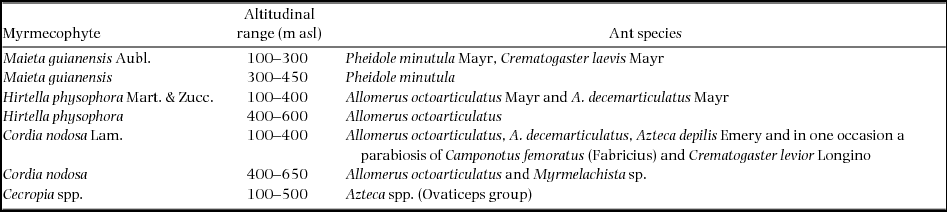
We returned to Mont Galbao in May 2015 to record additional information on the myrmecophytes and associated ants present in the region. The myrmecophytes and associated ants were extensively surveyed from 100 m asl to the top of Mont Galbao along the path and through off-the-path observations every 500 m in circles with a 30-m radius (Table 1).
Myrmecophytes and associated ants found in the extensive survey carried out on Mont Galbao, Saül (French Guiana).

Eastern Amazon devil's gardens were only found in cloud forests at altitudes above 530 m asl and the species of Myrmelachista involved exclusively inhabited C. nodosa plants. Below 530 m asl, the C. nodosa plants were never occupied by Myrmelachista. Tococa guianensis was not found on Mont Galbao or on Mont Itoupé in either our or previous inventories (DIADEMA project unpubl. data, Cremers et al. Reference CREMERS, FEUILLET, DE GRANVILLE, HOFF, GRACIE and MORI1993). At Mont Galbao, a total of 11 devil's gardens were found above 530 m asl. At Mont Itoupé, quantitative measurements of devil's gardens were not possible (too numerous; several hundreds), but their number and spread considerably increased with respect to the predominance of cloud forests in this area. Ant weeding activity (i.e. a lack of surrounding vegetation and even leaf litter) was always observed in presence of Myrmelachista ants, but never when the C. nodosa plants were occupied by other ant species such as Allomerus octoarticulatus Mayr. In medium-sized and larger gardens (i.e. more than five C. nodosa) the clearings were more obvious and almost no other plants were found in them (Figure 1). Nevertheless, there were three notable exceptions regularly occurring in devil's gardens, namely Calathea propinqua (Poepp. & Endl.) Körn., Miconia sp. and Vriesea splendens (Brongn.) Lem. While the first two were mostly abundant in the surroundings, the latter was more frequently found inside the gardens, suggesting the positive impact of this ant–plant association on the growth of this tank bromeliad.
The largest devil's garden found on Mont Galbao consisted of 80–90 treelets of different ages, equidistantly spread over a total surface area of about 600 m2.
Finding devil's gardens in French Guiana opens a series of questions concerning their relationship to gardens to the west, as well as the reason for their isolation. It is worth mentioning that ant–plant associations are relatively frequently studied in French Guiana (Dejean et al. Reference DEJEAN, QUILICHINI, DELABIE, ORIVEL, CORBARA and GIBERNAU2004, Solano et al. Reference SOLANO, DUROU, CORBARA, QUILICHINI, CERDAN, BELIN-DEPOUX, DELABIE and DEJEAN2003) and Brazil (Fonseca Reference FONSECA1999), and it is, therefore, very unlikely that such remarkable formations could have remained systematically unnoticed in the most accessible areas. We consider three hypotheses potentially explaining the large gap observed. First, the host plant distribution limits that of devil's gardens. Second, the rainfall and temperature requirements of the mutualism have a disjunct distribution, creating a habitat unsuitable for Myrmelachista between the distribution of C. nodosa recorded to the west and that recorded to the east. Third, the eastern mutualism represents relicts from climatic disruptions that occurred during the Cenozoic.
In order to investigate the host plant limitation hypothesis, we compared the known distribution of devil's gardens with the distribution of myrmecophytes potentially used by Myrmelachista ants to create devil's gardens (i.e. C. heterophylla, D. hirsuta, C. nodosa and T. guianensis). Devil's garden positions were obtained from previous works (Campbell et al. Reference CAMPBELL, RICHARDSON and ROSAS1989, Edwards et al. Reference EDWARDS, FREDERICKSON, SHEPARD and YU2009, Emery Reference EMERY1890, Frederickson & Gordon Reference FREDERICKSON and GORDON2009, Frederickson et al. Reference FREDERICKSON, GREENE and GORDON2005, Morawetz et al. Reference MORAWETZ, HENZL and WALLNÖFER1992, Olesen et al. Reference OLESEN, LINDBERG, ESKILDSENL, SVENNING and LINDBERG2002, Page et al. Reference PAGE, MADRIÑÁN and TOWERS1994, Pfannes & Baier Reference PFANNES and BAIER2002, Renner & Ricklefs Reference RENNER and RICKLEFS1998, Schultes Reference SCHULTES1985) and the distributions of myrmecophytes were obtained from herbarium occurrence records available from the Global Biodiversity Information Facility database (www.gbif.org/ accessed 15 September 2015). According to the data obtained, among the four plant species known to be associated with devil's gardens, C. heterophylla and D. hirsuta seem restricted to the Western Amazon (Figure 2b,c), consistent with the previously known distribution of devil's gardens (Figure 2a). However, C. nodosa and T. guianensis are continuously distributed all throughout the Amazon Basin, including French Guiana (Figure 2d,e), even though T. guianensis is generally restricted to low altitudes (Delnatte 2010). On Mont Galbao, the only myrmecophytic plants that we found above 530 m asl were C. nodosa and Hirtella physophora Mart. & Zucc. At this altitude, C. nodosa was inhabited by A. octoarticulatus or Myrmelachista sp., the latter being more frequent, and H. physophora plants were occupied by either Allomerus ants or uninhabited. To counter the argument of a host plant limitation, we found that C. nodosa, the only plant known to be inhabited by Myrmelachista ants in Eastern Amazonia, is the most widespread myrmecophyte in French Guiana and Amazonia at varying altitudes, thus providing a continuous hospitable area for Myrmelachista ants.
Distribution of known devil's gardens in Western (red diamonds) and Eastern (red triangles) Amazon (a), and of myrmecophytic plants (green dots) potentially associated with the creation of devil's gardens by Myrmelachista ants: Clidemia heterophylla (b), Duroia hirsuta (c), Cordia nodosa (d) and Tococa guianensis (e). Areas in black represent altitudes above 530 m asl. The green-shaded area represents the country of French Guiana.
To investigate whether the gap in the devil's gardens distribution could be explained by environmental barriers, we compared the environmental conditions (i.e. average temperatures, average rainfall, rainfall during the driest months and altitude) recorded for devil's gardens in the Western and Eastern Amazon according to the information available from previous studies. The ecological tolerances of Western Amazonian devil's gardens found in the literature include precipitation ranging from 2000 to 4000 mm y−1 (Edwards et al. Reference EDWARDS, FREDERICKSON, SHEPARD and YU2009, Renner & Ricklefs Reference RENNER and RICKLEFS1998) and altitudes of 100 to 1200 m asl (Frederickson & Gordon Reference FREDERICKSON and GORDON2007, Morawetz et al. Reference MORAWETZ, HENZL and WALLNÖFER1992), comprising at least some areas with marked dry seasons (Campbell et al. Reference CAMPBELL, RICHARDSON and ROSAS1989, Edwards et al. Reference EDWARDS, FREDERICKSON, SHEPARD and YU2009). In addition, devil's gardens have been noted in both terra firme forests and lowland forests (Morawetz et al. Reference MORAWETZ, HENZL and WALLNÖFER1992, Pfannes & Baier Reference PFANNES and BAIER2002). These conditions are widely represented in much of French Guiana where average annual precipitation ranges from 2000 to 4000 mm, average temperatures are close to 26°C throughout the year, and seasonality is especially strong in the coastal area with precipitation less than 60 mm mo−1 on average during the dry season, but they are less severe in the interior (Hijmans et al. Reference HIJMANS, CAMERON, PARRA, JONES and JARVIS2005). In contrast, the devil's gardens of the Eastern Amazon were only found in cloud forests. These constitute the most humid forests in the Guiana Shield with annual precipitation exceeding 4000 mm, higher average relative humidity explained by cloud cover in contact with the ground, and also characterized by a lower average temperature (21–22°C) (Hijmans et al. Reference HIJMANS, CAMERON, PARRA, JONES and JARVIS2005). Therefore, it is plausible that Myrmelachista ants of the Eastern Amazonian devil's gardens are confined to high altitudes due to low resistance to drought and/or to high temperatures.
Our third hypothesis was that the devil's gardens in French Guiana constitute relicts of a past and spread distribution area of this mutualism. This hypothesis would best be proven by the repeated fragmentation of the Amazonian rain forest during dry periods of the Cenozoic causing the isolation of some biotas and creating ecological refugia (Haffer & Prance Reference HAFFER and PRANCE2001). In agreement with this refuge hypothesis, important similarities have been reported between the highland flora of the Guiana Shield and that of Andean forests (de Granville Reference DE GRANVILLE1991). While this possibility exists, confirmation would require further examination, most notably a phylogeographic study of Myrmelachista ants including those involved in the formation of devil's gardens in Eastern and Western Amazonia. Moreover, according to this hypothesis, we might also expect devil's gardens to be present in montane forests in other countries such as Venezuela, Surinam or Guyana.
In conclusion, this rare mutualism longitudinally separated by thousands of kilometres from its previously known area of distribution provides compelling data for future biogeographic and phylogeographic studies and opens challenging research avenues. First, the isolation of these populations might be quite ancient (110–11 ky). Therefore, understanding how Myrmelachista ants in French Guiana have survived and avoided exclusion by other, more abundant mutualistic ant species in the region that also occupy C. nodosa (i.e. Allomerus) is of great interest to understanding the stability of mutualisms over time. Moreover, finding these charismatic formations in the cloud forests of French Guiana is a good example of the many mysteries these poorly known montane forests may still harbour, encouraging further scientific exploration.
ACKNOWLEDGEMENTS
We are grateful to Parc Amazonien de Guyane for logistic support, to Elise Bayle. . .for the creation of the distribution maps, Leslie Talaga for proofreading the early version of the manuscript and Andrea Yockey-Dejean for proofreading the final version of the manuscript. Financial support for the field mission to Mont Itoupé was provided by the French Agence Nationale de la Recherche through an ‘Investissement d'Avenir’ grant (CEBA, ref. ANR-10-LABX-25-01). ASL and ST were funded by a PhD scholarship (Centre National de la Recherche Scientifique and the Fond Social Européen for ASL; Université Antilles-Guyane for ST).