Up to 70% of children with attention-deficit/hyperactivity disorder (ADHD) experience difficulties initiating and maintaining sleep (Sung et al., Reference Sung, Hiscock, Sciberras and Efron2008). Sleep problems are more persistent in children with ADHD than in the general population, and exacerbate existing problems (Sung et al., Reference Sung, Hiscock, Sciberras and Efron2008; Hansen et al., Reference Hansen, Skirbekk, Oerbeck, Wentzel-Larsen and Kristensen2013; Langberg et al., Reference Langberg, Dvorsky, Marshall and Evans2013; Lycett et al., Reference Lycett, Mensah, Hiscock and Sciberras2014). There is a pressing need for evidence-based behavioural interventions to treat sleep problems in children with ADHD (Cortese et al., Reference Cortese, Brown, Corkum, Gruber, O'Brien, Stein, Weiss and Owen2013).
Some recent randomised controlled trials (RCTs) have examined the efficacy of behavioural interventions on sleep problems in children (Keshavarzi et al., Reference Keshavarzi, Bajoghli, Mohamadi, Salmanian, Kirov, Gerber, Holsboer-Trachsler and Brand2014; Hiscock et al., Reference Hiscock, Sciberras, Mensah, Gerner, Efron, Khano and Oberklaid2015; Corkum et al., Reference Corkum, Lingley-Pottie, Davidson, McGrath, Chambers, Mullane, Laredo, Woodford and Weiss2016). Keshavarzi et al. reported that a 12-week sleep-training programme for children with ADHD aged 10 years (n = 40) had beneficial effects on sleep and psychosocial functioning when compared to controls with ADHD who did not receive the intervention (n = 20) and typically developing children (n = 20) (Keshavarzi et al., Reference Keshavarzi, Bajoghli, Mohamadi, Salmanian, Kirov, Gerber, Holsboer-Trachsler and Brand2014). Outcomes were assessed immediately post-intervention thus longer-term benefits of this intervention are unknown. In a combined sample of children with and without ADHD (N = 61), Corkum and colleagues found that a distance sleep intervention was associated with improved sleep and broader psychosocial health outcomes assessed up to 6 months later (Corkum et al., Reference Corkum, Lingley-Pottie, Davidson, McGrath, Chambers, Mullane, Laredo, Woodford and Weiss2016).
We similarly have reported short-term benefits of a two-session behavioural sleep intervention for children with ADHD (N = 244) v. usual care (Hiscock et al., Reference Hiscock, Sciberras, Mensah, Gerner, Efron, Khano and Oberklaid2015). The intervention was associated with moderate improvements in most child outcomes up to 6 months post-randomisation including improved sleep, inattentive symptoms, quality of life, daily functioning, and behaviour. Intervention children also had small improvements in teacher-reported classroom behaviour and working memory. Although the intervention was associated with initial benefits for caregiver mental health, benefits were not observed at the 6 month time point. The current study examines whether this intervention was associated with sustained benefits for children and families at 12 months post-randomisation.
The benefits of behavioural sleep interventions in improving longer-term outcomes for children with ADHD are currently unknown. The shorter-term benefits of these interventions are certainly promising given the magnitude of the effects observed, the generalisability of improvements to other areas of functioning and the benefits on blinded outcomes including actigraphy, working memory and teacher-reported behaviour (Hiscock et al., Reference Hiscock, Sciberras, Mensah, Gerner, Efron, Khano and Oberklaid2015; Corkum et al., Reference Corkum, Lingley-Pottie, Davidson, McGrath, Chambers, Mullane, Laredo, Woodford and Weiss2016). More generally, it is important clinically to know if there are sustained benefits of interventions but research trials tend to assess outcomes either immediately following or up to 3 months post-intervention (Rothwell, Reference Rothwell2005; Parker et al., Reference Parker, Wales, Chalhoub and Harpin2013). The potential of sleep interventions to improve longer-term outcomes also offers a pragmatic approach to improving outcomes for children with ADHD in real life clinical practice. The brevity of the Sleeping Sound intervention, for example, means that it can be integrated into practice and the tailored nature of the intervention also fits with real life clinical approaches (Sciberras et al., Reference Sciberras, Mulraney, Heussler, Rinehart, Schuster, Gold, Hayes and Hiscock2017).
Given the promise of behavioural sleep interventions in improving outcomes for children with ADHD it is imperative that we understand how child or family characteristics may be associated with treatment response in order to better tailor interventions to individual child and family needs. In general, most studies focus on overall group outcomes when reporting the results of clinical trials and similarly few ADHD trials report on the subgroups for which interventions appear to be more or less effective (Hinshaw, Reference Hinshaw2007; Van der Oord and Daley, Reference Van der Oord, Daley, Maric and Ollendick2015). Understanding the subgroups for whom treatments are effective is especially important in ADHD research, given that ADHD is a condition characterised by considerable heterogeneity. It is likely that both child level (e.g. severity of the problem, comorbidity, age) and parent level (e.g. mental health) factors are associated with improved or worse treatment outcomes (Van der Oord and Daley, Reference Van der Oord, Daley, Maric and Ollendick2015).
Much of what we know about the moderators of treatment outcome in ADHD comes from the Multimodal Treatment of ADHD (MTA) Study (Hinshaw, Reference Hinshaw2007; Van der Oord and Daley, Reference Van der Oord, Daley, Maric and Ollendick2015) and results vary depending on the treatment group analysed and the time point of follow-up. For example, in the ADHD groups receiving medication alone or combined medication and behavioural interventions, parental depression, ADHD symptom severity and child IQ were associated with a more modest treatment response (Owens et al., Reference Owens, Hinshaw, Kraemer, Arnold, Abikoff, Cantwell, Conners, Elliott, Greenhill, Hechtman, Hoza, Jensen, March, Newcorn, Pelham, Severe, Swanson, Vitiello, Wells and Wigal2003). However, for the behavioural treatment group, children with ADHD and a comorbid anxiety disorder had more improvement in ADHD and internalising symptoms than children with ADHD without comorbid anxiety (MTA Cooperative Group, 1999). Few investigations outside of the MTA study have examined the moderators of treatment outcome for young people with ADHD. Langberg and colleagues recently demonstrated that family factors such as lower parent stress predicted better treatment response to an academic skill intervention for adolescents with ADHD (Langberg et al., Reference Langberg, Evans, Schultz, Becker, Altaye and Girio-Herrera2016).
With regards to a behavioural sleep intervention, it is plausible that child factors such as initial sleep problem and ADHD symptom severity, presence of comorbidities, and ADHD medication use, as well as family factors including parent mental health and lower family socio-economic status, could all be associated with differential outcomes, given that these factors have been associated with sleep problem severity and persistence in children with ADHD (Hansen et al., Reference Hansen, Skirbekk, Oerbeck, Wentzel-Larsen and Kristensen2013; Lycett et al., Reference Lycett, Sciberras, Mensah and Hiscock2013, Reference Lycett, Mensah, Hiscock and Sciberras2014), and that similar factors have been identified in ADHD studies to be moderators of treatment outcome (Van der Oord and Daley, Reference Van der Oord, Daley, Maric and Ollendick2015). Research examining the moderators of treatment outcome for sleep interventions in the general youth population is sparse, however, one recent study found that higher levels of anxiety and depressive symptoms were associated with more improvements in sleep following a cognitive-behavioural and mindfulness-based group sleep intervention for adolescents with sleep difficulties (Blake et al., Reference Blake, Blake, Schwartz, Ranti, Waloszek, G, Simmons, Landau, Dahl, McMakin, Dudgeon, Trinder and Allen2017). Given that this was an adolescent-focused intervention, parent factors were not examined. We have not yet reported on the moderators of treatment outcome from the original Sleeping Sound trial (Hiscock et al., Reference Hiscock, Sciberras, Mensah, Gerner, Efron, Khano and Oberklaid2015), thus in the current study we examine the moderators of treatment outcome over time i.e. the full 12 month study period.
The aims of the present research were two-fold. First, we aim to examine whether a behavioural sleep intervention for children with ADHD is associated with longer-term improvements in child and caregiver wellbeing 12 months later assessed via parent and teacher reports. Second, we investigate whether several plausible child (e.g. sleep problem severity, ADHD symptom severity, comorbidities, age, sex) and family (e.g. parent high school completion, parent mental health) factors are moderators of treatment outcome over time.
Method
Design
A RCT design was used to examine the efficacy of a behavioural sleep intervention to treat moderate/severe sleep problems in children with ADHD, compared to usual clinical care (Sciberras et al., Reference Sciberras, Efron, Gerner, Davey, Mensah, Oberklaid and Hiscock2010). Twelve month follow-up data are the focus of this paper. This study was approved by The Royal Children's Hospital (#30033) and the Victorian Department of Education and Early Childhood Development (#2010_000573) ethics committees. The trial was registered with ISRCTN, http://www.controlled-trials.com (ISRCTN68819261).
Eligibility and recruitment
Study invitation letters were mailed to the parents/caregivers of children with ADHD aged between 5 and 12 years seen by paediatricians from 21 paediatrics practices in Victoria, Australia, in the past year. Families were asked to contact the study team if they did not wish to hear any more about the study; families who did not opt out were telephoned to assess interest in the study and eligibility.
Children were eligible if they met the full Diagnostic and Statistical Manual for Mental Disorders (DSM) IV criteria for ADHD, assessed using the ADHD Rating Scale IV (DuPaul et al., Reference DuPaul, Power, Anastopoulos and Reid1998), with parents endorsing at least 6 of 9 inattention and/or hyperactivity/impulsivity symptoms as occurring often/very often. Symptom onset, duration and cross-situational impairment were assessed using purpose-designed questions. Children also needed to meet American Academy of Sleep Medicine criteria for a behavioural sleep disorder (sleep onset association disorder, limit setting disorder, delayed sleep phase and/or idiopathic/psychophysiological insomnia) (American Academy of Sleep Medicine, 2001) or be experiencing significant bedtime anxiety leading to insomnia (i.e. difficulty falling asleep three or more nights per week and displaying fearful behaviours, such as crying, asking for reassurance, or lying in bed worrying about things). Finally, parents needed to rate the child's sleep as being a moderate/severe sleep problem (Sung et al., Reference Sung, Hiscock, Sciberras and Efron2008).
Children were excluded if they were already receiving specialised sleep assistance from a psychologist or sleep clinic, or if the child had a serious medical condition, intellectual disability or suspected obstructed sleep apnoea, assessed using the Children's Sleep Habits Questionnaire (CSHQ) (Owens et al., Reference Owens, Spirito and McGuinn2000).
Interested and eligible families were mailed an information sheet, consent form, and baseline survey and enrolled and randomised once consent and the survey were returned. Following randomisation, intervention and control families were telephoned to complete the Anxiety Disorders Interview Schedule for Children IV (ADISC-IV) (Lyneham and Rapee, Reference Lyneham and Rapee2005). Teachers were mailed a baseline survey to complete if parental consent was provided. Parents and teachers were sent surveys to assess outcomes at 12 months post-randomisation. Participant recruitment and follow-up occurred from August 2010 to June 2013.
Randomisation and blinding
An independent statistician generated a randomisation schedule using a computerised random number sequence. Assignment was stratified by child gender, with a 1:1 ratio intervention v. usual clinical care and varying block sizes of 2–6. Families allocated to ‘usual care’ accessed care from their child's paediatrician, which does not usually involve the assessment and treatment of sleep problems (Sung et al., Reference Sung, Hiscock, Sciberras and Efron2008). We monitored access to services between follow-up assessments using a parent-reported survey (Hiscock et al., Reference Hiscock, Sciberras, Mensah, Gerner, Efron, Khano and Oberklaid2015). Paediatricians and teachers were not informed of the child's randomisation status.
Intervention
Intervention families attended two face-to-face sleep consultations with a trained clinician at the paediatrician's office, at the hospital or in the family home. Sessions were held 2 weeks apart and families were then called 2 weeks later to monitor progress. The intervention team comprised five psychologists (four with 1–4 years of clinical experience and one with 10 years’ experience), and one trainee consultant paediatrician with 4 years of paediatric clinical experience but no prior specialised paediatric sleep training. Clinicians were trained by HH and ES in two 3-h sessions.
The first treatment session consisted of an assessment of the child's sleep problem, establishment of treatment goals, education about normal sleep, sleep cycles and sleep hygiene, and development of an individualised behavioural sleep management plan. Families were given study designed information sheets to match the child's behavioural sleep management plan, which covered common behavioural sleep problems and management strategies (Mindell and Owen, Reference Mindell and Owen2010; Quach et al., Reference Quach, Hiscock, Ukoumunne and Wake2011); see Table 1. Parents completed a sleep diary between the first and second consultation. In the second session and follow-up phone call the sleep diary was reviewed, further strategies were provided and any problems encountered were addressed. Clinician treatment fidelity was assessed through a standardised consultation form, which clinicians completed after each session (Hiscock et al., Reference Hiscock, Sciberras, Mensah, Gerner, Efron, Khano and Oberklaid2015). HH and ES provided biweekly supervision with all clinicians.
Sleeping Sound with ADHD intervention content

Measures
Child sleep was assessed using the parent-rated CSHQ, a 33-item measure of difficulties initiating and maintaining sleep over the past week (Owens et al., Reference Owens, Spirito and McGuinn2000). The measure comprises several subscales, each rated on a three-point scale, with higher scores indicating more problematic sleep. In addition to an overall total sleep problem score, subscales include bedtime resistance, delayed sleep onset, sleep duration, sleep anxiety, night waking, parasomnias, obstructive sleep apnoea and daytime sleepiness. This measure is a widely used and accepted measure of child sleep with excellent psychometric properties (Lewandowski et al., Reference Lewandowski, Toliver-Sokol and Palermo2011). Internal reliability was very good in this study (Cronbach's α = 0.79). Parents also responded to the question ‘Has your child's sleep been a problem for you over the past 4 weeks?’ by answering ‘no-mild’ or ‘moderate-severe’, which has been administered to children with and without ADHD (Sung et al., Reference Sung, Hiscock, Sciberras and Efron2008; Quach et al., Reference Quach, Hiscock, Canterford and Wake2009). This dichotomous measure has been shown to be strongly associated with the CSHQ (Lycett et al., Reference Lycett, Mensah, Hiscock and Sciberras2014, Reference Lycett, Mensah, Hiscock and Sciberras2015) and sleep diary data (Lycett et al., Reference Lycett, Mensah, Hiscock and Sciberras2015).
Child quality of life was assessed using the well-validated 23-item Pediatric Quality of Life Inventory (PedsQL) 4.0-parent report (Varni et al., Reference Varni, Burwinkle, Seid and Skarr2003). For this study we report on the 15-item psychosocial score (Cronbach's α = 0.80) comprising emotional, social, and school subscales, with higher scores indicating better quality of life. Parents rated each of the items on a five-point scale from ‘never’ to ‘almost always’ based on the child's functioning over the last month.
Behaviour was measured using the parent- and teacher-reported Strengths and Difficulties Questionnaire (SDQ) (Goodman, Reference Goodman2001), a frequently used and validated measure (Goodman, Reference Goodman2001). The measure corresponds well with diagnostic categories (Hawes and Dadds, Reference Hawes and Dadds2004). We report the 20-item total problems score (α = 0.78 and 0.89 for parents and teachers, respectively), as well as the five-item emotion and conduct problems subscales. Each item is rated on a three-point scale from ‘not true’ to ‘certainly true’, with higher scores indicating more problems.
Daily functioning was measured using the Daily Parent Rating of Evening and Morning Behavior (DPREMB) (Kelsey et al., Reference Kelsey, Sumner and Casat2004), an 11-item measure of children's behaviour in the morning and evenings over the past 4 weeks (α = 0.83). Each item is rated on a four-point scale from ‘never’ to ‘a lot’; higher scores indicate poorer daily functioning. This measure had good psychometric properties including internal consistency, test-retest reliability and concurrent validity in children with ADHD (Faraone et al., Reference Faraone, Childress, Wigal, Kollins, McDonnell, DeSousa and Sallee2015).
Parent mental health was assessed using the well-validated Depression, Anxiety and Stress Scales (DASS) (Lovibond and Lovibond, Reference Lovibond and Lovibond1995). We use the 21-item DASS total score (α = 0.95), comprising seven items from each of the depression, anxiety and stress subscales, with higher scores indicating poorer mental health. Each item is rated on a four-point scale from ‘did not apply to me at all’ to ‘applied to me very much, or most of the time’.
Comorbid conditions were assessed using the Anxiety Disorders Interview Schedule for Children/Parent Version-IV (ADIS-C) completed at baseline. This is a semi-structured interview assessing for conditions according to DSM-IV criteria. In the study the following modules were administered: separation anxiety disorder, social phobia, generalised anxiety disorder, panic disorder, post-traumatic stress disorder, obsessive compulsive disorder, oppositional defiant disorder, and conduct disorder. For a positive diagnosis, children needed to meet DSM-IV symptom criteria and be experiencing significant impairment as indicated by a score of ⩾4 out of 8 on the impairment rating. Interviewers were rigorously trained and needed to have a minimum of a 4-year degree in psychology. Cross-coding of interviews indicated excellent reliability for all conditions (k = 0.83; p < 0.001) with the exception of obsessive compulsive disorder, which had good reliability (k = 0.69; p < 0.001). At baseline, we also asked parents whether their child had been diagnosed with an Autism Spectrum Disorder (ASD) (yes/no).
Other socio-demographic characteristics measured at baseline included a range of child (age, sex, ADHD medication use) and parent (parent age, parent high school completion) factors. Neighbourhood socioeconomic disadvantage was measured by the census-based Socio-Economic Indexes for Areas Disadvantage Index (SEIFA) for the child's postcode of residence (mean 1000, s.d. 100), with higher scores reflecting less disadvantage (Australian Bureau of Statistics, 2006).
Analyses
For aim 1 (whether the sleep intervention was associated with longer-term outcomes), comparisons of continuous outcomes between the intervention and control groups at 12 months were made using mixed effects linear regression models adjusted for a priori confounders and baseline functioning. A priori confounding variables were consistent with our reporting of the 3 and 6 month trial outcomes to ensure comparability (Hiscock et al., Reference Hiscock, Sciberras, Mensah, Gerner, Efron, Khano and Oberklaid2015). This approach involved fitting a single mixed model to the baseline, 3 month, 6 month, and 12 month data for each outcome, allowing a separate treatment effect at each follow-up time point. We focus on the 12 month treatment effect for aim 1 to extend our previously published work (Hiscock et al., Reference Hiscock, Sciberras, Mensah, Gerner, Efron, Khano and Oberklaid2015). The model included a random effect to account for the correlation between repeated measures within an individual, fitting a separate between- and within-cluster variance at each time point. This approach naturally deals with missing data as it allows all participants with baseline data to be included in analyses. At baseline parent-reported data were available for 244 participants and teacher-reported data were available for 205. Due to a small number of participants having missing data on baseline a priori confounders, the number included in parent- and teacher-reported mixed effects models were 222 and 191, respectively. Twelve month results are presented as adjusted mean differences (AMDs), 95% confidence intervals (CIs) and p values. Cohen's d effect sizes are also reported with effect sizes of ~0.20 considered small, ~0.50 moderate, and ~0.80 as large (Cohen, Reference Cohen1992). In terms of categorical outcomes, the proportion of children with parent-reported moderate/severe v. no/mild sleep problems at 12 months was compared between groups using adjusted mixed effects logistic regression analyses.
To identify child and family moderators of treatment outcome, we defined subgroups based on 10 dichotomous child and family variables measured at baseline: ADHD medication use, sleep problem severity ⩾75th percentile based on CSHQ Total Score, ADHD symptom severity ⩾75th percentile based on the ADHD Rating Scale IV Total Score, internalising comorbidity (ADISC-IV), externalising comorbidity (ADISC-IV), ASD diagnosis (parent report), age (5–9 v. 10–13 years), child sex, parent high school completion, and parent clinical depression scores on the DASS (⩾12). This allowed us to examine the main effect of each subgroup on outcomes over time (i.e. the full 12 month study period). We then repeated the mixed effect regression models with the inclusion of a trial arm by subgroup interaction term, to test whether the treatment effects over time differed for each of the subgroups. Finally we plotted the mean score for each outcome measure by subgroup in the intervention group only for each interaction effect with p ⩽ 0.05. All analyses were conducted using Stata version 15.0.
Results
Uptake and follow-up
Participant recruitment is summarised in Fig. 1. At 12 months post-randomisation, 183 children participated in the follow-up; 75% of the original sample. Children with and without parent-reported data available were similar on baseline ADHD symptom severity, sex, neighbourhood socioeconomic disadvantage and caregiver high school completion, although non-responders were slightly older than responders (10.5 years v. 10.0 years; p = 0.06). Teacher data were available for 100 intervention children and 98 usual care children (81%).
Intervention CONSORT (Consolidated Standards of Reporting Trials) flow chart. *All lost to follow-up due to failure to return 12 month follow-up questionnaires.

The average age was 10.1 years at baseline (s.d. 2.0). Most were male (85.3%) and taking ADHD medication (87.7%). Comorbidities were common, with 25.0% reported by their parents to have a comorbid ASD diagnosis, 62.0% with an internalising disorder (74.2% anxiety disorder and 19.7% a depressive disorder), and 68.3% met criteria for an externalising disorder on the ADISC-IV. On average, primary caregivers were aged 39.7 years (s.d. 6.3) and 50% had completed high school. Child and caregiver characteristics were well-balanced between trial arms.
Parent- and teacher-reported outcomes at 12 months
All participants had parent-reported moderate/severe sleep problems at trial entry. Intervention children were less likely to have a moderate-severe sleep problem at 12 months by parent report compared to usual care children [28.4% v. 46.5%; adjusted odds ratio (AOR) 0.4; 95% CI 0.2 to 0.9; p = 0.03].
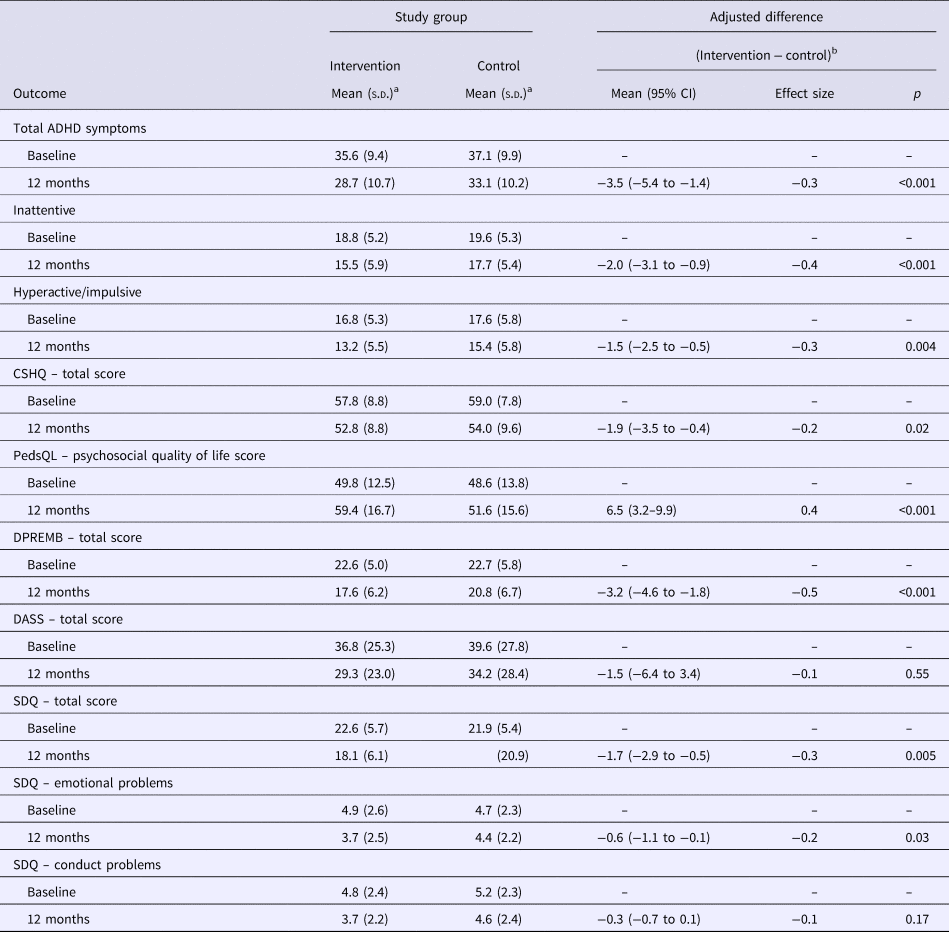
Intervention children had lower total scores on the CSHQ compared to the usual care children (AMD −1.9; 95% CI −3.5 to −0.4; p = 0.02; Cohen's d: −0.2) at 12 months (Table 2). There was also evidence that intervention children had fewer sleep onset delay (AMD −0.3; 95% CI −0.5 to −0.1; p = 0.002; d: −0.4), and night waking difficulties (AMD −0.4; 95% CI −0.8 to −0.01; p = 0.04; d: −0.2) on the CSHQ 12 months later. There were minimal differences at 12 months in terms of bedtime resistance, sleep duration, sleep anxiety, parasomnias and daytime sleepiness.
Comparison of parent-reported outcomes at 12-months between intervention and control groups

a Means reported for participants with complete data at 12 months.
b Results from a mixed-effects regression model fitted to the baseline, 3 month, 6 month, and 12 month time points adjusted for all confounding variables [child age, gender, medication use (yes/no), total number of mental health comorbidities, parent age, parent high school completion (yes/no), SEIFA (Socio-Economic Indexes for Areas) and baseline functioning].
Intervention children had fewer ADHD symptoms (p < 0.001, d: −0.3), better quality of life (p < 0.001; d: 0.4), fewer daily functioning difficulties (p < 0.001; d: −0.5), and fewer behaviour difficulties (p = 0.005; d: −0.3) by parent report at 12 months compared with controls. There were minimal differences between groups with regards to parent mental health at 12 months (Table 2).
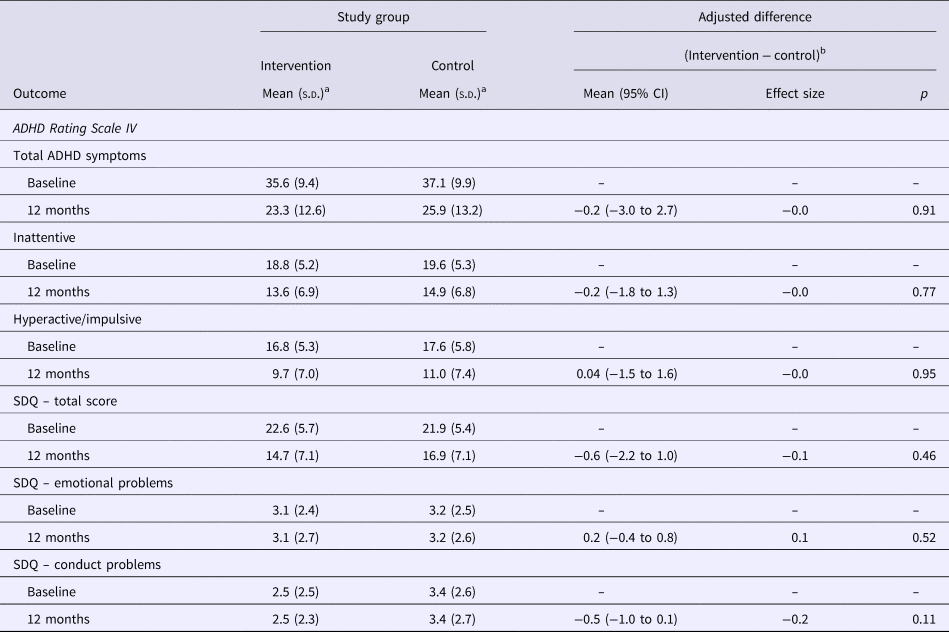
There was no evidence of differences between groups in ADHD symptom severity or behaviour at 12 months by teacher report (see Table 3).
Comparison of teacher-reported outcomes at 12-months between intervention and control groups

a Means reported for participants with complete data at 12 months.
b Results from a mixed-effects regression model fitted to the baseline, 3 month, 6 month, and 12 month time points adjusted for all confounding variables [child age, gender, medication use (yes/no), total number of mental health comorbidities, parent age, parent high school completion (yes/no), SEIFA (Socio-Economic Indexes for Areas) and baseline functioning].
Differential treatment outcomes over time according to child and family factors
Using parent report of moderate/severe sleep problems as the outcome, there was a main effect of ADHD symptom severity in that children with ADHD symptom severity scores ⩾75th percentile were more likely to have moderate/severe sleep problems over time. Tests of interaction found that parental clinical depressive symptoms moderated the treatment effect (AOR 5.6; 95% CI 1.8 to 17.4; p = 0.003) (see Table 4) in that children whose parents were experiencing clinical depressive symptoms had higher odds of moderate to severe sleep problems at 6 and 12 months (see Fig. 2).
Moderating effects of parent depression, ADHD medication use, and ADHD symptom severity on intervention outcomes over time (plotted for intervention group only).

Moderators of treatment outcome over time (persistence of moderate/severe sleep problems)a

a Results of the mixed effects logistic regression models fitted to the baseline, 3 month, 6 month, and 12 month time points. Reported values are for the pooled main effects and pooled interaction effects of each moderator over time.
There were main effects of parent-reported sleep problem severity, child sex, younger child age, comorbid ASD and parent depression on secondary outcomes (see online Supplementary Table S1) whereby over time children with sleep problems ⩾75th percentile had more sleep problems, boys had more behaviour problems than girls, children with comorbid ASD had more daily functioning difficulties, and younger children and those whose primary caregiver had clinical depression symptoms had poorer quality of life. Tests of interaction revealed few moderators in parent-reported continuous secondary outcomes over time (online Supplementary Table S1). Basline ADHD medication use was a moderator for sleep problems assessed using the CSHQ (p = 0.045) and baseline ADHD symptom severity was a moderator for ADHD (p = 0.04) and QoL (p = 0.04) outcomes over time. See Fig. 2 for a graphical representation of these effects identified at p ⩽ 0.05 plotted for the intervention group only. The intervention was more effective and reductions in parent-reported sleep problem severity were more likely to be sustained in children who were taking ADHD medication at baseline compared to those not taking medication. Children ⩾75th percentile of ADHD symptoms at baseline had a steady reduction in ADHD symptoms but overall had less improvement in quality of life.
Discussion
This is the longest follow-up of a behavioural sleep intervention for children with ADHD. In this study a brief behavioural sleep intervention was associated with sustained benefits 12 months later, albeit small, across numerous outcomes. With regards to sleep specifically, intervention children were less likely to have moderate-severe sleep problems and had fewer overall sleep problems, as well as fewer sleep onset delay and night waking difficulties by parent report 12 months later. They also fared better in ADHD symptom severity, quality of life, daily functioning, and behavioural difficulties at 12 months compared to controls. Very few moderators of treatment outcome were identified suggesting that this brief intervention is appropriate for most patients with ADHD with the exception that the intervention was less effective for some outcomes in children taking ADHD medication and for children who had a parent with clinical levels of depression.
Our findings are consistent with previous research demonstrating short-term improvements in psychosocial functioning for children with ADHD who receive behavioural sleep interventions (Keshavarzi et al., Reference Keshavarzi, Bajoghli, Mohamadi, Salmanian, Kirov, Gerber, Holsboer-Trachsler and Brand2014; Hiscock et al., Reference Hiscock, Sciberras, Mensah, Gerner, Efron, Khano and Oberklaid2015; Corkum et al., Reference Corkum, Lingley-Pottie, Davidson, McGrath, Chambers, Mullane, Laredo, Woodford and Weiss2016). Although the effect size differences between the intervention and usual care groups were small to moderate, we argue that these are important findings given the brevity of our intervention. We did not detect meaningful differences in teacher-reported outcomes at 12 months post-randomisation. This may suggest that the dosage of our intervention may not be sufficient to translate into sustained benefits in classroom behaviour. Our teacher-reported outcomes were restricted to measures of classroom behaviour and ADHD symptom severity; it is possible that benefits may have been observed if we had measured other teacher-reported outcomes, including daytime sleepiness, on task-behaviour and task-completion. It is possible that our lack of sustained effects by teacher report could be due to differences in teacher raters over time which is impossible to avoid in a study with a 12 month follow-up period.
Overall few moderators of treatment outcome were identified. Consistent with previous research findings that parent wellbeing is a moderator of treatment outcomes in ADHD (Owens et al., Reference Owens, Hinshaw, Kraemer, Arnold, Abikoff, Cantwell, Conners, Elliott, Greenhill, Hechtman, Hoza, Jensen, March, Newcorn, Pelham, Severe, Swanson, Vitiello, Wells and Wigal2003; Langberg et al., Reference Langberg, Evans, Schultz, Becker, Altaye and Girio-Herrera2016), we found that although parents with depression had similar improvements in sleep problems at 3 months, that effects over time were not as sustained as was observed for parents without clinical depression. Depression may make it difficult for parents to engage with and consistently implement intervention strategies over a longer period of time. A recent study found that depressed mothers of children with ADHD were less likely to reinforce positive child behaviours and were more likely to use coercive responses to negative child behaviours compared to mothers with remitted depression and those with no depression history (Thomas et al., Reference Thomas, O'Brien, Clarke, Liu and Chronis-Tuscano2015). Thus, more intensive intervention and parent support may be needed to optimise behavioural sleep interventions for children with ADHD who have parents with clinical levels of depression.
We found some evidence that children taking ADHD medication had a greater initial treatment effects at three months and more sustained improvements in sleep over time compared to children not taking ADHD medication. This suggests that perhaps medication use assists children (and their parents) to better comply with sleep routines and interventions. This finding is consistent with recommendations for multi-modal approaches to ADHD management to optimise outcomes for young people. It also provides evidence that medication use is not necessarily a causal factor contributing to sleep problems in children with ADHD. Initial ADHD severity had mixed effects on outcomes. Children with higher levels of ADHD severity had a greater reduction in ADHD symptoms over time, which may represent a regression to the mean but were also associated with less improvement in quality of life over time. The latter finding may suggest that children with higher levels of ADHD symptoms may require more intensive intervention support to achieve optimal outcomes.
Our study has a number of strengths. It is the largest RCT examining a behavioural sleep intervention for children with ADHD. We ascertained a ‘real-life’ sample of children with ADHD reflective of the comorbidities and presentations seen in clinical practice. Our behavioural sleep intervention was brief and therefore could be possibly feasible to deliver in daily clinical practice.
There are also some limitations. We did not have the resources to measure sleep using actigraphy at 12 months and instead relied on parent report of sleep to assess outcomes. There was also some loss to follow-up. This study used a previous version of the International Classification of Sleep Disorders, as this was the version that was current at the time of initial recruitment. However, it should be noted that the sleep categories that we used to recruit participants are similar to the more recent classification system and reflect the most common sleep problems experienced by children with ADHD (Sung et al., Reference Sung, Hiscock, Sciberras and Efron2008). The benefits identified at 12 months post-randomisation were for our parent-reported outcomes raising the possibility of bias in our results. However, at our 3 and 6 month follow-up (Hiscock et al., Reference Hiscock, Sciberras, Mensah, Gerner, Efron, Khano and Oberklaid2015) we identified benefits by teacher report and via a blinded direct assessment of working memory.
Conclusion
A brief behavioural sleep intervention for children with ADHD is associated with small benefits for sleep, ADHD symptom severity, quality of life, daily functioning and behavioural functioning 12 months later. The intervention appears more beneficial over time for children with ADHD taking medication and less beneficial over time for parents with clinical depression. Clinicians may need to assess and review sleep problems and their management over time and provide booster sessions or further strategies, as required.
Supplementary material
The supplementary material for this article can be found at https://doi.org/10.1017/S0033291718004063.
Acknowledgements
We thank all families, paediatricians and teachers for taking part in the study, and all of the research assistants, students and interns that contributed to data collection.
Financial support
This project is funded by a Project Grant from the Australian National Health and Medical Research Council (NHRMC, 607362). A/Prof. Sciberras and Dr Mensah are funded by NHMRC Career Development Fellowships (1110688, 1111160). A/Prof. Sciberras is also funded by a veski Inspiring Women's Fellowship. Dr Efron's position is funded by a Clinician Scientist Fellowship, Murdoch Childrens Research Institute. Prof. Hiscock is funded by a NHMRC Practitioner Fellowship (1136222). MCRI is supported by the Victorian Government's Operational Infrastructure Support Program.
Conflict of interest
None declared.
Ethical standards
The authors assert that all procedures contributing to this work comply with the ethical standards of the relevant national and institutional committees on human experimentation and with the Helsinki Declaration of 1975, as revised in 2008.